

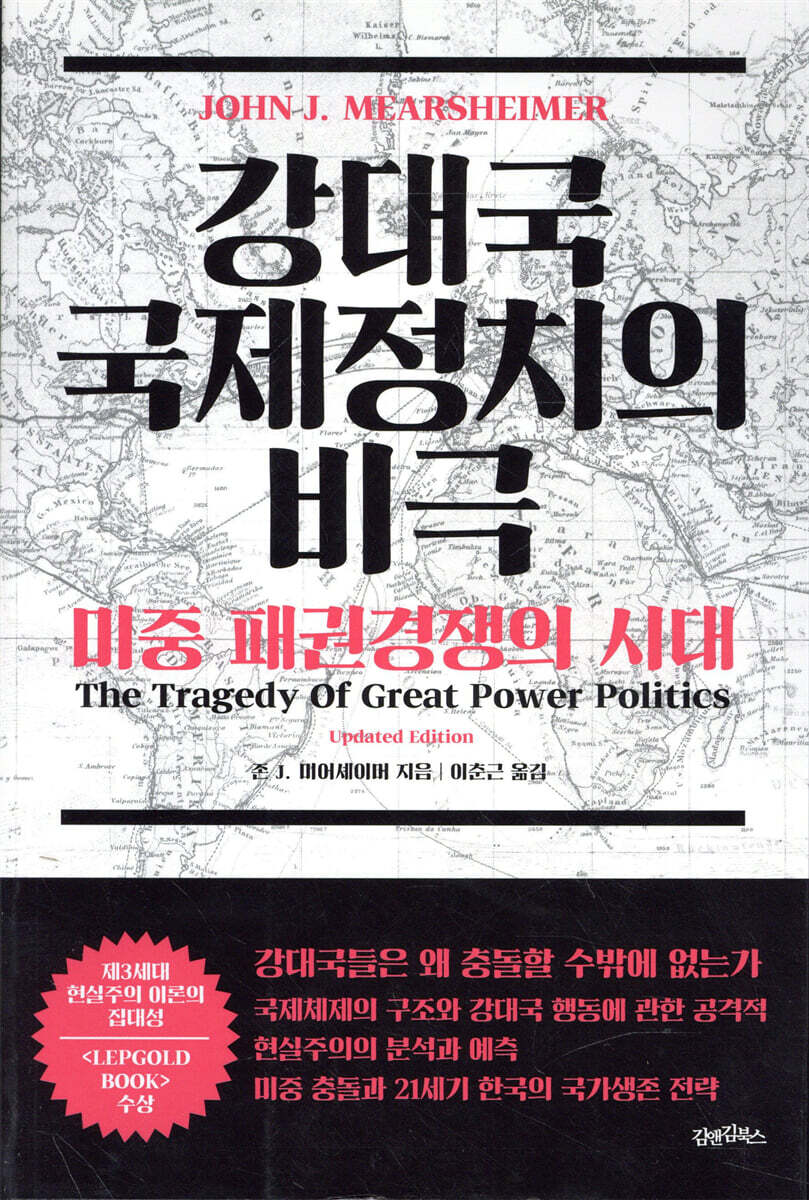
The Tragedy of Great Power International Politics: The Era of US-China Hegemony Competition
 |
Description
Book Introduction
The reality of international politics cannot but be realistic.
Mearsheimer's Offensive Realism in International Politics
Since its first publication in 2001, this book has received enthusiastic praise and criticism from international political academics in the United States and around the world.
It has been at the heart of debates in international political theory, ranging from praise for its stark examination of the harsh realities of international politics to skepticism for its overly pessimistic view of the subject.
This book has become a must-read for anyone studying international politics, and was awarded the "Rebgold Book" (2001), which is awarded to a major work in the field of international politics.
Professor Mearsheimer, the author of this book, is considered one of the five scholars who have had the greatest influence on international politics over the past 20 years.
A revised edition of this book was published in the United States in 2014, and in Korea in 2017 under the title The Tragedy of Great Power International Politics: The Era of US-China Hegemony Competition.
In this book, the author maintains the same position of aggressive realism, also known as third-generation realism, as in the first edition.
However, Chapter 10 poses the highly provocative question, "Can China rise peacefully?" and argues that the hegemonic competition between the United States and China has become an inevitable reality.
In this book, Professor Mearsheimer presents Offensive Realism, which goes beyond classical realism and neorealism (defensive realism), and proves his theory using historical examples.
Offensive realism belongs to the realist school of thought in that it believes that power and national interests, rather than norms or morals, govern the relations between nations.
However, it differs from classical realism in that it finds the reason why states pursue power not in human instinct but in the structure of the international system, which is a state of anarchy, and it differs from neorealism in that states are not satisfied with maintaining a balance of power but seek to achieve overwhelming power that can overwhelm other states.
Mearsheimer's Offensive Realism in International Politics
Since its first publication in 2001, this book has received enthusiastic praise and criticism from international political academics in the United States and around the world.
It has been at the heart of debates in international political theory, ranging from praise for its stark examination of the harsh realities of international politics to skepticism for its overly pessimistic view of the subject.
This book has become a must-read for anyone studying international politics, and was awarded the "Rebgold Book" (2001), which is awarded to a major work in the field of international politics.
Professor Mearsheimer, the author of this book, is considered one of the five scholars who have had the greatest influence on international politics over the past 20 years.
A revised edition of this book was published in the United States in 2014, and in Korea in 2017 under the title The Tragedy of Great Power International Politics: The Era of US-China Hegemony Competition.
In this book, the author maintains the same position of aggressive realism, also known as third-generation realism, as in the first edition.
However, Chapter 10 poses the highly provocative question, "Can China rise peacefully?" and argues that the hegemonic competition between the United States and China has become an inevitable reality.
In this book, Professor Mearsheimer presents Offensive Realism, which goes beyond classical realism and neorealism (defensive realism), and proves his theory using historical examples.
Offensive realism belongs to the realist school of thought in that it believes that power and national interests, rather than norms or morals, govern the relations between nations.
However, it differs from classical realism in that it finds the reason why states pursue power not in human instinct but in the structure of the international system, which is a state of anarchy, and it differs from neorealism in that states are not satisfied with maintaining a balance of power but seek to achieve overwhelming power that can overwhelm other states.
- You can preview some of the book's contents.
Preview
index
01 Introduction
aggressive realism
Liberalism vs. Realism
Liberal America and Power Politics
The plan for this book
02 Anarchy and the Struggle for Power
Why Nations Seek Power
The limits of hegemony
Power and fear
Prioritization of national goals
Creation of world order
cooperation between countries
conclusion
03 Wealth and Power
The material basis of national power
Population and Wealth: The Driving Force of Military Power
The economic basis of military power
The gap between potential national power and military power
04 Superiority of Army Power
Conquest vs. Coercion
The limits of independent naval power
The limitations of strategic air forces
The overwhelming importance of the army
The barrier of the sea
Nuclear Weapons and the Balance of Power
Measurement of military power
conclusion
05 Survival Strategies
National objectives at the operational level
Strategy for increasing national power
Strategies to deter invading nations
Strategies to Avoid
Concessions for realistic reasons
conclusion
06 Actions of the Great Powers
Japan (1868-1945)
Germany (1862-1945)
Soviet Union (1917-1991)
Italy (1861-1943)
Self-destructive behavior?
nuclear arms race
conclusion
07 Overseas Balancers: Britain and the United States
The Rise of American Power (1800-1900)
America and Europe, 1900-1990
The United States and Northeast Asia, 1900-1990
British Grand Strategy, 1792–1990
conclusion
08 Efforts for Balance and Passing the Blame
When do countries try to shift responsibility?
Revolutionary and Napoleonic France (1789–1815)
Bismarck's Prussia (1862–1870)
Kaiser Wilhelm's Germany (1890-1914)
Nazi Germany (1933–1941)
Cold War Era (1945-1990)
conclusion
09 Causes of Great Power Wars
International Political Structure and War
Bipolar vs. Multipolar
Balanced multipolar system vs. unbalanced multipolar system
The Great Power Wars of Modern Europe, 1792–1990
analyze
conclusion
10 Can China Rise Peacefully?
Summary of Offensive Realism Theory
America's pursuit of hegemony
China follows the path taken by the United States
Forming a coalition for balance
Is a US-China war possible?
Hope for a peaceful era
conclusion
aggressive realism
Liberalism vs. Realism
Liberal America and Power Politics
The plan for this book
02 Anarchy and the Struggle for Power
Why Nations Seek Power
The limits of hegemony
Power and fear
Prioritization of national goals
Creation of world order
cooperation between countries
conclusion
03 Wealth and Power
The material basis of national power
Population and Wealth: The Driving Force of Military Power
The economic basis of military power
The gap between potential national power and military power
04 Superiority of Army Power
Conquest vs. Coercion
The limits of independent naval power
The limitations of strategic air forces
The overwhelming importance of the army
The barrier of the sea
Nuclear Weapons and the Balance of Power
Measurement of military power
conclusion
05 Survival Strategies
National objectives at the operational level
Strategy for increasing national power
Strategies to deter invading nations
Strategies to Avoid
Concessions for realistic reasons
conclusion
06 Actions of the Great Powers
Japan (1868-1945)
Germany (1862-1945)
Soviet Union (1917-1991)
Italy (1861-1943)
Self-destructive behavior?
nuclear arms race
conclusion
07 Overseas Balancers: Britain and the United States
The Rise of American Power (1800-1900)
America and Europe, 1900-1990
The United States and Northeast Asia, 1900-1990
British Grand Strategy, 1792–1990
conclusion
08 Efforts for Balance and Passing the Blame
When do countries try to shift responsibility?
Revolutionary and Napoleonic France (1789–1815)
Bismarck's Prussia (1862–1870)
Kaiser Wilhelm's Germany (1890-1914)
Nazi Germany (1933–1941)
Cold War Era (1945-1990)
conclusion
09 Causes of Great Power Wars
International Political Structure and War
Bipolar vs. Multipolar
Balanced multipolar system vs. unbalanced multipolar system
The Great Power Wars of Modern Europe, 1792–1990
analyze
conclusion
10 Can China Rise Peacefully?
Summary of Offensive Realism Theory
America's pursuit of hegemony
China follows the path taken by the United States
Forming a coalition for balance
Is a US-China war possible?
Hope for a peaceful era
conclusion
Into the book
Chapter 2, perhaps the most important chapter in this book, will lay the groundwork for my theory of why states compete for power and why they pursue hegemony.
In Chapters 3 and 4 of this book, what force is will be defined and how to measure force will be discussed.
The purpose is to provide a basis for verifying my theory.
Unless we understand what power is and how states choose different strategies to maximize their relative power in the world, we cannot know whether states are acting according to offensive realism.
Chapter 3 will focus primarily on the potential power of nations, including their population and wealth.
Chapter 4 deals with actual military power.
Chapter 4 will be a particularly long one, in which I will argue for the “primacy of land power” and the “stopping power of the water.”
These efforts are novel and potentially controversial.
Chapter 5 will discuss the strategies adopted by great powers to acquire and maintain power.
Here we will have a detailed discussion of the usefulness of war as a means of acquiring power.
I want to focus on balancing and buck-passing, two important strategies that great powers adopt when faced with threats from other great powers that threaten the current equilibrium.
In chapters 6 and 7, we will examine historical records to find evidence to justify aggressive realism.
In particular, we will compare the behavior of the great powers between 1792 and 1990 to see whether their actions are consistent with the explanation of offensive realism.
In Chapter 8, I present a simple theory on when great powers adopt a balancing strategy and when they adopt a shifting-the-buck strategy, and I test these theories based on historical examples.
Chapter 9 focuses on the causes of the war.
Here I will present a simple theory and test whether it matches reality.
Chapter 10 focuses on the rise of China, which will become the most important issue in international politics in the 21st century.
In particular, it will raise the crucial question of whether China will rise peacefully.
I will use my theory to analyze how an increasingly powerful China will relate to its Asian neighbors and the United States.
--- p.69
Considering the history of the Cold War and the fact that both the United States and China are nuclear powers, one might think that an actual shooting war between the two countries is highly unlikely in the near future.
However, this conclusion is not correct.
Although the existence of nuclear weapons may be a powerful factor in preventing a major war between the United States and China, future US-China competition in Asia will likely take place in an environment more prone to war than was the case in Europe during the Cold War.
In particular, geographic factors and the imbalance of power between the United States and China make war more likely than it was between the United States and the Soviet Union from 1945 to 1990.
-p.
524
The picture I paint of what will happen if China continues to rise is not pretty.
In reality, it's completely bleak.
I would like to say something hopeful about peace in Asia.
But the reality is not like that.
International politics is a dangerous business, and no matter how well-intentioned a country may be, when a country with the will to become a hegemon emerges, whether in Europe or Asia, there is no way to alleviate the serious security competition.
There is ample reason to believe that China will ultimately seek hegemony in the Asian region.
In Chapters 3 and 4 of this book, what force is will be defined and how to measure force will be discussed.
The purpose is to provide a basis for verifying my theory.
Unless we understand what power is and how states choose different strategies to maximize their relative power in the world, we cannot know whether states are acting according to offensive realism.
Chapter 3 will focus primarily on the potential power of nations, including their population and wealth.
Chapter 4 deals with actual military power.
Chapter 4 will be a particularly long one, in which I will argue for the “primacy of land power” and the “stopping power of the water.”
These efforts are novel and potentially controversial.
Chapter 5 will discuss the strategies adopted by great powers to acquire and maintain power.
Here we will have a detailed discussion of the usefulness of war as a means of acquiring power.
I want to focus on balancing and buck-passing, two important strategies that great powers adopt when faced with threats from other great powers that threaten the current equilibrium.
In chapters 6 and 7, we will examine historical records to find evidence to justify aggressive realism.
In particular, we will compare the behavior of the great powers between 1792 and 1990 to see whether their actions are consistent with the explanation of offensive realism.
In Chapter 8, I present a simple theory on when great powers adopt a balancing strategy and when they adopt a shifting-the-buck strategy, and I test these theories based on historical examples.
Chapter 9 focuses on the causes of the war.
Here I will present a simple theory and test whether it matches reality.
Chapter 10 focuses on the rise of China, which will become the most important issue in international politics in the 21st century.
In particular, it will raise the crucial question of whether China will rise peacefully.
I will use my theory to analyze how an increasingly powerful China will relate to its Asian neighbors and the United States.
--- p.69
Considering the history of the Cold War and the fact that both the United States and China are nuclear powers, one might think that an actual shooting war between the two countries is highly unlikely in the near future.
However, this conclusion is not correct.
Although the existence of nuclear weapons may be a powerful factor in preventing a major war between the United States and China, future US-China competition in Asia will likely take place in an environment more prone to war than was the case in Europe during the Cold War.
In particular, geographic factors and the imbalance of power between the United States and China make war more likely than it was between the United States and the Soviet Union from 1945 to 1990.
-p.
524
The picture I paint of what will happen if China continues to rise is not pretty.
In reality, it's completely bleak.
I would like to say something hopeful about peace in Asia.
But the reality is not like that.
International politics is a dangerous business, and no matter how well-intentioned a country may be, when a country with the will to become a hegemon emerges, whether in Europe or Asia, there is no way to alleviate the serious security competition.
There is ample reason to believe that China will ultimately seek hegemony in the Asian region.
--- p.
544
544
Publisher's Review
The reality of international politics cannot but be realistic.
Mearsheimer's Offensive Realism in International Politics
Since its first publication in 2001, this book has received enthusiastic praise and criticism from international political academics in the United States and around the world.
It has been at the heart of debates in international political theory, ranging from praise for its stark examination of the harsh realities of international politics to skepticism for its overly pessimistic view of the subject.
This book has become a must-read for anyone studying international politics, and was awarded the "Rebgold Book" (2001), which is awarded to a major work in the field of international politics.
Professor Mearsheimer, the author of this book, is considered one of the five scholars who have had the greatest influence on international politics over the past 20 years.
A revised edition of this book was published in the United States in 2014, and in Korea in 2017 under the title The Tragedy of Great Power International Politics: The Era of US-China Hegemony Competition.
In this book, the author maintains the same position of aggressive realism, also known as third-generation realism, as in the first edition.
However, Chapter 10 poses the highly provocative question, "Can China rise peacefully?" and argues that the hegemonic competition between the United States and China has become an inevitable reality.
In this book, Professor Mearsheimer presents Offensive Realism, which goes beyond classical realism and neorealism (defensive realism), and proves his theory using historical examples.
Offensive realism belongs to the realist school of thought in that it believes that power and national interests, rather than norms or morals, govern the relations between nations.
However, it differs from classical realism in that it finds the reason why states pursue power not in human instinct but in the structure of the international system, which is a state of anarchy, and it differs from neorealism in that states are not satisfied with maintaining a balance of power but seek to achieve overwhelming power that can overwhelm other states.
Why Great Powers Inevitably Clash
Offensive realism's analysis of the structure of the international system and the behavior of great powers
The 20th century was a century of tremendous international violence.
During World War I, approximately 9 million people perished.
More than 50 million people lost their lives in World War II.
As soon as World War II ended, the Cold War engulfed the entire globe.
Although the Soviet Union and the United States did not fight directly during the Cold War, millions of lives were lost in proxy wars fought in Korea, Vietnam, Afghanistan, Nicaragua, and Angola.
Professor Mearsheimer says that even in the 21st century, the international system will not be able to escape this cycle of violence.
This is because the great powers that make up the international system fear each other and, as a result, engage in a constant competition for power.
In situations where one cannot be certain of the other party's military power and intentions, the best way to ensure one's own security is to have overwhelming power.
Therefore, all great powers seek superiority over their opponents, which inevitably leads to conflict between the great powers.
There is no way to avoid this tragic situation unless the nations that make up the international system agree to establish a world government.
Professor Mearsheimer believes that all great powers ultimately aim to become hegemons.
Because that is the most perfect way to ensure the survival of one's country.
However, no country can become a global hegemon.
Even the most powerful superpower cannot project enough force to cross a vast ocean and subdue its rivals.
However, it is possible to achieve hegemonic status in one's own region, as the United States has achieved in the Western Hemisphere.
No nation in the Western Hemisphere may threaten the United States militarily or economically or act against the United States' core interests.
A nation that has achieved a hegemonic position in its own region has as its primary national goal the prevention of the emergence of a hegemonic power in another region or continent.
Because the emergence of another hegemon would threaten the exceptional position enjoyed by the existing regional hegemons in their regions and in the world.
The United States, the world's most powerful nation, is the most realistic.
America's strategic goals as the sole regional hegemon
In a word, America's history is one of establishing its hegemony in the Western Hemisphere while simultaneously preventing the emergence of a hegemon that could rival it in Europe and Asia.
Beginning as a small nation on the eastern coast of North America, the United States achieved a territorial expansion unprecedented in history during the 19th century, while simultaneously driving the European powers out of the Western Hemisphere and preventing them from intervening there again.
This was the Manifest Destiny for the American people, and the goal pursued by the Monroe Doctrine.
By the late 19th century, the United States had established hegemony in the Western Hemisphere, making it an exceptionally secure nation.
As the dominant power in the Western Hemisphere, the United States thwarted attempts by Kaiser Wilhelm's Germany, Nazi Germany, and the Soviet Union during the Cold War to dominate Europe, and crushed Imperial Japan's ambitions for hegemony in Asia.
The United States initially shifted the responsibility to regional powers to deter potential hegemons, but when that became impossible on their own, it intervened directly to crush hegemonic challengers.
This offshore balancer strategy has been America's most important tactic, and it will not change in the future.
After the end of the Cold War, the United States waged wars against weaker nations like Iraq, Afghanistan, and Libya without any regard for other great powers, and launched a war on terrorism after 9/11, but now it is focused on great power international politics.
This is because China is emerging as a potential hegemon in the Asian region based on rapid economic growth.
The United States, as it has in the past, will seek to prevent China from becoming the dominant power in Asia.
Because the United States will not tolerate the existence of any country that poses a challenge to it on the world stage.
It is no exaggeration to say that this book is intended to help us understand the United States as the most important actor in the international system.
It clearly presents the process through which the United States became the dominant power in the Western Hemisphere, and how it has intervened and will intervene in the balance of power in Europe and Asia.
Historically, the United States has never sent troops solely for the purpose of maintaining peace, rather than maintaining a balance of power.
The United States has always acted as realism dictates when it comes to important national strategies.
Is the hegemonic rivalry between the US and China inevitable?
The Prospects of the US-China Conflict from an Aggressive Realist Perspective
Professor Mearsheimer says that if China's economic development continues for a significant period of time, it will follow the path taken by the United States.
In other words, China will try to dominate Asia just as the United States dominates the Western Hemisphere.
China's pursuit of hegemony in Asia is not because Chinese culture is inherently aggressive or because its leaders are misguided, but because it is the best guarantee of China's survival.
China has already become the second-largest economy after the United States, with a population four times larger than that of the United States.
China may become a more powerful potential threat than any of the four hegemonic challengers the United States faced in the past: Wilhelmine Germany, Nazi Germany, Imperial Japan, and the Soviet Union.
A stronger China will seek to drive the United States out of the Asia-Pacific region, much as the United States did in the Western Hemisphere in the mid-19th century, and will likely devise a Chinese version of the Monroe Doctrine.
In fact, China has made it clear that it intends to push the US Navy beyond the first island chain connecting the Greater Sunda Islands to Japan, the Philippines, and Taiwan, and even beyond the second island chain.
China also claims that the South China Sea, a strategically important sea area, is its inherent waters and that the United States has no right to intervene in any territorial disputes that arise in the South China Sea.
A much stronger China, like the United States, will have security interests spanning the globe and will seek the ability to project power beyond Asia and into the world.
However, the fact that China's power is growing is being felt not only by China but also by the United States and China's neighbors, and the feeling that China must be contained before its power grows further is also growing stronger.
The United States will seek to prevent China from becoming a hegemon in Asia, and to this end, it will seek to build a balancing coalition with China's neighbors who fear its rise to contain China.
The United States has already made significant progress in this regard through its 'Pivot to Asia' strategy.
In response, China is making efforts to break the US-led anti-China balance coalition through strategies such as the Belt and Road Initiative.
Ultimately, it is highly likely that a serious security competition similar to that of the Cold War will arise between China and the United States, and the possibility of a US-China war breaking out cannot be ruled out in the process.
Professor Mearsheimer says that unlike Europe during the Cold War, there is a possibility of a localized, limited war in Asia despite the presence of nuclear weapons.
Unlike the central front in Europe during the Cold War, conflict zones in Asia are geographically dispersed, making them relatively less likely to escalate into large-scale war or nuclear war.
He also says that the imbalance of power between China and other Asian countries, and the growing hyper-nationalism in Asian countries, especially in China, increase the likelihood of war in Asia.
What is clear is that the possibility of a future US-China war is much higher than the possibility of a US-Soviet war during the Cold War.
The days of An Mi-gyeong-jung will never come again.
Korea's Geopolitics and Strategic Choices
In a 2011 interview with Korean media, Professor Mearsheimer said, “Korea is in the most disadvantaged geopolitical position in the world.
Korea lives in a geopolitical environment where not even the slightest mistake is tolerated.
“All Koreans must think strategically,” he said.
As Professor Mearsheimer said, now is the time for Koreans to think and act strategically for national survival.
Since the end of the Cold War, the United States has tolerated China's economic growth and supported its integration into the international system, while China has focused on economic growth while adhering to the international rules established by the United States.
At that time, South Korea was in a strategically advantageous position to strengthen its security alliance with the United States while expanding its economic relationship with China.
But these days of peace and quiet will never come again.
Because China's rapid economic and military rise is changing the balance of power in Asia.
South Korea will increasingly be forced to choose between actively joining a US-led anti-China coalition or succumbing to the threat of China as a potential hegemon and aligning itself with China.
At least at this stage and in the near future, it would be the worst strategic choice for South Korea to abandon the United States and join China.
China does not yet possess the economic and military power to compete with the United States.
The United States is not only the sole regional hegemon in the current international system, but also has numerous allies across the globe.
Moreover, China is constrained by a global balance of power that is overwhelmingly favorable to the United States.
Moreover, from a geopolitical perspective, it is a strategically wrong choice for South Korea to side with China, a potential threat neighboring country.
China, having become a hegemonic power, will severely restrict Korea's sovereignty and freedom of action, and will be able to easily dominate Korea simply by making military and economic threats.
South Korea, more than any other country, has a strong strategic and security interest in containing China's rise as a potential hegemon.
China will further strengthen its efforts to separate South Korea from the trilateral alliance between South Korea, the US, and Japan, which is the core of its anti-China balance coalition.
As political and military confrontations between the United States and China intensify over issues such as the THAAD deployment, the South China Sea dispute, and North Korea, South Korea's economic relationship with China is likely to suffer a serious blow.
In order to prevent China from arbitrarily threatening economic retaliation or severing economic ties with Korea, it is essential to ensure symmetry in the economic dependence relationship.
The more symmetrical the economic dependence, the less likely China is to engage in serious economic retaliation without suffering losses of its own.
More importantly, unless Korea rebuilds its economic relationship with China on the strategic foundation of the ROK-US alliance, it will remain vulnerable to Chinese economic threats.
The US-China hegemony competition has just begun, and the recent THAAD retaliation may be just a preview.
What would happen if the US withdrew from Asia?
The US New Balance Strategy and the ROK-US Alliance as a Strategic Asset
The argument that the United States will strengthen its engagement policy in Asia and lead the containment of China in the future is based on two premises.
The fact that China will reach economic and military parity with the United States in the near future, and that the major powers in the Asian region will not be able to contain China on their own, is a major concern.
If either of these fails, the United States is likely to withdraw its troops from Asia.
In fact, some in American society are calling for the withdrawal of US troops stationed in Korea, Japan, and Germany.
In 2014, American strategist Peter Zeihan wrote in his book, “I’m not sure the United States still needs to guard the Demilitarized Zone and Charlie Point (a US military checkpoint in Germany).”
In 2015, Bremmer, editor-in-chief of Time magazine, argued that the United States should shift from being “indispensable to the world” to “independent from international affairs,” a claim that gained support from many Americans.
This trend of the United States shifting responsibility for the balance of power in their regions to other major powers has intensified since President Trump's election.
Professor Mearsheimer argues in this book that if China's rapid economic growth halts and China loses the possibility of dominating Asia, the United States will likely withdraw most of its troops stationed in Asia.
This means the United States is shifting its role from an onshore balancer to a traditional offshore balancer in the Asian region.
If the US military withdraws from Asia, it is highly likely that security provision to South Korea will also be discontinued.
Professor Mearsheimer says that in this case, South Korea will have to continue to live among dangerous neighbors and worry about its national survival.
In particular, he says, South Korea will have to deal with surrounding powers such as China, Japan, and Russia without the help of the United States.
It's not hard to imagine what the future holds for Korea when the United States disappears from the balance of power in Asia.
It is also quite predictable how China and Japan, with whom we have geopolitical and historical adversarial relations, will act toward Korea.
How will South Korea safeguard its sovereignty and security amidst a still-powerful China, which, while not yet a threat to American hegemony, is militarized against it? Some might recall the late Joseon Dynasty, a period a century ago when it was an arena for the great powers' struggle. Others might recall the Korean War that broke out shortly after liberation, following the withdrawal of US troops.
It is true that Korea's national power has grown beyond comparison to 100 years ago, but what matters in international politics is relative national power.
Is Korea's relative national power truly at a level that can guarantee its survival and future? France's vehement opposition to the withdrawal of US troops from Europe holds significant implications for Koreans.
Since the signing of the ROK-U.S. Mutual Defense Treaty on October 1, 1953, the ROK-U.S. alliance has been the practical foundation of Korea's security and prosperity.
All of Korea's current enemies or potential enemies want the collapse of the ROK-US alliance.
Not only China and North Korea, but even Japan secretly wants the collapse of the ROK-US alliance.
It may be that the only ones who need the ROK-US alliance now are the United States and South Korea.
The United States needs a strong Asian nation that can check China while also keeping Japan in check.
If the United States is confident that a unified Korea will stand by the United States and fulfill that role, it will be willing to support a Korean-led unification.
For South Korea, the United States is its best ally, both geopolitically and ideologically.
If South Korea were to lose the ROK-US alliance for any reason, it would be like losing its greatest strategic asset.
Professor Mearsheimer said this in the [Korean edition preface] of this book:
“The core message this book seeks to convey is that nations living in the dangerous world of international politics have no choice but to compete with other nations for power.
Even nations content to live in peace are inevitably drawn into a constant struggle for power.
…finding the right national security strategy for South Korea in the coming decades will not be an easy task.
Nevertheless, if South Korea is to maintain national security, it will have no choice but to carefully consider the long and difficult questions of alliance structure, the balance of power, the actions of great powers, and nuclear weapons.” I highly recommend this book to anyone interested in South Korea’s national survival and future.
Mearsheimer's Offensive Realism in International Politics
Since its first publication in 2001, this book has received enthusiastic praise and criticism from international political academics in the United States and around the world.
It has been at the heart of debates in international political theory, ranging from praise for its stark examination of the harsh realities of international politics to skepticism for its overly pessimistic view of the subject.
This book has become a must-read for anyone studying international politics, and was awarded the "Rebgold Book" (2001), which is awarded to a major work in the field of international politics.
Professor Mearsheimer, the author of this book, is considered one of the five scholars who have had the greatest influence on international politics over the past 20 years.
A revised edition of this book was published in the United States in 2014, and in Korea in 2017 under the title The Tragedy of Great Power International Politics: The Era of US-China Hegemony Competition.
In this book, the author maintains the same position of aggressive realism, also known as third-generation realism, as in the first edition.
However, Chapter 10 poses the highly provocative question, "Can China rise peacefully?" and argues that the hegemonic competition between the United States and China has become an inevitable reality.
In this book, Professor Mearsheimer presents Offensive Realism, which goes beyond classical realism and neorealism (defensive realism), and proves his theory using historical examples.
Offensive realism belongs to the realist school of thought in that it believes that power and national interests, rather than norms or morals, govern the relations between nations.
However, it differs from classical realism in that it finds the reason why states pursue power not in human instinct but in the structure of the international system, which is a state of anarchy, and it differs from neorealism in that states are not satisfied with maintaining a balance of power but seek to achieve overwhelming power that can overwhelm other states.
Why Great Powers Inevitably Clash
Offensive realism's analysis of the structure of the international system and the behavior of great powers
The 20th century was a century of tremendous international violence.
During World War I, approximately 9 million people perished.
More than 50 million people lost their lives in World War II.
As soon as World War II ended, the Cold War engulfed the entire globe.
Although the Soviet Union and the United States did not fight directly during the Cold War, millions of lives were lost in proxy wars fought in Korea, Vietnam, Afghanistan, Nicaragua, and Angola.
Professor Mearsheimer says that even in the 21st century, the international system will not be able to escape this cycle of violence.
This is because the great powers that make up the international system fear each other and, as a result, engage in a constant competition for power.
In situations where one cannot be certain of the other party's military power and intentions, the best way to ensure one's own security is to have overwhelming power.
Therefore, all great powers seek superiority over their opponents, which inevitably leads to conflict between the great powers.
There is no way to avoid this tragic situation unless the nations that make up the international system agree to establish a world government.
Professor Mearsheimer believes that all great powers ultimately aim to become hegemons.
Because that is the most perfect way to ensure the survival of one's country.
However, no country can become a global hegemon.
Even the most powerful superpower cannot project enough force to cross a vast ocean and subdue its rivals.
However, it is possible to achieve hegemonic status in one's own region, as the United States has achieved in the Western Hemisphere.
No nation in the Western Hemisphere may threaten the United States militarily or economically or act against the United States' core interests.
A nation that has achieved a hegemonic position in its own region has as its primary national goal the prevention of the emergence of a hegemonic power in another region or continent.
Because the emergence of another hegemon would threaten the exceptional position enjoyed by the existing regional hegemons in their regions and in the world.
The United States, the world's most powerful nation, is the most realistic.
America's strategic goals as the sole regional hegemon
In a word, America's history is one of establishing its hegemony in the Western Hemisphere while simultaneously preventing the emergence of a hegemon that could rival it in Europe and Asia.
Beginning as a small nation on the eastern coast of North America, the United States achieved a territorial expansion unprecedented in history during the 19th century, while simultaneously driving the European powers out of the Western Hemisphere and preventing them from intervening there again.
This was the Manifest Destiny for the American people, and the goal pursued by the Monroe Doctrine.
By the late 19th century, the United States had established hegemony in the Western Hemisphere, making it an exceptionally secure nation.
As the dominant power in the Western Hemisphere, the United States thwarted attempts by Kaiser Wilhelm's Germany, Nazi Germany, and the Soviet Union during the Cold War to dominate Europe, and crushed Imperial Japan's ambitions for hegemony in Asia.
The United States initially shifted the responsibility to regional powers to deter potential hegemons, but when that became impossible on their own, it intervened directly to crush hegemonic challengers.
This offshore balancer strategy has been America's most important tactic, and it will not change in the future.
After the end of the Cold War, the United States waged wars against weaker nations like Iraq, Afghanistan, and Libya without any regard for other great powers, and launched a war on terrorism after 9/11, but now it is focused on great power international politics.
This is because China is emerging as a potential hegemon in the Asian region based on rapid economic growth.
The United States, as it has in the past, will seek to prevent China from becoming the dominant power in Asia.
Because the United States will not tolerate the existence of any country that poses a challenge to it on the world stage.
It is no exaggeration to say that this book is intended to help us understand the United States as the most important actor in the international system.
It clearly presents the process through which the United States became the dominant power in the Western Hemisphere, and how it has intervened and will intervene in the balance of power in Europe and Asia.
Historically, the United States has never sent troops solely for the purpose of maintaining peace, rather than maintaining a balance of power.
The United States has always acted as realism dictates when it comes to important national strategies.
Is the hegemonic rivalry between the US and China inevitable?
The Prospects of the US-China Conflict from an Aggressive Realist Perspective
Professor Mearsheimer says that if China's economic development continues for a significant period of time, it will follow the path taken by the United States.
In other words, China will try to dominate Asia just as the United States dominates the Western Hemisphere.
China's pursuit of hegemony in Asia is not because Chinese culture is inherently aggressive or because its leaders are misguided, but because it is the best guarantee of China's survival.
China has already become the second-largest economy after the United States, with a population four times larger than that of the United States.
China may become a more powerful potential threat than any of the four hegemonic challengers the United States faced in the past: Wilhelmine Germany, Nazi Germany, Imperial Japan, and the Soviet Union.
A stronger China will seek to drive the United States out of the Asia-Pacific region, much as the United States did in the Western Hemisphere in the mid-19th century, and will likely devise a Chinese version of the Monroe Doctrine.
In fact, China has made it clear that it intends to push the US Navy beyond the first island chain connecting the Greater Sunda Islands to Japan, the Philippines, and Taiwan, and even beyond the second island chain.
China also claims that the South China Sea, a strategically important sea area, is its inherent waters and that the United States has no right to intervene in any territorial disputes that arise in the South China Sea.
A much stronger China, like the United States, will have security interests spanning the globe and will seek the ability to project power beyond Asia and into the world.
However, the fact that China's power is growing is being felt not only by China but also by the United States and China's neighbors, and the feeling that China must be contained before its power grows further is also growing stronger.
The United States will seek to prevent China from becoming a hegemon in Asia, and to this end, it will seek to build a balancing coalition with China's neighbors who fear its rise to contain China.
The United States has already made significant progress in this regard through its 'Pivot to Asia' strategy.
In response, China is making efforts to break the US-led anti-China balance coalition through strategies such as the Belt and Road Initiative.
Ultimately, it is highly likely that a serious security competition similar to that of the Cold War will arise between China and the United States, and the possibility of a US-China war breaking out cannot be ruled out in the process.
Professor Mearsheimer says that unlike Europe during the Cold War, there is a possibility of a localized, limited war in Asia despite the presence of nuclear weapons.
Unlike the central front in Europe during the Cold War, conflict zones in Asia are geographically dispersed, making them relatively less likely to escalate into large-scale war or nuclear war.
He also says that the imbalance of power between China and other Asian countries, and the growing hyper-nationalism in Asian countries, especially in China, increase the likelihood of war in Asia.
What is clear is that the possibility of a future US-China war is much higher than the possibility of a US-Soviet war during the Cold War.
The days of An Mi-gyeong-jung will never come again.
Korea's Geopolitics and Strategic Choices
In a 2011 interview with Korean media, Professor Mearsheimer said, “Korea is in the most disadvantaged geopolitical position in the world.
Korea lives in a geopolitical environment where not even the slightest mistake is tolerated.
“All Koreans must think strategically,” he said.
As Professor Mearsheimer said, now is the time for Koreans to think and act strategically for national survival.
Since the end of the Cold War, the United States has tolerated China's economic growth and supported its integration into the international system, while China has focused on economic growth while adhering to the international rules established by the United States.
At that time, South Korea was in a strategically advantageous position to strengthen its security alliance with the United States while expanding its economic relationship with China.
But these days of peace and quiet will never come again.
Because China's rapid economic and military rise is changing the balance of power in Asia.
South Korea will increasingly be forced to choose between actively joining a US-led anti-China coalition or succumbing to the threat of China as a potential hegemon and aligning itself with China.
At least at this stage and in the near future, it would be the worst strategic choice for South Korea to abandon the United States and join China.
China does not yet possess the economic and military power to compete with the United States.
The United States is not only the sole regional hegemon in the current international system, but also has numerous allies across the globe.
Moreover, China is constrained by a global balance of power that is overwhelmingly favorable to the United States.
Moreover, from a geopolitical perspective, it is a strategically wrong choice for South Korea to side with China, a potential threat neighboring country.
China, having become a hegemonic power, will severely restrict Korea's sovereignty and freedom of action, and will be able to easily dominate Korea simply by making military and economic threats.
South Korea, more than any other country, has a strong strategic and security interest in containing China's rise as a potential hegemon.
China will further strengthen its efforts to separate South Korea from the trilateral alliance between South Korea, the US, and Japan, which is the core of its anti-China balance coalition.
As political and military confrontations between the United States and China intensify over issues such as the THAAD deployment, the South China Sea dispute, and North Korea, South Korea's economic relationship with China is likely to suffer a serious blow.
In order to prevent China from arbitrarily threatening economic retaliation or severing economic ties with Korea, it is essential to ensure symmetry in the economic dependence relationship.
The more symmetrical the economic dependence, the less likely China is to engage in serious economic retaliation without suffering losses of its own.
More importantly, unless Korea rebuilds its economic relationship with China on the strategic foundation of the ROK-US alliance, it will remain vulnerable to Chinese economic threats.
The US-China hegemony competition has just begun, and the recent THAAD retaliation may be just a preview.
What would happen if the US withdrew from Asia?
The US New Balance Strategy and the ROK-US Alliance as a Strategic Asset
The argument that the United States will strengthen its engagement policy in Asia and lead the containment of China in the future is based on two premises.
The fact that China will reach economic and military parity with the United States in the near future, and that the major powers in the Asian region will not be able to contain China on their own, is a major concern.
If either of these fails, the United States is likely to withdraw its troops from Asia.
In fact, some in American society are calling for the withdrawal of US troops stationed in Korea, Japan, and Germany.
In 2014, American strategist Peter Zeihan wrote in his book, “I’m not sure the United States still needs to guard the Demilitarized Zone and Charlie Point (a US military checkpoint in Germany).”
In 2015, Bremmer, editor-in-chief of Time magazine, argued that the United States should shift from being “indispensable to the world” to “independent from international affairs,” a claim that gained support from many Americans.
This trend of the United States shifting responsibility for the balance of power in their regions to other major powers has intensified since President Trump's election.
Professor Mearsheimer argues in this book that if China's rapid economic growth halts and China loses the possibility of dominating Asia, the United States will likely withdraw most of its troops stationed in Asia.
This means the United States is shifting its role from an onshore balancer to a traditional offshore balancer in the Asian region.
If the US military withdraws from Asia, it is highly likely that security provision to South Korea will also be discontinued.
Professor Mearsheimer says that in this case, South Korea will have to continue to live among dangerous neighbors and worry about its national survival.
In particular, he says, South Korea will have to deal with surrounding powers such as China, Japan, and Russia without the help of the United States.
It's not hard to imagine what the future holds for Korea when the United States disappears from the balance of power in Asia.
It is also quite predictable how China and Japan, with whom we have geopolitical and historical adversarial relations, will act toward Korea.
How will South Korea safeguard its sovereignty and security amidst a still-powerful China, which, while not yet a threat to American hegemony, is militarized against it? Some might recall the late Joseon Dynasty, a period a century ago when it was an arena for the great powers' struggle. Others might recall the Korean War that broke out shortly after liberation, following the withdrawal of US troops.
It is true that Korea's national power has grown beyond comparison to 100 years ago, but what matters in international politics is relative national power.
Is Korea's relative national power truly at a level that can guarantee its survival and future? France's vehement opposition to the withdrawal of US troops from Europe holds significant implications for Koreans.
Since the signing of the ROK-U.S. Mutual Defense Treaty on October 1, 1953, the ROK-U.S. alliance has been the practical foundation of Korea's security and prosperity.
All of Korea's current enemies or potential enemies want the collapse of the ROK-US alliance.
Not only China and North Korea, but even Japan secretly wants the collapse of the ROK-US alliance.
It may be that the only ones who need the ROK-US alliance now are the United States and South Korea.
The United States needs a strong Asian nation that can check China while also keeping Japan in check.
If the United States is confident that a unified Korea will stand by the United States and fulfill that role, it will be willing to support a Korean-led unification.
For South Korea, the United States is its best ally, both geopolitically and ideologically.
If South Korea were to lose the ROK-US alliance for any reason, it would be like losing its greatest strategic asset.
Professor Mearsheimer said this in the [Korean edition preface] of this book:
“The core message this book seeks to convey is that nations living in the dangerous world of international politics have no choice but to compete with other nations for power.
Even nations content to live in peace are inevitably drawn into a constant struggle for power.
…finding the right national security strategy for South Korea in the coming decades will not be an easy task.
Nevertheless, if South Korea is to maintain national security, it will have no choice but to carefully consider the long and difficult questions of alliance structure, the balance of power, the actions of great powers, and nuclear weapons.” I highly recommend this book to anyone interested in South Korea’s national survival and future.
GOODS SPECIFICS
- Date of issue: May 31, 2017
- Page count, weight, size: 663 pages | 856g | 152*225*35mm
- ISBN13: 9788989566700
- ISBN10: 8989566703
You may also like
카테고리
korean


korean

![GQ KOREA Mark (Monthly): December [2025]](http://librairie.coreenne.fr/cdn/shop/files/8ef265dbbfbf186523ed75ba7319009d.jpg?v=1765340328&width=3840)


