

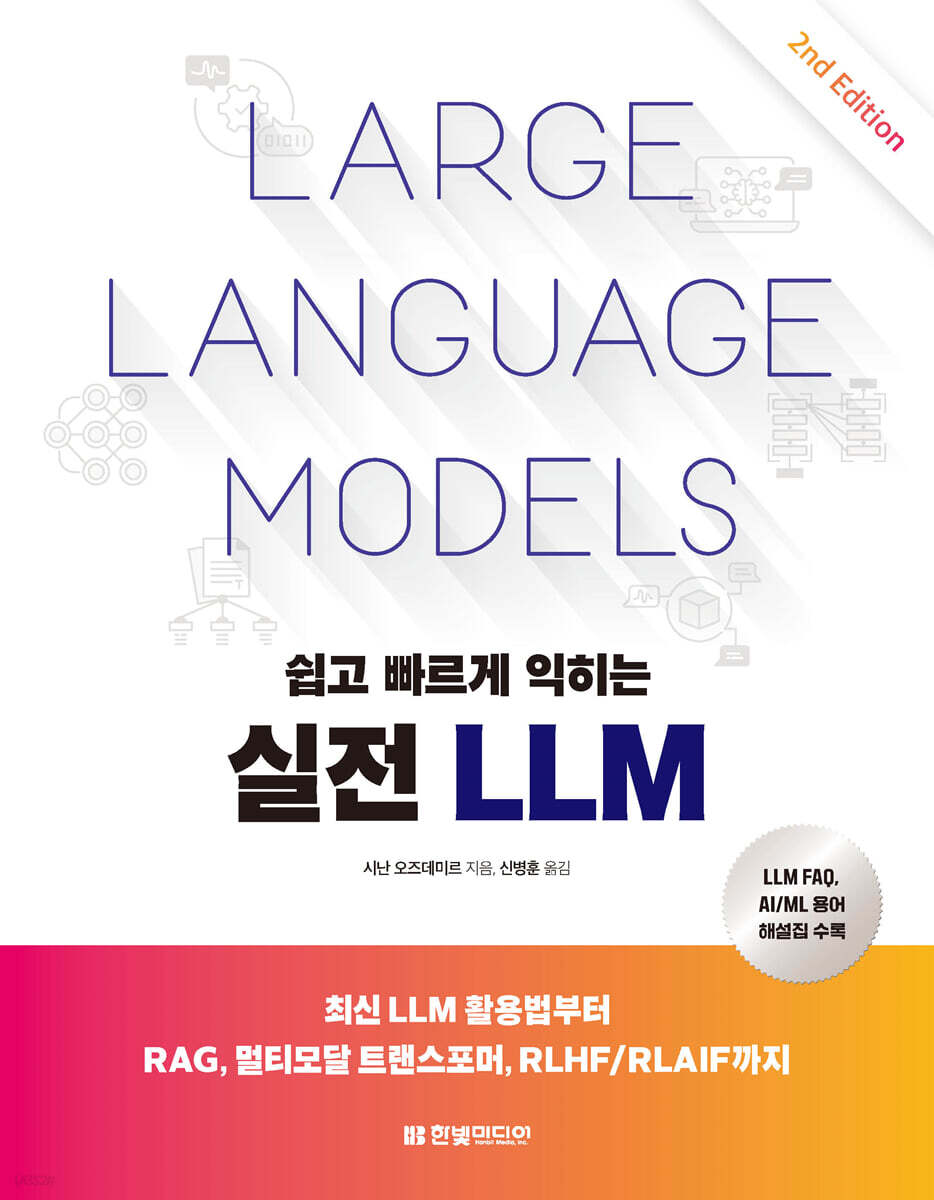
Practical LLM that you can learn quickly and easily
 |
Description
Book Introduction
The easiest and fastest way to learn the latest LLM trends and practices.
A Complete Practical LLM Guide, From GPT to Llama and Claude Models
This book provides a comprehensive understanding of LLM development in an easy-to-understand manner, with step-by-step guides, best practices, real-world case studies, and practical examples, so even those unfamiliar with LLM can begin developing right away.
Additionally, it covers practical aspects of optimizing and deploying LLM in the field, making it a complete guide that can be utilized by a wide range of users, from beginners to experts.
This second edition, now back with even more in-depth content, covers updated fine-tuning, comparison and strategic use of open-source and closed-source LLMs, data format and parameter settings, embedding optimization, advanced prompt engineering, and LLM evaluation. It also covers cutting-edge topics such as RAG chatbots, recommender systems, reinforcement learning-based AI sorting (RLHF/RLAIF), and building multimodal transformers. Become a leader in AI technology with this book, both an introduction to LLM and a practical guide.
A Complete Practical LLM Guide, From GPT to Llama and Claude Models
This book provides a comprehensive understanding of LLM development in an easy-to-understand manner, with step-by-step guides, best practices, real-world case studies, and practical examples, so even those unfamiliar with LLM can begin developing right away.
Additionally, it covers practical aspects of optimizing and deploying LLM in the field, making it a complete guide that can be utilized by a wide range of users, from beginners to experts.
This second edition, now back with even more in-depth content, covers updated fine-tuning, comparison and strategic use of open-source and closed-source LLMs, data format and parameter settings, embedding optimization, advanced prompt engineering, and LLM evaluation. It also covers cutting-edge topics such as RAG chatbots, recommender systems, reinforcement learning-based AI sorting (RLHF/RLAIF), and building multimodal transformers. Become a leader in AI technology with this book, both an introduction to LLM and a practical guide.
- You can preview some of the book's contents.
Preview
index
PART 1 Introduction to LLM
CHAPTER 1 Into the World of LLM
_1.1 What is LLM?
_1.2 Popular LLM
_1.3 Applications using LLM
_1.4 In conclusion
CHAPTER 2 Semantic-Based Search Using LLM
_2.1 Introduction
_2.2 Task
_2.3 Solution Overview
_2.4 Components
_2.5 Integration
_2.6 Cost of Closed Source Components
_2.7 In conclusion
CHAPTER 3 The First Step in Prompt Engineering
_3.1 Introduction
_3.2 Prompt Engineering
_3.3 Working with Multiple Models and Prompts
_3.4 In conclusion
CHAPTER 4 AI Ecosystem: Putting the Pieces Together
_4.1 Introduction
_4.2 The ever-changing performance of closed-source AI
_4.3 AI Inference vs. Thinking
_4.4 Case Study 1: Augmented Search Generation (RAG)
_4.5 Case Study 2: Automated AI Agent
_4.6 In conclusion
PART 2 How to Use the LLM
CHAPTER 5 Optimizing LLM with Custom Fine-Tuning
_5.1 Introduction
_5.2 Fine-tuning and Transfer Learning: A Beginner's Guide
_5.3 Exploring the OpenAI Fine-Tuning API
_5.4 Preparing Custom Examples with the OpenAI CLI
_5.5 Setting up OpenAI CLI
_5.6 First Fine Tuning LLM
_5.7 In conclusion
CHAPTER 6 ADVANCED PROMPT ENGINEERING
_6.1 Introduction
_6.2 Prompt Injection Attack
_6.3 Input/Output Validation
_6.4 Batch Prompting
_6.5 Prompt Chaining
_6.6 Case Study: How Good Is AI at Math?
_6.7 In conclusion
CHAPTER 7: Customizing Embeddings and Model Architectures
_7.1 Introduction
_7.2 Case Study: Building a Recommender System
_7.3 In conclusion
CHAPTER 8 AI Sorting: First Principles
_8.1 Introduction
_8.2 To whom and for what purpose will it be aligned?
_8.3 Sorting as a Bias Mitigation Tool
_8.4 Core Principles of Sorting
_8.5 Constitutional AI: A Step Toward Self-Alignment
_8.6 In conclusion
PART 3: How to Use Advanced LLM
CHAPTER 9 Beyond the Foundation Model
_9.1 Introduction
_9.2 Case Study: VQA
_9.3 Case Study: Feedback-Based Reinforcement Learning
_9.4 In conclusion
CHAPTER 10 Advanced Open Source LLM Fine-Tuning
_10.1 Introduction
_10.2 Example: Multi-label classification of animation genres using BERT
_10.3 Example: Generating LaTeX using GPT-2
_10.4 Sinan's Wise and Attractive Answer Generator: SAWYER
_10.5 In conclusion
CHAPTER 11 USING LLM IN A PRODUCTION ENVIRONMENT
_11.1 Introduction
_11.2 Deploying Closed Source LLM to a Production Environment
_11.3 Deploying Open Source LLM in a Production Environment
_11.4 In conclusion
CHAPTER 12 Evaluating the LLM
_12.1 Introduction
_12.2 Evaluating the creation task
_12.3 Assessing Understanding Tasks
_12.4 In conclusion
_12.5 Keep going!
PART 4 APPENDIX
APPENDIX A LLM Frequently Asked Questions (FAQs)
APPENDIX B LLM Glossary of Terms
APPENDIX C LLM Application Development Considerations
CHAPTER 1 Into the World of LLM
_1.1 What is LLM?
_1.2 Popular LLM
_1.3 Applications using LLM
_1.4 In conclusion
CHAPTER 2 Semantic-Based Search Using LLM
_2.1 Introduction
_2.2 Task
_2.3 Solution Overview
_2.4 Components
_2.5 Integration
_2.6 Cost of Closed Source Components
_2.7 In conclusion
CHAPTER 3 The First Step in Prompt Engineering
_3.1 Introduction
_3.2 Prompt Engineering
_3.3 Working with Multiple Models and Prompts
_3.4 In conclusion
CHAPTER 4 AI Ecosystem: Putting the Pieces Together
_4.1 Introduction
_4.2 The ever-changing performance of closed-source AI
_4.3 AI Inference vs. Thinking
_4.4 Case Study 1: Augmented Search Generation (RAG)
_4.5 Case Study 2: Automated AI Agent
_4.6 In conclusion
PART 2 How to Use the LLM
CHAPTER 5 Optimizing LLM with Custom Fine-Tuning
_5.1 Introduction
_5.2 Fine-tuning and Transfer Learning: A Beginner's Guide
_5.3 Exploring the OpenAI Fine-Tuning API
_5.4 Preparing Custom Examples with the OpenAI CLI
_5.5 Setting up OpenAI CLI
_5.6 First Fine Tuning LLM
_5.7 In conclusion
CHAPTER 6 ADVANCED PROMPT ENGINEERING
_6.1 Introduction
_6.2 Prompt Injection Attack
_6.3 Input/Output Validation
_6.4 Batch Prompting
_6.5 Prompt Chaining
_6.6 Case Study: How Good Is AI at Math?
_6.7 In conclusion
CHAPTER 7: Customizing Embeddings and Model Architectures
_7.1 Introduction
_7.2 Case Study: Building a Recommender System
_7.3 In conclusion
CHAPTER 8 AI Sorting: First Principles
_8.1 Introduction
_8.2 To whom and for what purpose will it be aligned?
_8.3 Sorting as a Bias Mitigation Tool
_8.4 Core Principles of Sorting
_8.5 Constitutional AI: A Step Toward Self-Alignment
_8.6 In conclusion
PART 3: How to Use Advanced LLM
CHAPTER 9 Beyond the Foundation Model
_9.1 Introduction
_9.2 Case Study: VQA
_9.3 Case Study: Feedback-Based Reinforcement Learning
_9.4 In conclusion
CHAPTER 10 Advanced Open Source LLM Fine-Tuning
_10.1 Introduction
_10.2 Example: Multi-label classification of animation genres using BERT
_10.3 Example: Generating LaTeX using GPT-2
_10.4 Sinan's Wise and Attractive Answer Generator: SAWYER
_10.5 In conclusion
CHAPTER 11 USING LLM IN A PRODUCTION ENVIRONMENT
_11.1 Introduction
_11.2 Deploying Closed Source LLM to a Production Environment
_11.3 Deploying Open Source LLM in a Production Environment
_11.4 In conclusion
CHAPTER 12 Evaluating the LLM
_12.1 Introduction
_12.2 Evaluating the creation task
_12.3 Assessing Understanding Tasks
_12.4 In conclusion
_12.5 Keep going!
PART 4 APPENDIX
APPENDIX A LLM Frequently Asked Questions (FAQs)
APPENDIX B LLM Glossary of Terms
APPENDIX C LLM Application Development Considerations
Detailed image

Publisher's Review
Back and Stronger! The Revised LLM Complete Guide
From AI agents, RAG chatbots, to Grok and Devin cases!
"Easy and Quick Practical LLM" is back, updated to reflect the latest AI trends and technologies! With LLMs now an essential tool in a wide range of industries, this book provides a practical guide for those new to LLM, clearly explaining the concepts and application methods, enabling immediate application in the workplace.
This second edition provides a step-by-step guide to LLM development, from basics to optimization and deployment, and delves into fine-tuning, embedding optimization, and prompt engineering to keep up with the latest trends.
Furthermore, it provides a richer understanding of the content by adding case studies of RAG chatbots and AI agents, as well as recent examples from Grok, Devin, and others. If you're planning to develop services using your LLM or want to learn about the latest AI trends and practical applications, this book is an excellent choice.
Unleash the true potential of your LLM with this book's in-depth knowledge and practical tips!
Key Contents
● Key LLM concepts such as pre-training, fine-tuning, and attention
● LLM customization and optimization using API and Python
● Building RAG chatbots and AI agents
● Advanced prompt engineering, including chain thinking and meaning-based few-shot prompts
Development of an embedding customization and recommendation system using user data.
Building a multimodal AI model using open-source LLM and large-scale visual datasets.
● LLM alignment and conversational AI optimization through RLHF/RLAIF
● Performance optimization using quantization, benchmarking, and evaluation frameworks
From AI agents, RAG chatbots, to Grok and Devin cases!
"Easy and Quick Practical LLM" is back, updated to reflect the latest AI trends and technologies! With LLMs now an essential tool in a wide range of industries, this book provides a practical guide for those new to LLM, clearly explaining the concepts and application methods, enabling immediate application in the workplace.
This second edition provides a step-by-step guide to LLM development, from basics to optimization and deployment, and delves into fine-tuning, embedding optimization, and prompt engineering to keep up with the latest trends.
Furthermore, it provides a richer understanding of the content by adding case studies of RAG chatbots and AI agents, as well as recent examples from Grok, Devin, and others. If you're planning to develop services using your LLM or want to learn about the latest AI trends and practical applications, this book is an excellent choice.
Unleash the true potential of your LLM with this book's in-depth knowledge and practical tips!
Key Contents
● Key LLM concepts such as pre-training, fine-tuning, and attention
● LLM customization and optimization using API and Python
● Building RAG chatbots and AI agents
● Advanced prompt engineering, including chain thinking and meaning-based few-shot prompts
Development of an embedding customization and recommendation system using user data.
Building a multimodal AI model using open-source LLM and large-scale visual datasets.
● LLM alignment and conversational AI optimization through RLHF/RLAIF
● Performance optimization using quantization, benchmarking, and evaluation frameworks
GOODS SPECIFICS
- Date of issue: March 31, 2025
- Page count, weight, size: 428 pages | 768g | 183*235*19mm
- ISBN13: 9791169213653
- ISBN10: 1169213650
You may also like
카테고리
korean


korean

![GQ KOREA Mark (Monthly): December [2025]](http://librairie.coreenne.fr/cdn/shop/files/8ef265dbbfbf186523ed75ba7319009d.jpg?v=1765340328&width=3840)


