

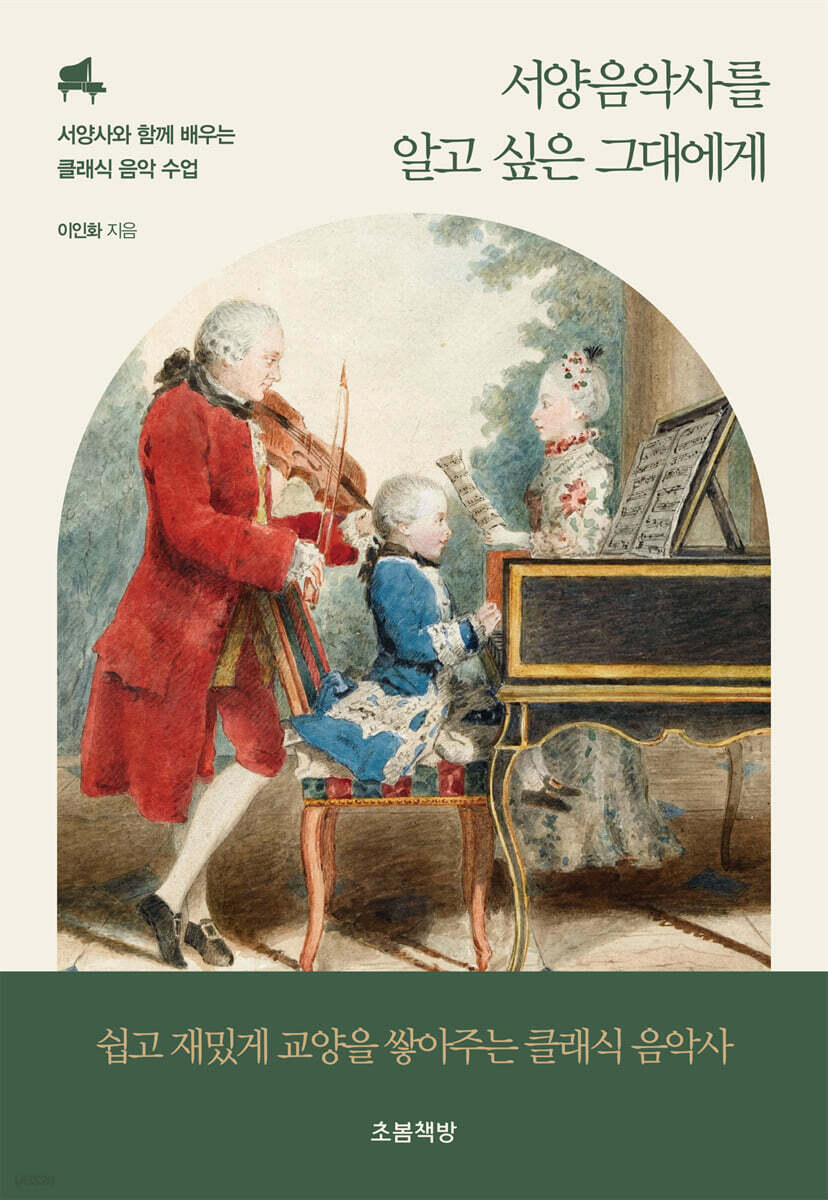
For those who want to know about Western music history
 |
Description
Book Introduction
I know the names of Bach, Mozart, Beethoven, and Schubert,
What if you can't remember what era they lived in?
A classical music class that follows the flow of Western history!
Is there a way to build a knowledge of classical music easily, quickly, and comprehensively? Author Lee In-hwa (principal of Buan High School), who has taught music for 30 years, wrote this book with this question in mind.
We reviewed a vast amount of material, but only covered the essential points necessary to understand the history of classical music, and summarized them to enable a concise understanding of the core knowledge of Western music history.
As a teacher before being a musician, he understands the heart of a 'learner' better than anyone else, so he kindly explains everything from establishing the basic concepts of classical music to the history of classical music.
In doing so, he explains the definition of music as 'what humans create by combining and transforming sound elements such as pitch, beat, melody, and harmony in various forms to express human thoughts and emotions.'
At first glance, it may seem very cumbersome and burdensome to examine the classics through their connection to knowledge in other fields and understand them within their context.
Before I began studying music in earnest at university, the author's thoughts were not much different from those of many preconceived notions and misconceptions.
It was because of the connotation of the word 'classical', even though the history of Western music is only about 400 years.
The 'classics' of music brought to mind the 'ancient' times of history, the Greek and Roman eras.
So the author confesses that he had a hard time bridging the gap between the actual era of music history and his own emotional era.
He says that the 'historical approach' is the best way to neatly organize the various tangled pieces of information in your head, and it is the most effective way to easily enjoy classical music.
By following the author's writings, you will gain an accurate understanding of Western history, encompassing politics, philosophy, science, and art, organized by era, and finally, you will create an "intellectual warehouse" capable of storing music.
If you gradually fill this with your own music, you will soon find that classical music has become closer to your heart.
What if you can't remember what era they lived in?
A classical music class that follows the flow of Western history!
Is there a way to build a knowledge of classical music easily, quickly, and comprehensively? Author Lee In-hwa (principal of Buan High School), who has taught music for 30 years, wrote this book with this question in mind.
We reviewed a vast amount of material, but only covered the essential points necessary to understand the history of classical music, and summarized them to enable a concise understanding of the core knowledge of Western music history.
As a teacher before being a musician, he understands the heart of a 'learner' better than anyone else, so he kindly explains everything from establishing the basic concepts of classical music to the history of classical music.
In doing so, he explains the definition of music as 'what humans create by combining and transforming sound elements such as pitch, beat, melody, and harmony in various forms to express human thoughts and emotions.'
At first glance, it may seem very cumbersome and burdensome to examine the classics through their connection to knowledge in other fields and understand them within their context.
Before I began studying music in earnest at university, the author's thoughts were not much different from those of many preconceived notions and misconceptions.
It was because of the connotation of the word 'classical', even though the history of Western music is only about 400 years.
The 'classics' of music brought to mind the 'ancient' times of history, the Greek and Roman eras.
So the author confesses that he had a hard time bridging the gap between the actual era of music history and his own emotional era.
He says that the 'historical approach' is the best way to neatly organize the various tangled pieces of information in your head, and it is the most effective way to easily enjoy classical music.
By following the author's writings, you will gain an accurate understanding of Western history, encompassing politics, philosophy, science, and art, organized by era, and finally, you will create an "intellectual warehouse" capable of storing music.
If you gradually fill this with your own music, you will soon find that classical music has become closer to your heart.
- You can preview some of the book's contents.
Preview
index
Bullet 4
PART 1 Show me some classical music
What is classical music? 13
The Flow of Classical Music 17
A Framework for Understanding the Timeline of Classical Music 18
20 Historical Backgrounds of Each Musical Movement According to Chronology
PART 2 What was music like before the Baroque era?
Music of Ancient Greece and Rome: A Comprehensive Era of Philosophers, Mathematicians, and Musicians 25
Praising God with Music in the Middle Ages 31
Renaissance Music Returns to Humanity 37
PART 3 A History of New Music, from Baroque to Romantic
Game Changers: 50 Baroque Music
Absolute Monarchy in Western and Eastern Europe 51
The Baroque was the most important turning point in the history of music.
Representative musician
Antonio Vivaldi 59
Johann Sebastian Bach 64
Georg Friedrich Handel 78
Music Textbook, Classical Music 87
The Social Background of the Classical Era 89
Classical era music is the classic of classics 93
Representative musician
Franz Joseph Haydn 95
Wolfgang Amadeus Mozart 104
Ludwig van Beethoven 134
Romantic music is adolescence 185
Romantic music is the music of storm and stress 185
The Social Background of the Romantic Era 188
Socio-cultural characteristics of Romantic music 193
The various trends of the Romantic era 197
Characteristics of Romantic Era Music 199
201 Representative Musicians and Works of the Romantic Era
Late Romantic Musicians and Works 203
A Special Encounter with Romantic Composers 209
PART 4: A History of Music Restarted: Modern and Contemporary Music
Modern Music 227
The Social Background of Modern Music 228
The Transition from the Romantic Era to Modern Music 231
Various Trends in the Modern Era 233
Schoenberg, who abandoned Bach and Beethoven and started music history again, 236
Contemporary Music 239
The Social Background of Contemporary Music 240
Various Trends in Contemporary Music 243
Popular Music 245
Gershwin, who elevated jazz to art music 247
The Path of Contemporary Music 248
References 251
PART 1 Show me some classical music
What is classical music? 13
The Flow of Classical Music 17
A Framework for Understanding the Timeline of Classical Music 18
20 Historical Backgrounds of Each Musical Movement According to Chronology
PART 2 What was music like before the Baroque era?
Music of Ancient Greece and Rome: A Comprehensive Era of Philosophers, Mathematicians, and Musicians 25
Praising God with Music in the Middle Ages 31
Renaissance Music Returns to Humanity 37
PART 3 A History of New Music, from Baroque to Romantic
Game Changers: 50 Baroque Music
Absolute Monarchy in Western and Eastern Europe 51
The Baroque was the most important turning point in the history of music.
Representative musician
Antonio Vivaldi 59
Johann Sebastian Bach 64
Georg Friedrich Handel 78
Music Textbook, Classical Music 87
The Social Background of the Classical Era 89
Classical era music is the classic of classics 93
Representative musician
Franz Joseph Haydn 95
Wolfgang Amadeus Mozart 104
Ludwig van Beethoven 134
Romantic music is adolescence 185
Romantic music is the music of storm and stress 185
The Social Background of the Romantic Era 188
Socio-cultural characteristics of Romantic music 193
The various trends of the Romantic era 197
Characteristics of Romantic Era Music 199
201 Representative Musicians and Works of the Romantic Era
Late Romantic Musicians and Works 203
A Special Encounter with Romantic Composers 209
PART 4: A History of Music Restarted: Modern and Contemporary Music
Modern Music 227
The Social Background of Modern Music 228
The Transition from the Romantic Era to Modern Music 231
Various Trends in the Modern Era 233
Schoenberg, who abandoned Bach and Beethoven and started music history again, 236
Contemporary Music 239
The Social Background of Contemporary Music 240
Various Trends in Contemporary Music 243
Popular Music 245
Gershwin, who elevated jazz to art music 247
The Path of Contemporary Music 248
References 251
Into the book
From the Renaissance to the Middle Ages, which were called the 'Dark Ages', music developed greatly, centered around the church.
Music developed more during the Middle Ages than during the Renaissance.
Initially, monophonic songs like Gregorian chant were sung, but gradually other parts were added, developing into polyphonic music.
--- p.34
Renaissance music was more influenced by the Reformation north of the Alps.
Luther loved music and was skilled at composing, singing, fluting, and playing the lute.
At that time, Catholic church music was complex polyphonic music with four parts, but Luther created hymns by adding lyrics in the native language to a single melody so that the lyrics could be easily heard and the congregation could easily sing along.
That's a 'choral'.
--- p.39
There are two factors that allowed Vivaldi to compose so many songs and leave behind great achievements in the history of music: the development of musical instruments and the Pieta Orphanage Orchestra.
During the Baroque period, musical instruments developed as craftsmen such as Amati, Guarneri, and Stradivari produced excellent string instruments, the form of the keyboard instrument harpsichord was perfected, and the fortepiano, the predecessor of the piano, was created.
Moreover, thanks to the Pieta Orphanage Orchestra, which could easily perform technically difficult pieces, Vivaldi was able to try bold musical experiments at any time.
--- p.63
After “Immortal Beloved” at age 42, Beethoven stopped falling in love with women, was so indifferent to his appearance and clothes that he was indistinguishable from a homeless person, would shout out loud in the street when stressed, and sometimes would pour cold water on his face at home and come out, and be treated like a lunatic.
--- p.150
From the Baroque era to the Romantic era, the foundation of classical music, ‘tonal music’, was maintained intact, and there is no significant difference in form from classical music, such as harmony and musical style derived from tonality.
In other words, in terms of form, it inherited classical music, but in terms of content, it was in opposition to classical music.
--- p.194
In the late Romantic period, tonal music began to break down, with composers increasingly using dissonance to express their strong individuality, nationalistic colors, and fleeting impressions.
Arnold Schoenberg (1874-1951) was a central figure in the deconstruction of tonal music, established the twelve-tone technique, and many modern and contemporary composers followed in his footsteps.
Music developed more during the Middle Ages than during the Renaissance.
Initially, monophonic songs like Gregorian chant were sung, but gradually other parts were added, developing into polyphonic music.
--- p.34
Renaissance music was more influenced by the Reformation north of the Alps.
Luther loved music and was skilled at composing, singing, fluting, and playing the lute.
At that time, Catholic church music was complex polyphonic music with four parts, but Luther created hymns by adding lyrics in the native language to a single melody so that the lyrics could be easily heard and the congregation could easily sing along.
That's a 'choral'.
--- p.39
There are two factors that allowed Vivaldi to compose so many songs and leave behind great achievements in the history of music: the development of musical instruments and the Pieta Orphanage Orchestra.
During the Baroque period, musical instruments developed as craftsmen such as Amati, Guarneri, and Stradivari produced excellent string instruments, the form of the keyboard instrument harpsichord was perfected, and the fortepiano, the predecessor of the piano, was created.
Moreover, thanks to the Pieta Orphanage Orchestra, which could easily perform technically difficult pieces, Vivaldi was able to try bold musical experiments at any time.
--- p.63
After “Immortal Beloved” at age 42, Beethoven stopped falling in love with women, was so indifferent to his appearance and clothes that he was indistinguishable from a homeless person, would shout out loud in the street when stressed, and sometimes would pour cold water on his face at home and come out, and be treated like a lunatic.
--- p.150
From the Baroque era to the Romantic era, the foundation of classical music, ‘tonal music’, was maintained intact, and there is no significant difference in form from classical music, such as harmony and musical style derived from tonality.
In other words, in terms of form, it inherited classical music, but in terms of content, it was in opposition to classical music.
--- p.194
In the late Romantic period, tonal music began to break down, with composers increasingly using dissonance to express their strong individuality, nationalistic colors, and fleeting impressions.
Arnold Schoenberg (1874-1951) was a central figure in the deconstruction of tonal music, established the twelve-tone technique, and many modern and contemporary composers followed in his footsteps.
--- p.225
Publisher's Review
Western history as the warp and classical music history as the weft
Weaving together the history of classical music not taught in school
The author says that the history of classical music must be studied alongside Western history to be properly understood.
So, as the subtitle, “Learning Music with Western History,” symbolizes, this book is woven with Western history as the warp and classical music history as the weft.
Western history and music stories can be difficult or stiff, but the author explains them in a fun and easy way with his signature humor and anecdotes, and he is kind enough to add explanations in boxes when additional explanations are needed.
It focuses on structuring the fragmentary knowledge and common sense about music learned over time (history) and adding new knowledge and common sense to develop the ability to understand the context of music.
This book is largely divided into four chapters.
Chapter 1 examines the flow of classical music by looking at a chronology comparing classical music and Western history.
Chapter 2 briefly examines music from the ancient, medieval, and Renaissance periods that preceded the Baroque era.
Baroque music, classical music, and romantic music are included in Chapter 3.
It would not be wrong to say that almost all the music we know today is music from the Baroque era, the Classical era, and the Romantic era.
Because it is a period that occupies most of classical music, there is a lot to know and a lot of interesting episodes.
The Baroque period was the time of Vivaldi, Bach, and Handel, and the Classical period was the time of Haydn, Mozart, and Beethoven.
Naturally, we devoted a lot of space to the lives and musical world of these musicians.
From romantic music to modern and contemporary music, many types of experimental music were created.
Some of these songs have already been recognized for their artistry and originality, but many are still in the experimental stage.
Chapter 4, which introduces modern and contemporary music, also includes popular music that has influenced and touched the hearts of many people just as much as classical music.
Heading
Most people who love music say that classical music education is essential for young people.
It's good for emotional development and creativity.
But most teenagers don't think that way.
Classical music is difficult and can be a headache, but it's also because we tend to think about it out of context, without any connection to our daily lives or knowledge in other fields.
At first, my thoughts weren't much different from yours.
When I studied Western music history in college, most Western music actually only had a history of about 400 years.
Yet, the emotional era was considered to be the ancient Greek era.
The feeling that the word 'classic' gives is reminiscent of 'ancient' times in history.
Anyway, I had a hard time bridging the gap between the actual era of music history and my emotional era.
What is music? It can be said to be something humans create by combining and transforming sound elements like pitch, beat, melody, and harmony into various forms to express human thoughts and emotions.
As musicians combine and transform sounds, they capture the history, politics, economics, philosophy, religion, and regional characteristics of the time.
It also reflects trends in other arts such as literature, art, and dance, as well as the individual circumstances and experiences of the musicians.
So, music must be understood in an organic connection with the history, politics, economics, philosophy, religion, regional characteristics, artistic trends, and the lives of musicians related to the music.
Everything you create, from diaries and writings to drawings and crafts, to even recipes for delicious ramen, seems to embody the thoughts of young people living in this era.
Okay, now I'll teach you how to help young people understand classical music within the context of the times and enjoy it in their daily lives.
The story of European history and music can be difficult or stiff.
I know full well that a typical, dry classical music history class is not only uninteresting, but also makes your eyelids heavy.
Sometimes I'll include a funny 'anecdote', and anything that needs further explanation will be put in a box.
The goal of this class is to structure the fragmentary knowledge and common sense about music that we have learned so far, using time (history) as an axis, and to develop the ability to understand the context of music by adding new knowledge and common sense to it.
The class content is divided into four major chapters.
Chapter 1 will provide a chronological overview of classical music and Western history, providing a glimpse into the history of classical music.
Chapters 2, 3, and 4 will specifically examine the flow of classical music by era, which we learned about in Chapter 1.
Starting with the Baroque era, music changed completely.
Most of the music we know today is from the Baroque period, the Classical period, and the Romantic period.
So, I focused on music from the Baroque, Classical, and Romantic periods, and divided it into pre-Baroque and post-Romantic periods.
Chapter 2 will briefly examine music from the ancient, medieval, and Renaissance periods that preceded the Baroque era.
Baroque music, classical music, and romantic music are included in three volumes.
Because it is a period that covers most of classical music, there is a lot to know and a lot to cover, but there are also a lot of interesting episodes.
From romantic music to modern and contemporary music, many types of experimental music were created.
Some of these songs have already been recognized for their artistry and originality, but many are still in the experimental stage.
Chapter 4, which introduces modern and contemporary music, also includes popular music that has influenced and touched the hearts of many people just as much as classical music.
This book is dedicated to young people who hum along to the melodies of classical music they learned in class, look forward to fun music lessons, and want to learn more about classical music.
So, let's dive into a fun classical music lesson that combines Western history!
November 2024
Lee In-hwa
Weaving together the history of classical music not taught in school
The author says that the history of classical music must be studied alongside Western history to be properly understood.
So, as the subtitle, “Learning Music with Western History,” symbolizes, this book is woven with Western history as the warp and classical music history as the weft.
Western history and music stories can be difficult or stiff, but the author explains them in a fun and easy way with his signature humor and anecdotes, and he is kind enough to add explanations in boxes when additional explanations are needed.
It focuses on structuring the fragmentary knowledge and common sense about music learned over time (history) and adding new knowledge and common sense to develop the ability to understand the context of music.
This book is largely divided into four chapters.
Chapter 1 examines the flow of classical music by looking at a chronology comparing classical music and Western history.
Chapter 2 briefly examines music from the ancient, medieval, and Renaissance periods that preceded the Baroque era.
Baroque music, classical music, and romantic music are included in Chapter 3.
It would not be wrong to say that almost all the music we know today is music from the Baroque era, the Classical era, and the Romantic era.
Because it is a period that occupies most of classical music, there is a lot to know and a lot of interesting episodes.
The Baroque period was the time of Vivaldi, Bach, and Handel, and the Classical period was the time of Haydn, Mozart, and Beethoven.
Naturally, we devoted a lot of space to the lives and musical world of these musicians.
From romantic music to modern and contemporary music, many types of experimental music were created.
Some of these songs have already been recognized for their artistry and originality, but many are still in the experimental stage.
Chapter 4, which introduces modern and contemporary music, also includes popular music that has influenced and touched the hearts of many people just as much as classical music.
Heading
Most people who love music say that classical music education is essential for young people.
It's good for emotional development and creativity.
But most teenagers don't think that way.
Classical music is difficult and can be a headache, but it's also because we tend to think about it out of context, without any connection to our daily lives or knowledge in other fields.
At first, my thoughts weren't much different from yours.
When I studied Western music history in college, most Western music actually only had a history of about 400 years.
Yet, the emotional era was considered to be the ancient Greek era.
The feeling that the word 'classic' gives is reminiscent of 'ancient' times in history.
Anyway, I had a hard time bridging the gap between the actual era of music history and my emotional era.
What is music? It can be said to be something humans create by combining and transforming sound elements like pitch, beat, melody, and harmony into various forms to express human thoughts and emotions.
As musicians combine and transform sounds, they capture the history, politics, economics, philosophy, religion, and regional characteristics of the time.
It also reflects trends in other arts such as literature, art, and dance, as well as the individual circumstances and experiences of the musicians.
So, music must be understood in an organic connection with the history, politics, economics, philosophy, religion, regional characteristics, artistic trends, and the lives of musicians related to the music.
Everything you create, from diaries and writings to drawings and crafts, to even recipes for delicious ramen, seems to embody the thoughts of young people living in this era.
Okay, now I'll teach you how to help young people understand classical music within the context of the times and enjoy it in their daily lives.
The story of European history and music can be difficult or stiff.
I know full well that a typical, dry classical music history class is not only uninteresting, but also makes your eyelids heavy.
Sometimes I'll include a funny 'anecdote', and anything that needs further explanation will be put in a box.
The goal of this class is to structure the fragmentary knowledge and common sense about music that we have learned so far, using time (history) as an axis, and to develop the ability to understand the context of music by adding new knowledge and common sense to it.
The class content is divided into four major chapters.
Chapter 1 will provide a chronological overview of classical music and Western history, providing a glimpse into the history of classical music.
Chapters 2, 3, and 4 will specifically examine the flow of classical music by era, which we learned about in Chapter 1.
Starting with the Baroque era, music changed completely.
Most of the music we know today is from the Baroque period, the Classical period, and the Romantic period.
So, I focused on music from the Baroque, Classical, and Romantic periods, and divided it into pre-Baroque and post-Romantic periods.
Chapter 2 will briefly examine music from the ancient, medieval, and Renaissance periods that preceded the Baroque era.
Baroque music, classical music, and romantic music are included in three volumes.
Because it is a period that covers most of classical music, there is a lot to know and a lot to cover, but there are also a lot of interesting episodes.
From romantic music to modern and contemporary music, many types of experimental music were created.
Some of these songs have already been recognized for their artistry and originality, but many are still in the experimental stage.
Chapter 4, which introduces modern and contemporary music, also includes popular music that has influenced and touched the hearts of many people just as much as classical music.
This book is dedicated to young people who hum along to the melodies of classical music they learned in class, look forward to fun music lessons, and want to learn more about classical music.
So, let's dive into a fun classical music lesson that combines Western history!
November 2024
Lee In-hwa
GOODS SPECIFICS
- Date of issue: November 25, 2024
- Page count, weight, size: 252 pages | 396g | 145*210*16mm
- ISBN13: 9791198503060
You may also like
카테고리
korean


korean

![GQ KOREA Mark (Monthly): December [2025]](http://librairie.coreenne.fr/cdn/shop/files/8ef265dbbfbf186523ed75ba7319009d.jpg?v=1765340328&width=3840)


