

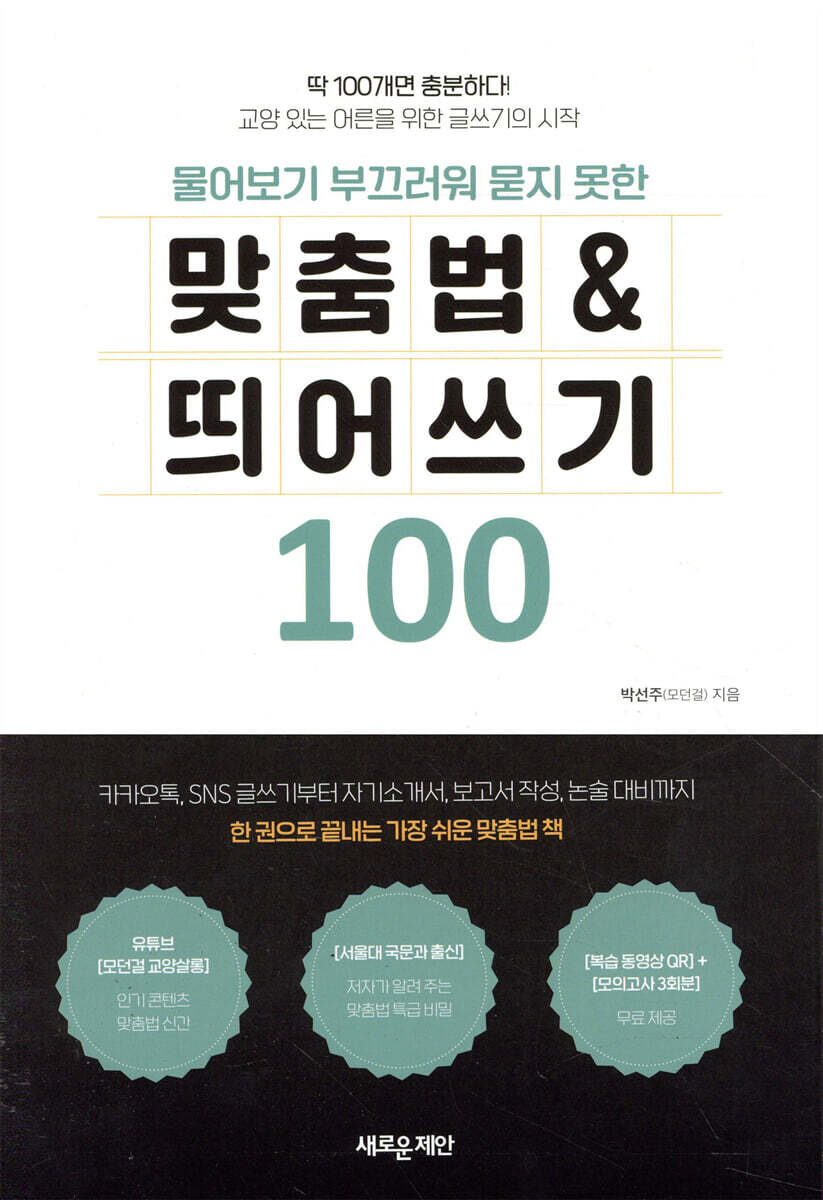
100 Spelling & Spacing Rules You're Too Embarrassed to Ask About
 |
Description
Book Introduction
100 confusing spelling and spacing mistakes, all sorted out Pay - pay? Get better - get better? What should I do - how? Can't do it - can't do it? Once - once? There are spellings that confuse me every time I use them, but I have nowhere to ask and am embarrassed to ask. There are also people who confidently use incorrect spellings without even knowing they are wrong. For these people, you need a book that you can keep on your bookshelf and look up spelling questions whenever you want. 『100 Spelling & Spacing Mistakes You're Too Embarrassed to Ask』 is a book that carefully selects 80 spelling mistakes and 20 spacing mistakes that Koreans often make. It is characterized by its concise and easy explanations, and it is easy to remember and can be applied immediately in real life by explaining the principles rather than just memorizing them. There is no better way to know the correct spelling of a word and avoid mistakes than repetition. Look at the table of contents in alphabetical order and look up any spelling or spacing you are curious about. |
- You can preview some of the book's contents.
Preview
index
Entering
Is it worse to be the person who makes a spelling mistake, or is it worse to be the person who points out the spelling mistake?
How to use this book
Chapter 1.
Why you should always follow the correct spelling
Fast and accurate communication is possible
Spelling puts food on the table
Your language reflects your sophistication.
I gave a rather extreme example, but
Chapter 2.
Key Spelling Terms for Easy Understanding
About words
About parts of speech
About sentence elements
If you don't know, just this!
Chapter 3.
80 Most Commonly Used and Mostly Wrong Spellings
Why is spelling so confusing?
01 Teach - Point out
02 Same - Same - Same
03 Renew - Renew
04 Geo - Go
05 Konkuk University - Konkuk University
06 Touch - Touch
07 Girl - Kkal
08 Ge - Ke
09 Pay - Make a payment
10 Go - Goo
11 Guji - If you must
12 Earrings - Earrings
13 Soon - Soon
[Pronunciation of ㅐ and ㅔ]
14 Clean - Clean
15 Shell - Shell
16 Nan - Ran
17 Fly away - Fly away
18 Better - to give birth
19 Yes - Yes
20 You - You
21 Increase - Increase
22 Different - Wrong
23 Pull - Pull
24 to - Day
[Advanced Course on 'Dae' and 'De']
25 Price - Price
[5 Twists in the Saishiot]
26 Throw - Throw
27 What the heck - What the heck
28 Doe - Doe
29 Stop by - Stop by
30. Ttida - Ttida
31 yang - yang
32 As - As
33 Rate - Rate
34 Match - Match
35 Maeda - Maeda
36 days - how many days
37. It's okay - say hello
38 Barada - Barada
39 Must - Mustly
40. To spread - to spread
41. See - See
42 Break - Break
43. To attach - to stick
44 Borrow - Borrow
45 Washing Dishes - Washing Dishes
46 Excited - Excited
47 Evidence - Disgust
48 Please - Please
49 No - No
50 - No
51 Suitable - Suitable
52 Where to get - get
53 What should I do - How
54 Anyway - Anyway
55 was - was
56 to - of
57 - Yes
58 Role - Role
59 Romance - Entertainment
60 Long time no see - Long time no see
61 Why - Why
62nd place - top
63 Later - Later
64 On purpose - partly
65 Lose - Forget
66 Stock - Stock
67 The year before last - the year before last
68. Cook - boil
69 Chase - Chase
70 Joe - Give
71 Brokerage - Relay
72 Avoid - Aim for
73 Chae - Che
74 Cake - Cake
[Foreign language notation]
75 Turn on - Kida
76 Hanae - Hane
77 Trying to - Trying to
78 Therefore - By doing so
79 Strange - Strange
80 Hard - Hard
Chapter 4.
20 Key Spacing Rules to Understand Through Principles
Spacing principles
Spacing of spacing
01 together
02 pieces
03 Thing
Until 04
05 Avenue
06 time
Because of 07
08 horse
09 million
10 can't
Only 11
Only 12
13th
I want 14
15 seeds
16 lines
17th
18 years old
19 once
20 must do
Chapter 5.
How to never make spelling mistakes
Classics are eternal: Korean dictionary
Directly from the government: National Institute of the Korean Language
There is no royal road: repetition, repetition, repetition
Spelling 80 at a glance
Going out
So, you don't make any spelling mistakes?
Is it worse to be the person who makes a spelling mistake, or is it worse to be the person who points out the spelling mistake?
How to use this book
Chapter 1.
Why you should always follow the correct spelling
Fast and accurate communication is possible
Spelling puts food on the table
Your language reflects your sophistication.
I gave a rather extreme example, but
Chapter 2.
Key Spelling Terms for Easy Understanding
About words
About parts of speech
About sentence elements
If you don't know, just this!
Chapter 3.
80 Most Commonly Used and Mostly Wrong Spellings
Why is spelling so confusing?
01 Teach - Point out
02 Same - Same - Same
03 Renew - Renew
04 Geo - Go
05 Konkuk University - Konkuk University
06 Touch - Touch
07 Girl - Kkal
08 Ge - Ke
09 Pay - Make a payment
10 Go - Goo
11 Guji - If you must
12 Earrings - Earrings
13 Soon - Soon
[Pronunciation of ㅐ and ㅔ]
14 Clean - Clean
15 Shell - Shell
16 Nan - Ran
17 Fly away - Fly away
18 Better - to give birth
19 Yes - Yes
20 You - You
21 Increase - Increase
22 Different - Wrong
23 Pull - Pull
24 to - Day
[Advanced Course on 'Dae' and 'De']
25 Price - Price
[5 Twists in the Saishiot]
26 Throw - Throw
27 What the heck - What the heck
28 Doe - Doe
29 Stop by - Stop by
30. Ttida - Ttida
31 yang - yang
32 As - As
33 Rate - Rate
34 Match - Match
35 Maeda - Maeda
36 days - how many days
37. It's okay - say hello
38 Barada - Barada
39 Must - Mustly
40. To spread - to spread
41. See - See
42 Break - Break
43. To attach - to stick
44 Borrow - Borrow
45 Washing Dishes - Washing Dishes
46 Excited - Excited
47 Evidence - Disgust
48 Please - Please
49 No - No
50 - No
51 Suitable - Suitable
52 Where to get - get
53 What should I do - How
54 Anyway - Anyway
55 was - was
56 to - of
57 - Yes
58 Role - Role
59 Romance - Entertainment
60 Long time no see - Long time no see
61 Why - Why
62nd place - top
63 Later - Later
64 On purpose - partly
65 Lose - Forget
66 Stock - Stock
67 The year before last - the year before last
68. Cook - boil
69 Chase - Chase
70 Joe - Give
71 Brokerage - Relay
72 Avoid - Aim for
73 Chae - Che
74 Cake - Cake
[Foreign language notation]
75 Turn on - Kida
76 Hanae - Hane
77 Trying to - Trying to
78 Therefore - By doing so
79 Strange - Strange
80 Hard - Hard
Chapter 4.
20 Key Spacing Rules to Understand Through Principles
Spacing principles
Spacing of spacing
01 together
02 pieces
03 Thing
Until 04
05 Avenue
06 time
Because of 07
08 horse
09 million
10 can't
Only 11
Only 12
13th
I want 14
15 seeds
16 lines
17th
18 years old
19 once
20 must do
Chapter 5.
How to never make spelling mistakes
Classics are eternal: Korean dictionary
Directly from the government: National Institute of the Korean Language
There is no royal road: repetition, repetition, repetition
Spelling 80 at a glance
Going out
So, you don't make any spelling mistakes?
Detailed image

Into the book
I hope this book will be helpful to those who want to write with correct spelling but don't know where to get the right information, those who wanted to study spelling but gave up because they were worried it would be too difficult, and those who hesitated every time they wrote because of spelling.
I wrote down only the essentials of spelling and spacing so that they are as easy to understand and remember as possible.
Please keep it by your side and read it whenever you are confused or cannot remember something.
--- p.4
In fact, most of the spelling mistakes we make are ones we wouldn't even know we made if we said them out loud.
But in the process of transcribing this into text, your knowledge of spelling is revealed.
The problem is that these days, we have a lot more to read and write about. With the advent of social media and the widespread adoption of smartphones, we communicate with people through messengers and post on social media dozens of times a day.
And that writing is seen by other people.
It also means that there are more instances where your spelling skills are revealed to others.
--- p.23
When referring to "earrings," is "earrings" or "earring hooks" correct? Both are correct.
Words that are both recognized as standard languages are called plural standard languages.
Originally, only 'earrings' was the standard word.
In the 17th century, it was called 'Gwiyeotgolhoe', and in the 19th century, it was called 'Gwiegori', which is how it became the current 'Gwigori'.
If you look at the etymology, it seems closer to ‘ring’ than ‘hook’, so it was written as ‘earring’.
However, there is a Korean proverb that says, “If you hang it on your nose, it is a nose ring, and if you hang it on your ear, it is an earring.”
Also, as people used the word 'earrings' a lot, they came to be recognized as standard language.
But 'earrings' is the wrong word.
--- p.62
What do you say to lengthen the hem of your pants? The correct answer is "Please lengthen it."
'Neulrida' and 'Neulida' have similar meanings and pronunciations, so they can be confusing, but they are used differently, so they should be used differently.
'Neulida' is a word mainly used to indicate length.
Since the hem of a trouser is made longer, we use the word ‘늘이다’.
Also, when you want to make your hair hang down, as in 'grow your hair long', you use '늘이다'.
On the other hand, '늘리다' is mainly used when increasing the area or volume, as in 'increase the size of a store.'
When the number or amount increases or the weight increases, such as ‘increase subscribers’ or ‘gain weight’, ‘increase’ is also used.
--- p.82
The pencil that was clearly on my desk just moments ago disappeared, I saw a dog walking on two legs like a human, rain falling under a clear sky—is that a "strange event" or a "strange thing"? When you want to express wonder at something rare, it's appropriate to say "strange."
'희안하다' is a non-standard form of '희한하다'.
'Heehanhada' is a Chinese character that combines 'hee (稀),' meaning rare, and 'han (罕),' meaning rare.
Since the word rare appears twice, it must mean that it is really rare.
--- p.208
'Together' can be written either attached or separated.
The reason is that 'together' can be used as a particle or adverb.
When 'together' is attached to a noun (noun, pronoun, numeral) and used as a particle meaning "like the typical characteristic of the preceding word," it is attached to the preceding word.
So, 'like a picture' must be written together.
When 'together' is used as an adverb with 'wa/gwa' to mean 'together', it is written with a space in front of the word.
In 'with me', 'together' is used with 'wa/gwa' to modify the verb 'to leave', so it is correct to write it with a space in front of the word.
--- p.224
The best way to become familiar with correct Korean spelling is to read a lot of text written correctly.
First of all, I recommend reading a lot of books.
Reading books not only allows you to gain specialized information in various fields, but also broadens your horizons by indirectly experiencing things you haven't experienced before.
The book's advantages don't end there.
Another advantage is that it is written in a way that is correct in spelling.
The book contains refined language that has undergone meticulous proofreading by the author and editor.
So, if you read a lot of books, you will naturally be exposed to a lot of correct notation forms.
As you get used to it, you will find yourself knowing which spellings are correct and which are incorrect without even realizing it.
So it is important to read a lot of books.
Also, whenever you write something, whether it's an email, message, or report, it's a good idea to be conscious of the spelling of the words you use and check them repeatedly.
I wrote down only the essentials of spelling and spacing so that they are as easy to understand and remember as possible.
Please keep it by your side and read it whenever you are confused or cannot remember something.
--- p.4
In fact, most of the spelling mistakes we make are ones we wouldn't even know we made if we said them out loud.
But in the process of transcribing this into text, your knowledge of spelling is revealed.
The problem is that these days, we have a lot more to read and write about. With the advent of social media and the widespread adoption of smartphones, we communicate with people through messengers and post on social media dozens of times a day.
And that writing is seen by other people.
It also means that there are more instances where your spelling skills are revealed to others.
--- p.23
When referring to "earrings," is "earrings" or "earring hooks" correct? Both are correct.
Words that are both recognized as standard languages are called plural standard languages.
Originally, only 'earrings' was the standard word.
In the 17th century, it was called 'Gwiyeotgolhoe', and in the 19th century, it was called 'Gwiegori', which is how it became the current 'Gwigori'.
If you look at the etymology, it seems closer to ‘ring’ than ‘hook’, so it was written as ‘earring’.
However, there is a Korean proverb that says, “If you hang it on your nose, it is a nose ring, and if you hang it on your ear, it is an earring.”
Also, as people used the word 'earrings' a lot, they came to be recognized as standard language.
But 'earrings' is the wrong word.
--- p.62
What do you say to lengthen the hem of your pants? The correct answer is "Please lengthen it."
'Neulrida' and 'Neulida' have similar meanings and pronunciations, so they can be confusing, but they are used differently, so they should be used differently.
'Neulida' is a word mainly used to indicate length.
Since the hem of a trouser is made longer, we use the word ‘늘이다’.
Also, when you want to make your hair hang down, as in 'grow your hair long', you use '늘이다'.
On the other hand, '늘리다' is mainly used when increasing the area or volume, as in 'increase the size of a store.'
When the number or amount increases or the weight increases, such as ‘increase subscribers’ or ‘gain weight’, ‘increase’ is also used.
--- p.82
The pencil that was clearly on my desk just moments ago disappeared, I saw a dog walking on two legs like a human, rain falling under a clear sky—is that a "strange event" or a "strange thing"? When you want to express wonder at something rare, it's appropriate to say "strange."
'희안하다' is a non-standard form of '희한하다'.
'Heehanhada' is a Chinese character that combines 'hee (稀),' meaning rare, and 'han (罕),' meaning rare.
Since the word rare appears twice, it must mean that it is really rare.
--- p.208
'Together' can be written either attached or separated.
The reason is that 'together' can be used as a particle or adverb.
When 'together' is attached to a noun (noun, pronoun, numeral) and used as a particle meaning "like the typical characteristic of the preceding word," it is attached to the preceding word.
So, 'like a picture' must be written together.
When 'together' is used as an adverb with 'wa/gwa' to mean 'together', it is written with a space in front of the word.
In 'with me', 'together' is used with 'wa/gwa' to modify the verb 'to leave', so it is correct to write it with a space in front of the word.
--- p.224
The best way to become familiar with correct Korean spelling is to read a lot of text written correctly.
First of all, I recommend reading a lot of books.
Reading books not only allows you to gain specialized information in various fields, but also broadens your horizons by indirectly experiencing things you haven't experienced before.
The book's advantages don't end there.
Another advantage is that it is written in a way that is correct in spelling.
The book contains refined language that has undergone meticulous proofreading by the author and editor.
So, if you read a lot of books, you will naturally be exposed to a lot of correct notation forms.
As you get used to it, you will find yourself knowing which spellings are correct and which are incorrect without even realizing it.
So it is important to read a lot of books.
Also, whenever you write something, whether it's an email, message, or report, it's a good idea to be conscious of the spelling of the words you use and check them repeatedly.
--- p.268
Publisher's Review
From writing on KakaoTalk and SNS to writing self-introductions, reports, and essays
Anyone who writes formal documents such as reports, emails, and self-introductions, such as office workers, new graduates, and job seekers; writers, marketers, planners, editors, and influencers whose job is writing; students preparing for various exams such as the essay and college entrance exams; and cultured people of this era who want to master spelling with just one book can all be readers of this book.
Language reflects your sophistication.
The language I use not only reveals who I am, but can also become the standard by which others judge me.
The secret to such easy spelling revealed by a Seoul National University graduate.
The author, a graduate of the Department of Korean Language and Literature at Seoul National University and the owner of the YouTube channel 'Modern Girl Culture Salon', uses her witty writing skills to teach 100 short but memorable, easy but highly useful spelling and spacing rules.
For some people, spelling can be the easiest thing in the world.
But, as the title of this book suggests, there may be people who are too embarrassed to ask questions because they feel like they are the only ones who don't know what others know.
Don't worry.
If you just learn the 100 spelling and spacing rules and principles taught in the book, you can be free from KakaoTalk, text messages, Facebook, and Inbyeol.
Plus, if you scan the QR code in the book, you can also watch a video explanation, so isn't it killing two birds with one stone?
Spelling that gets confusing every time I write,
Are you embarrassed to ask questions and have no one to ask?
There are spellings that you can't find a clear answer to even if you search on a portal site.
There are spellings that I don't know because I feel like I'm the only one who doesn't know them.
『100 Spelling & Spacing Mistakes You're Too Embarrassed to Ask』 is a book that carefully selects 80 spelling mistakes and 20 spacing mistakes that we often make in our daily lives.
The spelling we were curious about, the essentials we need to know, explained briefly, easily, and refreshingly, as if scratching an itch.
When contacting a blind date partner, when writing on social media,
Are you worried about spelling mistakes?
You're exchanging messages with someone you were introduced to, but the spelling is strange? Even before meeting, your expectations are diminished and your disappointment only grows.
Anyone can be the one making the spelling mistake or the one observing the spelling mistake.
To prevent this from happening, you need to get used to using words with correct spelling.
Keep this book on your bookshelf and look it up like a dictionary whenever you have questions about spelling or spacing.
I hope you make good use of the accompanying review videos.
I want to point out the other person's spelling mistake.
Do you think I'm just pretending to know everything?
A new post on a friend's profile has a particularly noticeable misspelling.
It's a bit awkward to send a message intentionally, but is there a way to naturally teach them correct spelling? Consider giving them this book.
You can point out someone's spelling mistakes without pretending to know or act like you're smart.
Both the giver and the receiver will have a joyful experience.
Anyone who writes formal documents such as reports, emails, and self-introductions, such as office workers, new graduates, and job seekers; writers, marketers, planners, editors, and influencers whose job is writing; students preparing for various exams such as the essay and college entrance exams; and cultured people of this era who want to master spelling with just one book can all be readers of this book.
Language reflects your sophistication.
The language I use not only reveals who I am, but can also become the standard by which others judge me.
The secret to such easy spelling revealed by a Seoul National University graduate.
The author, a graduate of the Department of Korean Language and Literature at Seoul National University and the owner of the YouTube channel 'Modern Girl Culture Salon', uses her witty writing skills to teach 100 short but memorable, easy but highly useful spelling and spacing rules.
For some people, spelling can be the easiest thing in the world.
But, as the title of this book suggests, there may be people who are too embarrassed to ask questions because they feel like they are the only ones who don't know what others know.
Don't worry.
If you just learn the 100 spelling and spacing rules and principles taught in the book, you can be free from KakaoTalk, text messages, Facebook, and Inbyeol.
Plus, if you scan the QR code in the book, you can also watch a video explanation, so isn't it killing two birds with one stone?
Spelling that gets confusing every time I write,
Are you embarrassed to ask questions and have no one to ask?
There are spellings that you can't find a clear answer to even if you search on a portal site.
There are spellings that I don't know because I feel like I'm the only one who doesn't know them.
『100 Spelling & Spacing Mistakes You're Too Embarrassed to Ask』 is a book that carefully selects 80 spelling mistakes and 20 spacing mistakes that we often make in our daily lives.
The spelling we were curious about, the essentials we need to know, explained briefly, easily, and refreshingly, as if scratching an itch.
When contacting a blind date partner, when writing on social media,
Are you worried about spelling mistakes?
You're exchanging messages with someone you were introduced to, but the spelling is strange? Even before meeting, your expectations are diminished and your disappointment only grows.
Anyone can be the one making the spelling mistake or the one observing the spelling mistake.
To prevent this from happening, you need to get used to using words with correct spelling.
Keep this book on your bookshelf and look it up like a dictionary whenever you have questions about spelling or spacing.
I hope you make good use of the accompanying review videos.
I want to point out the other person's spelling mistake.
Do you think I'm just pretending to know everything?
A new post on a friend's profile has a particularly noticeable misspelling.
It's a bit awkward to send a message intentionally, but is there a way to naturally teach them correct spelling? Consider giving them this book.
You can point out someone's spelling mistakes without pretending to know or act like you're smart.
Both the giver and the receiver will have a joyful experience.
GOODS SPECIFICS
- Publication date: October 9, 2022
- Page count, weight, size: 274 pages | 468g | 152*225*14mm
- ISBN13: 9788955336344
- ISBN10: 8955336349
You may also like
카테고리
korean


korean

![GQ KOREA Mark (Monthly): December [2025]](http://librairie.coreenne.fr/cdn/shop/files/8ef265dbbfbf186523ed75ba7319009d.jpg?v=1765340328&width=3840)


