

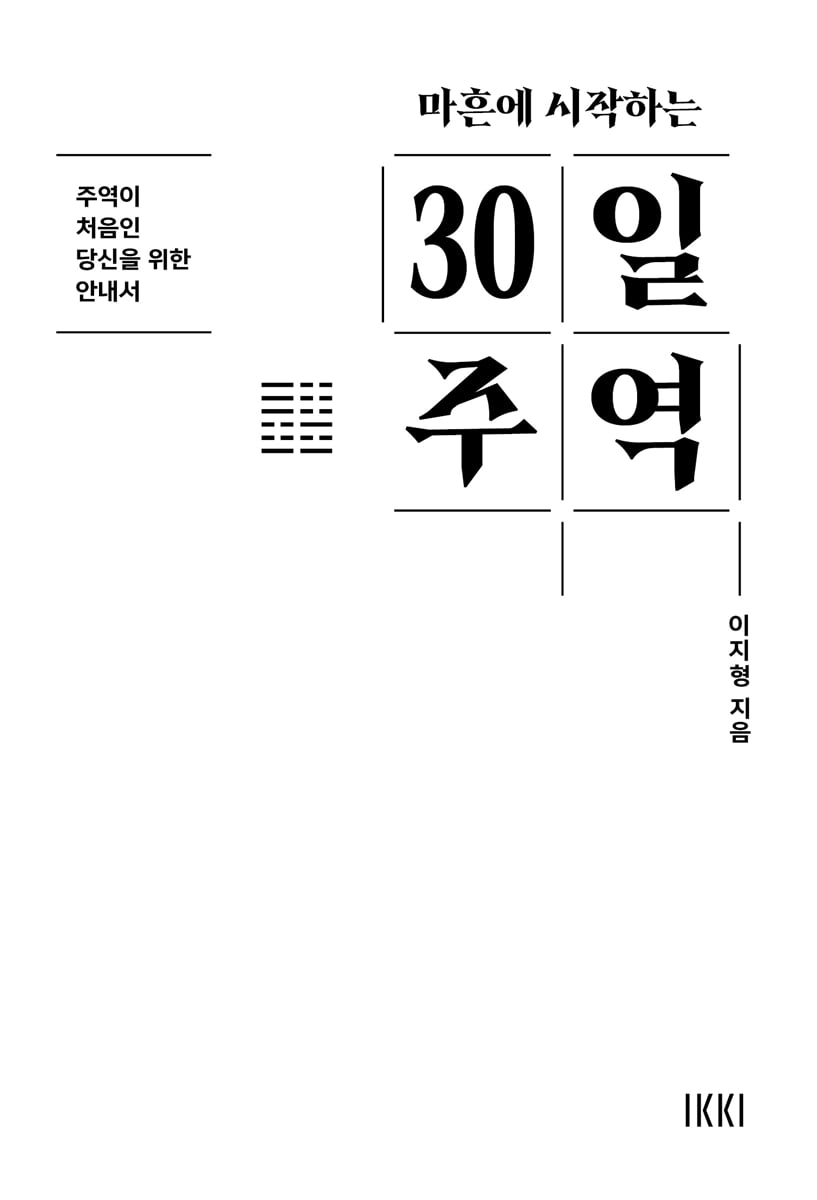
30-day main character starting at 40
 |
Description
Book Introduction
Finding your way through change,
It gives us the courage to love what we have lost.
A Guide to Life
Between Ecstasy and Desolation, and Beyond
The protagonist who was born in the chaos of the continent 3,000 years ago.
The world the author encountered in his youth was "ecstatic and desolate," but the protagonist he met again in late autumn, at the age of chrysanthemums, was different.
Amidst the scattered prophecies, a flowing flow was revealed, and a life orientation transcending both optimism and pessimism was revealed.
This book, through a 30-day journey, washes away the protagonist's clichés and pedantry, reviving his living voice.
The author reveals an ambivalent attitude by presenting both 'reasons why the Book of Changes should not be trusted' and 'reasons why the Book of Changes is beautiful'.
A setting that ends in an unfinished state before the story progresses to a point where they accuse and slash each other? All these flaws paradoxically make the protagonist beautiful.
"Shake, don't break / Look, let it go / Forget the big things, do the small things." Acknowledge the shaking but don't break, look but don't hold on, and do the small things you can do now.
As the last Hwasumijye hexagram says, completion is stagnation and incompletion is possibility.
This book is an introduction to the Book of Changes, and at the same time, an introduction to life.
Rather than learning the 64 hexagrams, learn how to make peace with anxiety.
The message the protagonist wanted to convey from the beginning was simple.
Don't worry.
You are already enough.
It gives us the courage to love what we have lost.
A Guide to Life
Between Ecstasy and Desolation, and Beyond
The protagonist who was born in the chaos of the continent 3,000 years ago.
The world the author encountered in his youth was "ecstatic and desolate," but the protagonist he met again in late autumn, at the age of chrysanthemums, was different.
Amidst the scattered prophecies, a flowing flow was revealed, and a life orientation transcending both optimism and pessimism was revealed.
This book, through a 30-day journey, washes away the protagonist's clichés and pedantry, reviving his living voice.
The author reveals an ambivalent attitude by presenting both 'reasons why the Book of Changes should not be trusted' and 'reasons why the Book of Changes is beautiful'.
A setting that ends in an unfinished state before the story progresses to a point where they accuse and slash each other? All these flaws paradoxically make the protagonist beautiful.
"Shake, don't break / Look, let it go / Forget the big things, do the small things." Acknowledge the shaking but don't break, look but don't hold on, and do the small things you can do now.
As the last Hwasumijye hexagram says, completion is stagnation and incompletion is possibility.
This book is an introduction to the Book of Changes, and at the same time, an introduction to life.
Rather than learning the 64 hexagrams, learn how to make peace with anxiety.
The message the protagonist wanted to convey from the beginning was simple.
Don't worry.
You are already enough.
- You can preview some of the book's contents.
Preview
index
Prologue Ecstatic, desolate
Part 1│Shaking, Not Falling
Can you sum up the main character of the first day in one word? / Second day: Shaking, but not collapsing. / Third day: Even if the world is complicated. / Fourth day: Memories of a red sunset. / Fifth day: Loving the scattered and abandoned.
Part 2│Constellations are not only beautiful
On the sixth day, the world constantly gives hints / On the seventh day, if I don't seek it, he will / On the eighth day, Chinese characters, the Bible, the burning of the Byeokamrok, Huineng / On the ninth day, sublimely before the vain scenery / On the tenth day, the secret hidden behind the constellations
Part 3│Even if I wander the world with the wind
Eleventh day: May it be beautiful and useless / Twelfth day: May it fall apart and be safe / Thirteenth day: There is no evil in thoughts / Fourteenth day: Regrets disappear / Fifteenth day: Eternal return, Nietzsche, Andy Warhol
Part 4│A Life Dreaming of Reversal and Paradox
Sixteenth day: Hide / Seventeenth day: In this world full of discord / Eighteenth day: Secretly, boldly / Nineteenth day: Suddenly, the landscapes of the earth / Twentieth day: The Four Great Difficulties or How to Cross the Desert
Part 5│Can be reversed
Twenty-first day: Autumn comes and countless things happen / Twenty-second day: The words the wind carries / Twenty-third day: Wise constraints set us free / Twenty-fourth day: A young fox tries to cross the river / Twenty-fifth day: Breaking down our obsessions
Part 6│Don't Worry
Twenty-sixth day Ten Wings / Twenty-seventh day The Dream of the Final Theory or the Story of the Gyesajeon / Twenty-eighth day Walking along the Hanyang Fortress Road / Twenty-ninth day Where is the protagonist? / Thirtyth day Don't worry, you!
Appendix 64 Summary
Part 1│Shaking, Not Falling
Can you sum up the main character of the first day in one word? / Second day: Shaking, but not collapsing. / Third day: Even if the world is complicated. / Fourth day: Memories of a red sunset. / Fifth day: Loving the scattered and abandoned.
Part 2│Constellations are not only beautiful
On the sixth day, the world constantly gives hints / On the seventh day, if I don't seek it, he will / On the eighth day, Chinese characters, the Bible, the burning of the Byeokamrok, Huineng / On the ninth day, sublimely before the vain scenery / On the tenth day, the secret hidden behind the constellations
Part 3│Even if I wander the world with the wind
Eleventh day: May it be beautiful and useless / Twelfth day: May it fall apart and be safe / Thirteenth day: There is no evil in thoughts / Fourteenth day: Regrets disappear / Fifteenth day: Eternal return, Nietzsche, Andy Warhol
Part 4│A Life Dreaming of Reversal and Paradox
Sixteenth day: Hide / Seventeenth day: In this world full of discord / Eighteenth day: Secretly, boldly / Nineteenth day: Suddenly, the landscapes of the earth / Twentieth day: The Four Great Difficulties or How to Cross the Desert
Part 5│Can be reversed
Twenty-first day: Autumn comes and countless things happen / Twenty-second day: The words the wind carries / Twenty-third day: Wise constraints set us free / Twenty-fourth day: A young fox tries to cross the river / Twenty-fifth day: Breaking down our obsessions
Part 6│Don't Worry
Twenty-sixth day Ten Wings / Twenty-seventh day The Dream of the Final Theory or the Story of the Gyesajeon / Twenty-eighth day Walking along the Hanyang Fortress Road / Twenty-ninth day Where is the protagonist? / Thirtyth day Don't worry, you!
Appendix 64 Summary
Detailed image

Publisher's Review
Between Ecstasy and Desolation, and Beyond
It was a late autumn day, with golden leaves falling on the street.
Someone asked the author.
“So, if you were to summarize the main character in one word, what would it be?” Just as it is impossible to summarize Seoraksan Mountain in one word, it is impossible to summarize the overlapping main characters in a single sentence.
However, after much thought, the author decides to bring out one sentence.
“The Book of Changes is a book that heals anxiety.” When the author first encountered the Book of Changes in his youth, it was a world of “ecstasy and desolation.”
The order of the 64 hexagrams was clear and neat.
It seemed like it would straighten out the chaos in my life.
But the more I got into it, the more other things came out.
The chaos and unrest of the continent 2,000 to 3,000 years ago permeated the entire text, and the lines were filled with desolation.
The protagonist I met again at the age of a chrysanthemum in late autumn was different.
A flowing flow emerged among the scattered prophecies.
A yearning for change, a life orientation that transcends both optimism and pessimism, was evident.
This book is a record of such a reunion.
During the 30-day journey, the author washes away the suffixes of the Book of Changes, which are polluted by clichés and pedantry, and revives the living voice of the Book of Changes.
An unbelievable, yet breathtakingly beautiful book
Interestingly, the book frankly reveals an ambivalent attitude toward the protagonist (pp. 278-293).
The author published "7 Reasons Why You Should Not Believe the Book of Changes" in the academic journal Skeptic.
However, at the end of this book, '7 Reasons Why You Should Not Believe the Book of Changes' and '7 Reasons Why the Book of Changes is Beautiful' are placed side by side.
Let's look at the reasons why you 'should not trust the protagonist'.
The fact that the sutras and the transmissions criticize and scratch each other, the fact that the text of the Book of Changes is a 'suturing', the fact that there is no sea in the world of the Book of Changes, the fact that the Book of Changes is not a system of supreme and pure deduction, the fiction of the setting that it ends incomplete, the arbitrary arrangement of the 64 hexagrams, and the question of whether yin and yang are truly the universal truth.
The author does not hide the protagonist's weaknesses.
But it is precisely these flaws that make the protagonist beautiful.
These are the reasons why the 'main character is beautiful'.
Overlapping layers, texts built up over time, the exquisiteness of embracing the entire world with only the flow of day and night, a declaration of optimism of 'not worrying' at the end of misfortune, wandering thoughts that exclude the 'center', the idea of 'eternal return' that confronts the linear worldview, the mystery that throws you and me into the vast universe, another universe created from abandoned messages.
The author says:
The main character is 'suture'.
It is a text that brings together the thoughts of different people from different times.
Before the event, they blame and fight each other.
The arrangement of the 64 hexagrams is close to disorder.
But it is precisely this imperfection that makes the protagonist come alive.
Because it is not a perfectly systematized theory, but rather captures the complexities and contradictions of life as they are.
In particular, the expression ‘wandering thinking that excludes the center’ is impressive.
The author explains the protagonist by borrowing Deleuze's concept of 'rhizome'.
It is not a structure that supports the center like a tree, but a structure that wanders aimlessly like an underground stem.
This is precisely the appearance of the protagonist, who reveals his own existence without relying on anything, through the 64 hexagrams and 384 lines.
Back to feeling
When unfolding the 31st Taeksanham (澤山咸) hexagram, what you encounter is not an abstract concept.
“Feel with your big toes, feel with your calves, feel with your thighs.” A world of sensation unfolds with your whole body.
Since Descartes declared, “I think, therefore I am,” we have long lived only in our heads.
The Book of Changes frees us from the tyranny of reason.
It tells us to go back to feeling, to listen to our emotions.
The two characters found in the 32nd hexagram, Leifenghang (雷風恒), are impressive.
'Regret'.
Regrets disappear.
Regret arises when we try to fit the world into our own mold, when we try to hold on to the past.
The author quotes a poem.
“I searched for spring all day long, but I did not see it / When I returned, smiling and smelling the plum blossoms, / Spring was already ripe at the tips of the branches.” The truth is not far away.
Just by looking around from where you are now, the way the world works is revealed.
Finding Your Way Through Change
At the heart of this book is the theme of 'change'.
The three sentences presented in the prologue encapsulate this.
“Shaking, not collapsing / Looking, letting go / Forgetting the big things, doing the small things.” Acknowledging the shaking, but not collapsing.
To look at something but not hold on to it, to let it flow.
Instead of setting grand goals, do small things you can do now.
The interpretation of the last hexagram, the 64th, Fire and Water Not Yet Dissolved (火水未濟), is particularly impressive.
Couldn't cross the river.
A young fox was about to cross a river when he accidentally got his tail wet.
Is it a failure? The author says.
Completion is stagnation, and incompleteness is a lack for the future.
The fact that it's not over yet is not despair, it's possibility.
This is why the main character intentionally ends with an incomplete hexagram rather than a complete hexagram.
Life is never complete.
We're all crossing the river, sometimes wetting our tails, and starting again.
This is the idea of 'eternal return' that the author speaks of.
A worldview that is not linear, a worldview with a clear beginning and end, but a worldview that is constantly turning and circulating.
64 hexagrams in everyday language
The virtue of this book is that it translates the main character into everyday language.
The San-taek-son (山澤損) hexagram is a hexagram that removes.
If you take away, at some point it will be added to you.
The Wind and Thunder Benefit hexagram is a supplementary hexagram.
But he tells me to give it to someone else, not me.
In the Su-pung-jeong (水風井) hexagram, we learn the virtue of a well that always stays in one place.
In the Fengtaekjungbu (風澤中孚) hexagram, you encounter a strong belief.
The protagonist promises.
“I will drink good wine with you for a long time.” The author connects Eastern and Western ideas, such as Nietzsche’s eternal recurrence, Andy Warhol’s repetitive images, and Zen Buddhism’s koan, to the main character, but is by no means pedantic.
The teachings of the Book of Changes are embodied through everyday scenes such as a walk along the Hanyang Fortress, the red sunset, and the scent of plum blossoms.
A life without worries
The message the author ultimately wants to convey is clear.
The title of the last chapter, Day 30, speaks volumes.
“Don’t worry, my dear!” The protagonist returns to the first premise of the book, which is a cure for anxiety.
Shouting optimism at the end of misfortune.
This is why the protagonist is beautiful.
The protagonist, who was created in the midst of the chaos and instability of the continent 2,000 to 3,000 years ago, went through all the worries and concerns and finally reached the declaration of 'no worries.'
That's not irresponsible optimism.
It is the freedom that comes from accepting change, letting go of attachments, being true to your feelings, and diligently doing small things.
The evening sea shines even brighter as the sun sets.
This book is a guide for those who want to start studying the Book of Changes in their forties, but in fact, age has nothing to do with it.
When you feel lost in the face of change, when anxiety creeps in, when regrets hold you back.
This book quietly reaches out to you at such moments.
The scenery the author promised in the prologue unfolds.
A red sunset burning over the western sea.
The evening sea becomes even more radiant as the sun sets.
The protagonist shows how beautiful life is.
It's not a perfect life.
It is a life of shaking, failing, getting your tail wet, and starting again.
As you follow this 30-day journey, you will feel how vividly the voices of 3,000 years ago speak to us living here today.
You find ecstasy in the midst of desolation.
This book is an introduction to the Book of Changes, and at the same time, an introduction to life.
Learn to read life, not just the classics.
Rather than learning the 64 hexagrams, learn how to make peace with anxiety.
And finally, you find out.
The message the protagonist wanted to convey from the beginning was simple.
Don't worry.
You are already enough.
This imperfect universe, made of abandoned messages, comforts us who are thrown into the vastness of space.
It was a late autumn day, with golden leaves falling on the street.
Someone asked the author.
“So, if you were to summarize the main character in one word, what would it be?” Just as it is impossible to summarize Seoraksan Mountain in one word, it is impossible to summarize the overlapping main characters in a single sentence.
However, after much thought, the author decides to bring out one sentence.
“The Book of Changes is a book that heals anxiety.” When the author first encountered the Book of Changes in his youth, it was a world of “ecstasy and desolation.”
The order of the 64 hexagrams was clear and neat.
It seemed like it would straighten out the chaos in my life.
But the more I got into it, the more other things came out.
The chaos and unrest of the continent 2,000 to 3,000 years ago permeated the entire text, and the lines were filled with desolation.
The protagonist I met again at the age of a chrysanthemum in late autumn was different.
A flowing flow emerged among the scattered prophecies.
A yearning for change, a life orientation that transcends both optimism and pessimism, was evident.
This book is a record of such a reunion.
During the 30-day journey, the author washes away the suffixes of the Book of Changes, which are polluted by clichés and pedantry, and revives the living voice of the Book of Changes.
An unbelievable, yet breathtakingly beautiful book
Interestingly, the book frankly reveals an ambivalent attitude toward the protagonist (pp. 278-293).
The author published "7 Reasons Why You Should Not Believe the Book of Changes" in the academic journal Skeptic.
However, at the end of this book, '7 Reasons Why You Should Not Believe the Book of Changes' and '7 Reasons Why the Book of Changes is Beautiful' are placed side by side.
Let's look at the reasons why you 'should not trust the protagonist'.
The fact that the sutras and the transmissions criticize and scratch each other, the fact that the text of the Book of Changes is a 'suturing', the fact that there is no sea in the world of the Book of Changes, the fact that the Book of Changes is not a system of supreme and pure deduction, the fiction of the setting that it ends incomplete, the arbitrary arrangement of the 64 hexagrams, and the question of whether yin and yang are truly the universal truth.
The author does not hide the protagonist's weaknesses.
But it is precisely these flaws that make the protagonist beautiful.
These are the reasons why the 'main character is beautiful'.
Overlapping layers, texts built up over time, the exquisiteness of embracing the entire world with only the flow of day and night, a declaration of optimism of 'not worrying' at the end of misfortune, wandering thoughts that exclude the 'center', the idea of 'eternal return' that confronts the linear worldview, the mystery that throws you and me into the vast universe, another universe created from abandoned messages.
The author says:
The main character is 'suture'.
It is a text that brings together the thoughts of different people from different times.
Before the event, they blame and fight each other.
The arrangement of the 64 hexagrams is close to disorder.
But it is precisely this imperfection that makes the protagonist come alive.
Because it is not a perfectly systematized theory, but rather captures the complexities and contradictions of life as they are.
In particular, the expression ‘wandering thinking that excludes the center’ is impressive.
The author explains the protagonist by borrowing Deleuze's concept of 'rhizome'.
It is not a structure that supports the center like a tree, but a structure that wanders aimlessly like an underground stem.
This is precisely the appearance of the protagonist, who reveals his own existence without relying on anything, through the 64 hexagrams and 384 lines.
Back to feeling
When unfolding the 31st Taeksanham (澤山咸) hexagram, what you encounter is not an abstract concept.
“Feel with your big toes, feel with your calves, feel with your thighs.” A world of sensation unfolds with your whole body.
Since Descartes declared, “I think, therefore I am,” we have long lived only in our heads.
The Book of Changes frees us from the tyranny of reason.
It tells us to go back to feeling, to listen to our emotions.
The two characters found in the 32nd hexagram, Leifenghang (雷風恒), are impressive.
'Regret'.
Regrets disappear.
Regret arises when we try to fit the world into our own mold, when we try to hold on to the past.
The author quotes a poem.
“I searched for spring all day long, but I did not see it / When I returned, smiling and smelling the plum blossoms, / Spring was already ripe at the tips of the branches.” The truth is not far away.
Just by looking around from where you are now, the way the world works is revealed.
Finding Your Way Through Change
At the heart of this book is the theme of 'change'.
The three sentences presented in the prologue encapsulate this.
“Shaking, not collapsing / Looking, letting go / Forgetting the big things, doing the small things.” Acknowledging the shaking, but not collapsing.
To look at something but not hold on to it, to let it flow.
Instead of setting grand goals, do small things you can do now.
The interpretation of the last hexagram, the 64th, Fire and Water Not Yet Dissolved (火水未濟), is particularly impressive.
Couldn't cross the river.
A young fox was about to cross a river when he accidentally got his tail wet.
Is it a failure? The author says.
Completion is stagnation, and incompleteness is a lack for the future.
The fact that it's not over yet is not despair, it's possibility.
This is why the main character intentionally ends with an incomplete hexagram rather than a complete hexagram.
Life is never complete.
We're all crossing the river, sometimes wetting our tails, and starting again.
This is the idea of 'eternal return' that the author speaks of.
A worldview that is not linear, a worldview with a clear beginning and end, but a worldview that is constantly turning and circulating.
64 hexagrams in everyday language
The virtue of this book is that it translates the main character into everyday language.
The San-taek-son (山澤損) hexagram is a hexagram that removes.
If you take away, at some point it will be added to you.
The Wind and Thunder Benefit hexagram is a supplementary hexagram.
But he tells me to give it to someone else, not me.
In the Su-pung-jeong (水風井) hexagram, we learn the virtue of a well that always stays in one place.
In the Fengtaekjungbu (風澤中孚) hexagram, you encounter a strong belief.
The protagonist promises.
“I will drink good wine with you for a long time.” The author connects Eastern and Western ideas, such as Nietzsche’s eternal recurrence, Andy Warhol’s repetitive images, and Zen Buddhism’s koan, to the main character, but is by no means pedantic.
The teachings of the Book of Changes are embodied through everyday scenes such as a walk along the Hanyang Fortress, the red sunset, and the scent of plum blossoms.
A life without worries
The message the author ultimately wants to convey is clear.
The title of the last chapter, Day 30, speaks volumes.
“Don’t worry, my dear!” The protagonist returns to the first premise of the book, which is a cure for anxiety.
Shouting optimism at the end of misfortune.
This is why the protagonist is beautiful.
The protagonist, who was created in the midst of the chaos and instability of the continent 2,000 to 3,000 years ago, went through all the worries and concerns and finally reached the declaration of 'no worries.'
That's not irresponsible optimism.
It is the freedom that comes from accepting change, letting go of attachments, being true to your feelings, and diligently doing small things.
The evening sea shines even brighter as the sun sets.
This book is a guide for those who want to start studying the Book of Changes in their forties, but in fact, age has nothing to do with it.
When you feel lost in the face of change, when anxiety creeps in, when regrets hold you back.
This book quietly reaches out to you at such moments.
The scenery the author promised in the prologue unfolds.
A red sunset burning over the western sea.
The evening sea becomes even more radiant as the sun sets.
The protagonist shows how beautiful life is.
It's not a perfect life.
It is a life of shaking, failing, getting your tail wet, and starting again.
As you follow this 30-day journey, you will feel how vividly the voices of 3,000 years ago speak to us living here today.
You find ecstasy in the midst of desolation.
This book is an introduction to the Book of Changes, and at the same time, an introduction to life.
Learn to read life, not just the classics.
Rather than learning the 64 hexagrams, learn how to make peace with anxiety.
And finally, you find out.
The message the protagonist wanted to convey from the beginning was simple.
Don't worry.
You are already enough.
This imperfect universe, made of abandoned messages, comforts us who are thrown into the vastness of space.
GOODS SPECIFICS
- Date of issue: October 25, 2025
- Page count, weight, size: 316 pages | 344g | 129*189*18mm
- ISBN13: 9791158712877
- ISBN10: 1158712871
You may also like
카테고리
korean


korean

![GQ KOREA Mark (Monthly): December [2025]](http://librairie.coreenne.fr/cdn/shop/files/8ef265dbbfbf186523ed75ba7319009d.jpg?v=1765340328&width=3840)


