

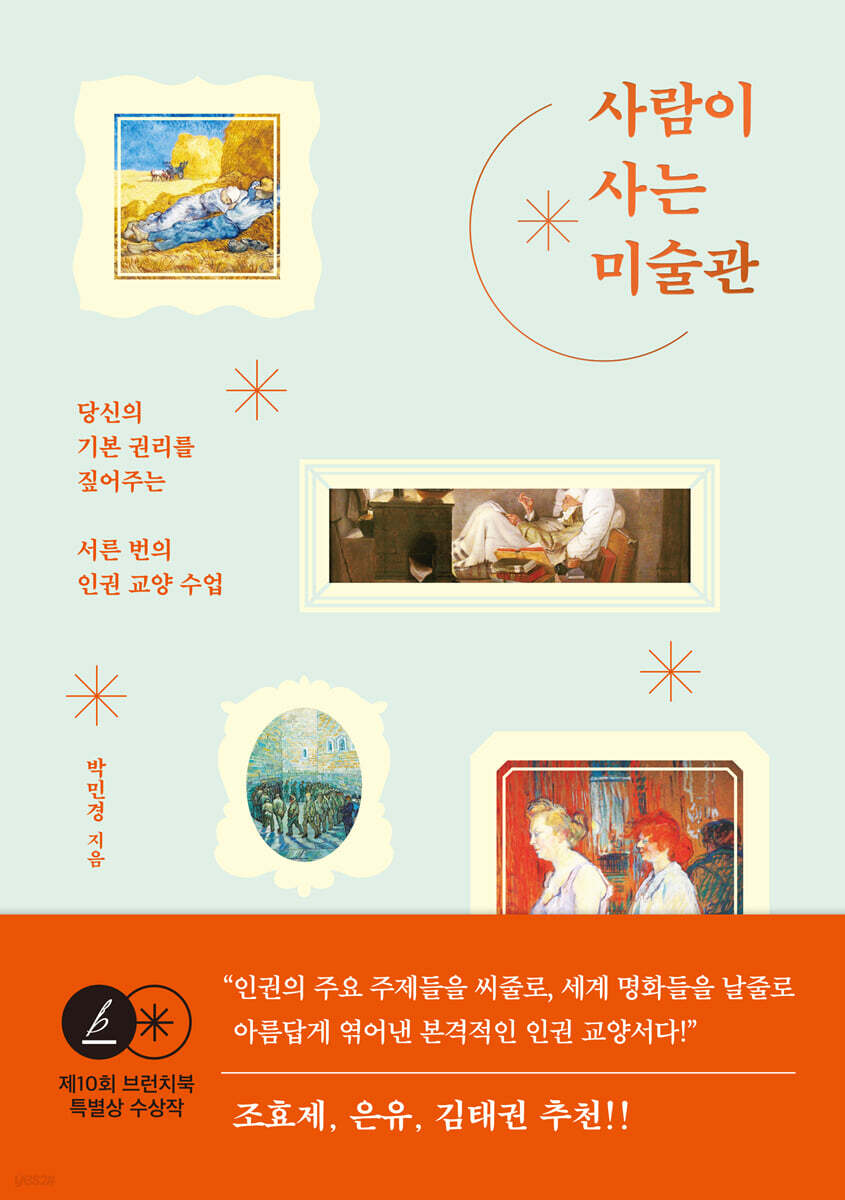
Art museum where people live
 |
Description
Book Introduction
Recommended by Jo Hyo-je, Eun-yu, and Kim Tae-kwon!
The story of a person living in a beautiful painting
“Seeing, reading, and thinking about paintings through the lens of human rights.”
A thorough human rights textbook that carefully examines the basic rights we must respect!
Winners of the 10th Brunch Book Special Award
This is the first human rights textbook published by Park Min-kyung, who has worked for over 15 years as an investigator and administrator at the National Human Rights Commission (hereinafter referred to as the "Human Rights Commission"), as well as in human rights education operations, drawing on her extensive experience.
The 'basic human rights' that we have seen, heard, and experienced in the field at the Human Rights Commission have been explained in an easy and interesting way through the medium of 'drawing'.
By discovering key human rights themes in works by well-known artists like Picasso, Delacroix, and Van Gogh, as well as lesser-known artists at home and abroad, and reading the history, concepts, and related events of human rights within them, we meticulously point out the fundamental rights that must be respected and protected in this society.
『The Art Museum Where People Live』 divides the main concepts of human rights into five broad categories: ‘Women,’ ‘Labor,’ ‘Discrimination and Hatred,’ ‘State,’ and ‘Dignity.’
This film tells the story of how women face great difficulties in a world where the glass ceiling still exists, how the workplace where people work to make a living has become a place where lives are taken, how discrimination develops into hatred and what tragedy that hatred causes, how many human rights violations the state has committed, and finally, why human dignity must be respected. This story is told in an entertaining way through famous paintings.
In addition, a "I'm curious" section is provided at the end of the manuscript to provide detailed explanations of the concepts of human rights and related events mentioned in the text, thereby helping readers think about humanities topics such as history, society, and politics.
The story of a person living in a beautiful painting
“Seeing, reading, and thinking about paintings through the lens of human rights.”
A thorough human rights textbook that carefully examines the basic rights we must respect!
Winners of the 10th Brunch Book Special Award
This is the first human rights textbook published by Park Min-kyung, who has worked for over 15 years as an investigator and administrator at the National Human Rights Commission (hereinafter referred to as the "Human Rights Commission"), as well as in human rights education operations, drawing on her extensive experience.
The 'basic human rights' that we have seen, heard, and experienced in the field at the Human Rights Commission have been explained in an easy and interesting way through the medium of 'drawing'.
By discovering key human rights themes in works by well-known artists like Picasso, Delacroix, and Van Gogh, as well as lesser-known artists at home and abroad, and reading the history, concepts, and related events of human rights within them, we meticulously point out the fundamental rights that must be respected and protected in this society.
『The Art Museum Where People Live』 divides the main concepts of human rights into five broad categories: ‘Women,’ ‘Labor,’ ‘Discrimination and Hatred,’ ‘State,’ and ‘Dignity.’
This film tells the story of how women face great difficulties in a world where the glass ceiling still exists, how the workplace where people work to make a living has become a place where lives are taken, how discrimination develops into hatred and what tragedy that hatred causes, how many human rights violations the state has committed, and finally, why human dignity must be respected. This story is told in an entertaining way through famous paintings.
In addition, a "I'm curious" section is provided at the end of the manuscript to provide detailed explanations of the concepts of human rights and related events mentioned in the text, thereby helping readers think about humanities topics such as history, society, and politics.
- You can preview some of the book's contents.
Preview
index
In publishing the book
Part 1 Women
1 Was she really a serial killer?
[Curious] Witch Hunt | Sexism
2 Who is the corset for?
[Curious] Foot Binding | Violence Against Women | Socially Vulnerable People
3. You must be beautiful even when you die.
[Curious] National Human Rights Commission Petition Concerning Flight Attendant Dress Code | Declaration of Women's Rights
4. The novel "Lady Macbeth of Mtsensk" redrawn
[Curious] The History of Women's Suffrage | Suffrage (Political Rights)
5 The Death of the Little Match Girl
[Curious] Children's Rights | The Flesh-Colored Crayon Case
6 Break the Glass Ceiling
[Curious] Ruth Bader Ginsburg | The Glass Ceiling
Part 2 Labor
1 He is on vacation
[Curious] The Dong-A Ilbo Blank Paper Incident | The Right to Rest
2. History of Human Rights, History of Struggle
[Curious] Jeon Tae-il and the Labor Standards Act | Three Labor Rights
3 Stop being like ramen youth
[Curious] The Screen Door Accident at Seoul's Guui Station and the Taean Thermal Power Plant Accident | Non-Regular Workers
4. Meet the Republic of Korea at Maseok
[Curious] Miners and Nurses Dispatched to Germany | Industrial Accidents
5 Thinking about women's labor
[Curious] International Women's Day | International Labor Organization
6 There is no such thing as insignificant labor.
[I'm curious] Labor rights
Part 3 Discrimination and Hatred
1 Discriminatory perceptions contained in ableist expressions
[Curious] Derogatory and Correct Expressions for People with Disabilities | Exceptions to Discrimination | Discrimination Against People with Disabilities
2 Hatred, Discrimination, and Refugees
[Curious] Syrian Civil War | Holocaust | Imperialism
3 Jesus was also a refugee
[Curious] UNHCR | Refugees
4. The time when discrimination disappears
[Curious] Key Events in the Black Resistance Movement | Racial Discrimination
5 A world where differences greet and face each other
[Curious] Rohingya Genocide | Kwantung Massacre | Pyongyang Chinese Massacre | LGBTQ+ | Protection of Ethnic Minorities
6 The invisible line of discrimination
[Curious] The French Revolution | The Gabo Reforms | Human Dignity and Value
Part 4: The State
1. A drug addict held life and death in his hands.
[Curious] Jeju April 3 Incident | Ideological Conversion System
2. Not all beautiful and brilliant history repeats itself.
[I'm curious] The Spanish Civil War
3. On the obligations that the state must fulfill
[Curious] Disaster and the Right to Safety | The Right to Life
4 A sad law made when the country was weak
[Curious] Rule of Law | People's Revolutionary Party Incident | National Defense Corps Incident | Yushin Constitution
5 Another Ugliness of the Revolution
[Curious] Personal Liberty and Security | Genocide | Declaration of the Rights of Man and the Citizen
6 'Jeongjo' still alive and breathing in the 21st century
[Curious] Japanese Military Comfort Women | UN Human Rights Council
Part 5 Dignity
1. Right to Survive in Heat Waves
[Curious] Climate Crisis and Human Rights | Greta Thunberg | Environmental Rights
2 No one deserves to be hit
[Curious] Children and Adolescents' Right to Life, Survival, and Development | The Best Interests Principle of the Child | The Right to Play
3 War, Peace, and Humanity
[I'm curious] The UN Charter
4. To be able to live with dignity
[Curious] Support for Women in Prostitution | UN Women | Misogyny
5 Even sinners have human rights.
[Curious] Human Rights in Correctional Facilities | Right to Health | Principle of Legality
6 Everyone becomes old
[Curious] Elderly Poverty and Suicide in South Korea | Elderly Human Rights
Universal Declaration of Human Rights
Sources and References
Part 1 Women
1 Was she really a serial killer?
[Curious] Witch Hunt | Sexism
2 Who is the corset for?
[Curious] Foot Binding | Violence Against Women | Socially Vulnerable People
3. You must be beautiful even when you die.
[Curious] National Human Rights Commission Petition Concerning Flight Attendant Dress Code | Declaration of Women's Rights
4. The novel "Lady Macbeth of Mtsensk" redrawn
[Curious] The History of Women's Suffrage | Suffrage (Political Rights)
5 The Death of the Little Match Girl
[Curious] Children's Rights | The Flesh-Colored Crayon Case
6 Break the Glass Ceiling
[Curious] Ruth Bader Ginsburg | The Glass Ceiling
Part 2 Labor
1 He is on vacation
[Curious] The Dong-A Ilbo Blank Paper Incident | The Right to Rest
2. History of Human Rights, History of Struggle
[Curious] Jeon Tae-il and the Labor Standards Act | Three Labor Rights
3 Stop being like ramen youth
[Curious] The Screen Door Accident at Seoul's Guui Station and the Taean Thermal Power Plant Accident | Non-Regular Workers
4. Meet the Republic of Korea at Maseok
[Curious] Miners and Nurses Dispatched to Germany | Industrial Accidents
5 Thinking about women's labor
[Curious] International Women's Day | International Labor Organization
6 There is no such thing as insignificant labor.
[I'm curious] Labor rights
Part 3 Discrimination and Hatred
1 Discriminatory perceptions contained in ableist expressions
[Curious] Derogatory and Correct Expressions for People with Disabilities | Exceptions to Discrimination | Discrimination Against People with Disabilities
2 Hatred, Discrimination, and Refugees
[Curious] Syrian Civil War | Holocaust | Imperialism
3 Jesus was also a refugee
[Curious] UNHCR | Refugees
4. The time when discrimination disappears
[Curious] Key Events in the Black Resistance Movement | Racial Discrimination
5 A world where differences greet and face each other
[Curious] Rohingya Genocide | Kwantung Massacre | Pyongyang Chinese Massacre | LGBTQ+ | Protection of Ethnic Minorities
6 The invisible line of discrimination
[Curious] The French Revolution | The Gabo Reforms | Human Dignity and Value
Part 4: The State
1. A drug addict held life and death in his hands.
[Curious] Jeju April 3 Incident | Ideological Conversion System
2. Not all beautiful and brilliant history repeats itself.
[I'm curious] The Spanish Civil War
3. On the obligations that the state must fulfill
[Curious] Disaster and the Right to Safety | The Right to Life
4 A sad law made when the country was weak
[Curious] Rule of Law | People's Revolutionary Party Incident | National Defense Corps Incident | Yushin Constitution
5 Another Ugliness of the Revolution
[Curious] Personal Liberty and Security | Genocide | Declaration of the Rights of Man and the Citizen
6 'Jeongjo' still alive and breathing in the 21st century
[Curious] Japanese Military Comfort Women | UN Human Rights Council
Part 5 Dignity
1. Right to Survive in Heat Waves
[Curious] Climate Crisis and Human Rights | Greta Thunberg | Environmental Rights
2 No one deserves to be hit
[Curious] Children and Adolescents' Right to Life, Survival, and Development | The Best Interests Principle of the Child | The Right to Play
3 War, Peace, and Humanity
[I'm curious] The UN Charter
4. To be able to live with dignity
[Curious] Support for Women in Prostitution | UN Women | Misogyny
5 Even sinners have human rights.
[Curious] Human Rights in Correctional Facilities | Right to Health | Principle of Legality
6 Everyone becomes old
[Curious] Elderly Poverty and Suicide in South Korea | Elderly Human Rights
Universal Declaration of Human Rights
Sources and References
Detailed image

Into the book
If we look a little closer at the picture, a new scene comes into view.
The dress of a woman who has fainted is undone.
In the left corner, scattered cards are left unused, and the overturned table speaks of the urgency of the scene.
Through the gaping holes in the garment, a corset appears to be very tightly tightened.
A corset is a type of corrective underwear that is worn around the waist and stomach to create a slim waist.
The setting of the painting is the upper class of Europe around the 18th century.
The woman fainted while playing cards because her corset was so tight around her waist.
Imagine sitting upright in tight underwear in a crowded banquet hall, playing cards for hours, or dancing in a ballroom.
Doesn't it feel suffocating just thinking about it?
--- p.22-24
The following painting is of a match girl on the street by Dutch artist Floris Arntzenius (1864-1925).
The girl looks very tired and worn out.
The girl, wearing soiled clothes and leaning on crutches, frowned deeply, her chin buried deep inside her body, whether from the cold or hunger.
Around his neck hangs a basket containing a few matchboxes.
It's quite different from the pretty and slender match girl we see in fairy tales.
Among the illustrations drawn around the 19th century, there are quite a few that feature the Little Match Girl.
Among them, I think this work depicts the Little Match Girl most realistically.
--- p.46
Changes in perceptions of child labor began to emerge around the turn of the 20th century.
Most countries now prohibit child labor.
The International Labor Organization (ILO) prohibits labor of children under the age of 13 and labor that threatens the safety of children.
Article 32 of the UN Convention on the Rights of the Child states that “no child shall be economically exploited and shall be protected from any form of work that is harmful to his or her health, development or education.”
But there are still children forced into forced labor all over the world.
Carpet factories in Pakistan and soccer ball factories in Bangladesh still use child labor to make products.
In Côte d'Ivoire, 15,000 children are sold into slavery on cocoa plantations, working more than 10 hours a day.
In Iraq, it is a reality that children make a living by collecting scrap metal in mine-infested areas.
--- p.52-53
On March 8, 1908, female workers in New York City, USA, began a demonstration to improve labor rights and secure the right to vote, chanting:
“Give us bread and roses!” Here, bread means a fair wage equal to that of men, and roses mean equal rights to participate in politics.
It is said that a now-deceased progressive politician gave roses to female workers every year on March 8th, Women's Day.
It is questionable whether the "bread and roses" that women fought for and fought for more than a century ago are now available to the women of South Korea.
The reality is that countless women are still cradling insufficient bread and withered roses in semiconductor factories, call centers, and supermarkets.
--- p.108
If you go to an art museum, you will see many works depicting splendid kings and nobles, or splendid and solemn gods.
Among them, this picture, which is humorous yet somehow uncomfortable, stands out.
This is a work titled “The Blind Leading the Blind” by Pieter Brueghel the Elder (1525-1569), a 16th-century Flemish genre painter.
The photo shows six people walking in a line, each with a cane, when the man leading them falls.
They say you see as much as you know.
Having worked on human rights issues for a long time, I immediately thought this picture was a picture of a disabled person.
After learning that the title of the piece included a word referring to a visually impaired person, I became even more curious about the story behind this piece.
After searching, I found out that it was a work that used a verse from the Gospel of Matthew as its title and depicted its content exactly as it was.
--- p.120-121
Not so long ago, a massacre similar to the one on the island of Chios was committed in South Korea.
This is the Jeju April 3 Incident.
The brutality of the Jeju April 3 Incident was no less, if not more, than that of the Chios Island incident.
The Jeju April 3 Incident was a massacre that took place over a period of 7 years and 7 months, from 1947 to 1954, after the defeat of Japan and the entry of the US military government into the Korean Peninsula.
In 1947, immediately after liberation, an incident occurred in Jeju, which was politically and economically isolated, where a child was killed by a mounted soldier's horse during a March 1st Independence Movement Day ceremony.
But the police do not apologize for the child's death, and instead open fire on protesting citizens.
This triggered public anger that engulfed Jeju, leading to a general strike.
--- p.182-184
The state has a clear obligation to confirm and guarantee the fundamental rights of its citizens.
Disaster victims should be able to demand their rights.
It wasn't because of the weather that froze the fire hoses, or because my father, who lived in a house owned by a bad person, that I could only watch in amazement as my house burned 40 years ago.
First and foremost, the landlord is at fault for the disaster.
However, if the state fails to address the violation of the people's basic rights and this leads to a bigger accident, the state is also clearly responsible.
In other words, it is clear that the fire department was at fault for allowing the fire hose to freeze.
The people who boarded the grandly named Medusa 200 years ago did nothing wrong.
The ones at fault were the captain who abandoned them and ran away, and the French government, which was unable to take proper action due to corruption and chaos.
--- p.201
Article 23 of the Universal Declaration of Human Rights guarantees freedom of occupation.
However, the first article of the Universal Declaration of Human Rights emphasizes the “dignity of every human being.”
The right to choose one's occupation and the right to dignity are both important rights.
However, Article 30 of the Universal Declaration of Human Rights states that engaging in activities that destroy the rights listed here is not a right.
Human dignity must be given the highest priority in any environment.
And I hope that all members of our society will remember that one of the roles of the state is to protect the dignity of each individual.
If the disabled Lautrec and the prostitutes he depicted had lived in a society where they could secure human dignity, they probably wouldn't have looked so sad.
--- p.262
This is a self-portrait by the 18th-century female painter Anna Dorothea Therbusch (1721-1782).
He looks like he's in his mid-50s.
It is truly remarkable that in the 18th century, when there was strong discrimination and restrictions against women, a female artist portrayed herself in her old age with such grace and dignity.
In fact, it is said that he was a progressive figure who was the first woman to enter the academy.
If you look closely at the picture, several unusual things will catch your eye.
The woman in the painting is wearing glasses, has one leg crossed, and is holding a book in her hand.
Rather than following the image society demanded of women at the time, such as a beautifully made-up appearance or an image overflowing with maternal love, she is staring straight ahead with a confident, intelligent attitude.
Just looking at her, she seems like a cool, cool grandmother.
The dress of a woman who has fainted is undone.
In the left corner, scattered cards are left unused, and the overturned table speaks of the urgency of the scene.
Through the gaping holes in the garment, a corset appears to be very tightly tightened.
A corset is a type of corrective underwear that is worn around the waist and stomach to create a slim waist.
The setting of the painting is the upper class of Europe around the 18th century.
The woman fainted while playing cards because her corset was so tight around her waist.
Imagine sitting upright in tight underwear in a crowded banquet hall, playing cards for hours, or dancing in a ballroom.
Doesn't it feel suffocating just thinking about it?
--- p.22-24
The following painting is of a match girl on the street by Dutch artist Floris Arntzenius (1864-1925).
The girl looks very tired and worn out.
The girl, wearing soiled clothes and leaning on crutches, frowned deeply, her chin buried deep inside her body, whether from the cold or hunger.
Around his neck hangs a basket containing a few matchboxes.
It's quite different from the pretty and slender match girl we see in fairy tales.
Among the illustrations drawn around the 19th century, there are quite a few that feature the Little Match Girl.
Among them, I think this work depicts the Little Match Girl most realistically.
--- p.46
Changes in perceptions of child labor began to emerge around the turn of the 20th century.
Most countries now prohibit child labor.
The International Labor Organization (ILO) prohibits labor of children under the age of 13 and labor that threatens the safety of children.
Article 32 of the UN Convention on the Rights of the Child states that “no child shall be economically exploited and shall be protected from any form of work that is harmful to his or her health, development or education.”
But there are still children forced into forced labor all over the world.
Carpet factories in Pakistan and soccer ball factories in Bangladesh still use child labor to make products.
In Côte d'Ivoire, 15,000 children are sold into slavery on cocoa plantations, working more than 10 hours a day.
In Iraq, it is a reality that children make a living by collecting scrap metal in mine-infested areas.
--- p.52-53
On March 8, 1908, female workers in New York City, USA, began a demonstration to improve labor rights and secure the right to vote, chanting:
“Give us bread and roses!” Here, bread means a fair wage equal to that of men, and roses mean equal rights to participate in politics.
It is said that a now-deceased progressive politician gave roses to female workers every year on March 8th, Women's Day.
It is questionable whether the "bread and roses" that women fought for and fought for more than a century ago are now available to the women of South Korea.
The reality is that countless women are still cradling insufficient bread and withered roses in semiconductor factories, call centers, and supermarkets.
--- p.108
If you go to an art museum, you will see many works depicting splendid kings and nobles, or splendid and solemn gods.
Among them, this picture, which is humorous yet somehow uncomfortable, stands out.
This is a work titled “The Blind Leading the Blind” by Pieter Brueghel the Elder (1525-1569), a 16th-century Flemish genre painter.
The photo shows six people walking in a line, each with a cane, when the man leading them falls.
They say you see as much as you know.
Having worked on human rights issues for a long time, I immediately thought this picture was a picture of a disabled person.
After learning that the title of the piece included a word referring to a visually impaired person, I became even more curious about the story behind this piece.
After searching, I found out that it was a work that used a verse from the Gospel of Matthew as its title and depicted its content exactly as it was.
--- p.120-121
Not so long ago, a massacre similar to the one on the island of Chios was committed in South Korea.
This is the Jeju April 3 Incident.
The brutality of the Jeju April 3 Incident was no less, if not more, than that of the Chios Island incident.
The Jeju April 3 Incident was a massacre that took place over a period of 7 years and 7 months, from 1947 to 1954, after the defeat of Japan and the entry of the US military government into the Korean Peninsula.
In 1947, immediately after liberation, an incident occurred in Jeju, which was politically and economically isolated, where a child was killed by a mounted soldier's horse during a March 1st Independence Movement Day ceremony.
But the police do not apologize for the child's death, and instead open fire on protesting citizens.
This triggered public anger that engulfed Jeju, leading to a general strike.
--- p.182-184
The state has a clear obligation to confirm and guarantee the fundamental rights of its citizens.
Disaster victims should be able to demand their rights.
It wasn't because of the weather that froze the fire hoses, or because my father, who lived in a house owned by a bad person, that I could only watch in amazement as my house burned 40 years ago.
First and foremost, the landlord is at fault for the disaster.
However, if the state fails to address the violation of the people's basic rights and this leads to a bigger accident, the state is also clearly responsible.
In other words, it is clear that the fire department was at fault for allowing the fire hose to freeze.
The people who boarded the grandly named Medusa 200 years ago did nothing wrong.
The ones at fault were the captain who abandoned them and ran away, and the French government, which was unable to take proper action due to corruption and chaos.
--- p.201
Article 23 of the Universal Declaration of Human Rights guarantees freedom of occupation.
However, the first article of the Universal Declaration of Human Rights emphasizes the “dignity of every human being.”
The right to choose one's occupation and the right to dignity are both important rights.
However, Article 30 of the Universal Declaration of Human Rights states that engaging in activities that destroy the rights listed here is not a right.
Human dignity must be given the highest priority in any environment.
And I hope that all members of our society will remember that one of the roles of the state is to protect the dignity of each individual.
If the disabled Lautrec and the prostitutes he depicted had lived in a society where they could secure human dignity, they probably wouldn't have looked so sad.
--- p.262
This is a self-portrait by the 18th-century female painter Anna Dorothea Therbusch (1721-1782).
He looks like he's in his mid-50s.
It is truly remarkable that in the 18th century, when there was strong discrimination and restrictions against women, a female artist portrayed herself in her old age with such grace and dignity.
In fact, it is said that he was a progressive figure who was the first woman to enter the academy.
If you look closely at the picture, several unusual things will catch your eye.
The woman in the painting is wearing glasses, has one leg crossed, and is holding a book in her hand.
Rather than following the image society demanded of women at the time, such as a beautifully made-up appearance or an image overflowing with maternal love, she is staring straight ahead with a confident, intelligent attitude.
Just looking at her, she seems like a cool, cool grandmother.
--- p.277
Publisher's Review
"This is a truly comprehensive human rights textbook, beautifully interweaving key human rights themes with famous paintings." _Professor Cho Hyo-je
“When you resonate with a masterpiece, your fierce feelings of hatred, anger, and discrimination disappear.” _Eunyu Writer
“The concept of human rights seems to have taken root not only in my head but also in my heart.” _Writer Kim Tae-kwon
“From the perspective of a human rights investigator
“See, read, and think about world-famous paintings.”
Including works by Picasso, Delacroix, and Van Gogh
Discover key themes of human rights in the works of lesser-known artists at home and abroad.
By reading the history, concepts, and related events of human rights in it,
A thorough human rights textbook that carefully examines the basic rights we must respect!
Park Min-kyung, who has worked for the National Human Rights Commission of Korea (hereinafter referred to as the “Human Rights Commission”) for over 15 years as an investigator, administrator, and human rights education operator, has published a human rights education book titled “Art Museum Where People Live,” which weaves together major human rights topics as the warp and world-famous paintings as the weft.
This book is a human rights manual with a new perspective, using the medium of 'pictures' to explain the 'basic human rights' that the author has seen, heard, and experienced in the field while at the National Human Rights Commission in an easy and interesting way.
By discovering key human rights themes in works by well-known artists like Picasso, Delacroix, and Van Gogh, as well as lesser-known artists at home and abroad, and reading the history, concepts, and related events of human rights within them, we meticulously point out the fundamental rights that must be respected and protected in this society.
This book is based on the Universal Declaration of Human Rights, a document that has had a profound impact on protecting and respecting human rights around the world.
《The Museum of Human Life》 divides the main concepts of human rights into five broad categories: ‘women,’ ‘labor,’ ‘discrimination and hatred,’ ‘state,’ and ‘dignity.’
It includes essential human rights topics such as children, people with disabilities, refugees, race, genocide, corporal punishment, the climate crisis, war and peace, prisoners, and the elderly.
This film tells the story of how women face great difficulties in a world where the glass ceiling still exists, how the workplace where people work to make a living has become a place where lives are taken, how discrimination develops into hatred and what tragedy that hatred causes, how many human rights violations the state has committed, and finally, why human dignity must be respected. This story is told in an entertaining way through famous paintings.
The masterpieces introduced here are scenes viewed through the lens of human rights rather than aesthetic value, and they provide food for thought through three-dimensional perspectives through dynamic stories intertwined with historical backgrounds, events, and characters.
The author doesn't stop there, but creates a "I'm curious" section at the end of each manuscript, providing detailed explanations of the concepts of human rights and related events mentioned in the text, thereby helping readers think about humanities topics such as history, society, and politics.
Author Park Min-kyung says, “I used to like paintings for their aesthetics, but after working at the National Human Rights Commission, I began to think about the human lives contained within them.”
So, I wanted to introduce famous paintings from around the world that made people think about human rights, and I emphasized that I wanted to explain human rights through pictures in an easy-to-understand way.
Although I am not well-versed in art or have studied human rights academically, it may have been possible because I have worked for a long time as a member of the Human Rights Commission and have heard living voices in the educational field.
Above all, it is noteworthy that this book lectures on the dignity, freedom, political, social, economic, and cultural rights that we must be respected and protected by from the state and society, using world-renowned paintings and real-life examples.
So it's easy, interesting, and fun to read.
"The Art Museum Where People Live" will serve as a valuable guide for young and adult readers living in this era, where the concept of human rights is still unfamiliar, to properly recognize their rights and cultivate a sense of balance.
It will also serve as an optimal educational resource for teachers who wish to foster human rights awareness in their students.
Written based on the Universal Declaration of Human Rights
The story of a person living in a beautiful painting
“Know how to empathize with others and recognize each other’s differences
When we become a society with a strong sense of human rights,
I believe that this can become a ‘world where people can live.’
The Universal Declaration of Human Rights was the first document in which the world agreed to state in writing that all people are free and equal, regardless of their sex, color, creed, religion, or other characteristics.
It consists of 30 articles and serves as the basis for respecting and protecting human rights and freedoms.
The texts set forth here are not without their comprehensiveness, as they have been refined to ensure maximum respect for everyone's rights.
That's why it's not easy to read our actual 'lives' between the lines of the text.
Author Park Min-kyung uses her favorite art as a medium to explain human rights in a way that is more closely related to our lives and is easy and fun to understand.
This book is divided into five parts.
Part 1, “Women,” tells the story of how prejudice against women can have dire consequences through Istvan Zorc’s “The Torture of Countess Bathory.”
In Pietro Longhi's painting "Fainting," we examine the corset, a symbol of violence that forced women to be beautiful, and in Paul Delaroche's "The Execution of Lady Jane Grey," which required women to remain beautiful even in death, we speak frankly about the human rights violations and discrimination committed by the Korean airline family.
On the other hand, we look back on the history of women's suffrage by connecting it with John Singer Sargent's "Ellen Terry as Lady Macbeth," which depicts the image of a dignified woman, and we also find children's rights in Floris Arntgenius's "The Little Match Girl," and the images of strong women who lived their own lives in Honoré Daumier's "Bluestockings" and Artemisia Gentileschi's "Judith Beheading Holofernes."
In Part 2, ‘Labor,’ we look at Vincent van Gogh’s “Noontime Rest” to point out that workers’ right to rest must be guaranteed, and look at Honoré Daumier’s “Insurrection” and Eugène Delacroix’s “Liberty Leading the People: July 28, 1830” to examine why poor women had no choice but to jump into the labor struggle.
Looking at Russian painter Ilya Repin's "Workers on the Volga" and Henry Willis's "The Stonebreaker," he criticizes the unstable working conditions of a young man who died in a screen door accident at Seoul's Guui Station. Looking at portraits of Asians painted during the Renaissance, he points out that even foreigners should not be discriminated against in their work and should be able to enjoy a decent standard of living.
It is a warning that we must not overlook the fact that the establishment of 'International Women's Day' was triggered by the Triangle Shirtwaist Factory fire in 1911, and that behind the beautiful 'Mont Saint-Michel', which took a thousand years to build, the harsh labor of ordinary people was hidden.
In Part 3, “Discrimination and Hatred,” we examine the widespread expressions of disability hatred in our daily lives through 16th-century genre painter Pieter Bruegel’s “The Blind Leading the Blind,” and we are reminded of the Syrian refugee Kurdi through “The Rescue” by Honoré Daumier, a painter who most realistically portrays the lives of ordinary people.
Looking at British artist Ford Maddox Brown's "The Last of England," we look back at the history of the Korean people as refugees and emphasize that there should be no borders in protecting human dignity.
In Klöcker Ehrenstrahl's "The Negro, the Parrot, and the Ape" and William Turner's "The Slave Ship," we look at the human rights and major events of black people, in Yoo Young-ho's "The Greeting Man," we look at the acts of hatred and discrimination against "difference" toward ethnicity, race, and sexual minorities, and in Gustave Courbet's "Hello, Mr. Courbet," we look at the bold crossing of the line of social status from a human rights perspective.
In Part 4, “The State,” the author looks at Eugène Delacroix’s “Massacre at Chios” and recalls the Jeju April 3 Incident, emphasizing that the history of violence must be recorded and remembered so that it is not repeated.
Pablo Picasso's Guernica brought the world to light of the horrific state violence perpetrated by the Franco dictatorship.
Théodore Géricault's "The Raft of the Medusa" is a painting depicting the wreck of the Medusa, which coincidentally overlaps with the Sewol ferry disaster.
While looking at the most famous sculpture, the Dying Lion, in Lucerne, Switzerland, we get a glimpse into the history of our country's mercenaries. In the stained glass on the church wall of a village in Vendée, France, and Jean Souriel's The Battle of Le Mans, we see the ugly massacre of civilians that took place after the French Revolution. While looking at Nicolas Poussin's The Kidnapping of the Sabine Women and Charles Christian Nal's The Rape of the Sabine Women, we continue with a sharp critique of the prejudice and hatred experienced by Kim Hak-soon, a victim of Japanese military sexual slavery.
In Part 5, “Dignity,” we look at Carl Spitzweg’s “The Poor Poet” to see that everyone has the right to health, happiness, and a decent standard of living; we look at Danwon Kim Hong-do’s “Seodang” to see that children and adolescents have the right to be protected from violence and abuse; and we look at Käthe Kollwitz’s “Mothers” to see that the continuation of peace, not war, is the most certain human right that humans can enjoy.
Looking at Henri de Toulouse-Lautrez's "Examination of the Sick," we discuss the importance of individual "dignity" over freedom of occupational choice, and through Vincent van Gogh's "Promenade of the Prisoners," we reflect on the ultimate purpose and reason for existence during the correctional period.
Finally, in Quinten Mathis's "The Ugly Duchess," we read about the hatred and discrimination against old age, and in Anna Dorothea Terbusch's "Self-Portrait with Spectacles," we discover that a graceful and dignified old age is also possible.
Above all, we demand that we view the elderly not simply as ‘objects of charity’ but as ‘parties with rights.’
“When you resonate with a masterpiece, your fierce feelings of hatred, anger, and discrimination disappear.” _Eunyu Writer
“The concept of human rights seems to have taken root not only in my head but also in my heart.” _Writer Kim Tae-kwon
“From the perspective of a human rights investigator
“See, read, and think about world-famous paintings.”
Including works by Picasso, Delacroix, and Van Gogh
Discover key themes of human rights in the works of lesser-known artists at home and abroad.
By reading the history, concepts, and related events of human rights in it,
A thorough human rights textbook that carefully examines the basic rights we must respect!
Park Min-kyung, who has worked for the National Human Rights Commission of Korea (hereinafter referred to as the “Human Rights Commission”) for over 15 years as an investigator, administrator, and human rights education operator, has published a human rights education book titled “Art Museum Where People Live,” which weaves together major human rights topics as the warp and world-famous paintings as the weft.
This book is a human rights manual with a new perspective, using the medium of 'pictures' to explain the 'basic human rights' that the author has seen, heard, and experienced in the field while at the National Human Rights Commission in an easy and interesting way.
By discovering key human rights themes in works by well-known artists like Picasso, Delacroix, and Van Gogh, as well as lesser-known artists at home and abroad, and reading the history, concepts, and related events of human rights within them, we meticulously point out the fundamental rights that must be respected and protected in this society.
This book is based on the Universal Declaration of Human Rights, a document that has had a profound impact on protecting and respecting human rights around the world.
《The Museum of Human Life》 divides the main concepts of human rights into five broad categories: ‘women,’ ‘labor,’ ‘discrimination and hatred,’ ‘state,’ and ‘dignity.’
It includes essential human rights topics such as children, people with disabilities, refugees, race, genocide, corporal punishment, the climate crisis, war and peace, prisoners, and the elderly.
This film tells the story of how women face great difficulties in a world where the glass ceiling still exists, how the workplace where people work to make a living has become a place where lives are taken, how discrimination develops into hatred and what tragedy that hatred causes, how many human rights violations the state has committed, and finally, why human dignity must be respected. This story is told in an entertaining way through famous paintings.
The masterpieces introduced here are scenes viewed through the lens of human rights rather than aesthetic value, and they provide food for thought through three-dimensional perspectives through dynamic stories intertwined with historical backgrounds, events, and characters.
The author doesn't stop there, but creates a "I'm curious" section at the end of each manuscript, providing detailed explanations of the concepts of human rights and related events mentioned in the text, thereby helping readers think about humanities topics such as history, society, and politics.
Author Park Min-kyung says, “I used to like paintings for their aesthetics, but after working at the National Human Rights Commission, I began to think about the human lives contained within them.”
So, I wanted to introduce famous paintings from around the world that made people think about human rights, and I emphasized that I wanted to explain human rights through pictures in an easy-to-understand way.
Although I am not well-versed in art or have studied human rights academically, it may have been possible because I have worked for a long time as a member of the Human Rights Commission and have heard living voices in the educational field.
Above all, it is noteworthy that this book lectures on the dignity, freedom, political, social, economic, and cultural rights that we must be respected and protected by from the state and society, using world-renowned paintings and real-life examples.
So it's easy, interesting, and fun to read.
"The Art Museum Where People Live" will serve as a valuable guide for young and adult readers living in this era, where the concept of human rights is still unfamiliar, to properly recognize their rights and cultivate a sense of balance.
It will also serve as an optimal educational resource for teachers who wish to foster human rights awareness in their students.
Written based on the Universal Declaration of Human Rights
The story of a person living in a beautiful painting
“Know how to empathize with others and recognize each other’s differences
When we become a society with a strong sense of human rights,
I believe that this can become a ‘world where people can live.’
The Universal Declaration of Human Rights was the first document in which the world agreed to state in writing that all people are free and equal, regardless of their sex, color, creed, religion, or other characteristics.
It consists of 30 articles and serves as the basis for respecting and protecting human rights and freedoms.
The texts set forth here are not without their comprehensiveness, as they have been refined to ensure maximum respect for everyone's rights.
That's why it's not easy to read our actual 'lives' between the lines of the text.
Author Park Min-kyung uses her favorite art as a medium to explain human rights in a way that is more closely related to our lives and is easy and fun to understand.
This book is divided into five parts.
Part 1, “Women,” tells the story of how prejudice against women can have dire consequences through Istvan Zorc’s “The Torture of Countess Bathory.”
In Pietro Longhi's painting "Fainting," we examine the corset, a symbol of violence that forced women to be beautiful, and in Paul Delaroche's "The Execution of Lady Jane Grey," which required women to remain beautiful even in death, we speak frankly about the human rights violations and discrimination committed by the Korean airline family.
On the other hand, we look back on the history of women's suffrage by connecting it with John Singer Sargent's "Ellen Terry as Lady Macbeth," which depicts the image of a dignified woman, and we also find children's rights in Floris Arntgenius's "The Little Match Girl," and the images of strong women who lived their own lives in Honoré Daumier's "Bluestockings" and Artemisia Gentileschi's "Judith Beheading Holofernes."
In Part 2, ‘Labor,’ we look at Vincent van Gogh’s “Noontime Rest” to point out that workers’ right to rest must be guaranteed, and look at Honoré Daumier’s “Insurrection” and Eugène Delacroix’s “Liberty Leading the People: July 28, 1830” to examine why poor women had no choice but to jump into the labor struggle.
Looking at Russian painter Ilya Repin's "Workers on the Volga" and Henry Willis's "The Stonebreaker," he criticizes the unstable working conditions of a young man who died in a screen door accident at Seoul's Guui Station. Looking at portraits of Asians painted during the Renaissance, he points out that even foreigners should not be discriminated against in their work and should be able to enjoy a decent standard of living.
It is a warning that we must not overlook the fact that the establishment of 'International Women's Day' was triggered by the Triangle Shirtwaist Factory fire in 1911, and that behind the beautiful 'Mont Saint-Michel', which took a thousand years to build, the harsh labor of ordinary people was hidden.
In Part 3, “Discrimination and Hatred,” we examine the widespread expressions of disability hatred in our daily lives through 16th-century genre painter Pieter Bruegel’s “The Blind Leading the Blind,” and we are reminded of the Syrian refugee Kurdi through “The Rescue” by Honoré Daumier, a painter who most realistically portrays the lives of ordinary people.
Looking at British artist Ford Maddox Brown's "The Last of England," we look back at the history of the Korean people as refugees and emphasize that there should be no borders in protecting human dignity.
In Klöcker Ehrenstrahl's "The Negro, the Parrot, and the Ape" and William Turner's "The Slave Ship," we look at the human rights and major events of black people, in Yoo Young-ho's "The Greeting Man," we look at the acts of hatred and discrimination against "difference" toward ethnicity, race, and sexual minorities, and in Gustave Courbet's "Hello, Mr. Courbet," we look at the bold crossing of the line of social status from a human rights perspective.
In Part 4, “The State,” the author looks at Eugène Delacroix’s “Massacre at Chios” and recalls the Jeju April 3 Incident, emphasizing that the history of violence must be recorded and remembered so that it is not repeated.
Pablo Picasso's Guernica brought the world to light of the horrific state violence perpetrated by the Franco dictatorship.
Théodore Géricault's "The Raft of the Medusa" is a painting depicting the wreck of the Medusa, which coincidentally overlaps with the Sewol ferry disaster.
While looking at the most famous sculpture, the Dying Lion, in Lucerne, Switzerland, we get a glimpse into the history of our country's mercenaries. In the stained glass on the church wall of a village in Vendée, France, and Jean Souriel's The Battle of Le Mans, we see the ugly massacre of civilians that took place after the French Revolution. While looking at Nicolas Poussin's The Kidnapping of the Sabine Women and Charles Christian Nal's The Rape of the Sabine Women, we continue with a sharp critique of the prejudice and hatred experienced by Kim Hak-soon, a victim of Japanese military sexual slavery.
In Part 5, “Dignity,” we look at Carl Spitzweg’s “The Poor Poet” to see that everyone has the right to health, happiness, and a decent standard of living; we look at Danwon Kim Hong-do’s “Seodang” to see that children and adolescents have the right to be protected from violence and abuse; and we look at Käthe Kollwitz’s “Mothers” to see that the continuation of peace, not war, is the most certain human right that humans can enjoy.
Looking at Henri de Toulouse-Lautrez's "Examination of the Sick," we discuss the importance of individual "dignity" over freedom of occupational choice, and through Vincent van Gogh's "Promenade of the Prisoners," we reflect on the ultimate purpose and reason for existence during the correctional period.
Finally, in Quinten Mathis's "The Ugly Duchess," we read about the hatred and discrimination against old age, and in Anna Dorothea Terbusch's "Self-Portrait with Spectacles," we discover that a graceful and dignified old age is also possible.
Above all, we demand that we view the elderly not simply as ‘objects of charity’ but as ‘parties with rights.’
GOODS SPECIFICS
- Date of issue: August 30, 2023
- Page count, weight, size: 300 pages | 512g | 148*210*20mm
- ISBN13: 9791192410197
- ISBN10: 119241019X
You may also like
카테고리
korean


korean

![GQ KOREA Mark (Monthly): December [2025]](http://librairie.coreenne.fr/cdn/shop/files/8ef265dbbfbf186523ed75ba7319009d.jpg?v=1765340328&width=3840)


