

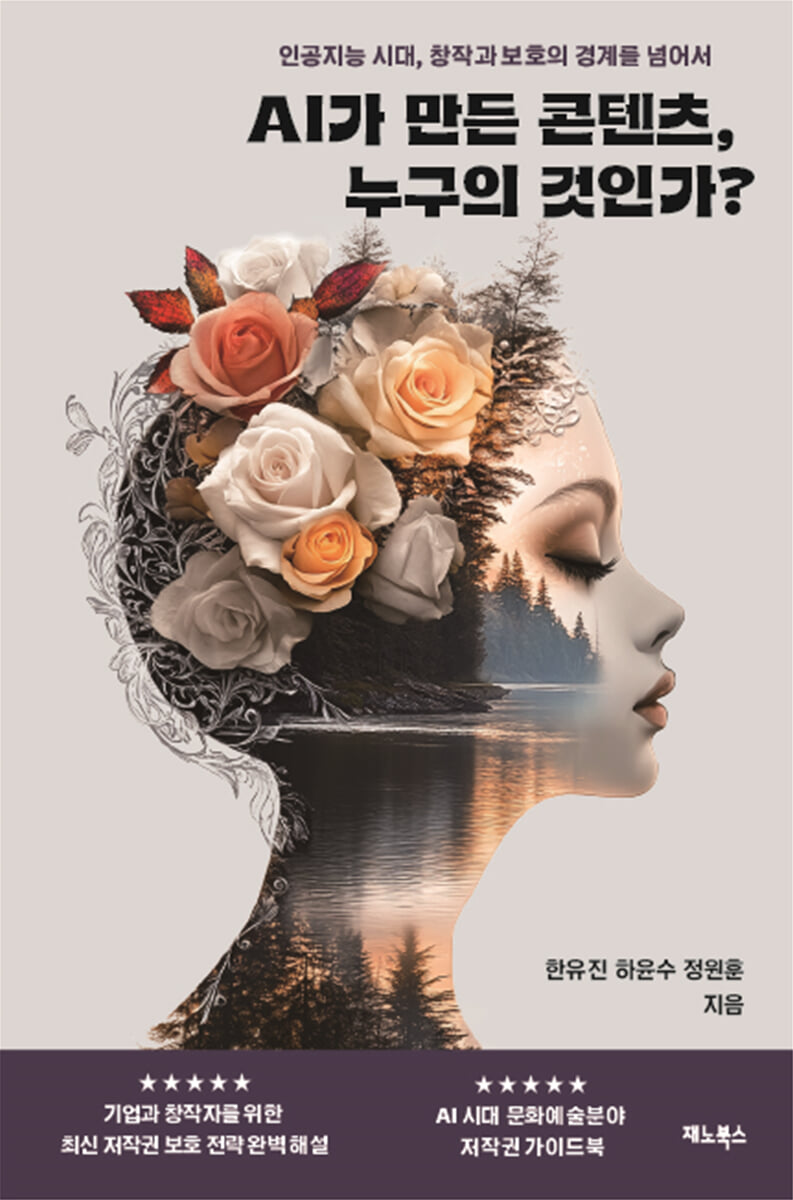
AI-generated content: Who owns it?
 |
Description
Book Introduction
As artificial intelligence revolutionizes the creative field, "AI-Created Content: Who Owns It?" closely analyzes the complex issues arising at the intersection of AI and copyright.
This book illuminates the reality that AI is becoming a driving force in creative processes, necessitating changes to copyright law, and provides essential guidance for creators, lawyers, and technologists alike.
This book illuminates the reality that AI is becoming a driving force in creative processes, necessitating changes to copyright law, and provides essential guidance for creators, lawyers, and technologists alike.
- You can preview some of the book's contents.
Preview
index
prolog
About the author
Part 1: Copyright: Why You Need to Know
Chapter 1: The Concept and Scope of Copyright Protection
① The concept and history of copyright
② To what extent can creative works and ideas be protected?
③ Types and classification of copyright
④ Copyright protection period and application standards
Chapter 2 Why must copyright be protected?
① Cases of inadvertent use of images and copyright infringement
② Things to keep in mind when companies use marketing materials
③ Copyright application method for YouTube and blog content
④ Limitations on the use of copyrighted works and fair use standards
Chapter 3 When my content has been used without permission
① What if the material I created is used without permission?
② Copyright infringement reporting procedures and legal response methods
③ Strategies to prevent disputes and protect creativity
④ Analysis of copyright infringement cases and practical responses
Part 2: How is Copyright Changing in the AI Era? 80
Chapter 4: Copyright Issues with AI-Generated Content 82
① The boundary between AI creations and human creations
② Are there any legal issues with content using AI tools?
③ Actual cases of disputes related to AI copyright
④ Legal measures to prevent copyright infringement in the AI era
Chapter 5: AI Copyright Risks Companies Should Be Aware of? 104
① Things to keep in mind when companies utilize AI
② Can automatically generated content be legally protected?
③ Legal Issues and Response Measures for AI-Based Content
④ AI content copyright protection and corporate response strategies
Part 3: Blockchain, Metaverse, and Copyright
Chapter 6: Strategies for Copyright Protection in the AI Era
① How companies and individuals protect copyright
② Copyright laws changing with the development of AI technology
③ Future copyright system and new regulatory direction
④ Technical responses and regulatory measures for AI copyright protection
Chapter 7: Blockchain Technology and Copyright Protection
① The impact of NFTs on copyright protection
② Blockchain technology and copyright protection
③ Smart contracts and copyright protection
④ How to Use Blockchain to Prevent Copyright Infringement
Chapter 8: Copyright Issues in the Metaverse Era
① Concept and characteristics of metaverse and copyright
② How is the copyright of creative works recognized in virtual space?
③ Legal protection of game items and digital avatars
④ Copyright protection and legal issues of metaverse content
Part 4: A Practical Guide to Digital Content Protection 188
Chapter 9: Copyright Protection Strategies for Businesses and Individuals? 190
① Practices to prevent copyright infringement
② How to Protect Your Content: Using Watermarks, Blockchain, and Licenses
③ Things to consider when using free images and free music
④ Strategy for protecting and utilizing secondary works
Chapter 10: Copyright Dispute Cases and Resolution Methods? 208
① Case of copyright dispute experienced by a famous company
② Analysis of legal issues for creators and startups
③ Successful copyright protection strategies and lessons learned
④ Practical Guide for Legal Response and Copyright Protection
About the author
Part 1: Copyright: Why You Need to Know
Chapter 1: The Concept and Scope of Copyright Protection
① The concept and history of copyright
② To what extent can creative works and ideas be protected?
③ Types and classification of copyright
④ Copyright protection period and application standards
Chapter 2 Why must copyright be protected?
① Cases of inadvertent use of images and copyright infringement
② Things to keep in mind when companies use marketing materials
③ Copyright application method for YouTube and blog content
④ Limitations on the use of copyrighted works and fair use standards
Chapter 3 When my content has been used without permission
① What if the material I created is used without permission?
② Copyright infringement reporting procedures and legal response methods
③ Strategies to prevent disputes and protect creativity
④ Analysis of copyright infringement cases and practical responses
Part 2: How is Copyright Changing in the AI Era? 80
Chapter 4: Copyright Issues with AI-Generated Content 82
① The boundary between AI creations and human creations
② Are there any legal issues with content using AI tools?
③ Actual cases of disputes related to AI copyright
④ Legal measures to prevent copyright infringement in the AI era
Chapter 5: AI Copyright Risks Companies Should Be Aware of? 104
① Things to keep in mind when companies utilize AI
② Can automatically generated content be legally protected?
③ Legal Issues and Response Measures for AI-Based Content
④ AI content copyright protection and corporate response strategies
Part 3: Blockchain, Metaverse, and Copyright
Chapter 6: Strategies for Copyright Protection in the AI Era
① How companies and individuals protect copyright
② Copyright laws changing with the development of AI technology
③ Future copyright system and new regulatory direction
④ Technical responses and regulatory measures for AI copyright protection
Chapter 7: Blockchain Technology and Copyright Protection
① The impact of NFTs on copyright protection
② Blockchain technology and copyright protection
③ Smart contracts and copyright protection
④ How to Use Blockchain to Prevent Copyright Infringement
Chapter 8: Copyright Issues in the Metaverse Era
① Concept and characteristics of metaverse and copyright
② How is the copyright of creative works recognized in virtual space?
③ Legal protection of game items and digital avatars
④ Copyright protection and legal issues of metaverse content
Part 4: A Practical Guide to Digital Content Protection 188
Chapter 9: Copyright Protection Strategies for Businesses and Individuals? 190
① Practices to prevent copyright infringement
② How to Protect Your Content: Using Watermarks, Blockchain, and Licenses
③ Things to consider when using free images and free music
④ Strategy for protecting and utilizing secondary works
Chapter 10: Copyright Dispute Cases and Resolution Methods? 208
① Case of copyright dispute experienced by a famous company
② Analysis of legal issues for creators and startups
③ Successful copyright protection strategies and lessons learned
④ Practical Guide for Legal Response and Copyright Protection
Detailed image

Into the book
Copyright is the exclusive right that a creator has over his or her creative work, and legally protects the originality and expression of the work.
Its purpose is to guarantee economic benefits and rights to creators, promote creative activities, and contribute to cultural development.
--- p.33
The main elements of copyright are divided into moral rights, copyright property rights, copyright transfer and permission to use, and neighboring rights, and the concepts and roles of each are explained.
--- p.57
Chapter 3, “Deepening Copyright Legal Relationships,” covers advanced legal relationships such as copyright attribution, contracts, and the international system.
This chapter explores practical solutions to problems through case studies, including works made for hire, commissioned works, and the international copyright protection system.
--- p.78
This chapter systematically examines various types of copyright infringement and their remedies, and particularly explores solutions to new problems arising in the digital environment and AI era.
Achieving a balance between protecting creators' rights and ensuring fair use will be an important task, while responding to new types of infringement that arise as technological advancements develop in the future.
--- p.103
The cultural industry includes industrial activities related to the entire process from planning to consumption of cultural products.
To promote this, we operate systems such as fund raising, tax support, and training of professional personnel, while at the same time promoting sound development through classification of grades and content regulations.
Especially as new forms of cultural industries emerge in the digital environment, a balanced approach to promotion and regulation becomes increasingly important.
Its purpose is to guarantee economic benefits and rights to creators, promote creative activities, and contribute to cultural development.
--- p.33
The main elements of copyright are divided into moral rights, copyright property rights, copyright transfer and permission to use, and neighboring rights, and the concepts and roles of each are explained.
--- p.57
Chapter 3, “Deepening Copyright Legal Relationships,” covers advanced legal relationships such as copyright attribution, contracts, and the international system.
This chapter explores practical solutions to problems through case studies, including works made for hire, commissioned works, and the international copyright protection system.
--- p.78
This chapter systematically examines various types of copyright infringement and their remedies, and particularly explores solutions to new problems arising in the digital environment and AI era.
Achieving a balance between protecting creators' rights and ensuring fair use will be an important task, while responding to new types of infringement that arise as technological advancements develop in the future.
--- p.103
The cultural industry includes industrial activities related to the entire process from planning to consumption of cultural products.
To promote this, we operate systems such as fund raising, tax support, and training of professional personnel, while at the same time promoting sound development through classification of grades and content regulations.
Especially as new forms of cultural industries emerge in the digital environment, a balanced approach to promotion and regulation becomes increasingly important.
--- p.121
Publisher's Review
As artificial intelligence (AI) emerges as a creative force, copyright law faces unprecedented challenges.
This book, "AI-Generated Content: Who Owns It?", delves into this revolutionary shift.
Authors Han Yu-jin, Ha Yun-su, and Jeong Won-hun provide clear guidance for lawyers, engineers, and creators on how to navigate this new environment.
This work consists of four main parts:
Understanding Copyright Fundamentals: Covers the basic concepts of copyright and highlights why copyright is important.
Copyright Issues in the AI Era: An in-depth analysis of the complex legal issues surrounding ownership of AI-generated content.
Converging Technology and Copyright: Exploring how emerging technologies, including blockchain and the metaverse, impact copyright protection.
A Practical Guide: Provides concrete strategies for protecting copyright using modern technology.
"AI-Generated Content: Who Owns It?" is an essential reference for creators, legal professionals, and technology developers in the digital age.
This book is essential for understanding how advances in AI technology are redefining the boundaries between creation and copyright, and will provide practical assistance to those seeking to protect their creations through this shift.
This book will serve as a valuable guide in preparing for the future of the evolving content industry.
Part 1, “Copyright: Why You Must Know It,” explains the basic concepts and scope of copyright protection.
It covers the basics of copyright, including its history, classification, and protection period, and emphasizes the importance of copyright by detailing various cases where copyright infringement can occur in the real world and the legal actions taken accordingly.
Part 2, "How is Copyright Changing in the AI Era?" focuses on the copyright issues that arise when AI creates creative works. Through discussions of copyright ownership and legal issues surrounding AI-generated content, as well as real-world dispute cases, this book provides an in-depth discussion of copyright issues in the AI era.
Part 3, "Blockchain, Metaverse, and Copyright," delves deeper into the ownership issue of AI content, exploring how AI creations can be protected under copyright law and what technological protection methods are available.
Part 4, "A Practical Guide to Digital Content Protection," presents copyright protection strategies utilizing modern technology.
We explain how to effectively manage and protect copyright using blockchain, NFTs, and AI-based copyright infringement detection systems.
This book is an essential reference for all creators and legal professionals living in the digital age. It provides concrete and practical guidance for understanding copyright in the AI era and protecting your own creative work.
Now, find the answer to how to prepare for the future content industry through this book.
This book, "AI-Generated Content: Who Owns It?", delves into this revolutionary shift.
Authors Han Yu-jin, Ha Yun-su, and Jeong Won-hun provide clear guidance for lawyers, engineers, and creators on how to navigate this new environment.
This work consists of four main parts:
Understanding Copyright Fundamentals: Covers the basic concepts of copyright and highlights why copyright is important.
Copyright Issues in the AI Era: An in-depth analysis of the complex legal issues surrounding ownership of AI-generated content.
Converging Technology and Copyright: Exploring how emerging technologies, including blockchain and the metaverse, impact copyright protection.
A Practical Guide: Provides concrete strategies for protecting copyright using modern technology.
"AI-Generated Content: Who Owns It?" is an essential reference for creators, legal professionals, and technology developers in the digital age.
This book is essential for understanding how advances in AI technology are redefining the boundaries between creation and copyright, and will provide practical assistance to those seeking to protect their creations through this shift.
This book will serve as a valuable guide in preparing for the future of the evolving content industry.
Part 1, “Copyright: Why You Must Know It,” explains the basic concepts and scope of copyright protection.
It covers the basics of copyright, including its history, classification, and protection period, and emphasizes the importance of copyright by detailing various cases where copyright infringement can occur in the real world and the legal actions taken accordingly.
Part 2, "How is Copyright Changing in the AI Era?" focuses on the copyright issues that arise when AI creates creative works. Through discussions of copyright ownership and legal issues surrounding AI-generated content, as well as real-world dispute cases, this book provides an in-depth discussion of copyright issues in the AI era.
Part 3, "Blockchain, Metaverse, and Copyright," delves deeper into the ownership issue of AI content, exploring how AI creations can be protected under copyright law and what technological protection methods are available.
Part 4, "A Practical Guide to Digital Content Protection," presents copyright protection strategies utilizing modern technology.
We explain how to effectively manage and protect copyright using blockchain, NFTs, and AI-based copyright infringement detection systems.
This book is an essential reference for all creators and legal professionals living in the digital age. It provides concrete and practical guidance for understanding copyright in the AI era and protecting your own creative work.
Now, find the answer to how to prepare for the future content industry through this book.
GOODS SPECIFICS
- Date of issue: February 22, 2025
- Page count, weight, size: 248 pages | 152*225*20mm
- ISBN13: 9791193297735
- ISBN10: 1193297737
You may also like
카테고리
korean


korean

![GQ KOREA Mark (Monthly): December [2025]](http://librairie.coreenne.fr/cdn/shop/files/8ef265dbbfbf186523ed75ba7319009d.jpg?v=1765340328&width=3840)


