

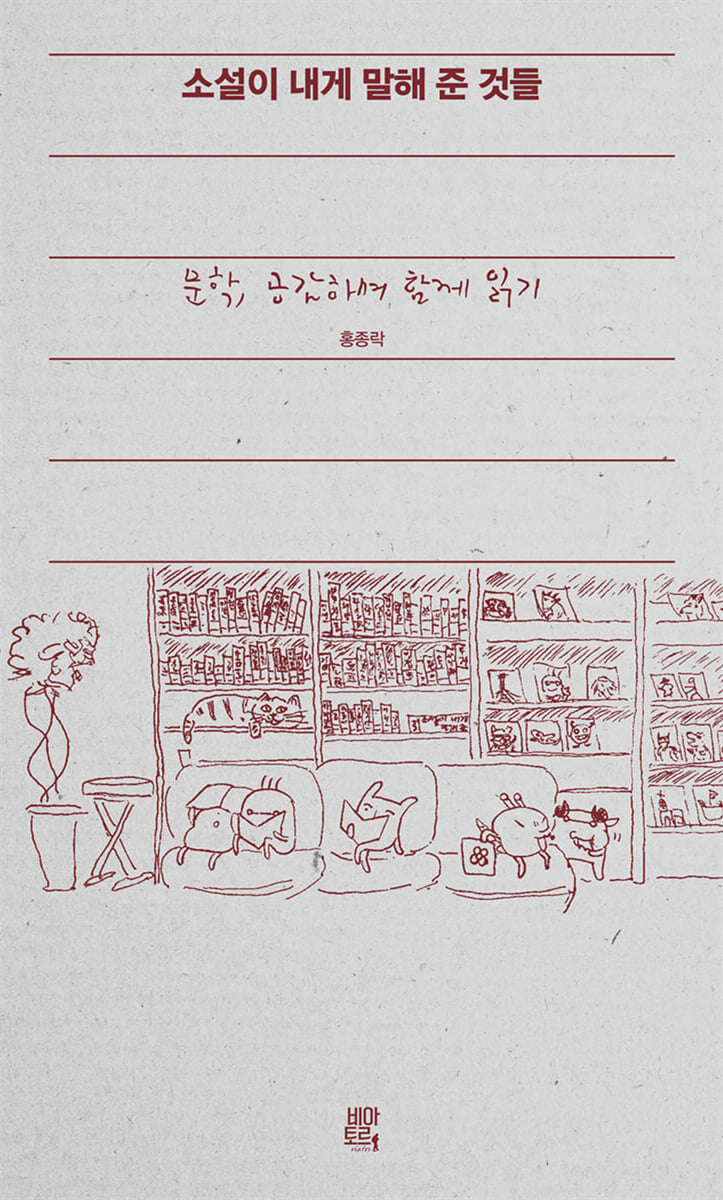
What the novel told me
 |
Description
Book Introduction
The novel ultimately brings us before God!
_Truth in Fiction and the Meaning of Life in Truth as Seen in 15 Literary Works
『What Novels Told Me』 is a new work by translator Hong Jong-rak, who has translated around 150 English books into Korean over the past 20 years. It unfolds the questions and insights about life and faith he discovered in 15 literary works, including 『The Brothers Karamazo』, 『The Hobbit』, 『Housekeeping』, and 『The Freezing Point』.
Following his previous work, What the Devil's Eyes Show, this work contains deep insights and religious messages drawn from literature, especially novels.
Every morning, the author goes to his desk in one corner of his house and begins his translation work.
My eyes are getting blurry and I'm getting more tired, so I decide not to read anything today, but I can't give up the joy and comfort that comes from reading for fun, not for a living, so I start reading again.
There are times when I can't remember what I read, like water draining from a bean sprout steamer, but I keep reading, just like when I eat, I get hungry, and when I get hungry, I eat again.
And if there's something I really want to remember or need to remember, I write it down.
This book is the fruit of such daily life.
_Truth in Fiction and the Meaning of Life in Truth as Seen in 15 Literary Works
『What Novels Told Me』 is a new work by translator Hong Jong-rak, who has translated around 150 English books into Korean over the past 20 years. It unfolds the questions and insights about life and faith he discovered in 15 literary works, including 『The Brothers Karamazo』, 『The Hobbit』, 『Housekeeping』, and 『The Freezing Point』.
Following his previous work, What the Devil's Eyes Show, this work contains deep insights and religious messages drawn from literature, especially novels.
Every morning, the author goes to his desk in one corner of his house and begins his translation work.
My eyes are getting blurry and I'm getting more tired, so I decide not to read anything today, but I can't give up the joy and comfort that comes from reading for fun, not for a living, so I start reading again.
There are times when I can't remember what I read, like water draining from a bean sprout steamer, but I keep reading, just like when I eat, I get hungry, and when I get hungry, I eat again.
And if there's something I really want to remember or need to remember, I write it down.
This book is the fruit of such daily life.
index
Introduction_ Novels won't feed you, but
01 A Root of Waves _『The Brothers Karamazov』
02 Alyosa VS.
Smerdyakov _The Brothers Karamazov
03 The Path of the Grand Inquisitor _ The Brothers Karamazov
04 On Being Lucky _『The Hobbit』
05 What's More Important Than Home _ "Housekeeping"
06 On the Failure of Family Education for Believers _『Home』
07 The Path to Trust _『Lyla』
08 Fear, Revenge, and the Testimony of Faith _ Harry Potter
09 An Evening with the Blind _『Cathedral』
10 How to Use Shelter _ "The Lord is My Shelter"
11 Cheers to Yoko _『Freezing Point』
12 If there is someone _『Freezing point in the stomach』
13 Memoirs, Prequels, and Invitations _『The Place Where Light Shines』
14 Living as You Are _Jane Eyre
15 Idols and Gifts _Jane Eyre
16 Place in English Literature _ 『Stoner』
17 What Hunger and Gluttony Tell Us _『What Love Did』
18 Portrait of a Partisan Father _ 『Father's Liberation Diary』
01 A Root of Waves _『The Brothers Karamazov』
02 Alyosa VS.
Smerdyakov _The Brothers Karamazov
03 The Path of the Grand Inquisitor _ The Brothers Karamazov
04 On Being Lucky _『The Hobbit』
05 What's More Important Than Home _ "Housekeeping"
06 On the Failure of Family Education for Believers _『Home』
07 The Path to Trust _『Lyla』
08 Fear, Revenge, and the Testimony of Faith _ Harry Potter
09 An Evening with the Blind _『Cathedral』
10 How to Use Shelter _ "The Lord is My Shelter"
11 Cheers to Yoko _『Freezing Point』
12 If there is someone _『Freezing point in the stomach』
13 Memoirs, Prequels, and Invitations _『The Place Where Light Shines』
14 Living as You Are _Jane Eyre
15 Idols and Gifts _Jane Eyre
16 Place in English Literature _ 『Stoner』
17 What Hunger and Gluttony Tell Us _『What Love Did』
18 Portrait of a Partisan Father _ 『Father's Liberation Diary』
Into the book
The metaphor of a single scallion that holds Alyosha up is also meaningful to me.
First, it helps you relax your shoulders a bit.
It frees you from the illusion that you are doing something great and takes the pressure off of having to do something great.
At the same time, this metaphor makes me hope:
I wish my life, my translations, this writing, everything I do were just a single wave of a wave.
Then, even if it is a very small thing, it could be something He has entrusted to us and could become a delicate channel of grace.
--- p.28
This novel reminds us that we live in an unstable world, that we are just temporary 'travelers'.
The thoughts, memories, and imaginations that the wandering Ruth unfolds are content that most Christians can accept as is.
What does the biblical teaching that Christians are pilgrims in this world mean for our specific life choices? Is it truly meaningless?
Lucille, who left home and family to find her new mother in order to become like everyone else, and her aunt and Ruth, who left home to be together.
Both sides give up something big to gain and keep something precious.
Both had something to gain and something to lose from that difficult choice.
Housekeeping is a story about people who knew exactly what they wanted and chose it.
What do I want, and what do I have to give up to get it or keep it? This book asks me that.
--- pp.101-102
I've often thought how wonderful it would be if faith were something obvious and visible to everyone, something that could be put out there and said, "Okay, this is it."
This is a thought I had when I was going through a period of doubt in my faith, and it is a regret that still comes to mind when I think of the people around me.
If the supernatural is truly the "true reality" that underpins the natural world and gives it meaning, why shouldn't that fact be more evident? The question arises: shouldn't there be evidence that everyone can readily acknowledge?
Such evidence might include miracles, the existence of faithful witnesses, and logical proof.
Among them, what I was mainly interested in and hoped to find was an irrefutable logical proof.
How nice it would be if there was such evidence.
--- p.161
It is surprising that, just as people's personalities are diverse, among the many people we meet, we are particularly drawn to the words and actions of some people and are influenced and moved by them.
It is usually easy to learn from bad things, but it is a mysterious thing that we also see and emulate truthful, good, and sacrificial behavior.
The growth and change Jane demonstrates makes us look forward to such open eyes and listening ears.
We also want good things to look good and precious things to come across as precious.
So I hope we don't just live the way things are.
I seek that kind of grace.
First, it helps you relax your shoulders a bit.
It frees you from the illusion that you are doing something great and takes the pressure off of having to do something great.
At the same time, this metaphor makes me hope:
I wish my life, my translations, this writing, everything I do were just a single wave of a wave.
Then, even if it is a very small thing, it could be something He has entrusted to us and could become a delicate channel of grace.
--- p.28
This novel reminds us that we live in an unstable world, that we are just temporary 'travelers'.
The thoughts, memories, and imaginations that the wandering Ruth unfolds are content that most Christians can accept as is.
What does the biblical teaching that Christians are pilgrims in this world mean for our specific life choices? Is it truly meaningless?
Lucille, who left home and family to find her new mother in order to become like everyone else, and her aunt and Ruth, who left home to be together.
Both sides give up something big to gain and keep something precious.
Both had something to gain and something to lose from that difficult choice.
Housekeeping is a story about people who knew exactly what they wanted and chose it.
What do I want, and what do I have to give up to get it or keep it? This book asks me that.
--- pp.101-102
I've often thought how wonderful it would be if faith were something obvious and visible to everyone, something that could be put out there and said, "Okay, this is it."
This is a thought I had when I was going through a period of doubt in my faith, and it is a regret that still comes to mind when I think of the people around me.
If the supernatural is truly the "true reality" that underpins the natural world and gives it meaning, why shouldn't that fact be more evident? The question arises: shouldn't there be evidence that everyone can readily acknowledge?
Such evidence might include miracles, the existence of faithful witnesses, and logical proof.
Among them, what I was mainly interested in and hoped to find was an irrefutable logical proof.
How nice it would be if there was such evidence.
--- p.161
It is surprising that, just as people's personalities are diverse, among the many people we meet, we are particularly drawn to the words and actions of some people and are influenced and moved by them.
It is usually easy to learn from bad things, but it is a mysterious thing that we also see and emulate truthful, good, and sacrificial behavior.
The growth and change Jane demonstrates makes us look forward to such open eyes and listening ears.
We also want good things to look good and precious things to come across as precious.
So I hope we don't just live the way things are.
I seek that kind of grace.
--- p.271
Publisher's Review
The author says that the novel has four characteristics in particular.
'First, even if a novel is fiction, its material is largely a reconstruction or combination of things the author experienced directly or indirectly.
Second, a good novel contains truth, a true message, even if it is not factual.
Third, novels reveal the reality of human beings.
Fourth, because a novel is not the story of a real person, it can actually become everyone's story.
Although the novel is clothed in the garb of fiction, it is filled with real experiences and memories.
Most of them are woven from the author's own experiences, stories he heard from those around him, and the atmosphere of the times.
Even true-story genres like memoirs and biographies do not simply convey facts as they are, but rather create new meaning through selection, emphasis, and omission. Just as novels offer another path toward truth,
This book demonstrates how these novels expose human desires for what they are, reveal their imitative nature, and lead readers to meaningful insights into God, the world, and humanity.
So how should we read a novel? When we realize that the characters' stories connect with our own lives, readers will find inspiration, comfort, reflection, and enlightenment.
What is needed is ‘empathy’ so that ‘his’ story becomes ‘my’ story.
By following the author's gaze and eavesdropping on the stories told by great writers such as Dostoevsky, Tolkien, Marilynne Robinson, and Ayako Miura, and participating in their conversations, I hope that our thoughts, feelings, and lives will be enriched, even if only a little.
“Through the works of various authors from different eras and backgrounds, I was able to think deeply and learn about humanity and life, various values and choices, and the issues of God and faith.” _From the preface
'First, even if a novel is fiction, its material is largely a reconstruction or combination of things the author experienced directly or indirectly.
Second, a good novel contains truth, a true message, even if it is not factual.
Third, novels reveal the reality of human beings.
Fourth, because a novel is not the story of a real person, it can actually become everyone's story.
Although the novel is clothed in the garb of fiction, it is filled with real experiences and memories.
Most of them are woven from the author's own experiences, stories he heard from those around him, and the atmosphere of the times.
Even true-story genres like memoirs and biographies do not simply convey facts as they are, but rather create new meaning through selection, emphasis, and omission. Just as novels offer another path toward truth,
This book demonstrates how these novels expose human desires for what they are, reveal their imitative nature, and lead readers to meaningful insights into God, the world, and humanity.
So how should we read a novel? When we realize that the characters' stories connect with our own lives, readers will find inspiration, comfort, reflection, and enlightenment.
What is needed is ‘empathy’ so that ‘his’ story becomes ‘my’ story.
By following the author's gaze and eavesdropping on the stories told by great writers such as Dostoevsky, Tolkien, Marilynne Robinson, and Ayako Miura, and participating in their conversations, I hope that our thoughts, feelings, and lives will be enriched, even if only a little.
“Through the works of various authors from different eras and backgrounds, I was able to think deeply and learn about humanity and life, various values and choices, and the issues of God and faith.” _From the preface
GOODS SPECIFICS
- Date of issue: September 29, 2025
- Page count, weight, size: 350 pages | 458g | 134*220*21mm
- ISBN13: 9791194216254
- ISBN10: 1194216250
You may also like
카테고리
korean


korean

![ELLE 엘르 스페셜 에디션 A형 : 12월 [2025]](http://librairie.coreenne.fr/cdn/shop/files/b8e27a3de6c9538896439686c6b0e8fb.jpg?v=1766436872&width=3840)


