

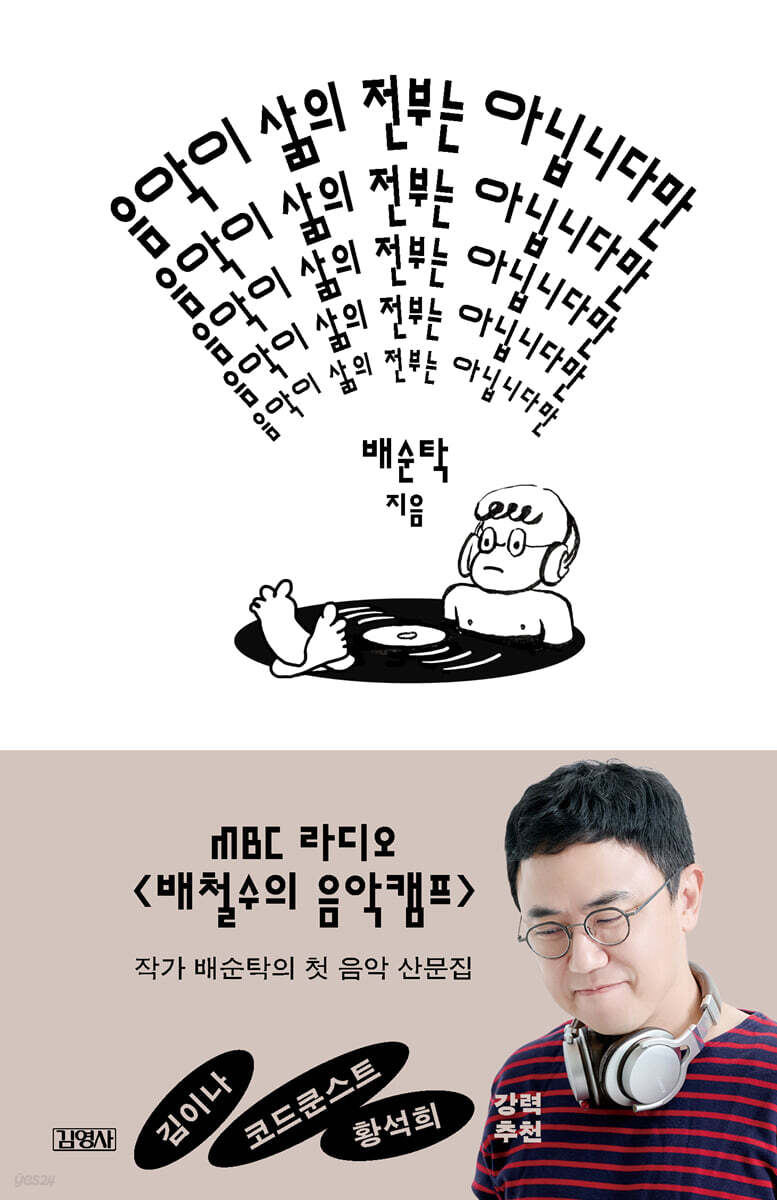
Music isn't everything in life
 |
Description
Book Introduction
The first music essay collection by Bae Soon-tak, writer for MBC Radio's "Bae Cheol-soo's Music Camp."
From Queen, Michael Jackson, and Bruno Mars to N.E.X.T., Red Velvet, and Lee Chan-hyuk
Playing with people, life, and the world contained in over 100 songs and albums
Highly recommended by lyricist Kim Ina, producer Code Kunst, and translator Hwang Seok-hee.
Writer Bae Soon-tak, for whom music is "almost" everything, has published a book titled "Music Isn't Everything in Life," which tells the story of us, who cannot survive without music, and of a world permeated by it. This is his first collection of music essays, having worked as a writer for MBC's long-running radio program "Bae Cheol-soo's Music Camp" for nearly 18 years, transcending genre boundaries and connecting with audiences across generations, from K-pop to rock and pop classics.
It delicately captures the story of a musician and the breath of the times contained in a single line of lyrics, leading us into the world of music.
For writer Bae Soon-tak, music is a language that interprets life and a coordinate system for reading humanity and the world.
Having shared magical stories about music through various media, including broadcasts, lectures, and columns, he shows in this book that listening to music is a process of empathy that transcends the boundaries of "me", encounters others, and ultimately becomes "us."
Through over 100 albums and songs, author Bae Soon-tak asks us, "How should we live?"
His accumulated experience through music goes beyond simply explaining music.
As the record of living a life dependent on music piled up, that playlist soon became an archive of a person's life.
As you read "Music Isn't Everything in Life," you will realize that too.
The moment when the story in the playlist becomes your own story.
From Queen, Michael Jackson, and Bruno Mars to N.E.X.T., Red Velvet, and Lee Chan-hyuk
Playing with people, life, and the world contained in over 100 songs and albums
Highly recommended by lyricist Kim Ina, producer Code Kunst, and translator Hwang Seok-hee.
Writer Bae Soon-tak, for whom music is "almost" everything, has published a book titled "Music Isn't Everything in Life," which tells the story of us, who cannot survive without music, and of a world permeated by it. This is his first collection of music essays, having worked as a writer for MBC's long-running radio program "Bae Cheol-soo's Music Camp" for nearly 18 years, transcending genre boundaries and connecting with audiences across generations, from K-pop to rock and pop classics.
It delicately captures the story of a musician and the breath of the times contained in a single line of lyrics, leading us into the world of music.
For writer Bae Soon-tak, music is a language that interprets life and a coordinate system for reading humanity and the world.
Having shared magical stories about music through various media, including broadcasts, lectures, and columns, he shows in this book that listening to music is a process of empathy that transcends the boundaries of "me", encounters others, and ultimately becomes "us."
Through over 100 albums and songs, author Bae Soon-tak asks us, "How should we live?"
His accumulated experience through music goes beyond simply explaining music.
As the record of living a life dependent on music piled up, that playlist soon became an archive of a person's life.
As you read "Music Isn't Everything in Life," you will realize that too.
The moment when the story in the playlist becomes your own story.
- You can preview some of the book's contents.
Preview
index
Introduction: Music changes people, music changes the world.
Chapter 1: Music Stories You Never Knew
How did a song criticizing materialism become synonymous with romance?: The Eagles' "Hotel California"
- It's not a love song, it's a creepy stalker song: The Police's "Every Breath You Take"
- George Orwell's "1984," and a song inspired by casino gambling: Alan Parsons Project's "Eye in the Sky"
- A captivating spell that captivates people: Culture Club's "Karma Chameleon"
- Queen, Abba, and Led Zeppelin all suffered from harsh criticism: Led Zeppelin
- A love song without a plan: Bruno Mars' "Marry You"
- Soccer player Sonny's cheer song, which contains a strong critical consciousness toward war: The Cranberries' "Zombie"
- Let's correct the misinterpretation.
- A 'brain official' exclusive to Korea: Paul McCartney, Europe's "The Final Countdown"
- It's okay if you don't know, but it's more fun if you know English expressions in hit pop music.
Chapter 2: How to Change Without Losing Your Center
- Beautiful melodrama, sacred popular culture: Kim Yuna's "Glass Mask"
- Musical magic that unlocks your inner lock: Radiohead's "In Rainbows"
- If you want to catch both rabbits: universality and individuality: Red Velvet's "Perfect Velvet"
- Music like a snapshot: Woohyo's "Girl's Emotion" "Dandelion"
- Art for Others, Born from a Devastating Egoist: Black Skirt's "TEEN TROUBLES"
- A melancholy that builds up little by little and is not boring: Epik High's "Shoebox"
- Secular hymns or sacred popular songs: Lee Seung-yeol's "SYX"
- Elite musician and street musician: John Batiste
- Silently, without being dazzled by what is seen, without rushing: Jannabi's "The Sound of Music pt. 1"
Chapter 3 If you want to feel the depth reached over time
There is no perfection in art: Bae Cheol-su's "Fly Again"
- Like a river flowing brightly: Taylor Swift's "Folklore"
Beyond Change, Evolution: Park Hyo-shin's "I Am A Dreamer"
- Throwing away innocence and playfulness: Akmu's "Sailing"
The Coexistence of Creative Eros and Destructive Thanatos: Lee Chan-hyuk's 《EROS》
A Poem for the Marginalized: Huckleberry Finn's "The Black Tiger"
- A unique aura perfected through constant effort: Sunwoo Jung-a's "Serenade"
- An all-out war against separation in the hell of sorrow: Lee So-ra's "On Sadness and Anger"
- Humans are not a single layer, but rather a multi-layered contradiction: Ian Lee's "Guilt-Free"
- "There's no need to gild the lily": Madonna, "Ray of Light"
- The Philosopher King Who Lives an Ordinary Life: Paul McCartney 《McCartney III》
- Classics have no tense: Pink Floyd's "Comfortably Numb"
- Music that is impossible without the accumulation of time like moss: Jeong Tae-chun's "Between Heavy Rain"
Chapter 4 If you want to know more deeply about an artist whose name everyone knows
- Born to stand on stage: Queen
- Misconceptions and Truths About "Creep": Radiohead's "Creep"
Emotional persuasiveness born between love and separation: Damien Rice's "O"
- I don't know where I'm going, but I won't be bored: David Bowie, "Space Oddity"
- A headache as a great stimulant
- A unique album completed with Digilog: Michael Jackson's "Bad"
- The legendary album that saved the American music industry: Michael Jackson's "Thriller"
- Annotations that enrich the original: Bob Dylan biopic "Completely Unknown"
- A Reconstruction of the Past, Worshipped as a God: Eric Clapton
- A charmingly noisy auditory pleasure: Oasis' "Definitely Maybe"
- Outsider Rebellion: Nirvana's "Smells Like Teen Spirit"
- A Hymn of Victory, a New Leap: Coldplay's "Viva la Vida"
- The song in "The Lion King" actually symbolizes a history of exploitation: Solomon Linda, "The Lion Sleeps Tonight (Mbube)"
Chapter 5: The Shock That Expands Your World
- I'll be everything!: Beyoncé, Lemonade
- A biscuit tin that you don't know what it will taste like until you eat it: Blur 《13》
- Every compelling story has irony: Thornapple's "Enlightenment"
- Always reaching new horizons: Sigur Ros's "Hvarf/Heim"
- Seriousness from frivolity, sophistication born from vulgar and obscene subjects: Pulp 《Different Class》
Imagination over Knowledge: Talking Heads' "Stop Making Sense"
- To the heart of controversy rather than boring peace: Next 《The Return of N.EX.T Part 2: World》
- Experimental, cutting-edge music from a seasoned band: YB's "Odyssey"
- A musical world explained through 'indifference' and 'suddenness': Jang Kiha and the Faces
- Artist who became a shaman: Chu Da-hye Cha Jisoo, "Minority"
- A place where I can finally stretch my legs after falling endlessly: Hanroro 〈Ipchun〉 〈Escape〉
Chapter 6: When Music and Other Arts Meet
- A halftime show that even turned the pouring rain into a performance, and Konglish
Enjoy overseas soccer more enjoyably with cheering songs
- The music that overflows throughout "Killing Commendatore": Haruki Murakami's "Killing Commendatore"
- Have you ever listened to music while watching a music cartoon?
- "I'm coming to hear your growing drums": 《Blue Giant》
- Showcasing music with delicacy and precision: Love and Mercy
Our Lives Through Film Music: 〈Score〉
- A moment of hallelujah even for those who have no strength left to die: Jeff Buckley, "Hallelujah"
Singing Happy Sorrow: Sing Street
- Filled with proverbs about triviality: Eternal Sunshine
The Paradox of a Murderer's Beautiful Song: Rudderless
- The melody is familiar to everyone, even if the composer's name is unfamiliar: Lalo Schifrin's "Mission: Impossible" OST
- The 'feeling good' that flows through simple, repetitive life: "Perfect Days"
A film rich in storytelling through song selection alone, rather than through original creation: Smuggler
- I still don't know life, I still don't know love: Love Actually
Chapter 7: Stories of Music That Changed the Flow of History
- Prohibition was enacted, and the emperor of swing was born.
- The history of LPs, which are still quite hot
- The end of the album era, starting with 'I hate'
How 'non-mainstream' disco conquered the world
- Does a good song somehow become known?
- Is AI's artistic practice black or white magic?
Chapter 8: How Do Tastes Become Habits and Change Your Life?
- I'm shallow but lovable
- Craftsman's conditions
- The best possible option, not the best possible option
- Talent or effort
- Writing about writing
- Don't confine yourself to a genre.
- Thank you so much for living hard, Bae Soon-tak!
- Why we listen to music
Chapter 1: Music Stories You Never Knew
How did a song criticizing materialism become synonymous with romance?: The Eagles' "Hotel California"
- It's not a love song, it's a creepy stalker song: The Police's "Every Breath You Take"
- George Orwell's "1984," and a song inspired by casino gambling: Alan Parsons Project's "Eye in the Sky"
- A captivating spell that captivates people: Culture Club's "Karma Chameleon"
- Queen, Abba, and Led Zeppelin all suffered from harsh criticism: Led Zeppelin
- A love song without a plan: Bruno Mars' "Marry You"
- Soccer player Sonny's cheer song, which contains a strong critical consciousness toward war: The Cranberries' "Zombie"
- Let's correct the misinterpretation.
- A 'brain official' exclusive to Korea: Paul McCartney, Europe's "The Final Countdown"
- It's okay if you don't know, but it's more fun if you know English expressions in hit pop music.
Chapter 2: How to Change Without Losing Your Center
- Beautiful melodrama, sacred popular culture: Kim Yuna's "Glass Mask"
- Musical magic that unlocks your inner lock: Radiohead's "In Rainbows"
- If you want to catch both rabbits: universality and individuality: Red Velvet's "Perfect Velvet"
- Music like a snapshot: Woohyo's "Girl's Emotion" "Dandelion"
- Art for Others, Born from a Devastating Egoist: Black Skirt's "TEEN TROUBLES"
- A melancholy that builds up little by little and is not boring: Epik High's "Shoebox"
- Secular hymns or sacred popular songs: Lee Seung-yeol's "SYX"
- Elite musician and street musician: John Batiste
- Silently, without being dazzled by what is seen, without rushing: Jannabi's "The Sound of Music pt. 1"
Chapter 3 If you want to feel the depth reached over time
There is no perfection in art: Bae Cheol-su's "Fly Again"
- Like a river flowing brightly: Taylor Swift's "Folklore"
Beyond Change, Evolution: Park Hyo-shin's "I Am A Dreamer"
- Throwing away innocence and playfulness: Akmu's "Sailing"
The Coexistence of Creative Eros and Destructive Thanatos: Lee Chan-hyuk's 《EROS》
A Poem for the Marginalized: Huckleberry Finn's "The Black Tiger"
- A unique aura perfected through constant effort: Sunwoo Jung-a's "Serenade"
- An all-out war against separation in the hell of sorrow: Lee So-ra's "On Sadness and Anger"
- Humans are not a single layer, but rather a multi-layered contradiction: Ian Lee's "Guilt-Free"
- "There's no need to gild the lily": Madonna, "Ray of Light"
- The Philosopher King Who Lives an Ordinary Life: Paul McCartney 《McCartney III》
- Classics have no tense: Pink Floyd's "Comfortably Numb"
- Music that is impossible without the accumulation of time like moss: Jeong Tae-chun's "Between Heavy Rain"
Chapter 4 If you want to know more deeply about an artist whose name everyone knows
- Born to stand on stage: Queen
- Misconceptions and Truths About "Creep": Radiohead's "Creep"
Emotional persuasiveness born between love and separation: Damien Rice's "O"
- I don't know where I'm going, but I won't be bored: David Bowie, "Space Oddity"
- A headache as a great stimulant
- A unique album completed with Digilog: Michael Jackson's "Bad"
- The legendary album that saved the American music industry: Michael Jackson's "Thriller"
- Annotations that enrich the original: Bob Dylan biopic "Completely Unknown"
- A Reconstruction of the Past, Worshipped as a God: Eric Clapton
- A charmingly noisy auditory pleasure: Oasis' "Definitely Maybe"
- Outsider Rebellion: Nirvana's "Smells Like Teen Spirit"
- A Hymn of Victory, a New Leap: Coldplay's "Viva la Vida"
- The song in "The Lion King" actually symbolizes a history of exploitation: Solomon Linda, "The Lion Sleeps Tonight (Mbube)"
Chapter 5: The Shock That Expands Your World
- I'll be everything!: Beyoncé, Lemonade
- A biscuit tin that you don't know what it will taste like until you eat it: Blur 《13》
- Every compelling story has irony: Thornapple's "Enlightenment"
- Always reaching new horizons: Sigur Ros's "Hvarf/Heim"
- Seriousness from frivolity, sophistication born from vulgar and obscene subjects: Pulp 《Different Class》
Imagination over Knowledge: Talking Heads' "Stop Making Sense"
- To the heart of controversy rather than boring peace: Next 《The Return of N.EX.T Part 2: World》
- Experimental, cutting-edge music from a seasoned band: YB's "Odyssey"
- A musical world explained through 'indifference' and 'suddenness': Jang Kiha and the Faces
- Artist who became a shaman: Chu Da-hye Cha Jisoo, "Minority"
- A place where I can finally stretch my legs after falling endlessly: Hanroro 〈Ipchun〉 〈Escape〉
Chapter 6: When Music and Other Arts Meet
- A halftime show that even turned the pouring rain into a performance, and Konglish
Enjoy overseas soccer more enjoyably with cheering songs
- The music that overflows throughout "Killing Commendatore": Haruki Murakami's "Killing Commendatore"
- Have you ever listened to music while watching a music cartoon?
- "I'm coming to hear your growing drums": 《Blue Giant》
- Showcasing music with delicacy and precision: Love and Mercy
Our Lives Through Film Music: 〈Score〉
- A moment of hallelujah even for those who have no strength left to die: Jeff Buckley, "Hallelujah"
Singing Happy Sorrow: Sing Street
- Filled with proverbs about triviality: Eternal Sunshine
The Paradox of a Murderer's Beautiful Song: Rudderless
- The melody is familiar to everyone, even if the composer's name is unfamiliar: Lalo Schifrin's "Mission: Impossible" OST
- The 'feeling good' that flows through simple, repetitive life: "Perfect Days"
A film rich in storytelling through song selection alone, rather than through original creation: Smuggler
- I still don't know life, I still don't know love: Love Actually
Chapter 7: Stories of Music That Changed the Flow of History
- Prohibition was enacted, and the emperor of swing was born.
- The history of LPs, which are still quite hot
- The end of the album era, starting with 'I hate'
How 'non-mainstream' disco conquered the world
- Does a good song somehow become known?
- Is AI's artistic practice black or white magic?
Chapter 8: How Do Tastes Become Habits and Change Your Life?
- I'm shallow but lovable
- Craftsman's conditions
- The best possible option, not the best possible option
- Talent or effort
- Writing about writing
- Don't confine yourself to a genre.
- Thank you so much for living hard, Bae Soon-tak!
- Why we listen to music
Detailed image

Into the book
We need to listen to music.
Through music, a country must overcome barriers and meet the world of others.
If I may exaggerate a little, the future of humanity may depend on it.
--- p.12, from “Introduction: Music Changes People, Music Changes the World”
It is the song with the strongest critical consciousness among the Cranberries' music, but it was loved as a cheer song for a certain soccer player.
First, let me reveal the soccer player.
Son Heung-min is the pride of South Korea.
First, we need to understand what “Zombie” means in this song released in 1994.
It is 'warmonger'.
The Cranberries call them 'zombies', denouncing them for having lost all human emotions.
At the same time, “Zombie” also refers to children who have fallen victim to violence and terrorism.
In other words, it is imbued with both the meaning of criticism and commemoration.
--- p.53, from “Chapter 1: Music Stories You Didn’t Know, Soccer Player Sonny’s Cheer Song with a Strong Criticism of War_The Cranberries’ “Zombie””
In this album, Kim Yuna does not hesitate to reveal that she is an aesthete.
Through his voice, even the confusion and the slur become art.
Thus, the new wave becomes beautiful and the common becomes sacred.
--- p.76, from “Chapter 2: How to Change Without Losing One’s Center, Beautiful Melancholy, Holy Popularity: Kim Yun-ah’s Glass Mask”
It's provocative.
Full of spirit.
From the beginning to the end of the album, you can feel a determination not to compromise in the slightest.
There's no particular reason.
Because I am young and ambitious, and the world seems ready to be my plaything.
That's all.
So don't mess with me.
I am a rock and roll star destined for eternal life.
To the generation that never experienced the Beatles, we say:
Don't worry about anything.
Here, the oasis comes out.
--- p.221, from 「Chapter 4: If you want to know more deeply about an artist whose name is known to everyone, the attractively loud auditory pleasure: Oasis 《Definitely Maybe》」
They never tend to be emotionally over-the-top.
On the contrary, it is avoided.
In short, it is far removed from the commonness of popular music that goes beyond crying and wailing in the face of separation and writhing in pain.
There is not a hint of victory.
In their music, even breakups come 'thud'.
--- p.278, from “Chapter 5: The Shock That Expands Your World, The World of Music Explained by ‘Indifference’ and ‘Thump’: Jang Ki-ha and Faces”
I believe there is a pretty big gap between understanding someone and understanding them 'better'.
And the element that makes it possible to understand Haruki Murakami's world 'better' is definitely music.
--- p.303, from “Chapter 6: When Music and Other Arts Meet: Music Overflowing in “Killing Commendatore”: Haruki Murakami’s “Killing Commendatore”
LPs are still loved by many even today.
There are some interesting statistics.
Last year, about half of American LP buyers said they didn't actually own a turntable.
There is absolutely no reason to criticize by saying, “Why buy something you won’t even listen to?”
This is because, as popular music has become fan-centered, LPs have become accepted as a type of merchandise.
--- p.379, from “Chapter 7: Stories of Music in History That Changed the Flow: The History of LPs That Are Still Quite Hot”
After all, humans are creatures who can only be satisfied by dividing things that cannot be categorized into right and wrong.
However, there is something that many philosophers have in common.
“All classifications are oppressive.”
If you think about it, it is true.
The gaze of power already exists in the act of classification itself.
The same goes for genre division.
That shouldn't be the case.
There is no reason to be bound by genre.
You have to escape from it.
Prejudice will melt away like snow, and joy will come to you.
Through music, a country must overcome barriers and meet the world of others.
If I may exaggerate a little, the future of humanity may depend on it.
--- p.12, from “Introduction: Music Changes People, Music Changes the World”
It is the song with the strongest critical consciousness among the Cranberries' music, but it was loved as a cheer song for a certain soccer player.
First, let me reveal the soccer player.
Son Heung-min is the pride of South Korea.
First, we need to understand what “Zombie” means in this song released in 1994.
It is 'warmonger'.
The Cranberries call them 'zombies', denouncing them for having lost all human emotions.
At the same time, “Zombie” also refers to children who have fallen victim to violence and terrorism.
In other words, it is imbued with both the meaning of criticism and commemoration.
--- p.53, from “Chapter 1: Music Stories You Didn’t Know, Soccer Player Sonny’s Cheer Song with a Strong Criticism of War_The Cranberries’ “Zombie””
In this album, Kim Yuna does not hesitate to reveal that she is an aesthete.
Through his voice, even the confusion and the slur become art.
Thus, the new wave becomes beautiful and the common becomes sacred.
--- p.76, from “Chapter 2: How to Change Without Losing One’s Center, Beautiful Melancholy, Holy Popularity: Kim Yun-ah’s Glass Mask”
It's provocative.
Full of spirit.
From the beginning to the end of the album, you can feel a determination not to compromise in the slightest.
There's no particular reason.
Because I am young and ambitious, and the world seems ready to be my plaything.
That's all.
So don't mess with me.
I am a rock and roll star destined for eternal life.
To the generation that never experienced the Beatles, we say:
Don't worry about anything.
Here, the oasis comes out.
--- p.221, from 「Chapter 4: If you want to know more deeply about an artist whose name is known to everyone, the attractively loud auditory pleasure: Oasis 《Definitely Maybe》」
They never tend to be emotionally over-the-top.
On the contrary, it is avoided.
In short, it is far removed from the commonness of popular music that goes beyond crying and wailing in the face of separation and writhing in pain.
There is not a hint of victory.
In their music, even breakups come 'thud'.
--- p.278, from “Chapter 5: The Shock That Expands Your World, The World of Music Explained by ‘Indifference’ and ‘Thump’: Jang Ki-ha and Faces”
I believe there is a pretty big gap between understanding someone and understanding them 'better'.
And the element that makes it possible to understand Haruki Murakami's world 'better' is definitely music.
--- p.303, from “Chapter 6: When Music and Other Arts Meet: Music Overflowing in “Killing Commendatore”: Haruki Murakami’s “Killing Commendatore”
LPs are still loved by many even today.
There are some interesting statistics.
Last year, about half of American LP buyers said they didn't actually own a turntable.
There is absolutely no reason to criticize by saying, “Why buy something you won’t even listen to?”
This is because, as popular music has become fan-centered, LPs have become accepted as a type of merchandise.
--- p.379, from “Chapter 7: Stories of Music in History That Changed the Flow: The History of LPs That Are Still Quite Hot”
After all, humans are creatures who can only be satisfied by dividing things that cannot be categorized into right and wrong.
However, there is something that many philosophers have in common.
“All classifications are oppressive.”
If you think about it, it is true.
The gaze of power already exists in the act of classification itself.
The same goes for genre division.
That shouldn't be the case.
There is no reason to be bound by genre.
You have to escape from it.
Prejudice will melt away like snow, and joy will come to you.
--- p.411, from “Chapter 8: How Tastes Become Habits and Change Your Life: Don’t Lock Yourself in a Genre”
Publisher's Review
“For the first time, I am writing a recommendation without even reading the book.
“It’s packed with expert perspective and music historical insight, yet never misses a moment of fun.”
_Kim Eana (lyricist, host of “Kim Eana’s Starry Night”)
“I recommend this book to anyone who wants to whisper to themselves about the times they truly miss and long to see.”
_Code Kunst (Producer)
“He is a man who always speaks the truth when it comes to music.
This book is just like him.”
Hwang Seok-hee (translator, author of "Mistranslated Words")
The first music essay collection by Bae Soon-tak, writer for MBC Radio's "Bae Cheol-soo's Music Camp."
About the magic of music that saves the world
Highly recommended by lyricist Kim Ina, producer Code Kunst, and translator Hwang Seok-hee.
We live in an era where at least 100,000 songs are released every day. With the advent of AI, more music is flowing through us, faster.
Yet, some songs subtly and deeply permeate our lives, leaving a lasting mark.
It provides comfort that holds on to a broken life and a fulfillment that allows us to share joy even with strangers.
Writer Bae Soon-tak, for whom music is "almost" everything, has published a book titled "Music Isn't Everything in Life," which tells the story of us, who cannot survive without music, and of a world permeated by it. This is his first collection of music essays, having worked as a writer for MBC's long-running radio program "Bae Cheol-soo's Music Camp" for nearly 18 years, transcending genre boundaries and connecting with audiences across generations, from K-pop to rock and pop classics.
It delicately captures the story of a musician and the breath of the times contained in a single line of lyrics, leading us into the world of music.
For writer Bae Soon-tak, music is a language that interprets life and a coordinate system for reading humanity and the world.
Having shared magical stories about music through various media, including broadcasts, lectures, and columns, he shows in this book that listening to music is a process of empathy that transcends the boundaries of "me", encounters others, and ultimately becomes "us."
“That is indeed true.
We need to listen to music.
Through music, a country must overcome barriers and meet the world of others.
“If I may exaggerate a little, the future of humanity may depend on it.” (p. 12)
The shock of depth and newness created by time
Another world opened by music
The author says that while music is good to just listen to, it becomes more interesting to listen to it whenever you study.
It reveals another face hidden in a melody that is so familiar.
The Eagles' "Hotel California," often mistaken as a symbol of romance and youth, actually contains a critique of materialism.
The Police's "Every Breath You Take" isn't a beautiful love song, it's a chilling stalker's gaze.
By reading the creator's hidden intentions, we can understand the message conveyed by the music more clearly.
Author Bae Soon-tak tells us that music can change people and the world.
Meanwhile, the author confesses that he was able to see himself reflected through musicians who maintained their own colors.
Radiohead, who play and sing like thinkers who get straight to the heart of the matter while maintaining an attitude of resistance to outdated conventions, and Jannabi, who constantly explore new sounds while maintaining their signature melodies.
In this way, the author focuses on musicians who do not lose their own rhythm even amidst constant variation.
Their journey ultimately shows that 'being yourself' is the most solid principle for surviving in an era of change.
“Tradition may be a great legacy of the past to some, but to others it may be a trite remnant of the old days.
In that case, Jannabi becomes a band that explores areas that are considered boring and mines new ores.
“This time too, they are not dazzled by what they see, and they move forward quietly, without rushing.” (p. 107)
In an age overflowing with songs that disappear after a moment's hit, there is music that actually deepens as time passes.
The author says that musicians are required to have a 'clear direction' rather than perfectionism.
As time goes by, we must do our best, but we must not fall into the illusion of perfect control.
Taylor Swift reveals herself with honesty rather than flashiness on "folklore."
Various genres and emotions intersect, but at the center is always a 'story'.
Park Hyo-shin's "I Am A Dreamer" focuses on the inner voice and shows maturity with restrained resonance instead of excessive technique.
The author captures in their music the depth of sincerity created by leisure, and the moment when experience is sublimated into art.
“Looking back, Taylor Swift has always had a ‘target’.
He tried to overcome or conquer that object.
Taylor Swift's music is different now that she's in her 30s.
He sank down and finally became calm.
“There will no longer be any such thing as excessive passion interfering with reflection.” (p. 118)
Unfamiliar music and art broaden our perspectives and expand our experiences.
Artist Bae Soon-tak shares moments of overwhelming emotion through music that shatters the squalor of life and the framework of thought.
Examples include Next's "The Return of N.EX.T Part 2: World," which "attempts everything without regard to genre," and Sigur Rós's "Hvarf/Heim," which allows us to feel the realm of immersion where the boundaries between self and world are naturally erased.
Through this encounter with unfamiliar music, we enter a realm of senses and thoughts previously unknown to us.
The author shows how new music opens our senses and broadens our perspective on life.
“I can’t forget the feeling of Icelandic life and nature flooding into me like a tidal wave, filling me up.
It was a state of emptiness where the boundaries between self and world were naturally erased.
I love the abstractness that permeates their music.
Sometimes we need this kind of abstraction.
“Through abstraction, which can burn away the squalor of life, we can experience a moment of salvation beyond overwhelming emotion.” (p. 258)
Beyond the 100 or so albums and individual songs, the stories surrounding the music are also interesting.
The history and knowledge of music unfold in a three-dimensional way, richly covering the landscape of the Prohibition era in the United States in the 1910s that popularized swing jazz, the history of the still-loved LP, the reasons for the decline of the album era, and even thoughts on artistic practices in the AI era.
Digging deep into what you like
The world as seen by humans
Author Bae Soon-tak gave this book the subtitle, 'This is not a music review.'
He doesn't stop at simply explaining the 100 or so albums and songs.
Following the questions that those songs pose, we ultimately ask, 'How should we live?'
In an age of overload, where we're overwhelmed by endless content and even flaunt our tastes on social media, this book speaks to the power of consistently choosing what you love.
Listening to your favorite songs over and over again is more than just a hobby; it's a small practice that shapes your life.
Tastes become habits, and habits become the direction of life.
And that direction ultimately creates a person's life.
While listening to Park Hyo-shin's "Breath," writer Bae Soon-tak shed tears that pierced his bones as he recalled his late father, and experienced inner healing.
In “Blue Giant,” a comic book that sounds like music, we see how a protagonist who has yet to develop his talents grows through hard work.
In this way, he has confirmed his emotions and the direction of his life through music.
The power to hold on to what he likes and the persistence of that taste led his life from being a music listener to someone who explains and promotes music.
The author's accumulated experience through music does not stop at simply explaining music.
As the record of living a life dependent on music piled up, that playlist soon became an archive of a person's life.
As you read "Music Isn't Everything in Life," you will realize that too.
The moment when the story in the playlist becomes your own story.
“It’s packed with expert perspective and music historical insight, yet never misses a moment of fun.”
_Kim Eana (lyricist, host of “Kim Eana’s Starry Night”)
“I recommend this book to anyone who wants to whisper to themselves about the times they truly miss and long to see.”
_Code Kunst (Producer)
“He is a man who always speaks the truth when it comes to music.
This book is just like him.”
Hwang Seok-hee (translator, author of "Mistranslated Words")
The first music essay collection by Bae Soon-tak, writer for MBC Radio's "Bae Cheol-soo's Music Camp."
About the magic of music that saves the world
Highly recommended by lyricist Kim Ina, producer Code Kunst, and translator Hwang Seok-hee.
We live in an era where at least 100,000 songs are released every day. With the advent of AI, more music is flowing through us, faster.
Yet, some songs subtly and deeply permeate our lives, leaving a lasting mark.
It provides comfort that holds on to a broken life and a fulfillment that allows us to share joy even with strangers.
Writer Bae Soon-tak, for whom music is "almost" everything, has published a book titled "Music Isn't Everything in Life," which tells the story of us, who cannot survive without music, and of a world permeated by it. This is his first collection of music essays, having worked as a writer for MBC's long-running radio program "Bae Cheol-soo's Music Camp" for nearly 18 years, transcending genre boundaries and connecting with audiences across generations, from K-pop to rock and pop classics.
It delicately captures the story of a musician and the breath of the times contained in a single line of lyrics, leading us into the world of music.
For writer Bae Soon-tak, music is a language that interprets life and a coordinate system for reading humanity and the world.
Having shared magical stories about music through various media, including broadcasts, lectures, and columns, he shows in this book that listening to music is a process of empathy that transcends the boundaries of "me", encounters others, and ultimately becomes "us."
“That is indeed true.
We need to listen to music.
Through music, a country must overcome barriers and meet the world of others.
“If I may exaggerate a little, the future of humanity may depend on it.” (p. 12)
The shock of depth and newness created by time
Another world opened by music
The author says that while music is good to just listen to, it becomes more interesting to listen to it whenever you study.
It reveals another face hidden in a melody that is so familiar.
The Eagles' "Hotel California," often mistaken as a symbol of romance and youth, actually contains a critique of materialism.
The Police's "Every Breath You Take" isn't a beautiful love song, it's a chilling stalker's gaze.
By reading the creator's hidden intentions, we can understand the message conveyed by the music more clearly.
Author Bae Soon-tak tells us that music can change people and the world.
Meanwhile, the author confesses that he was able to see himself reflected through musicians who maintained their own colors.
Radiohead, who play and sing like thinkers who get straight to the heart of the matter while maintaining an attitude of resistance to outdated conventions, and Jannabi, who constantly explore new sounds while maintaining their signature melodies.
In this way, the author focuses on musicians who do not lose their own rhythm even amidst constant variation.
Their journey ultimately shows that 'being yourself' is the most solid principle for surviving in an era of change.
“Tradition may be a great legacy of the past to some, but to others it may be a trite remnant of the old days.
In that case, Jannabi becomes a band that explores areas that are considered boring and mines new ores.
“This time too, they are not dazzled by what they see, and they move forward quietly, without rushing.” (p. 107)
In an age overflowing with songs that disappear after a moment's hit, there is music that actually deepens as time passes.
The author says that musicians are required to have a 'clear direction' rather than perfectionism.
As time goes by, we must do our best, but we must not fall into the illusion of perfect control.
Taylor Swift reveals herself with honesty rather than flashiness on "folklore."
Various genres and emotions intersect, but at the center is always a 'story'.
Park Hyo-shin's "I Am A Dreamer" focuses on the inner voice and shows maturity with restrained resonance instead of excessive technique.
The author captures in their music the depth of sincerity created by leisure, and the moment when experience is sublimated into art.
“Looking back, Taylor Swift has always had a ‘target’.
He tried to overcome or conquer that object.
Taylor Swift's music is different now that she's in her 30s.
He sank down and finally became calm.
“There will no longer be any such thing as excessive passion interfering with reflection.” (p. 118)
Unfamiliar music and art broaden our perspectives and expand our experiences.
Artist Bae Soon-tak shares moments of overwhelming emotion through music that shatters the squalor of life and the framework of thought.
Examples include Next's "The Return of N.EX.T Part 2: World," which "attempts everything without regard to genre," and Sigur Rós's "Hvarf/Heim," which allows us to feel the realm of immersion where the boundaries between self and world are naturally erased.
Through this encounter with unfamiliar music, we enter a realm of senses and thoughts previously unknown to us.
The author shows how new music opens our senses and broadens our perspective on life.
“I can’t forget the feeling of Icelandic life and nature flooding into me like a tidal wave, filling me up.
It was a state of emptiness where the boundaries between self and world were naturally erased.
I love the abstractness that permeates their music.
Sometimes we need this kind of abstraction.
“Through abstraction, which can burn away the squalor of life, we can experience a moment of salvation beyond overwhelming emotion.” (p. 258)
Beyond the 100 or so albums and individual songs, the stories surrounding the music are also interesting.
The history and knowledge of music unfold in a three-dimensional way, richly covering the landscape of the Prohibition era in the United States in the 1910s that popularized swing jazz, the history of the still-loved LP, the reasons for the decline of the album era, and even thoughts on artistic practices in the AI era.
Digging deep into what you like
The world as seen by humans
Author Bae Soon-tak gave this book the subtitle, 'This is not a music review.'
He doesn't stop at simply explaining the 100 or so albums and songs.
Following the questions that those songs pose, we ultimately ask, 'How should we live?'
In an age of overload, where we're overwhelmed by endless content and even flaunt our tastes on social media, this book speaks to the power of consistently choosing what you love.
Listening to your favorite songs over and over again is more than just a hobby; it's a small practice that shapes your life.
Tastes become habits, and habits become the direction of life.
And that direction ultimately creates a person's life.
While listening to Park Hyo-shin's "Breath," writer Bae Soon-tak shed tears that pierced his bones as he recalled his late father, and experienced inner healing.
In “Blue Giant,” a comic book that sounds like music, we see how a protagonist who has yet to develop his talents grows through hard work.
In this way, he has confirmed his emotions and the direction of his life through music.
The power to hold on to what he likes and the persistence of that taste led his life from being a music listener to someone who explains and promotes music.
The author's accumulated experience through music does not stop at simply explaining music.
As the record of living a life dependent on music piled up, that playlist soon became an archive of a person's life.
As you read "Music Isn't Everything in Life," you will realize that too.
The moment when the story in the playlist becomes your own story.
GOODS SPECIFICS
- Date of issue: November 17, 2025
- Format: Paperback book binding method guide
- Page count, weight, size: 420 pages | 456g | 126*190*24mm
- ISBN13: 9791173324055
- ISBN10: 1173324054
You may also like
카테고리
korean


korean

![GQ KOREA Mark (Monthly): December [2025]](http://librairie.coreenne.fr/cdn/shop/files/8ef265dbbfbf186523ed75ba7319009d.jpg?v=1765340328&width=3840)


