

Media that connects with teenagers
 |
Description
Book Introduction
For media literacy among teenagers
- How do you deal with the media?
Why should I watch the news?
Why does power seek to control the media?
Should we believe everything we see in advertisements?
Will paper newspapers disappear because of the internet and social media?
What's the difference between 'fake news' and 'misinformation'?
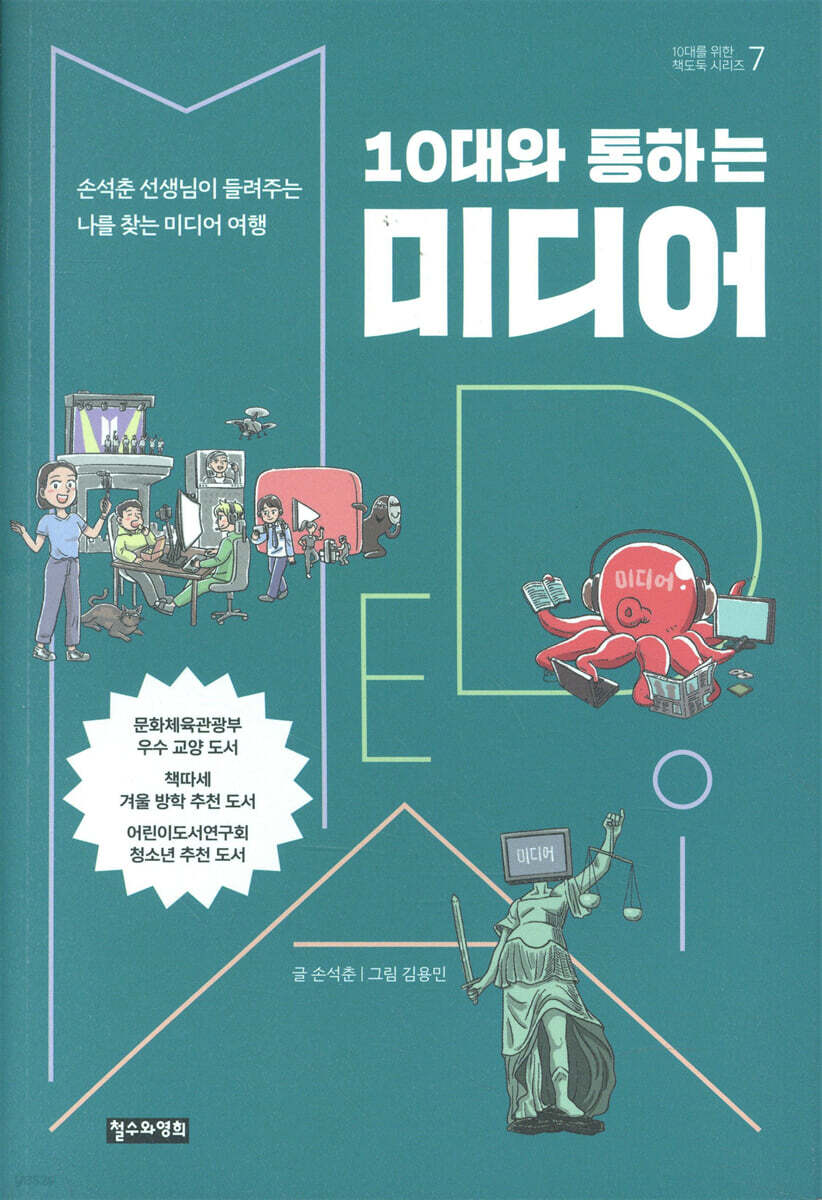
This book provides an easy-to-understand introduction to the history of media, the concept of media, and how to utilize media through interesting and entertaining stories about various media, including newspapers, television, advertising, movies, and social media.
It covers humanities content on media from a youth perspective, starting with speech, the first medium used by humans, and continuing to social media such as Twitter, Facebook, and YouTube.
We explore ways to utilize media wisely through topics such as the social role of broadcasting and newspapers for minorities, understanding the images in advertising, watching movies as a meeting point between art and media, using the Internet and social media appropriately, and the future of media.
- How do you deal with the media?
Why should I watch the news?
Why does power seek to control the media?
Should we believe everything we see in advertisements?
Will paper newspapers disappear because of the internet and social media?
What's the difference between 'fake news' and 'misinformation'?
This book provides an easy-to-understand introduction to the history of media, the concept of media, and how to utilize media through interesting and entertaining stories about various media, including newspapers, television, advertising, movies, and social media.
It covers humanities content on media from a youth perspective, starting with speech, the first medium used by humans, and continuing to social media such as Twitter, Facebook, and YouTube.
We explore ways to utilize media wisely through topics such as the social role of broadcasting and newspapers for minorities, understanding the images in advertising, watching movies as a meeting point between art and media, using the Internet and social media appropriately, and the future of media.
- You can preview some of the book's contents.
Preview
index
Revised Edition: Media Literacy for Teenagers
Introduction: Shall we embark on a journey into the world of media together?
Chapter 1.
Is my friend stupid or smart?
Smartphones, Games, and Addiction | The Birth of Internet Media | The Emergence of Collective Intelligence | Internet Addiction: A Disease and How to Protect Your Health
What should I do if my personal information is posted on the Internet?
How do articles appear on the main screens of Naver and Daum?
Chapter 2.
Media is a living thing?
Speech: Humans' First Media | Writing: The Starting Point of the Media Revolution | The 21st Century's "Media Ecosystem"
Please tell us about the relationship between media and democracy.
Why should I watch the news?
How do I become a journalist or broadcaster?
Chapter 3.
How old is the newspaper?
Newspapers: A Collaboration of Eastern and Western Technologies | Newspapers Are a Product of Democracy | Newspapers Are a Window to the World
Do you have any principles when writing articles?
Why do important stories differ in each newspaper?
Chapter 4.
Will the newspaper only tell the truth?
Truth is the lifeblood of journalism | The inconvenient truth in a newspaper article | The lie that protests ruin the economy | Why we need to remember the truth
Distortion of the truth in press photos
Why does power seek to control the media?
How are incorrect articles corrected?
How are editorials in newspapers created?
Chapter 5.
I would love to be on TV.
A History of Broadcast Media | How Television Became Everyday Life | Television and the Plastic Surgery Syndrome | Television is Politics
What is the difference between terrestrial channels, cable channels, and cable channels?
How do you do viewership surveys?
Chapter 6.
Is television fair?
Minority Rights the Media Must Protect | Why Do Only Chairman Appear in Television Dramas? | What Television Doesn't Show
How does one decide the order in which news is broadcast?
How are the three major broadcasting companies different?
Chapter 7.
Advertising is media? 153
Everything You See Is an Advertisement | Advertisements Engraved on Egyptian Artifacts | The Advertising Industry's Evolution After the Great Depression | Advertising and the Image Myth
What is the circulation of ABC?
Why was this system introduced?
What are the criteria for calculating advertising costs for newspapers and broadcasting?
Chapter 8.
Advertising is scarier than guns and swords.
Suppressing Press Freedom | Articles on Samsung's Slush Funds Disappear from Newspapers | Chosun Ilbo's Praise for Samsung's Founder
The horror of cigarette advertising
Should we believe everything we see in advertisements?
What is media rep? Why is it a problem?
Chapter 9.
Is film a hallucinogen or a stimulant?
From Still Painting to Moving Pictures | Jurassic Park and the Hollywood Formula | Film: Achieving a Better World | The Power of Film to Change the World
Seven Hollywood Laws
What are some movies that can teach us about media?
Chapter 10.
What is social media?
The Rise of Revolutionary Personal Media | The Smartphone-Powered Democratic Revolution | The Era of Everyone as a Journalist | Let's Change the World with "People's Media"
Can social media threaten democracy?
How much of an invasion of privacy are Facebook, Twitter, etc.?
Will paper newspapers disappear because of the internet and social media?
Chapter 11.
YouTube and the Future of Media
The Era of One-Person, One-Channel and "GodTube" | The Emergence of YouTube Journalism | The Dangers of YouTube and Fake News | YouTube's Potential and New Media
What's the difference between 'fake news' and 'misinformation'?
How can we improve media literacy?
Closing Remarks: How to Relate to the Media
Introduction: Shall we embark on a journey into the world of media together?
Chapter 1.
Is my friend stupid or smart?
Smartphones, Games, and Addiction | The Birth of Internet Media | The Emergence of Collective Intelligence | Internet Addiction: A Disease and How to Protect Your Health
What should I do if my personal information is posted on the Internet?
How do articles appear on the main screens of Naver and Daum?
Chapter 2.
Media is a living thing?
Speech: Humans' First Media | Writing: The Starting Point of the Media Revolution | The 21st Century's "Media Ecosystem"
Please tell us about the relationship between media and democracy.
Why should I watch the news?
How do I become a journalist or broadcaster?
Chapter 3.
How old is the newspaper?
Newspapers: A Collaboration of Eastern and Western Technologies | Newspapers Are a Product of Democracy | Newspapers Are a Window to the World
Do you have any principles when writing articles?
Why do important stories differ in each newspaper?
Chapter 4.
Will the newspaper only tell the truth?
Truth is the lifeblood of journalism | The inconvenient truth in a newspaper article | The lie that protests ruin the economy | Why we need to remember the truth
Distortion of the truth in press photos
Why does power seek to control the media?
How are incorrect articles corrected?
How are editorials in newspapers created?
Chapter 5.
I would love to be on TV.
A History of Broadcast Media | How Television Became Everyday Life | Television and the Plastic Surgery Syndrome | Television is Politics
What is the difference between terrestrial channels, cable channels, and cable channels?
How do you do viewership surveys?
Chapter 6.
Is television fair?
Minority Rights the Media Must Protect | Why Do Only Chairman Appear in Television Dramas? | What Television Doesn't Show
How does one decide the order in which news is broadcast?
How are the three major broadcasting companies different?
Chapter 7.
Advertising is media? 153
Everything You See Is an Advertisement | Advertisements Engraved on Egyptian Artifacts | The Advertising Industry's Evolution After the Great Depression | Advertising and the Image Myth
What is the circulation of ABC?
Why was this system introduced?
What are the criteria for calculating advertising costs for newspapers and broadcasting?
Chapter 8.
Advertising is scarier than guns and swords.
Suppressing Press Freedom | Articles on Samsung's Slush Funds Disappear from Newspapers | Chosun Ilbo's Praise for Samsung's Founder
The horror of cigarette advertising
Should we believe everything we see in advertisements?
What is media rep? Why is it a problem?
Chapter 9.
Is film a hallucinogen or a stimulant?
From Still Painting to Moving Pictures | Jurassic Park and the Hollywood Formula | Film: Achieving a Better World | The Power of Film to Change the World
Seven Hollywood Laws
What are some movies that can teach us about media?
Chapter 10.
What is social media?
The Rise of Revolutionary Personal Media | The Smartphone-Powered Democratic Revolution | The Era of Everyone as a Journalist | Let's Change the World with "People's Media"
Can social media threaten democracy?
How much of an invasion of privacy are Facebook, Twitter, etc.?
Will paper newspapers disappear because of the internet and social media?
Chapter 11.
YouTube and the Future of Media
The Era of One-Person, One-Channel and "GodTube" | The Emergence of YouTube Journalism | The Dangers of YouTube and Fake News | YouTube's Potential and New Media
What's the difference between 'fake news' and 'misinformation'?
How can we improve media literacy?
Closing Remarks: How to Relate to the Media
Detailed image
.jpg)
Into the book
-This is a problem that can arise when the world relies solely on portals.
As portal news tries to attract people's attention, they often post sensational titles and content.
There's a high chance that you'll waste your precious time with photos or celebrity articles that you don't really need to see.
It is often called a 'fishing article'.
You have to be careful not to get caught there.
-There are many people who place the separation of powers as the political symbol of a democratic system.
It refers to the balance of power between the legislative, executive, and judicial branches.
The media is so important that it can be considered the fourth branch that monitors all three branches.
Democracy and media influence each other and are still evolving.
-What we must remember is that with the development of printing and the spread of papermaking in Europe in the 1500s, newspapers as a printed medium appeared in Italy, Germany, the Netherlands, Spain, and England almost simultaneously, although there was a slight delay.
So, the newspaper is nearly 500 years old.
(Omitted) Newspapers first appeared in Korea after the opening of the country in 1876.
The Hansung Sunbo first appeared as a mass media in 1883, so there is a time difference of about 300 years compared to Europe.
-With the advent of radio broadcasting, many countries around the world actively embraced the new mass media.
In this land where we live, the Gyeongseong Broadcasting Station (JODK) opened on February 16, 1927.
But that was when Japanese imperialism was taking away our sovereignty.
It would be more correct to view it as an extension of Japanese broadcasting rather than our own broadcasting.
After liberation, Korea was finally able to broadcast its own broadcasts on September 3, 1947, after receiving recognition from the International Telecommunication Union (ITU).
This is why broadcasters celebrate that day (September 3rd) as 'Broadcast Day'.
-During the Roman Empire, there was a city that was instantly reduced to ashes by a massive volcanic eruption, right? That was the famous Pompeii.
It was when I went there and looked at the ruins left behind by the last days of Pompeii, which had suddenly come upon me at some point.
On the walls, you could see writings and pictures indicating a bakery, a milk shop, and an inn, as well as pictures suggesting a tavern.
That's exactly what advertising is.
- People who actually use Facebook and Twitter put their private lives on the web without much thought.
However, the things you post can spread uncontrollably as they are passed from friend to friend.
Even if you ask a friend to delete it, it may still remain on the Facebook pages of the people who are friends with that friend.
So, people on Twitter or Facebook should always keep in mind that when they post about their private lives, they don't know when or where it will be revealed.
-Trump supporters continued to support him enthusiastically.
Behind this lies the problem of ‘algorithm’.
The phenomenon of allowing media users to only see information filtered to their preferences and blocking opportunities to encounter diverse perspectives is called an algorithm.
-Social media, including YouTube, has opened a new era for humanity.
Because everyone can express themselves creatively and communicate with others.
It is a desirable phenomenon that diverse people's diverse thoughts are being communicated, which in the past were buried by the established media.
-It is clear that new media beyond blogs, Twitter, Facebook, YouTube, and Instagram will emerge in the media ecosystem in the future.
As the Fourth Industrial Revolution unfolds, big data and artificial intelligence (AI) will undoubtedly impact the media sector.
There will be media that we haven't even thought of yet.
For today's teenagers, media is a realm of infinite possibilities.
- In June 2022, lawsuits by teenagers and their parents are being filed in the United States against Meta Platforms, which operates Facebook and Instagram.
Teenagers and their parents filed a lawsuit seeking damages, claiming that social media platforms "use algorithms to trap and obsess over young people, ruining their lives." They claim excessive social media use causes them to have trouble sleeping, have trouble eating, and even lead them to make extreme choices.
-With the advancement of medicine and science in the future, today's teenagers may live to be over 100 years old on average.
But the truth that life must end someday remains unchanged.
That's why.
We must choose whether to live a one-time life foolishly, obscured by the media, or to live wisely, taking advantage of the media's strengths and weaknesses.
As portal news tries to attract people's attention, they often post sensational titles and content.
There's a high chance that you'll waste your precious time with photos or celebrity articles that you don't really need to see.
It is often called a 'fishing article'.
You have to be careful not to get caught there.
-There are many people who place the separation of powers as the political symbol of a democratic system.
It refers to the balance of power between the legislative, executive, and judicial branches.
The media is so important that it can be considered the fourth branch that monitors all three branches.
Democracy and media influence each other and are still evolving.
-What we must remember is that with the development of printing and the spread of papermaking in Europe in the 1500s, newspapers as a printed medium appeared in Italy, Germany, the Netherlands, Spain, and England almost simultaneously, although there was a slight delay.
So, the newspaper is nearly 500 years old.
(Omitted) Newspapers first appeared in Korea after the opening of the country in 1876.
The Hansung Sunbo first appeared as a mass media in 1883, so there is a time difference of about 300 years compared to Europe.
-With the advent of radio broadcasting, many countries around the world actively embraced the new mass media.
In this land where we live, the Gyeongseong Broadcasting Station (JODK) opened on February 16, 1927.
But that was when Japanese imperialism was taking away our sovereignty.
It would be more correct to view it as an extension of Japanese broadcasting rather than our own broadcasting.
After liberation, Korea was finally able to broadcast its own broadcasts on September 3, 1947, after receiving recognition from the International Telecommunication Union (ITU).
This is why broadcasters celebrate that day (September 3rd) as 'Broadcast Day'.
-During the Roman Empire, there was a city that was instantly reduced to ashes by a massive volcanic eruption, right? That was the famous Pompeii.
It was when I went there and looked at the ruins left behind by the last days of Pompeii, which had suddenly come upon me at some point.
On the walls, you could see writings and pictures indicating a bakery, a milk shop, and an inn, as well as pictures suggesting a tavern.
That's exactly what advertising is.
- People who actually use Facebook and Twitter put their private lives on the web without much thought.
However, the things you post can spread uncontrollably as they are passed from friend to friend.
Even if you ask a friend to delete it, it may still remain on the Facebook pages of the people who are friends with that friend.
So, people on Twitter or Facebook should always keep in mind that when they post about their private lives, they don't know when or where it will be revealed.
-Trump supporters continued to support him enthusiastically.
Behind this lies the problem of ‘algorithm’.
The phenomenon of allowing media users to only see information filtered to their preferences and blocking opportunities to encounter diverse perspectives is called an algorithm.
-Social media, including YouTube, has opened a new era for humanity.
Because everyone can express themselves creatively and communicate with others.
It is a desirable phenomenon that diverse people's diverse thoughts are being communicated, which in the past were buried by the established media.
-It is clear that new media beyond blogs, Twitter, Facebook, YouTube, and Instagram will emerge in the media ecosystem in the future.
As the Fourth Industrial Revolution unfolds, big data and artificial intelligence (AI) will undoubtedly impact the media sector.
There will be media that we haven't even thought of yet.
For today's teenagers, media is a realm of infinite possibilities.
- In June 2022, lawsuits by teenagers and their parents are being filed in the United States against Meta Platforms, which operates Facebook and Instagram.
Teenagers and their parents filed a lawsuit seeking damages, claiming that social media platforms "use algorithms to trap and obsess over young people, ruining their lives." They claim excessive social media use causes them to have trouble sleeping, have trouble eating, and even lead them to make extreme choices.
-With the advancement of medicine and science in the future, today's teenagers may live to be over 100 years old on average.
But the truth that life must end someday remains unchanged.
That's why.
We must choose whether to live a one-time life foolishly, obscured by the media, or to live wisely, taking advantage of the media's strengths and weaknesses.
--- From the text
Publisher's Review
For media literacy among teenagers
- How do you deal with the media?
Why should I watch the news?
Why does power seek to control the media?
Should we believe everything we see in advertisements?
Will paper newspapers disappear because of the internet and social media?
What's the difference between 'fake news' and 'misinformation'?
This book provides an easy-to-understand introduction to the history of media, the concept of media, and how to utilize media through interesting and entertaining stories about various media, including newspapers, television, advertising, movies, and social media.
It covers humanities content on media from a youth perspective, starting with speech, the first medium used by humans, and continuing to social media such as Twitter, Facebook, and YouTube.
We explore ways to utilize media wisely through topics such as the social role of broadcasting and newspapers for minorities, understanding the images in advertising, watching movies as a meeting point between art and media, using the Internet and social media appropriately, and the future of media.
Furthermore, it contains stories that young people are curious about or need to know about media.
It explains in an easy-to-understand way 27 questions about the media, such as why we should watch the news, why those in power try to control the media, should we believe everything we see in advertisements, what should we do if my personal information is posted on the Internet, and how viewership surveys are conducted.
Meanwhile, it tells us how to view the media, which has a great influence on the way we view the world and our outlook on life during adolescence, when we are drawing the blueprint for our lives.
He says that the direction of an individual's life can change and a change for a better society can be made depending on whether the Internet, newspapers, broadcasting, movies, advertisements, and social media make them stupid or smart friends.
The media has a significant, if unknowing, influence on young people's choices regarding what career to pursue, whether to attend college, what to major in if they do go to college, and where to place their values in life.
So this book emphasizes that properly understanding and examining the media is the way to find myself.
This book has been significantly revised to reflect the trends unfolding in global media over the past decade.
We've supplemented the section that touches on the fundamentals of media, and updated all statistics to the latest data.
It provides clues to help teenagers develop media literacy and navigate the world creatively.
- How do you deal with the media?
Why should I watch the news?
Why does power seek to control the media?
Should we believe everything we see in advertisements?
Will paper newspapers disappear because of the internet and social media?
What's the difference between 'fake news' and 'misinformation'?
This book provides an easy-to-understand introduction to the history of media, the concept of media, and how to utilize media through interesting and entertaining stories about various media, including newspapers, television, advertising, movies, and social media.
It covers humanities content on media from a youth perspective, starting with speech, the first medium used by humans, and continuing to social media such as Twitter, Facebook, and YouTube.
We explore ways to utilize media wisely through topics such as the social role of broadcasting and newspapers for minorities, understanding the images in advertising, watching movies as a meeting point between art and media, using the Internet and social media appropriately, and the future of media.
Furthermore, it contains stories that young people are curious about or need to know about media.
It explains in an easy-to-understand way 27 questions about the media, such as why we should watch the news, why those in power try to control the media, should we believe everything we see in advertisements, what should we do if my personal information is posted on the Internet, and how viewership surveys are conducted.
Meanwhile, it tells us how to view the media, which has a great influence on the way we view the world and our outlook on life during adolescence, when we are drawing the blueprint for our lives.
He says that the direction of an individual's life can change and a change for a better society can be made depending on whether the Internet, newspapers, broadcasting, movies, advertisements, and social media make them stupid or smart friends.
The media has a significant, if unknowing, influence on young people's choices regarding what career to pursue, whether to attend college, what to major in if they do go to college, and where to place their values in life.
So this book emphasizes that properly understanding and examining the media is the way to find myself.
This book has been significantly revised to reflect the trends unfolding in global media over the past decade.
We've supplemented the section that touches on the fundamentals of media, and updated all statistics to the latest data.
It provides clues to help teenagers develop media literacy and navigate the world creatively.
GOODS SPECIFICS
- Date of issue: January 1, 2023
- Page count, weight, size: 276 pages | 530g | 152*221*17mm
- ISBN13: 9791188215805
- ISBN10: 1188215809
You may also like
카테고리
korean


korean

![GQ KOREA Mark (Monthly): December [2025]](http://librairie.coreenne.fr/cdn/shop/files/8ef265dbbfbf186523ed75ba7319009d.jpg?v=1765340328&width=3840)


