

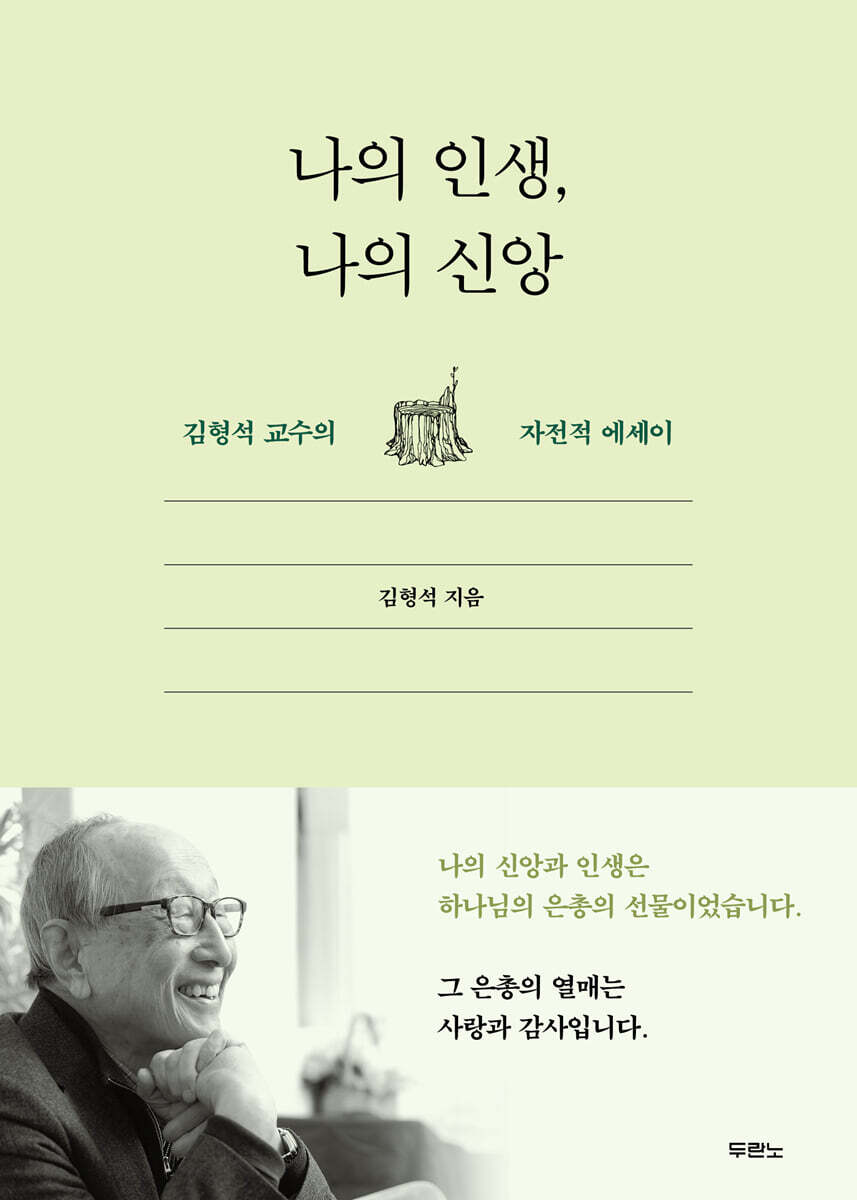
My life, my faith
 |
Description
Book Introduction
“God chose me.”
106-Year-Old Philosopher Kim Hyung-seok Confesses His Lifelong Faith
Life was faith, love was philosophy
Let's follow Professor Kim Hyung-seok's deep and steadfast journey of life and faith.
"My Life, My Faith" is the author's profound confession and sole record of life as a philosopher and Christian believer who has lived in response to God's calling.
He accepted his faith at the age of 14 and took his first steps in a rural church in Songsan-ri, North Pyongan Province. He confesses that he has never lived a moment without the hand of the Lord, from his time at Sungsil Middle School in Pyongyang, his studies in Japan, the liberation and the Korean War, to his career as a professor at Yonsei University.
Through his resignation from school due to his refusal to visit the Shinto shrine, his deep relationship with missionary Maury, and his study of philosophy, which included Nietzsche and Kierkegaard, he came to accept faith not as a doctrine or a formality, but as love and practice, or a ‘way of life.’
This book, which begins with the confession, “It was not I who chose Christ, but Christ who chose me,” testifies to the solid and noble path of faith that his life, which he chose to live as an anonymous saint, was.
For all those struggling to balance faith and life in today's complex world, this book resonates deeply as a quiet yet resolute testimony to faith.
※ This book is a republished version of 『For a Good and Beautiful Life』, published by Duranno in 2018, at the author's request, with only the title and cover changed.
Please make sure you don't make a mistake with your purchase.
106-Year-Old Philosopher Kim Hyung-seok Confesses His Lifelong Faith
Life was faith, love was philosophy
Let's follow Professor Kim Hyung-seok's deep and steadfast journey of life and faith.
"My Life, My Faith" is the author's profound confession and sole record of life as a philosopher and Christian believer who has lived in response to God's calling.
He accepted his faith at the age of 14 and took his first steps in a rural church in Songsan-ri, North Pyongan Province. He confesses that he has never lived a moment without the hand of the Lord, from his time at Sungsil Middle School in Pyongyang, his studies in Japan, the liberation and the Korean War, to his career as a professor at Yonsei University.
Through his resignation from school due to his refusal to visit the Shinto shrine, his deep relationship with missionary Maury, and his study of philosophy, which included Nietzsche and Kierkegaard, he came to accept faith not as a doctrine or a formality, but as love and practice, or a ‘way of life.’
This book, which begins with the confession, “It was not I who chose Christ, but Christ who chose me,” testifies to the solid and noble path of faith that his life, which he chose to live as an anonymous saint, was.
For all those struggling to balance faith and life in today's complex world, this book resonates deeply as a quiet yet resolute testimony to faith.
※ This book is a republished version of 『For a Good and Beautiful Life』, published by Duranno in 2018, at the author's request, with only the title and cover changed.
Please make sure you don't make a mistake with your purchase.
- You can preview some of the book's contents.
Preview
index
8 instead of header
Part 1 In God's Grace
1 It was providence, not freedom or fate. 14
2 The Call of Grace 25
3 Two Meetings That Changed My Life 38
4 College Life in Japan 51
5 One Realization and Another Event 63
6 Liberation and Becoming a Defector 72
7 The Lord's Vineyard, Central School 86
Serving the Church in the Time of War 100
9 Along with Yonsei University 117
Part 2: For a Good and Beautiful Life
10 Storm and Rest Intersect 136
11 Two World Trips 149
12 Bible Study 60 Years 164
13 Christianity Coexists with Our Lives 179
In the past 14 years, Christianity has grown to 201
15 The Word is preserved in writing through sermons 225
16 My Religious Writings 238
Part 3: Thinking about the wisdom of living together
17 Crossing the River of Sincerity 254
18 Beyond the Church Fences, in the Heart of the World 265
19 A New Attempt: Planting the Gospel Outside the Church 281
20 The Home Where the Lord Dwells 298
21 Is a Second Life Possible? 321
22 Why is Reformation Necessary? 332
Part 1 In God's Grace
1 It was providence, not freedom or fate. 14
2 The Call of Grace 25
3 Two Meetings That Changed My Life 38
4 College Life in Japan 51
5 One Realization and Another Event 63
6 Liberation and Becoming a Defector 72
7 The Lord's Vineyard, Central School 86
Serving the Church in the Time of War 100
9 Along with Yonsei University 117
Part 2: For a Good and Beautiful Life
10 Storm and Rest Intersect 136
11 Two World Trips 149
12 Bible Study 60 Years 164
13 Christianity Coexists with Our Lives 179
In the past 14 years, Christianity has grown to 201
15 The Word is preserved in writing through sermons 225
16 My Religious Writings 238
Part 3: Thinking about the wisdom of living together
17 Crossing the River of Sincerity 254
18 Beyond the Church Fences, in the Heart of the World 265
19 A New Attempt: Planting the Gospel Outside the Church 281
20 The Home Where the Lord Dwells 298
21 Is a Second Life Possible? 321
22 Why is Reformation Necessary? 332
Into the book
Long ago, I was answering questions from people who asked me about the conflict between our Presbyterian and Methodist churches over the doctrines of predestination and freedom in the faith, which added to the burden and distress of believers.
I have never struggled with such doctrinal issues before.
What I experienced was the ‘choice of grace.’
Now, looking back on my life, I make my own confession of faith.
The fact is that life is not only about freedom or the absoluteness of fate, but also about a certain providence of love.
The subject of that providence is God the Father.
--- p.23~24
Since I became a middle school student, my feelings and thoughts have changed.
In short, I felt like I was becoming an adult, and I felt a sense of pride that I had come to middle school with a purpose, unlike my other friends.
It was like a premonition that something was waiting for me.
I was gripped by a sense of urgency that I needed to prepare my life and that the time had come for someone to call me.
…there were two preachers.
They were Pastor Yoon In-gu and Pastor Kim Chang-jun, who represented the Presbyterian Church.
Pastor Yoon In-gu was relatively young, having recently returned from England, and Pastor Kim Chang-jun (I remember he was a Methodist) seemed a bit older.
Many students would gather and then disperse.
I was probably the youngest middle school student who attended and left without saying anything.
I took the two pastors' sermons to heart.
I was particularly impressed by Pastor Yoon's sermon.
I still remember the title and content.
Thinking back now, the cozy and solemn atmosphere of the worship service reminded me of the banquet hall described in the Bible.
Many young people were able to obtain spiritual nourishment, and I was one of them.
As I finished that revival meeting, I opened a door in my heart that I had not realized until then.
It was a change, like a chick trapped in an egg breaking its shell and coming out.
For a while, I felt as if I was intoxicated by something.
A new milestone has been reached in my life.
I felt like I was setting out on a long, long journey with faith and hope.
--- p.30~32
Toyohiko Kagawa, who is short, has a large head, and a broad forehead, was introduced by the host and began to talk as follows.
“I traveled around the world and ended up in Pyongyang via Siberia.
My friends recommended that I definitely visit Moranbong when I go to Pyongyang.
It is said to be a beautiful scenery that cannot be seen anywhere else.
This morning, I was walking down the road along the Taedong River from Moranbong when I came across a small tile-roofed house.
It was a building that exuded the tradition and sentiment of Joseon.
It was like a truly wonderful work of art.
But when I looked closely, I saw a sign on the main gate that said, 'Parasite School.'
The moment I saw that sign, I was reminded of my mother, who had disappeared from my memory.
My mother was a shameful person, worse than a parasite.
My father was traveling around the provinces doing politics, and he met my mother who was working as a handyman at a bar.
I am the one born from a woman whose name I don't even know.
If I were a daughter and not a son, I wouldn't have looked for you.
Because I was his son, they took me and put me in the family register.
I was so embarrassed and ashamed of that fact that I still hesitate to talk about it.
But since I came to believe in Christ and realized that the Lord chose me, a lowly person, I am no longer ashamed of it.
Because it is my heart to live and spread to everyone the truth of the grace that God chooses the most lowly people and uses them as His workers.
You must never make the women around us into women like my mother.
“Can there really be women living in hiding, shedding tears in such a beautiful land that God has given us?” I don’t remember the entirety of the lecture that day, but the confession left a great impression on the audience.
I also thought that living like that was the way of a believer.
After that, while I was in college in Japan, I heard his lectures several more times and read his books.
After liberation, I happened to read an article about him again.
--- p.36~37
As soon as chapel time was over, we ran from the auditorium through the school gate and into the school yard.
I ran to the front of Soongsil College and shouted, “Long live Soongsil College!”
In fact, I should have shouted “Long Live Korean Independence,” but I couldn’t do so in front of the deployed police.
Through this process, the mission withdrew from the school, and the school was forced to worship at the Shinto shrine.
Finally, management rights were transferred to Koreans.
Sungshin Women's University, which had effectively left the hands of missionaries, began anew by accepting Principal Jeong Du-hyeon.
Some of the teachers left the school.
The problem was our students.
If you refuse to visit the shrine, you will have no way to continue your studies.
Poet Yun Dong-ju, who was in the same grade, returned to his alma mater in Yongjeong.
I finally decided to drop out of school.
--- p.41
I got on the bus with Hong Jun's guidance, passed through Yeongyu, and took the train at Eopa Station.
On the train, I fell asleep, forgetting everything, because of the relief of being free and the accumulated fatigue.
It was at a time when Japanese soldiers and military supplies were continuously being transported to Manchuria.
The southbound train was forced to make unscheduled stops, making it impossible to predict how many hours it would take to reach Pyongyang.
I was in a deep sleep when I suddenly opened my eyes to a loud noise.
The train was passing over the railway bridge.
I woke up and looked out the window.
It was evening when the sun was setting in the west.
I was thinking that if it was this late, I would probably arrive at the country house late at night.
That was when.
I felt a very quiet voice coming from somewhere.
“When you were fourteen, I answered your prayer, and now you are thinking only about home?” was the rebuke.
I pressed my face against the car window and cried.
Yes, that's right.
The Lord remembered my prayers from my foolish days, but I had forgotten their meaning.
After crying silently, I said, “I was wrong.
“I will not do that again,” he promised.
It was a childish confession.
--- p.47
One time, I followed missionary Mauri to a rural church.
The church pastor was concerned that there was a seriously ill patient.
When I visited the house, it seemed like the person was suffering from typhoid fever.
Missionary Maury took the patient into his car and brought him to his residence.
After letting the patient sleep overnight, he was admitted to Pyongyang Gihyeol Hospital the next day.
He also warned me not to get close to him because it was dangerous.
I still can't forget his religious life.
Faith is living with Christ.
It is a life of giving love on behalf of the Lord.
It is the coexistence of love in Christ.
--- p.49
As I was about to end my college life, a great storm of trials and frustrations came crashing down on me.
At that time, Japan was allied with Germany and Italy and was waging war against Britain and the United States.
As the war became increasingly unfavorable, Japan began drafting university students and sending them to the front lines.
The problem was Korean college students.
It was a time when Japanese students could not be dragged into the military while Korean students could not be left behind, and there was no legal basis for conscription.
So they came up with the excuse of volunteering.
It was said to be a resource, but in reality it was a forced conscription.
They have been using police force to pressure parents and students to enlist.
It was a shocking event for our college students.
Even those who had just graduated from college were encouraged to volunteer for Japan and the Emperor, and young people who were on leave from school were no exception.
College students in Japan at the same time as me had no way out.
While our Japanese friends were fighting for their country, we had no place to complain about the humiliation of being dragged off as soldiers of Japan, an enemy nation.
Many of my friends had no choice but to spend their days drowning in alcohol and frustration.
Japanese police and officials were promoting the idea that Korean students enlisted with the same patriotism as Japanese students.
Some of my friends even returned to Korea and enlisted.
However, a few of my friends and I decided that it would be easier to go through the ordeal in Japan, so we stayed.
In the midst of all this, I wanted to ask myself what meaning my religious life had as I faced such a momentous event.
Because it was a life-threatening event and a major event that would determine the course of my life.
I wanted to stay in my boarding house, cut off from the outside world, and seek the Lord's will through the Bible and prayer.
I had time to sit quietly in my room and pray while reading the Bible.
Initially, we planned to do it for three days.
But one day, the Bible verses I was reading sounded like someone else's voice, not mine.
We have reached the Gospel of John.
I read the vine scene in chapter 15.
15 No longer do I call you servants, for a servant does not know what his master is doing. But I have called you friends, for everything I have heard from my Father I have made known to you. 16 You did not choose me, but I chose you and appointed you that you should go and bear fruit and that your fruit should last, so that whatever you ask the Father in my name, he may give it to you. 15:15-16
Tears flowed from my eyes while reading this far.
The words, “You did not choose me, but I chose you and appointed you,” shocked my heart and my life itself.
The Lord has chosen me.
Yes, that's right.
I'm not living my life.
It is continuing the Lord's life.
I lay down on the desk listening to that voice.
And I said the shortest prayer in the world.
“Father God!” he cried.
What am I worried about when God is my Father?
I came out.
The sky was clear and the surroundings were extremely quiet.
Yes, that's right.
God was alive in the past and is alive now.
God will continue to be my Father.
From then on, I was able to remain in the same quietness I had when I first entered the life of faith.
A storm was raging around me, but I was calm.
I was able to read books and have constant peace and prayer time at church.
I have never struggled with such doctrinal issues before.
What I experienced was the ‘choice of grace.’
Now, looking back on my life, I make my own confession of faith.
The fact is that life is not only about freedom or the absoluteness of fate, but also about a certain providence of love.
The subject of that providence is God the Father.
--- p.23~24
Since I became a middle school student, my feelings and thoughts have changed.
In short, I felt like I was becoming an adult, and I felt a sense of pride that I had come to middle school with a purpose, unlike my other friends.
It was like a premonition that something was waiting for me.
I was gripped by a sense of urgency that I needed to prepare my life and that the time had come for someone to call me.
…there were two preachers.
They were Pastor Yoon In-gu and Pastor Kim Chang-jun, who represented the Presbyterian Church.
Pastor Yoon In-gu was relatively young, having recently returned from England, and Pastor Kim Chang-jun (I remember he was a Methodist) seemed a bit older.
Many students would gather and then disperse.
I was probably the youngest middle school student who attended and left without saying anything.
I took the two pastors' sermons to heart.
I was particularly impressed by Pastor Yoon's sermon.
I still remember the title and content.
Thinking back now, the cozy and solemn atmosphere of the worship service reminded me of the banquet hall described in the Bible.
Many young people were able to obtain spiritual nourishment, and I was one of them.
As I finished that revival meeting, I opened a door in my heart that I had not realized until then.
It was a change, like a chick trapped in an egg breaking its shell and coming out.
For a while, I felt as if I was intoxicated by something.
A new milestone has been reached in my life.
I felt like I was setting out on a long, long journey with faith and hope.
--- p.30~32
Toyohiko Kagawa, who is short, has a large head, and a broad forehead, was introduced by the host and began to talk as follows.
“I traveled around the world and ended up in Pyongyang via Siberia.
My friends recommended that I definitely visit Moranbong when I go to Pyongyang.
It is said to be a beautiful scenery that cannot be seen anywhere else.
This morning, I was walking down the road along the Taedong River from Moranbong when I came across a small tile-roofed house.
It was a building that exuded the tradition and sentiment of Joseon.
It was like a truly wonderful work of art.
But when I looked closely, I saw a sign on the main gate that said, 'Parasite School.'
The moment I saw that sign, I was reminded of my mother, who had disappeared from my memory.
My mother was a shameful person, worse than a parasite.
My father was traveling around the provinces doing politics, and he met my mother who was working as a handyman at a bar.
I am the one born from a woman whose name I don't even know.
If I were a daughter and not a son, I wouldn't have looked for you.
Because I was his son, they took me and put me in the family register.
I was so embarrassed and ashamed of that fact that I still hesitate to talk about it.
But since I came to believe in Christ and realized that the Lord chose me, a lowly person, I am no longer ashamed of it.
Because it is my heart to live and spread to everyone the truth of the grace that God chooses the most lowly people and uses them as His workers.
You must never make the women around us into women like my mother.
“Can there really be women living in hiding, shedding tears in such a beautiful land that God has given us?” I don’t remember the entirety of the lecture that day, but the confession left a great impression on the audience.
I also thought that living like that was the way of a believer.
After that, while I was in college in Japan, I heard his lectures several more times and read his books.
After liberation, I happened to read an article about him again.
--- p.36~37
As soon as chapel time was over, we ran from the auditorium through the school gate and into the school yard.
I ran to the front of Soongsil College and shouted, “Long live Soongsil College!”
In fact, I should have shouted “Long Live Korean Independence,” but I couldn’t do so in front of the deployed police.
Through this process, the mission withdrew from the school, and the school was forced to worship at the Shinto shrine.
Finally, management rights were transferred to Koreans.
Sungshin Women's University, which had effectively left the hands of missionaries, began anew by accepting Principal Jeong Du-hyeon.
Some of the teachers left the school.
The problem was our students.
If you refuse to visit the shrine, you will have no way to continue your studies.
Poet Yun Dong-ju, who was in the same grade, returned to his alma mater in Yongjeong.
I finally decided to drop out of school.
--- p.41
I got on the bus with Hong Jun's guidance, passed through Yeongyu, and took the train at Eopa Station.
On the train, I fell asleep, forgetting everything, because of the relief of being free and the accumulated fatigue.
It was at a time when Japanese soldiers and military supplies were continuously being transported to Manchuria.
The southbound train was forced to make unscheduled stops, making it impossible to predict how many hours it would take to reach Pyongyang.
I was in a deep sleep when I suddenly opened my eyes to a loud noise.
The train was passing over the railway bridge.
I woke up and looked out the window.
It was evening when the sun was setting in the west.
I was thinking that if it was this late, I would probably arrive at the country house late at night.
That was when.
I felt a very quiet voice coming from somewhere.
“When you were fourteen, I answered your prayer, and now you are thinking only about home?” was the rebuke.
I pressed my face against the car window and cried.
Yes, that's right.
The Lord remembered my prayers from my foolish days, but I had forgotten their meaning.
After crying silently, I said, “I was wrong.
“I will not do that again,” he promised.
It was a childish confession.
--- p.47
One time, I followed missionary Mauri to a rural church.
The church pastor was concerned that there was a seriously ill patient.
When I visited the house, it seemed like the person was suffering from typhoid fever.
Missionary Maury took the patient into his car and brought him to his residence.
After letting the patient sleep overnight, he was admitted to Pyongyang Gihyeol Hospital the next day.
He also warned me not to get close to him because it was dangerous.
I still can't forget his religious life.
Faith is living with Christ.
It is a life of giving love on behalf of the Lord.
It is the coexistence of love in Christ.
--- p.49
As I was about to end my college life, a great storm of trials and frustrations came crashing down on me.
At that time, Japan was allied with Germany and Italy and was waging war against Britain and the United States.
As the war became increasingly unfavorable, Japan began drafting university students and sending them to the front lines.
The problem was Korean college students.
It was a time when Japanese students could not be dragged into the military while Korean students could not be left behind, and there was no legal basis for conscription.
So they came up with the excuse of volunteering.
It was said to be a resource, but in reality it was a forced conscription.
They have been using police force to pressure parents and students to enlist.
It was a shocking event for our college students.
Even those who had just graduated from college were encouraged to volunteer for Japan and the Emperor, and young people who were on leave from school were no exception.
College students in Japan at the same time as me had no way out.
While our Japanese friends were fighting for their country, we had no place to complain about the humiliation of being dragged off as soldiers of Japan, an enemy nation.
Many of my friends had no choice but to spend their days drowning in alcohol and frustration.
Japanese police and officials were promoting the idea that Korean students enlisted with the same patriotism as Japanese students.
Some of my friends even returned to Korea and enlisted.
However, a few of my friends and I decided that it would be easier to go through the ordeal in Japan, so we stayed.
In the midst of all this, I wanted to ask myself what meaning my religious life had as I faced such a momentous event.
Because it was a life-threatening event and a major event that would determine the course of my life.
I wanted to stay in my boarding house, cut off from the outside world, and seek the Lord's will through the Bible and prayer.
I had time to sit quietly in my room and pray while reading the Bible.
Initially, we planned to do it for three days.
But one day, the Bible verses I was reading sounded like someone else's voice, not mine.
We have reached the Gospel of John.
I read the vine scene in chapter 15.
15 No longer do I call you servants, for a servant does not know what his master is doing. But I have called you friends, for everything I have heard from my Father I have made known to you. 16 You did not choose me, but I chose you and appointed you that you should go and bear fruit and that your fruit should last, so that whatever you ask the Father in my name, he may give it to you. 15:15-16
Tears flowed from my eyes while reading this far.
The words, “You did not choose me, but I chose you and appointed you,” shocked my heart and my life itself.
The Lord has chosen me.
Yes, that's right.
I'm not living my life.
It is continuing the Lord's life.
I lay down on the desk listening to that voice.
And I said the shortest prayer in the world.
“Father God!” he cried.
What am I worried about when God is my Father?
I came out.
The sky was clear and the surroundings were extremely quiet.
Yes, that's right.
God was alive in the past and is alive now.
God will continue to be my Father.
From then on, I was able to remain in the same quietness I had when I first entered the life of faith.
A storm was raging around me, but I was calm.
I was able to read books and have constant peace and prayer time at church.
--- p.68~69
GOODS SPECIFICS
- Date of issue: July 2, 2025
- Page count, weight, size: 344 pages | 498g | 151*210*21mm
- ISBN13: 9788953151338
- ISBN10: 8953151333
You may also like
카테고리
korean


korean

![ELLE 엘르 스페셜 에디션 A형 : 12월 [2025]](http://librairie.coreenne.fr/cdn/shop/files/b8e27a3de6c9538896439686c6b0e8fb.jpg?v=1766436872&width=3840)


