

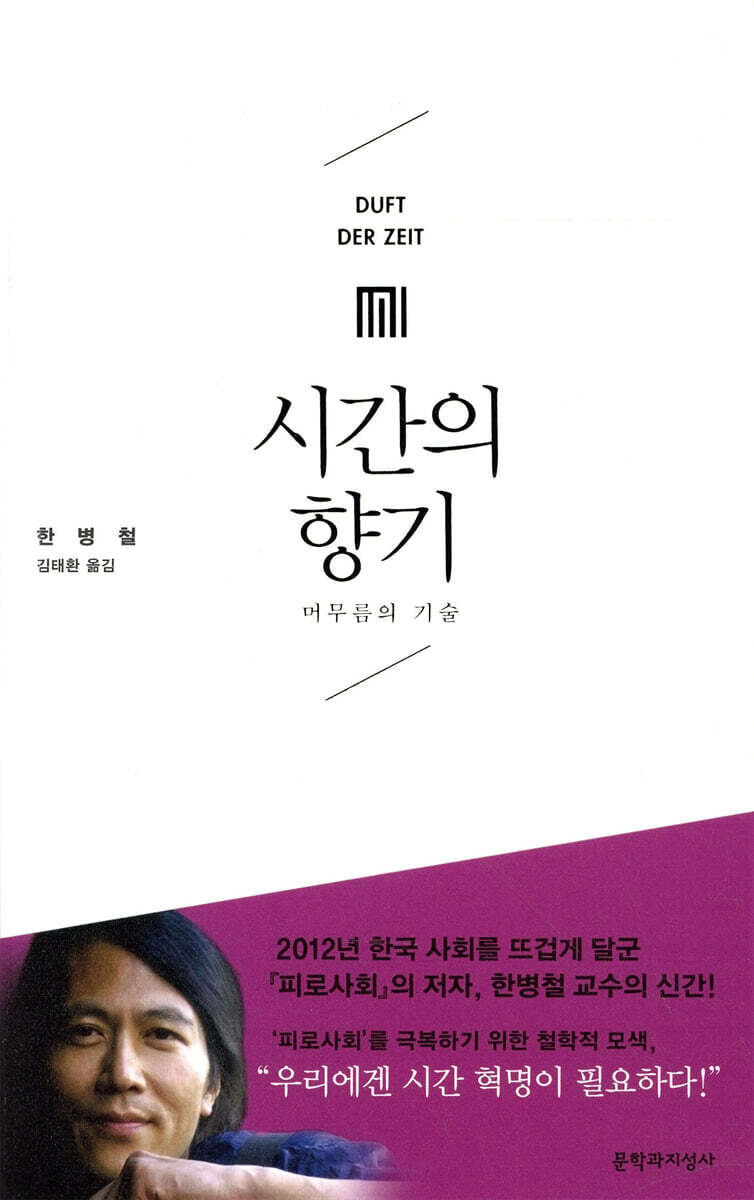
The scent of time
 |
Description
Book Introduction
A philosophical reflection for modern people who do not know true rest!
A new book by Professor Han Byeong-cheol, author of "The Fatigued Society"
"The Scent of Time" is a predecessor to "The Fatigue Society" and diagnoses that in modern society, all time has become hostage to labor.
All time is work time, and leisure time is nothing more than a supplementary means of preparing for work time.
According to Professor Han Byung-chul, today's time is in crisis as it loses its rhythm and direction and becomes atomized.
Today, the flow of time has lost both the rhythm of natural cycles and the narrative tension that comes from meaningful directionality.
Thus, the experience of persistence has become very rare.
In the process, life is not completed and ends suddenly.
The author finds the cause of all these problems in the tendency to “absolutize active life,” which has been strengthening since the modern era.
Accordingly, humans came to recognize the value of their existence only in the fact that they are workers and active beings.
The absolutization of active life also has a fundamental impact on the concept of time.
Time is simply a cost that must be minimized as much as possible.
It is precisely “scentless time.”
This is where the belief in speed is born.
Because time is money, impatience and the desire to bring everything forward become dominant psychology.
How can we recapture the scent of time? Professor Han Byung-chul argues that we must shift our values from those centered on an active life to those centered on a contemplative life.
'I work.
I am active.
If 'I do not work, therefore I am' was the dominant value system since the modern era, Professor Han Byung-chul inverts it to 'I do not work, I stop, therefore I am.'
In the time of stillness, inactivity, in self-reflection and contemplation of eternal truth, man truly begins to exist as a man.
The main theses of The Scent of Time, derived through a critical confrontation with the ideas of Hegel, Marx, Nietzsche, Proust, Heidegger, Hannah Arendt, and Lyotard, are concise and to the point, yet do not lose depth.
A new book by Professor Han Byeong-cheol, author of "The Fatigued Society"
"The Scent of Time" is a predecessor to "The Fatigue Society" and diagnoses that in modern society, all time has become hostage to labor.
All time is work time, and leisure time is nothing more than a supplementary means of preparing for work time.
According to Professor Han Byung-chul, today's time is in crisis as it loses its rhythm and direction and becomes atomized.
Today, the flow of time has lost both the rhythm of natural cycles and the narrative tension that comes from meaningful directionality.
Thus, the experience of persistence has become very rare.
In the process, life is not completed and ends suddenly.
The author finds the cause of all these problems in the tendency to “absolutize active life,” which has been strengthening since the modern era.
Accordingly, humans came to recognize the value of their existence only in the fact that they are workers and active beings.
The absolutization of active life also has a fundamental impact on the concept of time.
Time is simply a cost that must be minimized as much as possible.
It is precisely “scentless time.”
This is where the belief in speed is born.
Because time is money, impatience and the desire to bring everything forward become dominant psychology.
How can we recapture the scent of time? Professor Han Byung-chul argues that we must shift our values from those centered on an active life to those centered on a contemplative life.
'I work.
I am active.
If 'I do not work, therefore I am' was the dominant value system since the modern era, Professor Han Byung-chul inverts it to 'I do not work, I stop, therefore I am.'
In the time of stillness, inactivity, in self-reflection and contemplation of eternal truth, man truly begins to exist as a man.
The main theses of The Scent of Time, derived through a critical confrontation with the ideas of Hegel, Marx, Nietzsche, Proust, Heidegger, Hannah Arendt, and Lyotard, are concise and to the point, yet do not lose depth.
- You can preview some of the book's contents.
Preview
Publisher's Review
A new book by Professor Han Byeong-cheol, author of "The Burnout Society," which heated up Korean society in 2012!
Professor Han Byeong-cheol (Berlin University of the Arts), author of "The Fatigued Society," which was selected as the best humanities book of 2012, has translated and published his book "The Scent of Time" (2009) by Moonji Publishing.
『The Scent of Time』 is a predecessor to 『The Fatigue Society』 (2010), and diagnoses that in modern society, all time has become hostage to labor.
All time is work time, and leisure time is nothing more than a supplementary means of preparing for work time.
Why am I always so short on time and so pressed for time? Why does time pass so quickly and so futilely? Why, despite being so busy, do I have nothing left? Am I wasting the vast amount of time I've been given without learning how to use it wisely? This book, "The Scent of Time," is a philosophical reflection on these everyday questions we constantly face as we live.
It also interestingly demonstrates that the time problems we face cannot be solved by anything like efficient time management techniques.
A philosophical reflection for modern people who do not know true rest!
According to Professor Han Byung-chul, today's time is in crisis as it loses its rhythm and direction and becomes atomized.
Today, the flow of time has lost the rhythm of natural cycles, nor the narrative tension that comes from a meaningful direction toward future salvation, annihilation, or progress; it is experienced simply as the disappearance of endless presents.
Thus, the experience of persistence has become very rare.
Accordingly, each individual's life flows distractedly within this scattered time.
There are repeated impromptu starts and stops.
In the process, life is not completed and ends suddenly.
Professor Han Byeong-cheol finds the cause of all these problems in the tendency to “absolutize active life,” which has been strengthening since the modern era.
Accordingly, humans came to recognize the value of their existence only in the fact that they are workers and active beings.
It finds its most striking expression in the Hegelian-Marxist thought that only labor, which subordinates and transforms the world to one's will, brings ultimate freedom to man.
The absolutization of active life also has a fundamental impact on the concept of time.
Time is merely a quantitative unit without any rhythm or qualitative characteristics, a cost that must be shortened as much as possible.
It is precisely “scentless time.”
This is where the belief in speed is born.
Because time is money, impatience and the desire to bring everything forward become dominant psychology.
Moreover, such a mentality reinforces the feeling that time passes quickly.
A philosophical search to overcome the fatigue society, toward another time
So how can we recapture the scent of time? Professor Han Byung-chul argues that we must shift our values from those centered on an active life to those centered on a contemplative life.
'I work.
I am active.
If 'I do not work, therefore I am' was the dominant value system since the modern era, Professor Han Byung-chul inverts it to 'I do not work, I stop, therefore I am.'
In the time of stillness, inactivity, in self-reflection and contemplation of eternal truth, man truly begins to exist as a man.
So we must learn the art of staying.
In this Korean society, where the impatience to wait and the culture of impatience have become the concept of "hurry, hurry" and are on everyone's lips around the world, the skill of staying still, the ability to stop and reflect, is an important skill that must be encouraged.
The main theses of 『The Scent of Time』 are derived through a critical confrontation with the thoughts of Hegel, Marx, Nietzsche, Proust, Heidegger, Hannah Arendt, Lyotard, and others.
Although brief, the discussion of these major modern and contemporary thinkers is concise and to the point, yet lacks depth.
Proust's famous account of the scent and taste of madeleines soaked in linden blossom tea leads naturally into an analysis of the ancient Chinese clock, the "xiangren," and the sense of continuity it evokes leads to a beautiful account of Heidegger's philosophy of indigeneity and settlement.
Professor Han Byeong-cheol's books have long attracted the attention of a wider readership beyond the German philosophy community.
However, it was 『Fatigue Society』 that brought all of Germany's major media attention to him.
『The Scent of Time』 was the predecessor to 『The Fatigue Society』, and at the time of its publication, it did not receive as much attention from the German press as 『The Fatigue Society』.
However, through word of mouth, it became a book that was consistently loved by many readers.
(It is known that it has been published in its 7th edition in Germany.)
Professor Han Byeong-cheol published 『Transparent Society』 (2011) and 『The End of Eros』 (2012) in succession after 『The Fatigued Society』, and each publication has generated much buzz and controversy in German society.
This is another reason why we should continue to pay attention to Professor Han Byung-chul, who is introduced as ‘the most radical thinker today’ (Germany’s ZDF broadcast).
Professor Han Byung-chul has been nominated for the Tractatus Prize (prize money 25,000 euros), awarded annually to the best German-language philosophical essay, for three consecutive years (with six or seven finalists).
(Unfortunately, the award has not yet been given to any of them) The nominees were 『The Scent of Time』 in 2010, 『The Fatigue Society』 in 2011, and 『The Topology of Violence』 in 2012.
Munhak-kwa-Jiseongsa also plans to publish a translation of “Topology of Violence.”
Professor Han Byeong-cheol (Berlin University of the Arts), author of "The Fatigued Society," which was selected as the best humanities book of 2012, has translated and published his book "The Scent of Time" (2009) by Moonji Publishing.
『The Scent of Time』 is a predecessor to 『The Fatigue Society』 (2010), and diagnoses that in modern society, all time has become hostage to labor.
All time is work time, and leisure time is nothing more than a supplementary means of preparing for work time.
Why am I always so short on time and so pressed for time? Why does time pass so quickly and so futilely? Why, despite being so busy, do I have nothing left? Am I wasting the vast amount of time I've been given without learning how to use it wisely? This book, "The Scent of Time," is a philosophical reflection on these everyday questions we constantly face as we live.
It also interestingly demonstrates that the time problems we face cannot be solved by anything like efficient time management techniques.
A philosophical reflection for modern people who do not know true rest!
According to Professor Han Byung-chul, today's time is in crisis as it loses its rhythm and direction and becomes atomized.
Today, the flow of time has lost the rhythm of natural cycles, nor the narrative tension that comes from a meaningful direction toward future salvation, annihilation, or progress; it is experienced simply as the disappearance of endless presents.
Thus, the experience of persistence has become very rare.
Accordingly, each individual's life flows distractedly within this scattered time.
There are repeated impromptu starts and stops.
In the process, life is not completed and ends suddenly.
Professor Han Byeong-cheol finds the cause of all these problems in the tendency to “absolutize active life,” which has been strengthening since the modern era.
Accordingly, humans came to recognize the value of their existence only in the fact that they are workers and active beings.
It finds its most striking expression in the Hegelian-Marxist thought that only labor, which subordinates and transforms the world to one's will, brings ultimate freedom to man.
The absolutization of active life also has a fundamental impact on the concept of time.
Time is merely a quantitative unit without any rhythm or qualitative characteristics, a cost that must be shortened as much as possible.
It is precisely “scentless time.”
This is where the belief in speed is born.
Because time is money, impatience and the desire to bring everything forward become dominant psychology.
Moreover, such a mentality reinforces the feeling that time passes quickly.
A philosophical search to overcome the fatigue society, toward another time
So how can we recapture the scent of time? Professor Han Byung-chul argues that we must shift our values from those centered on an active life to those centered on a contemplative life.
'I work.
I am active.
If 'I do not work, therefore I am' was the dominant value system since the modern era, Professor Han Byung-chul inverts it to 'I do not work, I stop, therefore I am.'
In the time of stillness, inactivity, in self-reflection and contemplation of eternal truth, man truly begins to exist as a man.
So we must learn the art of staying.
In this Korean society, where the impatience to wait and the culture of impatience have become the concept of "hurry, hurry" and are on everyone's lips around the world, the skill of staying still, the ability to stop and reflect, is an important skill that must be encouraged.
The main theses of 『The Scent of Time』 are derived through a critical confrontation with the thoughts of Hegel, Marx, Nietzsche, Proust, Heidegger, Hannah Arendt, Lyotard, and others.
Although brief, the discussion of these major modern and contemporary thinkers is concise and to the point, yet lacks depth.
Proust's famous account of the scent and taste of madeleines soaked in linden blossom tea leads naturally into an analysis of the ancient Chinese clock, the "xiangren," and the sense of continuity it evokes leads to a beautiful account of Heidegger's philosophy of indigeneity and settlement.
Professor Han Byeong-cheol's books have long attracted the attention of a wider readership beyond the German philosophy community.
However, it was 『Fatigue Society』 that brought all of Germany's major media attention to him.
『The Scent of Time』 was the predecessor to 『The Fatigue Society』, and at the time of its publication, it did not receive as much attention from the German press as 『The Fatigue Society』.
However, through word of mouth, it became a book that was consistently loved by many readers.
(It is known that it has been published in its 7th edition in Germany.)
Professor Han Byeong-cheol published 『Transparent Society』 (2011) and 『The End of Eros』 (2012) in succession after 『The Fatigued Society』, and each publication has generated much buzz and controversy in German society.
This is another reason why we should continue to pay attention to Professor Han Byung-chul, who is introduced as ‘the most radical thinker today’ (Germany’s ZDF broadcast).
Professor Han Byung-chul has been nominated for the Tractatus Prize (prize money 25,000 euros), awarded annually to the best German-language philosophical essay, for three consecutive years (with six or seven finalists).
(Unfortunately, the award has not yet been given to any of them) The nominees were 『The Scent of Time』 in 2010, 『The Fatigue Society』 in 2011, and 『The Topology of Violence』 in 2012.
Munhak-kwa-Jiseongsa also plans to publish a translation of “Topology of Violence.”
GOODS SPECIFICS
- Date of issue: March 15, 2013
- Pages, weight, size: 182 pages | 215g | 124*200*20mm
- ISBN13: 9788932023960
- ISBN10: 8932023964
You may also like
카테고리
korean


korean

![GQ KOREA Mark (Monthly): December [2025]](http://librairie.coreenne.fr/cdn/shop/files/8ef265dbbfbf186523ed75ba7319009d.jpg?v=1765340328&width=3840)


