

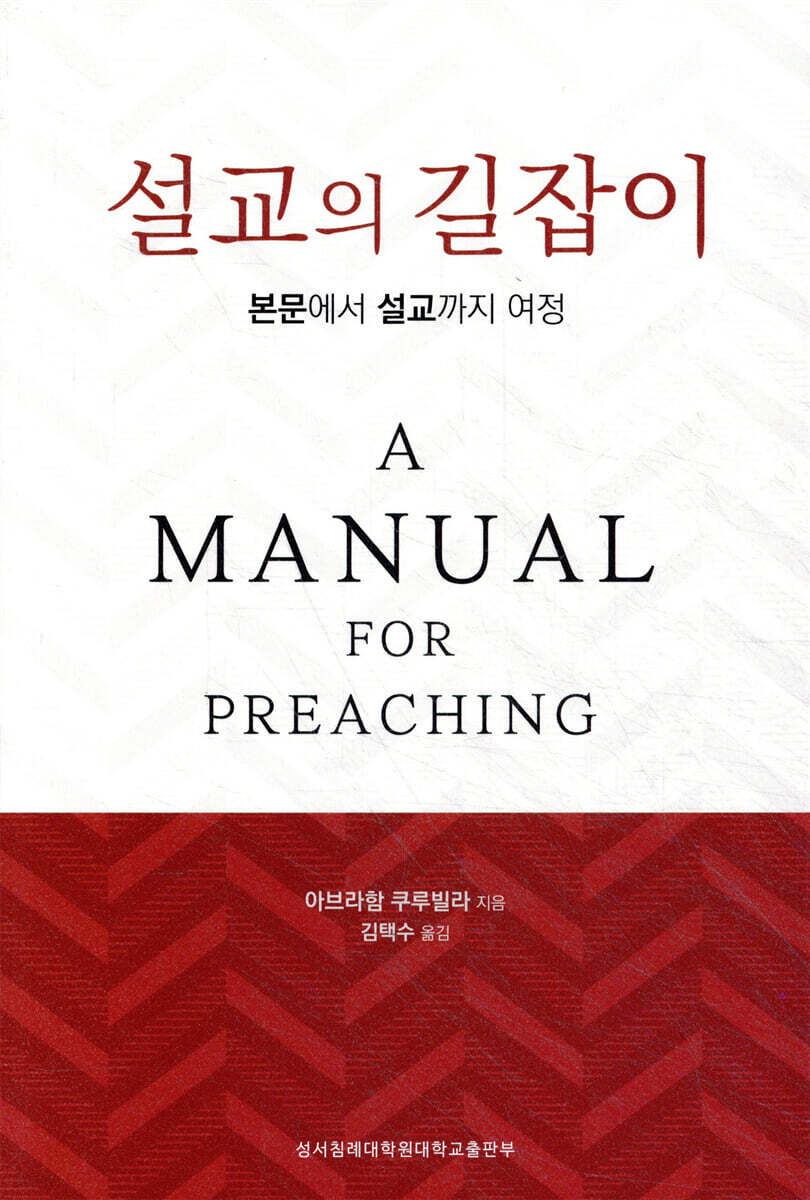
A Guide to Preaching
 |
Description
Book Introduction
The greatest homiletic since Haddon Robinson
We guide you on a sermon journey that glorifies God by conveying pericopean theology and becoming like Christ!
We guide you on a sermon journey that glorifies God by conveying pericopean theology and becoming like Christ!
index
Recommended words _7
Translator's Note: The more you read, the more impressed you become. _21
Author's Greetings from the Korean Edition _23
Author's Note, Remembering Grace _25
Opening the Sermon Journey_Introduction_29
1. Getting Ready for Your Sermon Journey_37
2 Discerning Theology in Pericope_Discerning Theology_77
3 Deriving Application from Pericope Theology_125
4 Creating Maps for Sermon Movement_169
5 Adding Liveliness to Sermon Movements_Fleshing Moves_205
6. Illustrating Sermon Ideas with Illustrations_Illustrating Ideas_153
7 Crafting Introductions and Conclusions _297
8. Producing Manuscripts in Living Language_347
9. Delivering Sermons: Carving the Word into Shape_Delivering Sermons_387
Reflecting on My Preaching Journey_Conclusion_417
supplement
1.
Big Ideas vs. Theological Focus _423
2.
Sermon Argument vs. Demonstration _431
3.
Sermon Manuscript Commentary: Ephesians 1:1-14 _439
4.
Sermon Manuscript Commentary: Genesis 26:1-33 _459
Reference Material _477
Search _495
Translator's Note: The more you read, the more impressed you become. _21
Author's Greetings from the Korean Edition _23
Author's Note, Remembering Grace _25
Opening the Sermon Journey_Introduction_29
1. Getting Ready for Your Sermon Journey_37
2 Discerning Theology in Pericope_Discerning Theology_77
3 Deriving Application from Pericope Theology_125
4 Creating Maps for Sermon Movement_169
5 Adding Liveliness to Sermon Movements_Fleshing Moves_205
6. Illustrating Sermon Ideas with Illustrations_Illustrating Ideas_153
7 Crafting Introductions and Conclusions _297
8. Producing Manuscripts in Living Language_347
9. Delivering Sermons: Carving the Word into Shape_Delivering Sermons_387
Reflecting on My Preaching Journey_Conclusion_417
supplement
1.
Big Ideas vs. Theological Focus _423
2.
Sermon Argument vs. Demonstration _431
3.
Sermon Manuscript Commentary: Ephesians 1:1-14 _439
4.
Sermon Manuscript Commentary: Genesis 26:1-33 _459
Reference Material _477
Search _495
Publisher's Review
In "The Vision of Preaching," he explained "preaching" as a biblical and pastoral ministry, a form of communication within the church community, theological and practical, aimed at transforming believers, and a spiritual ministry that glorifies God.
And at the heart of that vision is hermeneutics, a way of reading the Bible that has shaped how I understand preaching.
Furthermore, that biblical hermeneutics shapes the author's understanding of how preaching should be done.
In other words, this book, "A Guide to Preaching," continues the journey that began with "The Vision of Preaching."
I will summarize what the reader will read in each chapter of this book.
ㆍChapter 1 "Getting Ready for a Preaching Journey" - Covers the basics of preaching, setting the stage for a sequential long-term and short-term plan for preaching.
Long-term planning drives the overall structure of this book.
ㆍChapter 2, "Discerning Theology in Pericope" - Focuses on "hermeneutics," the core of preaching philosophy, that is, how to read and interpret the Bible.
The reader is guided through examples to grasp the core message of various texts, that is, the theology of various pericopes.
ㆍChapter 3 “Deriving Application from Pericopal Theology” - Defines and explains application and the move from pericopal theology to application.
We examine the main features and types of application and suggest ways to effectively apply it when preaching a specific pericope.
ㆍChapter 4 “Creating Maps for Sermon Movements” - Explains the process of creating a sermon through multiple movements.
ㆍChapter 5 “Fleshing Moves” - Explains how to expand on these various movements to enrich your sermons.
Just like the process of putting flesh on bones, the key is to consider the balance between revelation (the main text aspect) and relevance (the audience aspect).
ㆍChapter 6, “Illustrating Ideas in Sermons”—Explores the functions and types of illustrations in sermons, and suggests ways to find and organize illustrations and effectively utilize them in sermons.
ㆍChapter 7, “Crafting Introductions and Conclusions”—This chapter analyzes the structure of introductions and conclusions in sermons and provides practical guidelines for organizing and utilizing them more persuasively.
ㆍChapter 8, “Producing Manuscripts” – Emphasizes the usefulness of writing sermon manuscripts, compares sermons with and without manuscripts, and discusses ways to manage manuscripts using electronic devices when preaching.
It also covers the theological and ethical perspectives on sermon borrowing.
ㆍChapter 9 “Delivering Sermons” – Covers practical elements related to delivering sermons.
We explore important aspects of preaching, including sermon practice, managing tension, preparing just before a sermon, and how to properly wrap up afterward.
- Pages 31-32
Preaching is a procession in which God's shepherd preaches and delivers the word of God, and God's people are formed into the image of God's Son through the power of the Holy Spirit, ultimately giving glory to God.
This is an event of incomparable significance! Therefore, for us who are called to be preachers, this form of communication—the sermon—is of utmost importance.
When we examine and preach the words of the Bible, the listener becomes like Christ (Christlikeness). [Footnote] Preaching is a serious responsibility, a ministry imbued with dignity and specialness.
It is definitely a noble task.
- Pages 37-38
'Pericope (pronounced p─-ri-k─-p─, derived from Greek perikop─ = section, passage; added by the translator and editor.
In the field of homiletics, pericope is often translated as 'paragraph', but the Greek word perikop (translated as 'perikope' according to sound) added by the compiler as a technical term refers to a text of appropriate length that can be used in sermons and ceremonies in a church setting.
- Page 39, footnote 7.
Now that you've decided to preach, the first thing you need to do is choose a text to preach on.
Assuming that you plan to be in the preaching ministry for a long time, I strongly recommend the 'lectio continua' method, that is, selecting a book of the Bible and reading it continuously from pericophe to pericophe, respecting the trajectory of the biblical author's thoughts and the direction of his argument development, and then preaching.
I will simply call this "preaching," without adding any modifiers like textual, topical, or expository. [Footnote] Only this method of preaching helps the audience to understand precisely what the author intended in each pericope and how that intention is connected and developed throughout the book.
Furthermore, through this, the audience can more clearly understand how the author's theological intention to pursue a life that resembles Christ develops.
- Pages 41-42
And at the heart of that vision is hermeneutics, a way of reading the Bible that has shaped how I understand preaching.
Furthermore, that biblical hermeneutics shapes the author's understanding of how preaching should be done.
In other words, this book, "A Guide to Preaching," continues the journey that began with "The Vision of Preaching."
I will summarize what the reader will read in each chapter of this book.
ㆍChapter 1 "Getting Ready for a Preaching Journey" - Covers the basics of preaching, setting the stage for a sequential long-term and short-term plan for preaching.
Long-term planning drives the overall structure of this book.
ㆍChapter 2, "Discerning Theology in Pericope" - Focuses on "hermeneutics," the core of preaching philosophy, that is, how to read and interpret the Bible.
The reader is guided through examples to grasp the core message of various texts, that is, the theology of various pericopes.
ㆍChapter 3 “Deriving Application from Pericopal Theology” - Defines and explains application and the move from pericopal theology to application.
We examine the main features and types of application and suggest ways to effectively apply it when preaching a specific pericope.
ㆍChapter 4 “Creating Maps for Sermon Movements” - Explains the process of creating a sermon through multiple movements.
ㆍChapter 5 “Fleshing Moves” - Explains how to expand on these various movements to enrich your sermons.
Just like the process of putting flesh on bones, the key is to consider the balance between revelation (the main text aspect) and relevance (the audience aspect).
ㆍChapter 6, “Illustrating Ideas in Sermons”—Explores the functions and types of illustrations in sermons, and suggests ways to find and organize illustrations and effectively utilize them in sermons.
ㆍChapter 7, “Crafting Introductions and Conclusions”—This chapter analyzes the structure of introductions and conclusions in sermons and provides practical guidelines for organizing and utilizing them more persuasively.
ㆍChapter 8, “Producing Manuscripts” – Emphasizes the usefulness of writing sermon manuscripts, compares sermons with and without manuscripts, and discusses ways to manage manuscripts using electronic devices when preaching.
It also covers the theological and ethical perspectives on sermon borrowing.
ㆍChapter 9 “Delivering Sermons” – Covers practical elements related to delivering sermons.
We explore important aspects of preaching, including sermon practice, managing tension, preparing just before a sermon, and how to properly wrap up afterward.
- Pages 31-32
Preaching is a procession in which God's shepherd preaches and delivers the word of God, and God's people are formed into the image of God's Son through the power of the Holy Spirit, ultimately giving glory to God.
This is an event of incomparable significance! Therefore, for us who are called to be preachers, this form of communication—the sermon—is of utmost importance.
When we examine and preach the words of the Bible, the listener becomes like Christ (Christlikeness). [Footnote] Preaching is a serious responsibility, a ministry imbued with dignity and specialness.
It is definitely a noble task.
- Pages 37-38
'Pericope (pronounced p─-ri-k─-p─, derived from Greek perikop─ = section, passage; added by the translator and editor.
In the field of homiletics, pericope is often translated as 'paragraph', but the Greek word perikop (translated as 'perikope' according to sound) added by the compiler as a technical term refers to a text of appropriate length that can be used in sermons and ceremonies in a church setting.
- Page 39, footnote 7.
Now that you've decided to preach, the first thing you need to do is choose a text to preach on.
Assuming that you plan to be in the preaching ministry for a long time, I strongly recommend the 'lectio continua' method, that is, selecting a book of the Bible and reading it continuously from pericophe to pericophe, respecting the trajectory of the biblical author's thoughts and the direction of his argument development, and then preaching.
I will simply call this "preaching," without adding any modifiers like textual, topical, or expository. [Footnote] Only this method of preaching helps the audience to understand precisely what the author intended in each pericope and how that intention is connected and developed throughout the book.
Furthermore, through this, the audience can more clearly understand how the author's theological intention to pursue a life that resembles Christ develops.
- Pages 41-42
GOODS SPECIFICS
- Date of issue: May 5, 2025
- Page count, weight, size: 508 pages | 153*225*35mm
- ISBN13: 9791189118235
- ISBN10: 1189118238
You may also like
카테고리
korean


korean

![ELLE 엘르 스페셜 에디션 A형 : 12월 [2025]](http://librairie.coreenne.fr/cdn/shop/files/b8e27a3de6c9538896439686c6b0e8fb.jpg?v=1766436872&width=3840)


