

Tim Keller on the Christian Life
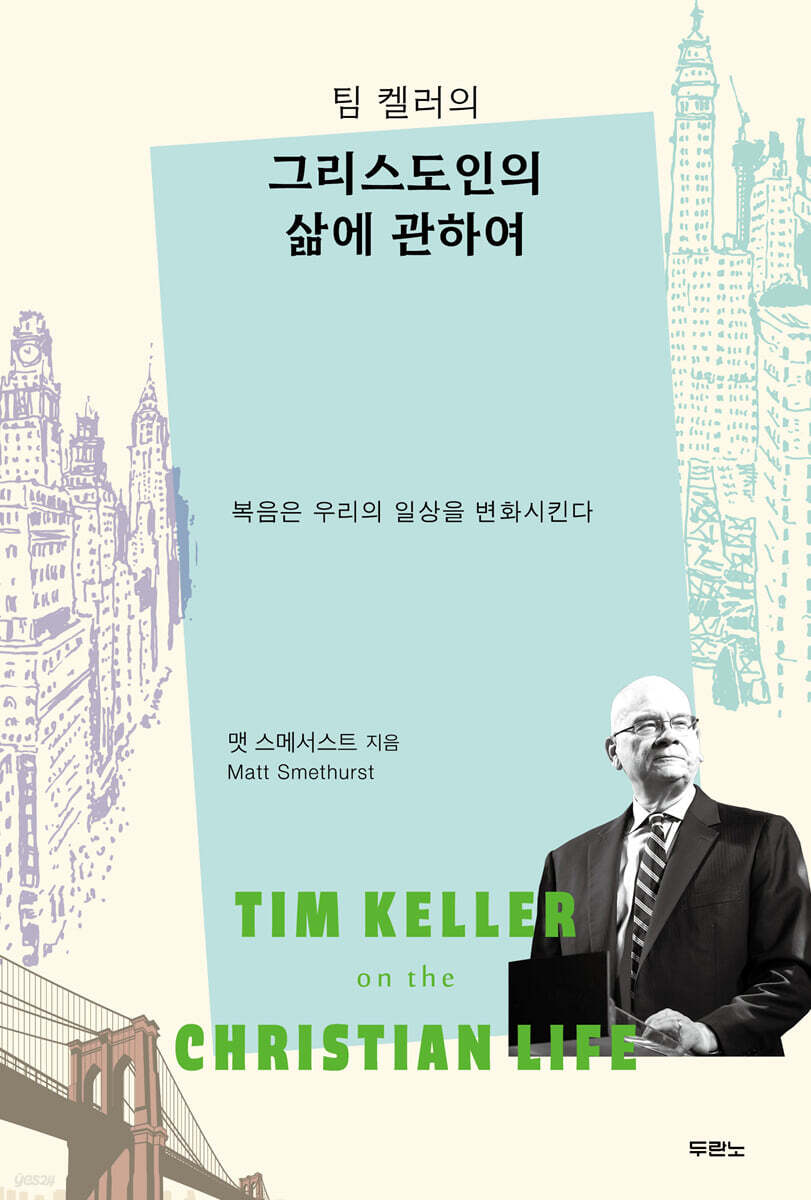 |
Description
Book Introduction
On the second anniversary of Pastor Tim Keller's death
The Christian Life: Ask Tim Keller for Directions
What does it mean to live like a Christian today?
Hear Tim Keller's wisdom for those who struggle
Living the Gospel, Speaking the Gospel Through Life
“A Life Rooted in God: Following the Eight Paths”
Recommended by Cathy Keller, Jeong Gap-shin, Lee In-ho, Park Tae-yang, Lee Jae-hoon, and Ko Sang-seop!!
Pastor Tim Keller on the Christian Life
"The Gospel changes lives." This declaration is not just a slogan, but a powerful force that brings about real change.
A book has been published for Christians who want to live out that change in their daily lives.
This book is a culmination of Pastor Tim Keller's pastoral legacy, and is based on the thousands of sermons and dozens of books he left behind, compiling "Eight Ways the Gospel Transforms Lives."
This book is neither a simple essay on faith nor a general discipleship manual.
Author Matt Smethurst has spent years compiling Tim Keller's vast collection of sermons, writings, lectures, and previously unpublished materials to compile Tim Keller's uniquely profound and practical response to the question, "What is the Christian life?"
Every word is imbued with the fragrance of the gospel.
This book focuses on the “8 Life-Changing Gospels” and guides us on how to live a “living faith” rather than a “life of belief.”
The Christian Life: Ask Tim Keller for Directions
What does it mean to live like a Christian today?
Hear Tim Keller's wisdom for those who struggle
Living the Gospel, Speaking the Gospel Through Life
“A Life Rooted in God: Following the Eight Paths”
Recommended by Cathy Keller, Jeong Gap-shin, Lee In-ho, Park Tae-yang, Lee Jae-hoon, and Ko Sang-seop!!
Pastor Tim Keller on the Christian Life
"The Gospel changes lives." This declaration is not just a slogan, but a powerful force that brings about real change.
A book has been published for Christians who want to live out that change in their daily lives.
This book is a culmination of Pastor Tim Keller's pastoral legacy, and is based on the thousands of sermons and dozens of books he left behind, compiling "Eight Ways the Gospel Transforms Lives."
This book is neither a simple essay on faith nor a general discipleship manual.
Author Matt Smethurst has spent years compiling Tim Keller's vast collection of sermons, writings, lectures, and previously unpublished materials to compile Tim Keller's uniquely profound and practical response to the question, "What is the Christian life?"
Every word is imbued with the fragrance of the gospel.
This book focuses on the “8 Life-Changing Gospels” and guides us on how to live a “living faith” rather than a “life of belief.”
- You can preview some of the book's contents.
Preview
index
Recommended Reading 1 _ A Book Containing Wisdom for Living Like a Christian
Recommendation 2 - A Good Guide for Those Who Want to Live the Gospel
Prologue _ Synthesizing the Masters of Synthesis
1.
One and only hero
The One to Whom All the Bible Points, Jesus Christ
2.
Dig into sin
Reordering the love of the wrong order
3.
Three Ways of Life
Why Religion Needs Grace
4.
Friendship with a purpose
How the Gospel Transforms Relationships
5.
When faith goes to work
Serving God and Neighbors Through Work
6.
Do justice and love mercy.
Embodying the King's Mercy
7.
Heaven's answer
How Prayer Opens Intimacy with God
8.
A painful gift
How Suffering Drives Us to the Heart of God
Epilogue: Great Humility: Exalting Only Christ
Acknowledgements
main
Recommendation 2 - A Good Guide for Those Who Want to Live the Gospel
Prologue _ Synthesizing the Masters of Synthesis
1.
One and only hero
The One to Whom All the Bible Points, Jesus Christ
2.
Dig into sin
Reordering the love of the wrong order
3.
Three Ways of Life
Why Religion Needs Grace
4.
Friendship with a purpose
How the Gospel Transforms Relationships
5.
When faith goes to work
Serving God and Neighbors Through Work
6.
Do justice and love mercy.
Embodying the King's Mercy
7.
Heaven's answer
How Prayer Opens Intimacy with God
8.
A painful gift
How Suffering Drives Us to the Heart of God
Epilogue: Great Humility: Exalting Only Christ
Acknowledgements
main
Into the book
When we read the Bible, we tend to “jump to the gospel” too quickly.
In that case, we may neglect the text itself that we are dealing with and fail to properly appreciate it.
These concerns are justified.
But thankfully, the instinct to discover Christ responsibly can be honed.
In fact, the experience is similar to watching the movie The Sixth Sense starring Bruce Willis for the second time.
Tim Keller explains it this way:
The film's shocking ending forces the audience to reinterpret every scene they've seen so far.
When you watch a movie for the second time, you can't help but be conscious of the ending even after watching the beginning and middle parts.
Because the ending sheds an undeniable light on all the preceding scenes.
Likewise, once we realize that the flow of every story and the climax of every theme in the Bible converge in Christ, we cannot help but see that any passage we read ultimately points to Jesus.
Tim Keller says there are two ways to read the Bible.
One way is to read the Bible as a story about yourself, and the other way is to read the Bible as a story about Him.
These two approaches are “fundamentally different.” Yes.
We must obey what the Bible says.
But if we read the Bible as a story about us—a list of things we must do to live worthy of God—it will ultimately crush us into submission.
But if we read the Bible as a story of salvation by grace through Jesus Christ, it will melt our hearts and make us willing to obey.
Every other culture, every other religion, every other philosophy gives us an identity based on our achievements.
Because it is an identity we create based on what we have accomplished, it can be easily broken depending on how we are.
But Christianity alone gives us an identity that is independent of who we are.
It doesn't break easily.
Stronger than heaven and earth.
It says this:
“I love you.
You are my beloved child, and I am very pleased with you.
It is not because of what you have accomplished, but because of what Jesus Christ has already accomplished.” Only when you read the Bible in this way does it become a life-changing story.
Otherwise, the Bible will weigh us down like a millstone around our neck.
If we view the Bible simply as a textbook, a devotional, or a moral guide, we miss its breathtaking beauty.
Above all, the Word of God is a book about Jesus.
Every time you open the Bible, don't miss His glory, majesty, and beauty.
Christ is everything. (From Chapter 1)
The greatest danger that threatens us all is not a matter of conduct or behavior, but idolatry.
This may sound unfamiliar to some.
They may think that, above all, we need to hear warnings about what we should not do.
… [But] our actions and behavior always stem from our attitudes and thoughts.
…the greatest danger in the spiritual life is idolatry, which permeates all our activities.
Tim Keller recalled.
“When I read this passage, it was like a ton of bricks falling on me.” This notion that the essence of sin lies in wrong worship became a “revolutionary principle” for him.
“After realizing this, I started making changes in my life.
And I found myself helping people much more effectively in my counseling and preaching than I ever had before.” Having just started a church, he began to explore the realm behind our actions.
Why do we commit certain sins? The answer is uncomfortable to hear.
“Because something other than God has become the real master of my heart.
Something other than God has become my beauty, something other than God has become my highest good.
“At the root of all sin is always idolatry.” Tim Keller, in one of his early sermons at Redeemer, said this, drawing on his new insight into the sharpening of idolatry:
“We all have ‘little masters,’ ‘little gods,’ and ‘false gods.’
…we worship such gods and at the same time are bound to them.
They rule our lives.
We are complicit in our own kidnapping.”
--- From Chapter 2
The inevitable intruder, pain
If you haven't experienced much grief by now, it's probably because you haven't lived very long.
Tim Keller addresses this issue candidly.
“No matter how careful we are, how well we plan our lives, how hard we work to be healthy and wealthy, to have good relationships with friends and family, and to be successful professionally, eventually something will ruin it.” No amount of “money, power, or planning” can stop the tentacles of suffering from reaching into our lives.
“Life is a tragedy.
(Omitted) The mysterious truth about this subject, as experienced Christians will attest, is that suffering often opens up a deeper and sweeter intimacy with the living God.
Tim Keller says:
God gives us full joy not “despite” the pain, but “through” the pain.
Indeed, “there is a special, rich, and heart-wrenching joy that seems to come to us only through suffering and only in suffering.”
In that case, we may neglect the text itself that we are dealing with and fail to properly appreciate it.
These concerns are justified.
But thankfully, the instinct to discover Christ responsibly can be honed.
In fact, the experience is similar to watching the movie The Sixth Sense starring Bruce Willis for the second time.
Tim Keller explains it this way:
The film's shocking ending forces the audience to reinterpret every scene they've seen so far.
When you watch a movie for the second time, you can't help but be conscious of the ending even after watching the beginning and middle parts.
Because the ending sheds an undeniable light on all the preceding scenes.
Likewise, once we realize that the flow of every story and the climax of every theme in the Bible converge in Christ, we cannot help but see that any passage we read ultimately points to Jesus.
Tim Keller says there are two ways to read the Bible.
One way is to read the Bible as a story about yourself, and the other way is to read the Bible as a story about Him.
These two approaches are “fundamentally different.” Yes.
We must obey what the Bible says.
But if we read the Bible as a story about us—a list of things we must do to live worthy of God—it will ultimately crush us into submission.
But if we read the Bible as a story of salvation by grace through Jesus Christ, it will melt our hearts and make us willing to obey.
Every other culture, every other religion, every other philosophy gives us an identity based on our achievements.
Because it is an identity we create based on what we have accomplished, it can be easily broken depending on how we are.
But Christianity alone gives us an identity that is independent of who we are.
It doesn't break easily.
Stronger than heaven and earth.
It says this:
“I love you.
You are my beloved child, and I am very pleased with you.
It is not because of what you have accomplished, but because of what Jesus Christ has already accomplished.” Only when you read the Bible in this way does it become a life-changing story.
Otherwise, the Bible will weigh us down like a millstone around our neck.
If we view the Bible simply as a textbook, a devotional, or a moral guide, we miss its breathtaking beauty.
Above all, the Word of God is a book about Jesus.
Every time you open the Bible, don't miss His glory, majesty, and beauty.
Christ is everything. (From Chapter 1)
The greatest danger that threatens us all is not a matter of conduct or behavior, but idolatry.
This may sound unfamiliar to some.
They may think that, above all, we need to hear warnings about what we should not do.
… [But] our actions and behavior always stem from our attitudes and thoughts.
…the greatest danger in the spiritual life is idolatry, which permeates all our activities.
Tim Keller recalled.
“When I read this passage, it was like a ton of bricks falling on me.” This notion that the essence of sin lies in wrong worship became a “revolutionary principle” for him.
“After realizing this, I started making changes in my life.
And I found myself helping people much more effectively in my counseling and preaching than I ever had before.” Having just started a church, he began to explore the realm behind our actions.
Why do we commit certain sins? The answer is uncomfortable to hear.
“Because something other than God has become the real master of my heart.
Something other than God has become my beauty, something other than God has become my highest good.
“At the root of all sin is always idolatry.” Tim Keller, in one of his early sermons at Redeemer, said this, drawing on his new insight into the sharpening of idolatry:
“We all have ‘little masters,’ ‘little gods,’ and ‘false gods.’
…we worship such gods and at the same time are bound to them.
They rule our lives.
We are complicit in our own kidnapping.”
--- From Chapter 2
The inevitable intruder, pain
If you haven't experienced much grief by now, it's probably because you haven't lived very long.
Tim Keller addresses this issue candidly.
“No matter how careful we are, how well we plan our lives, how hard we work to be healthy and wealthy, to have good relationships with friends and family, and to be successful professionally, eventually something will ruin it.” No amount of “money, power, or planning” can stop the tentacles of suffering from reaching into our lives.
“Life is a tragedy.
(Omitted) The mysterious truth about this subject, as experienced Christians will attest, is that suffering often opens up a deeper and sweeter intimacy with the living God.
Tim Keller says:
God gives us full joy not “despite” the pain, but “through” the pain.
Indeed, “there is a special, rich, and heart-wrenching joy that seems to come to us only through suffering and only in suffering.”
--- From the text
Publisher's Review
The Gospel, the Root of Life: Eight Invitations
Through eight chapters and eight invitations, let us follow the path of living a Christian life in this age.
1.
One Hero: Every scene in the Bible ultimately flows toward Jesus.
Tim Keller points to only one hero in the Bible: Jesus Christ.
When the way we look at the Bible changes, the way we look at life also changes.
You will come to realize the importance of reading the Bible from beginning to end with Christ at the center.
2.
Digging into Sin: Sin is not just bad behavior, it is a misdirection of love.
He slowly dissects our deep pain, desires, and the distorted love created by idols, and says that only the gospel gives true freedom.
We are invited to reject the idols of our hearts.
3.
Three ways of life: legalism, self-centered freedom, and the third way of the gospel.
This chapter makes us confess how easily we live without grace and shows us how the gospel is not a new standard but a new life.
4.
Purposeful Friendship: The Gospel Changes Distances Between People
A friend who tells the truth, suffers together, and aims for eternity together.
Keller says that friendship is the warmest ground in which the gospel can take root.
5.
When Faith Goes to Work: 'Calling' Isn't Just a Word for Ministers
Keller reminds us all that ordinary work, the small, repetitive tasks of daily life, are the places where God's kingdom is built.
6.
Do justice and love mercy: the grace received cannot remain unflowing.
The gospel that reaches into the darkest alleys of the city, a message that connects social responsibility and individual salvation—this was Keller's definition of the gospel.
7.
Heaven's Answer - Prayer: Prayer is not a request, but an encounter.
In this age of silence and questioning, Keller gently and persuasively demonstrates that prayer remains an intimate conversation with God.
8.
Painful Gift - Suffering; Grace begins where the question "Why?" ends.
Even in his final journey with cancer, Keller confessed that suffering was “God’s invitation to draw us deeper into Him.”
The Power of the Gospel to Transform Our Daily Lives
This book will be a gift to today's Christians who seek to live the gospel in their lives.
I hope to be challenged by the fact that 'the gospel changes our daily lives and everything our lives touch.'
Like Tim Keller's challenge, 'Read the Bible with the heart of Jesus,' 'Reject the idols within you,' 'Avoid moralism,' 'Be a good friend,' 'Work for the glory of God,' 'Live justly,' 'Pray passionately,' 'Endure suffering courageously.' So, I hope the gospel will change us and everything our lives touch.
Through eight chapters and eight invitations, let us follow the path of living a Christian life in this age.
1.
One Hero: Every scene in the Bible ultimately flows toward Jesus.
Tim Keller points to only one hero in the Bible: Jesus Christ.
When the way we look at the Bible changes, the way we look at life also changes.
You will come to realize the importance of reading the Bible from beginning to end with Christ at the center.
2.
Digging into Sin: Sin is not just bad behavior, it is a misdirection of love.
He slowly dissects our deep pain, desires, and the distorted love created by idols, and says that only the gospel gives true freedom.
We are invited to reject the idols of our hearts.
3.
Three ways of life: legalism, self-centered freedom, and the third way of the gospel.
This chapter makes us confess how easily we live without grace and shows us how the gospel is not a new standard but a new life.
4.
Purposeful Friendship: The Gospel Changes Distances Between People
A friend who tells the truth, suffers together, and aims for eternity together.
Keller says that friendship is the warmest ground in which the gospel can take root.
5.
When Faith Goes to Work: 'Calling' Isn't Just a Word for Ministers
Keller reminds us all that ordinary work, the small, repetitive tasks of daily life, are the places where God's kingdom is built.
6.
Do justice and love mercy: the grace received cannot remain unflowing.
The gospel that reaches into the darkest alleys of the city, a message that connects social responsibility and individual salvation—this was Keller's definition of the gospel.
7.
Heaven's Answer - Prayer: Prayer is not a request, but an encounter.
In this age of silence and questioning, Keller gently and persuasively demonstrates that prayer remains an intimate conversation with God.
8.
Painful Gift - Suffering; Grace begins where the question "Why?" ends.
Even in his final journey with cancer, Keller confessed that suffering was “God’s invitation to draw us deeper into Him.”
The Power of the Gospel to Transform Our Daily Lives
This book will be a gift to today's Christians who seek to live the gospel in their lives.
I hope to be challenged by the fact that 'the gospel changes our daily lives and everything our lives touch.'
Like Tim Keller's challenge, 'Read the Bible with the heart of Jesus,' 'Reject the idols within you,' 'Avoid moralism,' 'Be a good friend,' 'Work for the glory of God,' 'Live justly,' 'Pray passionately,' 'Endure suffering courageously.' So, I hope the gospel will change us and everything our lives touch.
GOODS SPECIFICS
- Date of issue: May 14, 2025
- Page count, weight, size: 308 pages | 414g | 142*210*19mm
- ISBN13: 9788953151031
- ISBN10: 8953151031
You may also like
카테고리
korean


korean

![GQ KOREA Mark (Monthly): December [2025]](http://librairie.coreenne.fr/cdn/shop/files/8ef265dbbfbf186523ed75ba7319009d.jpg?v=1765340328&width=3840)


