

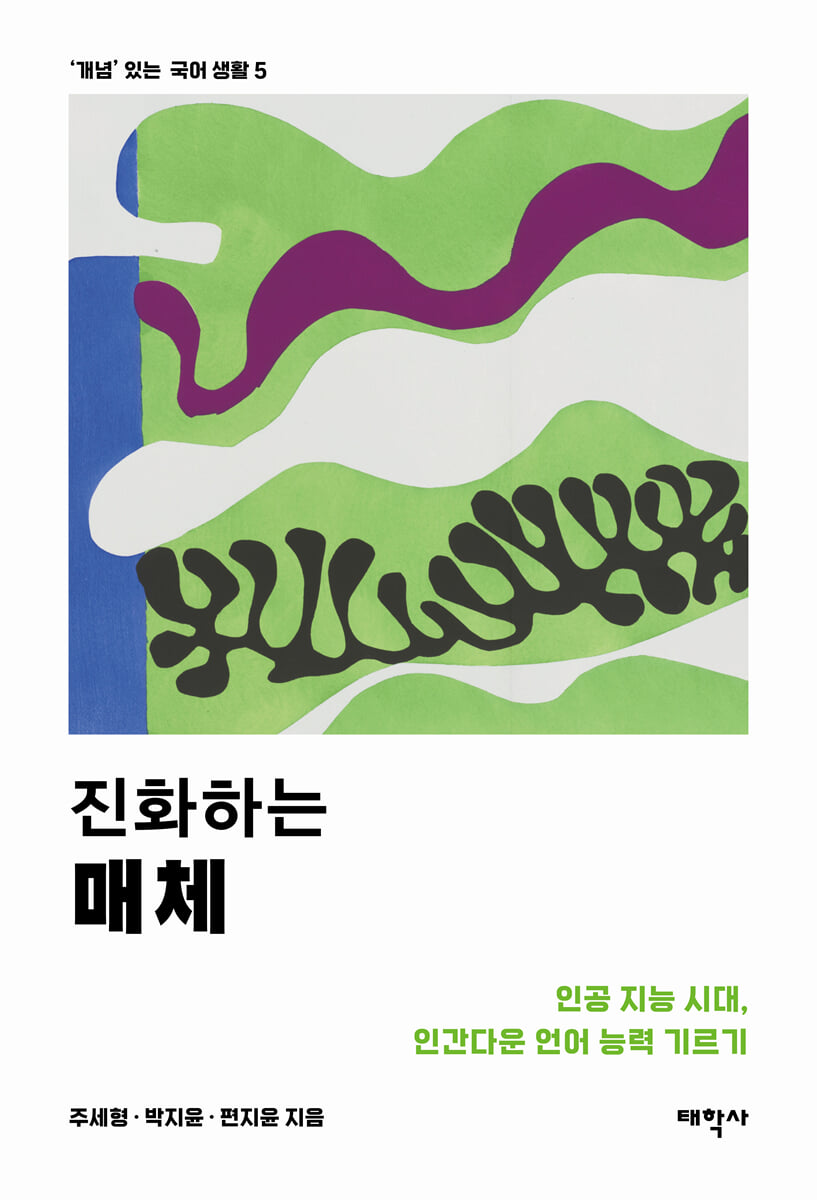
Evolving Media
 |
Description
Book Introduction
A Teacher's Reference Book that Can Be Applied Immediately to Real-World Classes
A must-read for students that will improve their skills in all subjects, starting with Korean.
A Citizen's Guide to Social Life
Media, the essence of Korean language education,
From its phase and meaning to the aspects of evolution
ㆍAre written language and books truly the superior medium?
ㆍIs it because learning fractions in elementary school math is for Korean language education?
ㆍIs drama something to be watched or read?
ㆍHow have hyperlinks changed the structure of writing?
ㆍWho is the writer and who is the reader?
We check the news on our smartphones every morning, stream dramas and movies, and utilize personalized information recommended by artificial intelligence.
In this way, human life is inextricably linked to various media.
Not only digital media, but also paper books, radio, television, and printed newspapers are all media that mediate human communication.
Meanwhile, media is constantly evolving as technology advances, and the nature of language and text, as well as the communication methods and cultures that utilize them, are constantly changing.
Therefore, discussing media in Korean language education can be said to be an essential task.
Media education has been widely covered in various fields such as social studies, computer education, library education, and art education. However, the reason for emphasizing media in Korean language education is not simply to learn media utilization skills.
This is because the process of learning and utilizing language itself is implemented through media.
In other words, in Korean language education, media is not a peripheral topic, but a core topic for understanding and teaching language skills.
With this problem in mind, this book, “Evolving Media,” was written.
Through this book, the authors argue that language activity is an essential mechanism that characterizes humanity, and that a deep understanding of the medium that mediates it is an important educational foundation for developing human capabilities.
A must-read for students that will improve their skills in all subjects, starting with Korean.
A Citizen's Guide to Social Life
Media, the essence of Korean language education,
From its phase and meaning to the aspects of evolution
ㆍAre written language and books truly the superior medium?
ㆍIs it because learning fractions in elementary school math is for Korean language education?
ㆍIs drama something to be watched or read?
ㆍHow have hyperlinks changed the structure of writing?
ㆍWho is the writer and who is the reader?
We check the news on our smartphones every morning, stream dramas and movies, and utilize personalized information recommended by artificial intelligence.
In this way, human life is inextricably linked to various media.
Not only digital media, but also paper books, radio, television, and printed newspapers are all media that mediate human communication.
Meanwhile, media is constantly evolving as technology advances, and the nature of language and text, as well as the communication methods and cultures that utilize them, are constantly changing.
Therefore, discussing media in Korean language education can be said to be an essential task.
Media education has been widely covered in various fields such as social studies, computer education, library education, and art education. However, the reason for emphasizing media in Korean language education is not simply to learn media utilization skills.
This is because the process of learning and utilizing language itself is implemented through media.
In other words, in Korean language education, media is not a peripheral topic, but a core topic for understanding and teaching language skills.
With this problem in mind, this book, “Evolving Media,” was written.
Through this book, the authors argue that language activity is an essential mechanism that characterizes humanity, and that a deep understanding of the medium that mediates it is an important educational foundation for developing human capabilities.
- You can preview some of the book's contents.
Preview
index
A word from the 'Conceptual Korean Language Life' project
preface
Class 1.
Media and the Essence of Korean Language Education
Why is media used in Korean language education?
Are written language and books truly the superior medium?
Is it because learning fractions in elementary school math is educational in the Korean language?
Is giving and receiving gifts also part of Korean language education?
The change in media that changed the typical format of news articles - Is it a newspaper article or a novel?
What's the difference between past and present bank advertisements?
Class 2.
Reading Evolves with Media - From 'Reading the Media' to 'Reading Beyond the Media'
Is the media a mirror that shows reality 'as it is' and 'objectively'?
Is drama something you watch or something you read?
‘Reading’ also evolves along with the media!
Is the reading that children learn these days different? (1) - Sometimes, reading shallowly and broadly can be a virtue!
Is the reading that children learn these days different? (2) - We must read algorithms beyond text!
Class 3.
Writing Evolves with Media - From "Writing in Media" to "Writing Beyond Media"
Cuneiform script is the beginning of digital recording media?
How have hyperlinks changed the structure of writing?
Thumbnails have become more important than the body of the article!
Who is the writer and who is the reader?
Artificial Intelligence and Media Writing - Creative Tools or Ethical Challenges?
Note
References
preface
Class 1.
Media and the Essence of Korean Language Education
Why is media used in Korean language education?
Are written language and books truly the superior medium?
Is it because learning fractions in elementary school math is educational in the Korean language?
Is giving and receiving gifts also part of Korean language education?
The change in media that changed the typical format of news articles - Is it a newspaper article or a novel?
What's the difference between past and present bank advertisements?
Class 2.
Reading Evolves with Media - From 'Reading the Media' to 'Reading Beyond the Media'
Is the media a mirror that shows reality 'as it is' and 'objectively'?
Is drama something you watch or something you read?
‘Reading’ also evolves along with the media!
Is the reading that children learn these days different? (1) - Sometimes, reading shallowly and broadly can be a virtue!
Is the reading that children learn these days different? (2) - We must read algorithms beyond text!
Class 3.
Writing Evolves with Media - From "Writing in Media" to "Writing Beyond Media"
Cuneiform script is the beginning of digital recording media?
How have hyperlinks changed the structure of writing?
Thumbnails have become more important than the body of the article!
Who is the writer and who is the reader?
Artificial Intelligence and Media Writing - Creative Tools or Ethical Challenges?
Note
References
Detailed image
Publisher's Review
From 'Why media is important in Korean language education'
Reading and writing that evolves with the media
Chapter 1 begins with the fundamental question, "Are books and written language the only media?" and explores the status and significance of media as the essence of Korean language education.
Korean language education is a subject that deals with the phenomenon of human communication, not language itself, and 'language' is at the center of it as the oldest medium.
However, with the development of technology, media have diversified, and people are now communicating through complex texts that combine not only text but also images, sounds, and movements.
Accordingly, the concept of new literacies emerged, and Korean language education began to encompass various semiotic systems and socio-semiotic perspectives.
The authors emphasize that while books remain a key medium for conveying structured knowledge, there is a need for education that trains students in the structure of written language in a video-centric media environment.
He also argues that the content of Korean language education should be expanded to include children's complex formal expressions, nonverbal communication, and the ability to interpret visual symbols such as comics and advertisements, and shows the process by which media changes alter linguistic choices, the nature of genres, and even ways of thinking.
Chapter 2 deals with the changing nature and expanding horizons of reading as media evolve.
Here, the authors emphasize that media literacy is not simply a skill, but the ability to critically read and judge how media represent reality, and that it requires understanding the "process of reconstructing reality," such as news, comments, and algorithmic recommendations.
This is because reading in the digital age expands to the process of interpreting complex texts that combine not only written language but also images, sounds, and videos.
Also, as McLuhan said, the medium itself constitutes the message, reading also constantly evolves along with changes in the medium.
He argues that we need to expand from the "deep reading" of print media to the "horizontal reading" of digital media, and further to "critical algorithmic literacy" that interprets algorithms and their socio-cultural contexts. He reminds us that reading is no longer confined to text, but rather an active act of interpreting the world.
Chapter 3 analyzes how new media environments have reshaped the structure and form of writing.
Humanity's desire to record things has continued from clay tablets to the cloud.
The recording medium that began with cuneiform clay tablets has led to digital archives like Google Books and the COVID-19 Web Archive, which clearly demonstrate how human knowledge is preserved and social memory is formed.
The advent of hypertext and QR codes subsequently transformed writing into a nonlinear, connected structure, expanding into a complex form of writing combining text, images, and video.
Writing in the digital age has evolved into short, visual expressions, with thumbnails and hashtags becoming the new grammar, and collective intelligence and comment culture breaking down the barriers between writers and readers.
Finally, the authors emphasize that collaboration with artificial intelligence is emerging as both a creative tool and an ethical challenge, while the subject and responsibility for writing still lies with humans.
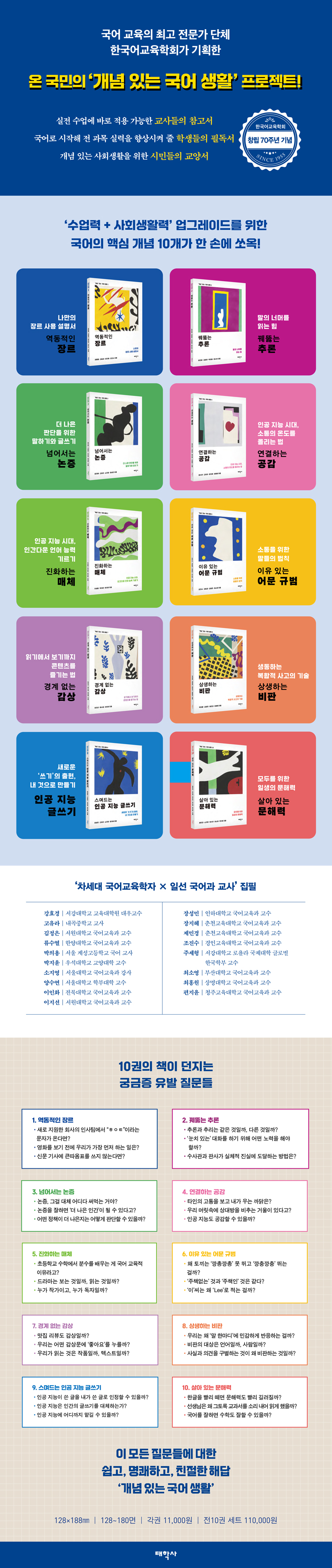
Korean Language Life with 'Concepts' (10 Volumes, Part 1)
"Conceptual Korean Language Life" is a publication by the Korean Language Education Society, Korea's first, best, and largest academic organization. To celebrate its 70th anniversary (launched as the "Korean Language Education Research Society" in 1955), the Society selects and publishes 20 of the most important "concepts" in Korean language education to summarize its academic achievements to date. The publication plan is to begin with the first 10 volumes in 2025, with the remaining 10 volumes to be completed in 2026.
This series was centered around the next generation of Korean language education scholars who will lead the Korean language education field and teachers who are leading the Korean language education field. It was planned with the goal of providing practical help not only to teachers and students in school education, but also to contribute to the language life of ordinary citizens by writing easy-to-understand content on the 'concepts' that are important in Korean language education.
Reading and writing that evolves with the media
Chapter 1 begins with the fundamental question, "Are books and written language the only media?" and explores the status and significance of media as the essence of Korean language education.
Korean language education is a subject that deals with the phenomenon of human communication, not language itself, and 'language' is at the center of it as the oldest medium.
However, with the development of technology, media have diversified, and people are now communicating through complex texts that combine not only text but also images, sounds, and movements.
Accordingly, the concept of new literacies emerged, and Korean language education began to encompass various semiotic systems and socio-semiotic perspectives.
The authors emphasize that while books remain a key medium for conveying structured knowledge, there is a need for education that trains students in the structure of written language in a video-centric media environment.
He also argues that the content of Korean language education should be expanded to include children's complex formal expressions, nonverbal communication, and the ability to interpret visual symbols such as comics and advertisements, and shows the process by which media changes alter linguistic choices, the nature of genres, and even ways of thinking.
Chapter 2 deals with the changing nature and expanding horizons of reading as media evolve.
Here, the authors emphasize that media literacy is not simply a skill, but the ability to critically read and judge how media represent reality, and that it requires understanding the "process of reconstructing reality," such as news, comments, and algorithmic recommendations.
This is because reading in the digital age expands to the process of interpreting complex texts that combine not only written language but also images, sounds, and videos.
Also, as McLuhan said, the medium itself constitutes the message, reading also constantly evolves along with changes in the medium.
He argues that we need to expand from the "deep reading" of print media to the "horizontal reading" of digital media, and further to "critical algorithmic literacy" that interprets algorithms and their socio-cultural contexts. He reminds us that reading is no longer confined to text, but rather an active act of interpreting the world.
Chapter 3 analyzes how new media environments have reshaped the structure and form of writing.
Humanity's desire to record things has continued from clay tablets to the cloud.
The recording medium that began with cuneiform clay tablets has led to digital archives like Google Books and the COVID-19 Web Archive, which clearly demonstrate how human knowledge is preserved and social memory is formed.
The advent of hypertext and QR codes subsequently transformed writing into a nonlinear, connected structure, expanding into a complex form of writing combining text, images, and video.
Writing in the digital age has evolved into short, visual expressions, with thumbnails and hashtags becoming the new grammar, and collective intelligence and comment culture breaking down the barriers between writers and readers.
Finally, the authors emphasize that collaboration with artificial intelligence is emerging as both a creative tool and an ethical challenge, while the subject and responsibility for writing still lies with humans.
Korean Language Life with 'Concepts' (10 Volumes, Part 1)
"Conceptual Korean Language Life" is a publication by the Korean Language Education Society, Korea's first, best, and largest academic organization. To celebrate its 70th anniversary (launched as the "Korean Language Education Research Society" in 1955), the Society selects and publishes 20 of the most important "concepts" in Korean language education to summarize its academic achievements to date. The publication plan is to begin with the first 10 volumes in 2025, with the remaining 10 volumes to be completed in 2026.
This series was centered around the next generation of Korean language education scholars who will lead the Korean language education field and teachers who are leading the Korean language education field. It was planned with the goal of providing practical help not only to teachers and students in school education, but also to contribute to the language life of ordinary citizens by writing easy-to-understand content on the 'concepts' that are important in Korean language education.
GOODS SPECIFICS
- Date of issue: October 18, 2025
- Page count, weight, size: 144 pages | 128*188*20mm
- ISBN13: 9791168103849
- ISBN10: 1168103843
You may also like
카테고리
korean


korean

![GQ KOREA Mark (Monthly): December [2025]](http://librairie.coreenne.fr/cdn/shop/files/8ef265dbbfbf186523ed75ba7319009d.jpg?v=1765340328&width=3840)


