

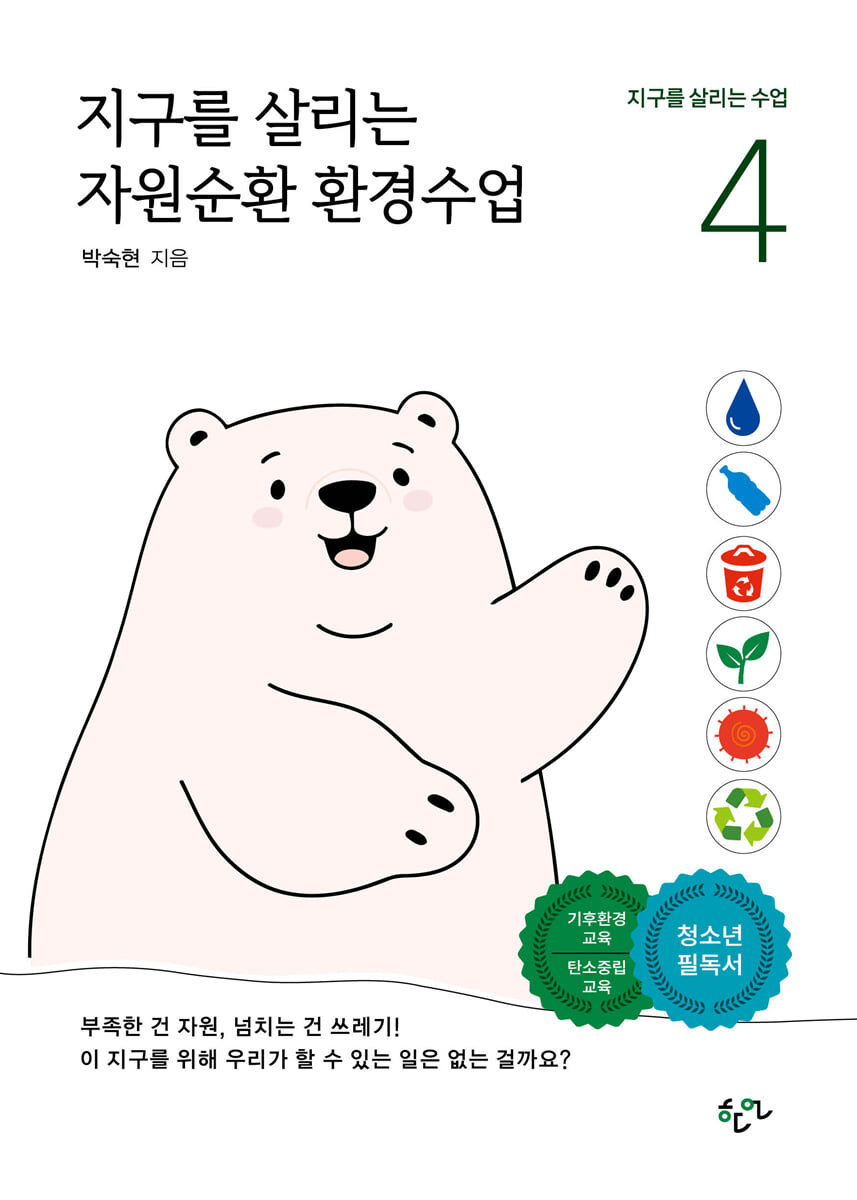
Resource Circulation Environmental Class to Save the Earth
 |
Description
Book Introduction
What if our small 'inconveniences' made the Earth's heart beat stronger?
If only we could keep the Earth's circulatory system healthy through our efforts!
Every year, we hear stories of whales washing up dead on shore with their stomachs full of plastic.
Crabs that make their homes out of plastic bottle caps are also appearing frequently, and plastic islands are floating in the middle of the Pacific Ocean.
A few years ago, our country was in an uproar due to a waste plastic waste crisis.
This happened because there was no longer any place to buy the waste vinyl or plastic collected by companies, so the collection companies stopped collecting the recyclable waste.
Mass production and consumption, which have become a part of modern life, not only cause the depletion of natural resources but also create a serious waste problem.
The author says the solution lies in resource recycling.
So, I wrote this book to help young people practice a recycling lifestyle by understanding both science and economics.
To do this, we must first change our thinking, and we need circular thinking rather than linear thinking like 'standing in line'.
It also emphasizes that we must make choices for the planet, even if they are a little inconvenient, and provides specific suggestions on how to use things for as long as possible and minimize disposable items and waste.
If only we could keep the Earth's circulatory system healthy through our efforts!
Every year, we hear stories of whales washing up dead on shore with their stomachs full of plastic.
Crabs that make their homes out of plastic bottle caps are also appearing frequently, and plastic islands are floating in the middle of the Pacific Ocean.
A few years ago, our country was in an uproar due to a waste plastic waste crisis.
This happened because there was no longer any place to buy the waste vinyl or plastic collected by companies, so the collection companies stopped collecting the recyclable waste.
Mass production and consumption, which have become a part of modern life, not only cause the depletion of natural resources but also create a serious waste problem.
The author says the solution lies in resource recycling.
So, I wrote this book to help young people practice a recycling lifestyle by understanding both science and economics.
To do this, we must first change our thinking, and we need circular thinking rather than linear thinking like 'standing in line'.
It also emphasizes that we must make choices for the planet, even if they are a little inconvenient, and provides specific suggestions on how to use things for as long as possible and minimize disposable items and waste.
- You can preview some of the book's contents.
Preview
index
Opening Remarks: Our Green Earth, But Health is a 'Red Light'
Part 1 How does science view resource circulation?
Chapter 1: What are the things that cycle?
1.
Circulation, the way our planet lives
No more lining up! / You have to turn around to survive
2.
Earth's circulatory system
There is no new water under the sun / Where did all that water come from? / The freshwater cycle / The ocean current cycle / The atmosphere cycle / The nutrient cycle / The carbon cycle / Carbon wasn't always a troublemaker.
3.
Recycling, another version of the Earth's cycle
How can recyclables become a circulating resource? / Unwelcome waste returns as a massive mountain.
The Beginning of the Recycling Business: Candy Vendors and Scrap Vendors / The Recycling Mark Is Not an Indulgence for Plastic
4.
Food recycling is most similar to the Earth's cycle.
Why does food waste stink? / Microorganisms, the heroes of food recycling
/ Food waste is also a valuable resource / Even the stench of food waste is useful?
5.
Two Faces of Methane
Methane, the Main Critic of Global Warming? / Can Methane from Landfills Become Biogas Energy?
Chapter 2: What doesn't circulate?
1.
Is the transformation of carbon innocent?
Collecting carbon dioxide and turning it back into coal / What is the secret behind the 'popular' carbon?
Plastic and oil are brothers / Types of plastic
2.
Circulating carbon, so what about plastic?
Can the carbon in plastics be recycled? / "Don't kick plastic around."
/ Incinerators and resource recovery facilities / Can't plastic be used as energy like oil?
3.
Additives: The Hinderer of Plastic Recycling
If it's so bad, why add additives? / PVC, the plastic world's biggest 'villain'
/ A cup of hot coffee in 'Styrofoam', Ok? / Can I touch the receipt with my lotioned hands or not?
4.
Today's ocean is under a 'microplastic warning'
Don't Ignore Microplastics Just Because They're Small / I ate 54 trillion pieces of plastic last year.
/ An island floating in the sea, 'Plastic Island'
5.
Even plastic and waste have different levels.
Why do only 'pets' get special treatment? / The secret behind the label
6.
My Waste Separation and Disposal Instructions
Paper / Glass / Iron and Aluminum / Batteries / Electronic Waste / Future Waste Resources
Part 2 How do we view resource circulation in economics?
Chapter 3: From a Linear Economy to a Circular Economy
1.
For a sustainable planet, circular economy
The Economics of Spaceship Earth / Now, the Circular Economy
2.
The Laws of Thermodynamics That Even Economists Should Know
All energy is conserved / There's a reason my room is messy /
Trash is ultimately due to entropy.
3.
Things need love too
If we use things for a long time, the Earth can live for a long time / The era of disposable products is coming to an end / Are there really this many disposable products coming out of our country?
4.
What answers does the economy give us?
The Circular Principle of the Economy / How Does the Market Work? / A Problem Even the Invisible Hand Can't Solve /
Greenwashing: Fooling consumers with green paint! / Reuse, recycling, upcycling—aren't they all the same thing?
5.
The Curse of Mass Production and Mass Consumption
Is it really a good thing to make a lot and use a lot? / Fast fashion in an era where clothes are instant /
The Invisible 'Bad Hand' Behind 'Good Prices' / 'No Country for Used Clothes' /
Delivery Food and COVID-19
Part 3 How do we recycle resources?
Chapter 4: For the Earth's Sustainable Circulation
1.
7 Consumer Behaviors That Help Circulate the Earth
First, reject / Second, reduce / Third, reuse / Fourth, repair and use /
Fifth, recycle / Sixth, recycle / Seventh, decompose / Eighth, recover energy
2.
minimalism
I'm a minimalist too / Stop adding! Let's subtract wisely /
Not just mine, but everyone's
3.
Zero Waste Lifestyle
Shopping Without Creating Waste / Telling Everyone About My Waste Diet! /
Break free from the shackles of delivery food and online shopping / Take heart! /
"Shells Gone": Zero Waste Store
4.
What if I were an engineer?
Fix it and use it / Are you intentionally making a defective product? / Give us the right to repair it! /
Training to learn basic operating principles
5.
A social enterprise that seeks eco-friendliness and value
From 'Geek' to Social Entrepreneur / Social Problem Solver /
From activist to zero-waste store owner / From club to vending machine business /
Resource recycling startup founder
6.
Living like a farmer
How to Make Odorless, Healthy Compost / Raise Earthworms / Build an Eco-Friendly Toilet
Conclusion_ If our small 'inconveniences' make the Earth's heart beat stronger
Part 1 How does science view resource circulation?
Chapter 1: What are the things that cycle?
1.
Circulation, the way our planet lives
No more lining up! / You have to turn around to survive
2.
Earth's circulatory system
There is no new water under the sun / Where did all that water come from? / The freshwater cycle / The ocean current cycle / The atmosphere cycle / The nutrient cycle / The carbon cycle / Carbon wasn't always a troublemaker.
3.
Recycling, another version of the Earth's cycle
How can recyclables become a circulating resource? / Unwelcome waste returns as a massive mountain.
The Beginning of the Recycling Business: Candy Vendors and Scrap Vendors / The Recycling Mark Is Not an Indulgence for Plastic
4.
Food recycling is most similar to the Earth's cycle.
Why does food waste stink? / Microorganisms, the heroes of food recycling
/ Food waste is also a valuable resource / Even the stench of food waste is useful?
5.
Two Faces of Methane
Methane, the Main Critic of Global Warming? / Can Methane from Landfills Become Biogas Energy?
Chapter 2: What doesn't circulate?
1.
Is the transformation of carbon innocent?
Collecting carbon dioxide and turning it back into coal / What is the secret behind the 'popular' carbon?
Plastic and oil are brothers / Types of plastic
2.
Circulating carbon, so what about plastic?
Can the carbon in plastics be recycled? / "Don't kick plastic around."
/ Incinerators and resource recovery facilities / Can't plastic be used as energy like oil?
3.
Additives: The Hinderer of Plastic Recycling
If it's so bad, why add additives? / PVC, the plastic world's biggest 'villain'
/ A cup of hot coffee in 'Styrofoam', Ok? / Can I touch the receipt with my lotioned hands or not?
4.
Today's ocean is under a 'microplastic warning'
Don't Ignore Microplastics Just Because They're Small / I ate 54 trillion pieces of plastic last year.
/ An island floating in the sea, 'Plastic Island'
5.
Even plastic and waste have different levels.
Why do only 'pets' get special treatment? / The secret behind the label
6.
My Waste Separation and Disposal Instructions
Paper / Glass / Iron and Aluminum / Batteries / Electronic Waste / Future Waste Resources
Part 2 How do we view resource circulation in economics?
Chapter 3: From a Linear Economy to a Circular Economy
1.
For a sustainable planet, circular economy
The Economics of Spaceship Earth / Now, the Circular Economy
2.
The Laws of Thermodynamics That Even Economists Should Know
All energy is conserved / There's a reason my room is messy /
Trash is ultimately due to entropy.
3.
Things need love too
If we use things for a long time, the Earth can live for a long time / The era of disposable products is coming to an end / Are there really this many disposable products coming out of our country?
4.
What answers does the economy give us?
The Circular Principle of the Economy / How Does the Market Work? / A Problem Even the Invisible Hand Can't Solve /
Greenwashing: Fooling consumers with green paint! / Reuse, recycling, upcycling—aren't they all the same thing?
5.
The Curse of Mass Production and Mass Consumption
Is it really a good thing to make a lot and use a lot? / Fast fashion in an era where clothes are instant /
The Invisible 'Bad Hand' Behind 'Good Prices' / 'No Country for Used Clothes' /
Delivery Food and COVID-19
Part 3 How do we recycle resources?
Chapter 4: For the Earth's Sustainable Circulation
1.
7 Consumer Behaviors That Help Circulate the Earth
First, reject / Second, reduce / Third, reuse / Fourth, repair and use /
Fifth, recycle / Sixth, recycle / Seventh, decompose / Eighth, recover energy
2.
minimalism
I'm a minimalist too / Stop adding! Let's subtract wisely /
Not just mine, but everyone's
3.
Zero Waste Lifestyle
Shopping Without Creating Waste / Telling Everyone About My Waste Diet! /
Break free from the shackles of delivery food and online shopping / Take heart! /
"Shells Gone": Zero Waste Store
4.
What if I were an engineer?
Fix it and use it / Are you intentionally making a defective product? / Give us the right to repair it! /
Training to learn basic operating principles
5.
A social enterprise that seeks eco-friendliness and value
From 'Geek' to Social Entrepreneur / Social Problem Solver /
From activist to zero-waste store owner / From club to vending machine business /
Resource recycling startup founder
6.
Living like a farmer
How to Make Odorless, Healthy Compost / Raise Earthworms / Build an Eco-Friendly Toilet
Conclusion_ If our small 'inconveniences' make the Earth's heart beat stronger
Publisher's Review
What's lacking is resources, what's overflowing is trash!
What are we going to do? A 'beautiful surrender' for the Earth.
What can we do for this planet? Is there really nothing we can do? Production is the job of large corporations, and resource depletion is a distant reality. Is there nothing I can do? This book says no.
We present solutions based on sound scientific and economic grounds.
After examining how linear thinking relates to the current situation and why circular thinking is necessary, we present principles of action that consumers can implement to contribute to a sustainable global environment.
It also offers practical tips for everyday life, such as consuming less, going on a waste diet, repairing things yourself, and living like a farmer.
What if someone else cleaned up my trash for me? The convenience would make me forget the need to reduce my own waste.
In that sense, aren't the suffering and disasters caused by our current resource and waste problems a cry from our planet, "I'm so sick right now!"? If only we could keep the Earth healthy, wouldn't we be willing to endure our minor "inconveniences"? In a way, using less and throwing away less could be considered a "beautiful surrender" for the planet.
With this book, it won't be difficult for any of us to make recycling a way of life.
What are we going to do? A 'beautiful surrender' for the Earth.
What can we do for this planet? Is there really nothing we can do? Production is the job of large corporations, and resource depletion is a distant reality. Is there nothing I can do? This book says no.
We present solutions based on sound scientific and economic grounds.
After examining how linear thinking relates to the current situation and why circular thinking is necessary, we present principles of action that consumers can implement to contribute to a sustainable global environment.
It also offers practical tips for everyday life, such as consuming less, going on a waste diet, repairing things yourself, and living like a farmer.
What if someone else cleaned up my trash for me? The convenience would make me forget the need to reduce my own waste.
In that sense, aren't the suffering and disasters caused by our current resource and waste problems a cry from our planet, "I'm so sick right now!"? If only we could keep the Earth healthy, wouldn't we be willing to endure our minor "inconveniences"? In a way, using less and throwing away less could be considered a "beautiful surrender" for the planet.
With this book, it won't be difficult for any of us to make recycling a way of life.
GOODS SPECIFICS
- Date of issue: March 15, 2024
- Page count, weight, size: 304 pages | 150*210*30mm
- ISBN13: 9788955969696
- ISBN10: 8955969694
You may also like
카테고리
korean


korean

![GQ KOREA Mark (Monthly): December [2025]](http://librairie.coreenne.fr/cdn/shop/files/8ef265dbbfbf186523ed75ba7319009d.jpg?v=1765340328&width=3840)


