

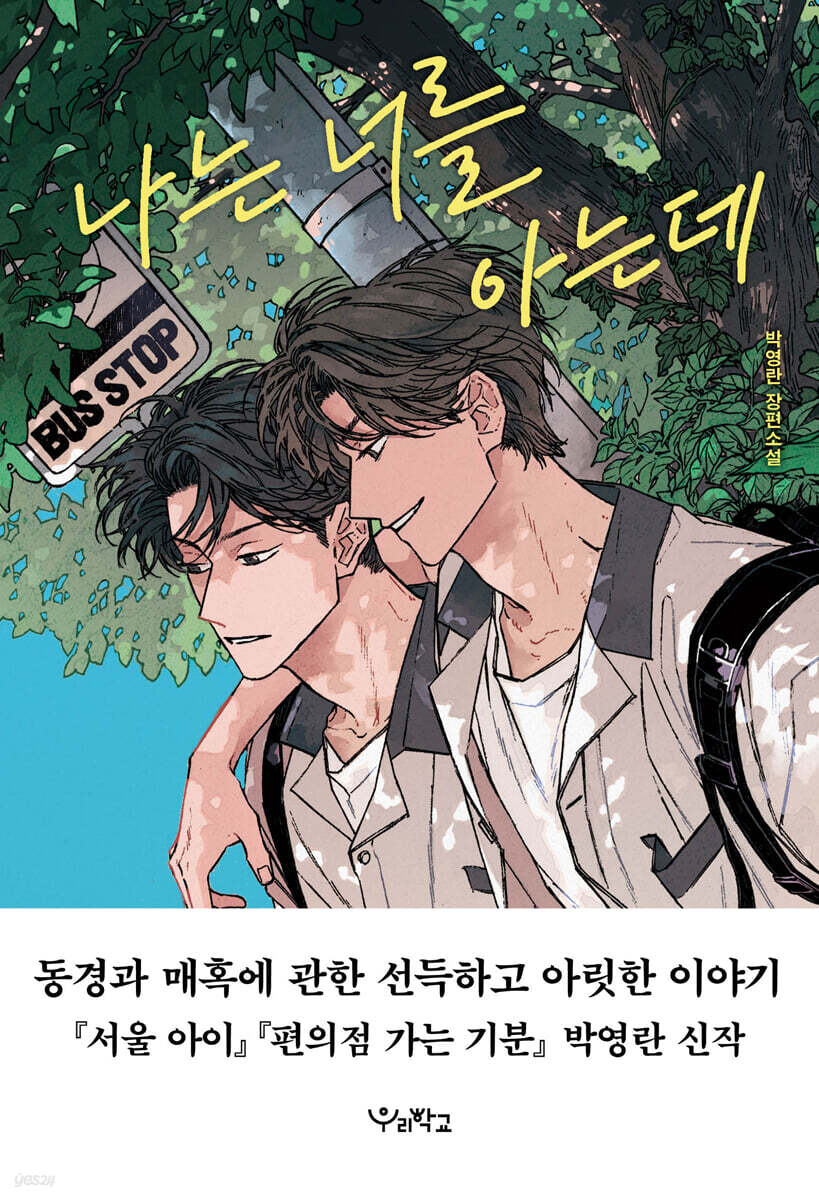
I know you
 |
Description
Book Introduction
“He came back, all the bad memories forgotten.”
In the dark of night, deep in the forest, somewhere between play and violence… …
A poignant and poignant story about longing and fascination.
That unfriendly 'person' who has an aura that steals your heart, buys you expensive meals, and occasionally shows 'me' kindness.
The person who committed school violence, transferred to Seoul, and went abroad to study, and whom I thought I would never see again, has returned.
With all those memories lost.
Author Park Young-ran, who deeply respects the teenagers' attitude toward life and has uniquely depicted the growth of adolescent protagonists in works such as "Seoul Child," "The House I Made," and "The Feeling of Going to the Convenience Store," shakes readers' hearts with an even more detailed narrative in her new work, "I Know You."
There was something between me and that person, whose relationship was difficult to define with words like neighbor, friend, or senior/junior, that even my parents and my best friend didn't know about.
Did that person really lose their memory? Why did they return? What did the time I spent with them mean to me? The story, which unfolds with endless doubt and ambiguity, holding onto selectively erased memories, opens up a variety of possibilities and unfolds with suspense, stimulating the reader's imagination until the very end.
The two different paths that he and I choose in the face of the unexpected bad things that everyone experiences as we grow up will take us on a compelling story that questions the boundaries between longing and fascination, play and violence, and memory and responsibility.
In the dark of night, deep in the forest, somewhere between play and violence… …
A poignant and poignant story about longing and fascination.
That unfriendly 'person' who has an aura that steals your heart, buys you expensive meals, and occasionally shows 'me' kindness.
The person who committed school violence, transferred to Seoul, and went abroad to study, and whom I thought I would never see again, has returned.
With all those memories lost.
Author Park Young-ran, who deeply respects the teenagers' attitude toward life and has uniquely depicted the growth of adolescent protagonists in works such as "Seoul Child," "The House I Made," and "The Feeling of Going to the Convenience Store," shakes readers' hearts with an even more detailed narrative in her new work, "I Know You."
There was something between me and that person, whose relationship was difficult to define with words like neighbor, friend, or senior/junior, that even my parents and my best friend didn't know about.
Did that person really lose their memory? Why did they return? What did the time I spent with them mean to me? The story, which unfolds with endless doubt and ambiguity, holding onto selectively erased memories, opens up a variety of possibilities and unfolds with suspense, stimulating the reader's imagination until the very end.
The two different paths that he and I choose in the face of the unexpected bad things that everyone experiences as we grow up will take us on a compelling story that questions the boundaries between longing and fascination, play and violence, and memory and responsibility.
- You can preview some of the book's contents.
Preview
index
Chapter 1 To Me
Chapter 2 To You
Chapter 3 You and Me
Author's Note
Chapter 2 To You
Chapter 3 You and Me
Author's Note
Detailed image
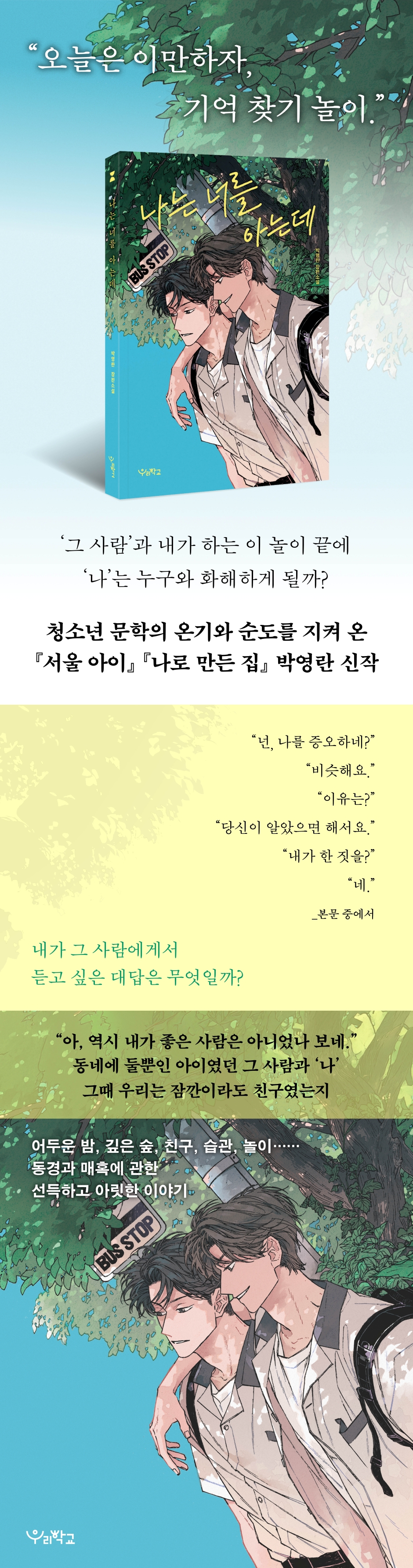
Into the book
Even if that person sees me, he won't recognize me.
In the past five years, I have grown about 30 centimeters taller and my body size has also increased.
I am completely different from the person he knew before.
--- p.17~18
“What is your relationship?”
“Neighborhood guy.”
“I wish there was a guy like that in my neighborhood.”
“You will be strong.”
“How did you manage to talk to a guy like that?”
“My brother and I are the only ones in the neighborhood who take the academy bus.”
--- p.25
“Is it true that you know me best here?”
The broken smile was strange, the sudden politeness was strange, and the question was strange.
Maybe he was just doing what his father told him to do.
Perhaps sensing our awkwardness, the man waved his hand in the air as if to discard the formality.
--- p.52
After the incident came to light, the man was driven out of the place where he was born and raised.
I thought he would never come back to this neighborhood.
At least I won't be returning to Forero.
Because that is a fatal punishment for that person.
--- p.62~63
“I came because I heard you had free time today.
I was wondering if you could go somewhere with me.
Oh, it won't take much time.
“Two hours at most?”
“Where is it?”
“The neighborhood I lived in when I was young.”
--- p.70
“What story do you want to hear?”
“A story about how we got along well.”
“Why is that?”
“It makes me feel good to hear stories like that.
“I somehow feel like I’m a good person.”
In the past five years, I have grown about 30 centimeters taller and my body size has also increased.
I am completely different from the person he knew before.
--- p.17~18
“What is your relationship?”
“Neighborhood guy.”
“I wish there was a guy like that in my neighborhood.”
“You will be strong.”
“How did you manage to talk to a guy like that?”
“My brother and I are the only ones in the neighborhood who take the academy bus.”
--- p.25
“Is it true that you know me best here?”
The broken smile was strange, the sudden politeness was strange, and the question was strange.
Maybe he was just doing what his father told him to do.
Perhaps sensing our awkwardness, the man waved his hand in the air as if to discard the formality.
--- p.52
After the incident came to light, the man was driven out of the place where he was born and raised.
I thought he would never come back to this neighborhood.
At least I won't be returning to Forero.
Because that is a fatal punishment for that person.
--- p.62~63
“I came because I heard you had free time today.
I was wondering if you could go somewhere with me.
Oh, it won't take much time.
“Two hours at most?”
“Where is it?”
“The neighborhood I lived in when I was young.”
--- p.70
“What story do you want to hear?”
“A story about how we got along well.”
“Why is that?”
“It makes me feel good to hear stories like that.
“I somehow feel like I’m a good person.”
--- p.117
Publisher's Review
“He came back, all the bad memories forgotten.”
In the dark of night, deep in the forest, somewhere between play and violence… …
A poignant and poignant story about longing and fascination.
That unfriendly 'person' who has an aura that steals your heart, buys you expensive meals, and occasionally shows 'me' kindness.
The person who committed school violence, transferred to Seoul, and went abroad to study, and whom I thought I would never see again, has returned.
With all those memories lost.
Author Park Young-ran, who deeply respects the teenagers' attitude toward life and has uniquely depicted the growth of adolescent protagonists in works such as "Seoul Child," "The House I Made," and "The Feeling of Going to the Convenience Store," shakes readers' hearts with an even more detailed narrative in her new work, "I Know You."
There was something between me and that person, whose relationship was difficult to define with words like neighbor, friend, or senior/junior, that even my parents and my best friend didn't know about.
Did that person really lose their memory? Why did they return? What did the time I spent with them mean to me? The story, which unfolds with endless doubt and ambiguity, holding onto selectively erased memories, opens up a variety of possibilities and unfolds with suspense, stimulating the reader's imagination until the very end.
The two different paths that he and I choose in the face of the unexpected bad things that everyone experiences as we grow up will take us on a compelling story that questions the boundaries between longing and fascination, play and violence, and memory and responsibility.
“We used to be close.”
The man came back, forgetting everything that happened five years ago.
The protagonist, 'I', remembers the school violence incident that 'that person', who was four years older than him, committed against his friends five years ago.
After the incident, he transferred to Seoul.
After graduating from there, he went to study abroad, but he came back in the summer when I was a senior in high school.
With all those memories lost.
Author Park Young-ran has deeply respected the serious attitude of teenagers toward life and has calmly depicted the growth of adolescent protagonists in works such as “Seoul Child,” “The House I Made,” and “The Feeling of Going to the Convenience Store.”
In this work, "I Know You," the author meticulously depicts the psychology of "I," who faces vague and fatal memories without wavering and ultimately names them "nothing anymore," and doggedly pursues the essence of longing and fascination, memory and responsibility.
There was something between me and that person, whose relationship was difficult to define with words like neighbor, friend, or senior/junior, that even my parents and my best friend didn't know about.
The reader will be the first to join hands with himself in the moment of reconciliation that the protagonist encounters after navigating endless doubts and ambiguities.
A gripping story unfolds, leaving two children at a crossroads, confronted by the unexpected negative experiences they all experience as they grow up.
“It seems like I did a lot of things wrong, right?”
In the dark of night, deep in the forest, somewhere between play and violence… …
A poignant and poignant story about longing and fascination.
For author Park Young-ran, who has depicted with extraordinary insight the subtle relationships of adolescence and the grammar of power formed within them, the space in this work is a place that gauges someone's economic and social status, and a comprehensive and complex place that fully embodies a person's violence, kindness, fascination, and fear.
He was born and raised in this area, lived in the best house in the neighborhood, and did not hesitate to walk alone along the dark mountain paths, which gave off an inaccessible atmosphere.
The reader will easily see the person who would easily open his heart overlapping with the luxurious country house complex that serves as the setting of the work.
“Is there anyone who hasn’t done something bad at least once?”
He was so innocent and calm that I couldn't believe it.
“There are more people who live without doing really bad things.”
“You say you don’t do bad things?”
"sure."
“What would you call a truly bad thing? For example?” _From the text
The reader is captivated by the sleek exterior, but when he looks inside, he encounters empty houses, and the neighborhood is surrounded by a forest that quickly deepens from the early evening, making him reluctant to go out. This makes him overlap with the inner landscape of the person who has lost his memory.
The protagonist, 'I', tries to dig into that person's heart.
Perhaps even that person himself is unaware of that feeling.
I feel like I need to check if the time I spent with that person was just a result of a bad habit or something.
The sentences, which delicately capture the nature of easily captivated subjects and the subtle grammar of relationships during adolescence, become the warp and weft to weave an unforgettable scene.
The dangerous and bad things that capture our hearts
Memories we lose and reconstruct as we grow up,
On the courage to face oneself even in ambiguity
The reader is left to continue to doubt the man's claims of having lost his memory.
The power to stimulate the reader's imagination by leaving open various possibilities and to lead the story with suspense until the end all comes from this doubt.
Could that person really have lost his memory? Could the person who showed me such strange favor and the person who inflicted such brutal violence on his friend really be the same person? Why did that person, who seemed like he could win anyone over, do such a thing? And what do I expect from him?
“I wanted you to know.”
“What did I do?”
"yes."
“I already know.
“I don’t remember, so it doesn’t feel real.”
“It would be convenient.” _From the text
In the work, a dark forest, a new town academy district, a rural housing complex, and an old neighborhood that has been transformed into a factory are intertwined like a maze that retrace a person's memories.
The reader wanders through it with the protagonist, following the traces of violence.
In a world where it has become increasingly difficult to hold someone accountable, this work offers an "ethics of memory" to those who nevertheless seek to confront themselves.
In the dark of night, deep in the forest, somewhere between play and violence… …
A poignant and poignant story about longing and fascination.
That unfriendly 'person' who has an aura that steals your heart, buys you expensive meals, and occasionally shows 'me' kindness.
The person who committed school violence, transferred to Seoul, and went abroad to study, and whom I thought I would never see again, has returned.
With all those memories lost.
Author Park Young-ran, who deeply respects the teenagers' attitude toward life and has uniquely depicted the growth of adolescent protagonists in works such as "Seoul Child," "The House I Made," and "The Feeling of Going to the Convenience Store," shakes readers' hearts with an even more detailed narrative in her new work, "I Know You."
There was something between me and that person, whose relationship was difficult to define with words like neighbor, friend, or senior/junior, that even my parents and my best friend didn't know about.
Did that person really lose their memory? Why did they return? What did the time I spent with them mean to me? The story, which unfolds with endless doubt and ambiguity, holding onto selectively erased memories, opens up a variety of possibilities and unfolds with suspense, stimulating the reader's imagination until the very end.
The two different paths that he and I choose in the face of the unexpected bad things that everyone experiences as we grow up will take us on a compelling story that questions the boundaries between longing and fascination, play and violence, and memory and responsibility.
“We used to be close.”
The man came back, forgetting everything that happened five years ago.
The protagonist, 'I', remembers the school violence incident that 'that person', who was four years older than him, committed against his friends five years ago.
After the incident, he transferred to Seoul.
After graduating from there, he went to study abroad, but he came back in the summer when I was a senior in high school.
With all those memories lost.
Author Park Young-ran has deeply respected the serious attitude of teenagers toward life and has calmly depicted the growth of adolescent protagonists in works such as “Seoul Child,” “The House I Made,” and “The Feeling of Going to the Convenience Store.”
In this work, "I Know You," the author meticulously depicts the psychology of "I," who faces vague and fatal memories without wavering and ultimately names them "nothing anymore," and doggedly pursues the essence of longing and fascination, memory and responsibility.
There was something between me and that person, whose relationship was difficult to define with words like neighbor, friend, or senior/junior, that even my parents and my best friend didn't know about.
The reader will be the first to join hands with himself in the moment of reconciliation that the protagonist encounters after navigating endless doubts and ambiguities.
A gripping story unfolds, leaving two children at a crossroads, confronted by the unexpected negative experiences they all experience as they grow up.
“It seems like I did a lot of things wrong, right?”
In the dark of night, deep in the forest, somewhere between play and violence… …
A poignant and poignant story about longing and fascination.
For author Park Young-ran, who has depicted with extraordinary insight the subtle relationships of adolescence and the grammar of power formed within them, the space in this work is a place that gauges someone's economic and social status, and a comprehensive and complex place that fully embodies a person's violence, kindness, fascination, and fear.
He was born and raised in this area, lived in the best house in the neighborhood, and did not hesitate to walk alone along the dark mountain paths, which gave off an inaccessible atmosphere.
The reader will easily see the person who would easily open his heart overlapping with the luxurious country house complex that serves as the setting of the work.
“Is there anyone who hasn’t done something bad at least once?”
He was so innocent and calm that I couldn't believe it.
“There are more people who live without doing really bad things.”
“You say you don’t do bad things?”
"sure."
“What would you call a truly bad thing? For example?” _From the text
The reader is captivated by the sleek exterior, but when he looks inside, he encounters empty houses, and the neighborhood is surrounded by a forest that quickly deepens from the early evening, making him reluctant to go out. This makes him overlap with the inner landscape of the person who has lost his memory.
The protagonist, 'I', tries to dig into that person's heart.
Perhaps even that person himself is unaware of that feeling.
I feel like I need to check if the time I spent with that person was just a result of a bad habit or something.
The sentences, which delicately capture the nature of easily captivated subjects and the subtle grammar of relationships during adolescence, become the warp and weft to weave an unforgettable scene.
The dangerous and bad things that capture our hearts
Memories we lose and reconstruct as we grow up,
On the courage to face oneself even in ambiguity
The reader is left to continue to doubt the man's claims of having lost his memory.
The power to stimulate the reader's imagination by leaving open various possibilities and to lead the story with suspense until the end all comes from this doubt.
Could that person really have lost his memory? Could the person who showed me such strange favor and the person who inflicted such brutal violence on his friend really be the same person? Why did that person, who seemed like he could win anyone over, do such a thing? And what do I expect from him?
“I wanted you to know.”
“What did I do?”
"yes."
“I already know.
“I don’t remember, so it doesn’t feel real.”
“It would be convenient.” _From the text
In the work, a dark forest, a new town academy district, a rural housing complex, and an old neighborhood that has been transformed into a factory are intertwined like a maze that retrace a person's memories.
The reader wanders through it with the protagonist, following the traces of violence.
In a world where it has become increasingly difficult to hold someone accountable, this work offers an "ethics of memory" to those who nevertheless seek to confront themselves.
GOODS SPECIFICS
- Date of issue: November 17, 2025
- Page count, weight, size: 212 pages | 324g | 140*205*13mm
- ISBN13: 9791167553560
- ISBN10: 116755356X
You may also like
카테고리
korean


korean

![GQ KOREA Mark (Monthly): December [2025]](http://librairie.coreenne.fr/cdn/shop/files/8ef265dbbfbf186523ed75ba7319009d.jpg?v=1765340328&width=3840)


