

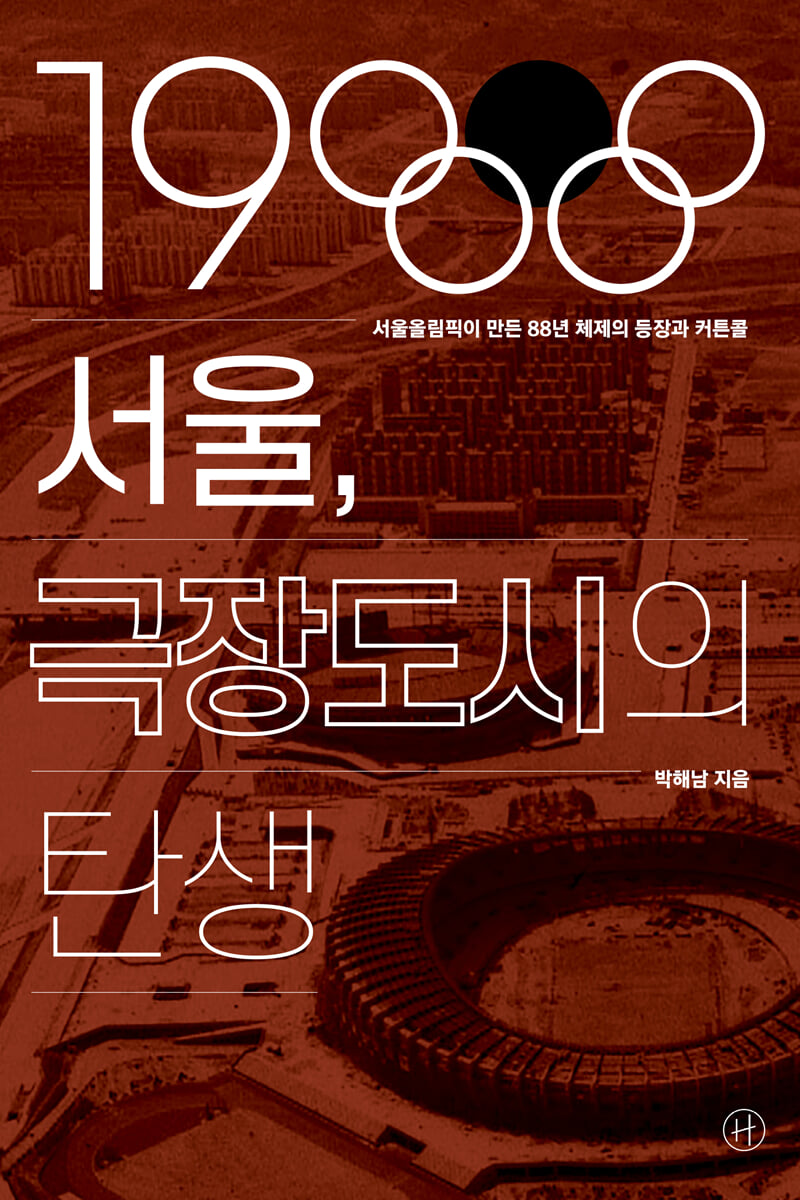
1988 Seoul, the birth of a theater city
 |
Description
Book Introduction
What we must overcome now is the '88 system'!
Leaving Seoul, the theater city created by the Seoul Olympics
The Challenge of Sociology in a New Era
The 1988 Seoul Olympics were not just a simple sports event.
The Seoul Olympics were called the culmination of the 3S policy of the final days of the military dictatorship, a state-led project to enhance national prestige, and, above all, an image-making effort to "enter the ranks of advanced nations."
However, this book goes beyond that familiar narrative and proposes a new perspective: viewing the Seoul Olympics as a gigantic "performance" that influenced the formation of society, and Seoul as a "theater city."
"1988 Seoul, the Birth of a Theater City" is a book written by sociologist Park Hae-nam (assistant professor of sociology at Keimyung University) that meticulously explores the social and historical background of the Seoul Olympics, the preparation process, and the social changes that followed.
The author diagnoses that the Seoul Olympics was a huge project that aimed to achieve the socio-political goals of ‘reforming the people’s customs’ and ‘reforming the urban landscape.’
The military regime sought to train citizens to be "healthy and diligent actors" and to present the city as a "plausible stage set" to the world.
In fact, the Seoul Olympics ended successfully, and Korea seemed to have taken the lead in the post-Cold War era and globalization through the Olympics.
However, the author diagnoses that as a result, Seoul was reconstructed as a theater city where ostentation and production were the norm, internalizing the gaze of 'foreigners', and thus a social order based on 'performance contracts', or the '88 system', was fully established.
Under the 1988 regime, citizens were no longer subjects with rights, but actors who had to always look good in the eyes of others, and the entire city became a stage for a dazzling spectacle.
In this book, the author points out that the 1988 regime is the vacuum left by the '87 regime', that is, the regime after democratization, and one of the sources of the social conflict we face today.
“How can we transform performance contracts into social contracts?” This question, which runs through this book, makes us reflect on the turning point of our times.
The landscape of conflict and division, which has become even more pronounced since the winter of 2024, reveals the fundamental vulnerability of "Theatre City Seoul."
It is time to confront the void left behind by the glamorous stage and to find new imagination to break away from a society where discrimination and exclusion are commonplace.
This book will serve as a solid starting point for those seeking to move beyond the current stagnation since democratization.
Leaving Seoul, the theater city created by the Seoul Olympics
The Challenge of Sociology in a New Era
The 1988 Seoul Olympics were not just a simple sports event.
The Seoul Olympics were called the culmination of the 3S policy of the final days of the military dictatorship, a state-led project to enhance national prestige, and, above all, an image-making effort to "enter the ranks of advanced nations."
However, this book goes beyond that familiar narrative and proposes a new perspective: viewing the Seoul Olympics as a gigantic "performance" that influenced the formation of society, and Seoul as a "theater city."
"1988 Seoul, the Birth of a Theater City" is a book written by sociologist Park Hae-nam (assistant professor of sociology at Keimyung University) that meticulously explores the social and historical background of the Seoul Olympics, the preparation process, and the social changes that followed.
The author diagnoses that the Seoul Olympics was a huge project that aimed to achieve the socio-political goals of ‘reforming the people’s customs’ and ‘reforming the urban landscape.’
The military regime sought to train citizens to be "healthy and diligent actors" and to present the city as a "plausible stage set" to the world.
In fact, the Seoul Olympics ended successfully, and Korea seemed to have taken the lead in the post-Cold War era and globalization through the Olympics.
However, the author diagnoses that as a result, Seoul was reconstructed as a theater city where ostentation and production were the norm, internalizing the gaze of 'foreigners', and thus a social order based on 'performance contracts', or the '88 system', was fully established.
Under the 1988 regime, citizens were no longer subjects with rights, but actors who had to always look good in the eyes of others, and the entire city became a stage for a dazzling spectacle.
In this book, the author points out that the 1988 regime is the vacuum left by the '87 regime', that is, the regime after democratization, and one of the sources of the social conflict we face today.
“How can we transform performance contracts into social contracts?” This question, which runs through this book, makes us reflect on the turning point of our times.
The landscape of conflict and division, which has become even more pronounced since the winter of 2024, reveals the fundamental vulnerability of "Theatre City Seoul."
It is time to confront the void left behind by the glamorous stage and to find new imagination to break away from a society where discrimination and exclusion are commonplace.
This book will serve as a solid starting point for those seeking to move beyond the current stagnation since democratization.
- You can preview some of the book's contents.
Preview
index
preface.
In search of the moment when the ghost of a 'normal life' appears
introduction.
When the city becomes a theater
: The 1988 Seoul Olympics and the Politics of Performance
Mega Event Seoul Olympics
The Seoul Olympics in Memory
A Lens Through which to View the Seoul Olympics: Spectacle, Theater, and Gaze
Viewing the Seoul Olympics as a performance
The Birth of Seoul, the City of Theaters
Part 1.
Soldiers' Dramaturgy
: Dramaturgy of soldiers in the 1960s and 1970s
Chapter 1.
Soldiers become directors
Suspended performances
The emergence of directors
Auditions and Eliminated Contestants
Actors under surveillance and discipline
Temporary stage
Chapter 2.
A developing nation, dreaming of spectacle
Dream of becoming an actor
Dreams of reaching the 'international stage'
Creating a stage
Performance Plan
The missing directors
Part 2.
After the intermission
: The dramatization of the soldiers who reappeared
Chapter 3.
The new military junta takes control of the megaphone.
Directors who reappeared
Difference and Repetition
Changed dramaturgy
Chapter 4.
The show must go on
A script I happened to get my hands on
Copycat Hits: The 1964 Tokyo Olympics
Society as a fully mobilized staff
Part 3.
To create a spectacle
: Towards the 1988 Seoul Olympics
Chapter 5.
Rewrite the script
The epic of 'civilization'
Leviathan called 'foreigner'
Chapter 6.
Make an actor
People without roles
People who became actors
Chapter 7.
Create a stage
Disappearing stage props
New stage sets
Part 4.
Simultaneous performance
: Inside and Outside of the Seoul Olympics
Chapter 8.
Voices resonate
Voices heard from outside the theater
Voices that echo throughout the theater
Chapter 9.
Another Olympics is held
Poor People's Olympics
Joint North-South Olympics
Chapter 10.
A playground called the Seoul Olympics
An 'open' stage for those invited
No Encore Requests: Pyongyang World Festival of Youth and Students
Curtain Call: Olympic Afterglow and Rental Housing
conclusion.
After the play ended
: The Seoul Olympics and the 1988 system
Actors who direct themselves
Touring: Daejeon Expo and World Cup, the continuing theater city
The birth of the 1988 regime
Americas
Search
In search of the moment when the ghost of a 'normal life' appears
introduction.
When the city becomes a theater
: The 1988 Seoul Olympics and the Politics of Performance
Mega Event Seoul Olympics
The Seoul Olympics in Memory
A Lens Through which to View the Seoul Olympics: Spectacle, Theater, and Gaze
Viewing the Seoul Olympics as a performance
The Birth of Seoul, the City of Theaters
Part 1.
Soldiers' Dramaturgy
: Dramaturgy of soldiers in the 1960s and 1970s
Chapter 1.
Soldiers become directors
Suspended performances
The emergence of directors
Auditions and Eliminated Contestants
Actors under surveillance and discipline
Temporary stage
Chapter 2.
A developing nation, dreaming of spectacle
Dream of becoming an actor
Dreams of reaching the 'international stage'
Creating a stage
Performance Plan
The missing directors
Part 2.
After the intermission
: The dramatization of the soldiers who reappeared
Chapter 3.
The new military junta takes control of the megaphone.
Directors who reappeared
Difference and Repetition
Changed dramaturgy
Chapter 4.
The show must go on
A script I happened to get my hands on
Copycat Hits: The 1964 Tokyo Olympics
Society as a fully mobilized staff
Part 3.
To create a spectacle
: Towards the 1988 Seoul Olympics
Chapter 5.
Rewrite the script
The epic of 'civilization'
Leviathan called 'foreigner'
Chapter 6.
Make an actor
People without roles
People who became actors
Chapter 7.
Create a stage
Disappearing stage props
New stage sets
Part 4.
Simultaneous performance
: Inside and Outside of the Seoul Olympics
Chapter 8.
Voices resonate
Voices heard from outside the theater
Voices that echo throughout the theater
Chapter 9.
Another Olympics is held
Poor People's Olympics
Joint North-South Olympics
Chapter 10.
A playground called the Seoul Olympics
An 'open' stage for those invited
No Encore Requests: Pyongyang World Festival of Youth and Students
Curtain Call: Olympic Afterglow and Rental Housing
conclusion.
After the play ended
: The Seoul Olympics and the 1988 system
Actors who direct themselves
Touring: Daejeon Expo and World Cup, the continuing theater city
The birth of the 1988 regime
Americas
Search
Detailed image

Into the book
“My problem awareness started here.
Because I began my study of sociology by looking at normal life as something unfamiliar, I began to question the way such a life is created.
In the West, the "social" was formed through discourse and practice aimed at preventing class conflict and poverty, and on this basis, "society" or normal life was created.
(…) On the other hand, Korean society appeared to be one that did not have a proper social safety net.
Despite this, why did a "normal" life path emerge in Korean society? In other words, what allowed a society to emerge in the southern part of the Korean Peninsula between the 1950s and 2020s? Could it be that something uniquely Korean, though distinct from the West, emerged? What caught my attention here was the 1988 Seoul Olympics.
Because I thought that was the moment when I created the appearance of a normal life.”
--- 「Preface.
In search of the moment when the ghost of a 'normal life' appears
“I believe that the process of preparing for the Seoul Olympics was a process of mobilizing all members of society, assigning them roles, and training them to perform skillfully.
In other words, it was a training process that made the daily lives of not only those who participated in the actual performance process, such as the Olympic opening and closing ceremonies, but also everyone who lives with the Olympics, into a performance.
In this way, the Olympics can be seen as an attempt by the producers to introduce 'order' into society.
In this extension, the Olympic directors sought to make the capital city of Seoul a space that embodies the order they wished to create and a model that demonstrates their excellence.
In other words, it transformed Seoul into a theater for spectacular performances.”
--- 「Introduction.
From "When the City Becomes a Theater: The 1988 Seoul Olympics and the Politics of Performance"
“The soldiers defined social evils through ‘performance,’ which can be translated as action or acting.
When we say that the situation in which actors on the stage of the city skillfully perform according to the script and the performance proceeds smoothly is called 'normal social order', social evil refers to those who disrupt the performance by not following the script and those who show such performances.
The performance ban that occurred in Korean society in the mid-20th century can be interpreted, from an individual's perspective, as the result of a continuous external shock that began with colonial rule, mobilization for war, the end of colonial rule, the conflict between the left and right, and finally the Korean War.
But the soldiers didn't take this situation into account at all.
All that mattered to them was that the stage where the epic of development was supposed to be performed was occupied by social evils, and that their actions were interfering with the performance.”
--- 「Chapter 1.
From "Soldiers Become Directors"
“In 1910, Korea became a colony.
However, this did not dampen the desire of Koreans to show the world their modernized body through sports.
(…) By the 1930s, the intellectuals’ aspiration to create world-class actors through sports had become a reality.
Even though it was a way of wearing the Japanese flag on one's chest.
(…) The soldiers also inherited the dream of producing actors who could stand on the international stage through sports.
The soldiers viewed the athletes' performances on the international stage as a preview of the developmental epic they were attempting to enact.
They gave sportspeople the task of ‘promoting national prestige,’ which was a four-letter phrase that meant that athletes had to become actors who stood at the center of the international stage.”
--- Chapter 2.
From “Developing Nation, Dreaming of Spectacle”
“Since 1981, there has been a very big change in the visual Leviathan.
From the perspective of the military directors, the 1986 Asian Games and the 1988 Seoul Olympics were mega-events that would make Asians and the world an audience for performances by Koreans.
Therefore, the eyes of Argos could not be formed solely by the eyes of members of the civil society mobilized by the soldiers.
No, the 'true' eyes of Argos were the eyes of the world that would witness the spectacle of the Asian Games and the Olympics.
Rather, the controlled civil society was like a thousand eyes or hands on the body of Argos.
Now that the eyes of the world or 'foreigners' have become important, we have to adapt to their perspectives.
So the soldiers decided that they had to 'normalize' the 'abnormality' of things like the impassability of traffic at midnight to fit the world's perspective.
They sought to maintain a system of surveillance and discipline by reminding Korean society that the world, as spectators of the spectacle of the Asian Games and the Olympics, would become the new watchdogs.”
--- 「Chapter 3.
From "New Military Government Takes the Megaphone"
“Their assessment was that post-war Tokyo was a place of poverty, disorder, and a lack of hope and purpose.
Just like the soldiers in Seoul in 1961 and in 1980, Tokyo directors also viewed post-war Tokyo as a space where performances had ceased.
If we interpret post-war Tokyo as a space of suspended performances, the meaning of the ray of light shining on youth also becomes clear.
This meant putting young Japanese people on stage and shining a light on them, and training them as actors who would perform according to a script.
The two goals were interconnected: to change Japan's image internationally and to revive the performing arts and social dramas that had been suspended domestically.
The performance that the Tokyo directors had in mind in 1952 might have been a narrative that led from war to peace.
However, the performances planned by the directors after the decision to hold the event in 1959 had a narrative that led from defeat to revival, or to the completion of modernization that had been interrupted by defeat.
That is why the directors placed great importance on showing the modernized nation of Japan and the modern city of Tokyo through the Olympics.”
--- 「Chapter 4.
From "The Show Must Go On"
“More important than this was the power of the world and foreigners.
As the soldiers reshaped the foreign body as the subject of their gaze during the Olympics, the world and foreigners themselves were transformed into the figure of Leviathan.
“The soldiers have continued to monitor, discipline, confine, and exhibit members of society, and now they are doing so under the pretext of hosting the Olympics for the world and foreigners to see,” he added.
--- 「Chapter 5.
From "Rewriting the Script"
“In reality, those who were mobilized as actors for the seven years since 1981 to prepare for the Olympics did not only live their daily lives under surveillance.
This period was like watching a kind of 'musical' over and over again.
Members of Korean society have repeatedly seen the dynamic movement of sports and repeatedly heard wholesome songs that sing of Korea's development.
In the 1980s, it was called the 3S (Sport, Screen, Sex) and was evaluated as a means of public ignorance or depoliticization.
However, the Seoul Olympics and the entire process of preparing for them can be interpreted more colorfully when viewed as a spectacle that aimed to guide the leisure behavior of Korean society amidst urbanization and industrialization.”
--- Chapter 6.
From "Making Actors"
“This presented the challenge to Seoul’s directors to create a spectacular landscape from a space that could be filmed.
Because it was clear that these spaces would be broadcast around the world via television.
Even if the stadiums that had already been built were like that, the area around the stadium as seen from the sky had to change, and the Olympic Park where the new stadium would be built had to change even more.
And the Seoul landscape that would be revealed through the marathon had to be different from before.
In terms of theater, these spaces were the front of the stage.
It was the space that stood out the most to the audience.
Two projects were initiated amidst this need.
One was to design Olympic Park to look better than Jamsil, which is just a collection of stadiums, and the other was to transform the Han River, which can be captured on video anywhere in the Seoul sky, including the sky above Jamsil Main Stadium.”
--- Chapter 7.
From "Making the Stage"
“Some people have raised their voices saying that both the stage and the production should change.
He argued that the Constitution is above the Olympics, and that the poor also have a right to the stage of the city, and that Leviathan's absolute power should not be exercised to push someone off the stage for a plausible performance, but to ensure that no one is left off the stage and can create their own performance.
For example, in 1985, the Korean Church Social Mission Council published a pamphlet depicting Hodori riding a bulldozer and saying, “All citizens have dignity and value as human beings and the right to pursue happiness.
The full text of Article 10 of the Constitution states, “The State has the duty to confirm and guarantee the fundamental and inviolable human rights of individuals.”
The council also asserted that “the government has a duty to provide us with solutions” for the 32 redevelopment projects planned for the Olympics.
--- Chapter 8.
From "Voices Resound"
“The agenda of the Joint Olympics spread beyond university students to civil society as a whole starting in May 1988.
On May 11, civil society leaders including Ham Seok-heon and Moon Ik-hwan proposed joint hosting of the Olympics between Seoul and Pyongyang.
On May 15, before committing suicide at Myeongdong Cathedral, Seoul National University student Cho Seong-man wrote in his suicide note, “No matter what happens, the Olympics must be a foundation for national reconciliation and unification through the participation of South and North Korea,” which also spread public opinion.
On May 18, three opposition party leaders (Kim Young-sam, Kim Dae-jung, and Kim Jong-pil) announced that the Olympics “should demonstrate the nation’s strength and serve as an opportunity for the unification of a divided nation.”
Of the three, Kim Dae-jung was the only one who supported the idea of joint hosting.
“On May 19th, the ‘Buddhist Headquarters for the Promotion of National Reconciliation and Joint Olympics’ was launched, on the 21st, Protestant pastors issued a statement calling for a joint Olympics, and on the 28th, 68 religious and social organizations issued a statement calling for a ‘Joint Inter-Korean Olympics and June 10 Student Conference,’ so much so that anyone who spoke of the nation was talking about a joint Olympics between Seoul and Pyongyang throughout May.”
--- Chapter 9.
From "Another Olympics to be held"
“The directors’ interest was not in reflecting the voices of those who spoke for the people, but in staging a ‘charitable spectacle’ that provided the poorest with modern living spaces in the form of apartments and the stage setting for the Olympics.
That's why, when they built rental apartments somewhere in the new city, they didn't take into account at all what the future consequences would be.
(…) The supply of rental apartments was an opportunity for the poor to experience the official Olympic housing as a spectacular stage setting, even if it was in a small space.
For those who lived in a space of 4-5 pyeong, a 7-8 pyeong rental apartment was a better form of housing than before.
But they did not experience the personal social rise that was associated with Korea's rise in national status, nor the pride that came with it, experienced by the middle class who began living in official Olympic housing.
“Rental apartment residents, in the heart of a new, middle-class city, had to endure discrimination and stigma, and were forced to watch the spectacle of official Olympic housing from a corner.”
--- Chapter 10.
From “The Seoul Olympics”
“The social conflict that Korean society has been painfully experiencing since the winter of 2024 demonstrates how vulnerable the 1988 system, based on a performance contract rather than a social contract, is in the face of social conflict and division.
As we move into the 2020s, many people are talking about the limitations of the 1987 system and discussing how to overcome them.
However, the limitations of the 1988 system are precisely the challenges that our society must seriously confront.
“Now is the time to seriously confront the questions of how to transform the performance contract into a social contract, and how to transform the Leviathan that sits in the audience and evaluates the actors on stage into a Leviathan that supports the stage of the lives of members of society.”
Because I began my study of sociology by looking at normal life as something unfamiliar, I began to question the way such a life is created.
In the West, the "social" was formed through discourse and practice aimed at preventing class conflict and poverty, and on this basis, "society" or normal life was created.
(…) On the other hand, Korean society appeared to be one that did not have a proper social safety net.
Despite this, why did a "normal" life path emerge in Korean society? In other words, what allowed a society to emerge in the southern part of the Korean Peninsula between the 1950s and 2020s? Could it be that something uniquely Korean, though distinct from the West, emerged? What caught my attention here was the 1988 Seoul Olympics.
Because I thought that was the moment when I created the appearance of a normal life.”
--- 「Preface.
In search of the moment when the ghost of a 'normal life' appears
“I believe that the process of preparing for the Seoul Olympics was a process of mobilizing all members of society, assigning them roles, and training them to perform skillfully.
In other words, it was a training process that made the daily lives of not only those who participated in the actual performance process, such as the Olympic opening and closing ceremonies, but also everyone who lives with the Olympics, into a performance.
In this way, the Olympics can be seen as an attempt by the producers to introduce 'order' into society.
In this extension, the Olympic directors sought to make the capital city of Seoul a space that embodies the order they wished to create and a model that demonstrates their excellence.
In other words, it transformed Seoul into a theater for spectacular performances.”
--- 「Introduction.
From "When the City Becomes a Theater: The 1988 Seoul Olympics and the Politics of Performance"
“The soldiers defined social evils through ‘performance,’ which can be translated as action or acting.
When we say that the situation in which actors on the stage of the city skillfully perform according to the script and the performance proceeds smoothly is called 'normal social order', social evil refers to those who disrupt the performance by not following the script and those who show such performances.
The performance ban that occurred in Korean society in the mid-20th century can be interpreted, from an individual's perspective, as the result of a continuous external shock that began with colonial rule, mobilization for war, the end of colonial rule, the conflict between the left and right, and finally the Korean War.
But the soldiers didn't take this situation into account at all.
All that mattered to them was that the stage where the epic of development was supposed to be performed was occupied by social evils, and that their actions were interfering with the performance.”
--- 「Chapter 1.
From "Soldiers Become Directors"
“In 1910, Korea became a colony.
However, this did not dampen the desire of Koreans to show the world their modernized body through sports.
(…) By the 1930s, the intellectuals’ aspiration to create world-class actors through sports had become a reality.
Even though it was a way of wearing the Japanese flag on one's chest.
(…) The soldiers also inherited the dream of producing actors who could stand on the international stage through sports.
The soldiers viewed the athletes' performances on the international stage as a preview of the developmental epic they were attempting to enact.
They gave sportspeople the task of ‘promoting national prestige,’ which was a four-letter phrase that meant that athletes had to become actors who stood at the center of the international stage.”
--- Chapter 2.
From “Developing Nation, Dreaming of Spectacle”
“Since 1981, there has been a very big change in the visual Leviathan.
From the perspective of the military directors, the 1986 Asian Games and the 1988 Seoul Olympics were mega-events that would make Asians and the world an audience for performances by Koreans.
Therefore, the eyes of Argos could not be formed solely by the eyes of members of the civil society mobilized by the soldiers.
No, the 'true' eyes of Argos were the eyes of the world that would witness the spectacle of the Asian Games and the Olympics.
Rather, the controlled civil society was like a thousand eyes or hands on the body of Argos.
Now that the eyes of the world or 'foreigners' have become important, we have to adapt to their perspectives.
So the soldiers decided that they had to 'normalize' the 'abnormality' of things like the impassability of traffic at midnight to fit the world's perspective.
They sought to maintain a system of surveillance and discipline by reminding Korean society that the world, as spectators of the spectacle of the Asian Games and the Olympics, would become the new watchdogs.”
--- 「Chapter 3.
From "New Military Government Takes the Megaphone"
“Their assessment was that post-war Tokyo was a place of poverty, disorder, and a lack of hope and purpose.
Just like the soldiers in Seoul in 1961 and in 1980, Tokyo directors also viewed post-war Tokyo as a space where performances had ceased.
If we interpret post-war Tokyo as a space of suspended performances, the meaning of the ray of light shining on youth also becomes clear.
This meant putting young Japanese people on stage and shining a light on them, and training them as actors who would perform according to a script.
The two goals were interconnected: to change Japan's image internationally and to revive the performing arts and social dramas that had been suspended domestically.
The performance that the Tokyo directors had in mind in 1952 might have been a narrative that led from war to peace.
However, the performances planned by the directors after the decision to hold the event in 1959 had a narrative that led from defeat to revival, or to the completion of modernization that had been interrupted by defeat.
That is why the directors placed great importance on showing the modernized nation of Japan and the modern city of Tokyo through the Olympics.”
--- 「Chapter 4.
From "The Show Must Go On"
“More important than this was the power of the world and foreigners.
As the soldiers reshaped the foreign body as the subject of their gaze during the Olympics, the world and foreigners themselves were transformed into the figure of Leviathan.
“The soldiers have continued to monitor, discipline, confine, and exhibit members of society, and now they are doing so under the pretext of hosting the Olympics for the world and foreigners to see,” he added.
--- 「Chapter 5.
From "Rewriting the Script"
“In reality, those who were mobilized as actors for the seven years since 1981 to prepare for the Olympics did not only live their daily lives under surveillance.
This period was like watching a kind of 'musical' over and over again.
Members of Korean society have repeatedly seen the dynamic movement of sports and repeatedly heard wholesome songs that sing of Korea's development.
In the 1980s, it was called the 3S (Sport, Screen, Sex) and was evaluated as a means of public ignorance or depoliticization.
However, the Seoul Olympics and the entire process of preparing for them can be interpreted more colorfully when viewed as a spectacle that aimed to guide the leisure behavior of Korean society amidst urbanization and industrialization.”
--- Chapter 6.
From "Making Actors"
“This presented the challenge to Seoul’s directors to create a spectacular landscape from a space that could be filmed.
Because it was clear that these spaces would be broadcast around the world via television.
Even if the stadiums that had already been built were like that, the area around the stadium as seen from the sky had to change, and the Olympic Park where the new stadium would be built had to change even more.
And the Seoul landscape that would be revealed through the marathon had to be different from before.
In terms of theater, these spaces were the front of the stage.
It was the space that stood out the most to the audience.
Two projects were initiated amidst this need.
One was to design Olympic Park to look better than Jamsil, which is just a collection of stadiums, and the other was to transform the Han River, which can be captured on video anywhere in the Seoul sky, including the sky above Jamsil Main Stadium.”
--- Chapter 7.
From "Making the Stage"
“Some people have raised their voices saying that both the stage and the production should change.
He argued that the Constitution is above the Olympics, and that the poor also have a right to the stage of the city, and that Leviathan's absolute power should not be exercised to push someone off the stage for a plausible performance, but to ensure that no one is left off the stage and can create their own performance.
For example, in 1985, the Korean Church Social Mission Council published a pamphlet depicting Hodori riding a bulldozer and saying, “All citizens have dignity and value as human beings and the right to pursue happiness.
The full text of Article 10 of the Constitution states, “The State has the duty to confirm and guarantee the fundamental and inviolable human rights of individuals.”
The council also asserted that “the government has a duty to provide us with solutions” for the 32 redevelopment projects planned for the Olympics.
--- Chapter 8.
From "Voices Resound"
“The agenda of the Joint Olympics spread beyond university students to civil society as a whole starting in May 1988.
On May 11, civil society leaders including Ham Seok-heon and Moon Ik-hwan proposed joint hosting of the Olympics between Seoul and Pyongyang.
On May 15, before committing suicide at Myeongdong Cathedral, Seoul National University student Cho Seong-man wrote in his suicide note, “No matter what happens, the Olympics must be a foundation for national reconciliation and unification through the participation of South and North Korea,” which also spread public opinion.
On May 18, three opposition party leaders (Kim Young-sam, Kim Dae-jung, and Kim Jong-pil) announced that the Olympics “should demonstrate the nation’s strength and serve as an opportunity for the unification of a divided nation.”
Of the three, Kim Dae-jung was the only one who supported the idea of joint hosting.
“On May 19th, the ‘Buddhist Headquarters for the Promotion of National Reconciliation and Joint Olympics’ was launched, on the 21st, Protestant pastors issued a statement calling for a joint Olympics, and on the 28th, 68 religious and social organizations issued a statement calling for a ‘Joint Inter-Korean Olympics and June 10 Student Conference,’ so much so that anyone who spoke of the nation was talking about a joint Olympics between Seoul and Pyongyang throughout May.”
--- Chapter 9.
From "Another Olympics to be held"
“The directors’ interest was not in reflecting the voices of those who spoke for the people, but in staging a ‘charitable spectacle’ that provided the poorest with modern living spaces in the form of apartments and the stage setting for the Olympics.
That's why, when they built rental apartments somewhere in the new city, they didn't take into account at all what the future consequences would be.
(…) The supply of rental apartments was an opportunity for the poor to experience the official Olympic housing as a spectacular stage setting, even if it was in a small space.
For those who lived in a space of 4-5 pyeong, a 7-8 pyeong rental apartment was a better form of housing than before.
But they did not experience the personal social rise that was associated with Korea's rise in national status, nor the pride that came with it, experienced by the middle class who began living in official Olympic housing.
“Rental apartment residents, in the heart of a new, middle-class city, had to endure discrimination and stigma, and were forced to watch the spectacle of official Olympic housing from a corner.”
--- Chapter 10.
From “The Seoul Olympics”
“The social conflict that Korean society has been painfully experiencing since the winter of 2024 demonstrates how vulnerable the 1988 system, based on a performance contract rather than a social contract, is in the face of social conflict and division.
As we move into the 2020s, many people are talking about the limitations of the 1987 system and discussing how to overcome them.
However, the limitations of the 1988 system are precisely the challenges that our society must seriously confront.
“Now is the time to seriously confront the questions of how to transform the performance contract into a social contract, and how to transform the Leviathan that sits in the audience and evaluates the actors on stage into a Leviathan that supports the stage of the lives of members of society.”
--- "conclusion.
After the play ended: From "The Seoul Olympics and the 1988 System"
After the play ended: From "The Seoul Olympics and the 1988 System"
Publisher's Review
1.
Why should we pay attention to the Seoul Olympics?
- Key scenes from our modern history revisited through performance theory
- The Seoul Olympics occupy a key position in the military dramaturgy.
A new sociological narrative that breaks away from the "industrialization versus democratization" framework.
Korean society, which had experienced colonization, liberation, division, and war, entered an era of 'development' in earnest when the military took power in 1961.
The era of development was an era of 'industrialization' and a time of dictatorship where everyone had to move in a single-minded manner under the watchful eyes of the military.
As the number of people oppressed and excluded during the rapid economic growth process increased, voices demanding a more humane life and a peaceful system grew louder, and after June 1987, Korean society entered an era of 'democratization.'
This is the main flow of modern Korean history that we know so far.
However, the author is keenly aware of what we miss when we look at it through the lens of ‘industrialization versus democratization.’
This is because, within this structure, which can be considered a kind of victory narrative, we cannot properly look into those who were excluded from the industrialization process as well as the democratization process.
There is a clear need to closely examine the process by which Korean society has established itself as a "society," that is, a "time and space where normal life is possible."
In this book, the author reinterprets the formation process of Korean society from the perspective of performance theory.
The core of performance theory is to examine the ruling class's ruling strategy as a kind of dramaturgy, that is, a series of processes of planning a performance, creating a stage, training actors, and directing the stage.
What the author focuses on here is the 1988 Seoul Olympics.
The Olympics, often called a mega-event, has long been used as a stage to improve a country's international image.
After taking power in 1961, the military established routine surveillance and control in the name of ensuring order and developing the economy.
What they emphasized as much as social stability was the gaze of the 'world' or 'foreigners'.
Large-scale sporting events like the Olympics and the Asian Games were crucial stages for soldiers who were obsessed with creating a country that looked good to foreigners and producing good citizens.
Preparations for the Olympics, which had been temporarily halted by Park Chung-hee's death, were restarted in 1980 with the rise of the new military junta.
Chun Doo-hwan and the new military junta, who brutally suppressed the democratization movement, including the Gwangju incident, resumed the project of reforming the customs of the entire nation by pouring all of society's capabilities into the Olympics.
“Since 1981, there has been a very big change in the visual Leviathan.
From the perspective of the military directors, the 1986 Asian Games and the 1988 Seoul Olympics were mega-events that would make Asians and the world an audience for performances by Koreans.
(…) Now that the eyes of the world or ‘foreigners’ have become important, we had to adapt to their perspectives.
So the soldiers decided that they had to 'normalize' the 'abnormality' of things like the impassability of traffic at midnight to fit the world's perspective.
They sought to maintain a system of surveillance and discipline by reminding Korean society that the world, as spectators of the spectacle of the Asian Games and the Olympics, would become the new watchdogs.”
- 〈Chapter 3.
"New Military Regime Takes the Megaphone," p. 126
2.
How the Olympics Made Seoul a Theater City
The soldiers' "performance contract" that replaced the citizens' "social contract"
Seoul recreated as a spectacular performance stage for a mega event
- Two 'official Olympic residences': the hierarchical structure of an urban landscape where apartments and rental housing coexist.
The capital, Seoul, was the city with the largest influx of people.
The fact that people continued to flock to Seoul despite the devastation of war showed the reality of a society that lacked resources and means of livelihood.
In the eyes of the soldiers, Seoul was chaos itself.
They tried to make Seoul into a plausible stage and its people into actors who fit the performance they envisioned.
From pushing the poor out to the outskirts and clearing out shantytowns to creating a well-behaved population and improving the cityscape, the soldiers' eyes scoured every corner of the city.
The author's argument is that all this surveillance and control was part of a "performance contract" to secure the legitimacy of rule by creating a stage that was pleasing to the "world."
Thomas Hobbes' social contract theory holds that the state, or 'Leviathan,' was formed when citizens delegated power to protect themselves.
However, because Korean society was created through a 'performance contract' between soldiers rather than a social contract between citizens, the dramaturgy of soldier-directors has had a continuous influence on society as a whole.
The period when the dramaturgy of soldiers was most dramatically revealed was the 1988 Seoul Olympics and the seven years of preparation.
The new military junta that seized power in 1980 mobilized all of society's capabilities and resources to host the Seoul Olympics.
In particular, by focusing on developing Jamsil, which will be the stage for the Olympics, and Gangnam and the Han River, which are expected to attract the attention of 'foreigners,' the entire city of Seoul was intended to become a spectacular performance stage for a mega event.
However, rather than being an event where the soldiers' expectations were met, the Seoul Olympics was a space where those who had been driven out because of the Olympics, those who demanded democracy, equality, and unification, constantly raised their voices and demanded alternatives.
Despite various conflicts, the Seoul Olympics ended successfully, and the voices of those who were displaced were partially realized in the form of "rental housing," a replica of the official Olympic housing.
The "Theater City Seoul," formed by the interweaving of the gaze of power and internal and external voices, has come to be established as a mixture of the two "official Olympic residences" created as a result of performance contracts, with the latest apartments for the middle class and the rental housing for the poor.
The class order of the urban landscape that was formed while preparing for the Seoul Olympics was directly reflected in the theater city.
“The directors’ interest was not in reflecting the voices of those who spoke for the people, but in staging a ‘charitable spectacle’ that provided the poorest with modern living spaces in the form of apartments and the stage setting for the Olympics.
That's why, when they built rental apartments somewhere in the new city, they didn't take into account at all what the future consequences would be.
(…) The supply of rental apartments was an opportunity for the poor to experience the official Olympic housing as a spectacular stage setting, even if it was in a small space.
For those who lived in a space of 4-5 pyeong, a 7-8 pyeong rental apartment was a better form of housing than before.
But they did not experience the personal social rise that was associated with Korea's rise in national status, nor the pride that came with it, experienced by the middle class who began living in official Olympic housing.
“Rental apartment residents, in the heart of a new, middle-class city, had to endure discrimination and stigma, and were forced to watch the spectacle of official Olympic housing from a corner.”
- 〈Chapter 10.
"The Seoul Olympics: A Playground," p. 298
3.
Can we overcome the '88 system'?
- The 1988 system established by internalizing the world's or foreigners' perspectives
- A sociological critique of theatrical life in a city where ostentation and staging are commonplace.
- Seeking a turning point in the era that will transform performance contracts into proper social contracts.
The Seoul Olympics created a clean and well-maintained theater city, and Seoul has since become a model for urban life.
The key point here is that not only the space but also the lifestyle of the people living in that space became a model for Korean society.
The middle class, established as citizens of an economically developing country and enjoying a lifestyle that foreigners find attractive, has transformed the dramaturgy of the military into its own narrative.
The self-awareness of being a model citizen of a country that overcame poverty and even made the Olympics a success is a representative narrative formed in conjunction with the theater city.
The performance contracts that reformed the customs of the people and improved the urban landscape through mega-events continued even after democratization.
The 1993 Daejeon Expo can be said to be a project to make Daejeon, following Seoul, a theater city.
A series of tasks carried out in preparation for the Olympics, such as emphasizing the public's cleanliness and civic awareness and improving the event site, rivers, and roads, were repeated in their entirety in preparation for the Expo.
The 2002 World Cup was prepared in a similar way.
But from this time on, something changed significantly.
After citizens finished their passionate street cheering, they cleared the roads without any external force and maintained order on their own without any disturbance or disorder.
While this could be praised as mature civic consciousness, the author keenly reflects that this attitude is the result of deeply internalizing the world's gaze.
The author names this system of social agreement formed through performance contracts the '88 system.'
The focus of attention, which had been suppressing citizens under the pretext of correcting social order, has now shifted from the military to the world or foreigners.
The 1987 system, which is centered around the direct presidential election system, continues to be the political structure that supports Korean society to this day. However, the author's insight is that the internalized oppression and inequality in our society will not change as long as the Leviathan based on performance contracts persists, even though the virtual subject of attention has changed from soldiers to foreigners.
The reason why conflicts are deepening and crises are recurring in our society is because we have failed to properly resolve the 1988 system, a performance contract system that was obsessed with appearing attractive to the world.
In that respect, "1988 Seoul, the Birth of a Theater City" is a must-read book at this critical juncture when we desperately need to transform performance contracts into proper social contracts.
“The social conflict that Korean society has been painfully experiencing since the winter of 2024 demonstrates how vulnerable the 1988 system, based on a performance contract rather than a social contract, is in the face of social conflict and division.
As we move into the 2020s, many people are talking about the limitations of the 1987 system and discussing how to overcome them.
However, the limitations of the 1988 system are precisely the challenges that our society must seriously confront.
“Now is the time to seriously confront the questions of how to transform the performance contract into a social contract, and how to transform the Leviathan that sits in the audience and evaluates the actors on stage into a Leviathan that supports the stage of the lives of members of society.”
- <conclusion.
After the Play Ends: The Seoul Olympics and the 1988 System, pp. 328-329
Why should we pay attention to the Seoul Olympics?
- Key scenes from our modern history revisited through performance theory
- The Seoul Olympics occupy a key position in the military dramaturgy.
A new sociological narrative that breaks away from the "industrialization versus democratization" framework.
Korean society, which had experienced colonization, liberation, division, and war, entered an era of 'development' in earnest when the military took power in 1961.
The era of development was an era of 'industrialization' and a time of dictatorship where everyone had to move in a single-minded manner under the watchful eyes of the military.
As the number of people oppressed and excluded during the rapid economic growth process increased, voices demanding a more humane life and a peaceful system grew louder, and after June 1987, Korean society entered an era of 'democratization.'
This is the main flow of modern Korean history that we know so far.
However, the author is keenly aware of what we miss when we look at it through the lens of ‘industrialization versus democratization.’
This is because, within this structure, which can be considered a kind of victory narrative, we cannot properly look into those who were excluded from the industrialization process as well as the democratization process.
There is a clear need to closely examine the process by which Korean society has established itself as a "society," that is, a "time and space where normal life is possible."
In this book, the author reinterprets the formation process of Korean society from the perspective of performance theory.
The core of performance theory is to examine the ruling class's ruling strategy as a kind of dramaturgy, that is, a series of processes of planning a performance, creating a stage, training actors, and directing the stage.
What the author focuses on here is the 1988 Seoul Olympics.
The Olympics, often called a mega-event, has long been used as a stage to improve a country's international image.
After taking power in 1961, the military established routine surveillance and control in the name of ensuring order and developing the economy.
What they emphasized as much as social stability was the gaze of the 'world' or 'foreigners'.
Large-scale sporting events like the Olympics and the Asian Games were crucial stages for soldiers who were obsessed with creating a country that looked good to foreigners and producing good citizens.
Preparations for the Olympics, which had been temporarily halted by Park Chung-hee's death, were restarted in 1980 with the rise of the new military junta.
Chun Doo-hwan and the new military junta, who brutally suppressed the democratization movement, including the Gwangju incident, resumed the project of reforming the customs of the entire nation by pouring all of society's capabilities into the Olympics.
“Since 1981, there has been a very big change in the visual Leviathan.
From the perspective of the military directors, the 1986 Asian Games and the 1988 Seoul Olympics were mega-events that would make Asians and the world an audience for performances by Koreans.
(…) Now that the eyes of the world or ‘foreigners’ have become important, we had to adapt to their perspectives.
So the soldiers decided that they had to 'normalize' the 'abnormality' of things like the impassability of traffic at midnight to fit the world's perspective.
They sought to maintain a system of surveillance and discipline by reminding Korean society that the world, as spectators of the spectacle of the Asian Games and the Olympics, would become the new watchdogs.”
- 〈Chapter 3.
"New Military Regime Takes the Megaphone," p. 126
2.
How the Olympics Made Seoul a Theater City
The soldiers' "performance contract" that replaced the citizens' "social contract"
Seoul recreated as a spectacular performance stage for a mega event
- Two 'official Olympic residences': the hierarchical structure of an urban landscape where apartments and rental housing coexist.
The capital, Seoul, was the city with the largest influx of people.
The fact that people continued to flock to Seoul despite the devastation of war showed the reality of a society that lacked resources and means of livelihood.
In the eyes of the soldiers, Seoul was chaos itself.
They tried to make Seoul into a plausible stage and its people into actors who fit the performance they envisioned.
From pushing the poor out to the outskirts and clearing out shantytowns to creating a well-behaved population and improving the cityscape, the soldiers' eyes scoured every corner of the city.
The author's argument is that all this surveillance and control was part of a "performance contract" to secure the legitimacy of rule by creating a stage that was pleasing to the "world."
Thomas Hobbes' social contract theory holds that the state, or 'Leviathan,' was formed when citizens delegated power to protect themselves.
However, because Korean society was created through a 'performance contract' between soldiers rather than a social contract between citizens, the dramaturgy of soldier-directors has had a continuous influence on society as a whole.
The period when the dramaturgy of soldiers was most dramatically revealed was the 1988 Seoul Olympics and the seven years of preparation.
The new military junta that seized power in 1980 mobilized all of society's capabilities and resources to host the Seoul Olympics.
In particular, by focusing on developing Jamsil, which will be the stage for the Olympics, and Gangnam and the Han River, which are expected to attract the attention of 'foreigners,' the entire city of Seoul was intended to become a spectacular performance stage for a mega event.
However, rather than being an event where the soldiers' expectations were met, the Seoul Olympics was a space where those who had been driven out because of the Olympics, those who demanded democracy, equality, and unification, constantly raised their voices and demanded alternatives.
Despite various conflicts, the Seoul Olympics ended successfully, and the voices of those who were displaced were partially realized in the form of "rental housing," a replica of the official Olympic housing.
The "Theater City Seoul," formed by the interweaving of the gaze of power and internal and external voices, has come to be established as a mixture of the two "official Olympic residences" created as a result of performance contracts, with the latest apartments for the middle class and the rental housing for the poor.
The class order of the urban landscape that was formed while preparing for the Seoul Olympics was directly reflected in the theater city.
“The directors’ interest was not in reflecting the voices of those who spoke for the people, but in staging a ‘charitable spectacle’ that provided the poorest with modern living spaces in the form of apartments and the stage setting for the Olympics.
That's why, when they built rental apartments somewhere in the new city, they didn't take into account at all what the future consequences would be.
(…) The supply of rental apartments was an opportunity for the poor to experience the official Olympic housing as a spectacular stage setting, even if it was in a small space.
For those who lived in a space of 4-5 pyeong, a 7-8 pyeong rental apartment was a better form of housing than before.
But they did not experience the personal social rise that was associated with Korea's rise in national status, nor the pride that came with it, experienced by the middle class who began living in official Olympic housing.
“Rental apartment residents, in the heart of a new, middle-class city, had to endure discrimination and stigma, and were forced to watch the spectacle of official Olympic housing from a corner.”
- 〈Chapter 10.
"The Seoul Olympics: A Playground," p. 298
3.
Can we overcome the '88 system'?
- The 1988 system established by internalizing the world's or foreigners' perspectives
- A sociological critique of theatrical life in a city where ostentation and staging are commonplace.
- Seeking a turning point in the era that will transform performance contracts into proper social contracts.
The Seoul Olympics created a clean and well-maintained theater city, and Seoul has since become a model for urban life.
The key point here is that not only the space but also the lifestyle of the people living in that space became a model for Korean society.
The middle class, established as citizens of an economically developing country and enjoying a lifestyle that foreigners find attractive, has transformed the dramaturgy of the military into its own narrative.
The self-awareness of being a model citizen of a country that overcame poverty and even made the Olympics a success is a representative narrative formed in conjunction with the theater city.
The performance contracts that reformed the customs of the people and improved the urban landscape through mega-events continued even after democratization.
The 1993 Daejeon Expo can be said to be a project to make Daejeon, following Seoul, a theater city.
A series of tasks carried out in preparation for the Olympics, such as emphasizing the public's cleanliness and civic awareness and improving the event site, rivers, and roads, were repeated in their entirety in preparation for the Expo.
The 2002 World Cup was prepared in a similar way.
But from this time on, something changed significantly.
After citizens finished their passionate street cheering, they cleared the roads without any external force and maintained order on their own without any disturbance or disorder.
While this could be praised as mature civic consciousness, the author keenly reflects that this attitude is the result of deeply internalizing the world's gaze.
The author names this system of social agreement formed through performance contracts the '88 system.'
The focus of attention, which had been suppressing citizens under the pretext of correcting social order, has now shifted from the military to the world or foreigners.
The 1987 system, which is centered around the direct presidential election system, continues to be the political structure that supports Korean society to this day. However, the author's insight is that the internalized oppression and inequality in our society will not change as long as the Leviathan based on performance contracts persists, even though the virtual subject of attention has changed from soldiers to foreigners.
The reason why conflicts are deepening and crises are recurring in our society is because we have failed to properly resolve the 1988 system, a performance contract system that was obsessed with appearing attractive to the world.
In that respect, "1988 Seoul, the Birth of a Theater City" is a must-read book at this critical juncture when we desperately need to transform performance contracts into proper social contracts.
“The social conflict that Korean society has been painfully experiencing since the winter of 2024 demonstrates how vulnerable the 1988 system, based on a performance contract rather than a social contract, is in the face of social conflict and division.
As we move into the 2020s, many people are talking about the limitations of the 1987 system and discussing how to overcome them.
However, the limitations of the 1988 system are precisely the challenges that our society must seriously confront.
“Now is the time to seriously confront the questions of how to transform the performance contract into a social contract, and how to transform the Leviathan that sits in the audience and evaluates the actors on stage into a Leviathan that supports the stage of the lives of members of society.”
- <conclusion.
After the Play Ends: The Seoul Olympics and the 1988 System, pp. 328-329
GOODS SPECIFICS
- Date of issue: June 30, 2025
- Page count, weight, size: 384 pages | 488g | 140*210*22mm
- ISBN13: 9791170873501
- ISBN10: 1170873502
You may also like
카테고리
korean


korean

![GQ KOREA Mark (Monthly): December [2025]](http://librairie.coreenne.fr/cdn/shop/files/8ef265dbbfbf186523ed75ba7319009d.jpg?v=1765340328&width=3840)


