

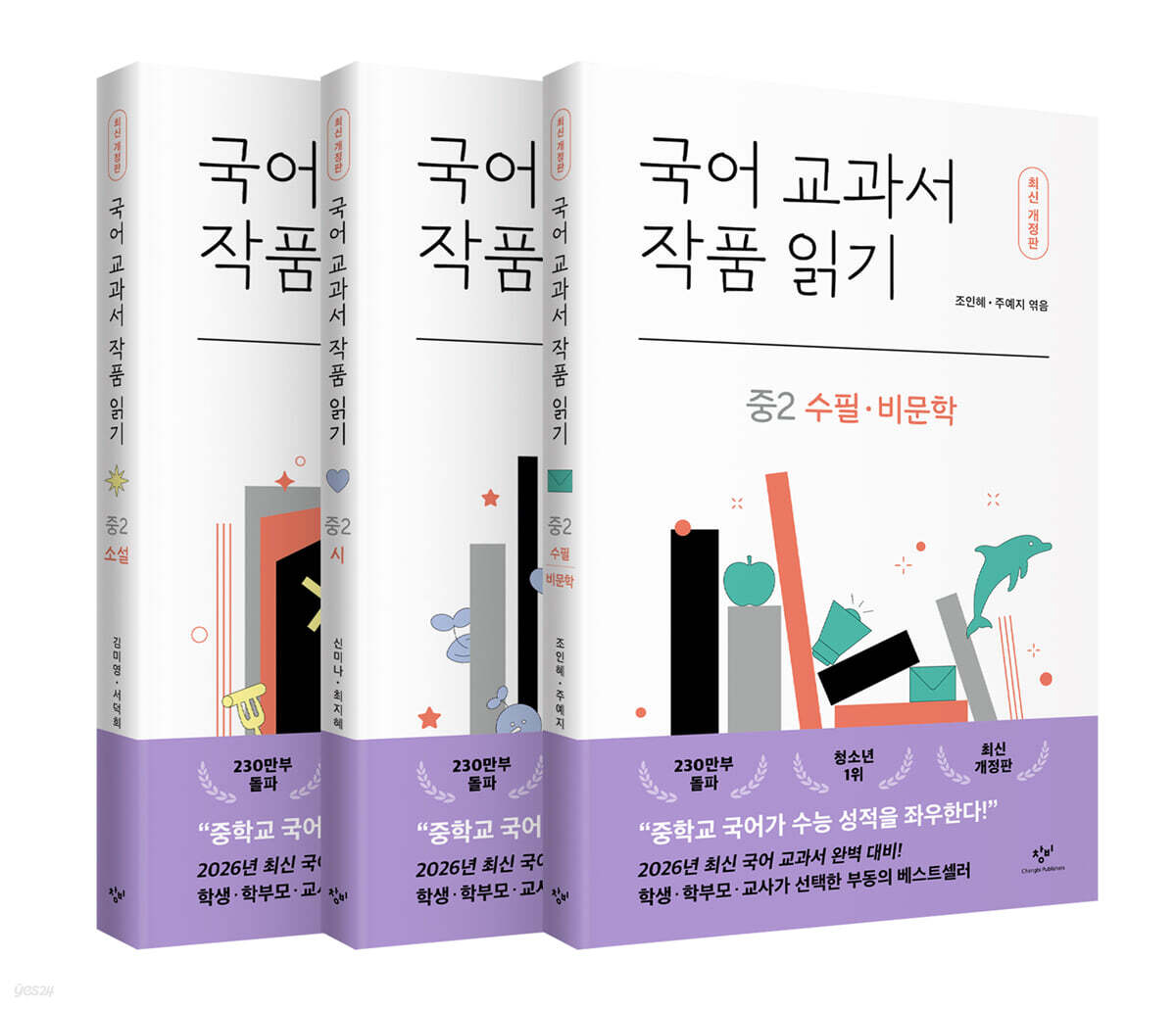
Korean language textbook reading work set for 2nd year middle school students
 |
Description
Book Introduction
“Middle school Korean language skills determine college entrance exam scores!”
Perfect preparation for the latest Korean language textbooks in 2026
A bestseller chosen by students, parents, and teachers
The series 'Reading Korean Language Textbooks', which was first introduced in 2010 and has been chosen by 2.3 million readers, has been republished in its latest revised edition.
Changbi's 'Reading Korean Textbooks' has been published in revised editions in accordance with the new curriculum since its first edition, and with the implementation of the '2022 Revised Curriculum', it is publishing the latest revised edition to prepare for the new Korean textbooks that second-year middle school students will be learning in 2026.
This curriculum emphasizes the ability to respond to future changes and adds a 'media' area.
The ability to critically understand media materials and creatively express one's thoughts has become more important than simply accepting the information given at face value.
Recently, as students' literacy skills have been declining due to not knowing the meaning of words and having difficulty understanding texts or understanding the context of texts they read, this has become a hot topic in schools.
Current Korean language teachers agree that starting with reading the original text of a Korean language textbook and building reading skills helps improve literacy.
Korean is the foundation for learning all subjects, and by establishing a solid foundation in Korean, critical and creative thinking skills can also be strengthened.
The latest revised edition of Changbi's 'Reading Korean Textbooks' has been strengthened with a customized structure that helps build a foundation for literacy and improve Korean language skills.
The latest revised edition of Changbi's 'Reading Korean Language Textbook Works' is organized by genre: poetry, novels, essays, and non-fiction, with the works included in the 10 newly revised Korean language textbooks for second-year middle school students.
In keeping with the changes in textbooks that have strengthened the inclusion of new contemporary works, as well as essential works that are repeatedly included in various textbooks, we have carefully selected and compiled works that are being included in textbooks for the first time.
Additionally, we have prepared activities to help strengthen literacy skills by providing helpful articles tailored to the level of second-year middle school students.
Through various activities, students can read independently to determine whether they know the exact meaning of words, whether they have properly grasped the main idea, and whether they have grasped the meaning of the work based on the context.
Many schools implement a free semester system and do not administer written exams during the first year of middle school, so the second year of middle school is the time when students really begin to feel the weight of studying and exams.
The second part of 'Reading Korean Language Textbooks' contains predicted written exam questions prepared by current teachers.
We have prepared for your first written exam by solving a variety of multiple-choice and essay-type questions, checking the grading criteria and sample answers, and thoroughly preparing for your life's first written exam.
With 15 years of accumulated expertise and the trust of countless readers, "Reading Korean Textbooks" is not only the perfect preparation for the changing textbooks, but also serves as a stepping stone for building a solid foundation in the Korean language.
Perfect preparation for the latest Korean language textbooks in 2026
A bestseller chosen by students, parents, and teachers
The series 'Reading Korean Language Textbooks', which was first introduced in 2010 and has been chosen by 2.3 million readers, has been republished in its latest revised edition.
Changbi's 'Reading Korean Textbooks' has been published in revised editions in accordance with the new curriculum since its first edition, and with the implementation of the '2022 Revised Curriculum', it is publishing the latest revised edition to prepare for the new Korean textbooks that second-year middle school students will be learning in 2026.
This curriculum emphasizes the ability to respond to future changes and adds a 'media' area.
The ability to critically understand media materials and creatively express one's thoughts has become more important than simply accepting the information given at face value.
Recently, as students' literacy skills have been declining due to not knowing the meaning of words and having difficulty understanding texts or understanding the context of texts they read, this has become a hot topic in schools.
Current Korean language teachers agree that starting with reading the original text of a Korean language textbook and building reading skills helps improve literacy.
Korean is the foundation for learning all subjects, and by establishing a solid foundation in Korean, critical and creative thinking skills can also be strengthened.
The latest revised edition of Changbi's 'Reading Korean Textbooks' has been strengthened with a customized structure that helps build a foundation for literacy and improve Korean language skills.
The latest revised edition of Changbi's 'Reading Korean Language Textbook Works' is organized by genre: poetry, novels, essays, and non-fiction, with the works included in the 10 newly revised Korean language textbooks for second-year middle school students.
In keeping with the changes in textbooks that have strengthened the inclusion of new contemporary works, as well as essential works that are repeatedly included in various textbooks, we have carefully selected and compiled works that are being included in textbooks for the first time.
Additionally, we have prepared activities to help strengthen literacy skills by providing helpful articles tailored to the level of second-year middle school students.
Through various activities, students can read independently to determine whether they know the exact meaning of words, whether they have properly grasped the main idea, and whether they have grasped the meaning of the work based on the context.
Many schools implement a free semester system and do not administer written exams during the first year of middle school, so the second year of middle school is the time when students really begin to feel the weight of studying and exams.
The second part of 'Reading Korean Language Textbooks' contains predicted written exam questions prepared by current teachers.
We have prepared for your first written exam by solving a variety of multiple-choice and essay-type questions, checking the grading criteria and sample answers, and thoroughly preparing for your life's first written exam.
With 15 years of accumulated expertise and the trust of countless readers, "Reading Korean Textbooks" is not only the perfect preparation for the changing textbooks, but also serves as a stepping stone for building a solid foundation in the Korean language.
- You can preview some of the book's contents.
Preview
index
[Reading Korean Language Textbook Works: Poetry for Second-Year Middle School Students]
Part 1: Sparkling Words, Conflicted Hearts - 12 stories, including First Love (Ko Jae-jong) and The Distant Future (Kim So-wol)
Part 2: Following the Voice of the Heart - 9 episodes including Snowman (Kim Ryong) and Little Seed (Park Nam-joon)
In the Breath of the Three-Part Era - 11 Pieces, Including Poor Love Song (Shin Kyung-rim) and Climax (Lee Yuk-sa)
Part 4: A World That Touches Your Heart - 10 Stories, Including Cricket (Na Hee-deok) and Tamjinchonyo (Jeong Yak-yong)
[Reading Korean Language Textbook Works: Middle School Novels]
Part 1: A Gaze That Makes Your Heart Grow
Seong Seok-je / A painting of the Himalayan cedar I drew
Joo Yoo-seop / Love Guest and Mother
Kim Min-ryeong / Second seat from the window
Alphonse Daudet / The Secret of Mr. Cornille
Part 2: A Look at the World
Park Lu-ah / I don't die unless it's really hard!
Ha Geun-chan / Sunani University
Park Ji-won / Yangbanjeon
Anton Chekhov / Chameleon
[Reading Korean Language Textbook Works: Essays and Non-Fiction for Middle School Students]
Part 1: Time to Meet Myself - 6 episodes including Father's Letter (Jeong Yak-yong)
Part 2: Growing Through Communication - Let's Talk Comfortably (Lee Geum-hee) and 8 other episodes
Part 3: Movements That Change the World - Consumption That Changes the World (National Moral Teachers' Association), etc. (7 episodes)
Part 4: Curious! The World We Live In - Why Do We Love First Love Stories (Tae Ji-won) and 8 other episodes
Part 1: Sparkling Words, Conflicted Hearts - 12 stories, including First Love (Ko Jae-jong) and The Distant Future (Kim So-wol)
Part 2: Following the Voice of the Heart - 9 episodes including Snowman (Kim Ryong) and Little Seed (Park Nam-joon)
In the Breath of the Three-Part Era - 11 Pieces, Including Poor Love Song (Shin Kyung-rim) and Climax (Lee Yuk-sa)
Part 4: A World That Touches Your Heart - 10 Stories, Including Cricket (Na Hee-deok) and Tamjinchonyo (Jeong Yak-yong)
[Reading Korean Language Textbook Works: Middle School Novels]
Part 1: A Gaze That Makes Your Heart Grow
Seong Seok-je / A painting of the Himalayan cedar I drew
Joo Yoo-seop / Love Guest and Mother
Kim Min-ryeong / Second seat from the window
Alphonse Daudet / The Secret of Mr. Cornille
Part 2: A Look at the World
Park Lu-ah / I don't die unless it's really hard!
Ha Geun-chan / Sunani University
Park Ji-won / Yangbanjeon
Anton Chekhov / Chameleon
[Reading Korean Language Textbook Works: Essays and Non-Fiction for Middle School Students]
Part 1: Time to Meet Myself - 6 episodes including Father's Letter (Jeong Yak-yong)
Part 2: Growing Through Communication - Let's Talk Comfortably (Lee Geum-hee) and 8 other episodes
Part 3: Movements That Change the World - Consumption That Changes the World (National Moral Teachers' Association), etc. (7 episodes)
Part 4: Curious! The World We Live In - Why Do We Love First Love Stories (Tae Ji-won) and 8 other episodes
Detailed image
Publisher's Review
Features of "Reading Korean Language Textbook Works: Middle School 2nd Grade Set" (Latest Revised Edition)
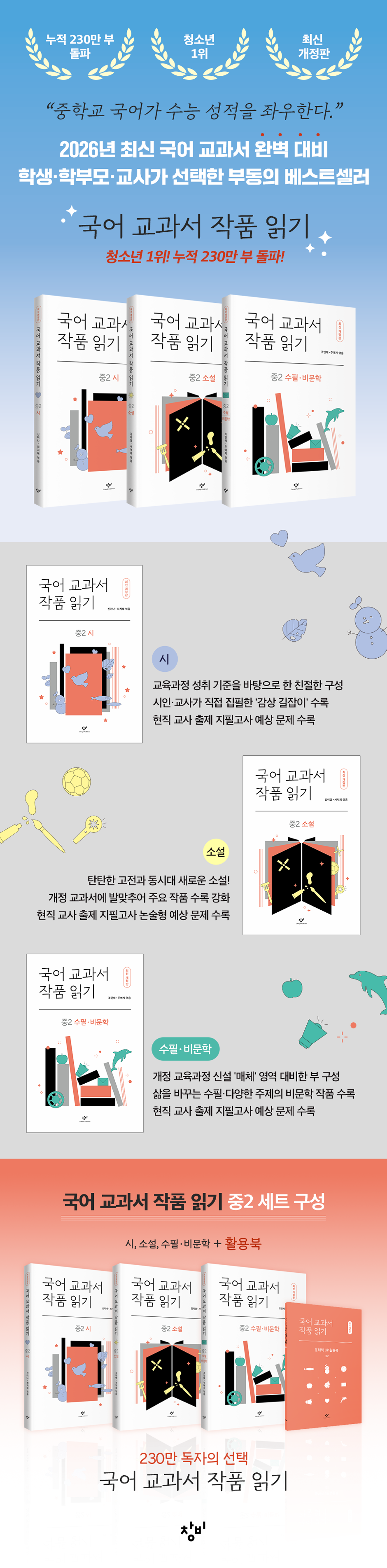
* Based on 10 revised middle school Korean language textbooks, carefully selected by current Korean language teachers and poets
According to the revised 2022 curriculum, second-year middle school students will study with new textbooks starting in 2026.
All the works included in 20 volumes (10 types) of middle school Korean language textbooks were carefully read and analyzed by poets and current Korean language teachers.
We selected works that students must read from 10 textbooks and added core works from outside the textbooks, including 42 poems, 8 novels, and 29 essays and non-fiction.
* The composition is structured to take into account the breathing of appreciation and includes the full text of the work.
We have compiled a balanced selection of essential works that are often included in textbooks, as well as new works that have been included to reflect the changing times.
In the case of poetry, the book was structured in a way that poets and teachers act as guides and lead natural appreciation of poetry.
In particular, to enable learning tailored to the curriculum achievement standards, an appreciation guide was attached to each poem, allowing students to appreciate the beauty of the poem while also learning the techniques and expressions of poetry learned in school.
In the case of novels, the revised curriculum achievement standards were aligned with the composition to enable understanding of the novel's mood, which changes depending on the point of view and the narrator, and works that satirize society with a critical perspective were included.
For essays and non-fiction prose, we've included a wide range of works, from beautiful essays that can change your life to non-fiction that actively explores the world we live in on various topics such as science, humanities, economics, and the environment. We've also organized works that critically understand various media and communication methods into one section to prepare for the newly added "media" area in the revised curriculum.
* Includes activity problems that foster creativity and written exam-style questions that build confidence.
We tried to make the work more three-dimensional by using various activities.
It not only ensures basic understanding, such as knowing the exact meaning of words and properly understanding the main idea, but also allows readers to expand their own thoughts based on the meaning contained in the work and proactively read the work.
Includes sample written exam questions prepared by current teachers.
By solving a variety of multiple-choice and essay-type problems and checking the grading criteria and example answers, you can perfectly prepare for the first written exam in your life, the second year of middle school.
* Based on 10 revised middle school Korean language textbooks, carefully selected by current Korean language teachers and poets
According to the revised 2022 curriculum, second-year middle school students will study with new textbooks starting in 2026.
All the works included in 20 volumes (10 types) of middle school Korean language textbooks were carefully read and analyzed by poets and current Korean language teachers.
We selected works that students must read from 10 textbooks and added core works from outside the textbooks, including 42 poems, 8 novels, and 29 essays and non-fiction.
* The composition is structured to take into account the breathing of appreciation and includes the full text of the work.
We have compiled a balanced selection of essential works that are often included in textbooks, as well as new works that have been included to reflect the changing times.
In the case of poetry, the book was structured in a way that poets and teachers act as guides and lead natural appreciation of poetry.
In particular, to enable learning tailored to the curriculum achievement standards, an appreciation guide was attached to each poem, allowing students to appreciate the beauty of the poem while also learning the techniques and expressions of poetry learned in school.
In the case of novels, the revised curriculum achievement standards were aligned with the composition to enable understanding of the novel's mood, which changes depending on the point of view and the narrator, and works that satirize society with a critical perspective were included.
For essays and non-fiction prose, we've included a wide range of works, from beautiful essays that can change your life to non-fiction that actively explores the world we live in on various topics such as science, humanities, economics, and the environment. We've also organized works that critically understand various media and communication methods into one section to prepare for the newly added "media" area in the revised curriculum.
* Includes activity problems that foster creativity and written exam-style questions that build confidence.
We tried to make the work more three-dimensional by using various activities.
It not only ensures basic understanding, such as knowing the exact meaning of words and properly understanding the main idea, but also allows readers to expand their own thoughts based on the meaning contained in the work and proactively read the work.
Includes sample written exam questions prepared by current teachers.
By solving a variety of multiple-choice and essay-type problems and checking the grading criteria and example answers, you can perfectly prepare for the first written exam in your life, the second year of middle school.
GOODS SPECIFICS
- Date of issue: November 7, 2025
- Page count, weight, size: 584 pages | 1,047g | 141*216*40mm
- ISBN13: 9788936431617
- ISBN10: 8936431617
You may also like
카테고리
korean


korean

![GQ KOREA Mark (Monthly): December [2025]](http://librairie.coreenne.fr/cdn/shop/files/8ef265dbbfbf186523ed75ba7319009d.jpg?v=1765340328&width=3840)


