

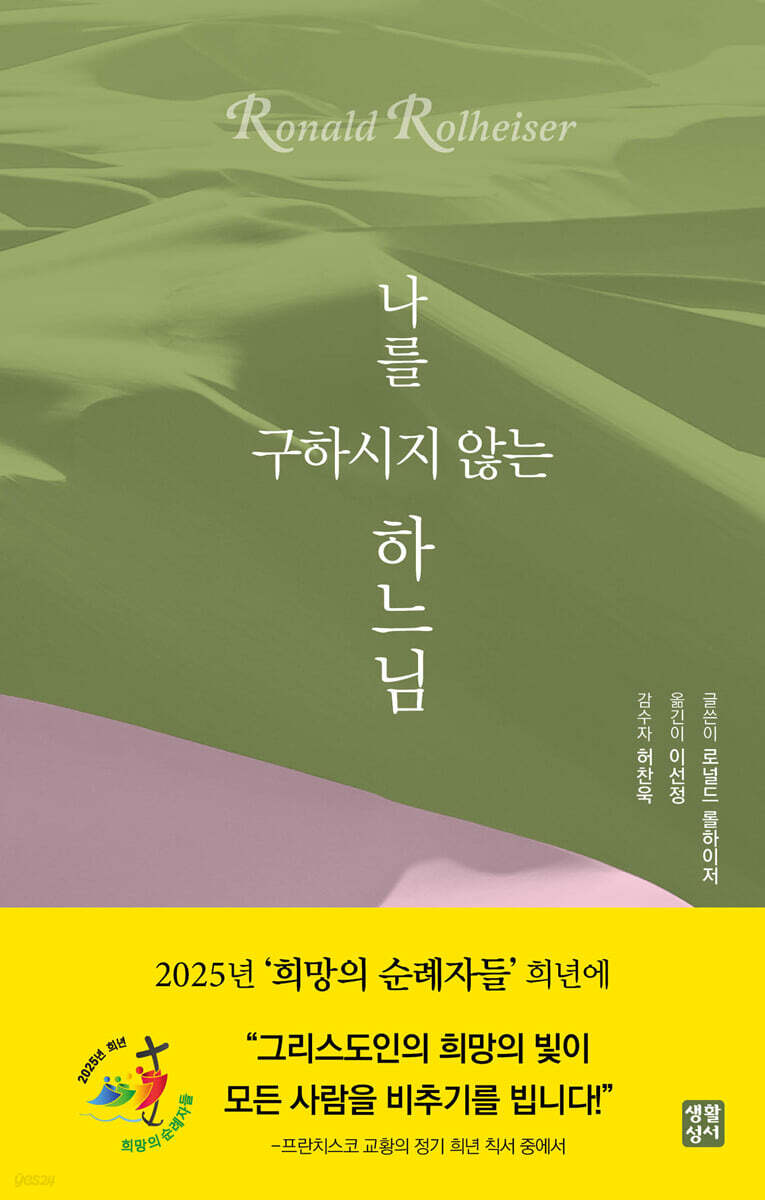
God who does not save me
 |
Description
Book Introduction
To the unresolved religious questions
A book that provides surprising answers
This is a collection of Lenten devotionals by Father Ronald Rolheiser, a leading spiritual writer of our time, in which he has distilled the heartfelt experiences of countless people through long periods of meditation and prayer.
Beyond the ordinary level of reading and commenting on the Passion of Jesus, it opens our eyes and ears to an astonishing spirituality that is easy to understand but never seen before.
Pope Francis, in his papal encyclical “Spes Non Confundit” (Hope Does Not Disappoint), issued for the 2025 Jubilee, calls for “supporting and fostering hope.”
“Pilgrims of Hope” He emphasizes the importance of the Jubilee, the pilgrimage, and above all, hope, wishing that all Christians living in the Jubilee “may their hope shine upon all people.”
In these times, Ronald Rolheiser's book will help us find God's grace, guiding us to hope amid the suffering that surrounds us.
A book that provides surprising answers
This is a collection of Lenten devotionals by Father Ronald Rolheiser, a leading spiritual writer of our time, in which he has distilled the heartfelt experiences of countless people through long periods of meditation and prayer.
Beyond the ordinary level of reading and commenting on the Passion of Jesus, it opens our eyes and ears to an astonishing spirituality that is easy to understand but never seen before.
Pope Francis, in his papal encyclical “Spes Non Confundit” (Hope Does Not Disappoint), issued for the 2025 Jubilee, calls for “supporting and fostering hope.”
“Pilgrims of Hope” He emphasizes the importance of the Jubilee, the pilgrimage, and above all, hope, wishing that all Christians living in the Jubilee “may their hope shine upon all people.”
In these times, Ronald Rolheiser's book will help us find God's grace, guiding us to hope amid the suffering that surrounds us.
- You can preview some of the book's contents.
Preview
index
Recommendation 4
Recommendation 8
16 at the beginning of the book
Chapter 1: The Passion and the Garden of Gethsemane
Jesus' Passivity and the Gift of His Passion 21
The Pain of a Beloved 26
Loved One's Drama 31
The Gladiator's Extreme Agony 35
The 41 Hardest Things in the World
Mental loneliness 46
52 Things to take on the exam
Blood, sweat, and tears 57
It's within striking distance if you throw a stone at it, but 61
The Passion of Jesus Seen Through the Eyes of His Divinity, Part 65
Chapter 2 The Cross as a Spiritual Revolution
72 Most Revolutionary Mental Events in History
Understanding the Deep Secret 76
Efforts to Understand the Mystery 81
Chapter 3: The Cross as God's Most Profound Revelation
The Torn Curtain of the Temple 84
The Path to Intimacy: Weakness 87
God, the Savior, Not the Rescuer, Who Suffered with Us 92
Cornerstone Sacrifice 97
Irresistible Ignorance 103
The Power of God in the Underworld 108
Chapter 4: The Cross of Salvation - Sins Washed Away by the Blood of the Lamb
Some Metaphors and Imagery 114
Jesus, Who Takes Away the Sins of the World 120
Jesus' Last Words: "It is finished." 129
The Death of Jesus, Flowing with Blood and Water 134
Standing at the foot of the cross with Our Lady 139
Carrying the Cross Following Jesus 144
Helping Simon of Cyrene to Carry the Cross 149
The Cross Revealed in a Moment of Humiliation 153
Good Friday Embrace 158
By His wounds we are healed 163
Chapter 5: Resurrection - All Graves Are Opened
Voices of Resurrection and Good Friday 168
The atoms moved 174
And forgiveness was granted 178
God's Conclusion 183
Procession of the Empty Tomb 188
Looking to the Resurrection 193
The Midwife of Resurrection 197
Waiting for Resurrection 202
Living Beyond the Cross 207
Daily Resurrection 212
I Believe in the Resurrection 218
Acknowledgments 223
Reviewer's Note 224
Works by Ronald Rolheiser 230
Recommendation 8
16 at the beginning of the book
Chapter 1: The Passion and the Garden of Gethsemane
Jesus' Passivity and the Gift of His Passion 21
The Pain of a Beloved 26
Loved One's Drama 31
The Gladiator's Extreme Agony 35
The 41 Hardest Things in the World
Mental loneliness 46
52 Things to take on the exam
Blood, sweat, and tears 57
It's within striking distance if you throw a stone at it, but 61
The Passion of Jesus Seen Through the Eyes of His Divinity, Part 65
Chapter 2 The Cross as a Spiritual Revolution
72 Most Revolutionary Mental Events in History
Understanding the Deep Secret 76
Efforts to Understand the Mystery 81
Chapter 3: The Cross as God's Most Profound Revelation
The Torn Curtain of the Temple 84
The Path to Intimacy: Weakness 87
God, the Savior, Not the Rescuer, Who Suffered with Us 92
Cornerstone Sacrifice 97
Irresistible Ignorance 103
The Power of God in the Underworld 108
Chapter 4: The Cross of Salvation - Sins Washed Away by the Blood of the Lamb
Some Metaphors and Imagery 114
Jesus, Who Takes Away the Sins of the World 120
Jesus' Last Words: "It is finished." 129
The Death of Jesus, Flowing with Blood and Water 134
Standing at the foot of the cross with Our Lady 139
Carrying the Cross Following Jesus 144
Helping Simon of Cyrene to Carry the Cross 149
The Cross Revealed in a Moment of Humiliation 153
Good Friday Embrace 158
By His wounds we are healed 163
Chapter 5: Resurrection - All Graves Are Opened
Voices of Resurrection and Good Friday 168
The atoms moved 174
And forgiveness was granted 178
God's Conclusion 183
Procession of the Empty Tomb 188
Looking to the Resurrection 193
The Midwife of Resurrection 197
Waiting for Resurrection 202
Living Beyond the Cross 207
Daily Resurrection 212
I Believe in the Resurrection 218
Acknowledgments 223
Reviewer's Note 224
Works by Ronald Rolheiser 230
Detailed image

Into the book
We must never lose hope under any circumstances.
God does not spare us from suffering, but He does save us from the end of suffering.
If we maintain hope and faith in the midst of suffering, God will surely save us.
This is the faith that the Church holds, and this is the ‘hope’ that Father Ronald Rolheiser constantly emphasizes in this book.
--- From "Archbishop Cho Hwan-gil's Letter of Recommendation"
Reading Father Rolheiser's book will be especially meaningful during the Jubilee Year proclaimed by Pope Francis.
Don't just read it; meditate on its contents, pray about it, and keep it with you throughout the year.
--- From "Recommendations"
What wisdom is hidden in the cross of Jesus? How are the wounds we receive connected to the wounds of Jesus who died on the cross? … How can we accept the call to make Jesus' death on the cross the model we should live by? The task of this book is to seek answers to these questions.
--- From "Introduction"
The cross teaches us that a life that embraces everything, like Jesus, can give as much to others as an active life.
We too suffer in difficult situations where we have no control, where we are humiliated, in pain, and not understood by those we love.
In a life of patience and acceptance, like Jesus who suffered, we have the opportunity to give of our love and ourselves in profound ways.
The reason God makes us feel the pain of darkness, as if He does not exist, is to make us realize that He is not the God we think He is, and that true faith is beyond the faith we imagine.
God is beyond what we feel and imagine.
God wants us to realize that faith is not a warm feeling in the heart or a conviction in the mind, but rather a mark imprinted on the soul, transcending thoughts and emotions.
--- From “Chapter 1: The Passion and the Garden of Gethsemane”
The mystery of the cross is too profound to be easily understood.
The depths of life, love, fidelity, morality, and faith cannot be grasped by human reason.
It is a mystery that cannot be fully understood.
That doesn't mean we're completely unaware of the mystery.
We intuitively understand much more than we can rationally grasp.
--- From "Chapter 2: The Cross as a Spiritual Revolution"
Our God is not a ‘rescuer’ but a ‘savior.’
This is the central revelation hidden in the cross.
Jesus identifies the most insignificant with himself.
“Whatever you did for one of the least of these my brothers, you did for me.” (Matthew 25:40)
Jesus identifies with the outcasts and the rejected, and tells us that in them we can encounter God in a special way.
Sin is a betrayal of love.
But to be able to betray love, one must first be loved and feel that love, however faintly.
From Karl Rahner's perspective, this is why Jesus begged the Father to forgive those who crucified him, saying that they did not know what they were doing.
--- From “Chapter 3, The Cross as God’s Most Profound Revelation”
Love is always a mystery.
If we could grasp it perfectly, it would not be a profound truth.
Profound truth exists beyond us.
To say that truth transcends our understanding does not mean that we cannot understand it at all.
It means that we cannot explain the truth satisfactorily.
God answers our prayers, not by giving us what we think we need, but by giving us what we really need.
As Father James Martin said, the resurrection does not come when we think it will, nor does the manner of the resurrection correspond to the way we think it will.
Carrying the cross means accepting surprising outcomes that are different from what we expected.
God does not spare us from suffering, but He does save us from the end of suffering.
If we maintain hope and faith in the midst of suffering, God will surely save us.
This is the faith that the Church holds, and this is the ‘hope’ that Father Ronald Rolheiser constantly emphasizes in this book.
--- From "Archbishop Cho Hwan-gil's Letter of Recommendation"
Reading Father Rolheiser's book will be especially meaningful during the Jubilee Year proclaimed by Pope Francis.
Don't just read it; meditate on its contents, pray about it, and keep it with you throughout the year.
--- From "Recommendations"
What wisdom is hidden in the cross of Jesus? How are the wounds we receive connected to the wounds of Jesus who died on the cross? … How can we accept the call to make Jesus' death on the cross the model we should live by? The task of this book is to seek answers to these questions.
--- From "Introduction"
The cross teaches us that a life that embraces everything, like Jesus, can give as much to others as an active life.
We too suffer in difficult situations where we have no control, where we are humiliated, in pain, and not understood by those we love.
In a life of patience and acceptance, like Jesus who suffered, we have the opportunity to give of our love and ourselves in profound ways.
The reason God makes us feel the pain of darkness, as if He does not exist, is to make us realize that He is not the God we think He is, and that true faith is beyond the faith we imagine.
God is beyond what we feel and imagine.
God wants us to realize that faith is not a warm feeling in the heart or a conviction in the mind, but rather a mark imprinted on the soul, transcending thoughts and emotions.
--- From “Chapter 1: The Passion and the Garden of Gethsemane”
The mystery of the cross is too profound to be easily understood.
The depths of life, love, fidelity, morality, and faith cannot be grasped by human reason.
It is a mystery that cannot be fully understood.
That doesn't mean we're completely unaware of the mystery.
We intuitively understand much more than we can rationally grasp.
--- From "Chapter 2: The Cross as a Spiritual Revolution"
Our God is not a ‘rescuer’ but a ‘savior.’
This is the central revelation hidden in the cross.
Jesus identifies the most insignificant with himself.
“Whatever you did for one of the least of these my brothers, you did for me.” (Matthew 25:40)
Jesus identifies with the outcasts and the rejected, and tells us that in them we can encounter God in a special way.
Sin is a betrayal of love.
But to be able to betray love, one must first be loved and feel that love, however faintly.
From Karl Rahner's perspective, this is why Jesus begged the Father to forgive those who crucified him, saying that they did not know what they were doing.
--- From “Chapter 3, The Cross as God’s Most Profound Revelation”
Love is always a mystery.
If we could grasp it perfectly, it would not be a profound truth.
Profound truth exists beyond us.
To say that truth transcends our understanding does not mean that we cannot understand it at all.
It means that we cannot explain the truth satisfactorily.
God answers our prayers, not by giving us what we think we need, but by giving us what we really need.
As Father James Martin said, the resurrection does not come when we think it will, nor does the manner of the resurrection correspond to the way we think it will.
Carrying the cross means accepting surprising outcomes that are different from what we expected.
--- From "Chapter 4 The Cross of Salvation - Sins Washed Away by the Blood of the Lamb"
Publisher's Review
★ A Powerful Testimony to the Power of Resurrection - Walter Brueggemann
☆ A profound spiritual meditation on the mystery of suffering and the cross - James Martin
★ A Remarkable Commentary on the Passion of Jesus - Richard Rohr
☆ A brilliant exploration of the essential mystery of the Christian faith - Kerry Weber
'Why do humans suffer?' 'Suffering', which is a substitute for suffering in Buddhist language, means a situation in which one cannot separate from an entity (person, thing, or object) that one does not want to experience.
In Christianity, suffering is a result of the original sin that came from Adam and Eve.
From these two explanations, it seems that pain is caused by external circumstances that are independent of human will, and is not something that arises from within, but rather a reaction to external stimuli.
Doesn't this mean that there is no life without pain, and that there is no way for humans in this world to escape suffering?
Reflections on Human Suffering and Salvation
Ronald Rolheiser's Finding Hope in Suffering
The Catholic Church's soteriology begins with the understanding that God is not a God who eliminates suffering, but rather a God who allows suffering to bear the fruit of salvation.
This book, the Korean version of 『The Passion and the Cross』(FRANCISCAN MEDIA, 2015), written by Ronald Rolheiser, a leading spiritual writer who has been receiving attention since Henri Nouwen, looks at human suffering and death from the perspective of salvation. It delivers a great message to the ‘pilgrims of hope’ living in the Jubilee year, not losing hope even in the midst of suffering.
"How can we accept the most crucial question of all: the call to make Jesus' death on the cross the model for our own lives? This book seeks to answer this question." - From the Preface, Ronald Rolheiser
Letting go of the subjective self
Jesus' Teachings in the Garden of Gethsemane
Jesus' public life to save humanity can be broadly divided into two parts.
The first half is a period of intense activity, when Jesus led his disciples, taught them, performed miracles, and ate with sinners.
But after the Last Supper and prayer in the Garden of Gethsemane, all activities cease.
Jesus, in complete contrast to before, accepts everything that is done to him and surrenders his body to the flow.
Even if it ends in death.
The suffering of Jesus, which seemed so helpless, actually brought abundant grace not only to Jesus but to all of us.
Jesus, who was arrested by soldiers sent by Pilate while praying in the Garden of Gethsemane, was tried and crucified with outrageous malice and contempt, but God led him to the glory of resurrection and ascension, and to the salvation of all mankind.
“The cross teaches us that a life that embraces everything, like Jesus, can give as much to others as an active life.
… we have the opportunity to give our love and ourselves in a profound way in a life of patience and acceptance like Jesus who suffered.” - Chapter 1 The Passion and the Garden of Gethsemane
The most revolutionary in history
Profound Wisdom, the Mystery of the Cross
What does the cross mean to people today? What do people think of this cross, which began as an accessory and has now become a common religious symbol? Believers might vaguely regard the cross, a religious symbol of Christianity, as a symbol of love, profundity, faithfulness, and faith.
On the other hand, it is likely that most people's understanding of the cross is a vague feeling that does not give a precise definition to the cross.
However, this understanding is not wrong.
This is because the mystery of the cross is so profound that it cannot be easily understood by humans, that is, it is a profound realm that cannot be easily grasped by human reason.
We can talk a lot about the cross, but we can't understand it all.
We can only try to understand the mystery of the cross.
The cross, God's ultimate revelation, is also the ultimate act of salvation that Jesus accomplished in the world.
We are saved by the cross, and the cross is the way to salvation.
“The cross of Jesus is God’s clearest revelation, showing us who God is and how we should live in the face of Jesus’ death on the cross.
“All of God’s teachings are condensed in the cross.”
- Chapter 2 The Cross as a Spiritual Revolution
To the 'Pilgrims of Hope'
A book that resonates deeply
What Ronald Rolheiser says is actually simple.
Even Jesus, the Son of God, was not saved from suffering.
But he was saved from the pain of the cross by the glory of resurrection.
The same is true for us, disciples who follow the teachings of Jesus.
Only when we can accept the mystery of resurrection, which human reason cannot comprehend, when we can understand the pain of the cross that oppresses us as a mystery, and when we can forge our way through the narrow path of suffering for the grace of God that gives us new life, can we finally encounter God's salvation that sets us free.
“If we maintain hope and faith in our suffering, God will surely save us.
This is the faith that the Church holds, and this is the ‘hope’ that Father Ronald Rolheiser constantly emphasizes in this book.
…The book's message of not losing hope even in suffering overlaps with the exhortation conveyed in the encyclical.
“This book will resonate deeply with us as we live as ‘pilgrims of hope.’” - Recommendation from Archbishop Cho Hwan-gil of the Daegu Archdiocese
☆ A profound spiritual meditation on the mystery of suffering and the cross - James Martin
★ A Remarkable Commentary on the Passion of Jesus - Richard Rohr
☆ A brilliant exploration of the essential mystery of the Christian faith - Kerry Weber
'Why do humans suffer?' 'Suffering', which is a substitute for suffering in Buddhist language, means a situation in which one cannot separate from an entity (person, thing, or object) that one does not want to experience.
In Christianity, suffering is a result of the original sin that came from Adam and Eve.
From these two explanations, it seems that pain is caused by external circumstances that are independent of human will, and is not something that arises from within, but rather a reaction to external stimuli.
Doesn't this mean that there is no life without pain, and that there is no way for humans in this world to escape suffering?
Reflections on Human Suffering and Salvation
Ronald Rolheiser's Finding Hope in Suffering
The Catholic Church's soteriology begins with the understanding that God is not a God who eliminates suffering, but rather a God who allows suffering to bear the fruit of salvation.
This book, the Korean version of 『The Passion and the Cross』(FRANCISCAN MEDIA, 2015), written by Ronald Rolheiser, a leading spiritual writer who has been receiving attention since Henri Nouwen, looks at human suffering and death from the perspective of salvation. It delivers a great message to the ‘pilgrims of hope’ living in the Jubilee year, not losing hope even in the midst of suffering.
"How can we accept the most crucial question of all: the call to make Jesus' death on the cross the model for our own lives? This book seeks to answer this question." - From the Preface, Ronald Rolheiser
Letting go of the subjective self
Jesus' Teachings in the Garden of Gethsemane
Jesus' public life to save humanity can be broadly divided into two parts.
The first half is a period of intense activity, when Jesus led his disciples, taught them, performed miracles, and ate with sinners.
But after the Last Supper and prayer in the Garden of Gethsemane, all activities cease.
Jesus, in complete contrast to before, accepts everything that is done to him and surrenders his body to the flow.
Even if it ends in death.
The suffering of Jesus, which seemed so helpless, actually brought abundant grace not only to Jesus but to all of us.
Jesus, who was arrested by soldiers sent by Pilate while praying in the Garden of Gethsemane, was tried and crucified with outrageous malice and contempt, but God led him to the glory of resurrection and ascension, and to the salvation of all mankind.
“The cross teaches us that a life that embraces everything, like Jesus, can give as much to others as an active life.
… we have the opportunity to give our love and ourselves in a profound way in a life of patience and acceptance like Jesus who suffered.” - Chapter 1 The Passion and the Garden of Gethsemane
The most revolutionary in history
Profound Wisdom, the Mystery of the Cross
What does the cross mean to people today? What do people think of this cross, which began as an accessory and has now become a common religious symbol? Believers might vaguely regard the cross, a religious symbol of Christianity, as a symbol of love, profundity, faithfulness, and faith.
On the other hand, it is likely that most people's understanding of the cross is a vague feeling that does not give a precise definition to the cross.
However, this understanding is not wrong.
This is because the mystery of the cross is so profound that it cannot be easily understood by humans, that is, it is a profound realm that cannot be easily grasped by human reason.
We can talk a lot about the cross, but we can't understand it all.
We can only try to understand the mystery of the cross.
The cross, God's ultimate revelation, is also the ultimate act of salvation that Jesus accomplished in the world.
We are saved by the cross, and the cross is the way to salvation.
“The cross of Jesus is God’s clearest revelation, showing us who God is and how we should live in the face of Jesus’ death on the cross.
“All of God’s teachings are condensed in the cross.”
- Chapter 2 The Cross as a Spiritual Revolution
To the 'Pilgrims of Hope'
A book that resonates deeply
What Ronald Rolheiser says is actually simple.
Even Jesus, the Son of God, was not saved from suffering.
But he was saved from the pain of the cross by the glory of resurrection.
The same is true for us, disciples who follow the teachings of Jesus.
Only when we can accept the mystery of resurrection, which human reason cannot comprehend, when we can understand the pain of the cross that oppresses us as a mystery, and when we can forge our way through the narrow path of suffering for the grace of God that gives us new life, can we finally encounter God's salvation that sets us free.
“If we maintain hope and faith in our suffering, God will surely save us.
This is the faith that the Church holds, and this is the ‘hope’ that Father Ronald Rolheiser constantly emphasizes in this book.
…The book's message of not losing hope even in suffering overlaps with the exhortation conveyed in the encyclical.
“This book will resonate deeply with us as we live as ‘pilgrims of hope.’” - Recommendation from Archbishop Cho Hwan-gil of the Daegu Archdiocese
GOODS SPECIFICS
- Date of issue: March 19, 2025
- Page count, weight, size: 232 pages | 120*188*12mm
- ISBN13: 9788984816879
- ISBN10: 8984816876
You may also like
카테고리
korean


korean

![GQ KOREA Mark (Monthly): December [2025]](http://librairie.coreenne.fr/cdn/shop/files/8ef265dbbfbf186523ed75ba7319009d.jpg?v=1765340328&width=3840)


