

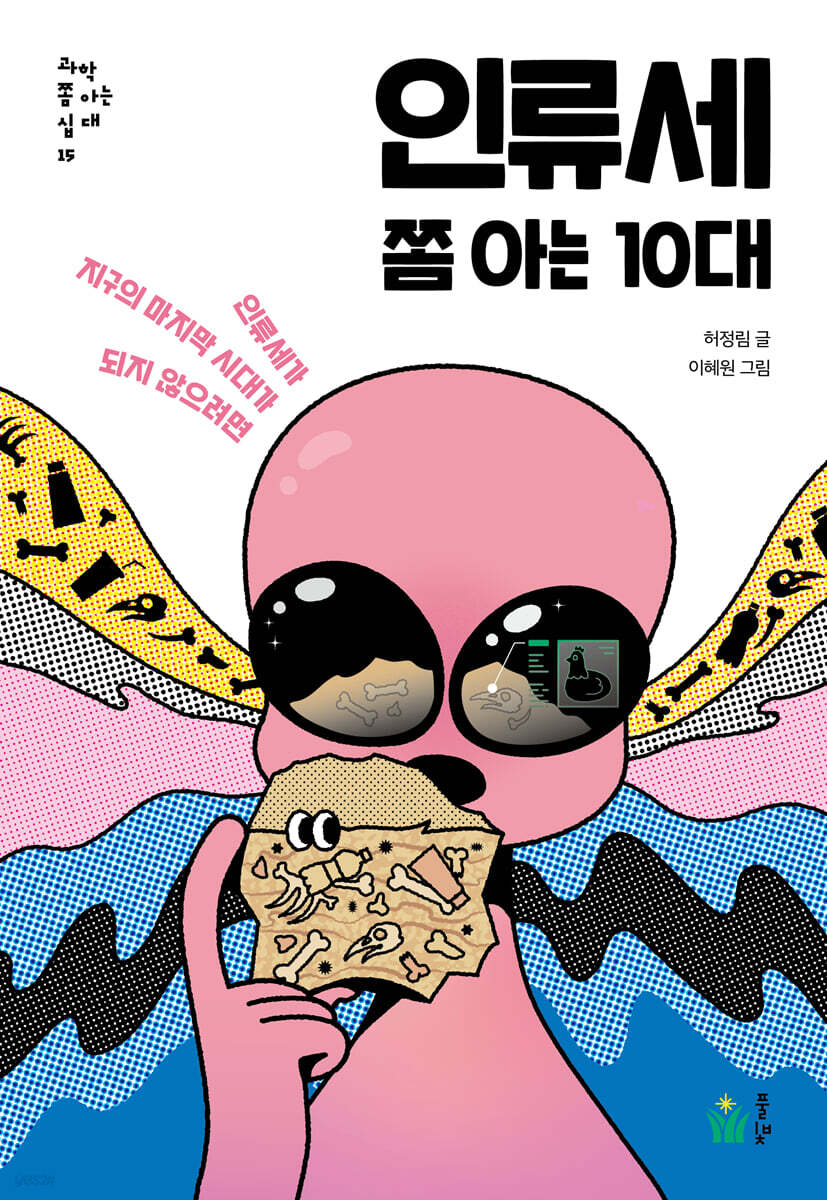
10 teenagers who know a little about the Anthropocene
 |
Description
Book Introduction
“There has never been a creature like this in the history of Earth!”
The emergence of the Anthropocene, a new geological epoch we have created. Is this the age of humanity? vs. is this a crisis for humanity? Among the major environmental issues like the climate crisis and plastic pollution, there's an unfamiliar word that pops up every now and then. The Anthropocene is a concept first proposed by Dutch chemist Paul Crutzen in 2000, referring to a new geological epoch in which human activities have affected the entire Earth. The Holocene is the Quaternary period of the Cenozoic Era, which began approximately 117 million years ago and continues to this day. What are the characteristics of the Anthropocene, so powerful that it has broken even the rule that transitions from one age to the next, ending the Holocene and categorizing it as a new geological epoch? Should we feel hopeful, or alarmed, that for the first time in Earth's history, a geological epoch has been named after a single species? "Teenagers Who Know a Little About the Anthropocene" is a popular science book that explains, based on scientific evidence, the definition and meaning of the new concept of the "Anthropocene" that young people who will live in the future must know, and contains environmental and cultural discussions surrounding the beginning of the Anthropocene, its impact on the Earth's ecosystem, and the actions that humans must take to leave a proper mark on the Earth. |
- You can preview some of the book's contents.
Preview
index
Introduction_Youth Earth Force! Protect the Earth in Crisis
Chapter 1.
The Anthropocene! What is it?
What can we learn from geological time?
What is the Anthropocene?
Humanity that changed the geological world
The Emergence of Humanity Through the History of the Earth's Environment
Chapter 2.
Find Evidence of Anthropocene Fossils
The Earth has started moving!
What is the geological basis for the Anthropocene?
- How do you get sea ice or glacier ice to the lab?
- So how do you find the secret in the ice?
When can we call it the Anthropocene?
What traces will the Anthropocene leave behind?
- Nuclear! The fuse for the Anthropocene?
- Are there any rocks made of plastic?
- Would you mistake a chicken for a human?
Chapter 3.
Understanding the Earth's ecosystem, from plants and animals to humans
The Power of Gaia! Its Principles and Abilities
- The Earth can clean itself?
- Ecosystem order! Food chain
Secrets of the Food Chain: Bioconcentration
- Reduce 'body burden'
- Earth's lost abilities
Chapter 4.
Between development and ecology, what will the Anthropocene leave behind?
The stain left by science
- Deadly radioactive contaminants
Polluted oceans, plastic islands
A rebellion at the table for humans
Dying Messages from Animals
Chapter 5.
My Footprints in the Anthropocene
In search of an old future
What kind of human being am I?
My Footsteps, Ecological Footprint
Finding Traces of the Anthropocene Through Ecological Footprints
Guidebook for Action and Practice for the Earth's Environment
Five Action Plans for the Global Environment
Outgoing article_'Hamlet's Choice', environmental practice is a matter of life and death that must be done!
Detailed image

Into the book
Do you remember that we learned in science class that the current geological epoch is the Holocene, the Quaternary period of the Cenozoic Era? Paul Crutzen predicted that a new geological epoch, the Anthropocene, would follow the Holocene, which began 11,700 years ago after the end of the Ice Age.
The claim that the Anthropocene has begun is supported by the finding that global increases in carbon dioxide and methane levels were observed in air samples taken from Arctic icebergs.
Coincidentally, this coincides with the time when James Watt invented the steam engine in 1784.
Based on this evidence, the argument began that the epoch should no longer be called the Holocene but the Anthropocene. ---「1.
Anthropocene! What is that?
A pillar of ice created by pushing a hollow shaft like a straw into a solid, massive glacier.
This ice sample is called a 'core'.
A European project team conducting ice coring in Antarctica in this way announced that the ice core contains a record spanning 740,000 years, almost twice as long as the 430,000 years we previously knew.
Aren't ice cores, which hold the secrets of vast ages, truly remarkable? Research on these ice cores not only demonstrates the influence of the natural law of the Earth's carbon cycle, but also reveals the climate of interglacial periods, a time when humans were absent.
It is a huge archive of traces left in nature that cannot be compared to the databases accumulated on computers.
---「2.
From "Finding Evidence of Anthropocene Fossils"
Gaia theory has enabled people to view environmental issues on a global scale.
In other words, the entire Earth is trying to maintain homeostasis, trying to maintain a constant state as a single living organism with self-regulating abilities.
Because of this homeostatic nature of the Earth, which seeks to return to the original form created by the goddess Gaia, the Earth has the power to maintain itself to a certain extent even in the face of environmental pollution.
However, due to environmental pollution, the Earth's ability to maintain homeostasis and self-regulation is reaching its limits.
Today's environmental pollution problem is none other than the creation of mankind, and the arrow of responsibility has begun to boomerang back and attack mankind, and the Earth is heading towards destruction. ---「3.
From “Properly Understanding the Earth’s Ecosystem, from Plants and Animals to Humans”
The large number of chickens is not just a stain on Earth's reputation as a "chicken planet," but a serious problem that threatens our dinner tables.
Will we be immune to the effects of eating chicken raised with antibiotics and growth promoters, which control the slow-growing life cycle? We are unknowingly complicit in a practice that uses any means necessary to generate profit.
It's like churning out products in a factory.
This is not just a chicken problem, but a problem that affects all food animals raised in factory farms.---「4.
Between Development and Ecology, What Will the Anthropocene Leave Behind?
The world's population doubled from 3 billion to 7 billion between 1961 and 2012, and the world's total demand for natural capital increased by 186 percent between 1961 and 2012.
This figure means that in 1961, one Earth could easily supply the natural capital needs of the entire human population, but in 2012, 1.6 Earths were needed to support the entire human race. It also means that there are more people living in 2012 than there were in 1961, but they are competing for fewer resources.
This ultimately means that poor countries with poor natural environments and climate conditions and their people's lives will become more difficult.
For example, if everyone on the planet lived like Americans, who have a 9.6-hectare ecological footprint, we would need over nine and a half Earths!
The claim that the Anthropocene has begun is supported by the finding that global increases in carbon dioxide and methane levels were observed in air samples taken from Arctic icebergs.
Coincidentally, this coincides with the time when James Watt invented the steam engine in 1784.
Based on this evidence, the argument began that the epoch should no longer be called the Holocene but the Anthropocene. ---「1.
Anthropocene! What is that?
A pillar of ice created by pushing a hollow shaft like a straw into a solid, massive glacier.
This ice sample is called a 'core'.
A European project team conducting ice coring in Antarctica in this way announced that the ice core contains a record spanning 740,000 years, almost twice as long as the 430,000 years we previously knew.
Aren't ice cores, which hold the secrets of vast ages, truly remarkable? Research on these ice cores not only demonstrates the influence of the natural law of the Earth's carbon cycle, but also reveals the climate of interglacial periods, a time when humans were absent.
It is a huge archive of traces left in nature that cannot be compared to the databases accumulated on computers.
---「2.
From "Finding Evidence of Anthropocene Fossils"
Gaia theory has enabled people to view environmental issues on a global scale.
In other words, the entire Earth is trying to maintain homeostasis, trying to maintain a constant state as a single living organism with self-regulating abilities.
Because of this homeostatic nature of the Earth, which seeks to return to the original form created by the goddess Gaia, the Earth has the power to maintain itself to a certain extent even in the face of environmental pollution.
However, due to environmental pollution, the Earth's ability to maintain homeostasis and self-regulation is reaching its limits.
Today's environmental pollution problem is none other than the creation of mankind, and the arrow of responsibility has begun to boomerang back and attack mankind, and the Earth is heading towards destruction. ---「3.
From “Properly Understanding the Earth’s Ecosystem, from Plants and Animals to Humans”
The large number of chickens is not just a stain on Earth's reputation as a "chicken planet," but a serious problem that threatens our dinner tables.
Will we be immune to the effects of eating chicken raised with antibiotics and growth promoters, which control the slow-growing life cycle? We are unknowingly complicit in a practice that uses any means necessary to generate profit.
It's like churning out products in a factory.
This is not just a chicken problem, but a problem that affects all food animals raised in factory farms.---「4.
Between Development and Ecology, What Will the Anthropocene Leave Behind?
The world's population doubled from 3 billion to 7 billion between 1961 and 2012, and the world's total demand for natural capital increased by 186 percent between 1961 and 2012.
This figure means that in 1961, one Earth could easily supply the natural capital needs of the entire human population, but in 2012, 1.6 Earths were needed to support the entire human race. It also means that there are more people living in 2012 than there were in 1961, but they are competing for fewer resources.
This ultimately means that poor countries with poor natural environments and climate conditions and their people's lives will become more difficult.
For example, if everyone on the planet lived like Americans, who have a 9.6-hectare ecological footprint, we would need over nine and a half Earths!
---「5.
From “My Footprints to Leave in the Anthropocene”
From “My Footprints to Leave in the Anthropocene”
Publisher's Review
There has been a change in the Earth's system that has been running for 4.6 billion years!
From the Gaia theory to the history of mass extinctions,
Why We Need to Know About the Anthropocene Right Now
4.6 billion years ago, our planet Earth was created in space.
It was not until 3.8 billion years ago that the Earth became habitable, and since then, various species of life, from eukaryotes to vertebrates, reptiles, mammals, and giant dinosaurs, have gradually emerged and adapted to the Earth's system.
And just 400,000 years ago, modern humans, Homo sapiens, appeared and began living on Earth.
If we divide the entire history of the Earth's environment into a calendar year, or 12 months, and compare them, we humans are the last to be born, born at around 11:00 PM on December 31st.
How did we, the latecomers, bring about this change that even countless plants and animals in the Earth's ecosystem could not?
This is because the advancement of science and technology that brought convenience to mankind has inflicted fatal damage on the Earth.
Human behavior, including the use of fossil fuels and the emergence of nuclear energy, the increase in man-made materials such as plastics, the increase in carbon dioxide and methane emissions that cause global warming, and the increase in chicken consumption, has brought about an environmental system that is clearly different from the past.
According to the 'Gaia theory' proposed by scientist James Lovelock, the Earth maintains homeostasis through the interaction of organisms, atmosphere, soil, and oceans.
It means that it is an organism that regulates its own condition like a living creature.
In this book, the author mentions the Gaia theory, stating that the Earth's homeostasis has been disrupted and its ability to regulate has reached its limit due to environmental problems caused by humans, and that if the Earth launches a counterattack, humans could become the target of the sixth mass extinction.
The 'Anthropocene' is not simply a geological phenomenon; it could be the Earth's final warning to humanity, and we stand at a crossroads of change we can no longer ignore.
Understanding the Anthropocene means knowing the direction in which humanity will move forward.
It's time to go beyond protecting the environment and become a true member of the Earth!
So that we can leave the right traces in the name of humanity.
Let's learn how to practice environmental protection in everyday life!
Stories about environmental pollution and climate change are familiar to young people.
But when asked about the Anthropocene, most people don't even know what it is.
In some ways, one could think that environmental issues and the Anthropocene are in the same context.
However, to properly understand the Anthropocene, we must note that it is not simply an environmental problem, but rather a problem affecting the entire Earth's systems.
A new geological epoch has begun due to humanity causing changes so powerful that they have affected the immense forces that have sustained the Earth for so long.
This means that humanity is not fully aware of the Earth, which has now become a completely different system.
A very unstable and uncertain future may be upon humanity, which has lived believing in the power of science and technology.
In "Teenagers Who Know a Little About the Anthropocene," the author emphasizes that the discussion about the Anthropocene is not a matter of likes and dislikes, but rather an issue that everyone must act on and think about in order to survive.
Through this book, we aim to increase young people's understanding of the Anthropocene and, furthermore, to teach them how each individual can take environmental action.
I wrote this book with the hope that the youth who will live in the future will develop the vision to become true members of the Earth and actively leave a proper mark on the Anthropocene.
From the Gaia theory to the history of mass extinctions,
Why We Need to Know About the Anthropocene Right Now
4.6 billion years ago, our planet Earth was created in space.
It was not until 3.8 billion years ago that the Earth became habitable, and since then, various species of life, from eukaryotes to vertebrates, reptiles, mammals, and giant dinosaurs, have gradually emerged and adapted to the Earth's system.
And just 400,000 years ago, modern humans, Homo sapiens, appeared and began living on Earth.
If we divide the entire history of the Earth's environment into a calendar year, or 12 months, and compare them, we humans are the last to be born, born at around 11:00 PM on December 31st.
How did we, the latecomers, bring about this change that even countless plants and animals in the Earth's ecosystem could not?
This is because the advancement of science and technology that brought convenience to mankind has inflicted fatal damage on the Earth.
Human behavior, including the use of fossil fuels and the emergence of nuclear energy, the increase in man-made materials such as plastics, the increase in carbon dioxide and methane emissions that cause global warming, and the increase in chicken consumption, has brought about an environmental system that is clearly different from the past.
According to the 'Gaia theory' proposed by scientist James Lovelock, the Earth maintains homeostasis through the interaction of organisms, atmosphere, soil, and oceans.
It means that it is an organism that regulates its own condition like a living creature.
In this book, the author mentions the Gaia theory, stating that the Earth's homeostasis has been disrupted and its ability to regulate has reached its limit due to environmental problems caused by humans, and that if the Earth launches a counterattack, humans could become the target of the sixth mass extinction.
The 'Anthropocene' is not simply a geological phenomenon; it could be the Earth's final warning to humanity, and we stand at a crossroads of change we can no longer ignore.
Understanding the Anthropocene means knowing the direction in which humanity will move forward.
It's time to go beyond protecting the environment and become a true member of the Earth!
So that we can leave the right traces in the name of humanity.
Let's learn how to practice environmental protection in everyday life!
Stories about environmental pollution and climate change are familiar to young people.
But when asked about the Anthropocene, most people don't even know what it is.
In some ways, one could think that environmental issues and the Anthropocene are in the same context.
However, to properly understand the Anthropocene, we must note that it is not simply an environmental problem, but rather a problem affecting the entire Earth's systems.
A new geological epoch has begun due to humanity causing changes so powerful that they have affected the immense forces that have sustained the Earth for so long.
This means that humanity is not fully aware of the Earth, which has now become a completely different system.
A very unstable and uncertain future may be upon humanity, which has lived believing in the power of science and technology.
In "Teenagers Who Know a Little About the Anthropocene," the author emphasizes that the discussion about the Anthropocene is not a matter of likes and dislikes, but rather an issue that everyone must act on and think about in order to survive.
Through this book, we aim to increase young people's understanding of the Anthropocene and, furthermore, to teach them how each individual can take environmental action.
I wrote this book with the hope that the youth who will live in the future will develop the vision to become true members of the Earth and actively leave a proper mark on the Anthropocene.
GOODS SPECIFICS
- Publication date: October 21, 2022
- Page count, weight, size: 140 pages | 218g | 140*203*20mm
- ISBN13: 9791161728537
- ISBN10: 1161728538
You may also like
카테고리
korean


korean

![GQ KOREA Mark (Monthly): December [2025]](http://librairie.coreenne.fr/cdn/shop/files/8ef265dbbfbf186523ed75ba7319009d.jpg?v=1765340328&width=3840)


