

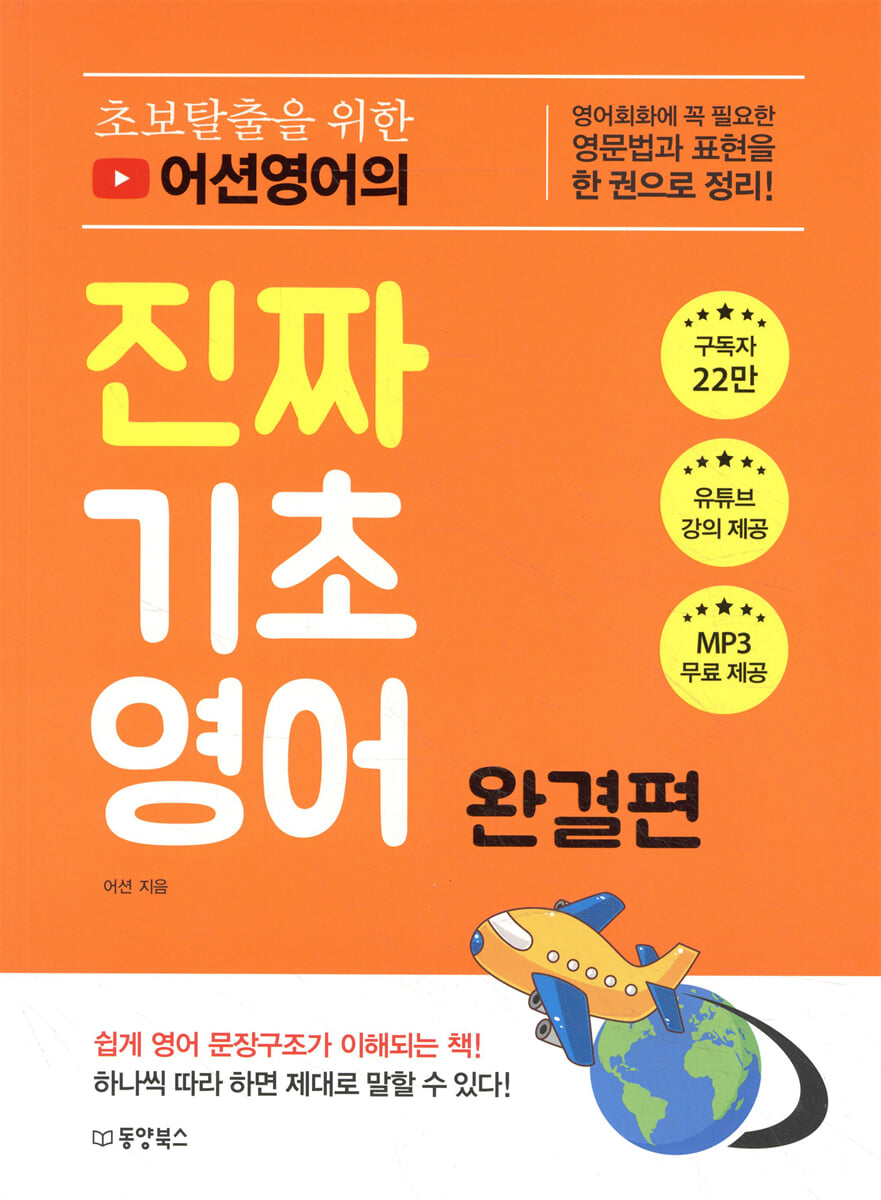
The Complete Guide to Basic English for Beginners
 |
Description
Book Introduction
Rich English content from 190,000 subscribers
The final installment of the 'Real Basic English' series from YouTube's Basic English channel [Action English]!
We've organized the essential English grammar and expressions for English conversation into a simple, beginner-level guide.
With just two chapters of study per day, the course is structured in three stages: Basic English Preparation Course - Basic English Essential Course - Basic English Intensive Course, allowing you to build a solid foundation in English step by step.
It is also a large-print book that is easy on the eyes, and the Korean pronunciation is written in a friendly manner, so anyone of any age can learn it with ease, even if they are not good at reading English.
Native speaker MP3s are available for free via QR code and on the Dongyang Books website, and free lectures are available on the author's YouTube channel.
The final installment of the 'Real Basic English' series from YouTube's Basic English channel [Action English]!
We've organized the essential English grammar and expressions for English conversation into a simple, beginner-level guide.
With just two chapters of study per day, the course is structured in three stages: Basic English Preparation Course - Basic English Essential Course - Basic English Intensive Course, allowing you to build a solid foundation in English step by step.
It is also a large-print book that is easy on the eyes, and the Korean pronunciation is written in a friendly manner, so anyone of any age can learn it with ease, even if they are not good at reading English.
Native speaker MP3s are available for free via QR code and on the Dongyang Books website, and free lectures are available on the author's YouTube channel.
- You can preview some of the book's contents.
Preview
index
INTRO Basic English Preparation Course
01 Learning the Alphabet
02 Four Basic Grammar Rules You Must Remember
03 Representative positions of adjectives
04 A typical way to say a sentence in more detail
PART 01 Essential Basic English Course
Chapter 01: A Complete Guide to the Essential Structure of the Verb "Be"
Unit 01 Talking about your current mood, status, and location
Unit 02 Denying your current mood, state, and position
Unit 03 Talking about past moods, states, and locations
Unit 04 Negating past moods, states, and locations
Unit 05: Talking about future moods, states, and locations
Unit 06 Negating future moods, states, and locations
Plus 01 How to tell time
Chapter 02: A Complete Guide to Essential Structures of Regular Verbs
Unit 07 Talking about what you're doing now
Unit 08 Saying that you are not doing something right now
Unit 09 Talking about things you usually do
Unit 10 Talking about things you don't usually do
Unit 11 Talking about things you did in the past (regular past tense)
Unit 12 Talking about things you did in the past (irregular past tense)
Unit 13 Talking about things you haven't done in the past
Unit 14 Talking about things to do in the future
Unit 15 Talking about things you won't do in the future
Unit 16: Talking about experiences of going somewhere
Unit 17 Talking about experiences of having done something
Plus 02 Representative usage of have
Part 02 Basic English Advanced Course
Chapter 03 Speaking with Meaning (Auxiliary Verbs)
Unit 18 Saying you can
Unit 19 Permission can & may
Unit 20: Asking for Permission: Can, Could & May
Unit 21 Requesting and Asking for Things Can, Could, Would & Will
Unit 22 Will & might: Making decisions or guesses about something you've just decided
Unit 23: Giving Advice or Advice Should
Unit 24 Must
Unit 25 Saying you must have to, has to
Unit 26 Saying you can't
Unit 27 Advice not to do something, advise something shouldn't
Unit 28 Comparing must not and don't have to
Plus 03 Auxiliary Verbs + Be Verb Expressions
Chapter 04 Speaking Comparatively (Comparative & Superlative)
Unit 29 Better & worse used when comparing
Unit 30 Short adjectives used for comparison (-er)
Unit 31 Long adjectives used for comparison (more ~)
Unit 32: Comparing with Emphasis
Unit 33 Comparative Patterns Using Nothing
Unit 34 Comparative patterns using the adjective less
Unit 35 Comparative Patterns Using Auxiliary Verbs
Unit 36 Comparative Adjectives + Nouns
Unit 37 Saying similar (as adjective as)
Unit 38: Saying the best & the worst
Unit 39 Saying the -est
Unit 40 Saying the most ~
Unit 41 Saying one of the best
Plus 04 Adverbs used when comparing
Chapter 05 Speaking Comparatively (Comparative & Superlative)
Preview Passive Voice Essential Patterns
Unit 42: What usually happens (passive present tense)
Unit 43: What Happened in the Past (Passive Past Tense)
Unit 44 What Happened in the Future (Passive Future Tense)
Unit 45 What's Happening Now (Passive Present Progressive)
Unit 46 Experiences (Passive Present Perfect)
Unit 47: Things that have never happened to me (passive present perfect experience negation)
Unit 48: Why Use the Passive Voice?
Plus 05 Things to keep in mind when using the passive voice
supplement
01 Various present perfect (have pp)
& has pp) usage
02 Representative irregular verbs 80
03 Top 78 Essential Adjectives for Conversation
04 Comparative Adjectives & Superlative Adjectives 30
05 Comparative Adverbs & Superlative Adverbs 10
01 Learning the Alphabet
02 Four Basic Grammar Rules You Must Remember
03 Representative positions of adjectives
04 A typical way to say a sentence in more detail
PART 01 Essential Basic English Course
Chapter 01: A Complete Guide to the Essential Structure of the Verb "Be"
Unit 01 Talking about your current mood, status, and location
Unit 02 Denying your current mood, state, and position
Unit 03 Talking about past moods, states, and locations
Unit 04 Negating past moods, states, and locations
Unit 05: Talking about future moods, states, and locations
Unit 06 Negating future moods, states, and locations
Plus 01 How to tell time
Chapter 02: A Complete Guide to Essential Structures of Regular Verbs
Unit 07 Talking about what you're doing now
Unit 08 Saying that you are not doing something right now
Unit 09 Talking about things you usually do
Unit 10 Talking about things you don't usually do
Unit 11 Talking about things you did in the past (regular past tense)
Unit 12 Talking about things you did in the past (irregular past tense)
Unit 13 Talking about things you haven't done in the past
Unit 14 Talking about things to do in the future
Unit 15 Talking about things you won't do in the future
Unit 16: Talking about experiences of going somewhere
Unit 17 Talking about experiences of having done something
Plus 02 Representative usage of have
Part 02 Basic English Advanced Course
Chapter 03 Speaking with Meaning (Auxiliary Verbs)
Unit 18 Saying you can
Unit 19 Permission can & may
Unit 20: Asking for Permission: Can, Could & May
Unit 21 Requesting and Asking for Things Can, Could, Would & Will
Unit 22 Will & might: Making decisions or guesses about something you've just decided
Unit 23: Giving Advice or Advice Should
Unit 24 Must
Unit 25 Saying you must have to, has to
Unit 26 Saying you can't
Unit 27 Advice not to do something, advise something shouldn't
Unit 28 Comparing must not and don't have to
Plus 03 Auxiliary Verbs + Be Verb Expressions
Chapter 04 Speaking Comparatively (Comparative & Superlative)
Unit 29 Better & worse used when comparing
Unit 30 Short adjectives used for comparison (-er)
Unit 31 Long adjectives used for comparison (more ~)
Unit 32: Comparing with Emphasis
Unit 33 Comparative Patterns Using Nothing
Unit 34 Comparative patterns using the adjective less
Unit 35 Comparative Patterns Using Auxiliary Verbs
Unit 36 Comparative Adjectives + Nouns
Unit 37 Saying similar (as adjective as)
Unit 38: Saying the best & the worst
Unit 39 Saying the -est
Unit 40 Saying the most ~
Unit 41 Saying one of the best
Plus 04 Adverbs used when comparing
Chapter 05 Speaking Comparatively (Comparative & Superlative)
Preview Passive Voice Essential Patterns
Unit 42: What usually happens (passive present tense)
Unit 43: What Happened in the Past (Passive Past Tense)
Unit 44 What Happened in the Future (Passive Future Tense)
Unit 45 What's Happening Now (Passive Present Progressive)
Unit 46 Experiences (Passive Present Perfect)
Unit 47: Things that have never happened to me (passive present perfect experience negation)
Unit 48: Why Use the Passive Voice?
Plus 05 Things to keep in mind when using the passive voice
supplement
01 Various present perfect (have pp)
& has pp) usage
02 Representative irregular verbs 80
03 Top 78 Essential Adjectives for Conversation
04 Comparative Adjectives & Superlative Adjectives 30
05 Comparative Adverbs & Superlative Adverbs 10
Detailed image

Publisher's Review
1.
Read the book carefully!
We have written the text in large Korean as close to the native speaker's pronunciation as possible so that anyone who knows Korean can read it without any problems.
Additionally, to make it easier to understand English pronunciation, the sounds of the alphabet are written one by one, and rather than just showing one representative pronunciation, other pronunciations are also written so that you can study them in more detail.
2.
Listen carefully to the two MP3 audio files: the English (native speaker) version and the Korean-English (native speaker) version!
The text has been recorded in Korean-English (native speaker) MP3 format so you can study anytime, anywhere.
Listen to it repeatedly while doing housework, commuting to and from work, and in your spare time so that your ears can become accustomed to English.
As you become more proficient, try listening to audio recordings of only the English (native speaker) voice, rather than the Korean and native speaker versions, and immediately recall the sentences in your head.
You can learn just by listening. Free MP3 downloads www.dongyangbooks.com
3.
Listen to it repeatedly and say it out loud!
You can never read English by just looking at it.
Try to speak like a native speaker.
In particular, if you listen to and speak each pronunciation at least 5 times, English will become familiar and natural to you.
And check out the sentences in Review to see if you can say them yourself.
Before you know it, you will feel your skills improving.
Read the book carefully!
We have written the text in large Korean as close to the native speaker's pronunciation as possible so that anyone who knows Korean can read it without any problems.
Additionally, to make it easier to understand English pronunciation, the sounds of the alphabet are written one by one, and rather than just showing one representative pronunciation, other pronunciations are also written so that you can study them in more detail.
2.
Listen carefully to the two MP3 audio files: the English (native speaker) version and the Korean-English (native speaker) version!
The text has been recorded in Korean-English (native speaker) MP3 format so you can study anytime, anywhere.
Listen to it repeatedly while doing housework, commuting to and from work, and in your spare time so that your ears can become accustomed to English.
As you become more proficient, try listening to audio recordings of only the English (native speaker) voice, rather than the Korean and native speaker versions, and immediately recall the sentences in your head.
You can learn just by listening. Free MP3 downloads www.dongyangbooks.com
3.
Listen to it repeatedly and say it out loud!
You can never read English by just looking at it.
Try to speak like a native speaker.
In particular, if you listen to and speak each pronunciation at least 5 times, English will become familiar and natural to you.
And check out the sentences in Review to see if you can say them yourself.
Before you know it, you will feel your skills improving.
GOODS SPECIFICS
- Publication date: February 15, 2022
- Page count, weight, size: 240 pages | 628g | 188*257*15mm
- ISBN13: 9791157687756
- ISBN10: 115768775X
You may also like
카테고리
korean


korean

![GQ KOREA Mark (Monthly): December [2025]](http://librairie.coreenne.fr/cdn/shop/files/8ef265dbbfbf186523ed75ba7319009d.jpg?v=1765340328&width=3840)


