

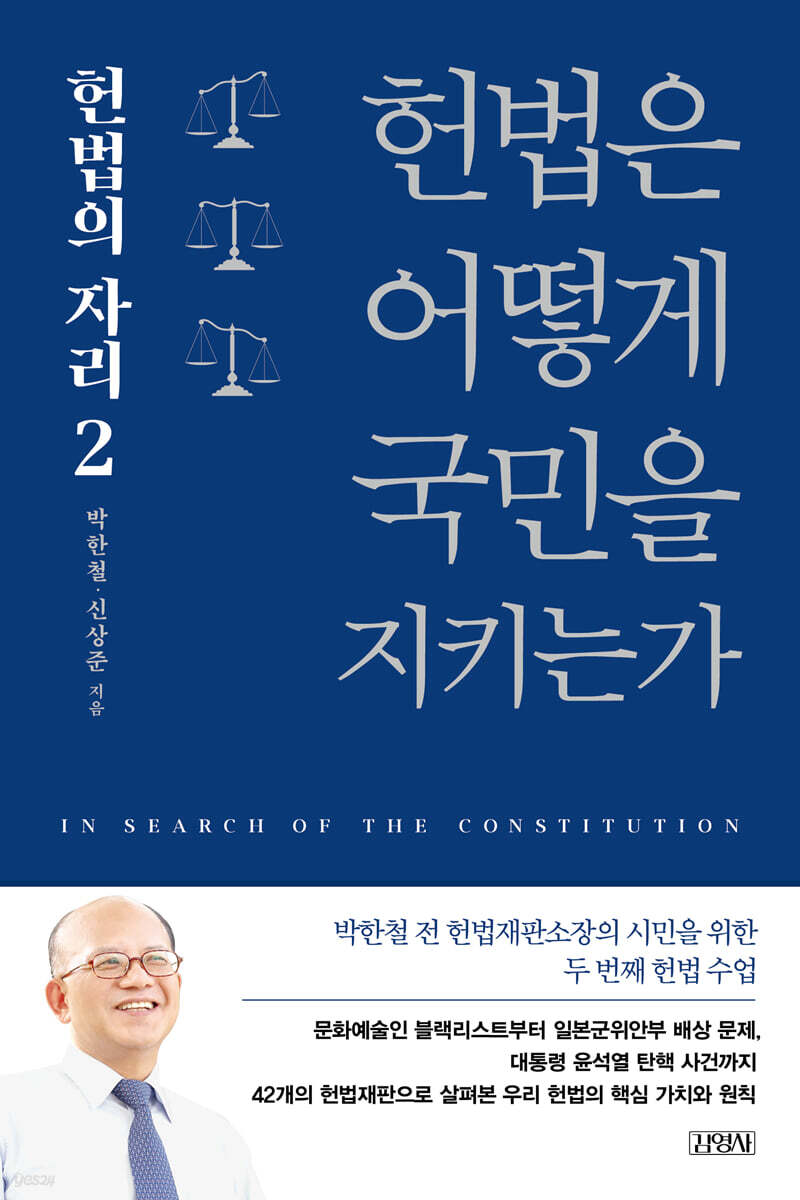
How does the Constitution protect the people?
 |
Description
Book Introduction
Professor Park Han-cheol, the 5th Chief Justice of the Constitutional Court, presents his second constitutional lecture for citizens.
From the blacklist of cultural figures to the issue of compensation for Japanese military comfort women to the impeachment of President Yoon Seok-yeol.
The core values and principles of our Constitution as examined through 42 constitutional court decisions.
Encountering the Constitution, where my life and rights are realized
Professor Park Han-cheol, the 5th Chief Justice of the Constitutional Court, who participated in or directly decided the Constitutional Court, which was a turning point in our society, from the first dissolution of a political party in constitutional history and the impeachment of President Park Geun-hye to the adultery case that reflected the changing times of several decades, has published a new book titled "How the Constitution Protects the People."
This is the second book following 『The Place of the Constitution』 (published by Kim Young-sa, 2022).
This new book was co-authored by Dr. Shin Sang-jun, a former student of Professor Park Han-cheol who has conducted legal and institutional research on currency, finance, and central banking at the Bank of Korea.
While the previous work examined the 13 constitutional court cases that had the greatest impact on Korean society to reveal the meaning of the Constitution, the new work shows how the Constitution protects the fundamental rights of the people and realizes democracy through 42 constitutional court cases.
Can the state control the expression of critical cultural and artistic figures? Can nighttime gatherings and demonstrations be banned to maintain order? Is the claim for compensation for the Japanese military comfort women a state responsibility or a diplomatic issue? What is the minimum measure the state should take regarding the climate crisis? Why is President Yoon Seok-yeol's declaration of martial law unconstitutional? In this way, constitutional adjudication is "a process of finding answers through constant questioning of the constitutional issues at issue and constitutional values" (p. 7).
This book comprehensively and systematically explains the core values that the Constitution sought to uphold and the zeitgeist that it sought to create, encompassing not only recent case law but also past and reference case law.
It will be established as a true 'constitutional textbook' for citizens.
From the blacklist of cultural figures to the issue of compensation for Japanese military comfort women to the impeachment of President Yoon Seok-yeol.
The core values and principles of our Constitution as examined through 42 constitutional court decisions.
Encountering the Constitution, where my life and rights are realized
Professor Park Han-cheol, the 5th Chief Justice of the Constitutional Court, who participated in or directly decided the Constitutional Court, which was a turning point in our society, from the first dissolution of a political party in constitutional history and the impeachment of President Park Geun-hye to the adultery case that reflected the changing times of several decades, has published a new book titled "How the Constitution Protects the People."
This is the second book following 『The Place of the Constitution』 (published by Kim Young-sa, 2022).
This new book was co-authored by Dr. Shin Sang-jun, a former student of Professor Park Han-cheol who has conducted legal and institutional research on currency, finance, and central banking at the Bank of Korea.
While the previous work examined the 13 constitutional court cases that had the greatest impact on Korean society to reveal the meaning of the Constitution, the new work shows how the Constitution protects the fundamental rights of the people and realizes democracy through 42 constitutional court cases.
Can the state control the expression of critical cultural and artistic figures? Can nighttime gatherings and demonstrations be banned to maintain order? Is the claim for compensation for the Japanese military comfort women a state responsibility or a diplomatic issue? What is the minimum measure the state should take regarding the climate crisis? Why is President Yoon Seok-yeol's declaration of martial law unconstitutional? In this way, constitutional adjudication is "a process of finding answers through constant questioning of the constitutional issues at issue and constitutional values" (p. 7).
This book comprehensively and systematically explains the core values that the Constitution sought to uphold and the zeitgeist that it sought to create, encompassing not only recent case law but also past and reference case law.
It will be established as a true 'constitutional textbook' for citizens.
index
Author's Note
Part 1 Prelude
1.
The secret Wordsworth hid in his poetry
2.
How did the zeitgeist influence the development of democracy?
3.
The establishment of a modern state and the birth of the constitution
Part 2: Understanding Constitutional Case Law
Chapter 1: The Establishment and Development of Democracy
1.
Violation of the requirements for martial law declaration and democratic principles
- President Yoon Seok-yeol's impeachment case (2025.
4. 4.
11:22)
2.
Dismantling private enterprises through public intervention and the principles of a market economy
- International Group dissolution incident (1993.
7. 29.)
3.
Inequality of voting values and the right to vote and equality
- National Assembly constituency demarcation incident (2014.
10.
30.)
4.
Cancellation of political party registration and freedom of political party establishment
- Case of cancellation of political party registration due to insufficient number of seats and valid votes (2014.
1. 28.)
5.
Freedom of election campaigning and political expression
- Case of ban on political expression and election campaigning on the Internet (2011.
12.
29.)
6.
Prior permission for assembly and freedom of assembly and demonstration
- Incident of ban on outdoor nighttime gatherings and demonstrations (2009.
9. 24.)
7.
Blacklist creation and management, personal information self-determination, and freedom of expression
- Case of blacklisting and exclusion from support projects in the cultural and arts world (2020.
12.
23.)
8.
Other important precedents
- Case of restricting the voting rights of criminals (2014.
1. 28.), Case of restriction of voting rights of overseas citizens (2007.
6. 28.
etc)
Chapter 2: Expansion of Citizens' Freedom and Rights
1.
Involuntary hospitalization and bodily freedom
- Incident of forced hospitalization of mentally ill patient (2016.
9. 29.)
2.
Changes in the Information Age and the Right to Self-Determination of Personal Information
- Case of denial of change of resident registration number (2015.
12.
23.)
3.
Internet real-name system and freedom of expression
- Internet real-name system incident (2012.
8. 23.)
4.
Limitations of development restrictions for public interest purposes and property rights restrictions
- Greenbelt incident (1998.
12.
24.)
5.
Other important precedents
- Overcrowding in detention centers (2016)
12.
29.), film pre-screening incident (1996.
10.
4.), Same-sex marriage ban case (1997.
7. 16.), Married Couple Joint Tax Case (2002.
8. 29.), oil spill case (2024.
4. 25.)
Chapter 3 Strengthening Respect for and Protection of Human Rights
1.
Obligation to employ disabled people and freedom of economic activity
- Case of mandatory employment system for the disabled (2003.
7. 24.)
2.
The risk of serious violations of fundamental rights and the state's obligation to restore human rights
- Japanese military comfort women compensation claim case (2011.
8. 30.)
3.
Location tracking, wiretapping, due process principles, and the right to self-determination of personal information
- Location tracking incident (2018.
6. 28.), Base Station Investigation Case (2018.
6. 28.), packet interception incident (2018.
8. 30.)
4.
Taxation due to legislative defects and the principle of tax law
- Case regarding the supplementary provisions of the old Tax Reduction and Exemption Regulation Act (2012.
5. 31.)
5.
Other important precedents
- Protective custody case (1989.
7. 14.), Case of restricted release when prosecutors seek a heavy sentence (1992.
12.
24.), Case of restriction of assistance of attorney (1992.
1. 28.
etc.), the case of punishment for bribery of a person (2012).
12.
27.)
Chapter 4: Ensuring Community Stability and Prosperity
1.
Death Penalty and the Right to Life
- Death penalty case (2010.
2. 25.)
2.
The concept of pluralism in terms of constituent elements, the principle of legality, and freedom of expression
- Case of praise and encouragement under the National Security Act (1990.
4. 2.)
3.
Suspension of the statute of limitations by special law, principle of non-retroactivity of criminal punishment, and rule of law
- The 〈May 18 Special Act〉 incident (1996.
2. 16.)
4.
The public interest in prohibiting requests from journalists and private school officials and preventing corruption
- The Anti-Corruption and Bribery Act (aka the Kim Young-ran Act) case (2016).
7. 28.)
5.
Greenhouse gas reduction targets and environmental rights under the Carbon Neutrality Basic Act
- Case of non-presentation of greenhouse gas reduction target (2024.
8. 29.)
6.
Other important precedents
- Case of social defense measures against sex offenders, etc. (2012.
12.
27.
etc.), Internet newspaper forced employment case (2016.
10.
27.), voluntary prostitution ban case (2016.
3. 31.)
Chapter 5: Advancement of Universal International Human Rights
1.
The issue of foreign workers' basic rights and legal discrimination
- Discrimination cases such as relaxation of standards for introducing foreign industrial trainees (2007.
8. 30.)
2.
Denial of access to legal counsel and the right to legal assistance for detained asylum seekers
- Case of temporary injunction to suspend the effect of refusal to meet with refugee lawyer (2014.
6. 5.), Case of refusal of access to lawyer for refugee held in repatriation waiting room (2018.
5. 31.)
3.
Other important precedents
Case of indefinite protection of foreigners subject to forced deportation (2023.
3. 23.), Case of limiting health insurance benefits for foreigners (2023.
9. 26.), Case of exclusion from COVID-19 emergency disaster support for refugees (2024.
3. 28.)
Part 3: Illumination of National Philosophy and Constitutional Theory
1.
What are the ideology and principles of democracy?
2.
What are the fundamental principles of liberalism?
3.
What is the principle of the rule of law?
4.
What are the core values that the national community pursues?
Part 4 Finale: A Proposal for Democracy
1.
Is democracy truly a universal human value?
2.
Liberal Democracy and the Gray Rhino Crisis
3.
How to overcome the crisis of liberal democracy
4.
The Future of Liberal Democracy: The Practice of Hongik Ingan
main
Search
Part 1 Prelude
1.
The secret Wordsworth hid in his poetry
2.
How did the zeitgeist influence the development of democracy?
3.
The establishment of a modern state and the birth of the constitution
Part 2: Understanding Constitutional Case Law
Chapter 1: The Establishment and Development of Democracy
1.
Violation of the requirements for martial law declaration and democratic principles
- President Yoon Seok-yeol's impeachment case (2025.
4. 4.
11:22)
2.
Dismantling private enterprises through public intervention and the principles of a market economy
- International Group dissolution incident (1993.
7. 29.)
3.
Inequality of voting values and the right to vote and equality
- National Assembly constituency demarcation incident (2014.
10.
30.)
4.
Cancellation of political party registration and freedom of political party establishment
- Case of cancellation of political party registration due to insufficient number of seats and valid votes (2014.
1. 28.)
5.
Freedom of election campaigning and political expression
- Case of ban on political expression and election campaigning on the Internet (2011.
12.
29.)
6.
Prior permission for assembly and freedom of assembly and demonstration
- Incident of ban on outdoor nighttime gatherings and demonstrations (2009.
9. 24.)
7.
Blacklist creation and management, personal information self-determination, and freedom of expression
- Case of blacklisting and exclusion from support projects in the cultural and arts world (2020.
12.
23.)
8.
Other important precedents
- Case of restricting the voting rights of criminals (2014.
1. 28.), Case of restriction of voting rights of overseas citizens (2007.
6. 28.
etc)
Chapter 2: Expansion of Citizens' Freedom and Rights
1.
Involuntary hospitalization and bodily freedom
- Incident of forced hospitalization of mentally ill patient (2016.
9. 29.)
2.
Changes in the Information Age and the Right to Self-Determination of Personal Information
- Case of denial of change of resident registration number (2015.
12.
23.)
3.
Internet real-name system and freedom of expression
- Internet real-name system incident (2012.
8. 23.)
4.
Limitations of development restrictions for public interest purposes and property rights restrictions
- Greenbelt incident (1998.
12.
24.)
5.
Other important precedents
- Overcrowding in detention centers (2016)
12.
29.), film pre-screening incident (1996.
10.
4.), Same-sex marriage ban case (1997.
7. 16.), Married Couple Joint Tax Case (2002.
8. 29.), oil spill case (2024.
4. 25.)
Chapter 3 Strengthening Respect for and Protection of Human Rights
1.
Obligation to employ disabled people and freedom of economic activity
- Case of mandatory employment system for the disabled (2003.
7. 24.)
2.
The risk of serious violations of fundamental rights and the state's obligation to restore human rights
- Japanese military comfort women compensation claim case (2011.
8. 30.)
3.
Location tracking, wiretapping, due process principles, and the right to self-determination of personal information
- Location tracking incident (2018.
6. 28.), Base Station Investigation Case (2018.
6. 28.), packet interception incident (2018.
8. 30.)
4.
Taxation due to legislative defects and the principle of tax law
- Case regarding the supplementary provisions of the old Tax Reduction and Exemption Regulation Act (2012.
5. 31.)
5.
Other important precedents
- Protective custody case (1989.
7. 14.), Case of restricted release when prosecutors seek a heavy sentence (1992.
12.
24.), Case of restriction of assistance of attorney (1992.
1. 28.
etc.), the case of punishment for bribery of a person (2012).
12.
27.)
Chapter 4: Ensuring Community Stability and Prosperity
1.
Death Penalty and the Right to Life
- Death penalty case (2010.
2. 25.)
2.
The concept of pluralism in terms of constituent elements, the principle of legality, and freedom of expression
- Case of praise and encouragement under the National Security Act (1990.
4. 2.)
3.
Suspension of the statute of limitations by special law, principle of non-retroactivity of criminal punishment, and rule of law
- The 〈May 18 Special Act〉 incident (1996.
2. 16.)
4.
The public interest in prohibiting requests from journalists and private school officials and preventing corruption
- The Anti-Corruption and Bribery Act (aka the Kim Young-ran Act) case (2016).
7. 28.)
5.
Greenhouse gas reduction targets and environmental rights under the Carbon Neutrality Basic Act
- Case of non-presentation of greenhouse gas reduction target (2024.
8. 29.)
6.
Other important precedents
- Case of social defense measures against sex offenders, etc. (2012.
12.
27.
etc.), Internet newspaper forced employment case (2016.
10.
27.), voluntary prostitution ban case (2016.
3. 31.)
Chapter 5: Advancement of Universal International Human Rights
1.
The issue of foreign workers' basic rights and legal discrimination
- Discrimination cases such as relaxation of standards for introducing foreign industrial trainees (2007.
8. 30.)
2.
Denial of access to legal counsel and the right to legal assistance for detained asylum seekers
- Case of temporary injunction to suspend the effect of refusal to meet with refugee lawyer (2014.
6. 5.), Case of refusal of access to lawyer for refugee held in repatriation waiting room (2018.
5. 31.)
3.
Other important precedents
Case of indefinite protection of foreigners subject to forced deportation (2023.
3. 23.), Case of limiting health insurance benefits for foreigners (2023.
9. 26.), Case of exclusion from COVID-19 emergency disaster support for refugees (2024.
3. 28.)
Part 3: Illumination of National Philosophy and Constitutional Theory
1.
What are the ideology and principles of democracy?
2.
What are the fundamental principles of liberalism?
3.
What is the principle of the rule of law?
4.
What are the core values that the national community pursues?
Part 4 Finale: A Proposal for Democracy
1.
Is democracy truly a universal human value?
2.
Liberal Democracy and the Gray Rhino Crisis
3.
How to overcome the crisis of liberal democracy
4.
The Future of Liberal Democracy: The Practice of Hongik Ingan
main
Search
Detailed image
.jpg)
Into the book
I hope that this will serve as an opportunity for citizens living in an era of democratic crisis to reflect on the true meaning of liberal democracy as stipulated in the Constitution.
It aims to show, in a concrete, yet comprehensive and three-dimensional way, how constitutional principles and core values such as 'human dignity,' 'liberalism,' 'democracy,' 'rule of law,' and 'republicanism' are applied and operated in our daily lives, using real-life examples.
It includes approximately 40 more constitutional precedents and significantly expands the explanations of national philosophy and constitutional theory.
--- From the author's note
For Weber, law is not only a constituent element of the state, but also an essential tool for carrying out the state's mission.
There are three basic legal relationships within a state.
These are legal relationships between individuals, legal relationships between individuals and the state, and legal relationships within state organizations.
These three legal relationships originate from the social contract, and the constitution, the basic law of the nation, is the document of this social contract.
--- 「Part 1 Prelude, 3.
From “The Establishment of a Modern State and the Birth of the Constitution”
The presidential impeachment system is a significant measure that nullifies the exercise of the people's sovereignty and political mandate after the fact by having the Constitutional Court remove the president elected by the people through a judicial decision, and it is the most exceptional procedure of popular sovereignty and democracy.
Beyond the constitutional significance of its conclusion, the impeachment trial of the president is also a constitutional process of community integration that re-embraces a divided politics and society in the name of the Constitution.
--- 「Part 2 Understanding Constitutional Case Law: Chapter 1 Establishment and Development of Democracy, 1.
Violation of the requirements for martial law declaration and democratic principles - Impeachment of President Yoon Seok-yeol (2025.
4. 4.
11:22) from
The rebellious and insurgent perpetrators of this incident destroyed the fundamental liberal democratic order that forms the foundation of our constitutional order. It goes without saying that as a result, our democracy has regressed over a long period of time. The lives and bodies of many citizens have been violated, and the freedoms of all citizens have been suppressed for a long time. The pain and harm they have inflicted on the people are extremely serious.
The benefits resulting from the completion of the statute of limitations are merely legal benefits and do not fall under the fundamental rights guaranteed by the Constitution.
In addition, there is a very important public interest need to punish those who committed crimes that destroyed the constitutional order during the process of taking power, restore justice, and correct the distorted flow of our constitutional history, as well as to establish a constitutional milestone to establish a liberal democratic basic order so that such an unfortunate incident will never be repeated in our constitutional history in the future. On the other hand, the trust interests of the rebels and seditionists in this case in their legal status due to the completion of the statute of limitations for the crime of military mutiny or sedition are not worth protecting.
--- 「Part 2 Understanding Constitutional Case Law: Chapter 4 Securing Community Stability and Prosperity, 3.
Suspension of the statute of limitations and the principle of non-retroactivity of criminal punishment under special laws, and the rule of law - the case of the 〈May 18 Special Act〉 (1996.
2. 16.) from
Article 1 of the Constitution states, “The Republic of Korea shall be a democratic republic.
It stipulates that “the sovereignty of the Republic of Korea resides in the people, and all state authority emanates from the people.”
This phrase describes the essence of democracy, which states that the source of all state power is the people, and the requirement of democracy that all exercise of state power must result from the willful acts of the people.
--- 「Part 3: Illumination of National Philosophy and Constitutional Theory, 1.
From “What are the ideology and principles of democracy?”
Article 10, combined with Article 1, derives the right of active citizenship, namely the freedom to participate in politics.
The focus of political participation is on the right to elect legislators and the president through elections and to participate in legislation and administration.
Historically, the right to political participation has been considered the fourth human right, along with life, liberty, and property.
Individuals are granted an independent status from the national community through fundamental rights, and can realize this status under the rule of law.
Furthermore, in principle, they acquire the ability to determine their own lives, shape their lives according to their own representations, and, in solidarity with others, exert a significant influence on the development of society as a whole.
--- 「Part 3: Illumination of National Philosophy and Constitutional Theory, 2.
From "What are the fundamental principles of liberalism?"
The basic meaning of the constitution of a 21st century socially integrated nation is that it is based on the 19th century modern constitutionalism constitution (freedom and human rights) and the 20th century social welfare state constitution (welfare and equality), but goes one step further and establishes, maintains, and develops a basic order that guarantees “human dignity and common prosperity” as the major direction for the future of the nation. At the same time, to make it more concrete, it means that each article of the constitution must be actively and harmoniously interpreted within the larger framework of human dignity and common prosperity.
Only then can all state functions actively respond to changes and conflicts in the modern information society of the 21st century, where all kinds of risks and conflicts are routine, and actively realize the constitutional value of social integration.
It aims to show, in a concrete, yet comprehensive and three-dimensional way, how constitutional principles and core values such as 'human dignity,' 'liberalism,' 'democracy,' 'rule of law,' and 'republicanism' are applied and operated in our daily lives, using real-life examples.
It includes approximately 40 more constitutional precedents and significantly expands the explanations of national philosophy and constitutional theory.
--- From the author's note
For Weber, law is not only a constituent element of the state, but also an essential tool for carrying out the state's mission.
There are three basic legal relationships within a state.
These are legal relationships between individuals, legal relationships between individuals and the state, and legal relationships within state organizations.
These three legal relationships originate from the social contract, and the constitution, the basic law of the nation, is the document of this social contract.
--- 「Part 1 Prelude, 3.
From “The Establishment of a Modern State and the Birth of the Constitution”
The presidential impeachment system is a significant measure that nullifies the exercise of the people's sovereignty and political mandate after the fact by having the Constitutional Court remove the president elected by the people through a judicial decision, and it is the most exceptional procedure of popular sovereignty and democracy.
Beyond the constitutional significance of its conclusion, the impeachment trial of the president is also a constitutional process of community integration that re-embraces a divided politics and society in the name of the Constitution.
--- 「Part 2 Understanding Constitutional Case Law: Chapter 1 Establishment and Development of Democracy, 1.
Violation of the requirements for martial law declaration and democratic principles - Impeachment of President Yoon Seok-yeol (2025.
4. 4.
11:22) from
The rebellious and insurgent perpetrators of this incident destroyed the fundamental liberal democratic order that forms the foundation of our constitutional order. It goes without saying that as a result, our democracy has regressed over a long period of time. The lives and bodies of many citizens have been violated, and the freedoms of all citizens have been suppressed for a long time. The pain and harm they have inflicted on the people are extremely serious.
The benefits resulting from the completion of the statute of limitations are merely legal benefits and do not fall under the fundamental rights guaranteed by the Constitution.
In addition, there is a very important public interest need to punish those who committed crimes that destroyed the constitutional order during the process of taking power, restore justice, and correct the distorted flow of our constitutional history, as well as to establish a constitutional milestone to establish a liberal democratic basic order so that such an unfortunate incident will never be repeated in our constitutional history in the future. On the other hand, the trust interests of the rebels and seditionists in this case in their legal status due to the completion of the statute of limitations for the crime of military mutiny or sedition are not worth protecting.
--- 「Part 2 Understanding Constitutional Case Law: Chapter 4 Securing Community Stability and Prosperity, 3.
Suspension of the statute of limitations and the principle of non-retroactivity of criminal punishment under special laws, and the rule of law - the case of the 〈May 18 Special Act〉 (1996.
2. 16.) from
Article 1 of the Constitution states, “The Republic of Korea shall be a democratic republic.
It stipulates that “the sovereignty of the Republic of Korea resides in the people, and all state authority emanates from the people.”
This phrase describes the essence of democracy, which states that the source of all state power is the people, and the requirement of democracy that all exercise of state power must result from the willful acts of the people.
--- 「Part 3: Illumination of National Philosophy and Constitutional Theory, 1.
From “What are the ideology and principles of democracy?”
Article 10, combined with Article 1, derives the right of active citizenship, namely the freedom to participate in politics.
The focus of political participation is on the right to elect legislators and the president through elections and to participate in legislation and administration.
Historically, the right to political participation has been considered the fourth human right, along with life, liberty, and property.
Individuals are granted an independent status from the national community through fundamental rights, and can realize this status under the rule of law.
Furthermore, in principle, they acquire the ability to determine their own lives, shape their lives according to their own representations, and, in solidarity with others, exert a significant influence on the development of society as a whole.
--- 「Part 3: Illumination of National Philosophy and Constitutional Theory, 2.
From "What are the fundamental principles of liberalism?"
The basic meaning of the constitution of a 21st century socially integrated nation is that it is based on the 19th century modern constitutionalism constitution (freedom and human rights) and the 20th century social welfare state constitution (welfare and equality), but goes one step further and establishes, maintains, and develops a basic order that guarantees “human dignity and common prosperity” as the major direction for the future of the nation. At the same time, to make it more concrete, it means that each article of the constitution must be actively and harmoniously interpreted within the larger framework of human dignity and common prosperity.
Only then can all state functions actively respond to changes and conflicts in the modern information society of the 21st century, where all kinds of risks and conflicts are routine, and actively realize the constitutional value of social integration.
--- 「Part 4 Finale: Proposals for Democracy, 3.
From “How to overcome the crisis of liberal democracy”
From “How to overcome the crisis of liberal democracy”
Publisher's Review
A Constitutional Textbook Reflecting 30 Years of Korean Society's History and Fierce Debate
A second constitutional lesson for citizens, presented by former Constitutional Court Chief Justice Park Han-cheol.
“The essence of constitutional adjudication is questioning.
This is because constitutional adjudication is a process of finding answers through continuous questioning of problematic constitutional issues and constitutional values.
If you keep asking questions, it will naturally lead to concerns about our political reality and future.
Ultimately, for a constitutional court to be a great one, it must be a beautiful symphony in which diverse opinions and values are harmoniously blended.
“This is why we must build a solid foundation for individuals, society, and the national community to develop together toward the future.” (From “How Does the Constitution Protect the People,” Author’s Note, p. 7)
On April 4, 2025, at 11:22 AM, the Constitutional Court unanimously upheld President Yoon Seok-yeol's impeachment, marking a step toward social integration in South Korea, a society that had been deeply divided.
This was “a constitutional procedure for community integration that re-embraced the divided politics and society in the name of the Constitution” (p. 56).
In this way, the Constitution provides the direction in which the community should advance, protects the lives of the people, the masters of the country, and realizes their rights.
Professor Park Han-cheol, the 5th Chief Justice of the Constitutional Court, who was involved in or directly decided on the Constitutional Tribunal, which was a turning point in our society, from the first dissolution of a political party in constitutional history and the impeachment of President Park Geun-hye to the adultery case that reflected the changing times of several decades, has published a new book titled “How Does the Constitution Protect the People?”
This is the second book following “The Place of the Constitution” (published by Kim Young-sa, 2022), and this new book was co-authored by Dr. Shin Sang-jun, a disciple of Professor Park Han-cheol who has conducted legal and institutional research on currency, finance, and central banks at the Bank of Korea.
While the previous work examined the 13 constitutional trials that had the greatest impact on Korean society and revealed the meaning of the Constitution, the new work shows how the Constitution protects the basic rights of the people and realizes democracy through 42 constitutional trials, ranging from the blacklist of artists and cultural figures to the issue of compensation for comfort women and the impeachment of President Yoon Seok-yeol.
The author examines the issues at stake in the Constitutional Court and the social changes that followed its ruling. He explains how the core principles and values of the Constitution, including democracy, liberalism, the rule of law, and republicanism, are applied to everyday life, and presents a vision for the Constitution to overcome the crisis of democracy.
It comprehensively and systematically explains the core values that the Constitution has sought to uphold and the zeitgeist it has sought to create, encompassing not only recent case law but also past and reference case law.
This book will be established as a true 'constitutional textbook' for citizens.
The core values and principles of our Constitution as examined through 42 constitutional court cases.
How has the Constitution reflected the times and protected the community?
· The Principle of Democratic Republic and Popular Sovereignty: The Establishment and Development of Democratic Politics
Article 1 of the Constitution clearly declares the form of government of the Republic of Korea and the principle of popular sovereignty.
How is diversity possible in a democratic nation? Can the state control the expression of artists and cultural figures critical of the government? The Constitutional Court unanimously ruled that the state's exclusion of artists and organizations critical of the government from cultural and artistic support programs was unconstitutional ("Case of Blacklisting and Exclusion from Cultural and Arts Support Programs").
Political opinions, even if they are public information, fall within the scope of the right to self-determination of personal information. Therefore, the government's information collection activities have no legal basis and seriously infringe upon the right to self-determination of personal information.
It also violates freedom of political expression and the right to equality by discriminating against those who express certain political views.
This decision “presented a constitutional standard for the democratic state administration attitude that the people’s representatives should have” (p. 92).
Why is President Yoon Seok-yeol's declaration of martial law unconstitutional? In the "President Yoon Seok-yeol Impeachment Case," the court unanimously upheld the decision (8-0) to remove President Yoon Seok-yeol from office, finding that he had neglected his duty to uphold the Constitution and gravely betrayed the trust of the people of the Republic of Korea, the sovereign of a democratic republic.
The Constitutional Court ruled that President Yoon Seok-yeol violated both the substantive and procedural requirements for declaring martial law as stipulated in the Constitution and the Martial Law Act.
The second presidential impeachment in constitutional history declared, "Even the most powerful person can never be above the law," reaffirming the principles of the rule of law and the supremacy of the Constitution (p. 55).
· The Supreme Value, Human Dignity: Protecting and Strengthening Respect for Human Rights
Article 10 of the Constitution declares human dignity as the highest value and imposes on all state powers the duty to confirm the inviolability of fundamental human rights and to protect them.
Is compensation for comfort women a national responsibility or a matter confined to diplomatic matters? The Constitutional Court ruled that the South Korean government's failure to take action to resolve the dispute with Japan regarding compensation claims for comfort women was unconstitutional ("Comfort Women's Claims for Compensation from Japan Case").
This is a decision that “confirmed the scope of responsibility for the serious violation of fundamental rights that the government of the Republic of Korea, which inherited the democratic legitimacy of the Provisional Government of the Republic of Korea, must properly assume” (p. 141).
Does a state's duty to protect fundamental rights apply only to its own citizens? The Constitutional Court has made significant contributions to the advancement of universal international human rights through numerous decisions actively recognizing the fundamental rights of refugees and foreigners residing in the country.
For example, the Ministry of Labor's Regulations, which exclude foreign industrial trainees from the application of key labor standards guaranteed by the Labor Standards Act, and the Emergency Disaster Relief Fund Processing Standards, which exclude recognized refugees from receiving COVID-19 emergency disaster relief, were ruled unconstitutional as infringing on the right to equality.
· Sustainable National Community: Ensuring community stability and prosperity
Ensuring the stability of the national community is directly linked to the state's highest duty: protecting the fundamental rights of its citizens.
What are the minimum measures a nation should take to address the climate crisis? The Constitutional Court upheld the constitutionality of the Carbon Neutrality Basic Act's provision requiring a 40 percent reduction in greenhouse gas emissions by 2030, but ruled it unconstitutional for failing to provide any quantitative standards for the reduction target from 2031 to 2049 (the "Greenhouse Gas Reduction Target Failure Case").
In this case, the Constitutional Court judged the unconstitutionality based on whether the state had taken the minimum necessary measures to protect fundamental rights (in this case, environmental rights), using the "principle of prohibition of underprotection" rather than the "principle of prohibition of excess," which is the general standard for judging violations of fundamental rights.
When is truly retroactive legislation, which applies later laws to events that have already occurred, fundamentally prohibited by our Constitution, possible? The Constitutional Court ruled that the "May 18 Special Act," intended to punish those involved in the December 12 military rebellion and the May 18 Gwangju Democratization Movement, was constitutional, not unconstitutional, and exceptionally permitted prosecution for criminal charges for which the statute of limitations had expired (the "May 18 Special Act Case").
Those involved in this incident have destroyed the fundamental liberal democratic order that forms the foundation of our constitutional order and have suppressed the freedom of the people for a long period of time. Therefore, even if the statute of limitations has expired, punishing them is a matter of public interest that is far more important than protecting the trust in their legal status.
This is a decision to “punish those who committed crimes that destroyed the constitutional order during the process of taking power, restore justice, and correct the distorted flow of our constitutional history,” and “establish a constitutional milestone to establish a liberal democratic basic order so that such an unfortunate incident will never be repeated in our constitutional history” (p. 187).
How to recover the lost rights of the people
Will we overcome the crisis of democracy?
Questioning the Constitution's Place
“Democracy is by no means a complete political system in itself.
As a political system that constantly changes in response to the changing times and trends, continuous improvement and problem-solving are necessary.
It is no exaggeration to say that the future of the 21st century depends on how we overcome the new challenges and trials facing democracy.” (pp. 31-32)
Today we are living in a time of crisis for democracy.
As division and conflict intensify, the importance of the Constitution has grown even greater.
The Constitutional Court has been mediating conflicts and protecting the people amidst the sharp debates and historical trends of Korean society.
How can the Constitution overcome the current crisis and protect democracy and the people? Democracy has evolved in various forms, from the direct democracy of ancient Greece to the modern constitutional democracy of the 19th century, the social welfare state democracy of the 20th century, and the popular democracy of the 21st century.
The "crisis of democracy" facing the 21st century is a sufficiently predictable and clearly recognizable danger, but because of its severity, it is a "gray rhino" problem that people tend to overlook or ignore.
The zeitgeist of the 21st century can be found in preparing for the dangers of the gray rhinoceros and correcting the consequences.
To this end, the author emphasizes the implementation of a 21st-century social integration state constitution (human dignity and common prosperity), which goes beyond the 19th-century modern constitutionalism constitution (freedom and human rights) and the 20th-century social welfare state constitution (welfare and equality).
The Constitution, which sets the direction for the national community and serves to protect the people, must actively realize the value of social integration by reflecting the zeitgeist of the 21st century.
This book will serve as a milestone for realizing the lives and rights of democratic citizens and a sustainable national community in an era of conflict and turmoil.
A second constitutional lesson for citizens, presented by former Constitutional Court Chief Justice Park Han-cheol.
“The essence of constitutional adjudication is questioning.
This is because constitutional adjudication is a process of finding answers through continuous questioning of problematic constitutional issues and constitutional values.
If you keep asking questions, it will naturally lead to concerns about our political reality and future.
Ultimately, for a constitutional court to be a great one, it must be a beautiful symphony in which diverse opinions and values are harmoniously blended.
“This is why we must build a solid foundation for individuals, society, and the national community to develop together toward the future.” (From “How Does the Constitution Protect the People,” Author’s Note, p. 7)
On April 4, 2025, at 11:22 AM, the Constitutional Court unanimously upheld President Yoon Seok-yeol's impeachment, marking a step toward social integration in South Korea, a society that had been deeply divided.
This was “a constitutional procedure for community integration that re-embraced the divided politics and society in the name of the Constitution” (p. 56).
In this way, the Constitution provides the direction in which the community should advance, protects the lives of the people, the masters of the country, and realizes their rights.
Professor Park Han-cheol, the 5th Chief Justice of the Constitutional Court, who was involved in or directly decided on the Constitutional Tribunal, which was a turning point in our society, from the first dissolution of a political party in constitutional history and the impeachment of President Park Geun-hye to the adultery case that reflected the changing times of several decades, has published a new book titled “How Does the Constitution Protect the People?”
This is the second book following “The Place of the Constitution” (published by Kim Young-sa, 2022), and this new book was co-authored by Dr. Shin Sang-jun, a disciple of Professor Park Han-cheol who has conducted legal and institutional research on currency, finance, and central banks at the Bank of Korea.
While the previous work examined the 13 constitutional trials that had the greatest impact on Korean society and revealed the meaning of the Constitution, the new work shows how the Constitution protects the basic rights of the people and realizes democracy through 42 constitutional trials, ranging from the blacklist of artists and cultural figures to the issue of compensation for comfort women and the impeachment of President Yoon Seok-yeol.
The author examines the issues at stake in the Constitutional Court and the social changes that followed its ruling. He explains how the core principles and values of the Constitution, including democracy, liberalism, the rule of law, and republicanism, are applied to everyday life, and presents a vision for the Constitution to overcome the crisis of democracy.
It comprehensively and systematically explains the core values that the Constitution has sought to uphold and the zeitgeist it has sought to create, encompassing not only recent case law but also past and reference case law.
This book will be established as a true 'constitutional textbook' for citizens.
The core values and principles of our Constitution as examined through 42 constitutional court cases.
How has the Constitution reflected the times and protected the community?
· The Principle of Democratic Republic and Popular Sovereignty: The Establishment and Development of Democratic Politics
Article 1 of the Constitution clearly declares the form of government of the Republic of Korea and the principle of popular sovereignty.
How is diversity possible in a democratic nation? Can the state control the expression of artists and cultural figures critical of the government? The Constitutional Court unanimously ruled that the state's exclusion of artists and organizations critical of the government from cultural and artistic support programs was unconstitutional ("Case of Blacklisting and Exclusion from Cultural and Arts Support Programs").
Political opinions, even if they are public information, fall within the scope of the right to self-determination of personal information. Therefore, the government's information collection activities have no legal basis and seriously infringe upon the right to self-determination of personal information.
It also violates freedom of political expression and the right to equality by discriminating against those who express certain political views.
This decision “presented a constitutional standard for the democratic state administration attitude that the people’s representatives should have” (p. 92).
Why is President Yoon Seok-yeol's declaration of martial law unconstitutional? In the "President Yoon Seok-yeol Impeachment Case," the court unanimously upheld the decision (8-0) to remove President Yoon Seok-yeol from office, finding that he had neglected his duty to uphold the Constitution and gravely betrayed the trust of the people of the Republic of Korea, the sovereign of a democratic republic.
The Constitutional Court ruled that President Yoon Seok-yeol violated both the substantive and procedural requirements for declaring martial law as stipulated in the Constitution and the Martial Law Act.
The second presidential impeachment in constitutional history declared, "Even the most powerful person can never be above the law," reaffirming the principles of the rule of law and the supremacy of the Constitution (p. 55).
· The Supreme Value, Human Dignity: Protecting and Strengthening Respect for Human Rights
Article 10 of the Constitution declares human dignity as the highest value and imposes on all state powers the duty to confirm the inviolability of fundamental human rights and to protect them.
Is compensation for comfort women a national responsibility or a matter confined to diplomatic matters? The Constitutional Court ruled that the South Korean government's failure to take action to resolve the dispute with Japan regarding compensation claims for comfort women was unconstitutional ("Comfort Women's Claims for Compensation from Japan Case").
This is a decision that “confirmed the scope of responsibility for the serious violation of fundamental rights that the government of the Republic of Korea, which inherited the democratic legitimacy of the Provisional Government of the Republic of Korea, must properly assume” (p. 141).
Does a state's duty to protect fundamental rights apply only to its own citizens? The Constitutional Court has made significant contributions to the advancement of universal international human rights through numerous decisions actively recognizing the fundamental rights of refugees and foreigners residing in the country.
For example, the Ministry of Labor's Regulations, which exclude foreign industrial trainees from the application of key labor standards guaranteed by the Labor Standards Act, and the Emergency Disaster Relief Fund Processing Standards, which exclude recognized refugees from receiving COVID-19 emergency disaster relief, were ruled unconstitutional as infringing on the right to equality.
· Sustainable National Community: Ensuring community stability and prosperity
Ensuring the stability of the national community is directly linked to the state's highest duty: protecting the fundamental rights of its citizens.
What are the minimum measures a nation should take to address the climate crisis? The Constitutional Court upheld the constitutionality of the Carbon Neutrality Basic Act's provision requiring a 40 percent reduction in greenhouse gas emissions by 2030, but ruled it unconstitutional for failing to provide any quantitative standards for the reduction target from 2031 to 2049 (the "Greenhouse Gas Reduction Target Failure Case").
In this case, the Constitutional Court judged the unconstitutionality based on whether the state had taken the minimum necessary measures to protect fundamental rights (in this case, environmental rights), using the "principle of prohibition of underprotection" rather than the "principle of prohibition of excess," which is the general standard for judging violations of fundamental rights.
When is truly retroactive legislation, which applies later laws to events that have already occurred, fundamentally prohibited by our Constitution, possible? The Constitutional Court ruled that the "May 18 Special Act," intended to punish those involved in the December 12 military rebellion and the May 18 Gwangju Democratization Movement, was constitutional, not unconstitutional, and exceptionally permitted prosecution for criminal charges for which the statute of limitations had expired (the "May 18 Special Act Case").
Those involved in this incident have destroyed the fundamental liberal democratic order that forms the foundation of our constitutional order and have suppressed the freedom of the people for a long period of time. Therefore, even if the statute of limitations has expired, punishing them is a matter of public interest that is far more important than protecting the trust in their legal status.
This is a decision to “punish those who committed crimes that destroyed the constitutional order during the process of taking power, restore justice, and correct the distorted flow of our constitutional history,” and “establish a constitutional milestone to establish a liberal democratic basic order so that such an unfortunate incident will never be repeated in our constitutional history” (p. 187).
How to recover the lost rights of the people
Will we overcome the crisis of democracy?
Questioning the Constitution's Place
“Democracy is by no means a complete political system in itself.
As a political system that constantly changes in response to the changing times and trends, continuous improvement and problem-solving are necessary.
It is no exaggeration to say that the future of the 21st century depends on how we overcome the new challenges and trials facing democracy.” (pp. 31-32)
Today we are living in a time of crisis for democracy.
As division and conflict intensify, the importance of the Constitution has grown even greater.
The Constitutional Court has been mediating conflicts and protecting the people amidst the sharp debates and historical trends of Korean society.
How can the Constitution overcome the current crisis and protect democracy and the people? Democracy has evolved in various forms, from the direct democracy of ancient Greece to the modern constitutional democracy of the 19th century, the social welfare state democracy of the 20th century, and the popular democracy of the 21st century.
The "crisis of democracy" facing the 21st century is a sufficiently predictable and clearly recognizable danger, but because of its severity, it is a "gray rhino" problem that people tend to overlook or ignore.
The zeitgeist of the 21st century can be found in preparing for the dangers of the gray rhinoceros and correcting the consequences.
To this end, the author emphasizes the implementation of a 21st-century social integration state constitution (human dignity and common prosperity), which goes beyond the 19th-century modern constitutionalism constitution (freedom and human rights) and the 20th-century social welfare state constitution (welfare and equality).
The Constitution, which sets the direction for the national community and serves to protect the people, must actively realize the value of social integration by reflecting the zeitgeist of the 21st century.
This book will serve as a milestone for realizing the lives and rights of democratic citizens and a sustainable national community in an era of conflict and turmoil.
GOODS SPECIFICS
- Date of issue: May 21, 2025
- Page count, weight, size: 556 pages | 698g | 140*210*35mm
- ISBN13: 9791173322075
You may also like
카테고리
korean


korean

![GQ KOREA Mark (Monthly): December [2025]](http://librairie.coreenne.fr/cdn/shop/files/8ef265dbbfbf186523ed75ba7319009d.jpg?v=1765340328&width=3840)


