

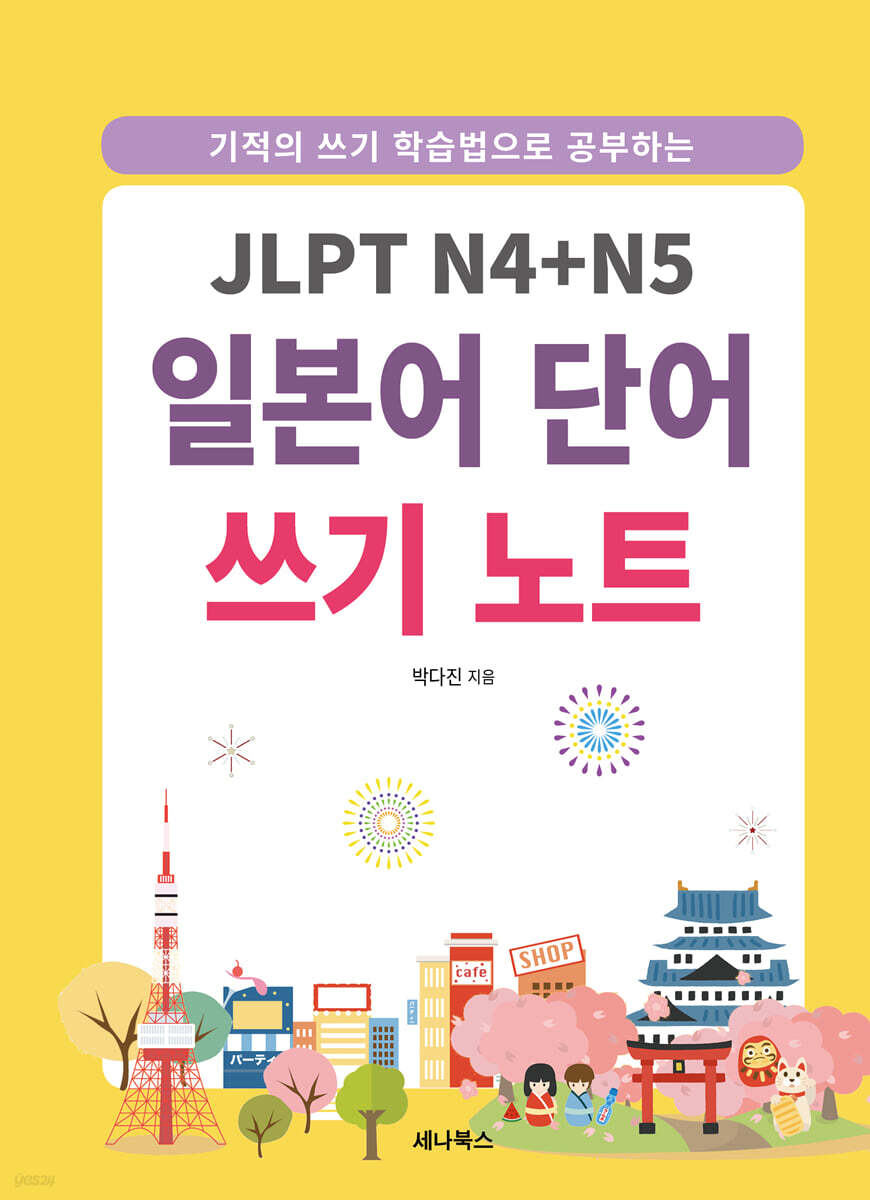
JLPT N4+N5 Japanese Vocabulary Writing Notes
 |
Description
Book Introduction
The 'miracle writing learning method' that your head and hands remember
Let's master basic Japanese vocabulary!
Includes 860 frequently appearing JLPT N4+N5 words!
This is designed to help you learn essential Japanese words and kanji that you must know for JLPT (Japanese Language Proficiency Test) N4+N5 and that are frequently used in real life by writing related sentences.
Learning the meaning of words through their use in sentences is more memorable than just learning the words.
In language learning, ‘word memorization’ can be said to be the first and most basic element.
Japanese is a foreign language that is easy to approach because it has the same word order as Korean, but it is also difficult because it is mostly made up of Chinese characters.
As the level increases, the number of words increases and it takes a lot of time to learn Chinese characters.
To be able to use perfect sentences, you need to know a wide range of words to be able to express yourself freely.
This is why you need to invest a lot of time in learning vocabulary.
Writing not only helps you learn by staying in your head for a long time, but it also allows you to fully enjoy the process of studying and gain a unique sense of accomplishment.
I am convinced that this method is a 'miracle writing learning method' where the hand remembers along with the head.
After studying this book, you will feel your basic Japanese vocabulary skills have improved significantly.
Learn 20 words and sentences daily over 38 days. This will prepare you for the JLPT N4+N5 exams while also building your intermediate-level vocabulary and kanji skills.
Let's master basic Japanese vocabulary!
Includes 860 frequently appearing JLPT N4+N5 words!
This is designed to help you learn essential Japanese words and kanji that you must know for JLPT (Japanese Language Proficiency Test) N4+N5 and that are frequently used in real life by writing related sentences.
Learning the meaning of words through their use in sentences is more memorable than just learning the words.
In language learning, ‘word memorization’ can be said to be the first and most basic element.
Japanese is a foreign language that is easy to approach because it has the same word order as Korean, but it is also difficult because it is mostly made up of Chinese characters.
As the level increases, the number of words increases and it takes a lot of time to learn Chinese characters.
To be able to use perfect sentences, you need to know a wide range of words to be able to express yourself freely.
This is why you need to invest a lot of time in learning vocabulary.
Writing not only helps you learn by staying in your head for a long time, but it also allows you to fully enjoy the process of studying and gain a unique sense of accomplishment.
I am convinced that this method is a 'miracle writing learning method' where the hand remembers along with the head.
After studying this book, you will feel your basic Japanese vocabulary skills have improved significantly.
Learn 20 words and sentences daily over 38 days. This will prepare you for the JLPT N4+N5 exams while also building your intermediate-level vocabulary and kanji skills.
- You can preview some of the book's contents.
Preview
index
Entering / 003
How to Use This Book / 006
Part 1.
N5 noun
Day 01 [N5 Nouns] Writing A-row Words / 010
Day 02 [N5 Nouns] Writing A-row Words / 016
Day 03 [N5 Nouns] Writing KA-row Words / 022
Day 04 [N5 Nouns] Writing KA-row Words / 028
Day 05 [N5 Nouns] Writing Sa-row Words / 034
Day 06 [N5 Nouns] Writing Ta-row Words / 040
Day 07 [N5 Nouns] Writing words from the na-row to the ha-row / 046
Day 08 [N5 Nouns] Writing Ha-row Words / 052
Day 09 [N5 Nouns] Writing M-row Words / 058
Day 10 [N5 Nouns] Writing Words from や行 to わ行 / 064
Part 2.
N5 Adjectives and Verbs
Day 11 [N5 Adjectives] Writing Words / 072
Day 12 [N5 Adjectives] Writing Words / 078
Day 13 [N5 い·な Adjectives] Writing Words / 084
Day 14 [N5 Verbs] Writing A-row Words / 090
Day 15 [N5 Verbs] Writing ka- and sa-row words / 096
Day 16 [N5 Verbs] Writing Ta-row and Na-row Words / 102
Day 17 [N5 Verbs] Writing Na-row to Wa-row Words / 108
Part 3.
N5 Adverbs, Conjunctions, and Interrogative Words
Day 18 [N5 Adverbs, Conjunctions, and Interrogative Words] Writing Words / 116
Day 19 [N5 Adverbs, Conjunctions, and Interrogative Words] Writing Words / 122
Part 4.
N4 noun
Day 20 [N4 Nouns] Writing A-row Words / 130
Day 21 [N4 Nouns] Writing A-row Words / 136
Day 22 [N4 Nouns] Writing KA-row Words / 142
Day 23 [N4 Nouns] Writing KA-row Words / 148
Day 24 [N4 Nouns] Writing Sa-row Words / 154
Day 25 [N4 Nouns] Writing Sa-row Words / 160
Day 26 [N4 Nouns] Writing Ta-row Words / 166
Day 27 [N4 Nouns] Writing Ha-row Words / 172
Day 28 [N4 Nouns] Writing Ha-row Words / 178
Day 29 [N4 Nouns] Writing words from the ま-わ row / 184
Part 5.
N4 Adjectives and Verbs
Day 30 [N4 I-Adjectives] Writing Words / 192
Day 31 [N4 な-adjective] Writing words / 198
Day 32 [N4 Verbs] Writing A-row Words / 204
Day 33 [N4 Verbs] Writing KA-row Words / 210
Day 34 [N4 Verbs] Writing Sa-row and Ta-row Words / 216
Day 35 [N4 Verbs] Writing Ta-row and Na-row Words / 222
Day 36 [N4 Verbs] Writing Na-row to Ha-row Words / 228
Day 37 [N4 Verbs] Writing Words from the Ma-row to the Wa-row / 234
Part 6.
N4 Adverbs and Conjunctions
Day 38 [N4 Adverbs and Conjunctions] Writing Words / 242
Appendix - Plus 100/250 Katakana Words
How to Use This Book / 006
Part 1.
N5 noun
Day 01 [N5 Nouns] Writing A-row Words / 010
Day 02 [N5 Nouns] Writing A-row Words / 016
Day 03 [N5 Nouns] Writing KA-row Words / 022
Day 04 [N5 Nouns] Writing KA-row Words / 028
Day 05 [N5 Nouns] Writing Sa-row Words / 034
Day 06 [N5 Nouns] Writing Ta-row Words / 040
Day 07 [N5 Nouns] Writing words from the na-row to the ha-row / 046
Day 08 [N5 Nouns] Writing Ha-row Words / 052
Day 09 [N5 Nouns] Writing M-row Words / 058
Day 10 [N5 Nouns] Writing Words from や行 to わ行 / 064
Part 2.
N5 Adjectives and Verbs
Day 11 [N5 Adjectives] Writing Words / 072
Day 12 [N5 Adjectives] Writing Words / 078
Day 13 [N5 い·な Adjectives] Writing Words / 084
Day 14 [N5 Verbs] Writing A-row Words / 090
Day 15 [N5 Verbs] Writing ka- and sa-row words / 096
Day 16 [N5 Verbs] Writing Ta-row and Na-row Words / 102
Day 17 [N5 Verbs] Writing Na-row to Wa-row Words / 108
Part 3.
N5 Adverbs, Conjunctions, and Interrogative Words
Day 18 [N5 Adverbs, Conjunctions, and Interrogative Words] Writing Words / 116
Day 19 [N5 Adverbs, Conjunctions, and Interrogative Words] Writing Words / 122
Part 4.
N4 noun
Day 20 [N4 Nouns] Writing A-row Words / 130
Day 21 [N4 Nouns] Writing A-row Words / 136
Day 22 [N4 Nouns] Writing KA-row Words / 142
Day 23 [N4 Nouns] Writing KA-row Words / 148
Day 24 [N4 Nouns] Writing Sa-row Words / 154
Day 25 [N4 Nouns] Writing Sa-row Words / 160
Day 26 [N4 Nouns] Writing Ta-row Words / 166
Day 27 [N4 Nouns] Writing Ha-row Words / 172
Day 28 [N4 Nouns] Writing Ha-row Words / 178
Day 29 [N4 Nouns] Writing words from the ま-わ row / 184
Part 5.
N4 Adjectives and Verbs
Day 30 [N4 I-Adjectives] Writing Words / 192
Day 31 [N4 な-adjective] Writing words / 198
Day 32 [N4 Verbs] Writing A-row Words / 204
Day 33 [N4 Verbs] Writing KA-row Words / 210
Day 34 [N4 Verbs] Writing Sa-row and Ta-row Words / 216
Day 35 [N4 Verbs] Writing Ta-row and Na-row Words / 222
Day 36 [N4 Verbs] Writing Na-row to Ha-row Words / 228
Day 37 [N4 Verbs] Writing Words from the Ma-row to the Wa-row / 234
Part 6.
N4 Adverbs and Conjunctions
Day 38 [N4 Adverbs and Conjunctions] Writing Words / 242
Appendix - Plus 100/250 Katakana Words
Detailed image

Into the book
1.
Contains 860 frequently appearing JLPT (Japanese Language Proficiency Test) N4 and N5 words.
2.
It consists of basic Japanese words and kanji that are frequently used in real life and must be known.
3.
You can study without burden with a study schedule of 20 lessons per day, for a total of 38 days.
4.
You can learn words and Chinese characters by writing them directly with related sentences.
5. You will be able to acquire intermediate-level vocabulary and kanji skills while preparing for JLPT N4 and N5 vocabulary.
What skills do I need to develop to be good at foreign languages?
To communicate naturally by organically linking the four language functions (listening, speaking, reading, and writing), you must be able to use appropriate words for the situation.
Therefore, in language learning, ‘word memorization’ can be said to be the first and most basic element.
Japanese is a foreign language that is easy to approach because it has the same word order as Korean, but it is also difficult because it is mostly made up of Chinese characters.
As the level increases, the number of words increases and it takes a lot of time to learn Chinese characters, so you have to invest a lot of time in studying.
If you want to use perfect sentences, you need to know a wide variety of words to be able to express yourself freely.
This is why you need to invest a lot of time in learning vocabulary.
This book covers essential words and kanji that are frequently used in real life and must be known for JLPT (Japanese Language Proficiency Test) N4 and N5.
Words are organized by part of speech and arranged in order of the 50 sounds, and 860 N4 and N5 words with high frequency of appearance have been carefully selected.
Also, learning the meaning of words through their use in sentences is more efficient in terms of vocabulary acquisition and helps them stay in memory longer than learning just the words, so we structured it so that you can learn them together with sentences.
Takashi Saito, the famous Japanese author of the book "Japanese I Want to Read Out Loud," talks about the power of writing in his book "Japanese I Want to Write Out Loud."
Writing, he says, uses the active use of one's body to deepen one's relationship with words and has the effect of engraving the letters in one's mind.
And it is said that the act of writing also has a calming effect.
This book is also designed to help you learn the basic Japanese vocabulary and related sentences you must know by writing them yourself.
I am convinced that this method is a 'miracle writing learning method' where the hand remembers along with the head.
It stays in your head for a long time, is effective, but you can also fully enjoy the process of studying and get a different sense of accomplishment.
After studying this book, you'll feel a significant improvement in your basic Japanese vocabulary. You'll be well-prepared for the JLPT N4 and N5 exams, while also gaining a solid grasp of intermediate-level vocabulary and kanji.
I sincerely hope that this book, which combines 20 words and sentences per day for 38 days, will serve as a small stepping stone to your Japanese studies.
Contains 860 frequently appearing JLPT (Japanese Language Proficiency Test) N4 and N5 words.
2.
It consists of basic Japanese words and kanji that are frequently used in real life and must be known.
3.
You can study without burden with a study schedule of 20 lessons per day, for a total of 38 days.
4.
You can learn words and Chinese characters by writing them directly with related sentences.
5. You will be able to acquire intermediate-level vocabulary and kanji skills while preparing for JLPT N4 and N5 vocabulary.
What skills do I need to develop to be good at foreign languages?
To communicate naturally by organically linking the four language functions (listening, speaking, reading, and writing), you must be able to use appropriate words for the situation.
Therefore, in language learning, ‘word memorization’ can be said to be the first and most basic element.
Japanese is a foreign language that is easy to approach because it has the same word order as Korean, but it is also difficult because it is mostly made up of Chinese characters.
As the level increases, the number of words increases and it takes a lot of time to learn Chinese characters, so you have to invest a lot of time in studying.
If you want to use perfect sentences, you need to know a wide variety of words to be able to express yourself freely.
This is why you need to invest a lot of time in learning vocabulary.
This book covers essential words and kanji that are frequently used in real life and must be known for JLPT (Japanese Language Proficiency Test) N4 and N5.
Words are organized by part of speech and arranged in order of the 50 sounds, and 860 N4 and N5 words with high frequency of appearance have been carefully selected.
Also, learning the meaning of words through their use in sentences is more efficient in terms of vocabulary acquisition and helps them stay in memory longer than learning just the words, so we structured it so that you can learn them together with sentences.
Takashi Saito, the famous Japanese author of the book "Japanese I Want to Read Out Loud," talks about the power of writing in his book "Japanese I Want to Write Out Loud."
Writing, he says, uses the active use of one's body to deepen one's relationship with words and has the effect of engraving the letters in one's mind.
And it is said that the act of writing also has a calming effect.
This book is also designed to help you learn the basic Japanese vocabulary and related sentences you must know by writing them yourself.
I am convinced that this method is a 'miracle writing learning method' where the hand remembers along with the head.
It stays in your head for a long time, is effective, but you can also fully enjoy the process of studying and get a different sense of accomplishment.
After studying this book, you'll feel a significant improvement in your basic Japanese vocabulary. You'll be well-prepared for the JLPT N4 and N5 exams, while also gaining a solid grasp of intermediate-level vocabulary and kanji.
I sincerely hope that this book, which combines 20 words and sentences per day for 38 days, will serve as a small stepping stone to your Japanese studies.
--- From "Entering"
GOODS SPECIFICS
- Date of issue: August 20, 2021
- Format: Springbook book binding method guide
- Page count, weight, size: 256 pages | 482g | 150*225*20mm
- ISBN13: 9791187316886
- ISBN10: 1187316881
You may also like
카테고리
korean


korean

![GQ KOREA Mark (Monthly): December [2025]](http://librairie.coreenne.fr/cdn/shop/files/8ef265dbbfbf186523ed75ba7319009d.jpg?v=1765340328&width=3840)


