

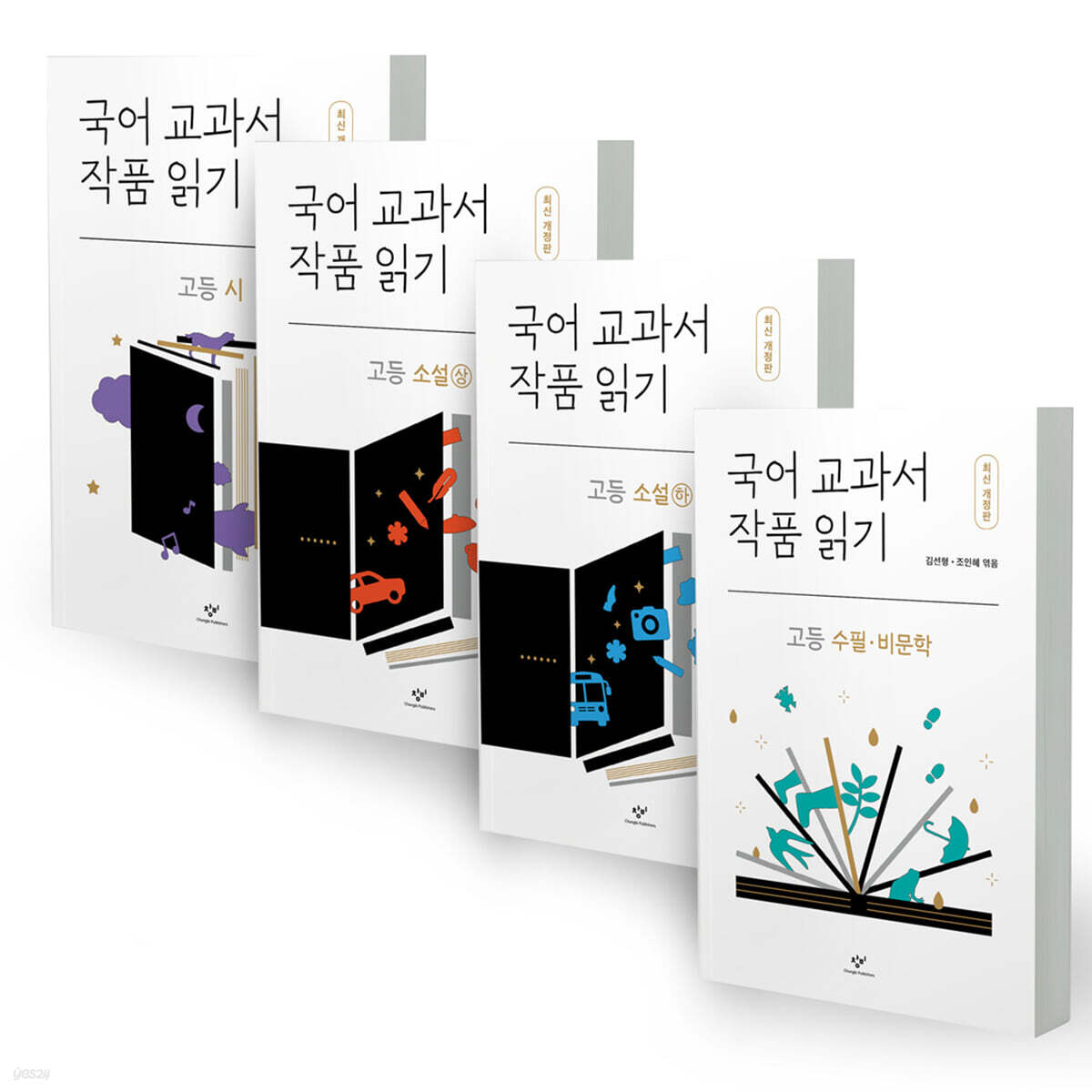
Reading Korean Textbook Works: High School Set
 |
Description
Book Introduction
The foundation of literacy is ‘reading Korean language textbooks’!
We will be a friendly guide for studying the increasingly difficult Korean language.
Starting in 2025, high school Korean language will be reorganized into Common Korean 1 and 2, and students will learn using nine new Common Korean language textbooks.
They say that these days, the Korean language is becoming more difficult and literacy is declining.
The more so, the more important it is to build a strong foundation from the beginning.
The Korean language is the foundation of all subjects.
The latest revised edition of Changbi's "Reading Korean Textbook Works" introduces poetry, novels, essays, and non-fiction works that students studying any of the nine common Korean textbooks according to the revised curriculum must read.
This book is a diverse collection of essential works that are repeatedly included in various textbooks, as well as works that are being included in textbooks for the first time to keep pace with the changing times.
Additionally, it contains commentary tailored to students' level and a wealth of post-reading activity questions to help students learn independently.
We will help students understand and enjoy the work on their own and develop their Korean language skills.
We will be a friendly guide for studying the increasingly difficult Korean language.
Starting in 2025, high school Korean language will be reorganized into Common Korean 1 and 2, and students will learn using nine new Common Korean language textbooks.
They say that these days, the Korean language is becoming more difficult and literacy is declining.
The more so, the more important it is to build a strong foundation from the beginning.
The Korean language is the foundation of all subjects.
The latest revised edition of Changbi's "Reading Korean Textbook Works" introduces poetry, novels, essays, and non-fiction works that students studying any of the nine common Korean textbooks according to the revised curriculum must read.
This book is a diverse collection of essential works that are repeatedly included in various textbooks, as well as works that are being included in textbooks for the first time to keep pace with the changing times.
Additionally, it contains commentary tailored to students' level and a wealth of post-reading activity questions to help students learn independently.
We will help students understand and enjoy the work on their own and develop their Korean language skills.
index
[Reading Korean Language Textbook Works: High School Poetry]
Part 1: The Person I Love (Jeong Ho-seung) / I Am Today (Oh Eun) and 15 other episodes
14 episodes including Part 2: Tie the Boat (Jang Seok-nam) and No Apples (Kim Yi-deum)
15 episodes including Part 3: To the Roots (Na Hee-deok) and Deep Soil (Jeong Hyeon-jong)
Part 4: One Longing Leads to Another Longing (Jeong Hee-seong)/Momentary (Ahn Mi-ok) and 14 other pieces
14 episodes including Part 5, Namshin Uiju, Yoo Dong Park Si-bong (Baek Seok)/Waterfall (Kim Su-young)
[Reading Korean Language Textbook Works: High School Novel Award]
Kim Ae-ran / Noh Chan-seong and Evan
Seo Yu-mi / That's not even a person
Kim Jung-hyuk / Offbeat D
Gong Seon-ok / A Bright Night Road
Kim Yeon-su / New York Bakery
An So-young / A Fool Who Only Reads Books
[Reading Korean Language Textbook Works: High School Novels, Part 2]
Yoon Heung-gil / The Man Left with Nine Pairs of Shoes
Park Wan-seo / Winter Outing
Lee Tae-jun / Stone Bridge
Chae Man-sik / Mr. Bang
Kim Yoo-jung / Spring, Spring
Author unknown / Heungbojeon
Unknown author / Chunhyangjeon
[Reading Korean Language Textbook Works: High School Essays and Non-Fiction]
Part 1: Some Words Never Die (Park Jun) / The Difficulty of Believing in Good Intentions (Kim Geum-hee), etc. 16 pieces
19 articles, including Part 2: Language's High Jump (Shin Ji-young) and The Human Brain and Artificial Intelligence (Kim Sang-wook)
Part 1: The Person I Love (Jeong Ho-seung) / I Am Today (Oh Eun) and 15 other episodes
14 episodes including Part 2: Tie the Boat (Jang Seok-nam) and No Apples (Kim Yi-deum)
15 episodes including Part 3: To the Roots (Na Hee-deok) and Deep Soil (Jeong Hyeon-jong)
Part 4: One Longing Leads to Another Longing (Jeong Hee-seong)/Momentary (Ahn Mi-ok) and 14 other pieces
14 episodes including Part 5, Namshin Uiju, Yoo Dong Park Si-bong (Baek Seok)/Waterfall (Kim Su-young)
[Reading Korean Language Textbook Works: High School Novel Award]
Kim Ae-ran / Noh Chan-seong and Evan
Seo Yu-mi / That's not even a person
Kim Jung-hyuk / Offbeat D
Gong Seon-ok / A Bright Night Road
Kim Yeon-su / New York Bakery
An So-young / A Fool Who Only Reads Books
[Reading Korean Language Textbook Works: High School Novels, Part 2]
Yoon Heung-gil / The Man Left with Nine Pairs of Shoes
Park Wan-seo / Winter Outing
Lee Tae-jun / Stone Bridge
Chae Man-sik / Mr. Bang
Kim Yoo-jung / Spring, Spring
Author unknown / Heungbojeon
Unknown author / Chunhyangjeon
[Reading Korean Language Textbook Works: High School Essays and Non-Fiction]
Part 1: Some Words Never Die (Park Jun) / The Difficulty of Believing in Good Intentions (Kim Geum-hee), etc. 16 pieces
19 articles, including Part 2: Language's High Jump (Shin Ji-young) and The Human Brain and Artificial Intelligence (Kim Sang-wook)
Detailed image
Publisher's Review
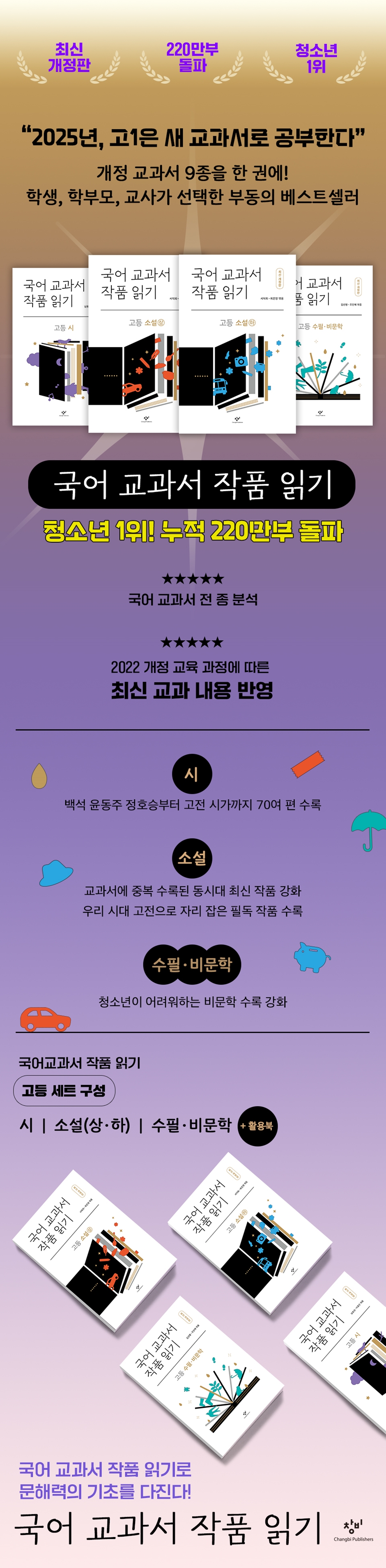
“In 2025, high school students will study using the new Korean language textbook.”
Nine revised textbooks in one volume!
A bestseller chosen by students, parents, and teachers
The proven series 'Reading Korean Language Textbooks', which was first introduced in 2010 and has been chosen by 2.2 million readers, has been republished in its latest revised edition.
Changbi's 'Reading Korean Textbooks' has been published in revised editions in accordance with the new curriculum since its first edition, and with the implementation of the '2022 Revised Curriculum', it is publishing the latest revised edition in preparation for the new Korean textbooks in 2025.
In this curriculum, high school Korean language textbooks were reorganized into ‘Common Korean Language 1’ and ‘Common Korean Language 2’.
With the introduction of the 'high school credit system' where credits are earned each semester, high school students earn credits through various elective subjects, but the common Korean language is still required to be learned, not as an elective.
Recently, as students' literacy skills have been declining due to difficulties in understanding texts because they do not know the meaning of words or are unable to grasp the context of texts they read, this has become a hot topic in schools.
Current Korean language teachers agree that starting with reading the original text of a Korean language textbook and building reading skills helps improve literacy.
Korean is the foundation for learning all subjects, and by establishing a solid foundation in Korean, critical and creative thinking skills can also be strengthened.
The latest revised edition of Changbi's 'Reading Korean Textbooks' has been strengthened with a customized structure that helps build a foundation for literacy and improve Korean language skills.
The latest revised edition of Changbi's 'Reading Korean Language Textbook Works' is organized by genre: poetry, novels, essays, and non-fiction, with the works included in the 18 volumes of the newly revised common Korean language textbooks in 9 categories.
This book is a diverse collection of essential works that are repeatedly included in various textbooks, works that convey a new era and sensibility, and works that should be read carefully and thoughtfully even if they may seem unfamiliar and difficult at first.
We also provide helpful texts for deeper appreciation, provide detailed definitions for each work, and provide activities to help students reach the new curriculum's achievement standards and improve literacy.
With nearly 15 years of accumulated expertise and the trust of countless readers, "Reading Korean Textbooks" is not only the perfect preparation for the changing textbooks, but also a stepping stone for building a solid foundation in Korean.
*The latest revised edition of the 'Reading Korean Language Textbooks' series is scheduled to be published in 2025 for the 2nd grade middle school series and in 2026 for the 3rd grade middle school series, in line with the development of new textbooks.
Features of "Reading Korean Language Textbook Works: High School Set" (Latest Revised Edition)
ㆍ Based on the nine revised high school common Korean language textbooks, carefully selected by current Korean language teachers and poets
According to the revised 2022 curriculum, high school students will be required to study common Korean language starting in 2025.
All works included in the 18 volumes of the 9 common Korean language textbooks were carefully read and analyzed by poets and current Korean language teachers.
We selected 72 poems, 13 novels, and 35 essays and non-fiction works that students must read from 9 textbooks.
ㆍ The section is composed with consideration for the breathing of the audience and includes the full text of the work.
We have included both essential works that are important enough to be included repeatedly in textbooks and new works that have been included to keep up with the changing times, and have organized the sections so as not to disrupt the flow of appreciation by genre.
In the case of poetry, the sections were organized by topic, taking into account the reading pace as if reading a book of poetry.
For novels, they are arranged in reverse chronological order to allow readers to feel the flow of the times. They include the full text as much as possible, and for medium-length or long stories, they extract key passages and add omitted plot summary to aid understanding.
Essays and non-literary prose are grouped by topic, such as ecology and society, science and technology, and media, to help readers understand the relevant fields.
ㆍ Strengthen the text and post-reading activities that help develop literacy skills, and provide word definitions.
To help you understand the work from a multifaceted perspective, we have included helpful notes to help you understand the author, the background of the work, and the branches of the work.
In addition to activities for self-directed appreciation, vocabulary learning activities, which are the basis for improving literacy, were strengthened.
For each work, explanations were provided for difficult words to aid understanding.
Nine revised textbooks in one volume!
A bestseller chosen by students, parents, and teachers
The proven series 'Reading Korean Language Textbooks', which was first introduced in 2010 and has been chosen by 2.2 million readers, has been republished in its latest revised edition.
Changbi's 'Reading Korean Textbooks' has been published in revised editions in accordance with the new curriculum since its first edition, and with the implementation of the '2022 Revised Curriculum', it is publishing the latest revised edition in preparation for the new Korean textbooks in 2025.
In this curriculum, high school Korean language textbooks were reorganized into ‘Common Korean Language 1’ and ‘Common Korean Language 2’.
With the introduction of the 'high school credit system' where credits are earned each semester, high school students earn credits through various elective subjects, but the common Korean language is still required to be learned, not as an elective.
Recently, as students' literacy skills have been declining due to difficulties in understanding texts because they do not know the meaning of words or are unable to grasp the context of texts they read, this has become a hot topic in schools.
Current Korean language teachers agree that starting with reading the original text of a Korean language textbook and building reading skills helps improve literacy.
Korean is the foundation for learning all subjects, and by establishing a solid foundation in Korean, critical and creative thinking skills can also be strengthened.
The latest revised edition of Changbi's 'Reading Korean Textbooks' has been strengthened with a customized structure that helps build a foundation for literacy and improve Korean language skills.
The latest revised edition of Changbi's 'Reading Korean Language Textbook Works' is organized by genre: poetry, novels, essays, and non-fiction, with the works included in the 18 volumes of the newly revised common Korean language textbooks in 9 categories.
This book is a diverse collection of essential works that are repeatedly included in various textbooks, works that convey a new era and sensibility, and works that should be read carefully and thoughtfully even if they may seem unfamiliar and difficult at first.
We also provide helpful texts for deeper appreciation, provide detailed definitions for each work, and provide activities to help students reach the new curriculum's achievement standards and improve literacy.
With nearly 15 years of accumulated expertise and the trust of countless readers, "Reading Korean Textbooks" is not only the perfect preparation for the changing textbooks, but also a stepping stone for building a solid foundation in Korean.
*The latest revised edition of the 'Reading Korean Language Textbooks' series is scheduled to be published in 2025 for the 2nd grade middle school series and in 2026 for the 3rd grade middle school series, in line with the development of new textbooks.
Features of "Reading Korean Language Textbook Works: High School Set" (Latest Revised Edition)
ㆍ Based on the nine revised high school common Korean language textbooks, carefully selected by current Korean language teachers and poets
According to the revised 2022 curriculum, high school students will be required to study common Korean language starting in 2025.
All works included in the 18 volumes of the 9 common Korean language textbooks were carefully read and analyzed by poets and current Korean language teachers.
We selected 72 poems, 13 novels, and 35 essays and non-fiction works that students must read from 9 textbooks.
ㆍ The section is composed with consideration for the breathing of the audience and includes the full text of the work.
We have included both essential works that are important enough to be included repeatedly in textbooks and new works that have been included to keep up with the changing times, and have organized the sections so as not to disrupt the flow of appreciation by genre.
In the case of poetry, the sections were organized by topic, taking into account the reading pace as if reading a book of poetry.
For novels, they are arranged in reverse chronological order to allow readers to feel the flow of the times. They include the full text as much as possible, and for medium-length or long stories, they extract key passages and add omitted plot summary to aid understanding.
Essays and non-literary prose are grouped by topic, such as ecology and society, science and technology, and media, to help readers understand the relevant fields.
ㆍ Strengthen the text and post-reading activities that help develop literacy skills, and provide word definitions.
To help you understand the work from a multifaceted perspective, we have included helpful notes to help you understand the author, the background of the work, and the branches of the work.
In addition to activities for self-directed appreciation, vocabulary learning activities, which are the basis for improving literacy, were strengthened.
For each work, explanations were provided for difficult words to aid understanding.
GOODS SPECIFICS
- Date of issue: December 20, 2024
- Page count, weight, size: 916 pages | 1,482g | 141*216*57mm
- ISBN13: 9788936431464
- ISBN10: 8936431463
You may also like
카테고리
korean


korean

![GQ KOREA Mark (Monthly): December [2025]](http://librairie.coreenne.fr/cdn/shop/files/8ef265dbbfbf186523ed75ba7319009d.jpg?v=1765340328&width=3840)


