

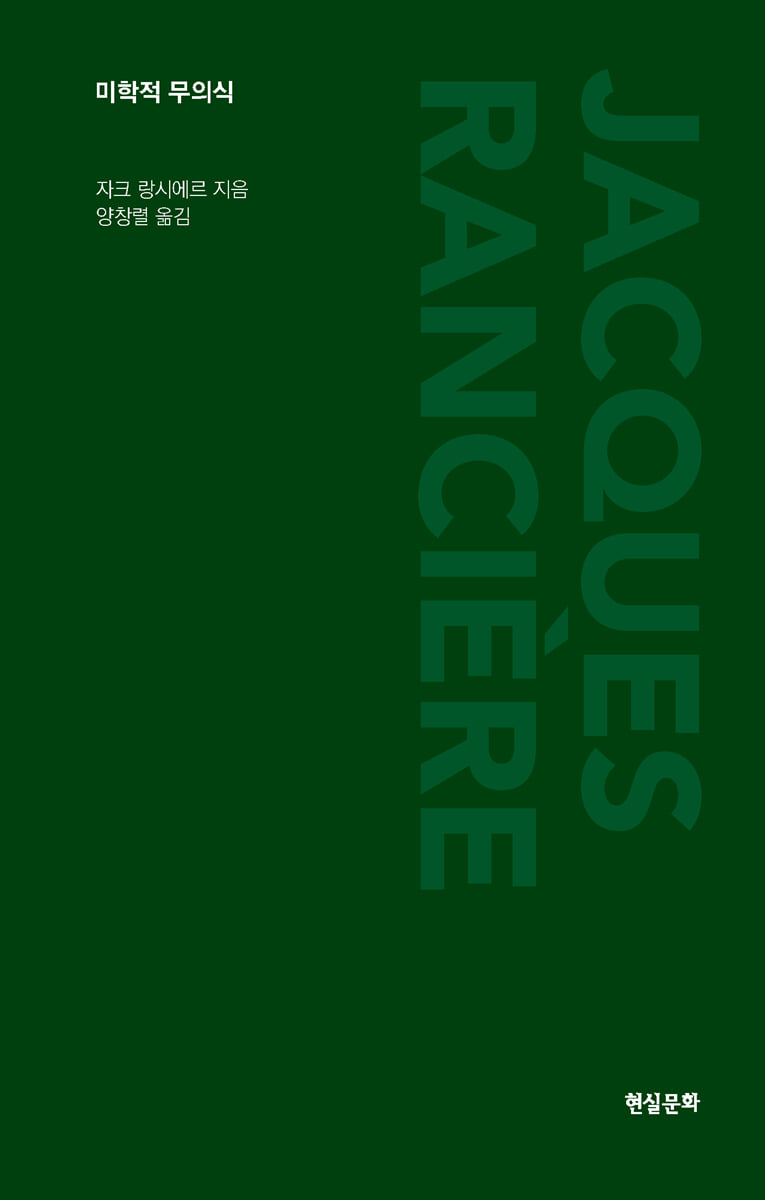
aesthetic unconsciousness
 |
Description
Book Introduction
Another way to read the unconscious beyond Freudian interpretation!
Reading the unconscious against the grain at the boundary between aesthetics and the unconscious!
The aesthetic unconscious unfolds through 'silent speech' and 'politics of detail'!
The common notion that art is a product of the aesthetic unconscious has often been supported by the authority of psychoanalysis.
Rancière overturns this conventional wisdom in this short pamphlet, The Aesthetic Unconscious.
He argues that Freud's unconscious was not simply a clinical "discovery," but rather became possible within the aesthetic system of art since the 19th century—a system in which the oppositions of what is said and what is seen, consciousness and the unconscious, knowledge and action, activity and passivity, logos and pathos are intertwined and function.
In other words, it is not that psychoanalysis has been interpreting art, but that art has already been ‘operating’ like the unconscious.
The fact that Freud formalized the unconscious by drawing on the Oedipal tragedy, Michelangelo's sculptures, novels, and plays is proof that art was a form of thought before it became an object of interpretation.
This book traces how non-thinking forms such as 'meaning in meaninglessness,' 'silent speech,' and 'insignificant details' operate thought, and depicts an aesthetic shift in which the sharing of the sensible is rearranged beyond the norms of representation.
Reading the unconscious against the grain at the boundary between aesthetics and the unconscious!
The aesthetic unconscious unfolds through 'silent speech' and 'politics of detail'!
The common notion that art is a product of the aesthetic unconscious has often been supported by the authority of psychoanalysis.
Rancière overturns this conventional wisdom in this short pamphlet, The Aesthetic Unconscious.
He argues that Freud's unconscious was not simply a clinical "discovery," but rather became possible within the aesthetic system of art since the 19th century—a system in which the oppositions of what is said and what is seen, consciousness and the unconscious, knowledge and action, activity and passivity, logos and pathos are intertwined and function.
In other words, it is not that psychoanalysis has been interpreting art, but that art has already been ‘operating’ like the unconscious.
The fact that Freud formalized the unconscious by drawing on the Oedipal tragedy, Michelangelo's sculptures, novels, and plays is proof that art was a form of thought before it became an object of interpretation.
This book traces how non-thinking forms such as 'meaning in meaninglessness,' 'silent speech,' and 'insignificant details' operate thought, and depicts an aesthetic shift in which the sharing of the sensible is rearranged beyond the norms of representation.
- You can preview some of the book's contents.
Preview
index
Subject's defect
aesthetic revolution
Two forms of unspoken speech
From one unconsciousness to another
Freud's modifications
About the various uses of Cebu
Medicine vs. Medicine
[Appendix] Controversial Objects—On the Aesthetic Unconscious (Preface to the Argentine Edition)
Translator's Note
Search
aesthetic revolution
Two forms of unspoken speech
From one unconsciousness to another
Freud's modifications
About the various uses of Cebu
Medicine vs. Medicine
[Appendix] Controversial Objects—On the Aesthetic Unconscious (Preface to the Argentine Edition)
Translator's Note
Search
Into the book
That even what seems meaningless has meaning, that what seems self-evident has mystery, and that even what seems like insignificant details are filled with thought.
…they are evidence that there is some kind of relationship between thought and non-thought, that thought exists in some way in sensible materiality, the involuntary in conscious thought, and meaning in the meaningless.
--- p.9
This pathos makes Oedipus an impossible protagonist in the classical period unless a radical correction is made about him.
The reason why [Oedipus] is an impossible [protagonist] is not because he kills his father and sleeps with his mother, but because of the way he learns it, that is, the identity he embodies in this learning, the tragic identity of knowledge and non-knowledge, the tragic identity of voluntary action and passively experienced pathos.
--- p.27
Psychoanalysis was invented at the point where philosophy and medicine questioned each other, by making thinking a problem of disease and disease a problem of thinking.
--- p.33
The birth of psychoanalysis is historically situated in the midst of this dominant counter-movement in literature, which has Schopenhauer and the young Nietzsche as its philosophical heroes, and which, from Zola to Maupassant, Ibsen or Strindberg, is immersed in the pure meaninglessness of raw life and its encounter with the forces of darkness.
--- p.45
The silent revolution called aesthetics opens up a space in which ideas of thought and corresponding ideas of writing can develop.
This notion of thinking is based on a fundamental assumption.
That there is a thought that does not think, a thought that operates not only in the heterogeneous elements of non-thinking but also in the form of non-thinking itself.
--- p.45
The statement that everything is said also means that the hierarchy of representational order has been abolished.
Freud's crucial rule that there are no 'details' that can be ignored, but rather that it is precisely such details that lead us to the path of truth, is in direct continuity with the aesthetic revolution.
--- p.49
The silent writing of things conveys in prose the truth of a civilization or an era, a truth that was once covered by the stage of the 'living word' that enjoyed glory.
The living word is now nothing more than a stage for empty eloquence, a superficial inflammatory speech.
But the hermeneutician is also a physician and symptomatologist who diagnoses the ills of vibrant individuals and vibrant societies.
--- p.52
What disturbs this order is the romantic Oedipus.
He is a hero of thought who does not know what he knows, who wants what he does not want, who acts through suffering, who speaks through silence.
Oedipus? And the procession of great Oedipal heroes that follows him? The reason why he is at the center of Freud's conceptual oeuvre is because Oedipus is the symbol of an artistic regime that identifies the state of art with the state of thought.
--- p.70
Freud's main point, as already mentioned, is not to establish a sexual etiology of artistic phenomena, but to intervene in the unconscious notions of thought that give norms to the products of the aesthetic regime of art, to bring order to the way in which art and thinking about art operate the relationship between knowledge and non-knowledge, meaning and meaninglessness, logos and pathos, the real and the fantastic.
--- p.73
Psychoanalysis is possible on the basis of an artistic system that discards the orderly plots of the representational age and gives new rights to the pathos of knowledge.
But Freud makes a very decisive choice in the fabric of the aesthetic unconscious.
He prefers the first form of the unspoken, that is, the symptom, the trace of history.
He contrasts that form with another form of speechlessness, the anonymous voice of unconscious and unaware life.
--- p.83
The aesthetic unconscious is not simply a historical backdrop against which Freud's unconscious stands out.
It is a constellation with its own dynamics, philosophy, and politics.
…they are evidence that there is some kind of relationship between thought and non-thought, that thought exists in some way in sensible materiality, the involuntary in conscious thought, and meaning in the meaningless.
--- p.9
This pathos makes Oedipus an impossible protagonist in the classical period unless a radical correction is made about him.
The reason why [Oedipus] is an impossible [protagonist] is not because he kills his father and sleeps with his mother, but because of the way he learns it, that is, the identity he embodies in this learning, the tragic identity of knowledge and non-knowledge, the tragic identity of voluntary action and passively experienced pathos.
--- p.27
Psychoanalysis was invented at the point where philosophy and medicine questioned each other, by making thinking a problem of disease and disease a problem of thinking.
--- p.33
The birth of psychoanalysis is historically situated in the midst of this dominant counter-movement in literature, which has Schopenhauer and the young Nietzsche as its philosophical heroes, and which, from Zola to Maupassant, Ibsen or Strindberg, is immersed in the pure meaninglessness of raw life and its encounter with the forces of darkness.
--- p.45
The silent revolution called aesthetics opens up a space in which ideas of thought and corresponding ideas of writing can develop.
This notion of thinking is based on a fundamental assumption.
That there is a thought that does not think, a thought that operates not only in the heterogeneous elements of non-thinking but also in the form of non-thinking itself.
--- p.45
The statement that everything is said also means that the hierarchy of representational order has been abolished.
Freud's crucial rule that there are no 'details' that can be ignored, but rather that it is precisely such details that lead us to the path of truth, is in direct continuity with the aesthetic revolution.
--- p.49
The silent writing of things conveys in prose the truth of a civilization or an era, a truth that was once covered by the stage of the 'living word' that enjoyed glory.
The living word is now nothing more than a stage for empty eloquence, a superficial inflammatory speech.
But the hermeneutician is also a physician and symptomatologist who diagnoses the ills of vibrant individuals and vibrant societies.
--- p.52
What disturbs this order is the romantic Oedipus.
He is a hero of thought who does not know what he knows, who wants what he does not want, who acts through suffering, who speaks through silence.
Oedipus? And the procession of great Oedipal heroes that follows him? The reason why he is at the center of Freud's conceptual oeuvre is because Oedipus is the symbol of an artistic regime that identifies the state of art with the state of thought.
--- p.70
Freud's main point, as already mentioned, is not to establish a sexual etiology of artistic phenomena, but to intervene in the unconscious notions of thought that give norms to the products of the aesthetic regime of art, to bring order to the way in which art and thinking about art operate the relationship between knowledge and non-knowledge, meaning and meaninglessness, logos and pathos, the real and the fantastic.
--- p.73
Psychoanalysis is possible on the basis of an artistic system that discards the orderly plots of the representational age and gives new rights to the pathos of knowledge.
But Freud makes a very decisive choice in the fabric of the aesthetic unconscious.
He prefers the first form of the unspoken, that is, the symptom, the trace of history.
He contrasts that form with another form of speechlessness, the anonymous voice of unconscious and unaware life.
--- p.83
The aesthetic unconscious is not simply a historical backdrop against which Freud's unconscious stands out.
It is a constellation with its own dynamics, philosophy, and politics.
--- p.125
Publisher's Review
The Aesthetic Unconscious: The Hidden Matrix of Freudian Psychoanalysis
At the beginning of this book, Jacques Rancière rejects the common approach of applying Freud's theory of the unconscious to aesthetics.
Rather, his core question goes against the grain.
'Why did Freud need literary and artistic examples (Oedipus, Gradiva, etc.) to prove his theory?' Rancière retracees the literary and artistic figures that made Freud's theory of the unconscious possible, and reveals the hidden theoretical collusion and conflict between aesthetics and psychoanalysis.
According to Rancière's insight, Freud's theory of the unconscious could only be formalized outside the clinical realm, on the basis of an 'unconscious way of thinking' that already had a privileged effect in the realm of works of art and literature.
This 'aesthetic unconscious' is summarized in the idea of 'thinking of the unthinking'.
It is the belief that even seemingly meaningless things have meaning, and that even the smallest details are filled with thought.
Freud was able to use artistic examples as interpreters of the 'trivial' facts ignored by his fellow positivists because these examples themselves were a kind of unconscious evidence of the presence of thought within sensuous materiality.
Rancière argues that the aesthetic unconscious was not simply the background of Freud's theory, but rather its hidden mother, saying that the aesthetic unconscious was the historical and ontological prerequisite for the birth and development of Freud's theory.
An aesthetic revolution that destroyed the order of the representational system
For Rancière, aesthetics is not a discipline that deals with art, but a specific historical system of thought that treats the state of art as a state of thought.
This aesthetic system is the result of an aesthetic revolution that destroyed the system of poetic representation that had persisted since ancient times.
The representational system was an order of strictly regulated relationships between what could be said and what could be seen.
In this order, while words express emotions and will, they control what they reveal, and are prohibited from directly showing on stage horrific sights that cannot be described in words (such as the horror of a gouged eye).
So, classical playwrights criticized Sophocles' protagonist Oedipus as a 'flawed subject'.
The flaw lies not simply in the incestuous material, but in the way the tragic truth is revealed and the pathos of Oedipus's mad knowledge.
He is obsessed with knowing things he would rather not know, refuses to hear the truth, and ultimately commits the horrific act of gouging out his own eyes.
Drama is a departure from the Aristotelian order, which dictates that action should unfold from a state of partial ignorance to a rational pursuit of a specific goal.
However, Rancière says that Oedipus's 'tragic identity of knowledge and non-knowledge, action and pathos' was the seed of an aesthetic revolution that the representational system could not embrace, and that the aesthetic revolution dismantled this entire order.
This new system elevates the tragic identity of knowledge and non-knowledge, of action (active) and suffering (passive), to the very core of art.
What is confusing and sensual is no longer a lower level of awareness, but is elevated to the level of thinking of the unthinking.
In this way, art is liberated from necessity and norms, and becomes a space where the power of the unspoken, that is, the unconscious, is privileged.
'Speechless Words' and the Politics of Details
In this book, Rancière connects the workings of the aesthetic unconscious with the politics of the senses, focusing on the concepts of ‘silent speech’ and ‘detail.’
The insight lies in the fact that the so-called "nothing"—the margins, the pauses, the insignificant details—are actually the key devices that ignite thought.
Rancière presents two ‘silent words’.
One is the hieroglyphic speech created by the traces and arrangements imprinted on the surface of objects, and the other is the anonymous voice that permeates the stage beyond the characters' psychology and lines.
The former, like the dust in an antique shop or the image of a city sewer, allows peripheral details to disrupt the central narrative and redraw the map of the senses.
Another 'unspoken language' is the deaf (inaudible) language of anonymous power.
This language goes beyond the actor's psychology and intentions, summoning anonymous emotions and the power of meaninglessness, and is embodied in shadows, wax figures, and superhumans (Craig), and the play of death (Cantor).
Together, the two forms sketch the space of literary speech=symptom speech, in this way, the 'unspoken speech' appears on the one hand as hieroglyphics to be deciphered, and on the other as anonymity that must be given a voice/body.
Rancière says that these two reflect each other.
The world as a text that demands deciphering and the world as anonymity that has yet to find a voice intersect, and we experience the depth of thought on the surface of the work.
As a result, it becomes clear that 'details are not decoration'.
Details are the key conduit of sensory rearrangement, and reading becomes not an act of gathering meaning, but a performance of participating in the rhythm in which meaning is generated.
At the beginning of this book, Jacques Rancière rejects the common approach of applying Freud's theory of the unconscious to aesthetics.
Rather, his core question goes against the grain.
'Why did Freud need literary and artistic examples (Oedipus, Gradiva, etc.) to prove his theory?' Rancière retracees the literary and artistic figures that made Freud's theory of the unconscious possible, and reveals the hidden theoretical collusion and conflict between aesthetics and psychoanalysis.
According to Rancière's insight, Freud's theory of the unconscious could only be formalized outside the clinical realm, on the basis of an 'unconscious way of thinking' that already had a privileged effect in the realm of works of art and literature.
This 'aesthetic unconscious' is summarized in the idea of 'thinking of the unthinking'.
It is the belief that even seemingly meaningless things have meaning, and that even the smallest details are filled with thought.
Freud was able to use artistic examples as interpreters of the 'trivial' facts ignored by his fellow positivists because these examples themselves were a kind of unconscious evidence of the presence of thought within sensuous materiality.
Rancière argues that the aesthetic unconscious was not simply the background of Freud's theory, but rather its hidden mother, saying that the aesthetic unconscious was the historical and ontological prerequisite for the birth and development of Freud's theory.
An aesthetic revolution that destroyed the order of the representational system
For Rancière, aesthetics is not a discipline that deals with art, but a specific historical system of thought that treats the state of art as a state of thought.
This aesthetic system is the result of an aesthetic revolution that destroyed the system of poetic representation that had persisted since ancient times.
The representational system was an order of strictly regulated relationships between what could be said and what could be seen.
In this order, while words express emotions and will, they control what they reveal, and are prohibited from directly showing on stage horrific sights that cannot be described in words (such as the horror of a gouged eye).
So, classical playwrights criticized Sophocles' protagonist Oedipus as a 'flawed subject'.
The flaw lies not simply in the incestuous material, but in the way the tragic truth is revealed and the pathos of Oedipus's mad knowledge.
He is obsessed with knowing things he would rather not know, refuses to hear the truth, and ultimately commits the horrific act of gouging out his own eyes.
Drama is a departure from the Aristotelian order, which dictates that action should unfold from a state of partial ignorance to a rational pursuit of a specific goal.
However, Rancière says that Oedipus's 'tragic identity of knowledge and non-knowledge, action and pathos' was the seed of an aesthetic revolution that the representational system could not embrace, and that the aesthetic revolution dismantled this entire order.
This new system elevates the tragic identity of knowledge and non-knowledge, of action (active) and suffering (passive), to the very core of art.
What is confusing and sensual is no longer a lower level of awareness, but is elevated to the level of thinking of the unthinking.
In this way, art is liberated from necessity and norms, and becomes a space where the power of the unspoken, that is, the unconscious, is privileged.
'Speechless Words' and the Politics of Details
In this book, Rancière connects the workings of the aesthetic unconscious with the politics of the senses, focusing on the concepts of ‘silent speech’ and ‘detail.’
The insight lies in the fact that the so-called "nothing"—the margins, the pauses, the insignificant details—are actually the key devices that ignite thought.
Rancière presents two ‘silent words’.
One is the hieroglyphic speech created by the traces and arrangements imprinted on the surface of objects, and the other is the anonymous voice that permeates the stage beyond the characters' psychology and lines.
The former, like the dust in an antique shop or the image of a city sewer, allows peripheral details to disrupt the central narrative and redraw the map of the senses.
Another 'unspoken language' is the deaf (inaudible) language of anonymous power.
This language goes beyond the actor's psychology and intentions, summoning anonymous emotions and the power of meaninglessness, and is embodied in shadows, wax figures, and superhumans (Craig), and the play of death (Cantor).
Together, the two forms sketch the space of literary speech=symptom speech, in this way, the 'unspoken speech' appears on the one hand as hieroglyphics to be deciphered, and on the other as anonymity that must be given a voice/body.
Rancière says that these two reflect each other.
The world as a text that demands deciphering and the world as anonymity that has yet to find a voice intersect, and we experience the depth of thought on the surface of the work.
As a result, it becomes clear that 'details are not decoration'.
Details are the key conduit of sensory rearrangement, and reading becomes not an act of gathering meaning, but a performance of participating in the rhythm in which meaning is generated.
GOODS SPECIFICS
- Date of issue: November 28, 2025
- Page count, weight, size: 148 pages | 120*188*20mm
- ISBN13: 9788965643135
- ISBN10: 8965643139
You may also like
카테고리
korean


korean

![GQ KOREA Mark (Monthly): December [2025]](http://librairie.coreenne.fr/cdn/shop/files/8ef265dbbfbf186523ed75ba7319009d.jpg?v=1765340328&width=3840)


