

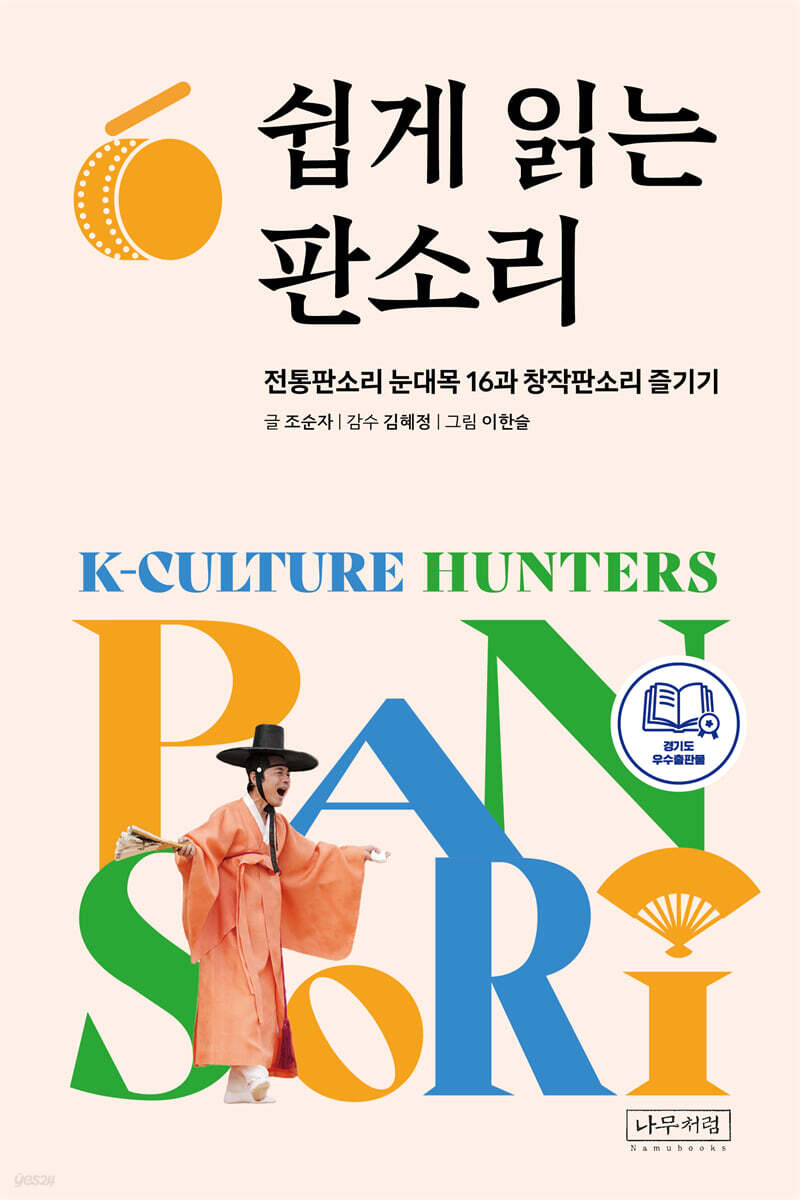
Easy-to-read pansori
 |
Description
Book Introduction
From Joseon to today,
200 years of pansori's emotions captured in one volume
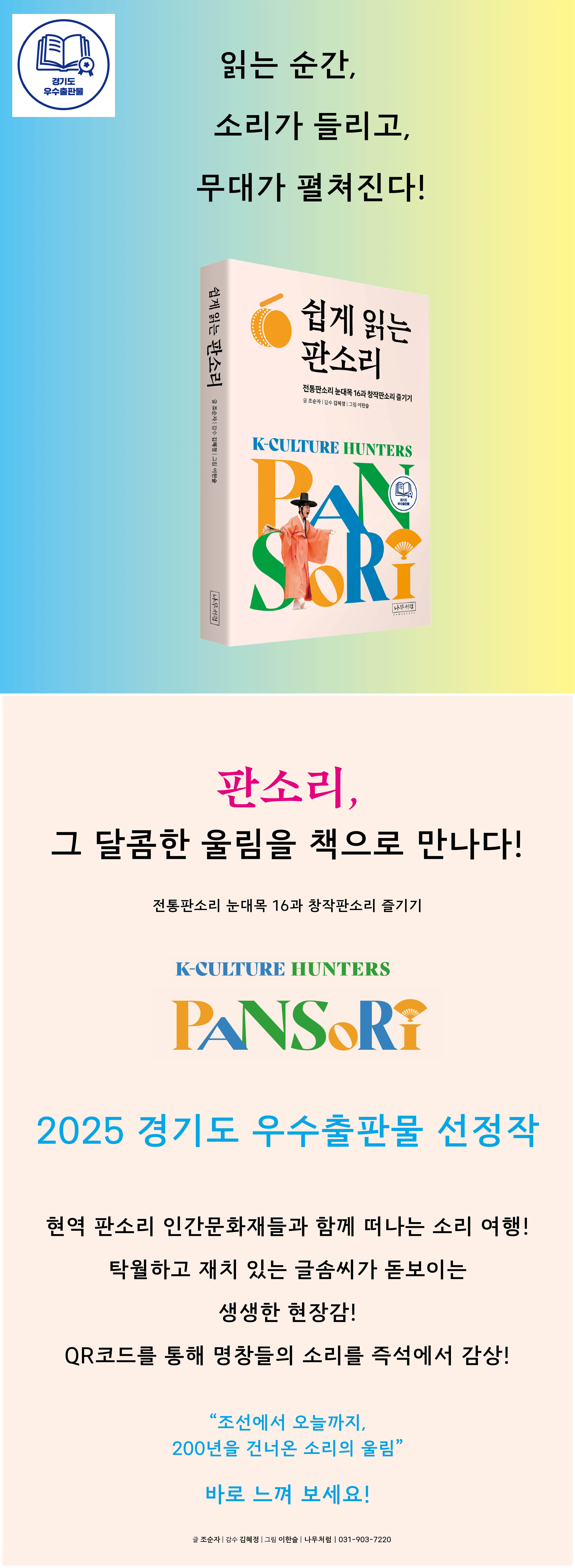
"Easy to Read Pansori" carefully selects and introduces 16 famous scenes from the five madangs of pansori, and introduces modern pansori, which ranges from traditional pansori to creative pansori.
This book includes photos of all the current pansori human cultural assets (holders) along with easy and vivid commentary, allowing readers to not only meet the faces of master singers they only knew by name, but also convey the vivid sense of presence as if they were participating in the pansori performance themselves.
Author Jo Soon-ja, based on her extensive experience in researching and teaching Korean traditional music theory, demonstrates exceptional writing skills in presenting pansori in an easy and enjoyable way.
The book is sprinkled with fun and humor throughout, making readers feel as if they are listening to a singer's "Aniri" as they turn the pages.
It also provides helpful explanations of difficult Pansori terminology and connects historical background with contemporary sensibilities, allowing readers to immerse themselves naturally.
Another special feature of this book is that it includes QR codes, allowing you to actually hear the voices of famous singers.
By scanning the QR code with your phone while reading the text, you can instantly listen to the corresponding passage or original pansori, making it both fun to read and fun to listen to.
In addition, to make it more enjoyable to look at, I drew a pretty flower score.
200 years of pansori's emotions captured in one volume
"Easy to Read Pansori" carefully selects and introduces 16 famous scenes from the five madangs of pansori, and introduces modern pansori, which ranges from traditional pansori to creative pansori.
This book includes photos of all the current pansori human cultural assets (holders) along with easy and vivid commentary, allowing readers to not only meet the faces of master singers they only knew by name, but also convey the vivid sense of presence as if they were participating in the pansori performance themselves.
Author Jo Soon-ja, based on her extensive experience in researching and teaching Korean traditional music theory, demonstrates exceptional writing skills in presenting pansori in an easy and enjoyable way.
The book is sprinkled with fun and humor throughout, making readers feel as if they are listening to a singer's "Aniri" as they turn the pages.
It also provides helpful explanations of difficult Pansori terminology and connects historical background with contemporary sensibilities, allowing readers to immerse themselves naturally.
Another special feature of this book is that it includes QR codes, allowing you to actually hear the voices of famous singers.
By scanning the QR code with your phone while reading the text, you can instantly listen to the corresponding passage or original pansori, making it both fun to read and fun to listen to.
In addition, to make it more enjoyable to look at, I drew a pretty flower score.
- You can preview some of the book's contents.
Preview
index
Recommendation
Part 1: A Master Singer Appears on the 'Soripan' Stage! Traditional Pansori
Aha! Pansori!
Chapter 1.
Come here, let's carry and play! Pansori "Chunhyangga"
■ Even looking at it this way, my love 'Sarangga'
■ If you leave now, when will you come back?, 'Farewell Song'
■ Chunhyang, imprisoned in prison, 'The bald ghost's description!
■ Geum Jun-mi-ju is a thousand-year-old blood, and 'the secret royal inspector is coming out!'
Chapter 2.
Oh my, brother! Pansori "Hongboga"
■ The unfortunate man's plight, 'Poverty Song'
■ Ana Dona! Where have you been? You're back now, 'Money Talk'
■ It's a slurping saw, 'the part where the publicity is being done!'
Chapter 3.
Twitch, twitch, your eyes widen, Pansori "Simcheongga"
■ Rise like a seagull in the vast expanse of water, and go to the water! 'Indang Suhaeng'
■ A goose soars high in the clear sky, 'Chewing the moon'
■ Let's see my daughter, where is she? 'The scene where Sim Bong-sa opens his eyes'
Chapter 4.
The Tiger is Coming Down! Pansori "Sugungga"
■ Get out of the way, 'A tiger is coming down'
■ Zara and the Rabbit, a Grand Festival of Repeated Intrigues
■ Please cut open the ship 'The part where you cut open the rabbit's ship'
Chapter 5.
Set Red Cliffs on Fire! Pansori "Red Cliff Song"
■ If you want to attract talent, you have to go through 'three hardships'
■ The 'Military Sorrow Song' that shook the Last Supper
■ Blow, Southeast Wind, 'Battle of Red Cliffs'
Part 2.
Let's start a new chapter! Creative Pansori
Wow! The soundboard these days!
Chapter 1.
Im Jin-taek, the lyrical clown who sang of the times
May in Gwangju, Baekbeom Kim Gu
Chapter 2.
Choi Yong-seok, who sings of the lives of ordinary people and satirizes reality
Bulletproof Suitcase, Chickens' Dream
Chapter 3.
Lee Ja-ram, who opened new horizons for pansori beyond national borders
"Sacheonga", "The Old Man and the Sea"
Chapter 4.
Han Seung-seok, the Bigabi clown who expanded the horizons of creative pansori
Laundry, I Smile When I Think of You
Acknowledgements
Part 1: A Master Singer Appears on the 'Soripan' Stage! Traditional Pansori
Aha! Pansori!
Chapter 1.
Come here, let's carry and play! Pansori "Chunhyangga"
■ Even looking at it this way, my love 'Sarangga'
■ If you leave now, when will you come back?, 'Farewell Song'
■ Chunhyang, imprisoned in prison, 'The bald ghost's description!
■ Geum Jun-mi-ju is a thousand-year-old blood, and 'the secret royal inspector is coming out!'
Chapter 2.
Oh my, brother! Pansori "Hongboga"
■ The unfortunate man's plight, 'Poverty Song'
■ Ana Dona! Where have you been? You're back now, 'Money Talk'
■ It's a slurping saw, 'the part where the publicity is being done!'
Chapter 3.
Twitch, twitch, your eyes widen, Pansori "Simcheongga"
■ Rise like a seagull in the vast expanse of water, and go to the water! 'Indang Suhaeng'
■ A goose soars high in the clear sky, 'Chewing the moon'
■ Let's see my daughter, where is she? 'The scene where Sim Bong-sa opens his eyes'
Chapter 4.
The Tiger is Coming Down! Pansori "Sugungga"
■ Get out of the way, 'A tiger is coming down'
■ Zara and the Rabbit, a Grand Festival of Repeated Intrigues
■ Please cut open the ship 'The part where you cut open the rabbit's ship'
Chapter 5.
Set Red Cliffs on Fire! Pansori "Red Cliff Song"
■ If you want to attract talent, you have to go through 'three hardships'
■ The 'Military Sorrow Song' that shook the Last Supper
■ Blow, Southeast Wind, 'Battle of Red Cliffs'
Part 2.
Let's start a new chapter! Creative Pansori
Wow! The soundboard these days!
Chapter 1.
Im Jin-taek, the lyrical clown who sang of the times
May in Gwangju, Baekbeom Kim Gu
Chapter 2.
Choi Yong-seok, who sings of the lives of ordinary people and satirizes reality
Bulletproof Suitcase, Chickens' Dream
Chapter 3.
Lee Ja-ram, who opened new horizons for pansori beyond national borders
"Sacheonga", "The Old Man and the Sea"
Chapter 4.
Han Seung-seok, the Bigabi clown who expanded the horizons of creative pansori
Laundry, I Smile When I Think of You
Acknowledgements
Detailed image
Into the book
It wouldn't be easy to tell a person's entire life story in one sitting, would it? But a storyteller does.
When a storyteller sings the entire story from beginning to end in one place, it is called 'Wanchang'.
For example, the pansori “Chunhyangga,” which contains the love story of Yi Mong-ryong and Seong Chun-hyang, is structured as “love-separation-hardship-reunion.”
If you compile this story into a book, it will become a novel.
--- p.16
Chunhyang lies face down in front of the front gate of her house and watches the back of her husband as he leaves.
“One swan turns and looks like a tree, two swans turn and look like stars, and on the fifteenth night, the full moon disappears into the clouds.”
Ah! What a wonderful expression! As it gradually receded from view, the random figure grew smaller and smaller, "appearing as small as a tree," then "as small as a star," and finally, like a full moon obscured by clouds, it disappeared forever.
It's goodbye forever.
--- p.49
Wow! I'm so happy that even after pouring, ...
It is said that Heungbo poured out so much rice and money in front of a reality that he could not believe even after seeing it with his own eyes that the rice was 100,000 seok and the money was 100,000 nyang.
Heungbo is already drunk on money.
--- p.93
The "Gunsaseolum Taryeong" from the pansori "Jeokbyeokga" is an original passage created in pansori that does not appear in "Romance of the Three Kingdoms."
This is a special scene that can only be heard in “Red Cliff Song,” and it contains the scene where the soldiers of Cao Cao’s camp each express their sorrows the day before the Battle of Red Cliffs.
This section is a lyrical scene that delicately expresses the psychology of soldiers. Although the composition varies depending on the original and school of music, it generally has common sections such as “Thinking of Parents,” “Thinking of Children,” “Thinking of Wife,” and “The Song of the Patriot.” --- p.189
Have you ever heard the saying, “A person’s name is their face and their personality”?
Sounds familiar, doesn't it? What about the line, "When I called his name, he came to me and became a flower"? Yes, that's part of Kim Chun-su's "Flower."
A name is a 'symbol representing a person's existence' and is also an important medium for forming social relationships.
The expression 'worth its name' probably came about in this context.
The reason I suddenly brought up the name is because, as I was introducing the singer Lee Ja-ram, the name felt new and meaningful.
--- p.263
The delicious vocal sounds of pansori singer Han Seung-seok are combined with guitar, piano, and janggu rhythms to create a new harmony.
You might be thinking, "Is this really pansori?"
These attempts are an effort to expand the boundaries of pansori.
When asked how he would define the identity of this music, he is unequivocal.
“Just because the accompaniment has changed doesn’t mean it’s not pansori.
If the sound I sing follows the pansori grammar, then it is pansori.” At least, it means that there are many different ways to try out different performance methods.
Han Seung-seok says this about creative pansori:
“Creative pansori doesn’t have to follow the format of existing traditional pansori.” “As long as the essence of pansori is not lost, the format can change flexibly.” Han Seung-seok doesn’t view creative pansori within a fixed framework.
I believe that the core of creative pansori is maintaining the musical idiom of traditional pansori while reflecting and expanding upon the changes of the times.
When a storyteller sings the entire story from beginning to end in one place, it is called 'Wanchang'.
For example, the pansori “Chunhyangga,” which contains the love story of Yi Mong-ryong and Seong Chun-hyang, is structured as “love-separation-hardship-reunion.”
If you compile this story into a book, it will become a novel.
--- p.16
Chunhyang lies face down in front of the front gate of her house and watches the back of her husband as he leaves.
“One swan turns and looks like a tree, two swans turn and look like stars, and on the fifteenth night, the full moon disappears into the clouds.”
Ah! What a wonderful expression! As it gradually receded from view, the random figure grew smaller and smaller, "appearing as small as a tree," then "as small as a star," and finally, like a full moon obscured by clouds, it disappeared forever.
It's goodbye forever.
--- p.49
Wow! I'm so happy that even after pouring, ...
It is said that Heungbo poured out so much rice and money in front of a reality that he could not believe even after seeing it with his own eyes that the rice was 100,000 seok and the money was 100,000 nyang.
Heungbo is already drunk on money.
--- p.93
The "Gunsaseolum Taryeong" from the pansori "Jeokbyeokga" is an original passage created in pansori that does not appear in "Romance of the Three Kingdoms."
This is a special scene that can only be heard in “Red Cliff Song,” and it contains the scene where the soldiers of Cao Cao’s camp each express their sorrows the day before the Battle of Red Cliffs.
This section is a lyrical scene that delicately expresses the psychology of soldiers. Although the composition varies depending on the original and school of music, it generally has common sections such as “Thinking of Parents,” “Thinking of Children,” “Thinking of Wife,” and “The Song of the Patriot.” --- p.189
Have you ever heard the saying, “A person’s name is their face and their personality”?
Sounds familiar, doesn't it? What about the line, "When I called his name, he came to me and became a flower"? Yes, that's part of Kim Chun-su's "Flower."
A name is a 'symbol representing a person's existence' and is also an important medium for forming social relationships.
The expression 'worth its name' probably came about in this context.
The reason I suddenly brought up the name is because, as I was introducing the singer Lee Ja-ram, the name felt new and meaningful.
--- p.263
The delicious vocal sounds of pansori singer Han Seung-seok are combined with guitar, piano, and janggu rhythms to create a new harmony.
You might be thinking, "Is this really pansori?"
These attempts are an effort to expand the boundaries of pansori.
When asked how he would define the identity of this music, he is unequivocal.
“Just because the accompaniment has changed doesn’t mean it’s not pansori.
If the sound I sing follows the pansori grammar, then it is pansori.” At least, it means that there are many different ways to try out different performance methods.
Han Seung-seok says this about creative pansori:
“Creative pansori doesn’t have to follow the format of existing traditional pansori.” “As long as the essence of pansori is not lost, the format can change flexibly.” Han Seung-seok doesn’t view creative pansori within a fixed framework.
I believe that the core of creative pansori is maintaining the musical idiom of traditional pansori while reflecting and expanding upon the changes of the times.
--- p.284
Publisher's Review
A journey to Nundae-mok 16, where the breath of a famous singer touches the heart.
Transferring the emotions of the stage into a book.
Part 1 of this book introduces 16 must-see scenes, the so-called "Nundae-mok," carefully selected from among the five traditional pansori madang.
You can experience the essence of pansori in one volume, including "Sarangga" which sings of the excitement between Yi Mong-ryong and Seong Chun-hyang, "Don Taryeong" which is full of humor and satire, "Indangsu Arrival Scene" which captures the tragic moment when Sim Cheong heads to Indangsu, "Cutting the Rabbit's Belly Scene" which gives a glimpse into the rabbit's wit, and "Battle of Red Cliffs" which sadly depicts Cao Cao's end.
In particular, vivid stage photos and QR codes of famous singers who continue our sound to this day are included, allowing us to vividly feel that pansori is still a 'living art'.
Through colorful photos and QR codes, readers can experience the immersive experience of being in a performance hall and easily and enjoyably enjoy the taste and style of pansori.
Creative Pansori,
Showing the present and future of pansori.
This book does not stop at traditional pansori, but also includes the flow of modern creative pansori in two parts.
We will highlight the leading composers of creative pansori, including Im Jin-taek, Choi Yong-seok, Lee Ja-ram, and Han Seung-seok, and introduce their representative works.
"May Gwangju," which depicts the Gwangju Democratization Movement; "Bulletproof Suitcase," which satirizes social realities; "The Old Man and the Sea," an adaptation of Hemingway's work; and "Laundry," a piano-accompanied piece, are all original pansori pieces that incorporate new materials and forms, demonstrating that pansori is not simply an art form confined to ancient tales, but a living, breathing performing art form alive on stage. Watching their performances via QR codes will have you exclaiming, "This is pansori!"
A Guide to Pansori for Education and the Public
This book can be read by a wide range of readers, from young people who are new to pansori to general readers and researchers seeking a deeper understanding of traditional art.
It is also suitable as an educational material for teachers to use in class, and is also perfect for use as a pansori appreciation textbook at cultural centers, club activities, or reading groups.
Transferring the emotions of the stage into a book.
Part 1 of this book introduces 16 must-see scenes, the so-called "Nundae-mok," carefully selected from among the five traditional pansori madang.
You can experience the essence of pansori in one volume, including "Sarangga" which sings of the excitement between Yi Mong-ryong and Seong Chun-hyang, "Don Taryeong" which is full of humor and satire, "Indangsu Arrival Scene" which captures the tragic moment when Sim Cheong heads to Indangsu, "Cutting the Rabbit's Belly Scene" which gives a glimpse into the rabbit's wit, and "Battle of Red Cliffs" which sadly depicts Cao Cao's end.
In particular, vivid stage photos and QR codes of famous singers who continue our sound to this day are included, allowing us to vividly feel that pansori is still a 'living art'.
Through colorful photos and QR codes, readers can experience the immersive experience of being in a performance hall and easily and enjoyably enjoy the taste and style of pansori.
Creative Pansori,
Showing the present and future of pansori.
This book does not stop at traditional pansori, but also includes the flow of modern creative pansori in two parts.
We will highlight the leading composers of creative pansori, including Im Jin-taek, Choi Yong-seok, Lee Ja-ram, and Han Seung-seok, and introduce their representative works.
"May Gwangju," which depicts the Gwangju Democratization Movement; "Bulletproof Suitcase," which satirizes social realities; "The Old Man and the Sea," an adaptation of Hemingway's work; and "Laundry," a piano-accompanied piece, are all original pansori pieces that incorporate new materials and forms, demonstrating that pansori is not simply an art form confined to ancient tales, but a living, breathing performing art form alive on stage. Watching their performances via QR codes will have you exclaiming, "This is pansori!"
A Guide to Pansori for Education and the Public
This book can be read by a wide range of readers, from young people who are new to pansori to general readers and researchers seeking a deeper understanding of traditional art.
It is also suitable as an educational material for teachers to use in class, and is also perfect for use as a pansori appreciation textbook at cultural centers, club activities, or reading groups.
GOODS SPECIFICS
- Date of issue: October 28, 2025
- Page count, weight, size: 291 pages | 140*210*18mm
- ISBN13: 9788992877701
You may also like
카테고리
korean


korean

![GQ KOREA Mark (Monthly): December [2025]](http://librairie.coreenne.fr/cdn/shop/files/8ef265dbbfbf186523ed75ba7319009d.jpg?v=1765340328&width=3840)


