

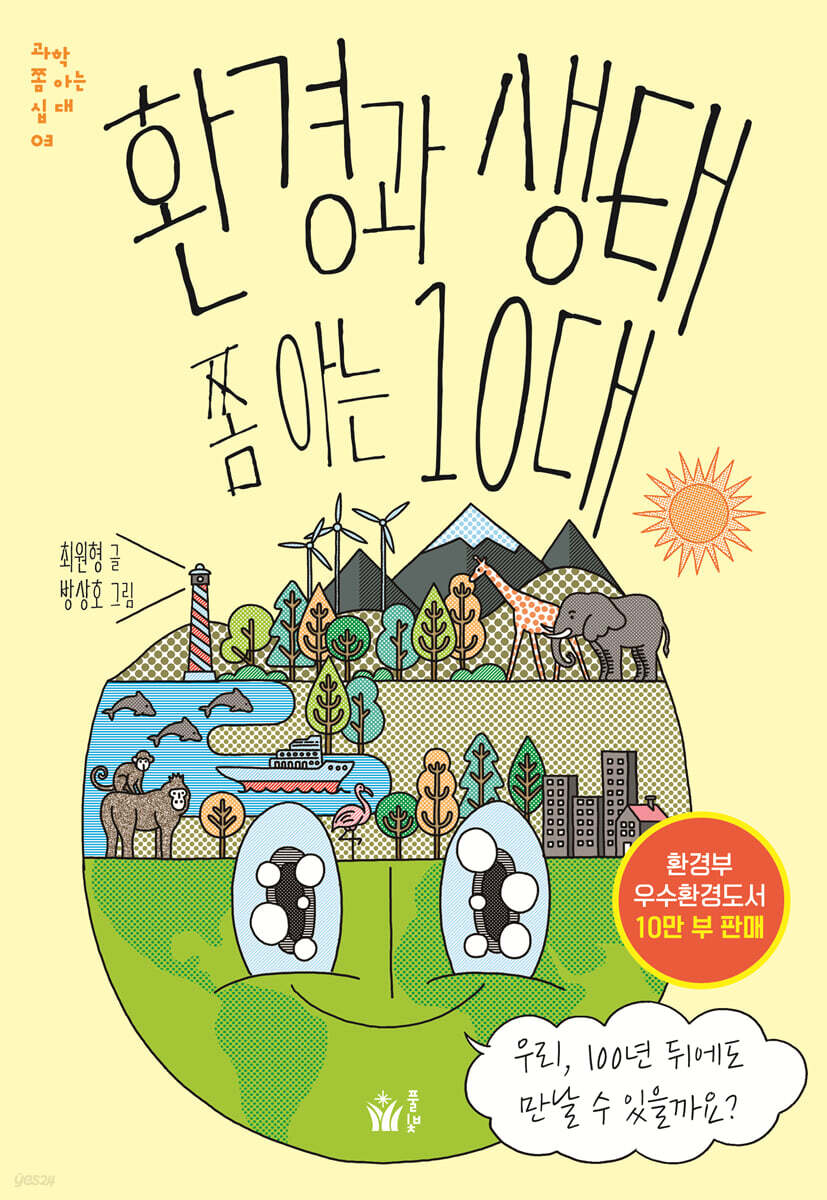
A teenager who knows a little about the environment and ecology
 |
Description
Book Introduction
The connection between me and nature through eight consumption behaviors
Once you know, the meaning of a bottle of water will change.
The third volume of the science education series for teenagers between elementary and middle school, "Teenagers Who Know a Little About Science," follows "Teenagers Who Know a Little About Artificial Intelligence" and "Teenagers Who Know a Little About Materials," and deals with environmental and ecological issues.
『Teenagers Who Know a Little About the Environment and Ecology』 captures eight consumption scenes that modern people easily and commonly engage in, and examines from various angles how my consumption affects who, what class, and what living creatures where.
Reflecting the shift in higher education science curriculum toward an integrated, multidisciplinary approach, this book offers a multi-faceted approach to social issues related to the environment and ecology.
It is an attempt to connect the behavior of 'consumption', which can be said to be the main identity of modern people, with environmental changes occurring all over the world.
Through this, we come to realize that the world we had understood as dots and lines is connected at various levels, and we come to understand the world organically.
Meanwhile, we sought to break away from the "guilt cycle" that often occurs when dealing with environmental issues and to achieve balance in the discussion by specifically clarifying the responsibilities that society, the state, and businesses must share.
It confronts individuals with their responsibility for creating a global environment stained with pain and tears, while simultaneously emphasizing that individual actions have the power to change reality.
Once you know, the meaning of a bottle of water will change.
The third volume of the science education series for teenagers between elementary and middle school, "Teenagers Who Know a Little About Science," follows "Teenagers Who Know a Little About Artificial Intelligence" and "Teenagers Who Know a Little About Materials," and deals with environmental and ecological issues.
『Teenagers Who Know a Little About the Environment and Ecology』 captures eight consumption scenes that modern people easily and commonly engage in, and examines from various angles how my consumption affects who, what class, and what living creatures where.
Reflecting the shift in higher education science curriculum toward an integrated, multidisciplinary approach, this book offers a multi-faceted approach to social issues related to the environment and ecology.
It is an attempt to connect the behavior of 'consumption', which can be said to be the main identity of modern people, with environmental changes occurring all over the world.
Through this, we come to realize that the world we had understood as dots and lines is connected at various levels, and we come to understand the world organically.
Meanwhile, we sought to break away from the "guilt cycle" that often occurs when dealing with environmental issues and to achieve balance in the discussion by specifically clarifying the responsibilities that society, the state, and businesses must share.
It confronts individuals with their responsibility for creating a global environment stained with pain and tears, while simultaneously emphasizing that individual actions have the power to change reality.
- You can preview some of the book's contents.
Preview
index
Stepping into the small details of everyday life and removing the shadows
01 Cup Ramen and Plantation What I Eat is the World
When you're hungry, cup ramen is the best! | Plantations sweep the primeval forest | What happens when forests disappear | Let's choose discomfort with joy | Finding justice in food
02 Bananas and Biodiversity The world is truly beautiful when there are all kinds of shapes.
Could Bananas Disappear? | Why Bananas Can't Survive Epidemics | The Crisis of Losing Diversity | The Tragedy of the Banana Republic | To Protect Things That Are Disappearing
03 The smaller the map of the avocado and local food table, the better
Where does the food you're eating come from? | The avocado's journey and carbon footprint | Who loses water when we eat avocados | Who's abusing the land? | Eating food grown locally
04 Water bottles and plastic waste Tonight's dinner is grilled mackerel with microplastics
Plastic in the belly of a whale, 10,000 meters below the surface | The Earth teeming with plastic waste | Is it too cheap and convenient? | Microplastic grilled fish for dinner tonight | Let's put plastic back where it belongs.
05 Cell Phones and Electronic Waste: The Loneliest Electronic Waste Graveyard in the World
Where does all this e-waste go? | Convenience benefits the developed world, while the poor suffer the consequences. | Why we constantly want to buy new things. | Let's recycle resources we've already used. | Reducing e-waste is up to everyone.
06 Fast Fashion and the Workers' Tears
Sold out, but you can always buy more? | Are skinny jeans really that comfortable? | The tears of workers hidden in the price of clothes | Environmental pollution favors the vulnerable | Outrageous ways to throw away clothes | Clothes that shake people's lives | Reimagining clothes
07 Chemical Revenge and Social Responsibility: Will We Still Be Able to Meet in 100 Years?
Decades-old mistakes are coming back | Chemicals are in almost everything around us | Cosmetics we use without knowing, and cosmetics we use knowingly | How to avoid harmful chemicals in our daily lives | Let's demand it from companies and governments
08 Long padding and animal rights How many do you need to survive the middle of winter?
Winter's must-have item, long padding | Where does all that fur come from? | Animals sacrificed for human consumption, clothing, and enjoyment | Animals do not exist for human enjoyment | How much do we really know about animals? | What should we do and how? | Ultimately, it's a matter of consumption.
Coming out and waiting for a new Greta Thunberg
01 Cup Ramen and Plantation What I Eat is the World
When you're hungry, cup ramen is the best! | Plantations sweep the primeval forest | What happens when forests disappear | Let's choose discomfort with joy | Finding justice in food
02 Bananas and Biodiversity The world is truly beautiful when there are all kinds of shapes.
Could Bananas Disappear? | Why Bananas Can't Survive Epidemics | The Crisis of Losing Diversity | The Tragedy of the Banana Republic | To Protect Things That Are Disappearing
03 The smaller the map of the avocado and local food table, the better
Where does the food you're eating come from? | The avocado's journey and carbon footprint | Who loses water when we eat avocados | Who's abusing the land? | Eating food grown locally
04 Water bottles and plastic waste Tonight's dinner is grilled mackerel with microplastics
Plastic in the belly of a whale, 10,000 meters below the surface | The Earth teeming with plastic waste | Is it too cheap and convenient? | Microplastic grilled fish for dinner tonight | Let's put plastic back where it belongs.
05 Cell Phones and Electronic Waste: The Loneliest Electronic Waste Graveyard in the World
Where does all this e-waste go? | Convenience benefits the developed world, while the poor suffer the consequences. | Why we constantly want to buy new things. | Let's recycle resources we've already used. | Reducing e-waste is up to everyone.
06 Fast Fashion and the Workers' Tears
Sold out, but you can always buy more? | Are skinny jeans really that comfortable? | The tears of workers hidden in the price of clothes | Environmental pollution favors the vulnerable | Outrageous ways to throw away clothes | Clothes that shake people's lives | Reimagining clothes
07 Chemical Revenge and Social Responsibility: Will We Still Be Able to Meet in 100 Years?
Decades-old mistakes are coming back | Chemicals are in almost everything around us | Cosmetics we use without knowing, and cosmetics we use knowingly | How to avoid harmful chemicals in our daily lives | Let's demand it from companies and governments
08 Long padding and animal rights How many do you need to survive the middle of winter?
Winter's must-have item, long padding | Where does all that fur come from? | Animals sacrificed for human consumption, clothing, and enjoyment | Animals do not exist for human enjoyment | How much do we really know about animals? | What should we do and how? | Ultimately, it's a matter of consumption.
Coming out and waiting for a new Greta Thunberg
Detailed image

Publisher's Review
How closely connected is my consumption with the world?
"Teenagers Who Know a Little About the Environment and Ecology" examines how eight common consumption patterns in modern life connect with every corner of the world from an environmental and ecological perspective.
The eight themes seem to originate from different places, but they are intertwined and converge again on the issue of consumption.
The first Cup Ramen follows the story of orangutans being driven out of the rainforest to mass-produce the palm oil needed to fry the noodles, and of independent farmers losing their land to large corporations and becoming tenant farmers (Chapter 1). The cause of this phenomenon is the large-scale plantation farming methods of large corporations that produce a single crop.
This also leads to the banana problem (Chapter 2) that follows in the next chapter.
Bananas are also one of the crops grown using plantation farming, and this is where the concept of biodiversity comes into play.
It describes a situation where, although mass cultivation of a single variety succeeded in increasing marketability, biodiversity was lost as a result of focusing on production of only one variety.
The case of a banana variety that was commercially successful in mass distribution and then went extinct provides an opportunity to consider how humans might respond if something similar were to happen to other crops.
Third, avocados emerged alongside the trend of consuming food as a fad (Chapter 3). To meet the sudden increase in demand, avocado cultivation area dramatically increased, causing many problems.
It depicts the energy consumed to bring food from distant lands to our tables, the polluted environment caused by mass production that is detrimental to the ecosystem, and even the local workers suffering from water shortages.
Through this, it speaks to the necessity for modern consumers to find justice in food.
And as one solution, we introduce the local food movement, which encourages eating food produced as close to where you live as possible.
Next, we covered the issues of plastic waste and microplastics from water bottles that are too easily used and thrown away (Chapter 4), the issue of electronic waste disposal from home appliances such as smartphones that are used and thrown away like trendy items (Chapter 5), and the reality of workers suffering from environmental pollution caused by fast fashion and low labor costs (Chapter 6).
This reveals that while no one is immune to the harm caused by environmental pollution, it is always the weak and voiceless who suffer the most severe damage first.
Next, we hear about the lives that are threatened by unverified chemicals (Chapter 7), and the voices of animals whose fur is plucked alive to fill the long padding that becomes a craze every winter (Chapter 8).
Readers finally come to grips with the issue of animal rights as they realize the countless lives lost without even knowing the damage they suffered.
The eight consumption behaviors featured in this book are not grand luxuries, but rather small pleasures or needs.
Therefore, the fact that no one can be free from the environmental problems caused by this consumption is what holds us back.
Because the consequences of consumption are so enormous and sometimes so cruel that they are beyond imagination.
But this isn't entirely the consumer's fault.
This isn't a problem that can be solved by stopping consumption right away.
The only way to resolve this issue is for all of us to take responsibility: the corporations that cleverly exploit natural human desires and the vulnerable; the government that has partially abandoned its responsibility to regulate these corporations and protect the environment; and I, as a consumer.
By addressing these relationships in a balanced way, this book allows us to see the world from a concrete and realistic perspective.
Knowing also means becoming uncomfortable.
After reading this book, you might find yourself thinking of dead sea creatures filled with plastic waste when you try to insert a straw into a beverage pack like you normally would.
Even if you're casually thinking about buying a T-shirt, you'll find yourself wondering if you really need it and if you're adding one more piece of trash to the world.
This is a 'pleasant inconvenience' that finds new meaning in consumption.
Whatever I throw away comes back to me.
Environmental issues don't flow in just one direction.
Because the world we live in is not closed but cyclical.
In other words, whatever we use and how we throw away, it comes back to us.
The destruction of rainforests to mass-produce profitable food has exacerbated climate change, causing suffering for modern people.
We've been constantly making and using plastic because it's convenient and cheap, and now microplastics are entering our mouths.
When you use a lot of water and pollute a river to wash your jeans stylishly, the immediate victims are the local residents, workers, and all the living things there, but that water will eventually flow back to us.
Someday, my turn will definitely come.
Just because you don't live near a production site or during a time when contamination occurred doesn't mean you're safe.
Pesticides that were sprayed on the ground decades ago remained in the ground and only a few years ago found their way into eggs and ended up on our tables.
Chemicals that were banned decades ago due to their proven hazards remain in whales' stomachs, causing their deaths.
This is what this book emphasizes.
The waste and chemicals produced through reckless consumption without regard for the Earth's environment will attack the vulnerable, even those we don't see right now.
Farmers living in remote places, children and the elderly in poor countries, plants and animals whose names were not even known before they died, and the places where they lived will be the first to be sacrificed.
But someday, my turn will definitely come.
Scientists around the world commonly say that climate change is occurring faster than predicted.
A new study has found that microplastics are found in almost all bottled water sold on the market, even before the dangers of microplastics were fully known.
What comes next?
Benefits go to the strong, harm to the weak - is this really justice?
Environmental and ecological issues are permeated with questions of justice.
In order to keep up with the consumption level of modern people (or to encourage consumption), mass production involves the suffering of low-wage workers and the tears of those who cannot express their suffering.
Fast fashion clothing is primarily produced in countries with cheap labor and unregulated access to land and water.
Ninety-seven percent of clothing sold in the United States is manufactured overseas.
The United States enjoys abundance, while the suffering of working in poor conditions and environmental pollution are outsourced to poor countries.
China imported 56 percent of the world's recyclable waste in 2016 alone.
In this vast wasteland, someone eats, sleeps, and raises children.
The greed of the powerful to easily dispose of their waste and the economic needs of the poor to extract usable resources from it force some people into such a precarious situation.
Meanwhile, companies intentionally design their products to degrade over time or to stimulate new consumer desires.
The profits obtained in this way do not go back to the workers.
Companies that make money through plantation farming simply move their farms when the land and water in the area become desolate.
Problems like environmental pollution and water shortages are solely the responsibility of the remaining residents.
When the environment is polluted and the ecosystem collapses, it is the workers who cannot speak, the ones with small voices, who bear the burden of suffering.
Therefore, we must find justice even in the most trivial of consumptions.
Are the farmers who produce the food I eat properly compensated? Are animals being cruelly exploited for the clothes I wear? Is the waste I so easily discard threatening the lives of animals? In this context, discussions on constitutional amendments to address animal rights have begun in Korea, and voices are being raised about the export of waste.
So what is my role here?
What should I, businesses, and the country do?
Can environmental problems be solved solely through the goodwill of individuals? This book argues that it's not enough for individuals to act out of guilt; both governments and corporations must assume responsibility.
First, consumers' choices must be expanded.
We should be able to easily choose products that are easy to recycle, clothing made with ethically sourced animal fur, food that pays farmers a fair price, jeans processed in a way that causes less pollution, and appliances that last, are efficient, and easy to repair when they break down.
Businesses must respond to these citizens' demands.
It is the government's responsibility to establish a system such as the 'Producer Responsibility Recycling System' that holds companies responsible for the pollution and waste generated during production.
The same goes for severely punishing companies that cause fatal damage to the environment and consumers' lives with unverified chemicals and pressuring them to disclose product information to consumers.
It is also important to improve systems and laws to suit the new environment.
Chemicals once considered safe are sometimes proven to be harmful in less than 100 years.
Therefore, strict standards must be established for corporate production activities.
It is also essential to establish systems to ensure that younger generations are properly educated about environmental issues.
It is the role of citizens to create responsible companies and countries, and to monitor and demand that they fulfill their roles.
In other words, this book emphasizes that only when we, as citizens, businesses, and the nation, fulfill our responsibilities can we pass on the nature we have enjoyed to the next generation as fully as possible.
A look at the most core concepts, discussions, and new approaches in environmental issues.
Environment? Ecology is also a dynamic field.
In 2018, the issue of microplastics was newly revealed, the World Health Organization announced that it would investigate whether they were harmful, and the media widely reported that microplastics were found in almost all bottled water products and salt farms.
Even within a few years, important issues can emerge or predictions can be overturned.
『10 Teens Who Know a Little About the Environment and Ecology』 has tried to faithfully cover the issues currently being discussed or new in this field.
In the case of foods such as bananas, avocados, and ramen, the focus was primarily on the mass production of single varieties by multinational corporations, that is, plantation farming.
Concepts such as carbon footprint and water footprint also emerge from here.
The problems that each food brings are examined separately according to their characteristics, but if we are to overcome them, they will inevitably meet on the same path.
The point is that we should consume food that is as close to where we live as possible and choose food that is produced in a just manner.
Here we introduce initiatives such as the local food movement and fair trade, and address the concept of biodiversity.
There are also creative attempts to address the environmental pollution left on Earth by electronic waste, plastic waste, and chemicals.
In 2019, the European Union introduced legislation requiring manufacturers to allow users to repair their own electronics.
A civic group has also developed an application to help consumers easily find information on chemicals contained in cosmetics.
To prevent unnecessary animal sacrifice, some clothing companies harvest animal fur from discarded coats and use it to make new coats.
"Teenagers Who Know a Little About the Environment and Ecology" not only examines the hottest environmental issues currently occurring on Earth, but also introduces the concepts behind these issues and informs creative methods for solving them.
After reading this book, you will not only gain an overview of the important environmental and ecological issues currently being discussed by modern people, but also gain insight into the role of young people as future leaders.
"Teenagers Who Know a Little About the Environment and Ecology" examines how eight common consumption patterns in modern life connect with every corner of the world from an environmental and ecological perspective.
The eight themes seem to originate from different places, but they are intertwined and converge again on the issue of consumption.
The first Cup Ramen follows the story of orangutans being driven out of the rainforest to mass-produce the palm oil needed to fry the noodles, and of independent farmers losing their land to large corporations and becoming tenant farmers (Chapter 1). The cause of this phenomenon is the large-scale plantation farming methods of large corporations that produce a single crop.
This also leads to the banana problem (Chapter 2) that follows in the next chapter.
Bananas are also one of the crops grown using plantation farming, and this is where the concept of biodiversity comes into play.
It describes a situation where, although mass cultivation of a single variety succeeded in increasing marketability, biodiversity was lost as a result of focusing on production of only one variety.
The case of a banana variety that was commercially successful in mass distribution and then went extinct provides an opportunity to consider how humans might respond if something similar were to happen to other crops.
Third, avocados emerged alongside the trend of consuming food as a fad (Chapter 3). To meet the sudden increase in demand, avocado cultivation area dramatically increased, causing many problems.
It depicts the energy consumed to bring food from distant lands to our tables, the polluted environment caused by mass production that is detrimental to the ecosystem, and even the local workers suffering from water shortages.
Through this, it speaks to the necessity for modern consumers to find justice in food.
And as one solution, we introduce the local food movement, which encourages eating food produced as close to where you live as possible.
Next, we covered the issues of plastic waste and microplastics from water bottles that are too easily used and thrown away (Chapter 4), the issue of electronic waste disposal from home appliances such as smartphones that are used and thrown away like trendy items (Chapter 5), and the reality of workers suffering from environmental pollution caused by fast fashion and low labor costs (Chapter 6).
This reveals that while no one is immune to the harm caused by environmental pollution, it is always the weak and voiceless who suffer the most severe damage first.
Next, we hear about the lives that are threatened by unverified chemicals (Chapter 7), and the voices of animals whose fur is plucked alive to fill the long padding that becomes a craze every winter (Chapter 8).
Readers finally come to grips with the issue of animal rights as they realize the countless lives lost without even knowing the damage they suffered.
The eight consumption behaviors featured in this book are not grand luxuries, but rather small pleasures or needs.
Therefore, the fact that no one can be free from the environmental problems caused by this consumption is what holds us back.
Because the consequences of consumption are so enormous and sometimes so cruel that they are beyond imagination.
But this isn't entirely the consumer's fault.
This isn't a problem that can be solved by stopping consumption right away.
The only way to resolve this issue is for all of us to take responsibility: the corporations that cleverly exploit natural human desires and the vulnerable; the government that has partially abandoned its responsibility to regulate these corporations and protect the environment; and I, as a consumer.
By addressing these relationships in a balanced way, this book allows us to see the world from a concrete and realistic perspective.
Knowing also means becoming uncomfortable.
After reading this book, you might find yourself thinking of dead sea creatures filled with plastic waste when you try to insert a straw into a beverage pack like you normally would.
Even if you're casually thinking about buying a T-shirt, you'll find yourself wondering if you really need it and if you're adding one more piece of trash to the world.
This is a 'pleasant inconvenience' that finds new meaning in consumption.
Whatever I throw away comes back to me.
Environmental issues don't flow in just one direction.
Because the world we live in is not closed but cyclical.
In other words, whatever we use and how we throw away, it comes back to us.
The destruction of rainforests to mass-produce profitable food has exacerbated climate change, causing suffering for modern people.
We've been constantly making and using plastic because it's convenient and cheap, and now microplastics are entering our mouths.
When you use a lot of water and pollute a river to wash your jeans stylishly, the immediate victims are the local residents, workers, and all the living things there, but that water will eventually flow back to us.
Someday, my turn will definitely come.
Just because you don't live near a production site or during a time when contamination occurred doesn't mean you're safe.
Pesticides that were sprayed on the ground decades ago remained in the ground and only a few years ago found their way into eggs and ended up on our tables.
Chemicals that were banned decades ago due to their proven hazards remain in whales' stomachs, causing their deaths.
This is what this book emphasizes.
The waste and chemicals produced through reckless consumption without regard for the Earth's environment will attack the vulnerable, even those we don't see right now.
Farmers living in remote places, children and the elderly in poor countries, plants and animals whose names were not even known before they died, and the places where they lived will be the first to be sacrificed.
But someday, my turn will definitely come.
Scientists around the world commonly say that climate change is occurring faster than predicted.
A new study has found that microplastics are found in almost all bottled water sold on the market, even before the dangers of microplastics were fully known.
What comes next?
Benefits go to the strong, harm to the weak - is this really justice?
Environmental and ecological issues are permeated with questions of justice.
In order to keep up with the consumption level of modern people (or to encourage consumption), mass production involves the suffering of low-wage workers and the tears of those who cannot express their suffering.
Fast fashion clothing is primarily produced in countries with cheap labor and unregulated access to land and water.
Ninety-seven percent of clothing sold in the United States is manufactured overseas.
The United States enjoys abundance, while the suffering of working in poor conditions and environmental pollution are outsourced to poor countries.
China imported 56 percent of the world's recyclable waste in 2016 alone.
In this vast wasteland, someone eats, sleeps, and raises children.
The greed of the powerful to easily dispose of their waste and the economic needs of the poor to extract usable resources from it force some people into such a precarious situation.
Meanwhile, companies intentionally design their products to degrade over time or to stimulate new consumer desires.
The profits obtained in this way do not go back to the workers.
Companies that make money through plantation farming simply move their farms when the land and water in the area become desolate.
Problems like environmental pollution and water shortages are solely the responsibility of the remaining residents.
When the environment is polluted and the ecosystem collapses, it is the workers who cannot speak, the ones with small voices, who bear the burden of suffering.
Therefore, we must find justice even in the most trivial of consumptions.
Are the farmers who produce the food I eat properly compensated? Are animals being cruelly exploited for the clothes I wear? Is the waste I so easily discard threatening the lives of animals? In this context, discussions on constitutional amendments to address animal rights have begun in Korea, and voices are being raised about the export of waste.
So what is my role here?
What should I, businesses, and the country do?
Can environmental problems be solved solely through the goodwill of individuals? This book argues that it's not enough for individuals to act out of guilt; both governments and corporations must assume responsibility.
First, consumers' choices must be expanded.
We should be able to easily choose products that are easy to recycle, clothing made with ethically sourced animal fur, food that pays farmers a fair price, jeans processed in a way that causes less pollution, and appliances that last, are efficient, and easy to repair when they break down.
Businesses must respond to these citizens' demands.
It is the government's responsibility to establish a system such as the 'Producer Responsibility Recycling System' that holds companies responsible for the pollution and waste generated during production.
The same goes for severely punishing companies that cause fatal damage to the environment and consumers' lives with unverified chemicals and pressuring them to disclose product information to consumers.
It is also important to improve systems and laws to suit the new environment.
Chemicals once considered safe are sometimes proven to be harmful in less than 100 years.
Therefore, strict standards must be established for corporate production activities.
It is also essential to establish systems to ensure that younger generations are properly educated about environmental issues.
It is the role of citizens to create responsible companies and countries, and to monitor and demand that they fulfill their roles.
In other words, this book emphasizes that only when we, as citizens, businesses, and the nation, fulfill our responsibilities can we pass on the nature we have enjoyed to the next generation as fully as possible.
A look at the most core concepts, discussions, and new approaches in environmental issues.
Environment? Ecology is also a dynamic field.
In 2018, the issue of microplastics was newly revealed, the World Health Organization announced that it would investigate whether they were harmful, and the media widely reported that microplastics were found in almost all bottled water products and salt farms.
Even within a few years, important issues can emerge or predictions can be overturned.
『10 Teens Who Know a Little About the Environment and Ecology』 has tried to faithfully cover the issues currently being discussed or new in this field.
In the case of foods such as bananas, avocados, and ramen, the focus was primarily on the mass production of single varieties by multinational corporations, that is, plantation farming.
Concepts such as carbon footprint and water footprint also emerge from here.
The problems that each food brings are examined separately according to their characteristics, but if we are to overcome them, they will inevitably meet on the same path.
The point is that we should consume food that is as close to where we live as possible and choose food that is produced in a just manner.
Here we introduce initiatives such as the local food movement and fair trade, and address the concept of biodiversity.
There are also creative attempts to address the environmental pollution left on Earth by electronic waste, plastic waste, and chemicals.
In 2019, the European Union introduced legislation requiring manufacturers to allow users to repair their own electronics.
A civic group has also developed an application to help consumers easily find information on chemicals contained in cosmetics.
To prevent unnecessary animal sacrifice, some clothing companies harvest animal fur from discarded coats and use it to make new coats.
"Teenagers Who Know a Little About the Environment and Ecology" not only examines the hottest environmental issues currently occurring on Earth, but also introduces the concepts behind these issues and informs creative methods for solving them.
After reading this book, you will not only gain an overview of the important environmental and ecological issues currently being discussed by modern people, but also gain insight into the role of young people as future leaders.
GOODS SPECIFICS
- Date of publication: May 20, 2019
- Page count, weight, size: 184 pages | 284g | 141*203*13mm
- ISBN13: 9791161727356
- ISBN10: 1161727353
You may also like
카테고리
korean


korean

![GQ KOREA Mark (Monthly): December [2025]](http://librairie.coreenne.fr/cdn/shop/files/8ef265dbbfbf186523ed75ba7319009d.jpg?v=1765340328&width=3840)


