

A teenager who knows a little about the market and prices
 |
Description
Book Introduction
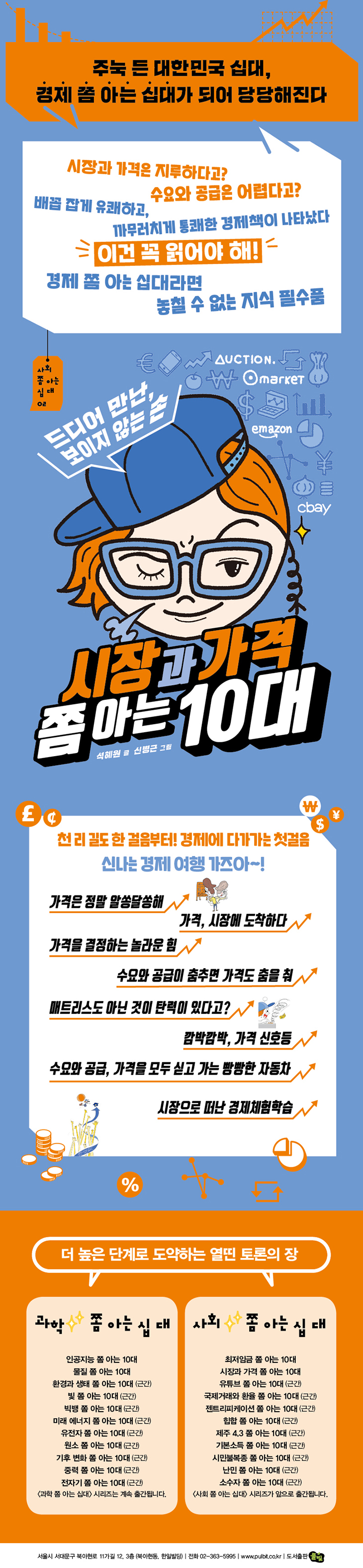
Are markets and prices boring? Are supply and demand difficult?
A hilarious and heartwarming economics book has arrived.
This is a must read!
A must-have knowledge item for any teenager with a passing knowledge of economics.
The economy? It's no longer an insurmountable mountain.
It is not a subject that is too complicated to understand or that you don't want to understand.
This is because here is a full-fledged economics textbook for middle school students, published by economics education expert Seok Hye-won.
It's called "Teenagers Who Know a Little About Markets and Prices: Finally Met the Invisible Hand."
This book mainly deals with market and price theory, and the laws of supply and demand, which appear in the economics section of middle school social studies textbooks.
However, because textbooks only summarize theories concisely, they give teenagers who are exposed to economics the prejudice that economics is difficult and rigid and difficult to approach.
"Teenagers Who Know a Little About Markets and Prices" blows away prejudices in one fell swoop.
This book clearly explains how prices of products we encounter in our daily lives are determined and why they fluctuate, including food, electricity bills, famous brand items, and even cell phones that we feel anxious about if they fall even for a moment, and the cars we drive every day. It also explains how demand and supply change accordingly, and how this in turn affects prices.
If you read this one book, teenagers will be able to straighten their shoulders and become confident teenagers who know a little about economics.
『Teenagers Who Know a Little About Markets and Prices』 is the second installment of the youth education series 『Teenagers Who Know a Little About Society』, which is a "hotbed of social debate that leaps to a higher level."
"Teenagers Who Know a Little About Society" is a series designed for teenagers, especially middle school students, who are struggling to find their way in the face of the vast mountain of knowledge between elementary and high school. Each volume contains topics that are thought-provoking and will spark active discussion among various social issues.
At a time when reading and discussion are increasingly becoming important goals of education, the "Teenagers Who Know a Little About Society" series has been painstakingly designed to kill two birds with one stone: "reading books" and "discussing together."
Above all, its significance lies in the fact that it goes beyond fragmentary knowledge and applies that knowledge to real life, and provides a friendly framework for comprehensive understanding by linking knowledge from one field to various fields.
A delightful, eye-opening knowledge game.
Let's have fun with "10 Teenagers Who Know a Little About Markets and Prices."
A hilarious and heartwarming economics book has arrived.
This is a must read!
A must-have knowledge item for any teenager with a passing knowledge of economics.
The economy? It's no longer an insurmountable mountain.
It is not a subject that is too complicated to understand or that you don't want to understand.
This is because here is a full-fledged economics textbook for middle school students, published by economics education expert Seok Hye-won.
It's called "Teenagers Who Know a Little About Markets and Prices: Finally Met the Invisible Hand."
This book mainly deals with market and price theory, and the laws of supply and demand, which appear in the economics section of middle school social studies textbooks.
However, because textbooks only summarize theories concisely, they give teenagers who are exposed to economics the prejudice that economics is difficult and rigid and difficult to approach.
"Teenagers Who Know a Little About Markets and Prices" blows away prejudices in one fell swoop.
This book clearly explains how prices of products we encounter in our daily lives are determined and why they fluctuate, including food, electricity bills, famous brand items, and even cell phones that we feel anxious about if they fall even for a moment, and the cars we drive every day. It also explains how demand and supply change accordingly, and how this in turn affects prices.
If you read this one book, teenagers will be able to straighten their shoulders and become confident teenagers who know a little about economics.
『Teenagers Who Know a Little About Markets and Prices』 is the second installment of the youth education series 『Teenagers Who Know a Little About Society』, which is a "hotbed of social debate that leaps to a higher level."
"Teenagers Who Know a Little About Society" is a series designed for teenagers, especially middle school students, who are struggling to find their way in the face of the vast mountain of knowledge between elementary and high school. Each volume contains topics that are thought-provoking and will spark active discussion among various social issues.
At a time when reading and discussion are increasingly becoming important goals of education, the "Teenagers Who Know a Little About Society" series has been painstakingly designed to kill two birds with one stone: "reading books" and "discussing together."
Above all, its significance lies in the fact that it goes beyond fragmentary knowledge and applies that knowledge to real life, and provides a friendly framework for comprehensive understanding by linking knowledge from one field to various fields.
A delightful, eye-opening knowledge game.
Let's have fun with "10 Teenagers Who Know a Little About Markets and Prices."
- You can preview some of the book's contents.
Preview
index
Going on a trip
The price of Chapter 1 is really confusing
Why do food prices vary depending on the time?
Why do electricity bills get more expensive the more you use them?
Why are famous brand items so expensive?
Chapter 2 Price, Arriving at the Market
The meaning behind the price
Market, where buyers and sellers meet
Not all markets are the same.
Chapter 3: The Amazing Power of Pricing
The price has gone up, should I buy it or not?
The price went up, I want to sell more
Harmony of Supply and Demand: Market Price and Equilibrium Quantity
Chapter 4 When supply and demand dance, prices dance too.
Demand and demand are different, strictly speaking.
I am the one who changes the demand
Supply and demand are different, of course.
I am the one who can change the supply
Chapter 5: Something that isn't even a mattress is elastic?
Chubby, bouncy, and resilient in the economy
The greater the price sensitivity, the greater the price elasticity of demand.
The greater the price sensitivity, the greater the price elasticity of supply.
Chapter 6 Blink Blink, Price Traffic Light
For consumers, the lower price is a green light to buy.
For producers, higher prices give them the green light to produce.
Satisfaction should be greater than the price.
Chapter 7: A Full Car Carrying Supply, Demand, and Prices
From Invention to Economic Good: The Automobile
Mercedes worth 9 billion won
Let everyone buy it, not just the rich
Model T price reduction made possible by the introduction of the Ford system.
Wage increases increase demand for cars
Chapter 8: Economic Experiential Learning at the Market
Why a market was created in Yangpyeong during the Joseon Dynasty
What if the market disappears?
There is an invisible hand in the market.
Ending the trip
The price of Chapter 1 is really confusing
Why do food prices vary depending on the time?
Why do electricity bills get more expensive the more you use them?
Why are famous brand items so expensive?
Chapter 2 Price, Arriving at the Market
The meaning behind the price
Market, where buyers and sellers meet
Not all markets are the same.
Chapter 3: The Amazing Power of Pricing
The price has gone up, should I buy it or not?
The price went up, I want to sell more
Harmony of Supply and Demand: Market Price and Equilibrium Quantity
Chapter 4 When supply and demand dance, prices dance too.
Demand and demand are different, strictly speaking.
I am the one who changes the demand
Supply and demand are different, of course.
I am the one who can change the supply
Chapter 5: Something that isn't even a mattress is elastic?
Chubby, bouncy, and resilient in the economy
The greater the price sensitivity, the greater the price elasticity of demand.
The greater the price sensitivity, the greater the price elasticity of supply.
Chapter 6 Blink Blink, Price Traffic Light
For consumers, the lower price is a green light to buy.
For producers, higher prices give them the green light to produce.
Satisfaction should be greater than the price.
Chapter 7: A Full Car Carrying Supply, Demand, and Prices
From Invention to Economic Good: The Automobile
Mercedes worth 9 billion won
Let everyone buy it, not just the rich
Model T price reduction made possible by the introduction of the Ford system.
Wage increases increase demand for cars
Chapter 8: Economic Experiential Learning at the Market
Why a market was created in Yangpyeong during the Joseon Dynasty
What if the market disappears?
There is an invisible hand in the market.
Ending the trip
Detailed image
Publisher's Review
A journey of a thousand miles begins with a single step! The first step toward economic prosperity.
We live in a world where we encounter various prices every day.
As your routine becomes more complex, there are more prices you need to know before deciding on an action.
First, let's hear the story of how prices are determined and why they fluctuate.
As the saying goes, "A journey of a thousand miles begins with a single step," theories and laws regarding the types and characteristics of markets, supply and demand, and the determination and fluctuation of prices are the most basic knowledge needed to understand the economy.
Knowing this is the first step toward developing the ability to analyze complex economic phenomena and understand their trends.
This book covers many stories related to real-life cases while explaining economic theories and laws.
Knowledge cannot be simply known; it must be connected to the impact or results it has on our actual lives to be meaningful.
The most frequently mentioned words in economic news are inflation, interest rates, exchange rates, wages, stock prices, crude oil, and real estate prices.
Although the word "price" was not used, prices are the comprehensive and average prices of all goods and services, interest rates are the cost of borrowing money, exchange rates are the price of exchanging different currencies, and wages are the price of labor, so all economic problems can be said to be problems of price.
Do you think ensuring that prices function properly in all markets is the key to a well-functioning economy? Ding dong ding! Exactly.
If you understand the importance of markets and prices, which are the most fundamental concepts in understanding all economic issues, you will not only grasp the economic knowledge covered in middle school, but also be able to delve deeper into the economic knowledge in high school, and even solve and answer the countless questions about the economy that you encounter in your daily life.
This book was designed to help middle school students properly understand the difficult terms and concepts that suddenly come crashing down like a tidal wave: types of markets, factors that determine prices, the laws of supply and demand, elasticity in the economy, the principle of price changes according to supply and demand, and even the famous "invisible hand."
If you don't properly imprint these principles and flow in your mind at the middle school level, you won't be able to build up your knowledge of economics, which will become more in-depth in high school.
Moreover, we may live our lives being swayed by the economy without understanding the larger context that influences our daily lives.
This is why it is extremely important to learn the basics of economic theory during middle school.
The market is a concert hall where prices and the harmony of supply and demand resonate.
But is it possible to make economics accessible and understandable to teenagers who shake their heads in disgust at the mere mention of it? That's why we need "Teenagers Who Know a Thing About Markets and Prices: Finally, We Met the Invisible Hand" right now.
Author Seok Hye-won, who has long worked as an expert in economic theory and a bank practitioner, has combined both theoretical and practical skills. By comparing middle school and high school curriculums, she selected the most important economic theories and applied them to products we encounter in our daily lives, providing comprehensive insight into how theories intertwine with reality.
For example, it allows us to see at a glance the cause and effect of how the price of ice cream, which is eaten as a snack, is determined, how that price changes, and what behavioral decisions consumers and producers make in response to the changed price.
It's not just about eating.
It provides a refreshing explanation of how economic theory is expressed in reality, like putting together puzzle pieces, using a variety of goods, from the cell phone we use all the time to the car we drive every day.
In this way, the one-dimensional economic theory that we learned only through dry graphs in textbooks is vividly presented in 3D images in this book.
It's so amazing.
This is the moment when the author's solid foundation, having published economics books for children and teenagers for many years, shines brightest.
If we look into the details a little more closely, it is as follows.
Food prices in restaurants vary depending on the time of day, electricity bills get more expensive the more you use, and even if a brand name is used, there is a significant difference in price between similar-looking products and other similar products.
Why are the prices so confusing?
Head to the market to unravel the mystery of prices.
When you go to the market, you see people trying to buy and sell scattered around, but surprisingly, the two meet somewhere.
What brought them together? The secret: price! Demand and supply walk a tightrope until they reach a price that's perfectly suited to both parties. Then, they greet each other warmly and shake hands.
But there is no such thing as an eternal relationship.
As the environment of demand for purchases changes and the supply that is being created moves, the strength of the hands that are held together weakens and the two grow apart.
But the market only works when the two meet.
They try to get closer by proposing new conditions to each other, and after such efforts, they meet at a new price.
The market is a vibrant and bustling place where supply and demand meet, part ways, and meet again to find the right conditions (price) for each other.
If this is the basic principle of life, where the heart of the economy beats and blood flows, then a more specific principle of movement, where fingers move and legs move to walk, is added.
The surprising fact that the economy is plump, bouncy, and resilient, even though it's not a mattress.
One day, when the amusement park held a half-price discount event, the number of visitors increased significantly.
When the price of cigarettes was raised, the number of buyers decreased.
This is because demand moves elastically depending on price.
When the price elasticity of demand is high.
As the coloring book craze has increased the number of people looking for colored pencils, the price of colored pencils has risen.
The owner of the colored pencil factory ran the machine day and night to produce more colored pencils.
What if supply also rises as prices rise? That means supply has a high price elasticity.
Onion prices have risen sharply due to abnormally low temperatures.
However, since it takes a long time for onions to be grown and brought to market, it is impossible to increase the supply of onions just because the price has risen.
When the price elasticity of supply is very small.
The degree to which supply and demand for each product move according to price, that is, the elasticity, is different, which is the secret to the movement of the huge body called the economy.
Ultimately, the key to solving economic problems lies in prices.
Prices are like traffic lights: for consumers, a lower price is the green light to buy, and for producers, a higher price is the green light to produce.
These price signals are what made cars such a part of our everyday lives.
The automobile started out as an invention, then became a rare commodity that only the wealthiest could afford to order, then became an expensive mass-produced product as machine production became possible, and then became a commodity that almost everyone could afford as the price went down and workers' wages went up. This is because consumers and producers constantly looked at the traffic light called price to make decisions and engage in economic activities.
South Korean youth, timid, are becoming economically literate teenagers, taking a step back.
This book unfolds the economy, which is alive and moving with its own vitality in every aspect of our lives.
What is the operating principle of vitality? How does that principle change when it meets circumstances? How does that change in turn affect our economic activities? This book makes us realize that even in our daily lives, which we have encountered without much thought, such sophisticated economic theories are playing a perfect sonata, with different tones coming together to create harmony.
The economy is like a work of art that is both interesting and beautiful.
"Teenagers Who Know a Thing About Markets and Prices: Finally Met the Invisible Hand" is a perfect combination of thorough textbook analysis, a surprising match between theory and practice, and a smooth, flowing narrative.
With just this one book, South Korean teenagers who are discouraged by the difficult economic situation can become confident teenagers who know a little about economics, both theoretically and practically.
Following this book, "10 Things You Need to Know About International Transactions and Exchange Rates" is being prepared. This book analyzes economic issues that arise when economic activities take place between countries, such as exchange rates, foreign exchange markets, trade wars, and globalization, by applying the laws of markets, prices, and supply and demand learned in this book. This is a great opportunity to expand the scale of economic knowledge.
Why not try this book to neatly organize the theories of markets, prices, and supply and demand—the starting point for solving all the economic problems we face? You'll likely find yourself grasping the once-difficult economics with clarity.
A heated social debate forum that leaps to a higher level [Teenagers who know a little about society]
[Teenagers Who Know a Little About Society] is a series designed for teenagers, especially middle school students, who are struggling to find their way in the face of the vast mountain of knowledge between elementary and high school. It contains topics that are thought-provoking and will spark active discussion among various social issues, selected from each volume.
At a time when reading and discussion are increasingly becoming important goals of education, the [Teenagers Who Know a Little About Society] series has put its heart and soul into killing two birds with one stone: 'reading books' and 'discussing together.'
Topic selection.
The seemingly narrow topic of a book encompasses a wide range of fields, and it also helps us regain awareness of issues we have previously overlooked. It was selected as a topic for discussion, allowing young people to freely but logically exchange opinions by dissecting the issue from various perspectives, whether for or against.
Professionalism.
Each book was written by an expert who has spent a long time thinking about, researching, and acting on each topic.
Reader-friendliness.
Forcing yourself to read is impossible.
The joy of reading leads to the joy of knowing.
For the [Teenagers Who Know a Little About Society] series, I thought most about where teenagers could empathize and find fun, and I tried to tell the story using the stories of teenagers and the words of teenagers as much as possible, rather than stories from afar.
The book is appropriately sized and has illustrations that bring the content to life, allowing readers to read the entire book in one sitting.
A fun game of knowledge.
Rather than just providing fragmented knowledge, we have created a friendly framework that allows for the application of that knowledge in real life, and for comprehensive understanding by connecting knowledge from one field to various fields.
If you are a teenager who feels that textbooks lack the fun, depth, and expansion of thought, you can instantly quench your thirst by reading [Teenagers Who Know a Little About Society].
Let's have some fun with #2 "Teenagers Who Know a Little About Markets and Prices".
We live in a world where we encounter various prices every day.
As your routine becomes more complex, there are more prices you need to know before deciding on an action.
First, let's hear the story of how prices are determined and why they fluctuate.
As the saying goes, "A journey of a thousand miles begins with a single step," theories and laws regarding the types and characteristics of markets, supply and demand, and the determination and fluctuation of prices are the most basic knowledge needed to understand the economy.
Knowing this is the first step toward developing the ability to analyze complex economic phenomena and understand their trends.
This book covers many stories related to real-life cases while explaining economic theories and laws.
Knowledge cannot be simply known; it must be connected to the impact or results it has on our actual lives to be meaningful.
The most frequently mentioned words in economic news are inflation, interest rates, exchange rates, wages, stock prices, crude oil, and real estate prices.
Although the word "price" was not used, prices are the comprehensive and average prices of all goods and services, interest rates are the cost of borrowing money, exchange rates are the price of exchanging different currencies, and wages are the price of labor, so all economic problems can be said to be problems of price.
Do you think ensuring that prices function properly in all markets is the key to a well-functioning economy? Ding dong ding! Exactly.
If you understand the importance of markets and prices, which are the most fundamental concepts in understanding all economic issues, you will not only grasp the economic knowledge covered in middle school, but also be able to delve deeper into the economic knowledge in high school, and even solve and answer the countless questions about the economy that you encounter in your daily life.
This book was designed to help middle school students properly understand the difficult terms and concepts that suddenly come crashing down like a tidal wave: types of markets, factors that determine prices, the laws of supply and demand, elasticity in the economy, the principle of price changes according to supply and demand, and even the famous "invisible hand."
If you don't properly imprint these principles and flow in your mind at the middle school level, you won't be able to build up your knowledge of economics, which will become more in-depth in high school.
Moreover, we may live our lives being swayed by the economy without understanding the larger context that influences our daily lives.
This is why it is extremely important to learn the basics of economic theory during middle school.
The market is a concert hall where prices and the harmony of supply and demand resonate.
But is it possible to make economics accessible and understandable to teenagers who shake their heads in disgust at the mere mention of it? That's why we need "Teenagers Who Know a Thing About Markets and Prices: Finally, We Met the Invisible Hand" right now.
Author Seok Hye-won, who has long worked as an expert in economic theory and a bank practitioner, has combined both theoretical and practical skills. By comparing middle school and high school curriculums, she selected the most important economic theories and applied them to products we encounter in our daily lives, providing comprehensive insight into how theories intertwine with reality.
For example, it allows us to see at a glance the cause and effect of how the price of ice cream, which is eaten as a snack, is determined, how that price changes, and what behavioral decisions consumers and producers make in response to the changed price.
It's not just about eating.
It provides a refreshing explanation of how economic theory is expressed in reality, like putting together puzzle pieces, using a variety of goods, from the cell phone we use all the time to the car we drive every day.
In this way, the one-dimensional economic theory that we learned only through dry graphs in textbooks is vividly presented in 3D images in this book.
It's so amazing.
This is the moment when the author's solid foundation, having published economics books for children and teenagers for many years, shines brightest.
If we look into the details a little more closely, it is as follows.
Food prices in restaurants vary depending on the time of day, electricity bills get more expensive the more you use, and even if a brand name is used, there is a significant difference in price between similar-looking products and other similar products.
Why are the prices so confusing?
Head to the market to unravel the mystery of prices.
When you go to the market, you see people trying to buy and sell scattered around, but surprisingly, the two meet somewhere.
What brought them together? The secret: price! Demand and supply walk a tightrope until they reach a price that's perfectly suited to both parties. Then, they greet each other warmly and shake hands.
But there is no such thing as an eternal relationship.
As the environment of demand for purchases changes and the supply that is being created moves, the strength of the hands that are held together weakens and the two grow apart.
But the market only works when the two meet.
They try to get closer by proposing new conditions to each other, and after such efforts, they meet at a new price.
The market is a vibrant and bustling place where supply and demand meet, part ways, and meet again to find the right conditions (price) for each other.
If this is the basic principle of life, where the heart of the economy beats and blood flows, then a more specific principle of movement, where fingers move and legs move to walk, is added.
The surprising fact that the economy is plump, bouncy, and resilient, even though it's not a mattress.
One day, when the amusement park held a half-price discount event, the number of visitors increased significantly.
When the price of cigarettes was raised, the number of buyers decreased.
This is because demand moves elastically depending on price.
When the price elasticity of demand is high.
As the coloring book craze has increased the number of people looking for colored pencils, the price of colored pencils has risen.
The owner of the colored pencil factory ran the machine day and night to produce more colored pencils.
What if supply also rises as prices rise? That means supply has a high price elasticity.
Onion prices have risen sharply due to abnormally low temperatures.
However, since it takes a long time for onions to be grown and brought to market, it is impossible to increase the supply of onions just because the price has risen.
When the price elasticity of supply is very small.
The degree to which supply and demand for each product move according to price, that is, the elasticity, is different, which is the secret to the movement of the huge body called the economy.
Ultimately, the key to solving economic problems lies in prices.
Prices are like traffic lights: for consumers, a lower price is the green light to buy, and for producers, a higher price is the green light to produce.
These price signals are what made cars such a part of our everyday lives.
The automobile started out as an invention, then became a rare commodity that only the wealthiest could afford to order, then became an expensive mass-produced product as machine production became possible, and then became a commodity that almost everyone could afford as the price went down and workers' wages went up. This is because consumers and producers constantly looked at the traffic light called price to make decisions and engage in economic activities.
South Korean youth, timid, are becoming economically literate teenagers, taking a step back.
This book unfolds the economy, which is alive and moving with its own vitality in every aspect of our lives.
What is the operating principle of vitality? How does that principle change when it meets circumstances? How does that change in turn affect our economic activities? This book makes us realize that even in our daily lives, which we have encountered without much thought, such sophisticated economic theories are playing a perfect sonata, with different tones coming together to create harmony.
The economy is like a work of art that is both interesting and beautiful.
"Teenagers Who Know a Thing About Markets and Prices: Finally Met the Invisible Hand" is a perfect combination of thorough textbook analysis, a surprising match between theory and practice, and a smooth, flowing narrative.
With just this one book, South Korean teenagers who are discouraged by the difficult economic situation can become confident teenagers who know a little about economics, both theoretically and practically.
Following this book, "10 Things You Need to Know About International Transactions and Exchange Rates" is being prepared. This book analyzes economic issues that arise when economic activities take place between countries, such as exchange rates, foreign exchange markets, trade wars, and globalization, by applying the laws of markets, prices, and supply and demand learned in this book. This is a great opportunity to expand the scale of economic knowledge.
Why not try this book to neatly organize the theories of markets, prices, and supply and demand—the starting point for solving all the economic problems we face? You'll likely find yourself grasping the once-difficult economics with clarity.
A heated social debate forum that leaps to a higher level [Teenagers who know a little about society]
[Teenagers Who Know a Little About Society] is a series designed for teenagers, especially middle school students, who are struggling to find their way in the face of the vast mountain of knowledge between elementary and high school. It contains topics that are thought-provoking and will spark active discussion among various social issues, selected from each volume.
At a time when reading and discussion are increasingly becoming important goals of education, the [Teenagers Who Know a Little About Society] series has put its heart and soul into killing two birds with one stone: 'reading books' and 'discussing together.'
Topic selection.
The seemingly narrow topic of a book encompasses a wide range of fields, and it also helps us regain awareness of issues we have previously overlooked. It was selected as a topic for discussion, allowing young people to freely but logically exchange opinions by dissecting the issue from various perspectives, whether for or against.
Professionalism.
Each book was written by an expert who has spent a long time thinking about, researching, and acting on each topic.
Reader-friendliness.
Forcing yourself to read is impossible.
The joy of reading leads to the joy of knowing.
For the [Teenagers Who Know a Little About Society] series, I thought most about where teenagers could empathize and find fun, and I tried to tell the story using the stories of teenagers and the words of teenagers as much as possible, rather than stories from afar.
The book is appropriately sized and has illustrations that bring the content to life, allowing readers to read the entire book in one sitting.
A fun game of knowledge.
Rather than just providing fragmented knowledge, we have created a friendly framework that allows for the application of that knowledge in real life, and for comprehensive understanding by connecting knowledge from one field to various fields.
If you are a teenager who feels that textbooks lack the fun, depth, and expansion of thought, you can instantly quench your thirst by reading [Teenagers Who Know a Little About Society].
Let's have some fun with #2 "Teenagers Who Know a Little About Markets and Prices".
GOODS SPECIFICS
- Date of issue: April 19, 2019
- Page count, weight, size: 176 pages | 274g | 140*203*20mm
- ISBN13: 9791161727332
- ISBN10: 1161727337
You may also like
카테고리
korean


korean

![GQ KOREA Mark (Monthly): December [2025]](http://librairie.coreenne.fr/cdn/shop/files/8ef265dbbfbf186523ed75ba7319009d.jpg?v=1765340328&width=3840)


