

New Testament Word Class
 |
Description
Book Introduction
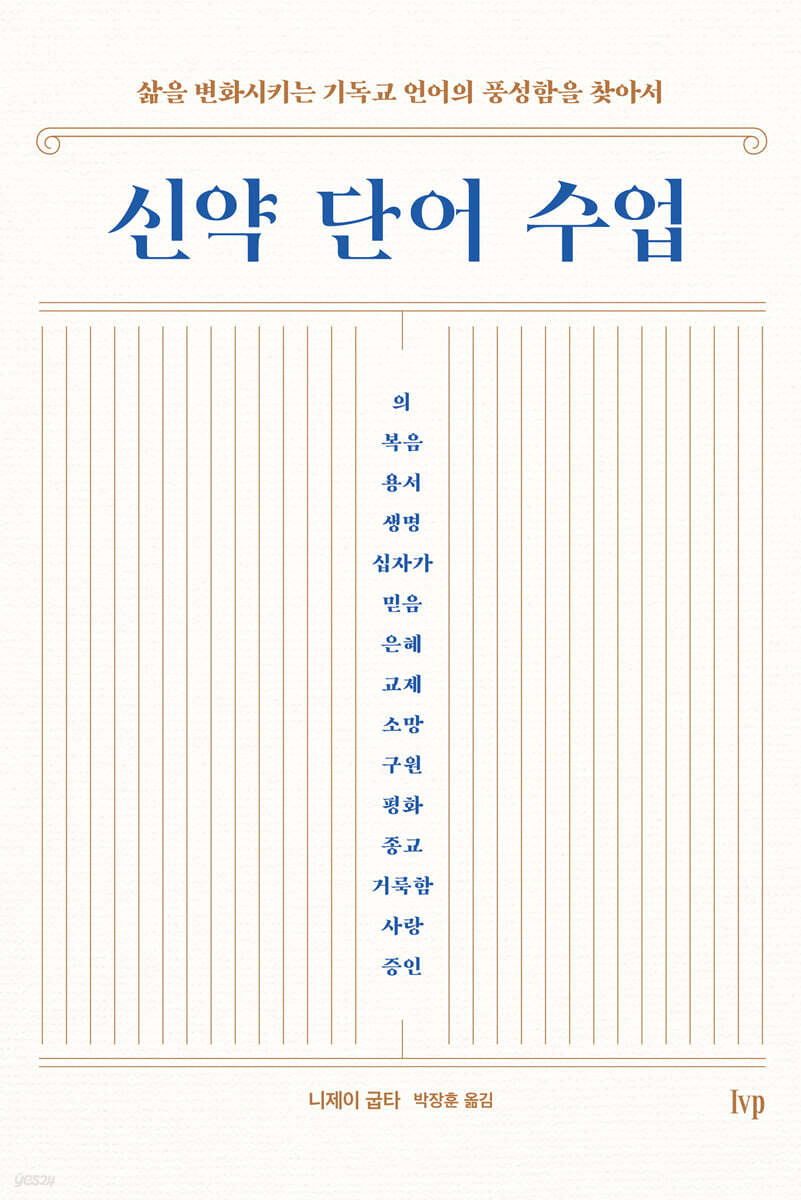
What does that word really mean? With Nijay Gupta's friendly and clear commentary The words of the New Testament come to life abundantly “The precious meaning of fifteen words in the New Testament It brings us to the scene of our lives today. “This is an amazing book!” Pastor Kim Hyung-guk, CEO of the Kingdom of God Gospel DNA Network Biblical theologian Nijay Gupta presents a three-dimensional view of the meaning of key Christian words, considering the Old and New Testament texts and their historical context. Righteousness, gospel, forgiveness, life, cross, faith, grace, fellowship, hope, salvation, peace, religion, holiness, love, witness. These fifteen words, which embody the essence of Christianity, have been abused and misused in the church, and seem to have lost their original color. Renowned New Testament scholar Nijay Gupta translates the true meaning of these words used by first-century Christians into modern language, transcending the limitations of time and space. To this end, we will select scriptures from the New Testament, from the Gospel of Matthew to the Book of Revelation, word by word, and explain them based on the text. In addition, we examine the Old Testament background (canonical context) that provides the foundation for the word and its connection to the first-century Jewish and Greco-Roman world (historical context). Words brought to life through kind and clear commentary offer cultural insights and implications for the here and now, shaping our worldview and prompting a rich transformation in our faith. |
- You can preview some of the book's contents.
Preview
index
Foreword - Paula Guder
Introduction
Chapter 1: Truth, Justice, and Mercy Before God and in the World│Gospel of Matthew
Chapter 2: The Gospel: God's Good News for the Life of the World│Gospel of Mark
Chapter 3: Forgiveness: Releasing and Restoring to Make Whole | Luke-Acts
Chapter 4: Life: Health, Growth, and Fulfillment│Gospel of John
Chapter 5: The Cross: New Life Through Participation in Christ's Death│1 and 2 Corinthians
Chapter 6: Faith: Knowing God and Becoming One with Him Through Jesus Christ│Galatians and Romans
Chapter 7 Grace: Transformed by God's Favor and Called to Be Givers│Ephesians
Chapter 8: Fellowship: Sharing Life with God and Others | Philippians
Chapter 9: Hope: Waiting for God's Redeemed Future│1 and 2 Thessalonians
Chapter 10: Salvation: Rescued, Reconciled, and Built for Prosperity│1 and 2 Timothy, Titus
Chapter 11 Peace: Wholeness, Goodness, and Harmony in Christ Jesus | Hebrews
Chapter 12 Religion: Fearing God by Loving Your Neighbor│Epistle of James
Chapter 13: Holiness: Glorious Otherness│1 Peter
Chapter 14: Love: Divine Affection, Loyalty, and Generosity│1 John
Chapter 15: The Witness: A Public Advocate for Jesus and His Way? No Matter What │ Revelation
Acknowledgements
References
Browse Topics
Search the Bible
Search ancient literature
Introduction
Chapter 1: Truth, Justice, and Mercy Before God and in the World│Gospel of Matthew
Chapter 2: The Gospel: God's Good News for the Life of the World│Gospel of Mark
Chapter 3: Forgiveness: Releasing and Restoring to Make Whole | Luke-Acts
Chapter 4: Life: Health, Growth, and Fulfillment│Gospel of John
Chapter 5: The Cross: New Life Through Participation in Christ's Death│1 and 2 Corinthians
Chapter 6: Faith: Knowing God and Becoming One with Him Through Jesus Christ│Galatians and Romans
Chapter 7 Grace: Transformed by God's Favor and Called to Be Givers│Ephesians
Chapter 8: Fellowship: Sharing Life with God and Others | Philippians
Chapter 9: Hope: Waiting for God's Redeemed Future│1 and 2 Thessalonians
Chapter 10: Salvation: Rescued, Reconciled, and Built for Prosperity│1 and 2 Timothy, Titus
Chapter 11 Peace: Wholeness, Goodness, and Harmony in Christ Jesus | Hebrews
Chapter 12 Religion: Fearing God by Loving Your Neighbor│Epistle of James
Chapter 13: Holiness: Glorious Otherness│1 Peter
Chapter 14: Love: Divine Affection, Loyalty, and Generosity│1 John
Chapter 15: The Witness: A Public Advocate for Jesus and His Way? No Matter What │ Revelation
Acknowledgements
References
Browse Topics
Search the Bible
Search ancient literature
Detailed image
Into the book
The Bible is an ancient and strange document.
Even with an English translation, reading and interpreting the New Testament is still a cross-cultural experience.
We must not only "translate" the language of the Bible into our native tongues, but also communicate the theological concepts at the heart of the Bible.
Our goal is not to change these concepts, but to ensure that their meaning is fully embedded in our cultural vocabulary.
--- From the "Introductory Note"
Some might get the impression from the above description that 'righteousness' ultimately means legally and meticulously fulfilling one's duties and observing laws and regulations.
Laws and regulations are good things, but justice is more than that.
Righteousness is about faithfulness and loyalty in relationships (keeping promises and being 'there for' others), and it even includes showing mercy to others.
--- From “Chapter 1: Truth, Justice, and Mercy Before God and in the World│Gospel of Matthew”
When I think of God's forgiveness, I often picture a judge releasing a criminal.
But a better parable that reflects Luke's view is the parable of the father caring for his children.
We who have been forgiven are not prisoners released into society.
We are sons and daughters who are embraced and welcomed.… Forgiveness is not just having your name inscribed in tiny letters in a large book of life.
You feel his kiss on your cheek mixed with the tears of joy flowing from your father's eyes as he worried about you.
You were lost and you are found.
Welcome back home.
--- From “Chapter 3 Forgiveness: Releasing and Restoring to Make Whole│Luke-Acts”
The world defines "winners" and "losers" according to its own terms, but Christians see things differently through the lens of the cross.
In fact, God chose the so-called "losers" and "nobodies" as part of His plan of redemption.
This is to change the way we value people and possessions (1 Corinthians 1:28).
Those who wish to live with Jesus and like Jesus must be willing to die to themselves and to the world for a deeper life in God.
--- From “Chapter 5: The Cross: New Life through Participation in Christ’s Death│1 and 2 Corinthians”
Fellowship is not an optional benefit of faith, but a necessity.
It's not about fun, it's about the mission of the gospel.
The distance Christians keep from one another represents their distance from God.
--- From “Chapter 8 Fellowship: Sharing Life with God and Others│Philippians”
When I sat down to research how the Old Testament uses the language of hope, I was surprised by what I discovered.
Previously, I had assumed that the Bible would use “hope” primarily when speaking of eschatology, that is, the final redemption and restoration of God’s people and God’s world. … But what I hadn’t anticipated was that the Old Testament doesn’t portray hope only, or even mostly, as relating to a time of fulfillment in the distant future.
Israel often professed its hope in a very 'present' way.
--- From “Chapter 9 Hope: Waiting for the Future Saved by God│1 and 2 Thessalonians”
After all, Christian peace is not a haven.
It is like a protective shield that surrounds our hearts and souls, enabling us to face life's many difficulties and challenges with resilience and indomitable courage.
--- From “Chapter 11 Peace: Perfection, Goodness, and Harmony in Christ Jesus│Hebrews”
Based on the notion that true religion is outward-looking and that piety is lived out, James addresses numerous social issues, but he places particular emphasis on economic issues (1:9-10; 2:1-7; 5:1-6).
What does religion have to do with money? Knowing that James is called the "Amos" of the New Testament makes the answer clear.
In the book of Amos, the Lord denounces Israel's disobedience to the covenant and threatens judgment (Amos 2:4-5).
This corruption was primarily manifested in the economic sphere.… Amos reminds us that true religion seeks good for all people according to the covenant (v. 14).
--- From “Chapter 12 Religion: Fearing God by Loving Your Neighbor│Epistle of James”
The Book of Revelation is not a book about the rapture, and the end times are not really its primary concern.
Rather, it is a book about helping meek Christians who are cornered by all odds see the world through God's eyes and see that their public witness is valuable, glorious, and effective, even if the world rejects them, shames them, tortures them, and kills them.
Even with an English translation, reading and interpreting the New Testament is still a cross-cultural experience.
We must not only "translate" the language of the Bible into our native tongues, but also communicate the theological concepts at the heart of the Bible.
Our goal is not to change these concepts, but to ensure that their meaning is fully embedded in our cultural vocabulary.
--- From the "Introductory Note"
Some might get the impression from the above description that 'righteousness' ultimately means legally and meticulously fulfilling one's duties and observing laws and regulations.
Laws and regulations are good things, but justice is more than that.
Righteousness is about faithfulness and loyalty in relationships (keeping promises and being 'there for' others), and it even includes showing mercy to others.
--- From “Chapter 1: Truth, Justice, and Mercy Before God and in the World│Gospel of Matthew”
When I think of God's forgiveness, I often picture a judge releasing a criminal.
But a better parable that reflects Luke's view is the parable of the father caring for his children.
We who have been forgiven are not prisoners released into society.
We are sons and daughters who are embraced and welcomed.… Forgiveness is not just having your name inscribed in tiny letters in a large book of life.
You feel his kiss on your cheek mixed with the tears of joy flowing from your father's eyes as he worried about you.
You were lost and you are found.
Welcome back home.
--- From “Chapter 3 Forgiveness: Releasing and Restoring to Make Whole│Luke-Acts”
The world defines "winners" and "losers" according to its own terms, but Christians see things differently through the lens of the cross.
In fact, God chose the so-called "losers" and "nobodies" as part of His plan of redemption.
This is to change the way we value people and possessions (1 Corinthians 1:28).
Those who wish to live with Jesus and like Jesus must be willing to die to themselves and to the world for a deeper life in God.
--- From “Chapter 5: The Cross: New Life through Participation in Christ’s Death│1 and 2 Corinthians”
Fellowship is not an optional benefit of faith, but a necessity.
It's not about fun, it's about the mission of the gospel.
The distance Christians keep from one another represents their distance from God.
--- From “Chapter 8 Fellowship: Sharing Life with God and Others│Philippians”
When I sat down to research how the Old Testament uses the language of hope, I was surprised by what I discovered.
Previously, I had assumed that the Bible would use “hope” primarily when speaking of eschatology, that is, the final redemption and restoration of God’s people and God’s world. … But what I hadn’t anticipated was that the Old Testament doesn’t portray hope only, or even mostly, as relating to a time of fulfillment in the distant future.
Israel often professed its hope in a very 'present' way.
--- From “Chapter 9 Hope: Waiting for the Future Saved by God│1 and 2 Thessalonians”
After all, Christian peace is not a haven.
It is like a protective shield that surrounds our hearts and souls, enabling us to face life's many difficulties and challenges with resilience and indomitable courage.
--- From “Chapter 11 Peace: Perfection, Goodness, and Harmony in Christ Jesus│Hebrews”
Based on the notion that true religion is outward-looking and that piety is lived out, James addresses numerous social issues, but he places particular emphasis on economic issues (1:9-10; 2:1-7; 5:1-6).
What does religion have to do with money? Knowing that James is called the "Amos" of the New Testament makes the answer clear.
In the book of Amos, the Lord denounces Israel's disobedience to the covenant and threatens judgment (Amos 2:4-5).
This corruption was primarily manifested in the economic sphere.… Amos reminds us that true religion seeks good for all people according to the covenant (v. 14).
--- From “Chapter 12 Religion: Fearing God by Loving Your Neighbor│Epistle of James”
The Book of Revelation is not a book about the rapture, and the end times are not really its primary concern.
Rather, it is a book about helping meek Christians who are cornered by all odds see the world through God's eyes and see that their public witness is valuable, glorious, and effective, even if the world rejects them, shames them, tortures them, and kills them.
--- From "Chapter 15: Testimony: A Public Advocate Defending Jesus and His Way? No Matter What Happens│Revelation"
Publisher's Review
The key words of the New Testament that we have misunderstood and tamed
Translate it into today's language!
“If you read this book, why doesn’t anyone
You might be wondering why you never thought to do this.
This book is well read and helpful.
“It is thought-provoking and inspiring.”
_From Paula Guder's 'Introduction'
Righteousness, gospel, forgiveness, life, cross, faith, grace, fellowship, hope, salvation, peace, religion, holiness, love, witness.
The church has a specific way of using these words.
You will know what these words mean.
So we use these words a lot and don't ask each other what they mean.
Sometimes, even during conversations, I feel like the meaning is strangely off.
But what if someone unfamiliar with this usage came along, noticed something awkward about the situation, and suddenly asked what the word meant? Perhaps the reason we didn't ask each other about these words, which hold the core of the Christian faith, was because we both knew how poor our understanding of them was.
In fact, it is not easy to clearly explain the meaning of the words used by the New Testament authors.
Between us and them lie the limitations of time and space, and the great cultural differences that arise from this.
The New Testament we read was translated from Greek into Korean, and this work, which continues to this day, is extremely important.
But to understand more deeply the meaning of these words, which have accumulated over a long period of time, we must broadly understand the context in which they are used.
Biblical theologian Nijay Gupta recognizes this need among Christians and uses his deep scholarly insight to enrich the meaning of fifteen words that embody the core of the Christian faith.
Revealing the true meaning of Christian language
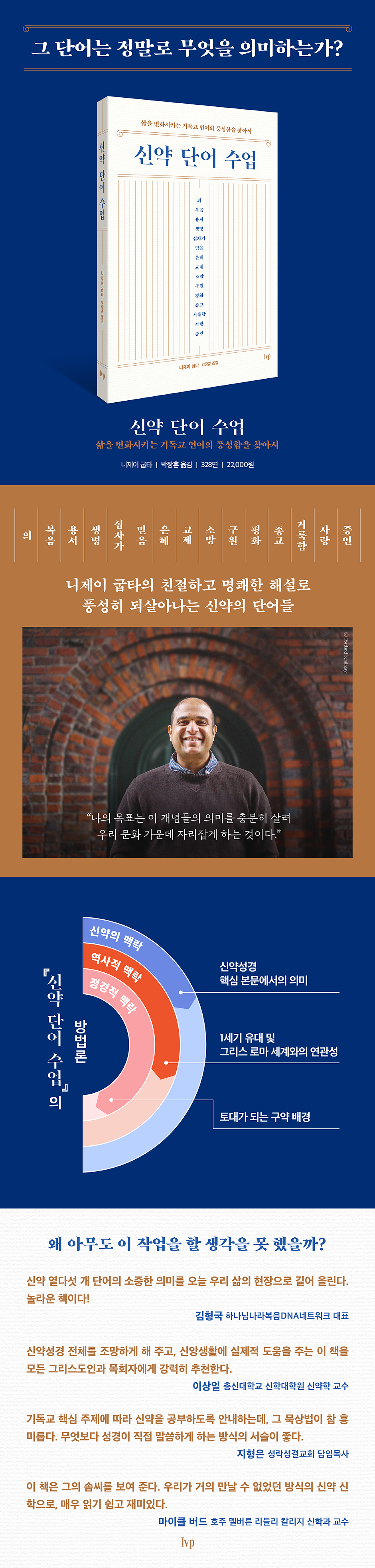
Three key contexts
“Words are just words.
“It is important to understand words in context.”
_In the 'Introduction'
In "New Testament Word Class," Nijay Gupta does refer to Greek dictionary definitions to explain the fifteen words above, but his emphasis is on the "context" in which these words are used.
The three contexts he focuses on allow us to understand the meaning of a word in three dimensions by building a dense world around it.
To this end, he devotes one chapter to each word, first examining the Old Testament background that underlies the word (① Canonical Context).
For example, chapter 1, which deals with "righteousness," begins with an explanation of the Hebrew word "tzedek," defines several similar words, and discusses the call of God's people to righteousness in the context of the covenant.
Gupta then explains what this word meant in the 1st century Greco-Roman world (② Historical Context).
For example, chapter 2, which deals with the 'gospel', reveals that 'euangelion' (good news) was a political word for pagans that suggested the stability and peace of the Roman Empire.
Only after the canonical and historical framework of the word has been established in this way does Gupta turn to the New Testament text (③ Literary Context).
By selecting the Gospel of Matthew as the main text in the New Testament that deals with the subject of 'righteousness' and the Gospel of Mark as the main text that deals with the subject of 'gospel', we can examine how the New Testament authors use the word.
The meticulous Gupta doesn't stop there.
He also presents other New Testament passages to supplement the main text so that the reader's understanding is not confined to one book.
Taking Chapter 1 as an example again, we will examine not only the Gospel of Matthew but also the Book of Romans to grasp the multi-layered meaning of ‘righteousness.’
This diligent research, condensed into language accessible to the general reader, is a “wonderful resource for churches and pastors.”
Living theology in life
“Gupta’s fascinating account is still a sin-filled world.
“It shows us how to live a hopeful life.”
David Garland, Professor of Christian Biblical Studies, George Truatt Theological Seminary
The fifteen words Gupta chose are “concepts that underpin the framework of New Testament theology.”
In the foreword, Paula Guder (Dean of St Paul's Cathedral, London) says:
“This book arms readers with fresh insights into the words of the New Testament and the theology behind them, allowing them to return to the New Testament itself and read the text anew.” Yes, it does.
『New Testament Word Class』 is not just a book that defines the meaning of words.
This book naturally develops a 'sound perspective' that covers the entirety of New Testament theology.
And the reader encounters the New Testament in a new way from this perspective.
In this book, Nijay Gupta does not understand 'theology' merely as 'academic research results', but rather as 'an internalized belief that is alive and dynamic in the field of life.'
The subtitle of the original book, “New Testament Theology for Real Life,” reflects the author’s intention well.
That is why at the end of each chapter he provides extended reflections on how theological concepts can be applied today.
Gupta's unwavering passion finally comes to a close here.
Ultimately, this is what Gupta is trying to say.
To speak the Christian language fluently is to experience our lives transformed by the living, breathing vitality contained in that language.
Main Readers
ㆍReaders who want to understand the meaning of key Christian words more deeply and clearly.
Christians who want to study New Testament theology in connection with today's concrete reality
ㆍThose interested in theology who wish to establish a foundation for biblical theological thinking and methodology
Pastors and church leaders who want to use accurate Christian language and messages
Features of this book
ㆍThe meaning of key New Testament words examined through the Old and New Testament texts and historical context
ㆍA friendly and clear explanation by Nijay Gupta, a biblical theologian who is gaining attention both domestically and internationally.
ㆍProvides extended reflections to help readers apply each theological concept to their lives.
A carefully selected list of recommended books for those who wish to study more professionally.
Translate it into today's language!
“If you read this book, why doesn’t anyone
You might be wondering why you never thought to do this.
This book is well read and helpful.
“It is thought-provoking and inspiring.”
_From Paula Guder's 'Introduction'
Righteousness, gospel, forgiveness, life, cross, faith, grace, fellowship, hope, salvation, peace, religion, holiness, love, witness.
The church has a specific way of using these words.
You will know what these words mean.
So we use these words a lot and don't ask each other what they mean.
Sometimes, even during conversations, I feel like the meaning is strangely off.
But what if someone unfamiliar with this usage came along, noticed something awkward about the situation, and suddenly asked what the word meant? Perhaps the reason we didn't ask each other about these words, which hold the core of the Christian faith, was because we both knew how poor our understanding of them was.
In fact, it is not easy to clearly explain the meaning of the words used by the New Testament authors.
Between us and them lie the limitations of time and space, and the great cultural differences that arise from this.
The New Testament we read was translated from Greek into Korean, and this work, which continues to this day, is extremely important.
But to understand more deeply the meaning of these words, which have accumulated over a long period of time, we must broadly understand the context in which they are used.
Biblical theologian Nijay Gupta recognizes this need among Christians and uses his deep scholarly insight to enrich the meaning of fifteen words that embody the core of the Christian faith.
Revealing the true meaning of Christian language
Three key contexts
“Words are just words.
“It is important to understand words in context.”
_In the 'Introduction'
In "New Testament Word Class," Nijay Gupta does refer to Greek dictionary definitions to explain the fifteen words above, but his emphasis is on the "context" in which these words are used.
The three contexts he focuses on allow us to understand the meaning of a word in three dimensions by building a dense world around it.
To this end, he devotes one chapter to each word, first examining the Old Testament background that underlies the word (① Canonical Context).
For example, chapter 1, which deals with "righteousness," begins with an explanation of the Hebrew word "tzedek," defines several similar words, and discusses the call of God's people to righteousness in the context of the covenant.
Gupta then explains what this word meant in the 1st century Greco-Roman world (② Historical Context).
For example, chapter 2, which deals with the 'gospel', reveals that 'euangelion' (good news) was a political word for pagans that suggested the stability and peace of the Roman Empire.
Only after the canonical and historical framework of the word has been established in this way does Gupta turn to the New Testament text (③ Literary Context).
By selecting the Gospel of Matthew as the main text in the New Testament that deals with the subject of 'righteousness' and the Gospel of Mark as the main text that deals with the subject of 'gospel', we can examine how the New Testament authors use the word.
The meticulous Gupta doesn't stop there.
He also presents other New Testament passages to supplement the main text so that the reader's understanding is not confined to one book.
Taking Chapter 1 as an example again, we will examine not only the Gospel of Matthew but also the Book of Romans to grasp the multi-layered meaning of ‘righteousness.’
This diligent research, condensed into language accessible to the general reader, is a “wonderful resource for churches and pastors.”
Living theology in life
“Gupta’s fascinating account is still a sin-filled world.
“It shows us how to live a hopeful life.”
David Garland, Professor of Christian Biblical Studies, George Truatt Theological Seminary
The fifteen words Gupta chose are “concepts that underpin the framework of New Testament theology.”
In the foreword, Paula Guder (Dean of St Paul's Cathedral, London) says:
“This book arms readers with fresh insights into the words of the New Testament and the theology behind them, allowing them to return to the New Testament itself and read the text anew.” Yes, it does.
『New Testament Word Class』 is not just a book that defines the meaning of words.
This book naturally develops a 'sound perspective' that covers the entirety of New Testament theology.
And the reader encounters the New Testament in a new way from this perspective.
In this book, Nijay Gupta does not understand 'theology' merely as 'academic research results', but rather as 'an internalized belief that is alive and dynamic in the field of life.'
The subtitle of the original book, “New Testament Theology for Real Life,” reflects the author’s intention well.
That is why at the end of each chapter he provides extended reflections on how theological concepts can be applied today.
Gupta's unwavering passion finally comes to a close here.
Ultimately, this is what Gupta is trying to say.
To speak the Christian language fluently is to experience our lives transformed by the living, breathing vitality contained in that language.
Main Readers
ㆍReaders who want to understand the meaning of key Christian words more deeply and clearly.
Christians who want to study New Testament theology in connection with today's concrete reality
ㆍThose interested in theology who wish to establish a foundation for biblical theological thinking and methodology
Pastors and church leaders who want to use accurate Christian language and messages
Features of this book
ㆍThe meaning of key New Testament words examined through the Old and New Testament texts and historical context
ㆍA friendly and clear explanation by Nijay Gupta, a biblical theologian who is gaining attention both domestically and internationally.
ㆍProvides extended reflections to help readers apply each theological concept to their lives.
A carefully selected list of recommended books for those who wish to study more professionally.
GOODS SPECIFICS
- Date of issue: September 27, 2024
- Page count, weight, size: 328 pages | 410g | 147*220*16mm
- ISBN13: 9788932822907
- ISBN10: 8932822905
You may also like
카테고리
korean


korean

![GQ KOREA Mark (Monthly): December [2025]](http://librairie.coreenne.fr/cdn/shop/files/8ef265dbbfbf186523ed75ba7319009d.jpg?v=1765340328&width=3840)


