

When Change Is Needed, the Enneagram
 |
Description
Book Introduction
An existential journey to find the whole me beyond my personality!
“The Enneagram has been a gift to the Korean church, which lacks a proper reflective tool.
When Change is Needed, Enneagram is on the path to finding yourself.
“This is another newly established milestone.”
_Jinsinsil (Director of the Mental Growth Research Institute)
Kim Hye-jin (Director of the Enneagram Research Institute), Yoon Mi-sook (Director of the Drawing Enneagram Research Institute), Lee Jae-cheon (Senior Pastor of Areumduri Church),
Recommended by Russ Hudson (co-author of The Wisdom of the Enneagram) and Richard Rohr (Franciscan priest)!
A practical guide to applying the Enneagram, a profound wisdom system about the human mind! This book introduces the Enneagram and explains how to apply it deeply in daily life and religious life.
The Enneagram is a profound system of wisdom about the human mind that has been passed down to only a select few for thousands of years.
In relation to the negative emotions we feel in all aspects of life, such as loss, anger, and anxiety, this book introduces the wisdom of the Enneagram, which reveals the essence of human personality.
What is your Enneagram number? How do you react to everyday events? Now, let's find your complete self with this book, a practical application of the Enneagram!
“The Enneagram has been a gift to the Korean church, which lacks a proper reflective tool.
When Change is Needed, Enneagram is on the path to finding yourself.
“This is another newly established milestone.”
_Jinsinsil (Director of the Mental Growth Research Institute)
Kim Hye-jin (Director of the Enneagram Research Institute), Yoon Mi-sook (Director of the Drawing Enneagram Research Institute), Lee Jae-cheon (Senior Pastor of Areumduri Church),
Recommended by Russ Hudson (co-author of The Wisdom of the Enneagram) and Richard Rohr (Franciscan priest)!
A practical guide to applying the Enneagram, a profound wisdom system about the human mind! This book introduces the Enneagram and explains how to apply it deeply in daily life and religious life.
The Enneagram is a profound system of wisdom about the human mind that has been passed down to only a select few for thousands of years.
In relation to the negative emotions we feel in all aspects of life, such as loss, anger, and anxiety, this book introduces the wisdom of the Enneagram, which reveals the essence of human personality.
What is your Enneagram number? How do you react to everyday events? Now, let's find your complete self with this book, a practical application of the Enneagram!
- You can preview some of the book's contents.
Preview
index
Recommended Introduction: The Enneagram, a Mirror of the Mind
Introduction: A Balanced Life
Part 1: The Three Centers: Identifying and Managing Dominant Power Centers
Overview: How We Were Broken…and How Can We Heal?
Chapter 1: What Do I Feel? _ The Heart-Shaped Stress Response
2. I can refuse
3. I can allow my emotions
4. My feelings… and your feelings
Chapter 2: What Do I Think? _ Hairstyle Stress Response
Finding Peace in the World #5
6. Trusting my experience and myself
Number 7 I can choose to be content.
Chapter 3: What Needs Need to Be Fulfilled? _ Jang-hyung's Stress Response
8 I can slow down
9. Decide a lot and combine a little
1. Both can be true
Part 2: How to Act: Identifying and Managing Repressed Centers of Power
Overview: Bringing out the suppressed center and finding balance
Chapter 4: Withdrawal Type - The Type That Avoids Others
4. Choose mediocrity
5. Be faithful to the world
Choice 9 - You can change your mind at any time.
Chapter 5: Opposition Type - Independent Type
Number 3 I am more important than what I do.
7. All emotions are important.
Vulnerability is different from weakness.
Chapter 6: Dependent Type - The Type That Turns to Others
1. “And it was good.”
2. What do I need?
All 6 will be fine
Conclusion: What are you willing to give up for change?
Acknowledgements
main
Introduction: A Balanced Life
Part 1: The Three Centers: Identifying and Managing Dominant Power Centers
Overview: How We Were Broken…and How Can We Heal?
Chapter 1: What Do I Feel? _ The Heart-Shaped Stress Response
2. I can refuse
3. I can allow my emotions
4. My feelings… and your feelings
Chapter 2: What Do I Think? _ Hairstyle Stress Response
Finding Peace in the World #5
6. Trusting my experience and myself
Number 7 I can choose to be content.
Chapter 3: What Needs Need to Be Fulfilled? _ Jang-hyung's Stress Response
8 I can slow down
9. Decide a lot and combine a little
1. Both can be true
Part 2: How to Act: Identifying and Managing Repressed Centers of Power
Overview: Bringing out the suppressed center and finding balance
Chapter 4: Withdrawal Type - The Type That Avoids Others
4. Choose mediocrity
5. Be faithful to the world
Choice 9 - You can change your mind at any time.
Chapter 5: Opposition Type - Independent Type
Number 3 I am more important than what I do.
7. All emotions are important.
Vulnerability is different from weakness.
Chapter 6: Dependent Type - The Type That Turns to Others
1. “And it was good.”
2. What do I need?
All 6 will be fine
Conclusion: What are you willing to give up for change?
Acknowledgements
main
Detailed image
Into the book
An era of alarm like the coronavirus pandemic is neither the first nor the last in human history, but it feels particularly acute because it has occurred in our own time.
Living in the time between, at the threshold that separates past and future, is a balancing act for which few are prepared.
Because going about life as usual no longer works.
We don't like it when the world around us spins out of control, but we have to deal with it.
Because control is an illusion.
Control is my most beloved fantasy, but that doesn't make it real.
In fact, nothing new happens as long as you stay in the comfort zone you have built.
More importantly, nothing creative happens in business as usual.
In every moment, even in the moments of crisis, the possibilities are endless, as long as you have the desire and courage to walk toward the possibilities of the future.
And the Enneagram is a very useful tool to help us do that.
--- From "Preface: A Balanced Life"
“The best part of you is also the worst part” is one of the principles of Enneagram wisdom.
In this case, the double tolerance is a good thing.
But that generosity can, and often does, have a very unhealthy tendency.
Usually, they give twice and keep giving until there is nothing left.
And then when you get back to your own life, you're out of energy to take care of yourself.
The second need to be needed has few boundaries.
And unfortunately, the standard for a person to be needed is determined by how much they feel they are needed.
--- From "Chapter 1: What Do I Feel?"
Types 5, 6, and 7, known as the Thinking Type, view the world and life as a series of problems and potential threats that we must anticipate and solve.
Since thinking is their dominant center, they use thinking to organize their inner world.
People in this type react to people, events, and difficulties through perception, observation, analysis, and planning to deal with potential problems.
They bring together all their perceptions of life and people and arrange them in a way that is comfortable for them.
They believe that if they can work all this out in their heads, they will be safe from external threats, know where they belong, and take responsibility for what is possible in the future.
They never feel or react to something until they think about it.
--- From "Chapter 2 What Am I Thinking About"
Numbers 8, 9, and 1 grapple with the question, “Who am I?”
This is because they are confused about where the appropriate boundaries are and try to take on too much on themselves.
Even when they pay attention, personal boundaries often disappear.
Number 8s don't know when to step back and listen or when to let others take the lead.
Number 9 resolves its fear of conflict and disconnection by integrating with more proactive people around it.
Number 1 not only takes on his or her own role at work and in other situations, but also takes on the responsibilities of others.
8s are satisfied with taking on a lot of work, 9s find joining forces with others a comfortable solution, but 1s resent having too much work to do.
And the resentment is compounded by the feeling that it is one's duty to 'improve' other people's work.
--- From "Chapter 3: What Needs Must Be Fulfilled?"
Numbers 4, 5, and 9 are all people with independent perspectives.
They draw their strength from within and do not seek or need others to agree with them or be with them.
Don't react even if others don't agree with you or have different views.
Other people are usually left to their own devices to think and believe as they please.
They are observers, each for their own reasons.
The reason number 4 observes is because they are used to being misunderstood when they speak, act intuitively, or act too quickly.
The reason number 5 observes is because he has learned to observe rather than participate due to the need to conserve energy.
The reason why 9s observe is because of their passion, sloth (defined in the Enneagram as the desire not to be influenced by life).
Additionally, because of their tendency to want to avoid conflict, Nines observe before acting, which is a good way to prevent division in relationships.
--- From "Chapter 4 Shrinking Type"
Those who belong to the opposition type attract people's attention.
They are all possessors of tremendous energy.
Active, energetic and very determined.
I have a big picture in my head, and my schedule is usually full and I have a ton of things to do.
Although they are not naturally or intuitively connected to their own or others' emotions, they identify and solve problems.
They are full of all kinds of ideas about an ideal world and strive to make those ideas a reality.
Life 3, 7, and 8 are all about control.
Most of them told me that they wanted to be responsible since they were young.
All three personality types repeatedly reported that they were the ones who provided energy to many of the groups they belonged to.
And then he quickly adds that sometimes it feels like a burden.
They find it difficult to tolerate others moving too slowly, but tend to avoid pointing it out directly.
I've heard many stories of people in this category trying not to raise their voices in social gatherings or deciding not to speak up at meetings or social events.
Such stories usually end with someone else approaching them and urging them to come forward or speak up.
--- From "Chapter 5: Confrontation"
Numbers 1, 2, and 6 are consciously or unconsciously examining the situation to assess what action is needed and whether or not you are the person who should be doing it.
They feel responsible for improving everything within their power, so their immediate circumstances determine their agenda.
They set very high standards for themselves, believing that they must do what others expect of them, and do it well.
Number 1 tends to focus on what is needed now.
Number 2 is to pay attention to the needs of the person in front of you.
Number 6 focuses on your daily responsibilities and schedule.
It is very difficult for these three types to make plans and stick to them.
Because everything changes depending on the day and what people ask of them.
Numbers in this behavior pattern rarely get their to-do list done because 24 hours in a day are not enough.
Number 1: After completing one's own work, there are many cases where one does the work that others failed to do properly.
Number 2 is over-immersive.
Most 6s have a hard time properly assessing how much time something takes.
Living in the time between, at the threshold that separates past and future, is a balancing act for which few are prepared.
Because going about life as usual no longer works.
We don't like it when the world around us spins out of control, but we have to deal with it.
Because control is an illusion.
Control is my most beloved fantasy, but that doesn't make it real.
In fact, nothing new happens as long as you stay in the comfort zone you have built.
More importantly, nothing creative happens in business as usual.
In every moment, even in the moments of crisis, the possibilities are endless, as long as you have the desire and courage to walk toward the possibilities of the future.
And the Enneagram is a very useful tool to help us do that.
--- From "Preface: A Balanced Life"
“The best part of you is also the worst part” is one of the principles of Enneagram wisdom.
In this case, the double tolerance is a good thing.
But that generosity can, and often does, have a very unhealthy tendency.
Usually, they give twice and keep giving until there is nothing left.
And then when you get back to your own life, you're out of energy to take care of yourself.
The second need to be needed has few boundaries.
And unfortunately, the standard for a person to be needed is determined by how much they feel they are needed.
--- From "Chapter 1: What Do I Feel?"
Types 5, 6, and 7, known as the Thinking Type, view the world and life as a series of problems and potential threats that we must anticipate and solve.
Since thinking is their dominant center, they use thinking to organize their inner world.
People in this type react to people, events, and difficulties through perception, observation, analysis, and planning to deal with potential problems.
They bring together all their perceptions of life and people and arrange them in a way that is comfortable for them.
They believe that if they can work all this out in their heads, they will be safe from external threats, know where they belong, and take responsibility for what is possible in the future.
They never feel or react to something until they think about it.
--- From "Chapter 2 What Am I Thinking About"
Numbers 8, 9, and 1 grapple with the question, “Who am I?”
This is because they are confused about where the appropriate boundaries are and try to take on too much on themselves.
Even when they pay attention, personal boundaries often disappear.
Number 8s don't know when to step back and listen or when to let others take the lead.
Number 9 resolves its fear of conflict and disconnection by integrating with more proactive people around it.
Number 1 not only takes on his or her own role at work and in other situations, but also takes on the responsibilities of others.
8s are satisfied with taking on a lot of work, 9s find joining forces with others a comfortable solution, but 1s resent having too much work to do.
And the resentment is compounded by the feeling that it is one's duty to 'improve' other people's work.
--- From "Chapter 3: What Needs Must Be Fulfilled?"
Numbers 4, 5, and 9 are all people with independent perspectives.
They draw their strength from within and do not seek or need others to agree with them or be with them.
Don't react even if others don't agree with you or have different views.
Other people are usually left to their own devices to think and believe as they please.
They are observers, each for their own reasons.
The reason number 4 observes is because they are used to being misunderstood when they speak, act intuitively, or act too quickly.
The reason number 5 observes is because he has learned to observe rather than participate due to the need to conserve energy.
The reason why 9s observe is because of their passion, sloth (defined in the Enneagram as the desire not to be influenced by life).
Additionally, because of their tendency to want to avoid conflict, Nines observe before acting, which is a good way to prevent division in relationships.
--- From "Chapter 4 Shrinking Type"
Those who belong to the opposition type attract people's attention.
They are all possessors of tremendous energy.
Active, energetic and very determined.
I have a big picture in my head, and my schedule is usually full and I have a ton of things to do.
Although they are not naturally or intuitively connected to their own or others' emotions, they identify and solve problems.
They are full of all kinds of ideas about an ideal world and strive to make those ideas a reality.
Life 3, 7, and 8 are all about control.
Most of them told me that they wanted to be responsible since they were young.
All three personality types repeatedly reported that they were the ones who provided energy to many of the groups they belonged to.
And then he quickly adds that sometimes it feels like a burden.
They find it difficult to tolerate others moving too slowly, but tend to avoid pointing it out directly.
I've heard many stories of people in this category trying not to raise their voices in social gatherings or deciding not to speak up at meetings or social events.
Such stories usually end with someone else approaching them and urging them to come forward or speak up.
--- From "Chapter 5: Confrontation"
Numbers 1, 2, and 6 are consciously or unconsciously examining the situation to assess what action is needed and whether or not you are the person who should be doing it.
They feel responsible for improving everything within their power, so their immediate circumstances determine their agenda.
They set very high standards for themselves, believing that they must do what others expect of them, and do it well.
Number 1 tends to focus on what is needed now.
Number 2 is to pay attention to the needs of the person in front of you.
Number 6 focuses on your daily responsibilities and schedule.
It is very difficult for these three types to make plans and stick to them.
Because everything changes depending on the day and what people ask of them.
Numbers in this behavior pattern rarely get their to-do list done because 24 hours in a day are not enough.
Number 1: After completing one's own work, there are many cases where one does the work that others failed to do properly.
Number 2 is over-immersive.
Most 6s have a hard time properly assessing how much time something takes.
--- From "Chapter 6 Dependency"
Publisher's Review
The Enneagram, the most profound personality type analysis system for humans
The MBTI craze is strong.
Why? We want to understand and describe who we are and what our personalities are.
There is also a desire to define and understand the personality traits of those around me.
But Christians go one step further.
Why don't our beliefs and personalities align? That person, though capable, acts like that, even though he claims to be a Christian? As social beings, we live our lives reflecting on ourselves, hoping for the best from those around us, and then being disappointed.
Concerns about the contradictory behavior of human life have existed since ancient times.
This was no different for monks who were training in spirituality.
The monks of the monastery combined ancient wisdom, passed down orally for thousands of years, with spirituality to create a profound system of personality type analysis.
The Enneagram, which was born in this way, does not simply analyze the personality that is revealed on the outside, but focuses on looking deep into the inner self of a person and understanding each person's innate nature.
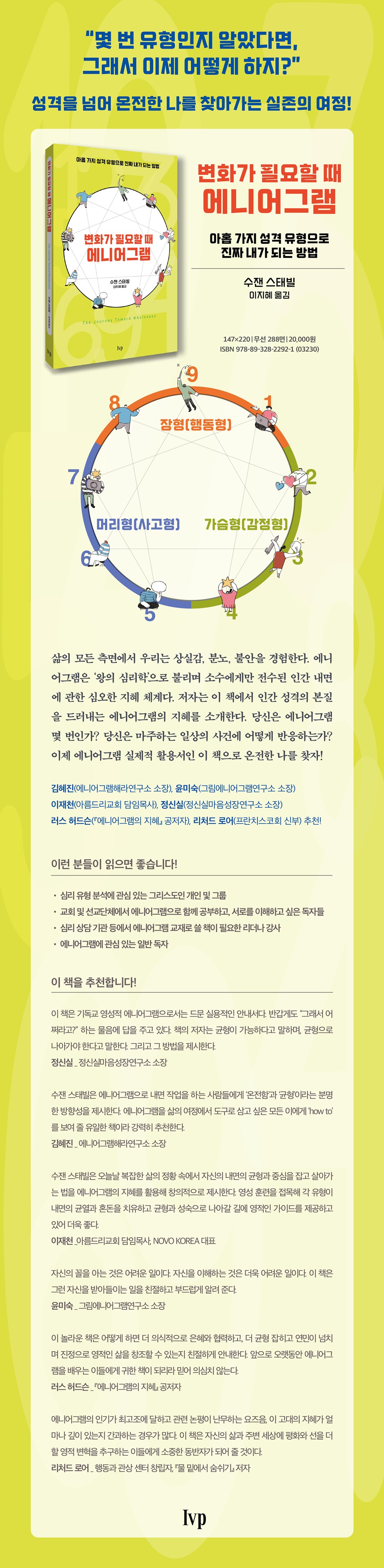
The Enneagram defines humans as nine numerical types: the head type, which perceives all information through thought; the heart type, which interprets everything through emotion; and the gut type, which acts and sees instinctively.
The Enneagram has been passed down to this day as the most useful tool for understanding the hidden nature of humans.
Enneagram expert Susan Stabile's book on using the Enneagram
Susan Stabile established herself as an expert Enneagram instructor under the guidance of Father Richard Lohr, a leading American spiritual leader and godfather of the Enneagram.
She has lectured and taught the Enneagram over 500 times at numerous universities and church organizations across the United States over the past 30 years.
In The Road Back To You and The Path Between Us, both published in 2016 and influential to countless readers, Suzanne Stabile explores the wisdom of the Enneagram to help people discover their true selves and how their Enneagram number impacts their relationships with others.
The author goes one step further here.
We've come to understand our true selves and others through the Enneagram, but what if our lives remain the same? What should we do next?
Spiritual practices that fulfill your yearning for wholeness and balance.
In stressful situations, people often tend to revert to old, familiar, and unhealthy ways.
The author examines how these uncertain situations affect our behavior and argues that the Enneagram can help us restore balance to our lives.
The author first explains in detail what the Enneagram is.
The Enneagram, which is divided into nine types, is analyzed by classifying it according to the three centers of the Enneagram: thinking, feeling, and behavior.
Next, we will show you through examples what behavior each number type exhibits in stressful situations.
Readers will find balance within their own centers (thoughts, emotions, and actions) and progress toward full growth by following the spiritual training guided by this book for each type.
What makes this book special is that, unlike existing introductory books on the Enneagram, it guides you to use the Enneagram in a deep and broad way.
Many people who have been trained in the Enneagram want to go beyond simply knowing their number type and see how it can positively change their lives.
While many Enneagram training and books have focused on revealing essential human tendencies and relationship dynamics, this book uses the wisdom of the Enneagram to offer spiritual training methods for each number type to endure stress in various life situations and actually make changes in their own lives.
So, it guides us to begin our journey of growing into a balanced and whole self.
This book is a practical guide to the use of the Enneagram, providing appropriate help to everyone from those who are curious about what the Enneagram is, to those who are new to the Enneagram and have some knowledge, to those who want to move towards deeper inner reflection. It helps you find your whole self and move towards mature relationships.
characteristic
ㆍProvides a deeper personality type analysis than MBTI.
ㆍIt goes beyond simple personality types and suggests a path toward balance and integration toward wholeness.
ㆍEach number type provides spiritual practices that can be utilized in stressful situations.
Main Readers
Christian individuals and groups interested in psychological type analysis
ㆍReaders who want to study the Enneagram together in churches and missionary organizations and understand each other
Leaders or instructors who need a book to use as an Enneagram textbook in psychological counseling centers, etc.
General readers interested in the Enneagram
The MBTI craze is strong.
Why? We want to understand and describe who we are and what our personalities are.
There is also a desire to define and understand the personality traits of those around me.
But Christians go one step further.
Why don't our beliefs and personalities align? That person, though capable, acts like that, even though he claims to be a Christian? As social beings, we live our lives reflecting on ourselves, hoping for the best from those around us, and then being disappointed.
Concerns about the contradictory behavior of human life have existed since ancient times.
This was no different for monks who were training in spirituality.
The monks of the monastery combined ancient wisdom, passed down orally for thousands of years, with spirituality to create a profound system of personality type analysis.
The Enneagram, which was born in this way, does not simply analyze the personality that is revealed on the outside, but focuses on looking deep into the inner self of a person and understanding each person's innate nature.
The Enneagram defines humans as nine numerical types: the head type, which perceives all information through thought; the heart type, which interprets everything through emotion; and the gut type, which acts and sees instinctively.
The Enneagram has been passed down to this day as the most useful tool for understanding the hidden nature of humans.
Enneagram expert Susan Stabile's book on using the Enneagram
Susan Stabile established herself as an expert Enneagram instructor under the guidance of Father Richard Lohr, a leading American spiritual leader and godfather of the Enneagram.
She has lectured and taught the Enneagram over 500 times at numerous universities and church organizations across the United States over the past 30 years.
In The Road Back To You and The Path Between Us, both published in 2016 and influential to countless readers, Suzanne Stabile explores the wisdom of the Enneagram to help people discover their true selves and how their Enneagram number impacts their relationships with others.
The author goes one step further here.
We've come to understand our true selves and others through the Enneagram, but what if our lives remain the same? What should we do next?
Spiritual practices that fulfill your yearning for wholeness and balance.
In stressful situations, people often tend to revert to old, familiar, and unhealthy ways.
The author examines how these uncertain situations affect our behavior and argues that the Enneagram can help us restore balance to our lives.
The author first explains in detail what the Enneagram is.
The Enneagram, which is divided into nine types, is analyzed by classifying it according to the three centers of the Enneagram: thinking, feeling, and behavior.
Next, we will show you through examples what behavior each number type exhibits in stressful situations.
Readers will find balance within their own centers (thoughts, emotions, and actions) and progress toward full growth by following the spiritual training guided by this book for each type.
What makes this book special is that, unlike existing introductory books on the Enneagram, it guides you to use the Enneagram in a deep and broad way.
Many people who have been trained in the Enneagram want to go beyond simply knowing their number type and see how it can positively change their lives.
While many Enneagram training and books have focused on revealing essential human tendencies and relationship dynamics, this book uses the wisdom of the Enneagram to offer spiritual training methods for each number type to endure stress in various life situations and actually make changes in their own lives.
So, it guides us to begin our journey of growing into a balanced and whole self.
This book is a practical guide to the use of the Enneagram, providing appropriate help to everyone from those who are curious about what the Enneagram is, to those who are new to the Enneagram and have some knowledge, to those who want to move towards deeper inner reflection. It helps you find your whole self and move towards mature relationships.
characteristic
ㆍProvides a deeper personality type analysis than MBTI.
ㆍIt goes beyond simple personality types and suggests a path toward balance and integration toward wholeness.
ㆍEach number type provides spiritual practices that can be utilized in stressful situations.
Main Readers
Christian individuals and groups interested in psychological type analysis
ㆍReaders who want to study the Enneagram together in churches and missionary organizations and understand each other
Leaders or instructors who need a book to use as an Enneagram textbook in psychological counseling centers, etc.
General readers interested in the Enneagram
GOODS SPECIFICS
- Date of issue: September 30, 2024
- Page count, weight, size: 288 pages | 147*220*20mm
- ISBN13: 9788932822921
- ISBN10: 8932822921
You may also like
카테고리
korean


korean

![ELLE 엘르 스페셜 에디션 A형 : 12월 [2025]](http://librairie.coreenne.fr/cdn/shop/files/b8e27a3de6c9538896439686c6b0e8fb.jpg?v=1766436872&width=3840)


