

Impressionism in One Volume
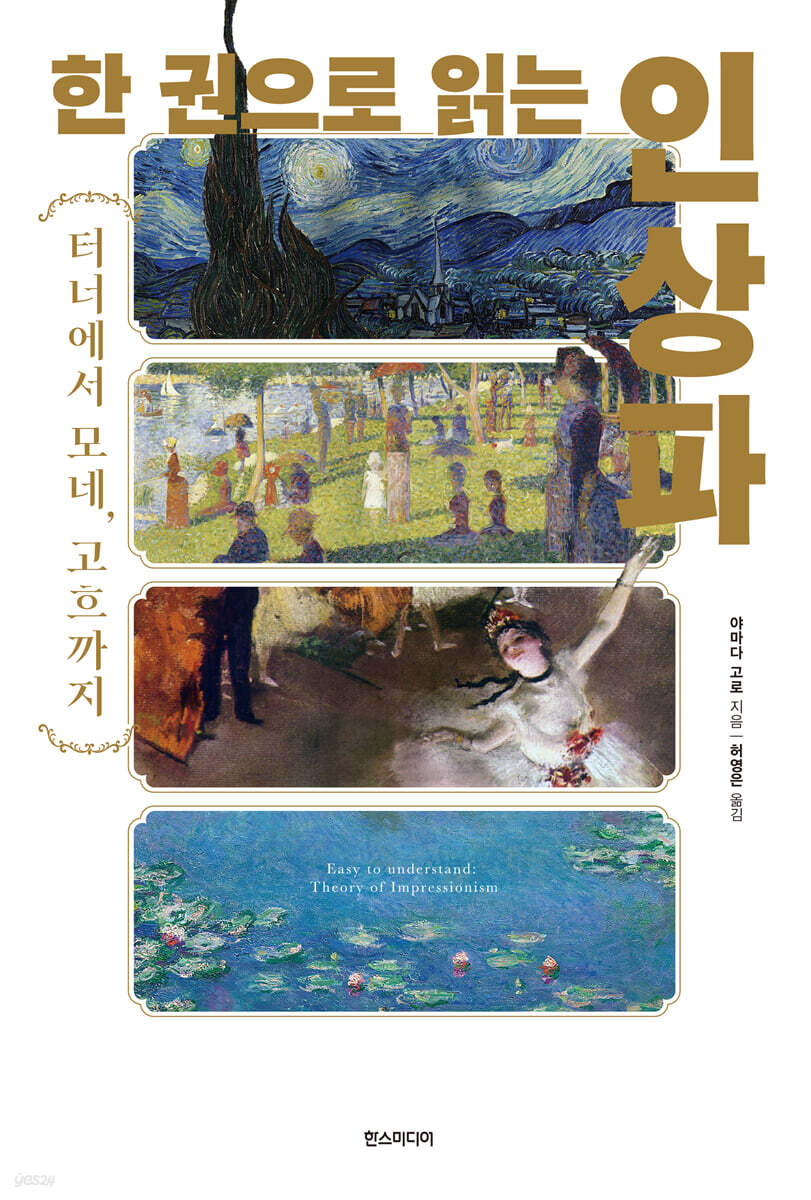 |
Description
Book Introduction
From the birth of Impressionism to its peak and the new wave of Post-Impressionism
Read the history of Impressionism in one volume!
This book contains a compilation of videos introducing Impressionism and its lineage of painters from the popular Japanese YouTube channel "Yamada Goro's Culture Course for Adults," which introduces the masters and masterpieces of Western painting.
Beginning with Turner, who pioneered Impressionism in England, through Millet, Courbet, Manet, and Boudin, who directly influenced French Impressionism, through Bazille, Monet, Renoir, Sisley, Pissarro, Degas, Cassatt, Morisot, and Caillebotte, who were at the core of Impressionism, and finally Seurat, who put an end to the Impressionist exhibitions, and finally Cézanne, Gauguin, and Van Gogh, who served as a bridge between Impressionism and 20th-century art, this book contains the paintings and lives of a total of 18 artists.
Through this book, you will be able to understand not only the art and lives of individual Impressionist painters, but also the role Impressionism played in the history of Western painting.
Read the history of Impressionism in one volume!
This book contains a compilation of videos introducing Impressionism and its lineage of painters from the popular Japanese YouTube channel "Yamada Goro's Culture Course for Adults," which introduces the masters and masterpieces of Western painting.
Beginning with Turner, who pioneered Impressionism in England, through Millet, Courbet, Manet, and Boudin, who directly influenced French Impressionism, through Bazille, Monet, Renoir, Sisley, Pissarro, Degas, Cassatt, Morisot, and Caillebotte, who were at the core of Impressionism, and finally Seurat, who put an end to the Impressionist exhibitions, and finally Cézanne, Gauguin, and Van Gogh, who served as a bridge between Impressionism and 20th-century art, this book contains the paintings and lives of a total of 18 artists.
Through this book, you will be able to understand not only the art and lives of individual Impressionist painters, but also the role Impressionism played in the history of Western painting.
- You can preview some of the book's contents.
Preview
index
Entering
Character relationship chart
Part 1: The Birth of Impressionism
Chapter 1: The Beatles of the Art World!? Turner, the Painter of Light and Color
Chapter 2: Millet, the Peasant Painter Who Had No Intention to Paint Peasants
Chapter 3: Courbet, the Big Brother Who Raised Impressionism, and the Spirit of the Emperor of the Fallen
Chapter 4: The Father of Impressionism, Manet's Anguish Surrounding His Wife and Son
Chapter 5: The Sea Wasn't the Only Thing Painted with Natural Light!? Budin, Prince of the Sky
Part 2: The Beginning and End of Impressionism
Chapter 6: Bazille, the Unsung Hero of the Birth of Impressionism
Chapter 7: Knowing the Truth Changes Your Impression!? Why Monet, the Big Daddy of Impressionism, Painted the "Water Lilies" Series
Chapter 8: Renoir Abandons the Brushstroke Technique, as It Was Not Suitable for Portraiture
Chapter 9: Sisley, who adhered to Impressionism throughout his life like flowing water
Chapter 10: The opening and closing of the Impressionist exhibition were all thanks to Pissarro's generosity.
Chapter 11: The Heretic of Impressionism: Degas's Secret Private Life
Chapter 12: Cassatt, who introduced Impressionism to America and supported Degas to the end
Chapter 13: Berthe Morisot, at the Center of Parisian Bourgeois Cultural Circles
Chapter 14: Caillebotte, the wealthy patron of the Impressionists both during and after their deaths
* Impressionist Exhibition - A total of 8 records
Part 3: The New Wave After Impressionism
Chapter 15: Seurat's Pointillism, Not a Fine-Tip Division
Chapter 16: Cézanne, who exploited his clumsy skills to become the "Father of Modern Painting"
Chapter 17: Gauguin's turbulent life, colored by colors ahead of its time
Chapter 18: Van Gogh's Paintings and Life, Distorted by Overflowing Emotions
Impressionism Chronology
Footnote index
Character relationship chart
Part 1: The Birth of Impressionism
Chapter 1: The Beatles of the Art World!? Turner, the Painter of Light and Color
Chapter 2: Millet, the Peasant Painter Who Had No Intention to Paint Peasants
Chapter 3: Courbet, the Big Brother Who Raised Impressionism, and the Spirit of the Emperor of the Fallen
Chapter 4: The Father of Impressionism, Manet's Anguish Surrounding His Wife and Son
Chapter 5: The Sea Wasn't the Only Thing Painted with Natural Light!? Budin, Prince of the Sky
Part 2: The Beginning and End of Impressionism
Chapter 6: Bazille, the Unsung Hero of the Birth of Impressionism
Chapter 7: Knowing the Truth Changes Your Impression!? Why Monet, the Big Daddy of Impressionism, Painted the "Water Lilies" Series
Chapter 8: Renoir Abandons the Brushstroke Technique, as It Was Not Suitable for Portraiture
Chapter 9: Sisley, who adhered to Impressionism throughout his life like flowing water
Chapter 10: The opening and closing of the Impressionist exhibition were all thanks to Pissarro's generosity.
Chapter 11: The Heretic of Impressionism: Degas's Secret Private Life
Chapter 12: Cassatt, who introduced Impressionism to America and supported Degas to the end
Chapter 13: Berthe Morisot, at the Center of Parisian Bourgeois Cultural Circles
Chapter 14: Caillebotte, the wealthy patron of the Impressionists both during and after their deaths
* Impressionist Exhibition - A total of 8 records
Part 3: The New Wave After Impressionism
Chapter 15: Seurat's Pointillism, Not a Fine-Tip Division
Chapter 16: Cézanne, who exploited his clumsy skills to become the "Father of Modern Painting"
Chapter 17: Gauguin's turbulent life, colored by colors ahead of its time
Chapter 18: Van Gogh's Paintings and Life, Distorted by Overflowing Emotions
Impressionism Chronology
Footnote index
Detailed image

Into the book
Goro: By this stage, Turner was drawing not only the form of the object, but also the impression it made on people.
The speed is fast, the locomotive is powerful, or it's raining and foggy.
It contained such an extremely abstract 'impression' and was no longer interested in accurately depicting the shape of a steam locomotive.
A: Does this mean that this work is 'Impressionist'?
Goro: That's right.
In that respect, Turner was ahead of the Impressionists.
---From "Chapter 1: The Beatles of the Art World!? Turner, the Painter of Light and Color"
Goro: Meanwhile, young people who admired Manet, such as Renoir, Bazille, and Sisley, who were Monet's studio friends, often gathered at a tavern called Café Guerbois in the Batignolles district where Manet's studio was located, and raised their voices saying, "The Salon judges don't know anything!"
They were called the Batignolles because they operated in the Batignolles district.
Ashi: A later Impressionist!
Goro: In short, as [The Luncheon on the Grass] became a hot topic, young artists gathered around Manet and came to be called the Batignolles, and from there the Impressionist movement was born.
---From "Chapter 4: The Father of Impressionism, Manet's Anguish Surrounding His Wife and Son"
Goro: Moreover, Louis Llorix understood well that what was important in Impressionism was a ‘painting that clearly expresses the feeling.’
The atmosphere of the frosty weather has been recreated properly, and the bustling crowds are also recognizable.
I realized that the key feature was to properly convey the feeling of lush shrubbery and the feeling of a sea shrouded in morning fog.
And even those who are called Impressionists admitted that this is the goal we are aiming for.
I was happy to be called an Impressionist because I pursued an art that expressed emotions that could not be captured in photographs.
I don't think Louis Leroy would have revealed his name if he had only been criticizing.
Anyway, the article he wrote contained this inside story.
---From "Chapter 7: Knowing the Truth Changes Your Impression!? Why Monet, the Big Daddy of Impressionism, Painted the [Water Lilies] Series"
Therefore: The Impressionists were people who painted under sunlight, so much so that they were called the 'plein air painters.'
I went outside the studio and pursued vivid expressions of natural light.
The landscape painting was also painted outdoors until the end.
Monet stubbornly pursued the changes in color according to outdoor light and season while painting the [Water Lilies] and [Haystacks] series.
What about Degas, on the other hand? Did he paint [Etoile] outside?
Ashi: No, I don't think so.
Goro: Of course, I drew it indoors.
Because ballet isn't performed outdoors.
If you look at the related book, it says that Degas suffered from a hereditary eye disease called 'glare disease', and in any case, it is said that he hated outside light because of his eye disease.
So, we pursued the effect of artificial lighting, which was new at the time, indoors.
---From "Chapter 11: The Heretic of Impressionism, Degas's Secret Private Life That Could Not Be Hidden"
So: Then one day, Cezanne finally realized.
'No matter how hard I try, I can't draw a picture that depicts nature realistically.
But I thought, 'If I can't draw the subject well, why don't I change the subject into a form that only I can draw well?'
Among Cezanne's famous sayings, there is one that says, 'Consider nature as a sphere, a cylinder, and a cone.' If you change 'sphere, cylinder, and cone' to a plane, it becomes 'circle, square, and triangle.'
'Let's transform the complex shapes of nature into the simplest form I can draw and reconstruct them.' That's what Cézanne thought.
---From Chapter 16, Cezanne, who took advantage of his poor skills to become the 'Father of Modern Painting'
Therefore: Since the Abbey of Saint-Rémy was a psychiatric hospital, I received appropriate treatment while painting, but my paintings became increasingly distorted.
The most famous one is the one on the next page.
Cypress trees sway, clouds swirl… It's truly chaotic, isn't it? The problem is that van Gogh himself didn't attempt this expression intentionally; he simply thought he was painting in a normal way.
Because he himself said, 'I can only draw what I see.'
I thought I was just drawing what I saw with my own eyes.
Ashi: That seems a bit strange….
Therefore: To put it the other way around, this is how the world looked to Van Gogh.
You may have had visual abnormalities but were not aware of them.
The speed is fast, the locomotive is powerful, or it's raining and foggy.
It contained such an extremely abstract 'impression' and was no longer interested in accurately depicting the shape of a steam locomotive.
A: Does this mean that this work is 'Impressionist'?
Goro: That's right.
In that respect, Turner was ahead of the Impressionists.
---From "Chapter 1: The Beatles of the Art World!? Turner, the Painter of Light and Color"
Goro: Meanwhile, young people who admired Manet, such as Renoir, Bazille, and Sisley, who were Monet's studio friends, often gathered at a tavern called Café Guerbois in the Batignolles district where Manet's studio was located, and raised their voices saying, "The Salon judges don't know anything!"
They were called the Batignolles because they operated in the Batignolles district.
Ashi: A later Impressionist!
Goro: In short, as [The Luncheon on the Grass] became a hot topic, young artists gathered around Manet and came to be called the Batignolles, and from there the Impressionist movement was born.
---From "Chapter 4: The Father of Impressionism, Manet's Anguish Surrounding His Wife and Son"
Goro: Moreover, Louis Llorix understood well that what was important in Impressionism was a ‘painting that clearly expresses the feeling.’
The atmosphere of the frosty weather has been recreated properly, and the bustling crowds are also recognizable.
I realized that the key feature was to properly convey the feeling of lush shrubbery and the feeling of a sea shrouded in morning fog.
And even those who are called Impressionists admitted that this is the goal we are aiming for.
I was happy to be called an Impressionist because I pursued an art that expressed emotions that could not be captured in photographs.
I don't think Louis Leroy would have revealed his name if he had only been criticizing.
Anyway, the article he wrote contained this inside story.
---From "Chapter 7: Knowing the Truth Changes Your Impression!? Why Monet, the Big Daddy of Impressionism, Painted the [Water Lilies] Series"
Therefore: The Impressionists were people who painted under sunlight, so much so that they were called the 'plein air painters.'
I went outside the studio and pursued vivid expressions of natural light.
The landscape painting was also painted outdoors until the end.
Monet stubbornly pursued the changes in color according to outdoor light and season while painting the [Water Lilies] and [Haystacks] series.
What about Degas, on the other hand? Did he paint [Etoile] outside?
Ashi: No, I don't think so.
Goro: Of course, I drew it indoors.
Because ballet isn't performed outdoors.
If you look at the related book, it says that Degas suffered from a hereditary eye disease called 'glare disease', and in any case, it is said that he hated outside light because of his eye disease.
So, we pursued the effect of artificial lighting, which was new at the time, indoors.
---From "Chapter 11: The Heretic of Impressionism, Degas's Secret Private Life That Could Not Be Hidden"
So: Then one day, Cezanne finally realized.
'No matter how hard I try, I can't draw a picture that depicts nature realistically.
But I thought, 'If I can't draw the subject well, why don't I change the subject into a form that only I can draw well?'
Among Cezanne's famous sayings, there is one that says, 'Consider nature as a sphere, a cylinder, and a cone.' If you change 'sphere, cylinder, and cone' to a plane, it becomes 'circle, square, and triangle.'
'Let's transform the complex shapes of nature into the simplest form I can draw and reconstruct them.' That's what Cézanne thought.
---From Chapter 16, Cezanne, who took advantage of his poor skills to become the 'Father of Modern Painting'
Therefore: Since the Abbey of Saint-Rémy was a psychiatric hospital, I received appropriate treatment while painting, but my paintings became increasingly distorted.
The most famous one is the one on the next page.
Cypress trees sway, clouds swirl… It's truly chaotic, isn't it? The problem is that van Gogh himself didn't attempt this expression intentionally; he simply thought he was painting in a normal way.
Because he himself said, 'I can only draw what I see.'
I thought I was just drawing what I saw with my own eyes.
Ashi: That seems a bit strange….
Therefore: To put it the other way around, this is how the world looked to Van Gogh.
You may have had visual abnormalities but were not aware of them.
---From "Chapter 18: Van Gogh's Paintings and Life Distorted by Overflowing Emotions"
Publisher's Review
Impressionist painters who brought about a modern revolution in Western painting
After the invention of photography, painters felt a sense of crisis that classical painting, which depicted nature identically using perspective and shading, could not compete with photography, and began to search for new forms of expression.
'Romanticism', which dramatically portrayed contemporary reality using brush strokes, and 'Realism', which realistically depicted the daily lives of workers and the bourgeoisie, went one step further and created 'Impressionism', which directly transferred the impressions felt rather than the visible scenes into paintings.
Impressionist painters inherited the realism of depicting reality as it was, but boldly shifted their direction to emphasize individual subjectivity over the universal objectivity that Western painting had emphasized.
They developed the technique of 'brush stroke division (color division)', which involves juxtaposing paints in block shapes without mixing them, to express the 'feeling', or subjective 'impression', experienced through the bright light and movement of light in nature.
This was a direct rejection of the smooth gradation technique that was traditionally used to express shading in Western painting.
They also adopted the flatness of Japanese art, which was popular at the time, and abandoned 'perspective,' another tradition of Western painting.
In this way, the Impressionists were painters who broke the tradition of Western painting that had continued for 400 years since the Renaissance, both in ideology and technique.
They liberated Western painting from the practice of simply imitating nature, and took a major step toward exploring the unique expression of painting that cannot be captured in photographs, thus opening the way for 20th-century art.
Dangerous, erotic, and the hidden stories of great painters revealed!
Part 1 introduces five painters who had a great influence on Impressionism, including Turner, the British national painter who painted Impressionist paintings 30 years before the Impressionists; the Barbizon School painters including Millet who began painting landscapes outdoors; the rebel Courbet who held his own exhibition against the Salon; Manet, the father of Impressionism whom the Impressionists admired and followed; and Boudin, who pioneered the use of brush strokes outdoors.
Part 2 introduces nine representative Impressionist painters who participated in eight Impressionist group exhibitions, including Bazille, the unsung hero of the birth of Impressionism who supported his colleagues who were struggling in poverty; Monet, the artist of the [Water Lilies] series that represents Impressionism; Renoir, who is considered one of the two greatest Impressionist masters along with Monet; Sisley, who is considered the most typical Impressionist painter; Pissarro, the oldest Impressionist who mediated between the opposing Monet and Degas groups; Degas, the heretic of Impressionism who pursued the effects of artificial lighting; Cassatt, who introduced Impressionism to the United States; Berthe Morisot, Monet's model who was at the center of the bourgeois cultural circle; and Caillebotte, who supported his Impressionist colleagues.
Part 3 introduces four post-Impressionist painters who opened up new trends and served as bridges between 20th-century painting for about 20 years after Impressionism: Seurat, who liberated painting from the imitation of nature with pointillism; Cézanne, the father of modern painting who recognized the essence of painting; Gauguin, who had a great influence on 20th-century painting with his actions ahead of his time; and Van Gogh, who had no choice but to paint distorted pictures due to his intense passion and anguish.
Each chapter contains commentary on the unique lives and representative works of these 18 painters, as well as the moving life stories of these artists who helped and influenced each other to create Impressionism.
A new type of art textbook, featuring over 500 paintings and materials, and a conversation-style text!
The world's easiest Impressionism lecture that you can understand right away while reading!
This book is a massive 488-page volume containing the works and lives of major Impressionist artists and various related materials.
Additionally, the interactive format of the book, with engaging questions and answers, helps anyone easily understand the characteristics of the works that represent Impressionism and the life of the artist.
It is designed to be a fun read, with a variety of diagrams that allow you to see the relationships between the artists at a glance, and annotations that provide detailed terminology and related information, allowing you to naturally acquire general knowledge while reading.
Currently, author Goro Yamada's YouTube channel has over 660,000 subscribers, and this book on Impressionism topped the Japanese Amazon art history bestseller list immediately after its publication.
After the invention of photography, painters felt a sense of crisis that classical painting, which depicted nature identically using perspective and shading, could not compete with photography, and began to search for new forms of expression.
'Romanticism', which dramatically portrayed contemporary reality using brush strokes, and 'Realism', which realistically depicted the daily lives of workers and the bourgeoisie, went one step further and created 'Impressionism', which directly transferred the impressions felt rather than the visible scenes into paintings.
Impressionist painters inherited the realism of depicting reality as it was, but boldly shifted their direction to emphasize individual subjectivity over the universal objectivity that Western painting had emphasized.
They developed the technique of 'brush stroke division (color division)', which involves juxtaposing paints in block shapes without mixing them, to express the 'feeling', or subjective 'impression', experienced through the bright light and movement of light in nature.
This was a direct rejection of the smooth gradation technique that was traditionally used to express shading in Western painting.
They also adopted the flatness of Japanese art, which was popular at the time, and abandoned 'perspective,' another tradition of Western painting.
In this way, the Impressionists were painters who broke the tradition of Western painting that had continued for 400 years since the Renaissance, both in ideology and technique.
They liberated Western painting from the practice of simply imitating nature, and took a major step toward exploring the unique expression of painting that cannot be captured in photographs, thus opening the way for 20th-century art.
Dangerous, erotic, and the hidden stories of great painters revealed!
Part 1 introduces five painters who had a great influence on Impressionism, including Turner, the British national painter who painted Impressionist paintings 30 years before the Impressionists; the Barbizon School painters including Millet who began painting landscapes outdoors; the rebel Courbet who held his own exhibition against the Salon; Manet, the father of Impressionism whom the Impressionists admired and followed; and Boudin, who pioneered the use of brush strokes outdoors.
Part 2 introduces nine representative Impressionist painters who participated in eight Impressionist group exhibitions, including Bazille, the unsung hero of the birth of Impressionism who supported his colleagues who were struggling in poverty; Monet, the artist of the [Water Lilies] series that represents Impressionism; Renoir, who is considered one of the two greatest Impressionist masters along with Monet; Sisley, who is considered the most typical Impressionist painter; Pissarro, the oldest Impressionist who mediated between the opposing Monet and Degas groups; Degas, the heretic of Impressionism who pursued the effects of artificial lighting; Cassatt, who introduced Impressionism to the United States; Berthe Morisot, Monet's model who was at the center of the bourgeois cultural circle; and Caillebotte, who supported his Impressionist colleagues.
Part 3 introduces four post-Impressionist painters who opened up new trends and served as bridges between 20th-century painting for about 20 years after Impressionism: Seurat, who liberated painting from the imitation of nature with pointillism; Cézanne, the father of modern painting who recognized the essence of painting; Gauguin, who had a great influence on 20th-century painting with his actions ahead of his time; and Van Gogh, who had no choice but to paint distorted pictures due to his intense passion and anguish.
Each chapter contains commentary on the unique lives and representative works of these 18 painters, as well as the moving life stories of these artists who helped and influenced each other to create Impressionism.
A new type of art textbook, featuring over 500 paintings and materials, and a conversation-style text!
The world's easiest Impressionism lecture that you can understand right away while reading!
This book is a massive 488-page volume containing the works and lives of major Impressionist artists and various related materials.
Additionally, the interactive format of the book, with engaging questions and answers, helps anyone easily understand the characteristics of the works that represent Impressionism and the life of the artist.
It is designed to be a fun read, with a variety of diagrams that allow you to see the relationships between the artists at a glance, and annotations that provide detailed terminology and related information, allowing you to naturally acquire general knowledge while reading.
Currently, author Goro Yamada's YouTube channel has over 660,000 subscribers, and this book on Impressionism topped the Japanese Amazon art history bestseller list immediately after its publication.
GOODS SPECIFICS
- Date of issue: March 11, 2025
- Page count, weight, size: 488 pages | 1,060g | 154*226*35mm
- ISBN13: 9791193712948
- ISBN10: 1193712947
You may also like
카테고리
korean


korean

![GQ KOREA Mark (Monthly): December [2025]](http://librairie.coreenne.fr/cdn/shop/files/8ef265dbbfbf186523ed75ba7319009d.jpg?v=1765340328&width=3840)


