

Study of Korean grammatical similarities
 |
Description
Book Introduction
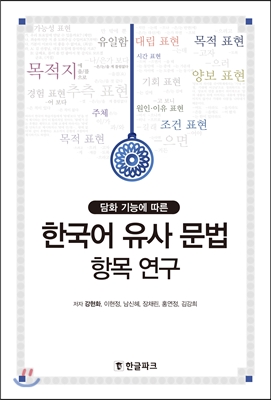
This book selects Korean grammar items through textbook and corpus analysis, groups them by discourse function, and organizes their commonalities and differences.
In addition, by inductively organizing the discourse functions used in actual Korean language textbooks, we were able to examine the discourse functions actually used, and we provided basic materials for effectively teaching the differences between grammar items with similar functions.
In addition, by presenting the proficiency levels and overlap between educational materials in actual Korean language education materials, we aimed to provide basic data on the proficiency levels and importance of individual grammar items to assist in teaching Korean.
In addition, by inductively organizing the discourse functions used in actual Korean language textbooks, we were able to examine the discourse functions actually used, and we provided basic materials for effectively teaching the differences between grammar items with similar functions.
In addition, by presenting the proficiency levels and overlap between educational materials in actual Korean language education materials, we aimed to provide basic data on the proficiency levels and importance of individual grammar items to assist in teaching Korean.
- You can preview some of the book's contents.
Preview
index
Part 1.
Chapter 1.
Issues in Research on Grammar Items for Korean Language Education
1.1 The Importance of Discourse-Approach Grammar Research
1.2 Grammar item selection and research method
Chapter 2.
Complexity of grammatical items
2.1 Issues in research by field
2.2 Complexity variables
Part 2.
Chapter 3.
inspection
3.1 Extreme
: until, even, even
3.2 Listing
: in, ini, is, is
3.3 Destination
: to, to, to
3.4 Originated from
: to, to, from, from
3.5 Similar
: together, like, as much
3.6 Doesn't matter
: either this or that, or even this
3.7 Uniqueness
: only, outside, only
3.8 Location
: in, in
3.9 Connection
: and/or, and, and
3.10 Subject
: This/that, this/that
3.10 lanes
: Ina, Inama, Even
Chapter 4.
Connective expression
4.1 Result Representation
: - is the result, - is the end, and is the remainder
4.2 Opportunity Expression
: -eun/neun kim-e, -neun gil
4.3 Contrasting Expressions
: -jiman, -deunde, -euna, -eun/neun on the other hand, -eun/neun instead, -neungga hamyeon, -eudo
4.4 Purpose Expression
: -to try, -to try, -to try, -to try, -to try, -to try
4.5 Time expression (order of precedence)
: -go, -goseo, -eoseo, -go then, -eun next, -eun after, -eun after
4.6 Time Expression (Simultaneity)
: -며, -으면, -을 때, -는 during, -는 among, -는 in the middle, -는 between, -는 in the middle, -는 at the same time
4.7 Expression of Concession
: -Eodo, -Eodo, -Euldo, -Eundeul, -Eumeundae, -Eobbae, -Eunhaha, -Eunhaha, -Eunhaha
4.8 Cause and Reason Expressions
: -어, -니까, -던, -그래서, -길래, -느러고, -이는만한, -기처, -는 불면, -는 불면, -은/는 의적, -어 할 수 있습니다
4.9 Conditional Expressions
:-if, -eoya, -geoyeon, -neun-myeon, -eoya-ji
4.10 Immediate Sequential Representation
: -Okay, -right away, -so scary, -as it is
4.10 Additional Expressions
:-은/는 더, -을 not only
Chapter 5.
Closing expression
5.1 Expressing Possibilities
: -has no choice, -is likely to happen, -is easy, -is worth it, -is likely, -is able to happen, -is possible, -is possible, -is not sure, -is difficult, -is not possible, -is unlikely, -is impossible
5.2 Expressing Experience
: -어 더 보기, -은 has/hasn't
5.3 Expression of Abilities
: -can/can't, -know/don't know
5.4 Natural expressions
: -은/는 law, -기/게 is bound to happen
5.5 Expression of notes and slogans
: -gi, -eum, -eul
5.6 Expression of objection and dissatisfaction
: -nyani (yo), -nyana (yo), -nya-kka-ni (yo), -nyamyeon-so (yo), -neunda-go (yo), -neunda-ni (yo), -nenda-nisa (yo), -neunda-nisa (yo), -neunda-ni (yo), -neunda-nisa (yo), -neunda-da (yo), -neunda-da, eurago (yo), -eura-ni (yo), -eura-myeon-so (yo), -eurae (yo), -sleep (yo), -jani (yo), -ja-nisa (yo), -ja-myeon-so (yo)
5.7 Expressing discovered facts
: -Yes, -yes, -yes
5.8 Burden Removal Expression
: -어 throw away, -어 clean up
5.9 State persistence expressions
: -어 더다, -어 있습니다, -어 있다, -고 있다
5.10 Expression of Achievement
: -go say, -eo say
5.11 Attribute Judgment Expression
: -eun/neun is on the side, -eun/neun is on the axis, -eun/neun has a feeling
5.12 Expression of Regret
: -go say, -eo throw away
5.13 Expressions to inform
: -geona(yo) , -geona(yo) , -deorago(yo) , -neundae(yo)
5.14 Expression of Intentions and Plans
: -geut- , -eulge(yo) , -eulrae(yo) , -euljido , -gojahada , -tend to , -geuldabo , -geuljihasang , -eulteda
5.15 Mandatory Expression
: -must be, -must be
5.16 Suggestions and Requests
: -Let's go, -Let's go, -Let's go, -Let's go, -Let's go, -Let's go, -Let's go
5.17 Progress expression
: -go is , -neun is in the middle
5.18 Speculative Expression
: -eun/neun/eul must be, -geu--eul will be, -eul will be (-eul will be, -eul will be, -eul will be), -eul will be (yo), -na/eunga seems, -na/eunga wants, -na/eunga has, -eun/neun/eul looks like, -eun/neun/eul seems like/seems like
5.19 Limited expression
: - is only , - follows
5.20 Haerache interrogative endings
: -ni, -nya
5.21 Expression of Hope
: -I want to, -I wish to, -I wish to do, -I wish to be
Proficiency Levels and Overlap in Appendix Korean Language Education Materials
Chapter 1.
Issues in Research on Grammar Items for Korean Language Education
1.1 The Importance of Discourse-Approach Grammar Research
1.2 Grammar item selection and research method
Chapter 2.
Complexity of grammatical items
2.1 Issues in research by field
2.2 Complexity variables
Part 2.
Chapter 3.
inspection
3.1 Extreme
: until, even, even
3.2 Listing
: in, ini, is, is
3.3 Destination
: to, to, to
3.4 Originated from
: to, to, from, from
3.5 Similar
: together, like, as much
3.6 Doesn't matter
: either this or that, or even this
3.7 Uniqueness
: only, outside, only
3.8 Location
: in, in
3.9 Connection
: and/or, and, and
3.10 Subject
: This/that, this/that
3.10 lanes
: Ina, Inama, Even
Chapter 4.
Connective expression
4.1 Result Representation
: - is the result, - is the end, and is the remainder
4.2 Opportunity Expression
: -eun/neun kim-e, -neun gil
4.3 Contrasting Expressions
: -jiman, -deunde, -euna, -eun/neun on the other hand, -eun/neun instead, -neungga hamyeon, -eudo
4.4 Purpose Expression
: -to try, -to try, -to try, -to try, -to try, -to try
4.5 Time expression (order of precedence)
: -go, -goseo, -eoseo, -go then, -eun next, -eun after, -eun after
4.6 Time Expression (Simultaneity)
: -며, -으면, -을 때, -는 during, -는 among, -는 in the middle, -는 between, -는 in the middle, -는 at the same time
4.7 Expression of Concession
: -Eodo, -Eodo, -Euldo, -Eundeul, -Eumeundae, -Eobbae, -Eunhaha, -Eunhaha, -Eunhaha
4.8 Cause and Reason Expressions
: -어, -니까, -던, -그래서, -길래, -느러고, -이는만한, -기처, -는 불면, -는 불면, -은/는 의적, -어 할 수 있습니다
4.9 Conditional Expressions
:-if, -eoya, -geoyeon, -neun-myeon, -eoya-ji
4.10 Immediate Sequential Representation
: -Okay, -right away, -so scary, -as it is
4.10 Additional Expressions
:-은/는 더, -을 not only
Chapter 5.
Closing expression
5.1 Expressing Possibilities
: -has no choice, -is likely to happen, -is easy, -is worth it, -is likely, -is able to happen, -is possible, -is possible, -is not sure, -is difficult, -is not possible, -is unlikely, -is impossible
5.2 Expressing Experience
: -어 더 보기, -은 has/hasn't
5.3 Expression of Abilities
: -can/can't, -know/don't know
5.4 Natural expressions
: -은/는 law, -기/게 is bound to happen
5.5 Expression of notes and slogans
: -gi, -eum, -eul
5.6 Expression of objection and dissatisfaction
: -nyani (yo), -nyana (yo), -nya-kka-ni (yo), -nyamyeon-so (yo), -neunda-go (yo), -neunda-ni (yo), -nenda-nisa (yo), -neunda-nisa (yo), -neunda-ni (yo), -neunda-nisa (yo), -neunda-da (yo), -neunda-da, eurago (yo), -eura-ni (yo), -eura-myeon-so (yo), -eurae (yo), -sleep (yo), -jani (yo), -ja-nisa (yo), -ja-myeon-so (yo)
5.7 Expressing discovered facts
: -Yes, -yes, -yes
5.8 Burden Removal Expression
: -어 throw away, -어 clean up
5.9 State persistence expressions
: -어 더다, -어 있습니다, -어 있다, -고 있다
5.10 Expression of Achievement
: -go say, -eo say
5.11 Attribute Judgment Expression
: -eun/neun is on the side, -eun/neun is on the axis, -eun/neun has a feeling
5.12 Expression of Regret
: -go say, -eo throw away
5.13 Expressions to inform
: -geona(yo) , -geona(yo) , -deorago(yo) , -neundae(yo)
5.14 Expression of Intentions and Plans
: -geut- , -eulge(yo) , -eulrae(yo) , -euljido , -gojahada , -tend to , -geuldabo , -geuljihasang , -eulteda
5.15 Mandatory Expression
: -must be, -must be
5.16 Suggestions and Requests
: -Let's go, -Let's go, -Let's go, -Let's go, -Let's go, -Let's go, -Let's go
5.17 Progress expression
: -go is , -neun is in the middle
5.18 Speculative Expression
: -eun/neun/eul must be, -geu--eul will be, -eul will be (-eul will be, -eul will be, -eul will be), -eul will be (yo), -na/eunga seems, -na/eunga wants, -na/eunga has, -eun/neun/eul looks like, -eun/neun/eul seems like/seems like
5.19 Limited expression
: - is only , - follows
5.20 Haerache interrogative endings
: -ni, -nya
5.21 Expression of Hope
: -I want to, -I wish to, -I wish to do, -I wish to be
Proficiency Levels and Overlap in Appendix Korean Language Education Materials
Publisher's Review
- Based on the duplication of titles in Korean language textbooks and related dictionaries, frequency of corpus, etc., the target grammar items were selected by dividing them into particles, connecting expressions, and concluding expressions, and then similar sentence structures were explained by organizing them by function.
- By explaining in detail the similarities and differences between similar grammar items, it can be used as basic material for effective teaching in the classroom.
- The differences between similar grammatical items were explained by dividing them into semantic differences, grammatical differences, and discourse differences.
- By explaining in detail the similarities and differences between similar grammar items, it can be used as basic material for effective teaching in the classroom.
- The differences between similar grammatical items were explained by dividing them into semantic differences, grammatical differences, and discourse differences.
GOODS SPECIFICS
- Date of issue: May 8, 2017
- Page count, weight, size: 416 pages | 627g | 152*225*30mm
- ISBN13: 9788955188813
- ISBN10: 8955188811
You may also like
카테고리
korean


korean

![GQ KOREA Mark (Monthly): December [2025]](http://librairie.coreenne.fr/cdn/shop/files/8ef265dbbfbf186523ed75ba7319009d.jpg?v=1765340328&width=3840)


