

At least but better
 |
Description
Book Introduction
A living legend in the design industry,
Experience Dieter Rams' work and voice firsthand!
Dieter Rams, the designer of designers, is called 'the designer's designer', 'the pioneer of minimalism', and 'the root of Apple design'.
His work and design philosophy have had a major influence worldwide.
Many designers still consider Dieter Rams a source of inspiration.
Dieter Rams' book, "Less but Better," in which he personally explains his work and design philosophy, has finally been translated and published.
In this book, he shows what 'at least but better' design is and how he implemented it through various works.
Let's also hear Dieter Rams' voice directly, including his thoughts on the definition and essence of design, its direction, and its future.
Experience Dieter Rams' work and voice firsthand!
Dieter Rams, the designer of designers, is called 'the designer's designer', 'the pioneer of minimalism', and 'the root of Apple design'.
His work and design philosophy have had a major influence worldwide.
Many designers still consider Dieter Rams a source of inspiration.
Dieter Rams' book, "Less but Better," in which he personally explains his work and design philosophy, has finally been translated and published.
In this book, he shows what 'at least but better' design is and how he implemented it through various works.
Let's also hear Dieter Rams' voice directly, including his thoughts on the definition and essence of design, its direction, and its future.
- You can preview some of the book's contents.
Preview
Into the book
Design is a mirror that embodies all cultures and social situations.
As such, the design discourse paradigm is always changing, and has continued to change since postmodernism.
In today's era of expanded globalization, the role of product usability and durability has become much greater than before.
On the one hand, this is because the world's resources are limited, and on the other hand, the number of people participating in the consumption process is constantly increasing.
For me, design is not a ploy to entice us to buy luxury goods, but rather a system that provides a sense of direction and attitude in a complex, chaotic, yet fascinating and open world.
The key is to seriously consider how to make this world a place where everyone can welcome a tomorrow worth living in.
--- p.5
According to Morse, Brown is defined by three principles: the principle of order, the principle of harmony, and the principle of economy.
This is an analysis that is absolutely accurate and still applies today.
However, one point that Richard Morse hinted at, but which I think is very important, is that the order, harmony and economy of Brown's designs were not ends in themselves, but were components of a completely new 'type of design'.
Moreover, these principles emerged as a result of a much deeper intention: to design functional and user-friendly products.
Whether it's a record player, a kitchen appliance, a slide projector, or a razor, a product with a disorganized, cluttered, confusing, or excessive design simply won't do its job.
The harmony of design, or aesthetics, also has a functional purpose of creating a desirable emotional relationship between the product and the user.
Following Richard Morse's writing, I would like to add a fourth 'principle' that has influenced Brown's designs: sustainability.
By focusing on the essential functional aspects, paying attention to order and harmony, and eliminating the superfluous and unnecessary, you will inevitably achieve an extremely concise product design.
These designs transcend all trends and highlight the essence.
So it's no coincidence that so many Braun appliances have been produced and sold for decades without any significant changes to their overall design.
--- p.29~31
The design of the Braun lighter was heavily influenced by the principle of 'less but better'.
The basic shapes were cylinders, flat rectangular solids, and cubes.
In creating the lighter, we attempted to design a personal item that was as simple as a small sculpture, yet had value in its sophistication and delicate finish.
A lighter should be something that feels good to hold, to light, to look at, and to put in your pocket.
Working on lighter designs has always been a pleasure for me.
The T 2 tabletop lighter, nicknamed 'Cylinder' because of its cylindrical shape, was the first lighter I designed for Braun.
The ignition device was a magnetic one, which was quite innovative at the time, and the press of a button generated the charge needed to start the flame.
Because the device required a certain amount of force to operate, the button was designed with a cutout on the side of the cylinder, and was specially large and placed in a position that was perfect for pressing with the entire thumb when holding the lighter.
--- p.58
The main task of Brown designers is the comprehensive design of a product, that is, designing the product itself and all its components.
Designers determine the basic shape, size and proportions of a product, the arrangement of operating elements, the design of the external structure, colors, and even the product graphics, including all the letters and symbols that go into the product.
All elements of the product, including packaging boxes, cassettes, accessories, and cleaning tools, are also designed by the design department.
Designers are equally deeply involved in the material selection process for their products, a factor that is increasingly important from an environmental perspective.
--- p.72
Simply put, while studying and working as an architect, I was exposed to design that fills the world in new ways.
Those things really impressed me and inspired me to create my own designs.
At the time, I was at a stage in my life where I was establishing my own ideas about what kind of environment I wanted to live in and how I wanted to live.
What values, then and even now, have I considered most important in the furniture systems I've designed? I think they are simplicity and restraint.
When you fill a system bookshelf with books, the bookshelf itself almost disappears from view.
I designed all my furniture based on the mindset I expressed in the somewhat contradictory statement, “Good design is minimal design.”
The goal of this restrained design is definitely not the uninspired bleakness that I and my like-minded fellow designers have been accused of mass-producing.
Our goal is freedom from the domination of 'things'.
The living environment I wanted to design and ultimately enjoy was a free space where anyone could customize it to suit themselves, a space that allowed movement and room for change.
Then and now, I find typical or overly domestic environments stifling and cumbersome.
There is something destructive about the sheer variety of things that surround us, the overwhelming variety.
I once said that my goal was to strip away all the clutter and let the essence stand out.
The resulting form is calm, pleasant, easy to understand, and long-lasting.
The long lifespan of the furniture I design is a compelling proof of this.
These shelves, tables and chairs transcend all age-old design styles with their simplicity, as they don't follow trends.
--- p.134~138
For me, the role of design is a question of ethical sphere.
Because good design is a virtue.
The better world we must build must be built with moral values in mind.
This approach is completely different from the widely held view that design is a form of light entertainment.
According to this universal opinion, everything, whether it be products, music, architecture, advertising, or TV programs, should be created to suit the tastes of the target consumers at that time.
As long as you like it, it's good.
It is a victory of the idea that 'anything is okay as long as it gets through.'
This is closer to a postmodern, cynical indifference toward the duty to pursue values.
Looking at it from this perspective explains a lot.
This also includes the contradiction of wanting to be different from others at all costs, while mocking the modernist aesthetics that developed based on functionality.
In my experience, things that are made different for the sake of being different are rarely better, but better things are almost always different.
As such, the design discourse paradigm is always changing, and has continued to change since postmodernism.
In today's era of expanded globalization, the role of product usability and durability has become much greater than before.
On the one hand, this is because the world's resources are limited, and on the other hand, the number of people participating in the consumption process is constantly increasing.
For me, design is not a ploy to entice us to buy luxury goods, but rather a system that provides a sense of direction and attitude in a complex, chaotic, yet fascinating and open world.
The key is to seriously consider how to make this world a place where everyone can welcome a tomorrow worth living in.
--- p.5
According to Morse, Brown is defined by three principles: the principle of order, the principle of harmony, and the principle of economy.
This is an analysis that is absolutely accurate and still applies today.
However, one point that Richard Morse hinted at, but which I think is very important, is that the order, harmony and economy of Brown's designs were not ends in themselves, but were components of a completely new 'type of design'.
Moreover, these principles emerged as a result of a much deeper intention: to design functional and user-friendly products.
Whether it's a record player, a kitchen appliance, a slide projector, or a razor, a product with a disorganized, cluttered, confusing, or excessive design simply won't do its job.
The harmony of design, or aesthetics, also has a functional purpose of creating a desirable emotional relationship between the product and the user.
Following Richard Morse's writing, I would like to add a fourth 'principle' that has influenced Brown's designs: sustainability.
By focusing on the essential functional aspects, paying attention to order and harmony, and eliminating the superfluous and unnecessary, you will inevitably achieve an extremely concise product design.
These designs transcend all trends and highlight the essence.
So it's no coincidence that so many Braun appliances have been produced and sold for decades without any significant changes to their overall design.
--- p.29~31
The design of the Braun lighter was heavily influenced by the principle of 'less but better'.
The basic shapes were cylinders, flat rectangular solids, and cubes.
In creating the lighter, we attempted to design a personal item that was as simple as a small sculpture, yet had value in its sophistication and delicate finish.
A lighter should be something that feels good to hold, to light, to look at, and to put in your pocket.
Working on lighter designs has always been a pleasure for me.
The T 2 tabletop lighter, nicknamed 'Cylinder' because of its cylindrical shape, was the first lighter I designed for Braun.
The ignition device was a magnetic one, which was quite innovative at the time, and the press of a button generated the charge needed to start the flame.
Because the device required a certain amount of force to operate, the button was designed with a cutout on the side of the cylinder, and was specially large and placed in a position that was perfect for pressing with the entire thumb when holding the lighter.
--- p.58
The main task of Brown designers is the comprehensive design of a product, that is, designing the product itself and all its components.
Designers determine the basic shape, size and proportions of a product, the arrangement of operating elements, the design of the external structure, colors, and even the product graphics, including all the letters and symbols that go into the product.
All elements of the product, including packaging boxes, cassettes, accessories, and cleaning tools, are also designed by the design department.
Designers are equally deeply involved in the material selection process for their products, a factor that is increasingly important from an environmental perspective.
--- p.72
Simply put, while studying and working as an architect, I was exposed to design that fills the world in new ways.
Those things really impressed me and inspired me to create my own designs.
At the time, I was at a stage in my life where I was establishing my own ideas about what kind of environment I wanted to live in and how I wanted to live.
What values, then and even now, have I considered most important in the furniture systems I've designed? I think they are simplicity and restraint.
When you fill a system bookshelf with books, the bookshelf itself almost disappears from view.
I designed all my furniture based on the mindset I expressed in the somewhat contradictory statement, “Good design is minimal design.”
The goal of this restrained design is definitely not the uninspired bleakness that I and my like-minded fellow designers have been accused of mass-producing.
Our goal is freedom from the domination of 'things'.
The living environment I wanted to design and ultimately enjoy was a free space where anyone could customize it to suit themselves, a space that allowed movement and room for change.
Then and now, I find typical or overly domestic environments stifling and cumbersome.
There is something destructive about the sheer variety of things that surround us, the overwhelming variety.
I once said that my goal was to strip away all the clutter and let the essence stand out.
The resulting form is calm, pleasant, easy to understand, and long-lasting.
The long lifespan of the furniture I design is a compelling proof of this.
These shelves, tables and chairs transcend all age-old design styles with their simplicity, as they don't follow trends.
--- p.134~138
For me, the role of design is a question of ethical sphere.
Because good design is a virtue.
The better world we must build must be built with moral values in mind.
This approach is completely different from the widely held view that design is a form of light entertainment.
According to this universal opinion, everything, whether it be products, music, architecture, advertising, or TV programs, should be created to suit the tastes of the target consumers at that time.
As long as you like it, it's good.
It is a victory of the idea that 'anything is okay as long as it gets through.'
This is closer to a postmodern, cynical indifference toward the duty to pursue values.
Looking at it from this perspective explains a lot.
This also includes the contradiction of wanting to be different from others at all costs, while mocking the modernist aesthetics that developed based on functionality.
In my experience, things that are made different for the sake of being different are rarely better, but better things are almost always different.
--- p.151
Publisher's Review
Dieter Rams on the Principles and Future of Design
“What is good design?”
Dieter Rams, the idol of Jonathan Ive, famous for Apple's simple design.
Perhaps that is why Apple's design is famously influenced by Dieter Rams.
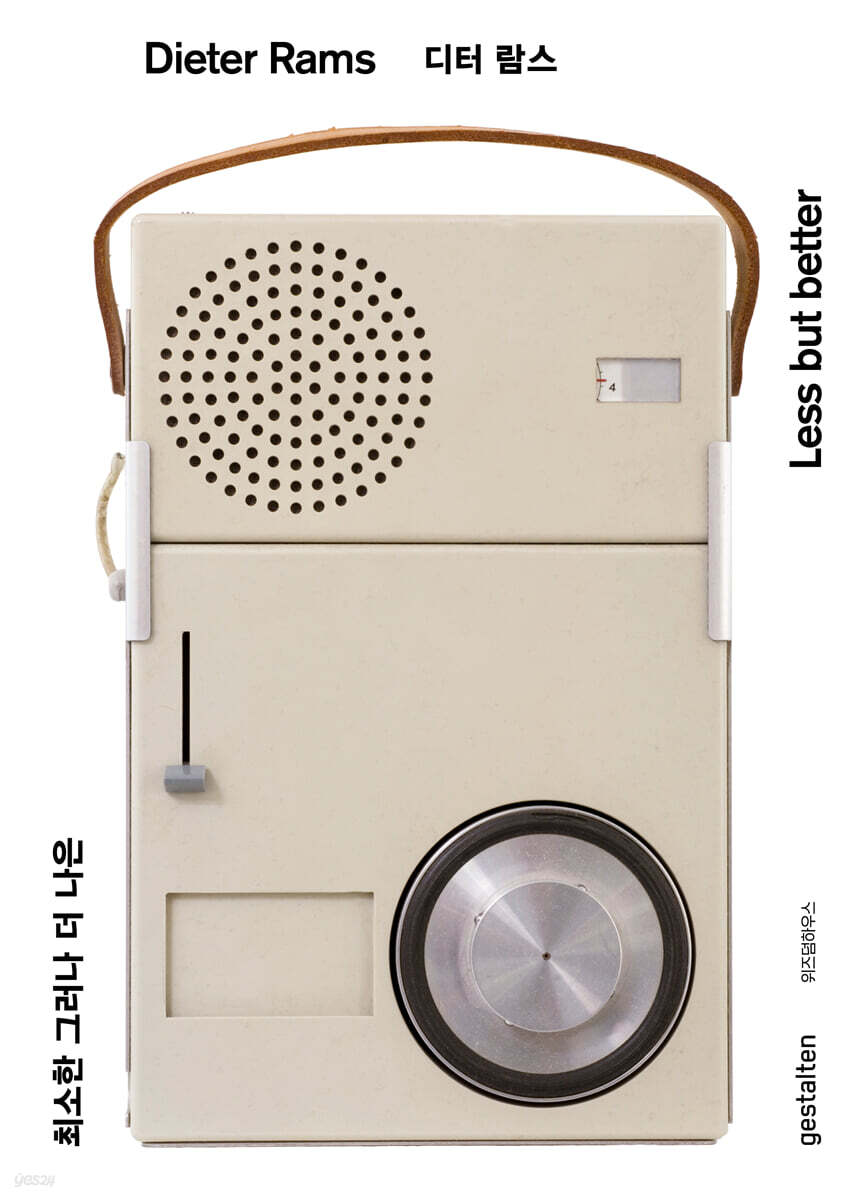
In particular, the first generation iPod released in 2001 is said to have been inspired by Braun's pocket radio T3 designed by Dieter Rams in 1958.
What kind of design philosophy did Dieter Rams have, and how did he design, that his design sensibility is still talked about even after 70 years?
To understand Dieter Rams' design, we must first look at the 'Ten Principles of Design'.
Good design is innovative.
Good design makes a product useful.
Good design is aesthetic.
Good design makes a product easy to understand.
Good design is not intrusive.
Good design is honest.
Good design lasts a long time.
Good design is thorough down to the smallest detail.
Good design is environmentally friendly.
Good design is minimal design.
'Good design', which encompasses these ten principles, is, as the title of this book suggests, 'at least but better' design.
Dieter Rams wanted to make our lives better through minimal design.
At the same time, Dieter Rams says that these principles cannot and should not become absolute laws.
“As culture and technology continue to advance, the concepts that constitute good design also continue to evolve.”
‘Good design’ is not just a concern for designers.
The word ‘design’ is so familiar to us that the saying “everything in life is design” is circulated.
In particular, as the consumer goods market grows and a variety of products are produced, the importance of design, especially product design, has grown.
The person who created the basics of product design in this trend was Dieter Rams.
“By focusing on essential functional aspects, paying attention to order and harmony, and eliminating the superfluous and unnecessary, you will inevitably achieve an extremely concise product design.
“This kind of design transcends all trends and highlights the essence.”
Dieter Rams' only book finally published in Korean!
Dieter Rams did not want this book to be considered a textbook.
Rather, he says, the book's goal is "to enrich current design discourse with valuable resources."
Because design is “a mirror that embodies all culture and social situations,” the paradigm of design and its results are always changing, and must change.
“For me, design is not a ploy to entice people to buy luxury goods, but rather a system that provides a sense of direction and attitude in a complex, chaotic, yet fascinating and open world.
The key is to seriously consider how to make this world a place where everyone can have a tomorrow worth living in.”
The original text of this book, first published in Germany in 1995 (the translation was in progress for the 9th edition published in 2021), is in 'German + English', but the Korean edition is in 'English + Korean' at the request of the German copyright holder.
This book is designed to be identical to the original book, without the back cover text, table of contents, or author introduction, in keeping with Dieter Rams' spirit of "at least but better."
However, the Korean version was produced in hardcover with the permission of the German copyright holder and the Dieter Rams Foundation so that it can be kept and read for a long time.
“What is good design?”
Dieter Rams, the idol of Jonathan Ive, famous for Apple's simple design.
Perhaps that is why Apple's design is famously influenced by Dieter Rams.
In particular, the first generation iPod released in 2001 is said to have been inspired by Braun's pocket radio T3 designed by Dieter Rams in 1958.
What kind of design philosophy did Dieter Rams have, and how did he design, that his design sensibility is still talked about even after 70 years?
To understand Dieter Rams' design, we must first look at the 'Ten Principles of Design'.
Good design is innovative.
Good design makes a product useful.
Good design is aesthetic.
Good design makes a product easy to understand.
Good design is not intrusive.
Good design is honest.
Good design lasts a long time.
Good design is thorough down to the smallest detail.
Good design is environmentally friendly.
Good design is minimal design.
'Good design', which encompasses these ten principles, is, as the title of this book suggests, 'at least but better' design.
Dieter Rams wanted to make our lives better through minimal design.
At the same time, Dieter Rams says that these principles cannot and should not become absolute laws.
“As culture and technology continue to advance, the concepts that constitute good design also continue to evolve.”
‘Good design’ is not just a concern for designers.
The word ‘design’ is so familiar to us that the saying “everything in life is design” is circulated.
In particular, as the consumer goods market grows and a variety of products are produced, the importance of design, especially product design, has grown.
The person who created the basics of product design in this trend was Dieter Rams.
“By focusing on essential functional aspects, paying attention to order and harmony, and eliminating the superfluous and unnecessary, you will inevitably achieve an extremely concise product design.
“This kind of design transcends all trends and highlights the essence.”
Dieter Rams' only book finally published in Korean!
Dieter Rams did not want this book to be considered a textbook.
Rather, he says, the book's goal is "to enrich current design discourse with valuable resources."
Because design is “a mirror that embodies all culture and social situations,” the paradigm of design and its results are always changing, and must change.
“For me, design is not a ploy to entice people to buy luxury goods, but rather a system that provides a sense of direction and attitude in a complex, chaotic, yet fascinating and open world.
The key is to seriously consider how to make this world a place where everyone can have a tomorrow worth living in.”
The original text of this book, first published in Germany in 1995 (the translation was in progress for the 9th edition published in 2021), is in 'German + English', but the Korean edition is in 'English + Korean' at the request of the German copyright holder.
This book is designed to be identical to the original book, without the back cover text, table of contents, or author introduction, in keeping with Dieter Rams' spirit of "at least but better."
However, the Korean version was produced in hardcover with the permission of the German copyright holder and the Dieter Rams Foundation so that it can be kept and read for a long time.
GOODS SPECIFICS
- Date of issue: January 24, 2024
- Format: Hardcover book binding method guide
- Page count, weight, size: 154 pages | 930g | 210*297*15mm
- ISBN13: 9791171710799
- ISBN10: 1171710798
You may also like
카테고리
korean


korean

![GQ KOREA Mark (Monthly): December [2025]](http://librairie.coreenne.fr/cdn/shop/files/8ef265dbbfbf186523ed75ba7319009d.jpg?v=1765340328&width=3840)


