

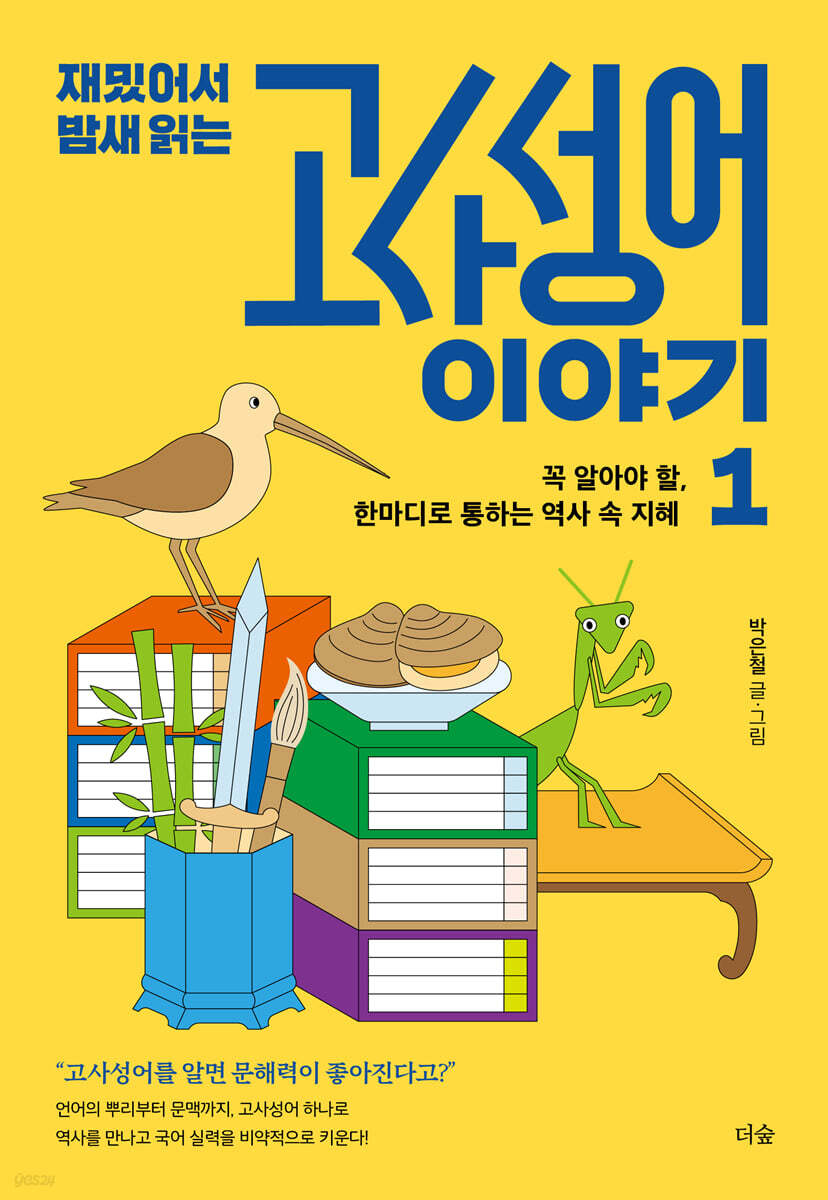
A fun story about Chinese idioms that will have you reading all night long.
 |
Description
Book Introduction
“Knowing idioms improves literacy?”
From the roots of language to its context, a single idiom
Meet history and improve your Korean language skills by leaps and bounds!
Idioms are a treasure trove for understanding history, learning wisdom, and gaining deep insight.
It covers a wide range of fields, including literature, history, and philosophy, and is particularly helpful for young people to develop vocabulary and the ability to quickly understand context.
The [Fun Night] series, which has delivered all the basic knowledge and information of the world through easy-to-understand descriptions and fun stories, meets readers this time with 『Fun Idiom Stories 1 and 2 that Will Keep You Reading All Night』.
This book introduces a total of 240 idioms over two volumes, and it is full of interesting and informative information, including the background and story of each idiom, in-depth knowledge and information, and related idioms that are good to learn together.
Through this, we do not simply have students memorize idioms, but clearly convey the meaning of idioms that they have been familiar with but not properly understood.
It guides readers into the colorful and vivid world of idioms by following the historical context of the idioms, such as the culture, customs, nature, and geography of the time, as well as the history contained in the idioms.
The addition of over 40 witty illustrations further enhances the reading experience.
The author of this book is a Chinese character teacher with 35 years of experience and a principal who also draws cartoons. All of the illustrations in the text were created with great care by the author himself.
To help modern readers understand idioms more quickly and easily, we have used humorous and sensuous illustrations to explain and express them.
In one book, you will encounter a world encompassing language, history, and wisdom.
From the roots of language to its context, a single idiom
Meet history and improve your Korean language skills by leaps and bounds!
Idioms are a treasure trove for understanding history, learning wisdom, and gaining deep insight.
It covers a wide range of fields, including literature, history, and philosophy, and is particularly helpful for young people to develop vocabulary and the ability to quickly understand context.
The [Fun Night] series, which has delivered all the basic knowledge and information of the world through easy-to-understand descriptions and fun stories, meets readers this time with 『Fun Idiom Stories 1 and 2 that Will Keep You Reading All Night』.
This book introduces a total of 240 idioms over two volumes, and it is full of interesting and informative information, including the background and story of each idiom, in-depth knowledge and information, and related idioms that are good to learn together.
Through this, we do not simply have students memorize idioms, but clearly convey the meaning of idioms that they have been familiar with but not properly understood.
It guides readers into the colorful and vivid world of idioms by following the historical context of the idioms, such as the culture, customs, nature, and geography of the time, as well as the history contained in the idioms.
The addition of over 40 witty illustrations further enhances the reading experience.
The author of this book is a Chinese character teacher with 35 years of experience and a principal who also draws cartoons. All of the illustrations in the text were created with great care by the author himself.
To help modern readers understand idioms more quickly and easily, we have used humorous and sensuous illustrations to explain and express them.
In one book, you will encounter a world encompassing language, history, and wisdom.
- You can preview some of the book's contents.
Preview
index
preface
Chapter 1: The Eyes That See Through People
1.
Finding a Jewel in a Rock_Hwasijibyeok
2.
The more the better_多多善
3.
A trivial talent put to valuable use_The chicken cries and the dog steals
4.
Focus on recruiting talent_Samgochoryeo
5.
The ability to recognize talent_Baekrakilgo
Chapter 2: Nature is a Treasure Trove of Enlightenment
6.
Recklessness or spirit_Dangranggeocheol 螳螂拒轍
7.
Experience cannot be ignored_The wisdom of the old horse
8.
The method may be different, but the essence is the same_Josammosa
9.
Useless Waiting_Baeknyeonhacheong
10.
Unfathomable sorrow_broken heart
11.
Opening the Door to Success Against the Current_Climbing the Dragon Gate
Chapter 3: A True Friend
12.
You can cut off a neck, but you can't cut off friendship_Mungyeongjigyo (刎頸之交)
13.
The value of one person who understands me_Baek A-jeol-hyeon
14.
Endless devotion to one person_Guanpo Zhijiao
15.
It couldn't get any better_The icing on the cake
16.
A friendship that can give everything_Liver and gallbladder mutual support
Chapter 4: Keeping Faith
17.
There is a blessing in showing mercy to the weak._Gyeolchoboeun
18.
Inflexible, old-fashioned belief_Misengjisin (尾生之信)
19.
Don't be fooled by sweet words_Gumilbokgum
20.
A match made in heaven_Wolha Bingin
Chapter 5 Into the War
21.
Being quick-witted isn't always a good thing_계렁鷄肋
22.
Enemies on all sides_Four-sided Chu Song
23.
Overcome the crisis with reverse thinking_Bae Su-jin's back-to-the-water strategy
24.
There is nothing to be rough about_Bamboo breaking momentum
Chapter 6: Speak in Parables
25.
Diplomacy that Moves Hearts: Preventing All-Out War_Fisherman's Geography
26.
Luck never comes twice_Sujudaeto
27.
The people are the foundation of the nation_50 steps, 100 steps
28.
The logic of illogicality_contradiction
29.
Riding on the strength of others_The fox borrows the might of the tiger
Chapter 7: The Path of Learning
30.
Wisdom to overcome poverty_Hyeongseoljigong螢雪之功
31.
Effort never betrays_Gwalmoksangdae
32.
The Truth that Unifies into One_Dagimangyang
33.
Why You Can't Stop Learning_The Blue Comes Out of the Blue
Chapter 8: A Consistent Mind
34.
Standards that vary depending on the situation_Yeodojijae
35.
A promise like life_Gyepoilnak (季布一諾)
36.
Posture for welcoming a distinguished guest_Topoakbal (吐哺握髮)
37.
When hearts connect_Yeomhwamiso拈華微笑
Chapter 9: Why the Environment Matters
38.
The environment that makes people_Namgyulbukji
39.
A mother's determination to save her child_Mencius's mother's decision
40.
How to Make People Believe a Lie_Three People Make a Tiger
Appendix_The more the better, the more Idioms You Want to Know
Chapter 1: The Eyes That See Through People
1.
Finding a Jewel in a Rock_Hwasijibyeok
2.
The more the better_多多善
3.
A trivial talent put to valuable use_The chicken cries and the dog steals
4.
Focus on recruiting talent_Samgochoryeo
5.
The ability to recognize talent_Baekrakilgo
Chapter 2: Nature is a Treasure Trove of Enlightenment
6.
Recklessness or spirit_Dangranggeocheol 螳螂拒轍
7.
Experience cannot be ignored_The wisdom of the old horse
8.
The method may be different, but the essence is the same_Josammosa
9.
Useless Waiting_Baeknyeonhacheong
10.
Unfathomable sorrow_broken heart
11.
Opening the Door to Success Against the Current_Climbing the Dragon Gate
Chapter 3: A True Friend
12.
You can cut off a neck, but you can't cut off friendship_Mungyeongjigyo (刎頸之交)
13.
The value of one person who understands me_Baek A-jeol-hyeon
14.
Endless devotion to one person_Guanpo Zhijiao
15.
It couldn't get any better_The icing on the cake
16.
A friendship that can give everything_Liver and gallbladder mutual support
Chapter 4: Keeping Faith
17.
There is a blessing in showing mercy to the weak._Gyeolchoboeun
18.
Inflexible, old-fashioned belief_Misengjisin (尾生之信)
19.
Don't be fooled by sweet words_Gumilbokgum
20.
A match made in heaven_Wolha Bingin
Chapter 5 Into the War
21.
Being quick-witted isn't always a good thing_계렁鷄肋
22.
Enemies on all sides_Four-sided Chu Song
23.
Overcome the crisis with reverse thinking_Bae Su-jin's back-to-the-water strategy
24.
There is nothing to be rough about_Bamboo breaking momentum
Chapter 6: Speak in Parables
25.
Diplomacy that Moves Hearts: Preventing All-Out War_Fisherman's Geography
26.
Luck never comes twice_Sujudaeto
27.
The people are the foundation of the nation_50 steps, 100 steps
28.
The logic of illogicality_contradiction
29.
Riding on the strength of others_The fox borrows the might of the tiger
Chapter 7: The Path of Learning
30.
Wisdom to overcome poverty_Hyeongseoljigong螢雪之功
31.
Effort never betrays_Gwalmoksangdae
32.
The Truth that Unifies into One_Dagimangyang
33.
Why You Can't Stop Learning_The Blue Comes Out of the Blue
Chapter 8: A Consistent Mind
34.
Standards that vary depending on the situation_Yeodojijae
35.
A promise like life_Gyepoilnak (季布一諾)
36.
Posture for welcoming a distinguished guest_Topoakbal (吐哺握髮)
37.
When hearts connect_Yeomhwamiso拈華微笑
Chapter 9: Why the Environment Matters
38.
The environment that makes people_Namgyulbukji
39.
A mother's determination to save her child_Mencius's mother's decision
40.
How to Make People Believe a Lie_Three People Make a Tiger
Appendix_The more the better, the more Idioms You Want to Know
Detailed image

Into the book
One day, Yu Bang held a banquet and invited Han Xin, and they talked about the character and abilities of his subordinate generals.
Yoo Bang slyly asked Han Shin, who was sharply analyzing the generals with unimpeded logic.
“How many soldiers do you think Jim can lead?”
Hanshin answered.
“I believe Your Majesty can command around 100,000 men.”
The breasts, who were offended by the words that it was only about 100,000, asked again.
“So how much can you lead?”
Then Hanshin answered.
“For me, the more [多] the better [多].
“The more soldiers you have, the better you can govern.”
When Yoobang heard this, he burst into laughter and asked,
“Really? Then why did you, someone so outstanding, become my captive?”
Hanshin said.
“Your Majesty, you cannot be a general of soldiers, but you can be a general of generals.
Moreover, Your Majesty is blessed by Heaven and is in a position that cannot be overcome by human power.
This is why I am captivated by Your Majesty.”
In this conversation between Yoo Bang and Han Shin, the phrase "the more the better" came out.
--- From "The more the better _ The more the better"
King Yeonggong had a subject named Mijaha.
He received special favor from the Duke of Yeong from an early age thanks to his boyish good looks.
One late night, someone came running to Mijaha and told her that her mother was in critical condition.
Mija, who was in a hurry, lied that it was the king's order and went home to see her mother in the king's carriage.
According to the Wei law at the time, anyone who rode the king's carriage without permission was subject to a monthly punishment of having their heels cut off.
However, when the king heard the report, he praised it greatly.
“Mijaha is truly a filial son.
“How great must one’s filial piety have been for one to forget that one’s own heel was cut off?”
One day, Mijaha was walking in the peach orchard with Yeonggong.
Every tree was ripe with delicious, thin-skinned, sweet peaches called “Sumildo” (水蜜桃).
Mijaha found a ripe peach, picked one, and took a bite.
Then, he said that the peach was very sweet and gave it to Yeonggong, who was eating the peach he had just finished eating.
Upon seeing this, the ministers pleaded with the Duke of Yeong to severely punish Mijaha for blasphemy.
But even then, Younggong praised him greatly, saying:
“Look at how much Mijaha cares about me.
“Why would he have forgotten that it was a peach in his mouth and told him to eat it?”
As time passed, Mijaha's appearance began to become more and more ordinary.
Then, the fiery favor of the king cooled down.
One day, Mijaha committed a minor mistake and stood before the air force.
But at this time, the crime that Younggong was accusing was the actions that Mijaha had done in the past.
“Mijaha was originally a troublesome guy.
He dared to steal my carriage and give me the dirty peaches he was eating.
How can this be forgiven?”
What was once highly praised when favored has now become an unforgivable sin.
The phrase "Yeodojijoe" (餘桃之罪) means "the sin of giving a leftover peach," and it means that even the same action can be judged differently depending on one's love or hate.
In addition to the lesson that we must always be careful about our conduct, it also means that we should examine our own standards when evaluating the words and actions of others.
--- From "Standards that change depending on the situation_Yeodojijoe"
Many people gathered to hear the sermons of Shakyamuni, including the ten disciples who were known for their outstanding practice and wisdom, including Mahakasyapa, Subhuti, Sariputra, Maudgalyayana, and Ananda.
However, Sakyamuni, who had ascended the throne, looked straight ahead in silence for a long time.
Then, instead of giving a sermon, he picked up a flower and showed it to the crowd.
People were at a loss as to what to do with Shakyamuni's unusual behavior and just looked at each other.
Just then, his disciple, Kasyapa, saw this and smiled broadly.
Shakyamuni saw Kasyapa's smile and said:
“The profound and profound world of the right Dharma and Nirvana that I have realized will open a formless and mysterious gateway.
That is, it will be transmitted in a form that goes beyond the sutras, not through words or letters, so I now entrust it to Kasyapa.”
Kasyapa received the essence of Buddhist philosophy directly from his teacher.
Yoo Bang slyly asked Han Shin, who was sharply analyzing the generals with unimpeded logic.
“How many soldiers do you think Jim can lead?”
Hanshin answered.
“I believe Your Majesty can command around 100,000 men.”
The breasts, who were offended by the words that it was only about 100,000, asked again.
“So how much can you lead?”
Then Hanshin answered.
“For me, the more [多] the better [多].
“The more soldiers you have, the better you can govern.”
When Yoobang heard this, he burst into laughter and asked,
“Really? Then why did you, someone so outstanding, become my captive?”
Hanshin said.
“Your Majesty, you cannot be a general of soldiers, but you can be a general of generals.
Moreover, Your Majesty is blessed by Heaven and is in a position that cannot be overcome by human power.
This is why I am captivated by Your Majesty.”
In this conversation between Yoo Bang and Han Shin, the phrase "the more the better" came out.
--- From "The more the better _ The more the better"
King Yeonggong had a subject named Mijaha.
He received special favor from the Duke of Yeong from an early age thanks to his boyish good looks.
One late night, someone came running to Mijaha and told her that her mother was in critical condition.
Mija, who was in a hurry, lied that it was the king's order and went home to see her mother in the king's carriage.
According to the Wei law at the time, anyone who rode the king's carriage without permission was subject to a monthly punishment of having their heels cut off.
However, when the king heard the report, he praised it greatly.
“Mijaha is truly a filial son.
“How great must one’s filial piety have been for one to forget that one’s own heel was cut off?”
One day, Mijaha was walking in the peach orchard with Yeonggong.
Every tree was ripe with delicious, thin-skinned, sweet peaches called “Sumildo” (水蜜桃).
Mijaha found a ripe peach, picked one, and took a bite.
Then, he said that the peach was very sweet and gave it to Yeonggong, who was eating the peach he had just finished eating.
Upon seeing this, the ministers pleaded with the Duke of Yeong to severely punish Mijaha for blasphemy.
But even then, Younggong praised him greatly, saying:
“Look at how much Mijaha cares about me.
“Why would he have forgotten that it was a peach in his mouth and told him to eat it?”
As time passed, Mijaha's appearance began to become more and more ordinary.
Then, the fiery favor of the king cooled down.
One day, Mijaha committed a minor mistake and stood before the air force.
But at this time, the crime that Younggong was accusing was the actions that Mijaha had done in the past.
“Mijaha was originally a troublesome guy.
He dared to steal my carriage and give me the dirty peaches he was eating.
How can this be forgiven?”
What was once highly praised when favored has now become an unforgivable sin.
The phrase "Yeodojijoe" (餘桃之罪) means "the sin of giving a leftover peach," and it means that even the same action can be judged differently depending on one's love or hate.
In addition to the lesson that we must always be careful about our conduct, it also means that we should examine our own standards when evaluating the words and actions of others.
--- From "Standards that change depending on the situation_Yeodojijoe"
Many people gathered to hear the sermons of Shakyamuni, including the ten disciples who were known for their outstanding practice and wisdom, including Mahakasyapa, Subhuti, Sariputra, Maudgalyayana, and Ananda.
However, Sakyamuni, who had ascended the throne, looked straight ahead in silence for a long time.
Then, instead of giving a sermon, he picked up a flower and showed it to the crowd.
People were at a loss as to what to do with Shakyamuni's unusual behavior and just looked at each other.
Just then, his disciple, Kasyapa, saw this and smiled broadly.
Shakyamuni saw Kasyapa's smile and said:
“The profound and profound world of the right Dharma and Nirvana that I have realized will open a formless and mysterious gateway.
That is, it will be transmitted in a form that goes beyond the sutras, not through words or letters, so I now entrust it to Kasyapa.”
Kasyapa received the essence of Buddhist philosophy directly from his teacher.
--- From "When Hearts Connect_Smile of Salt"
Publisher's Review
From recruiting talented people to the meaning of a true friend,
From the secret to victory to the path of scholarship in pursuit of truth
Learning history through idioms
Volume 1 contains insight into history, culture, human relationships, and life through idioms on a variety of topics, from the insight that sees through talent to the enlightenment learned from nature, the meaning of true friends and trust, and the importance of the environment and learning.
Idioms that convey the wisdom of recognizing and employing talented people are also interesting.
The story of Baekrak Ilgo (伯樂一顧), which originated from the story that when Baekrak looked back once, the price of horses suddenly jumped, tells us that no matter how precious a treasure is, its value is revealed only when there is someone to recognize it.
The famous story of Liu Bei visiting Zhuge Liang's thatched hut three times to recruit him reminds us of the importance of sincerity and effort in pursuing talent.
The phrase "Gyeomyeonggudo" (鷄鳴狗盜), which refers to a person who steals by imitating the sounds of a rooster crowing and a dog barking, contains a profound insight that even seemingly insignificant abilities can be put to good use.
You can also encounter the wisdom and enlightenment that nature gives.
Nomajiji (老馬之智), meaning "wisdom of an old horse," reminds us of the need to seek the wisdom of those with experience in times of crisis, while also showing that everyone has their own strengths and advantages.
The story of the mantis rejecting the crossbow, featuring the insect mantis, is read as a warning against recklessness that does not know one's place, but also as a symbol of the spirit of challenge and courage that overcomes one's limits.
In fact, the praying mantis (Dangrang) is the top predator in the insect world, hunting not only lizards and snakes, but also birds and mice, and boldly confronting creatures larger than itself.
Idioms that provide historical lessons and insight into human nature are also interesting.
The story of Gumilbokgeom (口蜜腹劍), which means ‘honey in the mouth and a sword in the stomach’, contains the story of Li Im-bo, a great traitor who ruined the Tang Dynasty.
Although he was outwardly kind and gentle, his inner self wielded power through conspiracy and trickery until the day he died, revealing the essence of hypocrisy and betrayal.
The phrase "baisujin" (背水陣), which means a desperate determination to not retreat until the end, originated from the story of Han Xin, a famous general of the Han Dynasty.
He achieved victory with an unconventional strategy of setting up camp with his back to the river.
His struggles, in which he had no choice but to fight harder because he had nowhere to retreat, make us realize how important desperation and determination are when we tackle any task.
Essential idioms, witty pictures,
Full of knowledge and stories that go one step deeper
An interesting journey of idioms
In addition to the core essential idioms, it provides a wealth of reading material through various structures such as “An Inch Deeper,” “Idioms within Idioms,” and “Chinese Idioms with Similar Meanings.”
"One Inch Deeper" goes beyond the background and origin of idioms and contains interesting knowledge and information across various fields.
For example, in the story of Han Xin and Liu Bang in Dadaikseon (多多益善), Liu Bang's strategy for recruiting talented people is examined, and in the story of Nomajiji (老馬之智), where the Gojuk Kingdom, famous for Bai Yi and Shuji, appears, it is mentioned that although Gojuk Kingdom is recorded as a vassal state of the Yin Dynasty in China, there is evidence through various historical materials and relics that Gojuk Kingdom was a vassal state of Gojoseon.
Also, in the book “Harsh Politics is More Fearsome Than a Tiger” (苛政猛於虎), the origin of the expression “harsh politics is more frightening than a tiger” is discussed, along with the meaning of compatibility and the extinction of tigers in our country.
In “Idioms in Idioms,” we introduce other idioms that appear in the origins of idioms.
For example, in the Song of Four Sides Chu, the phrase "taking the land and coming back" appears together, explaining that the two idioms originated from the same background.
In Daqi Wangyang (多岐亡羊), which means that the paths of learning are many and it is difficult to find the truth, the phrase "ilmobulbal (一毛不拔)", which means "not pulling out even a single hair for others," is also discussed, and it tells us about the extreme altruism and egoism of Mozi and Yang Zi.
This book goes beyond simply introducing idioms and proverbs, offering readers a wealth of learning and entertainment through the historical background, stories of the characters, and timeless wisdom and lessons contained within.
This book, which offers a new approach and depth to idioms, will be an interesting educational resource for both teenagers and adults.
From the secret to victory to the path of scholarship in pursuit of truth
Learning history through idioms
Volume 1 contains insight into history, culture, human relationships, and life through idioms on a variety of topics, from the insight that sees through talent to the enlightenment learned from nature, the meaning of true friends and trust, and the importance of the environment and learning.
Idioms that convey the wisdom of recognizing and employing talented people are also interesting.
The story of Baekrak Ilgo (伯樂一顧), which originated from the story that when Baekrak looked back once, the price of horses suddenly jumped, tells us that no matter how precious a treasure is, its value is revealed only when there is someone to recognize it.
The famous story of Liu Bei visiting Zhuge Liang's thatched hut three times to recruit him reminds us of the importance of sincerity and effort in pursuing talent.
The phrase "Gyeomyeonggudo" (鷄鳴狗盜), which refers to a person who steals by imitating the sounds of a rooster crowing and a dog barking, contains a profound insight that even seemingly insignificant abilities can be put to good use.
You can also encounter the wisdom and enlightenment that nature gives.
Nomajiji (老馬之智), meaning "wisdom of an old horse," reminds us of the need to seek the wisdom of those with experience in times of crisis, while also showing that everyone has their own strengths and advantages.
The story of the mantis rejecting the crossbow, featuring the insect mantis, is read as a warning against recklessness that does not know one's place, but also as a symbol of the spirit of challenge and courage that overcomes one's limits.
In fact, the praying mantis (Dangrang) is the top predator in the insect world, hunting not only lizards and snakes, but also birds and mice, and boldly confronting creatures larger than itself.
Idioms that provide historical lessons and insight into human nature are also interesting.
The story of Gumilbokgeom (口蜜腹劍), which means ‘honey in the mouth and a sword in the stomach’, contains the story of Li Im-bo, a great traitor who ruined the Tang Dynasty.
Although he was outwardly kind and gentle, his inner self wielded power through conspiracy and trickery until the day he died, revealing the essence of hypocrisy and betrayal.
The phrase "baisujin" (背水陣), which means a desperate determination to not retreat until the end, originated from the story of Han Xin, a famous general of the Han Dynasty.
He achieved victory with an unconventional strategy of setting up camp with his back to the river.
His struggles, in which he had no choice but to fight harder because he had nowhere to retreat, make us realize how important desperation and determination are when we tackle any task.
Essential idioms, witty pictures,
Full of knowledge and stories that go one step deeper
An interesting journey of idioms
In addition to the core essential idioms, it provides a wealth of reading material through various structures such as “An Inch Deeper,” “Idioms within Idioms,” and “Chinese Idioms with Similar Meanings.”
"One Inch Deeper" goes beyond the background and origin of idioms and contains interesting knowledge and information across various fields.
For example, in the story of Han Xin and Liu Bang in Dadaikseon (多多益善), Liu Bang's strategy for recruiting talented people is examined, and in the story of Nomajiji (老馬之智), where the Gojuk Kingdom, famous for Bai Yi and Shuji, appears, it is mentioned that although Gojuk Kingdom is recorded as a vassal state of the Yin Dynasty in China, there is evidence through various historical materials and relics that Gojuk Kingdom was a vassal state of Gojoseon.
Also, in the book “Harsh Politics is More Fearsome Than a Tiger” (苛政猛於虎), the origin of the expression “harsh politics is more frightening than a tiger” is discussed, along with the meaning of compatibility and the extinction of tigers in our country.
In “Idioms in Idioms,” we introduce other idioms that appear in the origins of idioms.
For example, in the Song of Four Sides Chu, the phrase "taking the land and coming back" appears together, explaining that the two idioms originated from the same background.
In Daqi Wangyang (多岐亡羊), which means that the paths of learning are many and it is difficult to find the truth, the phrase "ilmobulbal (一毛不拔)", which means "not pulling out even a single hair for others," is also discussed, and it tells us about the extreme altruism and egoism of Mozi and Yang Zi.
This book goes beyond simply introducing idioms and proverbs, offering readers a wealth of learning and entertainment through the historical background, stories of the characters, and timeless wisdom and lessons contained within.
This book, which offers a new approach and depth to idioms, will be an interesting educational resource for both teenagers and adults.
GOODS SPECIFICS
- Date of issue: December 15, 2024
- Page count, weight, size: 286 pages | 442g | 145*210*17mm
- ISBN13: 9791194273097
- ISBN10: 1194273092
You may also like
카테고리
korean


korean

![GQ KOREA Mark (Monthly): December [2025]](http://librairie.coreenne.fr/cdn/shop/files/8ef265dbbfbf186523ed75ba7319009d.jpg?v=1765340328&width=3840)


