

A fun spelling story that you'll read all night long
 |
Description
Book Introduction
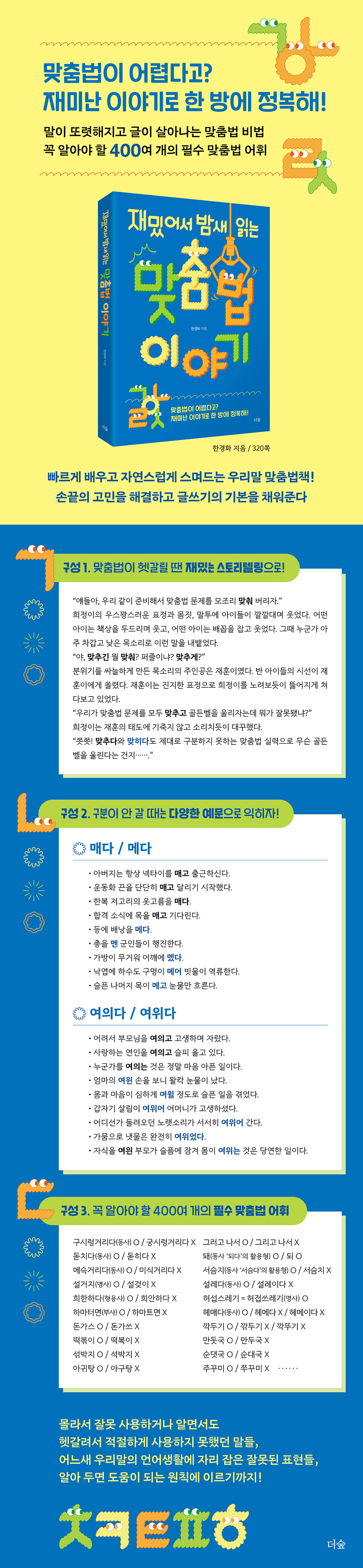
Spelling is difficult?
Conquer spelling in one go with a fun story!
Spelling tips that make your speech clearer and your writing come alive
400 essential spelling words you need to know!
In an age where communication is mediated by printed matter, proper spelling is an essential tool for preparing for important exams, crafting flawless reports and personal statements, and reflecting one's culture and social standing. It serves as the foundation for all writing.
Reflecting this importance, columns on spelling have been serialized in several newspapers for a long time, and a broadcast on Korean spelling has been a long-running program that has been airing for over 20 years and is loved.
However, even though it is a Korean word that we use every day, spelling is something that we always get confused about and make mistakes in.
The recently published 『Spelling Stories That Are Fun to Read All Night』 is not a book that simply points out spelling mistakes.
This is a 'fun to read' spelling book that improves vocabulary and makes it easy to learn correct spelling through rich and diverse stories and sentences.
The author is a Korean language teacher who has been deeply contemplating ways to teach Korean spelling to students who have difficulty with it in an easier and more fun way.
In this book, the author includes many examples and helpful explanations to help students learn, master, and memorize spelling in a more interesting and fun way.
It explains spelling through stories that are easy to understand, and the columns such as 'Why you should use punctuation marks', 'Why you should use spacing', 'Why you should use honorifics', and the easy and concise 'Explanations on parts of speech' that appear throughout the book faithfully cover many important topics covered in the Korean language curriculum.
Conquer spelling in one go with a fun story!
Spelling tips that make your speech clearer and your writing come alive
400 essential spelling words you need to know!
In an age where communication is mediated by printed matter, proper spelling is an essential tool for preparing for important exams, crafting flawless reports and personal statements, and reflecting one's culture and social standing. It serves as the foundation for all writing.
Reflecting this importance, columns on spelling have been serialized in several newspapers for a long time, and a broadcast on Korean spelling has been a long-running program that has been airing for over 20 years and is loved.
However, even though it is a Korean word that we use every day, spelling is something that we always get confused about and make mistakes in.
The recently published 『Spelling Stories That Are Fun to Read All Night』 is not a book that simply points out spelling mistakes.
This is a 'fun to read' spelling book that improves vocabulary and makes it easy to learn correct spelling through rich and diverse stories and sentences.
The author is a Korean language teacher who has been deeply contemplating ways to teach Korean spelling to students who have difficulty with it in an easier and more fun way.
In this book, the author includes many examples and helpful explanations to help students learn, master, and memorize spelling in a more interesting and fun way.
It explains spelling through stories that are easy to understand, and the columns such as 'Why you should use punctuation marks', 'Why you should use spacing', 'Why you should use honorifics', and the easy and concise 'Explanations on parts of speech' that appear throughout the book faithfully cover many important topics covered in the Korean language curriculum.
- You can preview some of the book's contents.
Preview
index
preface
Chapter 1: Confusing Spelling: Verbs and Adjectives
1 “You and I think differently”, “I’m right and you’re wrong”
How do you differentiate between earning and earning?
2 “I lost my parents at a young age”, “I became thin from sadness”
How do you tell the difference? Stop by, listen
3 “Intentionally increasing one’s age”, “Stretching a rubber band”
How do you tell the difference? Every, every
4 “To harm a person”, “To cut through the grass”
How do you distinguish between shining and reflecting?
5 “Pursuit of Happiness”, “Chasing Thieves”
How do you tell the difference? Pull, pull
6 “Solve the puzzle”, “Guess the answer”
How do you tell the difference? Ttida, Ttida
7 “Renew your passport”, “Renew your record”
How do you tell the difference? Veda, Baeda
8 “I’m running out of energy”, “I’m getting a free gift”
How do you differentiate between lose and forget?
9 “The dictionary is thick”, “The friendship is deep”
How do you tell the difference? Hazel, pale, pale
10 “The day we meet is not far away”, “The place we meet is not far away”
How do you differentiate between: to sew and to deepen, to pick up and to pick up?
11 “Always dressed in shabby clothes”, “Always dressed in shabby clothes”, “Always dressed in shabby clothes”
How do you tell the difference? Eerie · Eerie, Eerie · Eerie
12 “Knock, knock, the sound of water leaking”, “He has strong fists and is very energetic”
How do you tell the difference? It's absurd, it's nonsensical, it's ridiculous.
〔Column〕Why You Should Use Punctuation Marks
Chapter 2: Confusing Spelling: Nouns
1 “The sunlight is so bright”, “I like the warmth of the sunlight”
How do you tell the difference? Up, up-, up-
2 “Shiny pumpkin skin”, “Hard eggshell”
How do you tell the difference? How many days, how many days?
3 “Who lives in Namchon across the mountain?”, “Shall we go look for a rainbow across the mountain?”
How do you distinguish between preface and preface?
4 “A butterfly landed on a bud”, “A cloud landed on a peak”
How do you differentiate between thanks, fault, and due?
5 “Please don’t interfere at all”, “I’ve cut off all contact with my friends”
How do you tell the difference? -Exhaust, -Subtract
6 “The test was appropriately difficult”, “The test was difficult”
How do you tell the difference? Collision, rear-end collision
7 "The main character is making his first appearance in a drama", "I was surprised by the sudden appearance of a bear"
How do you differentiate between payment and settlement?
8 “Taste traditional Korean food”, “Taste authentic Korean food”
How do you distinguish between parts?
9 “Extend the period”, “Postpone the deadline”
How do you tell the difference? Grain, kernel
10 “The festival is in full swing”, “The festival is still a long way off”
How do you tell the difference? Single, single-body
How do you tell the difference? Back and ear, dottegi market and dotdegi market
〔Column〕Why You Should Space
Chapter 3: Confusing Spelling: Adverbs, Particles, and More
1 “I will definitely win”, “Sit up straight with your back straight”
How do you tell the difference? Early on, early on
2 “He closed his eyes tightly”, “He looks old”
How do you tell the difference? Why, why
3 “You’re late.
“What happened?”, “It’s too late, what should I do?”
How do you tell the difference? If possible, if possible
4 “Aren’t you going to do it?”, “Can’t you do it?”
How do you distinguish them? One by one, one by one
5 “Let’s go in a little later”, “Let’s stay outside and then go in”
How do you distinguish between them? Therefore, then
6 “Fulfill your duties as a student”, “Punish by law”
How do you differentiate between good and bad?
7 “Eat or not”, “How cold it is”
How do you tell the difference? Chae, Che
8 “A story handed down from ancient times”, “A story handed down from ancient times”
How do you differentiate between -dae and -de?
9 “I won’t eat it”, “I won’t eat it”
How do you tell the difference? - Jang-i, - Ja-gi
10 “He is a student”, “He is a singer”
How do you distinguish between the particle 'mangeul' and the dependent noun 'mangeul'?
〔Column〕Why You Should Use Honorifics
〔Appendix〕 Spellings that are always wrong and confusing
Chapter 1: Confusing Spelling: Verbs and Adjectives
1 “You and I think differently”, “I’m right and you’re wrong”
How do you differentiate between earning and earning?
2 “I lost my parents at a young age”, “I became thin from sadness”
How do you tell the difference? Stop by, listen
3 “Intentionally increasing one’s age”, “Stretching a rubber band”
How do you tell the difference? Every, every
4 “To harm a person”, “To cut through the grass”
How do you distinguish between shining and reflecting?
5 “Pursuit of Happiness”, “Chasing Thieves”
How do you tell the difference? Pull, pull
6 “Solve the puzzle”, “Guess the answer”
How do you tell the difference? Ttida, Ttida
7 “Renew your passport”, “Renew your record”
How do you tell the difference? Veda, Baeda
8 “I’m running out of energy”, “I’m getting a free gift”
How do you differentiate between lose and forget?
9 “The dictionary is thick”, “The friendship is deep”
How do you tell the difference? Hazel, pale, pale
10 “The day we meet is not far away”, “The place we meet is not far away”
How do you differentiate between: to sew and to deepen, to pick up and to pick up?
11 “Always dressed in shabby clothes”, “Always dressed in shabby clothes”, “Always dressed in shabby clothes”
How do you tell the difference? Eerie · Eerie, Eerie · Eerie
12 “Knock, knock, the sound of water leaking”, “He has strong fists and is very energetic”
How do you tell the difference? It's absurd, it's nonsensical, it's ridiculous.
〔Column〕Why You Should Use Punctuation Marks
Chapter 2: Confusing Spelling: Nouns
1 “The sunlight is so bright”, “I like the warmth of the sunlight”
How do you tell the difference? Up, up-, up-
2 “Shiny pumpkin skin”, “Hard eggshell”
How do you tell the difference? How many days, how many days?
3 “Who lives in Namchon across the mountain?”, “Shall we go look for a rainbow across the mountain?”
How do you distinguish between preface and preface?
4 “A butterfly landed on a bud”, “A cloud landed on a peak”
How do you differentiate between thanks, fault, and due?
5 “Please don’t interfere at all”, “I’ve cut off all contact with my friends”
How do you tell the difference? -Exhaust, -Subtract
6 “The test was appropriately difficult”, “The test was difficult”
How do you tell the difference? Collision, rear-end collision
7 "The main character is making his first appearance in a drama", "I was surprised by the sudden appearance of a bear"
How do you differentiate between payment and settlement?
8 “Taste traditional Korean food”, “Taste authentic Korean food”
How do you distinguish between parts?
9 “Extend the period”, “Postpone the deadline”
How do you tell the difference? Grain, kernel
10 “The festival is in full swing”, “The festival is still a long way off”
How do you tell the difference? Single, single-body
How do you tell the difference? Back and ear, dottegi market and dotdegi market
〔Column〕Why You Should Space
Chapter 3: Confusing Spelling: Adverbs, Particles, and More
1 “I will definitely win”, “Sit up straight with your back straight”
How do you tell the difference? Early on, early on
2 “He closed his eyes tightly”, “He looks old”
How do you tell the difference? Why, why
3 “You’re late.
“What happened?”, “It’s too late, what should I do?”
How do you tell the difference? If possible, if possible
4 “Aren’t you going to do it?”, “Can’t you do it?”
How do you distinguish them? One by one, one by one
5 “Let’s go in a little later”, “Let’s stay outside and then go in”
How do you distinguish between them? Therefore, then
6 “Fulfill your duties as a student”, “Punish by law”
How do you differentiate between good and bad?
7 “Eat or not”, “How cold it is”
How do you tell the difference? Chae, Che
8 “A story handed down from ancient times”, “A story handed down from ancient times”
How do you differentiate between -dae and -de?
9 “I won’t eat it”, “I won’t eat it”
How do you tell the difference? - Jang-i, - Ja-gi
10 “He is a student”, “He is a singer”
How do you distinguish between the particle 'mangeul' and the dependent noun 'mangeul'?
〔Column〕Why You Should Use Honorifics
〔Appendix〕 Spellings that are always wrong and confusing
Detailed image
Into the book
"'Yeotboro' is wrong? Then I've been teaching my children the wrong expressions all along!" Startled, Ms. Mija searched the internet for 'ye' and 'yeot' and related expressions.
There were some parts that were understandable, but there were also some parts that were difficult and not well understood, perhaps because they were related to grammar.
In particular, I had a hard time understanding why, instead of reading children's books, I would always say "from the old days" when telling them old stories that Ms. Mija knew, and instead of saying "from the old days", I would say "from the old days" instead.
Since I am used to it, the pronunciation of ‘from the old days’ is clear, but the pronunciation of ‘from the old days’ is boring and even feels awkward.
How can we solve Ms. Mija's worries?
--- From “Stories Handed Down from the Past”, “Stories Handed Down from the Past”
Her mother, a middle school math teacher, listened to Joo-hye's complaints and asked to see her math test paper.
Mom carefully looked over the math test paper that Joo-hye took out of her bag and then said.
“Joo-hye, this math test is evenly divided into ‘difficulty levels’ so there shouldn’t be any problems.”
“Please look at questions 3, 7, 10, and 17.
If you give us such a 'high difficulty' problem, how do we solve it?
yes?"
When Joo-hye heard her mother's words, she was so shocked that she started screaming, but her mother calmly explained to her like this.
“Well, what Joo-hye said about problems 3, 7, 10, and 17 are ‘high-difficulty’ problems with a higher ‘difficulty’ level than the other problems, right?”
“What is difficulty and what does high difficulty mean?
“I told you it was a difficult problem.”
“Oh my, I should explain to our Joohye the difficulty level, the level of difficulty, and the level of difficulty!”
--- Among “It was a test with an appropriate level of difficulty” and “It was a test with a high level of difficulty”
“Sister~ It’s a flower bud.”
"Where? Are we already at the top of the mountain?"
Startled by the word 'peak', I looked around and saw Mina.
Mina was running down, holding a flower bud that had just started to bloom in her right hand.
Mijin said to Mina.
“I… thought I was already at the top of the mountain.”
“Sister, we haven’t even been here that long and we’re already at the top of a mountain?”
At that time, my mother, who was listening to my brother and I's conversation, smiled and said.
“Our Mijin and Mina need to study spelling.
“You can’t tell the difference between a ‘bud’ and a ‘peak.’”
--- From “A butterfly landed on a bud”, “A cloud landed on a peak”
There is a phrase that we often hear in our daily lives, such as, 'Teacher, the third-year senior will be here later.'
This is an expression of respect used to address a senior in front of a teacher.
When I hear things like this at school sometimes, I feel dumbfounded, but I also feel guilty that I failed to teach my students proper politeness and honorifics.
In this sentence, the subject who said he would come later, that is, the senior, is older than the person who said this, but the person who heard it, that is, the teacher, is older than the senior, so it is an incorrect expression.
At this time, the correct expression would be, 'Teacher, the third-year senior is said to be coming later.'
Honorifics don't just elevate your speech; they help you develop a higher level of linguistic sensibility.
If you use honorifics incorrectly, it can not only be awkward, but can also seem rude, so let's use them correctly.
And whether you use formal or informal speech, you must use 'warm words' such as respect and consideration.
There were some parts that were understandable, but there were also some parts that were difficult and not well understood, perhaps because they were related to grammar.
In particular, I had a hard time understanding why, instead of reading children's books, I would always say "from the old days" when telling them old stories that Ms. Mija knew, and instead of saying "from the old days", I would say "from the old days" instead.
Since I am used to it, the pronunciation of ‘from the old days’ is clear, but the pronunciation of ‘from the old days’ is boring and even feels awkward.
How can we solve Ms. Mija's worries?
--- From “Stories Handed Down from the Past”, “Stories Handed Down from the Past”
Her mother, a middle school math teacher, listened to Joo-hye's complaints and asked to see her math test paper.
Mom carefully looked over the math test paper that Joo-hye took out of her bag and then said.
“Joo-hye, this math test is evenly divided into ‘difficulty levels’ so there shouldn’t be any problems.”
“Please look at questions 3, 7, 10, and 17.
If you give us such a 'high difficulty' problem, how do we solve it?
yes?"
When Joo-hye heard her mother's words, she was so shocked that she started screaming, but her mother calmly explained to her like this.
“Well, what Joo-hye said about problems 3, 7, 10, and 17 are ‘high-difficulty’ problems with a higher ‘difficulty’ level than the other problems, right?”
“What is difficulty and what does high difficulty mean?
“I told you it was a difficult problem.”
“Oh my, I should explain to our Joohye the difficulty level, the level of difficulty, and the level of difficulty!”
--- Among “It was a test with an appropriate level of difficulty” and “It was a test with a high level of difficulty”
“Sister~ It’s a flower bud.”
"Where? Are we already at the top of the mountain?"
Startled by the word 'peak', I looked around and saw Mina.
Mina was running down, holding a flower bud that had just started to bloom in her right hand.
Mijin said to Mina.
“I… thought I was already at the top of the mountain.”
“Sister, we haven’t even been here that long and we’re already at the top of a mountain?”
At that time, my mother, who was listening to my brother and I's conversation, smiled and said.
“Our Mijin and Mina need to study spelling.
“You can’t tell the difference between a ‘bud’ and a ‘peak.’”
--- From “A butterfly landed on a bud”, “A cloud landed on a peak”
There is a phrase that we often hear in our daily lives, such as, 'Teacher, the third-year senior will be here later.'
This is an expression of respect used to address a senior in front of a teacher.
When I hear things like this at school sometimes, I feel dumbfounded, but I also feel guilty that I failed to teach my students proper politeness and honorifics.
In this sentence, the subject who said he would come later, that is, the senior, is older than the person who said this, but the person who heard it, that is, the teacher, is older than the senior, so it is an incorrect expression.
At this time, the correct expression would be, 'Teacher, the third-year senior is said to be coming later.'
Honorifics don't just elevate your speech; they help you develop a higher level of linguistic sensibility.
If you use honorifics incorrectly, it can not only be awkward, but can also seem rude, so let's use them correctly.
And whether you use formal or informal speech, you must use 'warm words' such as respect and consideration.
--- From "Reasons for Using Honorifics"
Publisher's Review
When you're confused about spelling, try fun storytelling instead of a dictionary!
Korean spelling that you can learn quickly and naturally
The author has met countless students who, when taking tests, either did not understand the meaning of words or could not find the answer because they did not grasp the given content, and he says that it is difficult to teach all the spelling rules of the Korean language through school classes alone.
So in this book, the author doesn't simply tell you to memorize this large vocabulary.
Various stories and examples help us to naturally incorporate correct spelling into our spoken and written speech.
In the section 〈Chapter 1 Verbs and Adjectives〉, many verbs and adjectives that are confusing and difficult to distinguish are mentioned, but the most representative ones are yeo-i-da/yeo-wi-da, deul-reuda/deul-ri-da, dallya/mis-da, chasing/chasing, absurd/abominable, etc.
In the case of 'Yeouida/Yeouida', it is common to write it incorrectly because the shape of the letters is different by just one dot.
However, the author continuously introduces 'Yeouida/Yeouida' in the story so that the difference between the two words can be naturally learned and distinguished.
'들르다', which means to stop by for a moment while passing by, and '들리다', which means to perceive a sound through the sensory organs of a person or animal, are words that are often misspelled to the point that if you can use them accurately, you can be somewhat confident in your spelling.
The chapters covering these two words present several sentences to help students understand the differences, and further explain the conjugations and basic parts of speech, thereby covering the core content of the curriculum.
There are just as many people who use 'different/wrong' incorrectly as there are who use it correctly.
In the story, we come to realize the clear difference between the two words, and that they are different not only in meaning but also in part of speech.
Representative examples include '벌이다/벌리다', which are often used as if they were the same word without distinguishing them because their pronunciations are similar; '참다/참다', which are often mistaken for words with the same meaning and are more emphasized; and '어의없는/어이없는', which are often used as the correct expression because of the assumption that the meaning will be used.
In addition, in the section titled “Chapter 2 Nouns,” there are many nouns that require careful pronunciation and spelling, such as “appearance/appearance,” “payment/settlement,” “collision/crash,” and “in the meantime/in the meantime.”
In the section titled “Chapter 3 Adverbs, Particles, etc.”, there are many words that many people use incorrectly and get confused about, such as ‘early/early,’ ‘whan/wen,’ ‘chae/che,’ ‘jangi/jaengi,’ and ‘ieo/ieo.’
Spelling is an important foundation of Korean language knowledge.
It's the beginning of sophisticated self-expression.
Now let's finish it with this one volume!
Among students of the digital native generation, spelling is increasingly being neglected or struggles with spelling due to a lack of vocabulary.
This trend goes beyond simple learning problems and has serious implications for important assessment situations such as exams.
This problem is not limited to teenagers.
Adults also often experience confusion in communication or difficulty expressing their thoughts accurately due to poor spelling and spacing.
Incorrect spelling not only reduces the quality of your writing, it can also lead to a loss of trust and unnecessary misunderstandings.
Mastering correct spelling not only greatly aids learning processes like writing, but also plays a crucial role in improving test performance and effectively expressing yourself in various social situations, such as interpersonal relationships and the workplace.
This book goes beyond viewing spelling as a mere set of rules, and guides you through its practical application in daily life and learning.
With over 400 essential spelling words you need to know, this book highlights how spelling can be a powerful tool for expressing yourself and connecting with the world, helping readers develop richer and more accurate language skills.
Korean spelling that you can learn quickly and naturally
The author has met countless students who, when taking tests, either did not understand the meaning of words or could not find the answer because they did not grasp the given content, and he says that it is difficult to teach all the spelling rules of the Korean language through school classes alone.
So in this book, the author doesn't simply tell you to memorize this large vocabulary.
Various stories and examples help us to naturally incorporate correct spelling into our spoken and written speech.
In the section 〈Chapter 1 Verbs and Adjectives〉, many verbs and adjectives that are confusing and difficult to distinguish are mentioned, but the most representative ones are yeo-i-da/yeo-wi-da, deul-reuda/deul-ri-da, dallya/mis-da, chasing/chasing, absurd/abominable, etc.
In the case of 'Yeouida/Yeouida', it is common to write it incorrectly because the shape of the letters is different by just one dot.
However, the author continuously introduces 'Yeouida/Yeouida' in the story so that the difference between the two words can be naturally learned and distinguished.
'들르다', which means to stop by for a moment while passing by, and '들리다', which means to perceive a sound through the sensory organs of a person or animal, are words that are often misspelled to the point that if you can use them accurately, you can be somewhat confident in your spelling.
The chapters covering these two words present several sentences to help students understand the differences, and further explain the conjugations and basic parts of speech, thereby covering the core content of the curriculum.
There are just as many people who use 'different/wrong' incorrectly as there are who use it correctly.
In the story, we come to realize the clear difference between the two words, and that they are different not only in meaning but also in part of speech.
Representative examples include '벌이다/벌리다', which are often used as if they were the same word without distinguishing them because their pronunciations are similar; '참다/참다', which are often mistaken for words with the same meaning and are more emphasized; and '어의없는/어이없는', which are often used as the correct expression because of the assumption that the meaning will be used.
In addition, in the section titled “Chapter 2 Nouns,” there are many nouns that require careful pronunciation and spelling, such as “appearance/appearance,” “payment/settlement,” “collision/crash,” and “in the meantime/in the meantime.”
In the section titled “Chapter 3 Adverbs, Particles, etc.”, there are many words that many people use incorrectly and get confused about, such as ‘early/early,’ ‘whan/wen,’ ‘chae/che,’ ‘jangi/jaengi,’ and ‘ieo/ieo.’
Spelling is an important foundation of Korean language knowledge.
It's the beginning of sophisticated self-expression.
Now let's finish it with this one volume!
Among students of the digital native generation, spelling is increasingly being neglected or struggles with spelling due to a lack of vocabulary.
This trend goes beyond simple learning problems and has serious implications for important assessment situations such as exams.
This problem is not limited to teenagers.
Adults also often experience confusion in communication or difficulty expressing their thoughts accurately due to poor spelling and spacing.
Incorrect spelling not only reduces the quality of your writing, it can also lead to a loss of trust and unnecessary misunderstandings.
Mastering correct spelling not only greatly aids learning processes like writing, but also plays a crucial role in improving test performance and effectively expressing yourself in various social situations, such as interpersonal relationships and the workplace.
This book goes beyond viewing spelling as a mere set of rules, and guides you through its practical application in daily life and learning.
With over 400 essential spelling words you need to know, this book highlights how spelling can be a powerful tool for expressing yourself and connecting with the world, helping readers develop richer and more accurate language skills.
GOODS SPECIFICS
- Date of issue: August 30, 2024
- Page count, weight, size: 320 pages | 502g | 145*210*20mm
- ISBN13: 9791194273004
- ISBN10: 1194273009
You may also like
카테고리
korean


korean

![GQ KOREA Mark (Monthly): December [2025]](http://librairie.coreenne.fr/cdn/shop/files/8ef265dbbfbf186523ed75ba7319009d.jpg?v=1765340328&width=3840)


