

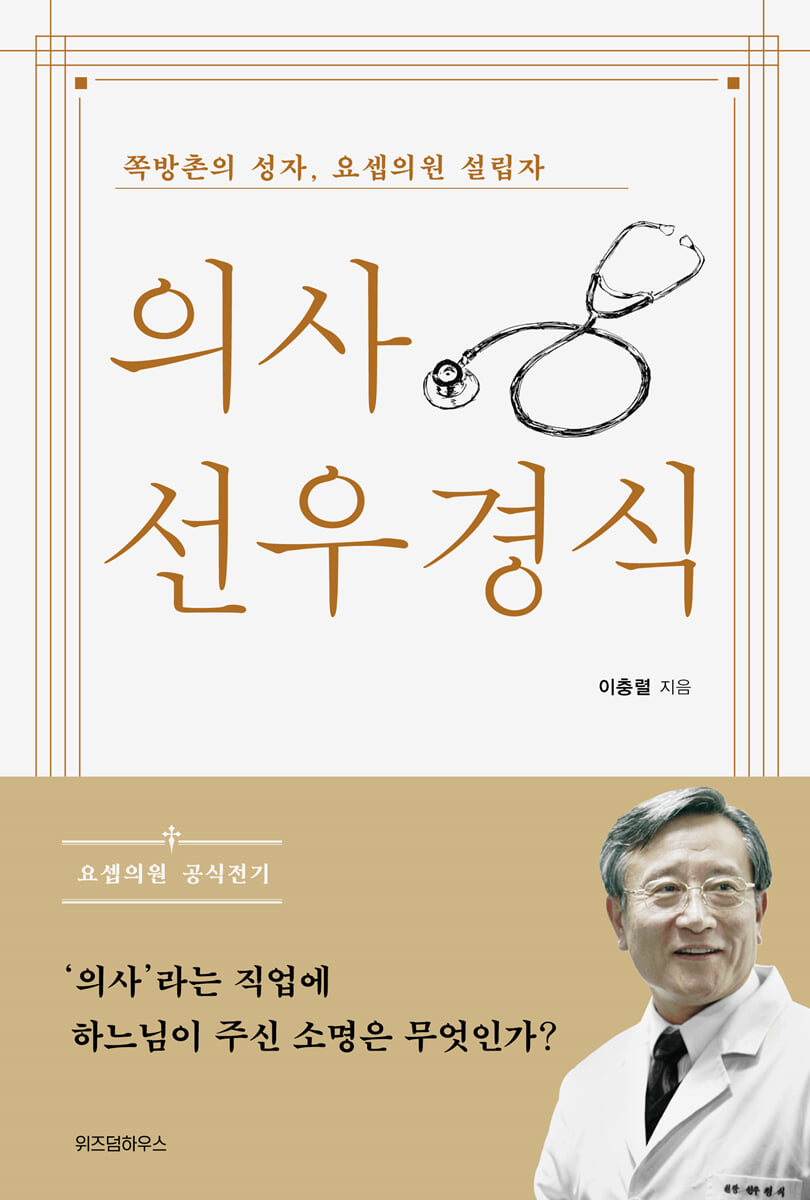
Dr. Seonwoo Kyungsik
 |
Description
Book Introduction
What is the calling God has given to the profession of ‘doctor’?
'Everything is free for poor patients', said the founder of Joseph's Hospital.
A masterpiece that captures the life, spirituality, and inner world of Dr. Seonwoo Kyung-sik, the director of Joseph Clinic!
At the entrance to the shantytown next to Yeongdeungpo's flashy shopping malls, there is Joseph's Hospital, a hospital that provides everything free of charge to poor patients.
The person who played a major role in the creation of this place is Director Seonwoo Kyung-sik, known as the ‘Saint of the Jjokbangchon.’
He gave up his position as a specialist at a large American hospital and as a professor at a Korean medical school to devote his life to serving poor patients.
Since receiving my medical license, I have been thinking about what my calling as a doctor is and working to fulfill that calling.
This book is the official and only biography of Dr. Seonwoo Gyeong-sik, written by author Lee Chung-ryeol, famous for his biographical literature, after reviewing thousands of pages of various materials and interviewing many people in person.
Let's encounter the life, spirituality, and inner world of Seonwoo Gyeongsik, a saint of our time who dedicated his life to helping the poor and the sick, through the vivid brush of author Lee Chung-ryeol!
'Everything is free for poor patients', said the founder of Joseph's Hospital.
A masterpiece that captures the life, spirituality, and inner world of Dr. Seonwoo Kyung-sik, the director of Joseph Clinic!
At the entrance to the shantytown next to Yeongdeungpo's flashy shopping malls, there is Joseph's Hospital, a hospital that provides everything free of charge to poor patients.
The person who played a major role in the creation of this place is Director Seonwoo Kyung-sik, known as the ‘Saint of the Jjokbangchon.’
He gave up his position as a specialist at a large American hospital and as a professor at a Korean medical school to devote his life to serving poor patients.
Since receiving my medical license, I have been thinking about what my calling as a doctor is and working to fulfill that calling.
This book is the official and only biography of Dr. Seonwoo Gyeong-sik, written by author Lee Chung-ryeol, famous for his biographical literature, after reviewing thousands of pages of various materials and interviewing many people in person.
Let's encounter the life, spirituality, and inner world of Seonwoo Gyeongsik, a saint of our time who dedicated his life to helping the poor and the sick, through the vivid brush of author Lee Chung-ryeol!
- You can preview some of the book's contents.
Preview
index
A Biography that faithfully restores the 21 years of life spent with Dr. Joseph
Preface: Seonwoo Kyung-sik, the Doctor of the Poor
Part 1: In the midst of conflict
1 What is a doctor?
2 Depart for Jeongseon, Gangwon-do
3. Discover a new path
4 For patients dying from poverty
5 Can we build a hospital with 10 out of 10?
6 Advice from Cardinal Kim Soo-hwan
Can you serve as a full-time director for 3 years?
8 Mountains beyond mountains
9 Hospitals where people work wearing cotton pants
10 Towards the Path of Faith
Part 2: A Long and Dangerous Free Clinic
11 Patients in the blind spot of health insurance
12 Bean sprouts grow in a bottomless pot.
13 Where there are poor patients
14 The importance of volunteers and staff
15 News of redevelopment
Part 3: Lower
16 The final hurdle
17 Roll up your sleeves again
18 The Realization I Gained While Being Grabbed by the Collar
19 Laugh together, cry together
The crisis that came with the IMF
21 Oh, Father!
22 On the Wings of Song
Part 4: To Be a Good Neighbor
23 Etiquette for dying patients
24 'Proud Catholic Medical School Students'
25th Anniversary of Opening and Companions
26 To become a doctor who keeps the Hippocratic Oath
Samsung Electronics Executive Lee Jae-yong Swallows Tears Over the Reality of the 27-room Village
28 Hospitals that care for more difficult patients
29 A poor patient is a precious and noble flower bud to the doctor.
Part 5 Until the end of life
30 Unstoppable Passion
31 Falling, rising, falling again
32 I hope I can overcome it
33 Until the last moment
Review_ A small seed sown silently
Seonwoo Gyeongsik Chronology
References and Interviews
pictorial
Preface: Seonwoo Kyung-sik, the Doctor of the Poor
Part 1: In the midst of conflict
1 What is a doctor?
2 Depart for Jeongseon, Gangwon-do
3. Discover a new path
4 For patients dying from poverty
5 Can we build a hospital with 10 out of 10?
6 Advice from Cardinal Kim Soo-hwan
Can you serve as a full-time director for 3 years?
8 Mountains beyond mountains
9 Hospitals where people work wearing cotton pants
10 Towards the Path of Faith
Part 2: A Long and Dangerous Free Clinic
11 Patients in the blind spot of health insurance
12 Bean sprouts grow in a bottomless pot.
13 Where there are poor patients
14 The importance of volunteers and staff
15 News of redevelopment
Part 3: Lower
16 The final hurdle
17 Roll up your sleeves again
18 The Realization I Gained While Being Grabbed by the Collar
19 Laugh together, cry together
The crisis that came with the IMF
21 Oh, Father!
22 On the Wings of Song
Part 4: To Be a Good Neighbor
23 Etiquette for dying patients
24 'Proud Catholic Medical School Students'
25th Anniversary of Opening and Companions
26 To become a doctor who keeps the Hippocratic Oath
Samsung Electronics Executive Lee Jae-yong Swallows Tears Over the Reality of the 27-room Village
28 Hospitals that care for more difficult patients
29 A poor patient is a precious and noble flower bud to the doctor.
Part 5 Until the end of life
30 Unstoppable Passion
31 Falling, rising, falling again
32 I hope I can overcome it
33 Until the last moment
Review_ A small seed sown silently
Seonwoo Gyeongsik Chronology
References and Interviews
pictorial
Detailed image

Into the book
After obtaining his medical license in 1969, Seonwoo Kyungsik constantly thought about becoming a doctor.
At that time, there was no national health insurance system, so you had to pay for medical treatment or surgery when registering.
While working at the hospital, he saw the reality of poor patients having to turn away, and he was reminded of the Hippocratic Oath, which states, “I will transcend social status and fulfill my duty to my patients.”
I felt a sense of guilt that I could not keep the pledge I made as a student to “use medicine to save people,” and after much thought, I sought a third path.
--- p.7
The number of people waiting in line in front of the House of Love increased as time passed.
As specialists Lee Gyeong-sik, Ko Yong-bok, and several residents took turns participating in the treatment, the system was established, and people suffering from various illnesses but who had been too afraid to go to the hospital began to come to Sarang House one after another.
Among the 60 to 70 patients treated were those requiring hospitalization, those needing appendectomy, pregnant women with breech babies, and those with tuberculosis.
Each time, Seonwoo Kyungsik would tell the two foreign priests, “This patient seems to have pneumonia,” “This patient seems to have a broken leg,” and “This patient seems to have stomach cancer,” and he would tell them which patients needed hospitalization or surgery, saying that they should be taken to the hospital.
On days like that, I didn't feel at ease even when I went home.
It was because the doctor in the white coat felt guilty for leaving the patient in the care of a foreign priest.
I pictured priests carrying the patients on their backs to city hospitals or St. Mary's Hospital, begging them to provide them with charity care.
However, in the cramped rooms of the Love House, which had no medical facilities, the only treatment available was medication.
Sometimes, when priests contacted him saying they could not find a charity ward, Seonwoo Kyungsik participated in fundraising and even called the hospitals where he worked or his classmates to ask for hospitalization or surgery at a low price.
But, in a corner of my heart, I always felt guilty that I was not fulfilling my responsibilities as a doctor.
It was 1984, when he was 39 years old.
--- pp.45~46
After some time, Seonwoo Gyeongsik had a difficult time meeting Cardinal Kim Su-hwan.
At the time, Cardinal Kim lamented the reality that although more than 300,000 rural people come to Seoul every year, most of them are poor and live in the shantytowns of Mokdong across the Anyang River in Siheung or Yangpyeong-dong, and are becoming urban poor who are constantly living in fear of forced eviction.
However, at the time, the Archdiocese of Seoul did not have the economic means to carry out pastoral care for the urban poor or social welfare projects, and it was also lacking in professional manpower, so it was dependent on foreign religious organizations. So, when Cardinal Seonwoo Kyung-sik heard the explanation that he was trying to establish a hospital by forming a union, he let out a faint sigh.
“Brother Joseph, the church should be rushing to those places and providing welfare services, but it is shameful that it is not doing so.
The urban poor, who were created by urban development following economic development in the 1960s, were always vulnerable to the risk of disease due to poor living conditions.
Although there are parishes (cathedrals) in each of those areas, the reality is that there are limits to how much help they can provide.
I am truly grateful that laypeople, rather than the church, are making efforts to more effectively and concretely address their medical issues.
“However, I am a little worried about how we will procure such enormous funds.”
Seonwoo Gyeongsik, who was listening to Cardinal Kim Su-hwan's words, nodded and answered in a polite tone.
“So, I was also embarrassed at first.
However, too many people in that area are left out of the blind spot of medical care and treatment.
There are so many people who die not because they are sick, but because they have no money.
“I studied medicine to help save lives, so I joined in establishing this hospital, even though I knew it would not be easy. I came to hear your advice.”
--- pp.54~56
After a while, a preparatory committee meeting was held.
Now that the director has been decided, it was time to come up with a name for the hospital.
Seonwoo Kyungsik was the first to express his opinion.
“As you know, I take the spirituality of Saint Charles de Foucauld (1858-1916), who lived his entire life with the poor and marginalized, as the coordinates of my faith.
I also live as a member of the Little Brothers of Jesus, which he founded, and attend a meeting once a month to study his spirituality.
So, I think it would be good to name the hospital after him, ‘Foucauld Clinic.’ What are your thoughts?”
The preparatory committee members shook their heads.
It was admirable to want to follow the spirit of Saint Foucault, but I wondered how many people knew about him.
At that time, Baek Wol-hyeon, who was serving as the general secretary of the Church Poor Medical Council, made a new proposal.
“For ease of understanding, how about naming it ‘Joseph’s Hospital’ after Saint Joseph, the father of Jesus, the protector of the Holy Family, and the dying and the workers?”
“That name sounds good.
“It is a coincidence, but the baptismal name of the first director, Seonwoo Gyeong-sik, was also Joseph.”
Seonwoo Gyeongsik waved his hand and declined.
“Then, there might be a misunderstanding that this hospital is my hospital, so let’s find a different name.”
"No, sir. How many people would know that his baptismal name was Joseph? You're worrying too much.
haha."
--- pp.63~64
Then one day I got a call from a wholesaler.
The accounting clerk who received the call was surprised and ran to Seonwoo Kyungsik.
“Director, please answer the phone.
“They are shouting at us to replace CEO Kim Soo-hwan.”
His heart sank.
“I changed my phone number.
“I am the director, so please speak to me.”
“We don’t need a director, we need to replace CEO Kim Su-hwan.
No, does it make sense that he took over 10 million won worth of medicine and hasn't paid back a single penny?
Although Joseph Hospital is a social welfare corporation registered with the Ministry of Health and Welfare, it was an affiliated hospital of the Catholic Social Welfare Association of the Seoul Archdiocese of the Catholic Church.
Since the head of the welfare association was Cardinal Kim Su-hwan, the legal representative of Joseph's House was also Cardinal Kim.
“The director is not here right now, and I am the actual person in charge of this hospital.
If you just wait a month, I'll pay you back any amount.
“I’m so sorry.”
"all right.
But if you don't pay within a month, I will sue CEO Kim Soo-hwan.
And I can't give you any medicine until you pay me back."
“Yes, I understand.
“I’m so sorry.”
Seonwoo Kyungsik put down the phone and felt all the energy drain from his body.
The accounting staff also looked at him with a worried expression.
The only thought on his mind was that he should not cause trouble to Cardinal Kim Su-hwan.
--- pp.81~82
A few days after returning from the Bigum Valley outing, Seonwoo Gyeongsik received a shocking phone call from the owner of the Gwanak General Market building where the hospital was located.
“Director, this area has been designated as a redevelopment zone.
So, since they are planning to tear down this building and build a new one soon, it looks like the hospital will have to relocate.
“The office currently rented on the second floor has also decided to move out.”
He was relieved to receive this phone call just as he was thinking that the hospital would be able to continue without any major difficulties as donations were steadily increasing as it was approaching its third anniversary.
But there was no time to lose one's mind.
The person who would take care of the situation and come up with a plan was ultimately Seonwoo Kyungsik himself.
“I am taken aback by this sudden news.
So, can you tell me when the redevelopment will start?”
“They say they will first develop this Sillim intersection and then designate the nearby Dorimcheon Riverside area, which is a densely populated area of slum housing, as a redevelopment zone.
So, I think redevelopment will begin within 1-2 years.
However, from our perspective of having to build a new building, we are telling you this quickly so that the residents can move out quickly.”
"yes.
Well, since we still have some time, let's find a place."
Seonwoo Kyungsik hung up the phone with a soft sigh.
Meanwhile, the rent for buildings in Seoul has been rising, and I was worried about where I could settle down with my current deposit.
--- pp.135~136
The patients at Yeongdeungpo Joseph Clinic were a little different from those in Sillim-dong.
Unlike Sillim-dong, where the majority of residents were poor, this area was mainly populated by alcoholics, drug addicts, tuberculosis and hepatitis patients, former inmates from prisons and rehabilitation centers, and travelers whose resident registration had been canceled, living in shacks built like chicken coops around the hospital. These people soon became Joseph's regular customers.
The ten departments, including dentistry, neuropsychiatry, otolaryngology, ophthalmology, dermatology, urology, and oriental medicine, had their clinics open at 7 p.m., but by 3 p.m., local residents were occupying the chairs in the hospital waiting room and lounging around as if it were their own living room.
Among them, many homeless people had not washed for several days and had not even changed their clothes, so they often smelled bad. In order to receive proper treatment, they had to be given a bath first.
However, there were many cases where people who were accustomed to living outside would complain that they did not want to bother washing and asked to be examined.
Some of them came very drunk, and in such cases, they had no choice but to be stopped on the first floor.
“Normal treatment is not possible when you are drunk, so please come after sobering up.”
“I only had a little bit of alcohol.
“Why aren’t you treating me?”
They were shouting and arguing without any reason.
Tyler tried to be calm, but it didn't help.
“It smells strongly of alcohol.
“Come back later.”
From this point on, they did not back down meekly, spitting out six-letter words.
When the staff couldn't handle it, Seonwoo Kyungsik came down and dealt with the drunk patients himself, and in some cases, he was so reckless that a physical fight broke out, with people pushing and shoving each other.
Since most alcoholics know that they cannot think clearly when they are drunk, Seonwoo Kyungsik thought it was best to endure the situation and sort it out, even if it meant being grabbed by the collar.
--- pp.160~161
At 4 p.m. on June 27th, during the peak of the heat, Executive Director Lee Jae-yong visited Representative Joseph with company officials.
Seonwoo Kyungsik guided him to the director's office, where he made him drink tea and explained the history and current status of Joseph Hospital.
Afterwards, he guided us from the first to the fourth floor, and Executive Director Lee Jae-yong encouraged the staff, volunteers, and patients.
After touring the hospital, Seonwoo Kyungsik asked Executive Director Lee Jae-yong.
“Director Lee, have you ever been to a place called Jjokbangchon?”
“I don’t have much social experience and I mostly work at the company, so I haven’t been to the shantytown yet.”
“I asked because I thought that might be the case.
Now that you've come this far, why not take a look around the shantytown in this alley? Seeing how they live will help you understand the reason for our hospital's existence and the need for auxiliary facilities like the kitchen and laundry you just saw."
“Yes, sir.
“If you give me the opportunity to see the village called Jjokbangchon, I will look around and learn a lot.”
--- p.226
Hospitalization expenses were covered by Ilsan Baek Hospital's fund, but a caregiver was needed.
His only family was his older brother who lived in the countryside, and it was not easy for the Joseph Clinic to find volunteers who could care for him for several months.
Was luck on your side in difficult circumstances?
At that time, Mr. Kang ○ stepped forward.
He was hospitalized in the same room as Mr. Lee Jae-gang at Gangnam City Hospital, and upon discharge, he was staying at the House of the Blessed Virgin Mary at the recommendation of a staff member at Joseph Hospital.
Mr. Kang ○ said he would go to Ilsan Baek Hospital to provide care, and other people living at the Seongmo Jaheon House and Mokdong House also heard this news and took turns providing care.
Once wanderers and homeless, they stayed by Mr. Lee's side along with the volunteers from the Joseph Clinic.
After recovering to some extent, Mr. Lee moved to the house of the Virgin Mary.
Here too, they took turns caring for him, helping him urinate and defecate, and massaging his back day and night to prevent bedsores.
Thanks to this kind of dedicated care, Jaegang Lee gradually recovered his health.
Seonwoo Gyeongsik watched patients take care of those in more difficult situations, and he resolved to run Mokdong House and Seongmo Jaheon House better, no matter how difficult it was.
--- pp.236~237
Now, Seonwoo Gyeongsik was quite old, over 60 years old.
Was it because I stopped working and couldn't recuperate properly?
In mid-October, as autumn deepened, he called Professor Koh Young-cho, who had operated on him when he suffered an acute cerebral infarction in May, and told him, “I kept losing energy, so I had a blood test and my hemoglobin level was low, and even my stool was black.”
Professor Koh Young-cho recommended an endoscopy, suspecting that the gastrointestinal bleeding may have occurred because the patient was taking two types of anticoagulants, including aspirin, after stent insertion.
The next day, Seonwoo Kyungsik underwent an endoscopy at Joseph Hospital by Dr. Kim Bo-kyung, a gastroenterologist and medical volunteer.
But what is this again?
Unexpectedly, advanced stomach cancer was discovered.
He was admitted to Kangnam St. Mary's Hospital for surgery and underwent a total gastrectomy and regional lymph node dissection to remove gastric cancer, but metastases were already found in multiple lymph nodes.
After a major surgery that removed two-thirds of his stomach, he began chemotherapy.
He said that it was a bit difficult, but he could bear it, and he bravely overcame the pain. Even during the cancer treatment, when his condition improved, he visited Joseph's Hospital to encourage the medical staff and volunteers.
At that time, there was no national health insurance system, so you had to pay for medical treatment or surgery when registering.
While working at the hospital, he saw the reality of poor patients having to turn away, and he was reminded of the Hippocratic Oath, which states, “I will transcend social status and fulfill my duty to my patients.”
I felt a sense of guilt that I could not keep the pledge I made as a student to “use medicine to save people,” and after much thought, I sought a third path.
--- p.7
The number of people waiting in line in front of the House of Love increased as time passed.
As specialists Lee Gyeong-sik, Ko Yong-bok, and several residents took turns participating in the treatment, the system was established, and people suffering from various illnesses but who had been too afraid to go to the hospital began to come to Sarang House one after another.
Among the 60 to 70 patients treated were those requiring hospitalization, those needing appendectomy, pregnant women with breech babies, and those with tuberculosis.
Each time, Seonwoo Kyungsik would tell the two foreign priests, “This patient seems to have pneumonia,” “This patient seems to have a broken leg,” and “This patient seems to have stomach cancer,” and he would tell them which patients needed hospitalization or surgery, saying that they should be taken to the hospital.
On days like that, I didn't feel at ease even when I went home.
It was because the doctor in the white coat felt guilty for leaving the patient in the care of a foreign priest.
I pictured priests carrying the patients on their backs to city hospitals or St. Mary's Hospital, begging them to provide them with charity care.
However, in the cramped rooms of the Love House, which had no medical facilities, the only treatment available was medication.
Sometimes, when priests contacted him saying they could not find a charity ward, Seonwoo Kyungsik participated in fundraising and even called the hospitals where he worked or his classmates to ask for hospitalization or surgery at a low price.
But, in a corner of my heart, I always felt guilty that I was not fulfilling my responsibilities as a doctor.
It was 1984, when he was 39 years old.
--- pp.45~46
After some time, Seonwoo Gyeongsik had a difficult time meeting Cardinal Kim Su-hwan.
At the time, Cardinal Kim lamented the reality that although more than 300,000 rural people come to Seoul every year, most of them are poor and live in the shantytowns of Mokdong across the Anyang River in Siheung or Yangpyeong-dong, and are becoming urban poor who are constantly living in fear of forced eviction.
However, at the time, the Archdiocese of Seoul did not have the economic means to carry out pastoral care for the urban poor or social welfare projects, and it was also lacking in professional manpower, so it was dependent on foreign religious organizations. So, when Cardinal Seonwoo Kyung-sik heard the explanation that he was trying to establish a hospital by forming a union, he let out a faint sigh.
“Brother Joseph, the church should be rushing to those places and providing welfare services, but it is shameful that it is not doing so.
The urban poor, who were created by urban development following economic development in the 1960s, were always vulnerable to the risk of disease due to poor living conditions.
Although there are parishes (cathedrals) in each of those areas, the reality is that there are limits to how much help they can provide.
I am truly grateful that laypeople, rather than the church, are making efforts to more effectively and concretely address their medical issues.
“However, I am a little worried about how we will procure such enormous funds.”
Seonwoo Gyeongsik, who was listening to Cardinal Kim Su-hwan's words, nodded and answered in a polite tone.
“So, I was also embarrassed at first.
However, too many people in that area are left out of the blind spot of medical care and treatment.
There are so many people who die not because they are sick, but because they have no money.
“I studied medicine to help save lives, so I joined in establishing this hospital, even though I knew it would not be easy. I came to hear your advice.”
--- pp.54~56
After a while, a preparatory committee meeting was held.
Now that the director has been decided, it was time to come up with a name for the hospital.
Seonwoo Kyungsik was the first to express his opinion.
“As you know, I take the spirituality of Saint Charles de Foucauld (1858-1916), who lived his entire life with the poor and marginalized, as the coordinates of my faith.
I also live as a member of the Little Brothers of Jesus, which he founded, and attend a meeting once a month to study his spirituality.
So, I think it would be good to name the hospital after him, ‘Foucauld Clinic.’ What are your thoughts?”
The preparatory committee members shook their heads.
It was admirable to want to follow the spirit of Saint Foucault, but I wondered how many people knew about him.
At that time, Baek Wol-hyeon, who was serving as the general secretary of the Church Poor Medical Council, made a new proposal.
“For ease of understanding, how about naming it ‘Joseph’s Hospital’ after Saint Joseph, the father of Jesus, the protector of the Holy Family, and the dying and the workers?”
“That name sounds good.
“It is a coincidence, but the baptismal name of the first director, Seonwoo Gyeong-sik, was also Joseph.”
Seonwoo Gyeongsik waved his hand and declined.
“Then, there might be a misunderstanding that this hospital is my hospital, so let’s find a different name.”
"No, sir. How many people would know that his baptismal name was Joseph? You're worrying too much.
haha."
--- pp.63~64
Then one day I got a call from a wholesaler.
The accounting clerk who received the call was surprised and ran to Seonwoo Kyungsik.
“Director, please answer the phone.
“They are shouting at us to replace CEO Kim Soo-hwan.”
His heart sank.
“I changed my phone number.
“I am the director, so please speak to me.”
“We don’t need a director, we need to replace CEO Kim Su-hwan.
No, does it make sense that he took over 10 million won worth of medicine and hasn't paid back a single penny?
Although Joseph Hospital is a social welfare corporation registered with the Ministry of Health and Welfare, it was an affiliated hospital of the Catholic Social Welfare Association of the Seoul Archdiocese of the Catholic Church.
Since the head of the welfare association was Cardinal Kim Su-hwan, the legal representative of Joseph's House was also Cardinal Kim.
“The director is not here right now, and I am the actual person in charge of this hospital.
If you just wait a month, I'll pay you back any amount.
“I’m so sorry.”
"all right.
But if you don't pay within a month, I will sue CEO Kim Soo-hwan.
And I can't give you any medicine until you pay me back."
“Yes, I understand.
“I’m so sorry.”
Seonwoo Kyungsik put down the phone and felt all the energy drain from his body.
The accounting staff also looked at him with a worried expression.
The only thought on his mind was that he should not cause trouble to Cardinal Kim Su-hwan.
--- pp.81~82
A few days after returning from the Bigum Valley outing, Seonwoo Gyeongsik received a shocking phone call from the owner of the Gwanak General Market building where the hospital was located.
“Director, this area has been designated as a redevelopment zone.
So, since they are planning to tear down this building and build a new one soon, it looks like the hospital will have to relocate.
“The office currently rented on the second floor has also decided to move out.”
He was relieved to receive this phone call just as he was thinking that the hospital would be able to continue without any major difficulties as donations were steadily increasing as it was approaching its third anniversary.
But there was no time to lose one's mind.
The person who would take care of the situation and come up with a plan was ultimately Seonwoo Kyungsik himself.
“I am taken aback by this sudden news.
So, can you tell me when the redevelopment will start?”
“They say they will first develop this Sillim intersection and then designate the nearby Dorimcheon Riverside area, which is a densely populated area of slum housing, as a redevelopment zone.
So, I think redevelopment will begin within 1-2 years.
However, from our perspective of having to build a new building, we are telling you this quickly so that the residents can move out quickly.”
"yes.
Well, since we still have some time, let's find a place."
Seonwoo Kyungsik hung up the phone with a soft sigh.
Meanwhile, the rent for buildings in Seoul has been rising, and I was worried about where I could settle down with my current deposit.
--- pp.135~136
The patients at Yeongdeungpo Joseph Clinic were a little different from those in Sillim-dong.
Unlike Sillim-dong, where the majority of residents were poor, this area was mainly populated by alcoholics, drug addicts, tuberculosis and hepatitis patients, former inmates from prisons and rehabilitation centers, and travelers whose resident registration had been canceled, living in shacks built like chicken coops around the hospital. These people soon became Joseph's regular customers.
The ten departments, including dentistry, neuropsychiatry, otolaryngology, ophthalmology, dermatology, urology, and oriental medicine, had their clinics open at 7 p.m., but by 3 p.m., local residents were occupying the chairs in the hospital waiting room and lounging around as if it were their own living room.
Among them, many homeless people had not washed for several days and had not even changed their clothes, so they often smelled bad. In order to receive proper treatment, they had to be given a bath first.
However, there were many cases where people who were accustomed to living outside would complain that they did not want to bother washing and asked to be examined.
Some of them came very drunk, and in such cases, they had no choice but to be stopped on the first floor.
“Normal treatment is not possible when you are drunk, so please come after sobering up.”
“I only had a little bit of alcohol.
“Why aren’t you treating me?”
They were shouting and arguing without any reason.
Tyler tried to be calm, but it didn't help.
“It smells strongly of alcohol.
“Come back later.”
From this point on, they did not back down meekly, spitting out six-letter words.
When the staff couldn't handle it, Seonwoo Kyungsik came down and dealt with the drunk patients himself, and in some cases, he was so reckless that a physical fight broke out, with people pushing and shoving each other.
Since most alcoholics know that they cannot think clearly when they are drunk, Seonwoo Kyungsik thought it was best to endure the situation and sort it out, even if it meant being grabbed by the collar.
--- pp.160~161
At 4 p.m. on June 27th, during the peak of the heat, Executive Director Lee Jae-yong visited Representative Joseph with company officials.
Seonwoo Kyungsik guided him to the director's office, where he made him drink tea and explained the history and current status of Joseph Hospital.
Afterwards, he guided us from the first to the fourth floor, and Executive Director Lee Jae-yong encouraged the staff, volunteers, and patients.
After touring the hospital, Seonwoo Kyungsik asked Executive Director Lee Jae-yong.
“Director Lee, have you ever been to a place called Jjokbangchon?”
“I don’t have much social experience and I mostly work at the company, so I haven’t been to the shantytown yet.”
“I asked because I thought that might be the case.
Now that you've come this far, why not take a look around the shantytown in this alley? Seeing how they live will help you understand the reason for our hospital's existence and the need for auxiliary facilities like the kitchen and laundry you just saw."
“Yes, sir.
“If you give me the opportunity to see the village called Jjokbangchon, I will look around and learn a lot.”
--- p.226
Hospitalization expenses were covered by Ilsan Baek Hospital's fund, but a caregiver was needed.
His only family was his older brother who lived in the countryside, and it was not easy for the Joseph Clinic to find volunteers who could care for him for several months.
Was luck on your side in difficult circumstances?
At that time, Mr. Kang ○ stepped forward.
He was hospitalized in the same room as Mr. Lee Jae-gang at Gangnam City Hospital, and upon discharge, he was staying at the House of the Blessed Virgin Mary at the recommendation of a staff member at Joseph Hospital.
Mr. Kang ○ said he would go to Ilsan Baek Hospital to provide care, and other people living at the Seongmo Jaheon House and Mokdong House also heard this news and took turns providing care.
Once wanderers and homeless, they stayed by Mr. Lee's side along with the volunteers from the Joseph Clinic.
After recovering to some extent, Mr. Lee moved to the house of the Virgin Mary.
Here too, they took turns caring for him, helping him urinate and defecate, and massaging his back day and night to prevent bedsores.
Thanks to this kind of dedicated care, Jaegang Lee gradually recovered his health.
Seonwoo Gyeongsik watched patients take care of those in more difficult situations, and he resolved to run Mokdong House and Seongmo Jaheon House better, no matter how difficult it was.
--- pp.236~237
Now, Seonwoo Gyeongsik was quite old, over 60 years old.
Was it because I stopped working and couldn't recuperate properly?
In mid-October, as autumn deepened, he called Professor Koh Young-cho, who had operated on him when he suffered an acute cerebral infarction in May, and told him, “I kept losing energy, so I had a blood test and my hemoglobin level was low, and even my stool was black.”
Professor Koh Young-cho recommended an endoscopy, suspecting that the gastrointestinal bleeding may have occurred because the patient was taking two types of anticoagulants, including aspirin, after stent insertion.
The next day, Seonwoo Kyungsik underwent an endoscopy at Joseph Hospital by Dr. Kim Bo-kyung, a gastroenterologist and medical volunteer.
But what is this again?
Unexpectedly, advanced stomach cancer was discovered.
He was admitted to Kangnam St. Mary's Hospital for surgery and underwent a total gastrectomy and regional lymph node dissection to remove gastric cancer, but metastases were already found in multiple lymph nodes.
After a major surgery that removed two-thirds of his stomach, he began chemotherapy.
He said that it was a bit difficult, but he could bear it, and he bravely overcame the pain. Even during the cancer treatment, when his condition improved, he visited Joseph's Hospital to encourage the medical staff and volunteers.
--- pp.272~273
Publisher's Review
Our saint who lived with the sick in the most difficult places,
Meet Seonwoo Kyungsik, who lives a life worthy of a doctor, guided by the Hippocratic Oath and the Bible!
As the economic situation worsens, the hardships of the poor increase.
So, at times like these, we must support the lives of the poor and the sick.
It is a time when we miss Director Seonwoo Kyung-sik even more, who dedicated his life to providing free medical treatment to poor patients, calling them “invaluable and noble flower buds to doctors.”
Unfortunately, the life of Director Seonwoo Kyung-sik has not been well known.
The Joseph Clinic, where Director Seonwoo Kyung-sik worked his entire life, was a free medical clinic for the poor, such as the homeless and travelers, who were excluded from the health insurance system. He was also the type of person who did not like to take action on his own.
But especially in these difficult and divided times when our society is struggling, the lives of people like Director Seonwoo Kyung-sik deserve even more attention.
The life of Director Seonwoo Kyung-sik has only been known through documentaries and articles from broadcasting companies.
Author Lee Chung-ryeol, a master of Korean biographical literature who wrote “Gansong Jeon Hyeong-pil,” “Ah, Cardinal Kim Su-hwan,” and “Father Lee Tae-seok,” wrote “Doctor Seonwoo Gyeong-sik” after being deeply moved by the life of Seonwoo Gyeong-sik, a saint of our time who lived for the poor and sick, while contemplating the life of a doctor.
This book is the official and only biography of Joseph Hospital (Joseph Nanum Foundation), which has received church approval from the Catholic Archdiocese of Seoul.
Vividly portrayed by author Lee Chung-ryeol, a master of electric literature
The Life of Director Seonwoo Kyung-sik, the "Saint of the Jjokbangchon"
After choosing to become a doctor, Seonwoo Kyungsik works at a hospital and is exposed to the harsh reality of having to turn away patients who cannot afford treatment.
Disappointed by this, he went to the United States, where there was no refusal to treat poor emergency patients, and worked as a specialist, but he refused the life of a well-paid American doctor and returned to Korea.
After returning to Korea, he found his path through medical volunteer work at St. Francis Hospital and Sarang House in Sillim-dong.
I found the path of becoming a doctor who loves poor patients like friends and becomes their neighbor.
To this end, they felt the need for a hospital where poor local residents could receive medical benefits, so they decided to form a union and establish a hospital.
However, establishing a hospital required enormous funds, and Seonwoo Gyeong-sik met with Cardinal Kim Su-hwan to ask for help.
Cardinal Kim helped establish the Seoul Catholic Social Welfare Association as an affiliated organization and raised funds through fundraising.
Joseph Hospital, which was established after many difficulties, moved from Sillim-dong to its current location in Yeongdeungpo, establishing itself as a free hospital for poor patients.
As a free hospital, he heard concerns from those around him, such as, "How can we possibly run it? It won't last more than three months." However, Seonwoo Gyeongsik overcame these difficulties with unwavering determination and faith, laying the foundation for a model free hospital.
However, because it was a free hospital, there were many homeless people, travelers, and alcoholics.
Seonwoo Kyungsik was also human, so whenever someone he thought had been treated well came back to the hospital drunk, he felt doubtful, and it was difficult and painful.
Every time, he encouraged himself by saying, "The virtue that is more important and necessary for a doctor than medical skills is the heart that loves patients and the heart that does not give up on patients."
Even more challenging was securing the necessary funding for the hospital. With the IMF crisis causing a surge in patients and further straining management, Seonwoo Kyung-sik overcame the challenges by organizing a support group and holding charity concerts.
“More than anything, the gift that the reality of poverty has awakened me to is the realization that the poor are the most precious and noble of patients, like flower buds to doctors.
“It was these people who needed me and called me to this position at Joseph’s.”
Seonwoo Gyeong-sik, who had been providing free medical treatment throughout his life without even getting married, suffered from acute cerebral infarction and stomach cancer, but continued to work hard for patients until the end, passing away in 2008 at the age of 63.
This book is not intended to praise the life of Director Seonwoo Kyungsik.
Rather, it calmly shows the life of a person who ponders the profession of 'doctor' and strives to live as a 'true doctor' in his own right.
In these days when life is becoming more difficult and people are less interested in others, the life of Dr. Seonwoo Kyung-sik will resonate deeply with us.
※ All royalties from this book will be donated to the Joseph Nanum Foundation.
Meet Seonwoo Kyungsik, who lives a life worthy of a doctor, guided by the Hippocratic Oath and the Bible!
As the economic situation worsens, the hardships of the poor increase.
So, at times like these, we must support the lives of the poor and the sick.
It is a time when we miss Director Seonwoo Kyung-sik even more, who dedicated his life to providing free medical treatment to poor patients, calling them “invaluable and noble flower buds to doctors.”
Unfortunately, the life of Director Seonwoo Kyung-sik has not been well known.
The Joseph Clinic, where Director Seonwoo Kyung-sik worked his entire life, was a free medical clinic for the poor, such as the homeless and travelers, who were excluded from the health insurance system. He was also the type of person who did not like to take action on his own.
But especially in these difficult and divided times when our society is struggling, the lives of people like Director Seonwoo Kyung-sik deserve even more attention.
The life of Director Seonwoo Kyung-sik has only been known through documentaries and articles from broadcasting companies.
Author Lee Chung-ryeol, a master of Korean biographical literature who wrote “Gansong Jeon Hyeong-pil,” “Ah, Cardinal Kim Su-hwan,” and “Father Lee Tae-seok,” wrote “Doctor Seonwoo Gyeong-sik” after being deeply moved by the life of Seonwoo Gyeong-sik, a saint of our time who lived for the poor and sick, while contemplating the life of a doctor.
This book is the official and only biography of Joseph Hospital (Joseph Nanum Foundation), which has received church approval from the Catholic Archdiocese of Seoul.
Vividly portrayed by author Lee Chung-ryeol, a master of electric literature
The Life of Director Seonwoo Kyung-sik, the "Saint of the Jjokbangchon"
After choosing to become a doctor, Seonwoo Kyungsik works at a hospital and is exposed to the harsh reality of having to turn away patients who cannot afford treatment.
Disappointed by this, he went to the United States, where there was no refusal to treat poor emergency patients, and worked as a specialist, but he refused the life of a well-paid American doctor and returned to Korea.
After returning to Korea, he found his path through medical volunteer work at St. Francis Hospital and Sarang House in Sillim-dong.
I found the path of becoming a doctor who loves poor patients like friends and becomes their neighbor.
To this end, they felt the need for a hospital where poor local residents could receive medical benefits, so they decided to form a union and establish a hospital.
However, establishing a hospital required enormous funds, and Seonwoo Gyeong-sik met with Cardinal Kim Su-hwan to ask for help.
Cardinal Kim helped establish the Seoul Catholic Social Welfare Association as an affiliated organization and raised funds through fundraising.
Joseph Hospital, which was established after many difficulties, moved from Sillim-dong to its current location in Yeongdeungpo, establishing itself as a free hospital for poor patients.
As a free hospital, he heard concerns from those around him, such as, "How can we possibly run it? It won't last more than three months." However, Seonwoo Gyeongsik overcame these difficulties with unwavering determination and faith, laying the foundation for a model free hospital.
However, because it was a free hospital, there were many homeless people, travelers, and alcoholics.
Seonwoo Kyungsik was also human, so whenever someone he thought had been treated well came back to the hospital drunk, he felt doubtful, and it was difficult and painful.
Every time, he encouraged himself by saying, "The virtue that is more important and necessary for a doctor than medical skills is the heart that loves patients and the heart that does not give up on patients."
Even more challenging was securing the necessary funding for the hospital. With the IMF crisis causing a surge in patients and further straining management, Seonwoo Kyung-sik overcame the challenges by organizing a support group and holding charity concerts.
“More than anything, the gift that the reality of poverty has awakened me to is the realization that the poor are the most precious and noble of patients, like flower buds to doctors.
“It was these people who needed me and called me to this position at Joseph’s.”
Seonwoo Gyeong-sik, who had been providing free medical treatment throughout his life without even getting married, suffered from acute cerebral infarction and stomach cancer, but continued to work hard for patients until the end, passing away in 2008 at the age of 63.
This book is not intended to praise the life of Director Seonwoo Kyungsik.
Rather, it calmly shows the life of a person who ponders the profession of 'doctor' and strives to live as a 'true doctor' in his own right.
In these days when life is becoming more difficult and people are less interested in others, the life of Dr. Seonwoo Kyung-sik will resonate deeply with us.
※ All royalties from this book will be donated to the Joseph Nanum Foundation.
GOODS SPECIFICS
- Date of issue: April 11, 2024
- Page count, weight, size: 308 pages | 560g | 152*225*18mm
- ISBN13: 9791171711505
- ISBN10: 1171711506
You may also like
카테고리
korean


korean

![GQ KOREA Mark (Monthly): December [2025]](http://librairie.coreenne.fr/cdn/shop/files/8ef265dbbfbf186523ed75ba7319009d.jpg?v=1765340328&width=3840)


