

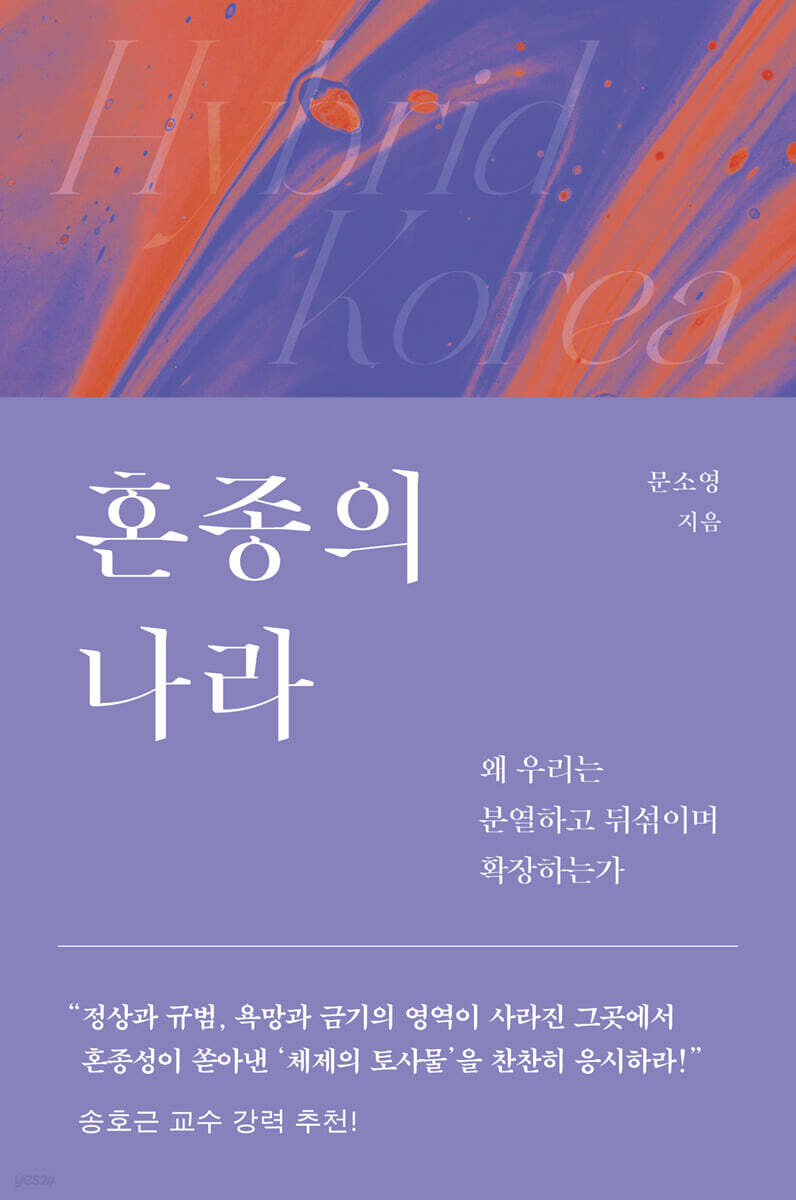
A country of hybrids
 |
Description
Book Introduction
“Hybridity is the source of innovative birth!”
Money, cuts and resets, anti-intellectualism, hybrid Korean wave, new concept tradition, Everyday Micropolitics, Post-COVID, and Artificial Intelligence The Strange and Beautiful Korean Culture Seen Through Seven Keywords “In a place where the realm of normality and norms, desires and taboos have disappeared, “Look closely at the ‘system’s vomit’ that hybridity has poured out!” _Recommended by Song Ho-geun, sociologist and distinguished professor at Hallym University Why does this seem so appealing these days? The answer to the 'reason for taste' that I didn't even know about is right in this book! * Why are regression, possession, and reincarnation like “Please Marry My Husband” and “The Youngest Son of a Chaebol Family” popular? * Did Parasite and Squid Game truly captivate the world because they were so “Korean”? * Why do people these days say 'cutting ties' instead of 'cutting ties'? * How did art galleries beat movie theaters to become a dating hotspot? * Traditional latticework and chandeliers… What are the characteristics revealed in the interior of the Blue House? This book is written by cultural journalist Moon So-young, who has explored the intersection of art and our daily lives through works such as “Reading Masterpieces” and “Economics in Painting,” and examines Korean culture through seven keywords under the concept of “hybridity.” This book poses questions about the hidden aspects of everyday life, including various visual cultures such as movies, dramas, entertainment, and art, as well as social issues, and captures the characteristics of today's Korean society and Koreans hidden in them. It is a collection of content that has been serialized in the popular JoongAng Ilbo column, "Society Implied by Culture." The author chooses 'hybrid' as a single word that captures the Korean cultural trend that is captivating individuals, generations, our society, and the entire world. Postcolonial scholar Homi Bhabha used this concept to explain how colonial cultures influenced by empires can foster diversity and potential, ultimately overturning cultural power. The author invokes this concept as a core principle that permeates Korean culture, and lucidly analyzes cultural phenomena throughout society. |
- You can preview some of the book's contents.
Preview
index
A strange and beautiful country of hybrids seen through the eyes of a hybrid generation.
Chapter 1 Money
"Because they're rich, they're good": Capitalism Replaces Religion
The golden spoon marketing era: making money by bragging about your wealth
The Rich and the Art: Why Do the Rich Buy Obscure Modern Art?
The self-commodifying pop art master predicted the "subscription" and "like" era.
Chapter 2: Cut Losses and Reset
Instead of cutting ties, cut ties, because people have become capital.
How the Game Generation Turned Their Lives Around with the Hwe-Bing-Hwan and K-Vengeance Drama
A bizarre combination of family observation entertainment sensationalism and familialism
Goo Hara Law: Are you still family even if you don't act as a parent?
Chapter 3 Anti-intellectualism
Death of an Expert: In "The Land of the Blind," Are Those Who Can Sight Fools?
Anti-intellectualism: The illusion that democracy is the equality of knowledge and ignorance
Disaster and Scapegoat: Blame the government, blame the victims, or blame Halloween?
Chapter 4: Hybrid Korean Wave
Is Chicken and the Squid Game Really the Most Korean and Global?
Olympic Broadcasting and BTS: Do We Have a Great Nation Mindset?
Why Are Greek Sculptures and Myths Featured in Korean Muscle Variety Shows?
The lament of Joseon white porcelain. Ironically, only the names of the potters who were taken to Japan remain.
Chapter 5: A New Concept of Tradition
Dalhangari's Best Branding Success Story
Why do we need standards for the 'standard' portraits of the spirits of the imagination?
Ghost Internet Holy Land and YouTube Shamanism
The Blue House's bizarre interior is also a modern cultural heritage.
Korea turns everything into a statue
Chapter 6: Micropolitics of Everyday Life
Is whitening a "white" trend? Are Westerners "white"?
Freedom of Expression vs. Political Correctness: When Well-Intentioned Expression Conflicts with Political Correctness
Lessons from K-pop Fandom on Fandom Politics
Why did the "Seo Jang-hoon-style comfort" advice become popular?
Chapter 7: Post-Corona and Artificial Intelligence
Art galleries over movie theaters? Why art galleries are becoming a hot date spot.
Between analog and digital in Top Gun: Maverick and Love, Death + Robots
When asked about the "Nukalhyup" (a liar), ChatGPT made up a fabrication.
The Impact of Generative and Polarized AI on the Birth of Masters
Chapter 1 Money
"Because they're rich, they're good": Capitalism Replaces Religion
The golden spoon marketing era: making money by bragging about your wealth
The Rich and the Art: Why Do the Rich Buy Obscure Modern Art?
The self-commodifying pop art master predicted the "subscription" and "like" era.
Chapter 2: Cut Losses and Reset
Instead of cutting ties, cut ties, because people have become capital.
How the Game Generation Turned Their Lives Around with the Hwe-Bing-Hwan and K-Vengeance Drama
A bizarre combination of family observation entertainment sensationalism and familialism
Goo Hara Law: Are you still family even if you don't act as a parent?
Chapter 3 Anti-intellectualism
Death of an Expert: In "The Land of the Blind," Are Those Who Can Sight Fools?
Anti-intellectualism: The illusion that democracy is the equality of knowledge and ignorance
Disaster and Scapegoat: Blame the government, blame the victims, or blame Halloween?
Chapter 4: Hybrid Korean Wave
Is Chicken and the Squid Game Really the Most Korean and Global?
Olympic Broadcasting and BTS: Do We Have a Great Nation Mindset?
Why Are Greek Sculptures and Myths Featured in Korean Muscle Variety Shows?
The lament of Joseon white porcelain. Ironically, only the names of the potters who were taken to Japan remain.
Chapter 5: A New Concept of Tradition
Dalhangari's Best Branding Success Story
Why do we need standards for the 'standard' portraits of the spirits of the imagination?
Ghost Internet Holy Land and YouTube Shamanism
The Blue House's bizarre interior is also a modern cultural heritage.
Korea turns everything into a statue
Chapter 6: Micropolitics of Everyday Life
Is whitening a "white" trend? Are Westerners "white"?
Freedom of Expression vs. Political Correctness: When Well-Intentioned Expression Conflicts with Political Correctness
Lessons from K-pop Fandom on Fandom Politics
Why did the "Seo Jang-hoon-style comfort" advice become popular?
Chapter 7: Post-Corona and Artificial Intelligence
Art galleries over movie theaters? Why art galleries are becoming a hot date spot.
Between analog and digital in Top Gun: Maverick and Love, Death + Robots
When asked about the "Nukalhyup" (a liar), ChatGPT made up a fabrication.
The Impact of Generative and Polarized AI on the Birth of Masters
Detailed image
.jpg)
Into the book
As the saying goes, 'a terrible hybrid', in our society, the word 'hybrid' is still often used in a negative sense.
But the cultures of all empires, such as Persia and Rome, were hybrids.
Cultural colonies influenced by empires can subvert cultural power by fostering hybridity and thereby breaking down the boundaries between empire and colony.
As postcolonial scholar Homi Bhabha (1949~) has said, purity is merely a myth, and new forms of identity can emerge from hybridity, the “third space,” and these hybrid identities are inherently fluid, dynamic, and adaptable, giving rise to something new and innovative.
---From "Introduction - A Strange and Beautiful Country of Hybrids Seen Through the Eyes of a Hybrid Generation"
Capitalism replacing religion is a global phenomenon.
The reason why “Parasite” swept the Palme d’Or (Best Picture) at the Cannes Film Festival in France and the Academy Award for Best Picture in the U.S. is because it garnered sympathy from people around the world by cleverly portraying the phenomenon through spatial symbolism (a mansion on a hill, a semi-basement, an underground bunker) and black humor.
However, this phenomenon is particularly prominent among young people in Korea.
This is because the rejection of Confucianism, which dominated the Korean Peninsula for over 500 years, especially Joseon-style Neo-Confucianism, has rapidly increased, and the problems revealed in recent years by the 86 Generation movement, the successors to Confucianism, have further fueled the antipathy of the youth.
---From “Because they’re rich, they’re good” - Capitalism that replaced religion
I don't know when it started, but Korean society these days, especially the 1020 generation that was crazy about Mr. Song, seems to admire and revere innate wealth as if it were a talent.
It's been a long time since the whole nation was moved and excited by the story of a track and field athlete who trained by eating only ramen because he was so poor in the 1980s.
Even in the case of a top star singer who debuted in the 2000s, one of the reasons his popularity plummeted was because he “emphasized his extreme poverty as a child and his struggles so much that it felt like listening to a lecture from an old fart.”
Nowadays, many people find vicariously satisfying watching the "Young and Rich" celebrities who were born with wealth and naturally consume luxury goods, rather than the self-made success stories that put pressure on them to "work hard."
This is the reality that the American economist Thorstein Veblen (1857-1929) sharply criticized, which is the leisure class that avoids working hard and their conspicuous consumption that they admire and worship.
In times when the economic and social structure is dynamic, venture startups and professional jobs are in the spotlight, and social mobility is active, Veblen's theory of the leisure class tends to lose relative power due to the admiration for the "hard-working rich." However, the fact that the theory of the leisure class is now gaining strength is evidence that the current economic and social structure is not like that.
---From "Golden Spoon Marketing - The Era of Making Money by Showing Off Money"
Pessimism and victim mentality are also connected to the fact that most web novels about the return of the throne are revenge stories.
Drama critic Shin Joo-jin's diagnosis is that revenge dramas have been noticeably increasing in Korean TV dramas since 2000, including dramas based on web novels like "The Youngest Son of a Chaebol Family."
One of the reasons is that the sense of victimization that "I am living an unfair life" has spread throughout society due to the unstable employment environment and widening gap between the rich and the poor since the 1997 foreign exchange crisis.
Revenge dramas “reflect the reality of today’s society, which is becoming increasingly devastated by endless competition, and at the same time, revenge dramas themselves are a powerful emotional outburst and a proxy mechanism for resolution of such social reality” (Shin Ju-jin, “A Study on the Transitional Structure of ‘Revenge Affect’” (2018)).
In the case of the Netflix original drama "The Glory" (2022-2023), which became a global hit, the issue of school violence was added to the issue of class.
The protagonist, a child from a poor family, is not protected by the school or public authorities even if he or she becomes a victim of school violence, and the child from a wealthy family is not properly punished even if he or she becomes the perpetrator.
Although it contains dramatic exaggeration, it also reflects real concerns and dissatisfaction with the fact that social mobility is becoming more difficult and class systems are becoming more entrenched in Korean society.
On the other hand, you can also look at it this way.
As discontent grows over the "soft punishment" for violent crimes, private revenge content is on the rise and gaining popularity.
For example, revenge tragedy became popular during the English Renaissance under Elizabeth I, which scholars attribute to the strengthened prohibition on private revenge.
The hallmark of these revenge dramas is that there is a lot of bloodshed, most of the characters die, and in particular, both the target of revenge and the one taking revenge die.
In this respect, William Shakespeare's (1564-1616) masterpiece Hamlet (1601) is also classified as a revenge play.
---From "The Return of the King and K-Revenge - How the Gaming Generation Turned Their Lives Around"
The reason why “Squid Game” became a global success is not because it introduced the most Korean game.
This is because by mixing the unfamiliar and the familiar, and making a child's play that is easy for anyone to understand into a life-or-death game, the viewer becomes more immersed and feels a cruel irony.
[…] In short, “Squid Game” is a content that appeals to a global audience by ingeniously combining universal and local elements, clichéd and original elements.
The technology of this combination has been strongly influenced by the American film industry, which has led the way up to now.
So, rather than being the most Korean, "Squid Game" is in some ways quite Hollywood-like, and it can be seen as doing what Hollywood has been doing better.
---From "Chicken and the Squid Game - Is it truly the most Korean and therefore the most global?"
Can the moon jar simply be called "ancient"? Even the white porcelain jars made in the 18th century were reborn as "modern products" under the name "moon jar."
It's not just because of the naming.
In the late Joseon Dynasty, it was just one of many types of white porcelain vessels.
However, in modern times, it has come to have the aesthetic meaning of “the pinnacle of Korean beauty.”
However, the aesthetic adjectives that are often attached to moon jars, such as “simplicity,” “the beauty of white,” and “the beauty of natural distortion,” were actually first mentioned as characteristics of Joseon white porcelain by art critic Yanagi Muneyoshi (1889-1961) during the Japanese colonial period.
The current moon jar aesthetic was created by Korean artists and critics who simultaneously accepted and overcame Yanagi.
[…] However, Yanagi later drew backlash by defining Joseon’s beauty as a passive “beauty of sorrow.”
Yanagi pointed out that the small base of the Joseon jar compared to its body showed a “loss of stability” and that it unconsciously reflected “the suffering and sorrow experienced by a people” who could not stay grounded on the ground.
On the other hand, Kim Hwan-ki regarded the small heel of the moon jar as “the avant-garde of modern art.”
It is quite exquisite that he compared Joseon white porcelain to the buildings of Le Corbusier, a master of modern architecture.
The pilotis (buildings built on columns standing in an open space to separate them from the ground), a characteristic of Le Corbusier's architecture, fit well with the unique form of the moon jar, which Kim Hwan-ki described as "narrow-bottomed and almost floating."
Instead of seeing “sadness” like Yanagi in the narrow heel of the moon jar, Kim Hwan-ki saw freedom and the spirit of the avant-garde.
The history of this aesthetic discourse is behind the moon jar becoming an icon of Korean beauty.
I dare say that the Moon Jar is the best example of branding in Korean cultural history, combining philosophy and emotion.
---From "Moon Jar - The Best Branding Success Story"
It is worth referring to the German documentary Kunst in Bewegung (Art in Motion) (2004).
A documentary about how Western art, meant to commemorate something, has fallen into a lower and lower place.
The pedestals of tall statues have been lowered, and through Rodin's low pedestal sculptures, sculptures without pedestals at all have appeared, and instead of sculptures, works have emerged that induce memories through abstract media such as letters laid on the floor.
[…] The movement to move away from authoritative monuments, including statues of traditional forms, has become even stronger in the 21st century, but it is ironic that Korea is diligently continuing this old tradition that was not originally ours.
Statues of great figures from the 1960s and 1970s could be seen as products of a transitional period in history, but even in the 21st century, Korean government officials and organizations are still obsessed with statues.
Is it really necessary to erect a giant, out-of-place statue of a Joseon Dynasty figure in front of his birthplace, historic site, or traditional Korean house, without even knowing what he actually looked like? Should we even commemorate Gangnam Style and other Hallyu dramas with such enormous, utterly unattractive statues?
---From "Statues - Korea, where everything is turned into statues"
Legal disputes surrounding the copyright of learning data for generative artificial intelligence are a global phenomenon, and governments around the world, including Korea, are pursuing legislation.
Even if it is insufficient, this problem can be solved to some extent through laws and regulations.
A bigger and more serious problem is the extreme polarization that the future world of artificial intelligence will bring.
I've interviewed experts while writing several articles on artificial intelligence, and they all sounded concerned about the polarization that will emerge across the industry.
For artists who have already established themselves in the popular webtoon industry, not to mention pure art, with their unique content and drawing style, artificial intelligence, far from being a threat, can actually be a beneficial tool.
The problem is that only a few of them will survive, while the majority of writers who lack such capabilities will be driven out by artificial intelligence.
You might ask, isn't the problem that we can't actively utilize AI and develop the capacity to compete with it?
However, among the writers who have not yet developed their abilities, there are many young writers who do not know how they will grow in the future.
If the pool of creators itself shrinks too much, the opportunities for future masters to emerge also decrease.
We are now facing a huge social challenge.
But the cultures of all empires, such as Persia and Rome, were hybrids.
Cultural colonies influenced by empires can subvert cultural power by fostering hybridity and thereby breaking down the boundaries between empire and colony.
As postcolonial scholar Homi Bhabha (1949~) has said, purity is merely a myth, and new forms of identity can emerge from hybridity, the “third space,” and these hybrid identities are inherently fluid, dynamic, and adaptable, giving rise to something new and innovative.
---From "Introduction - A Strange and Beautiful Country of Hybrids Seen Through the Eyes of a Hybrid Generation"
Capitalism replacing religion is a global phenomenon.
The reason why “Parasite” swept the Palme d’Or (Best Picture) at the Cannes Film Festival in France and the Academy Award for Best Picture in the U.S. is because it garnered sympathy from people around the world by cleverly portraying the phenomenon through spatial symbolism (a mansion on a hill, a semi-basement, an underground bunker) and black humor.
However, this phenomenon is particularly prominent among young people in Korea.
This is because the rejection of Confucianism, which dominated the Korean Peninsula for over 500 years, especially Joseon-style Neo-Confucianism, has rapidly increased, and the problems revealed in recent years by the 86 Generation movement, the successors to Confucianism, have further fueled the antipathy of the youth.
---From “Because they’re rich, they’re good” - Capitalism that replaced religion
I don't know when it started, but Korean society these days, especially the 1020 generation that was crazy about Mr. Song, seems to admire and revere innate wealth as if it were a talent.
It's been a long time since the whole nation was moved and excited by the story of a track and field athlete who trained by eating only ramen because he was so poor in the 1980s.
Even in the case of a top star singer who debuted in the 2000s, one of the reasons his popularity plummeted was because he “emphasized his extreme poverty as a child and his struggles so much that it felt like listening to a lecture from an old fart.”
Nowadays, many people find vicariously satisfying watching the "Young and Rich" celebrities who were born with wealth and naturally consume luxury goods, rather than the self-made success stories that put pressure on them to "work hard."
This is the reality that the American economist Thorstein Veblen (1857-1929) sharply criticized, which is the leisure class that avoids working hard and their conspicuous consumption that they admire and worship.
In times when the economic and social structure is dynamic, venture startups and professional jobs are in the spotlight, and social mobility is active, Veblen's theory of the leisure class tends to lose relative power due to the admiration for the "hard-working rich." However, the fact that the theory of the leisure class is now gaining strength is evidence that the current economic and social structure is not like that.
---From "Golden Spoon Marketing - The Era of Making Money by Showing Off Money"
Pessimism and victim mentality are also connected to the fact that most web novels about the return of the throne are revenge stories.
Drama critic Shin Joo-jin's diagnosis is that revenge dramas have been noticeably increasing in Korean TV dramas since 2000, including dramas based on web novels like "The Youngest Son of a Chaebol Family."
One of the reasons is that the sense of victimization that "I am living an unfair life" has spread throughout society due to the unstable employment environment and widening gap between the rich and the poor since the 1997 foreign exchange crisis.
Revenge dramas “reflect the reality of today’s society, which is becoming increasingly devastated by endless competition, and at the same time, revenge dramas themselves are a powerful emotional outburst and a proxy mechanism for resolution of such social reality” (Shin Ju-jin, “A Study on the Transitional Structure of ‘Revenge Affect’” (2018)).
In the case of the Netflix original drama "The Glory" (2022-2023), which became a global hit, the issue of school violence was added to the issue of class.
The protagonist, a child from a poor family, is not protected by the school or public authorities even if he or she becomes a victim of school violence, and the child from a wealthy family is not properly punished even if he or she becomes the perpetrator.
Although it contains dramatic exaggeration, it also reflects real concerns and dissatisfaction with the fact that social mobility is becoming more difficult and class systems are becoming more entrenched in Korean society.
On the other hand, you can also look at it this way.
As discontent grows over the "soft punishment" for violent crimes, private revenge content is on the rise and gaining popularity.
For example, revenge tragedy became popular during the English Renaissance under Elizabeth I, which scholars attribute to the strengthened prohibition on private revenge.
The hallmark of these revenge dramas is that there is a lot of bloodshed, most of the characters die, and in particular, both the target of revenge and the one taking revenge die.
In this respect, William Shakespeare's (1564-1616) masterpiece Hamlet (1601) is also classified as a revenge play.
---From "The Return of the King and K-Revenge - How the Gaming Generation Turned Their Lives Around"
The reason why “Squid Game” became a global success is not because it introduced the most Korean game.
This is because by mixing the unfamiliar and the familiar, and making a child's play that is easy for anyone to understand into a life-or-death game, the viewer becomes more immersed and feels a cruel irony.
[…] In short, “Squid Game” is a content that appeals to a global audience by ingeniously combining universal and local elements, clichéd and original elements.
The technology of this combination has been strongly influenced by the American film industry, which has led the way up to now.
So, rather than being the most Korean, "Squid Game" is in some ways quite Hollywood-like, and it can be seen as doing what Hollywood has been doing better.
---From "Chicken and the Squid Game - Is it truly the most Korean and therefore the most global?"
Can the moon jar simply be called "ancient"? Even the white porcelain jars made in the 18th century were reborn as "modern products" under the name "moon jar."
It's not just because of the naming.
In the late Joseon Dynasty, it was just one of many types of white porcelain vessels.
However, in modern times, it has come to have the aesthetic meaning of “the pinnacle of Korean beauty.”
However, the aesthetic adjectives that are often attached to moon jars, such as “simplicity,” “the beauty of white,” and “the beauty of natural distortion,” were actually first mentioned as characteristics of Joseon white porcelain by art critic Yanagi Muneyoshi (1889-1961) during the Japanese colonial period.
The current moon jar aesthetic was created by Korean artists and critics who simultaneously accepted and overcame Yanagi.
[…] However, Yanagi later drew backlash by defining Joseon’s beauty as a passive “beauty of sorrow.”
Yanagi pointed out that the small base of the Joseon jar compared to its body showed a “loss of stability” and that it unconsciously reflected “the suffering and sorrow experienced by a people” who could not stay grounded on the ground.
On the other hand, Kim Hwan-ki regarded the small heel of the moon jar as “the avant-garde of modern art.”
It is quite exquisite that he compared Joseon white porcelain to the buildings of Le Corbusier, a master of modern architecture.
The pilotis (buildings built on columns standing in an open space to separate them from the ground), a characteristic of Le Corbusier's architecture, fit well with the unique form of the moon jar, which Kim Hwan-ki described as "narrow-bottomed and almost floating."
Instead of seeing “sadness” like Yanagi in the narrow heel of the moon jar, Kim Hwan-ki saw freedom and the spirit of the avant-garde.
The history of this aesthetic discourse is behind the moon jar becoming an icon of Korean beauty.
I dare say that the Moon Jar is the best example of branding in Korean cultural history, combining philosophy and emotion.
---From "Moon Jar - The Best Branding Success Story"
It is worth referring to the German documentary Kunst in Bewegung (Art in Motion) (2004).
A documentary about how Western art, meant to commemorate something, has fallen into a lower and lower place.
The pedestals of tall statues have been lowered, and through Rodin's low pedestal sculptures, sculptures without pedestals at all have appeared, and instead of sculptures, works have emerged that induce memories through abstract media such as letters laid on the floor.
[…] The movement to move away from authoritative monuments, including statues of traditional forms, has become even stronger in the 21st century, but it is ironic that Korea is diligently continuing this old tradition that was not originally ours.
Statues of great figures from the 1960s and 1970s could be seen as products of a transitional period in history, but even in the 21st century, Korean government officials and organizations are still obsessed with statues.
Is it really necessary to erect a giant, out-of-place statue of a Joseon Dynasty figure in front of his birthplace, historic site, or traditional Korean house, without even knowing what he actually looked like? Should we even commemorate Gangnam Style and other Hallyu dramas with such enormous, utterly unattractive statues?
---From "Statues - Korea, where everything is turned into statues"
Legal disputes surrounding the copyright of learning data for generative artificial intelligence are a global phenomenon, and governments around the world, including Korea, are pursuing legislation.
Even if it is insufficient, this problem can be solved to some extent through laws and regulations.
A bigger and more serious problem is the extreme polarization that the future world of artificial intelligence will bring.
I've interviewed experts while writing several articles on artificial intelligence, and they all sounded concerned about the polarization that will emerge across the industry.
For artists who have already established themselves in the popular webtoon industry, not to mention pure art, with their unique content and drawing style, artificial intelligence, far from being a threat, can actually be a beneficial tool.
The problem is that only a few of them will survive, while the majority of writers who lack such capabilities will be driven out by artificial intelligence.
You might ask, isn't the problem that we can't actively utilize AI and develop the capacity to compete with it?
However, among the writers who have not yet developed their abilities, there are many young writers who do not know how they will grow in the future.
If the pool of creators itself shrinks too much, the opportunities for future masters to emerge also decrease.
We are now facing a huge social challenge.
---From "Generative Artificial Intelligence and Polarization - The Impact of Artificial Intelligence on the Birth of Masters"
Publisher's Review
Popular things, things we like, have something in common!
Asking the "reasons for taste" that permeate our culture
It is said that the global interest and popularity of Korean culture soared to the point where it could be called the greatest golden age since the beginning of history.
But why? This isn't a story about "nationalism," where you might say, "Oh, it's not that bad," but rather a book about "A Hybrid Nation," which examines the true nature of our culture and the current state of Korean society and culture, pointing out where they're headed.
Why do people say Korean culture is fresh, fun, and "hip"? In the same vein, we could also ask the opposite question.
Why are some things disliked, uncomfortable, and unwelcome? The author asks, examining movies, dramas, entertainment programs, and social issues.
'Is it because content like 'Parasite', 'Squid Game', and 'Physical 100' have become popular worldwide?', 'Why do so-called 'returns,' such as 'The Youngest Son' and 'Marry My Husband,' which involve regression, possession, and reincarnation, continue to be popular?', 'How did K-pop idol groups like BTS, BLACKPINK, and LOONA gain global fandoms?', 'Why did 'Moon Jar' become a work that represents Korean beauty?', 'How did art museums surpass movie theaters to become dating 'hot spots'?'
Hybrids are capable, strong, and dynamic.
It is the source of innovative birth!
The word 'hybrid' in the book's title is a single word that runs through all these questions.
Although sometimes used negatively, as in 'terrible hybrid', the term 'hybrid' actually gained widespread popularity when postcolonial scholar Homi Bhabha argued that purity was merely a myth and that a new form of identity could be born from hybridity, a 'third space' - something fluid, dynamic, adaptable, and innovative.
The author of this book says that he is a member of 'Generation X', a hybrid generation that has enjoyed freedom and material abundance thanks to economic growth and democratization, while also being familiar with traditional, Confucian ways of thinking and collectivist value systems.
He also talks about the ambivalent feelings he felt when studying abroad in England and observing the culture there, despite these hybrid characteristics.
It focuses on the mixed emotions that arise when encountering the culture of Western empires, which are both "bad foreign powers" that destroyed and severed the traditions of our ancestors and, at the same time, have had a tremendous influence on Korean culture today, and can therefore be considered another cultural root.
And he says that this mixed situation is not limited to the inner self of an individual, but is also prevalent throughout our society today.
Culture implies society!
Korean culture viewed through seven keywords
As a member of a generation that grew up vividly witnessing the development, growth, and transformation of the Korean Wave, from Dae Jang Geum to Squid Game, and from Seo Taiji and Boys to BTS, the author analyzes Korean culture using the following seven keywords, focusing on this hybrid characteristic that is overflowing throughout our culture.
The first is ‘money’.
Capitalism, which is rapidly replacing the Confucian traditions and collectivism of the past, has become the highest value in our society today, as clearly shown in the line from the movie “Parasite”: “They’re good because they’re rich.”
The second is 'Cutting Off Losses and Reset', which discusses the various contradictory situations that arise in the process of liberalism and individualism shedding existing values.
The third is 'anti-intellectualism,' which, combined with the hybrid nature of our society, exacerbates and worsens the confusion.
It sheds light on the problems caused by anti-intellectual thinking such as, 'My ignorance and your knowledge are equal.'
Fourth, 'Hybrid Hallyu' examines various cases that demonstrate that the power of Korean culture, which is attracting global attention, does not exist solely in 'Koreanness' but is actually erupting in extremely 'hybrid' situations.
Fifth, the 'new concept of tradition' questions the very vague concept of 'tradition' in terms of definition and scope, and reveals that even what many consider to be long-standing traditions, such as the 'moon jar,' are products of the modern era.
Sixth, 'Micropolitics of Everyday Life' addresses the political issues we face in our daily lives, where countless values, such as progressive and conservative, race, gender, sexual orientation, and religion, clash and divide us.
Finally, in "Post-Corona and Artificial Intelligence," we explore the COVID-19 pandemic that has accelerated digitalization, the artificial intelligence that has become deeply embedded in our lives, the various problems and situations it has created, and the near future.
Asking the "reasons for taste" that permeate our culture
It is said that the global interest and popularity of Korean culture soared to the point where it could be called the greatest golden age since the beginning of history.
But why? This isn't a story about "nationalism," where you might say, "Oh, it's not that bad," but rather a book about "A Hybrid Nation," which examines the true nature of our culture and the current state of Korean society and culture, pointing out where they're headed.
Why do people say Korean culture is fresh, fun, and "hip"? In the same vein, we could also ask the opposite question.
Why are some things disliked, uncomfortable, and unwelcome? The author asks, examining movies, dramas, entertainment programs, and social issues.
'Is it because content like 'Parasite', 'Squid Game', and 'Physical 100' have become popular worldwide?', 'Why do so-called 'returns,' such as 'The Youngest Son' and 'Marry My Husband,' which involve regression, possession, and reincarnation, continue to be popular?', 'How did K-pop idol groups like BTS, BLACKPINK, and LOONA gain global fandoms?', 'Why did 'Moon Jar' become a work that represents Korean beauty?', 'How did art museums surpass movie theaters to become dating 'hot spots'?'
Hybrids are capable, strong, and dynamic.
It is the source of innovative birth!
The word 'hybrid' in the book's title is a single word that runs through all these questions.
Although sometimes used negatively, as in 'terrible hybrid', the term 'hybrid' actually gained widespread popularity when postcolonial scholar Homi Bhabha argued that purity was merely a myth and that a new form of identity could be born from hybridity, a 'third space' - something fluid, dynamic, adaptable, and innovative.
The author of this book says that he is a member of 'Generation X', a hybrid generation that has enjoyed freedom and material abundance thanks to economic growth and democratization, while also being familiar with traditional, Confucian ways of thinking and collectivist value systems.
He also talks about the ambivalent feelings he felt when studying abroad in England and observing the culture there, despite these hybrid characteristics.
It focuses on the mixed emotions that arise when encountering the culture of Western empires, which are both "bad foreign powers" that destroyed and severed the traditions of our ancestors and, at the same time, have had a tremendous influence on Korean culture today, and can therefore be considered another cultural root.
And he says that this mixed situation is not limited to the inner self of an individual, but is also prevalent throughout our society today.
Culture implies society!
Korean culture viewed through seven keywords
As a member of a generation that grew up vividly witnessing the development, growth, and transformation of the Korean Wave, from Dae Jang Geum to Squid Game, and from Seo Taiji and Boys to BTS, the author analyzes Korean culture using the following seven keywords, focusing on this hybrid characteristic that is overflowing throughout our culture.
The first is ‘money’.
Capitalism, which is rapidly replacing the Confucian traditions and collectivism of the past, has become the highest value in our society today, as clearly shown in the line from the movie “Parasite”: “They’re good because they’re rich.”
The second is 'Cutting Off Losses and Reset', which discusses the various contradictory situations that arise in the process of liberalism and individualism shedding existing values.
The third is 'anti-intellectualism,' which, combined with the hybrid nature of our society, exacerbates and worsens the confusion.
It sheds light on the problems caused by anti-intellectual thinking such as, 'My ignorance and your knowledge are equal.'
Fourth, 'Hybrid Hallyu' examines various cases that demonstrate that the power of Korean culture, which is attracting global attention, does not exist solely in 'Koreanness' but is actually erupting in extremely 'hybrid' situations.
Fifth, the 'new concept of tradition' questions the very vague concept of 'tradition' in terms of definition and scope, and reveals that even what many consider to be long-standing traditions, such as the 'moon jar,' are products of the modern era.
Sixth, 'Micropolitics of Everyday Life' addresses the political issues we face in our daily lives, where countless values, such as progressive and conservative, race, gender, sexual orientation, and religion, clash and divide us.
Finally, in "Post-Corona and Artificial Intelligence," we explore the COVID-19 pandemic that has accelerated digitalization, the artificial intelligence that has become deeply embedded in our lives, the various problems and situations it has created, and the near future.
GOODS SPECIFICS
- Date of issue: March 25, 2024
- Page count, weight, size: 268 pages | 408g | 134*202*17mm
- ISBN13: 9791167374028
- ISBN10: 1167374029
You may also like
카테고리
korean


korean

![GQ KOREA Mark (Monthly): December [2025]](http://librairie.coreenne.fr/cdn/shop/files/8ef265dbbfbf186523ed75ba7319009d.jpg?v=1765340328&width=3840)


