

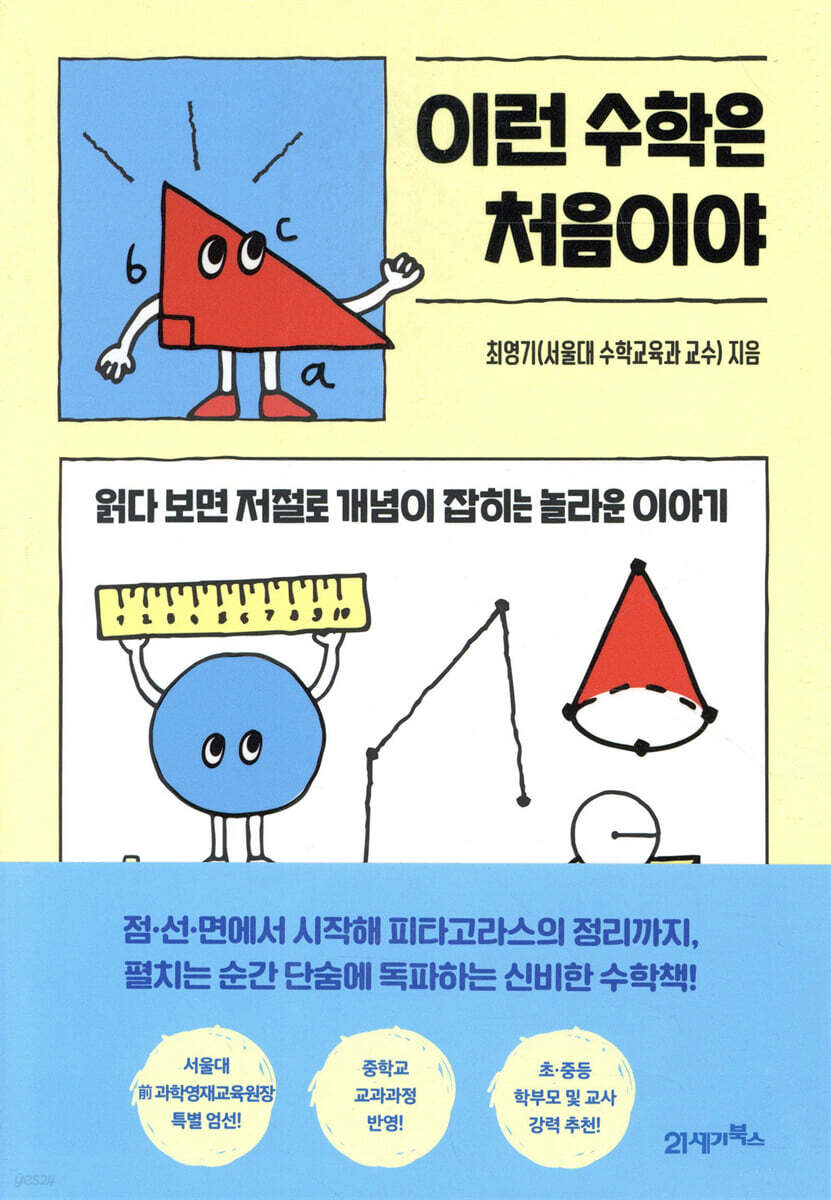
This is my first time seeing math like this
 |
Description
Book Introduction
“If only I had learned math like this in the first place!” The World's Easiest Math Lecture by a Seoul National University Mathematics Education Professor A beautiful world of points, lines, and planes unfolds endlessly, from a single point to a shape! As you follow the mystical world of shapes, illustrated by a Seoul National University professor of mathematics education, you'll experience the astonishing experience of naturally ingraining mathematical concepts, from the birth of mathematical formulas to the infinitely expanding world of mathematical concepts. The author, who served as the director of the Seoul National University Science Gifted Education Center and has researched gifted education methods, has structured the story based on the middle school curriculum so that this book is not just fun, but can also lead to improved math skills. Additionally, for elementary and middle school students who want to study mathematics in a fun way, we have carefully selected essential mathematical concepts and introduced them to the world of mathematics in the easiest and most interesting way possible through unique stories never seen before. This is the author's first book for teenagers, and it will help them become familiar with math and look forward to math class! |
- You can preview some of the book's contents.
Preview
index
As I published the book, I thought, “If only I had learned it this way from the beginning!”
Prologue This is a surprising and mysterious story about shapes.
Lesson 1: From a Point to a Shape - Lines, Angles, Triangles, and Polygons
The birth of points, lines, and planes
Each - Between You and Me
Boundaries - What Makes Me Me
How did I become a triangle?
[The moment you open your eyes to math 1] Alternating angles say the Earth is not flat
The DNA of a Triangle - My Own Angle 180°
The beautiful relationship between 'change' and 'angle'
The Egyptian pyramids were born from a²+b²=c²
The formula for life discovered in polygons
Law of Constancy of Peripheral Angles - When the points meet, it is 360°
[The Moment You Open Your Eyes to Math 2] The Principle of Exterior Angles Discovered in Everyday Life
- Looking back at the story 1
Lesson 2: What a perfect shape! - Square, Circle, Center of Gravity
How can we find the area?
I want to be the widest triangle
What happens if a square grows infinitely?
Won - It's perfect no matter how you look at it!
[The Moment You Open Your Eyes to Math 3] Construction - How to See the World with Circles and Lines
Find the triangle's doppelganger
When a circle and a line meet
Points, lines, and planes that shine when together
What happens if you divide each angle in half?
The triangle that dreams of perfection
Center of Gravity - Finding My True Self
- Looking back at the story 2
Lecture 3: That's how mathematics came to me - Similarity, Pi, Pythagoras
Similarity - I'm happy because you're here!
[The Moment You Open Your Eyes to Math 4] Vanishing Point - Seeing from a Human Perspective
The joy of calculating the area of a triangle
Pi - The Mysterious Number in a Circle
Equal treatment for all, the heart of the circle
A heart-pounding world created by shapes!
[The Moment You Open Your Eyes to Math 5] The Pythagorean Theorem and the Beauty of Its Proof
- Looking back at the story 3
Prologue This is a surprising and mysterious story about shapes.
Lesson 1: From a Point to a Shape - Lines, Angles, Triangles, and Polygons
The birth of points, lines, and planes
Each - Between You and Me
Boundaries - What Makes Me Me
How did I become a triangle?
[The moment you open your eyes to math 1] Alternating angles say the Earth is not flat
The DNA of a Triangle - My Own Angle 180°
The beautiful relationship between 'change' and 'angle'
The Egyptian pyramids were born from a²+b²=c²
The formula for life discovered in polygons
Law of Constancy of Peripheral Angles - When the points meet, it is 360°
[The Moment You Open Your Eyes to Math 2] The Principle of Exterior Angles Discovered in Everyday Life
- Looking back at the story 1
Lesson 2: What a perfect shape! - Square, Circle, Center of Gravity
How can we find the area?
I want to be the widest triangle
What happens if a square grows infinitely?
Won - It's perfect no matter how you look at it!
[The Moment You Open Your Eyes to Math 3] Construction - How to See the World with Circles and Lines
Find the triangle's doppelganger
When a circle and a line meet
Points, lines, and planes that shine when together
What happens if you divide each angle in half?
The triangle that dreams of perfection
Center of Gravity - Finding My True Self
- Looking back at the story 2
Lecture 3: That's how mathematics came to me - Similarity, Pi, Pythagoras
Similarity - I'm happy because you're here!
[The Moment You Open Your Eyes to Math 4] Vanishing Point - Seeing from a Human Perspective
The joy of calculating the area of a triangle
Pi - The Mysterious Number in a Circle
Equal treatment for all, the heart of the circle
A heart-pounding world created by shapes!
[The Moment You Open Your Eyes to Math 5] The Pythagorean Theorem and the Beauty of Its Proof
- Looking back at the story 3
Detailed image

Into the book
Line segments meet with the same endpoints, greet each other, and measure the angle created to determine the degree of intimacy between them.
As we greeted each other like that, a shape was created where three line segments went around each other and had the same endpoint.
Looking at that shape, it was strangely divided into an inside part and an outside part with three line segments as the boundary.
A shape that can be distinguished inside and outside like this is called a closed shape, and this is how the first closed shape was created.
It's a triangle!
--- p.32
Wow! Amazing, isn't it? If you follow this process, you'll see that the sum of the exterior angles of any polygon is always 360°.
Let's think about it another way this time. Looking at the following figure, you can see that the larger the exterior angle, the sharper the interior angle.
This means, conversely, that the smaller the exterior angle, the more blunt the sharpness of the triangle.
So, let's cut off one side of the triangle. What shape do you think it will be? It's a square.
--- p.67
If you continue this process indefinitely, what you will eventually reach is a circle.
A circle has a larger area than any polygon with the same perimeter.
So, the attempts of shapes to increase their area end up in circles.
In the end, when you think about it by adding extension to extension, it turns out that the shape with the largest area among the shapes with the same perimeter is a circle.
How about relating this to the human world? The polygons have come to possess a kind of wish they could never achieve on their own.
The goal was to grow to an increasingly larger area.
--- p.91
Let's find point B. Finally, the shape of triangle ABC came to mind.
All of this was possible because we found the location of point B with the help of line segment AC.
This is how important it is to maintain your own position.
A triangle is made up of three sides and three angles, and the six pieces of information derived from these are the information that determines everything about the triangle, that is, the DNA of the triangle.
--- p.109
Then one day, a straight line passed through the circle.
I felt a sense of encounter with something, warmth, comfort, and comfort.
To soothe my regret, I tried to remember the point where the circle met the straight line.
At first, they met at one point, and as the line moved, they met at two other points, and eventually they met at a point in the middle of the circle.
The first encounter with circles and straight lines began at A0 and ended at A4.
Although the circle and the line have parted ways, we decided to name them to remember their meeting.
--- p.117
The circle is a mature shape that can create beautiful relationships while maintaining perfect harmony with other shapes.
In that sense, the circle is the shape of perfect shapes and the dream and hope of all shapes.
Right triangles with the same hypotenuse or quadrilaterals with opposite angles summing to 180° can also be combined to form a circle.
In that sense, I think it could be said that the circle is the romance of all shapes.
However, the circle does not ignore or reject the triangle or square, thinking that it is better than itself.
Just embrace them.
--- p.130
Each of the three points has the potential to become a triangle or a circle, but that power is invisible to the eye.
But just because you can't see it doesn't mean it's not possible.
Sometimes they exist alone and live as a single point, and sometimes they join forces to form a triangle.
And you can make a circle by maximizing the possibilities.
At this point, what we need to create a circle is the help of a perpendicular bisector.
--- p.137
In fact, there can be numerous strings within a circle.
Some strings are very short, and some strings are very long.
Perhaps the short strings complained and grumbled about their own shortness? The circle must have been aware of that discontent. The circle's solution, which encompassed everything, was to have that string meet another string.
It is the product of the lengths of the line segments divided by the intersection point where it meets another chord and the product of the lengths of the line segments divided by the other chord that intersects that intersection point.
As we greeted each other like that, a shape was created where three line segments went around each other and had the same endpoint.
Looking at that shape, it was strangely divided into an inside part and an outside part with three line segments as the boundary.
A shape that can be distinguished inside and outside like this is called a closed shape, and this is how the first closed shape was created.
It's a triangle!
--- p.32
Wow! Amazing, isn't it? If you follow this process, you'll see that the sum of the exterior angles of any polygon is always 360°.
Let's think about it another way this time. Looking at the following figure, you can see that the larger the exterior angle, the sharper the interior angle.
This means, conversely, that the smaller the exterior angle, the more blunt the sharpness of the triangle.
So, let's cut off one side of the triangle. What shape do you think it will be? It's a square.
--- p.67
If you continue this process indefinitely, what you will eventually reach is a circle.
A circle has a larger area than any polygon with the same perimeter.
So, the attempts of shapes to increase their area end up in circles.
In the end, when you think about it by adding extension to extension, it turns out that the shape with the largest area among the shapes with the same perimeter is a circle.
How about relating this to the human world? The polygons have come to possess a kind of wish they could never achieve on their own.
The goal was to grow to an increasingly larger area.
--- p.91
Let's find point B. Finally, the shape of triangle ABC came to mind.
All of this was possible because we found the location of point B with the help of line segment AC.
This is how important it is to maintain your own position.
A triangle is made up of three sides and three angles, and the six pieces of information derived from these are the information that determines everything about the triangle, that is, the DNA of the triangle.
--- p.109
Then one day, a straight line passed through the circle.
I felt a sense of encounter with something, warmth, comfort, and comfort.
To soothe my regret, I tried to remember the point where the circle met the straight line.
At first, they met at one point, and as the line moved, they met at two other points, and eventually they met at a point in the middle of the circle.
The first encounter with circles and straight lines began at A0 and ended at A4.
Although the circle and the line have parted ways, we decided to name them to remember their meeting.
--- p.117
The circle is a mature shape that can create beautiful relationships while maintaining perfect harmony with other shapes.
In that sense, the circle is the shape of perfect shapes and the dream and hope of all shapes.
Right triangles with the same hypotenuse or quadrilaterals with opposite angles summing to 180° can also be combined to form a circle.
In that sense, I think it could be said that the circle is the romance of all shapes.
However, the circle does not ignore or reject the triangle or square, thinking that it is better than itself.
Just embrace them.
--- p.130
Each of the three points has the potential to become a triangle or a circle, but that power is invisible to the eye.
But just because you can't see it doesn't mean it's not possible.
Sometimes they exist alone and live as a single point, and sometimes they join forces to form a triangle.
And you can make a circle by maximizing the possibilities.
At this point, what we need to create a circle is the help of a perpendicular bisector.
--- p.137
In fact, there can be numerous strings within a circle.
Some strings are very short, and some strings are very long.
Perhaps the short strings complained and grumbled about their own shortness? The circle must have been aware of that discontent. The circle's solution, which encompassed everything, was to have that string meet another string.
It is the product of the lengths of the line segments divided by the intersection point where it meets another chord and the product of the lengths of the line segments divided by the other chord that intersects that intersection point.
--- p.187
Publisher's Review
“I started to become familiar with math with this one book!”
As you follow the story, you will learn math concepts naturally!
While Korean students consistently rank among the top in math achievement in international assessments, they rank among the lowest in items measuring whether they like and are interested in math.
Professor Choi Young-ki, a professor of mathematics education at Seoul National University and former director of the Seoul National University Science Gifted Education Center, points out this very point, saying, “Now that the knowledge required by the times has clearly changed, mathematics education must also move toward fostering the insight to properly see the essence of concepts.”
He also emphasizes that “only then can we cultivate creative individuals who can discover something and come up with something new.”
The author says that what students need most right now is a love of mathematics. After much deliberation on how to enhance both fun and learning ability, he published this book as his first attempt.
To prevent the phenomenon of mathematics becoming difficult and rigid again during class time, the author chose to carefully select only the essential concepts from the middle school curriculum and developed an exciting story within them.
This book, which contains colorful stories unfolding in the world of shapes with over 100 illustrations and friendly explanations, will stimulate elementary school students' curiosity about middle school math concepts before they enter middle school, and help middle school students reflect more deeply on what they learn in school.
This will be a meaningful book that broadens your perspective on the world through mathematics by getting closer to the concepts and essence of mathematics.
“This is the most mysterious and beautiful story about shapes.”
No one has ever solved a shape so interestingly before!
Professor Choi Young-ki of the Department of Mathematics Education at Seoul National University guides us into the fascinating world of mathematics through stories of strange and mysterious shapes that begin with points and extend infinitely to the Pythagorean theorem, starting from points, lines, and planes.
This book consists of three chapters, and Chapter 1, 'How a Dot Becomes a Shape', tells the story of how points come together to form line segments, how those lines come together to form shapes, and how the angles are created within those shapes.
In 'Lecture 2: Such Perfect Shapes!', the process of calculating the area of shapes such as triangles, squares, and circles and their formulas are covered in an interesting way.
In the final lecture, 'That's how mathematics came to me', we cover more advanced geometric concepts that unfold on a plane, focusing on the similarity properties of geometric shapes.
Additionally, the 'Moment of Opening Your Eyes to Math' section, included throughout the text, tells the story of how mathematical discoveries and mathematical concepts created by shapes have been applied to our lives up to now.
Lastly, the 'Story Review' section at the end of each chapter extracts only the mathematical concepts from the story and organizes them with curriculum notation so that the concepts and formulas can be summarized at a glance.
After reading this book, you will have the amazing experience of naturally organizing the concepts and formulas in your head, making math classes, which used to be difficult, enjoyable, and solving math problems smoothly without any difficulties.
As you follow the story, you will learn math concepts naturally!
While Korean students consistently rank among the top in math achievement in international assessments, they rank among the lowest in items measuring whether they like and are interested in math.
Professor Choi Young-ki, a professor of mathematics education at Seoul National University and former director of the Seoul National University Science Gifted Education Center, points out this very point, saying, “Now that the knowledge required by the times has clearly changed, mathematics education must also move toward fostering the insight to properly see the essence of concepts.”
He also emphasizes that “only then can we cultivate creative individuals who can discover something and come up with something new.”
The author says that what students need most right now is a love of mathematics. After much deliberation on how to enhance both fun and learning ability, he published this book as his first attempt.
To prevent the phenomenon of mathematics becoming difficult and rigid again during class time, the author chose to carefully select only the essential concepts from the middle school curriculum and developed an exciting story within them.
This book, which contains colorful stories unfolding in the world of shapes with over 100 illustrations and friendly explanations, will stimulate elementary school students' curiosity about middle school math concepts before they enter middle school, and help middle school students reflect more deeply on what they learn in school.
This will be a meaningful book that broadens your perspective on the world through mathematics by getting closer to the concepts and essence of mathematics.
“This is the most mysterious and beautiful story about shapes.”
No one has ever solved a shape so interestingly before!
Professor Choi Young-ki of the Department of Mathematics Education at Seoul National University guides us into the fascinating world of mathematics through stories of strange and mysterious shapes that begin with points and extend infinitely to the Pythagorean theorem, starting from points, lines, and planes.
This book consists of three chapters, and Chapter 1, 'How a Dot Becomes a Shape', tells the story of how points come together to form line segments, how those lines come together to form shapes, and how the angles are created within those shapes.
In 'Lecture 2: Such Perfect Shapes!', the process of calculating the area of shapes such as triangles, squares, and circles and their formulas are covered in an interesting way.
In the final lecture, 'That's how mathematics came to me', we cover more advanced geometric concepts that unfold on a plane, focusing on the similarity properties of geometric shapes.
Additionally, the 'Moment of Opening Your Eyes to Math' section, included throughout the text, tells the story of how mathematical discoveries and mathematical concepts created by shapes have been applied to our lives up to now.
Lastly, the 'Story Review' section at the end of each chapter extracts only the mathematical concepts from the story and organizes them with curriculum notation so that the concepts and formulas can be summarized at a glance.
After reading this book, you will have the amazing experience of naturally organizing the concepts and formulas in your head, making math classes, which used to be difficult, enjoyable, and solving math problems smoothly without any difficulties.
GOODS SPECIFICS
- Publication date: November 11, 2020
- Page count, weight, size: 204 pages | 362g | 135*197*20mm
- ISBN13: 9788950993016
- ISBN10: 8950993015
You may also like
카테고리
korean


korean

![GQ KOREA Mark (Monthly): December [2025]](http://librairie.coreenne.fr/cdn/shop/files/8ef265dbbfbf186523ed75ba7319009d.jpg?v=1765340328&width=3840)


