

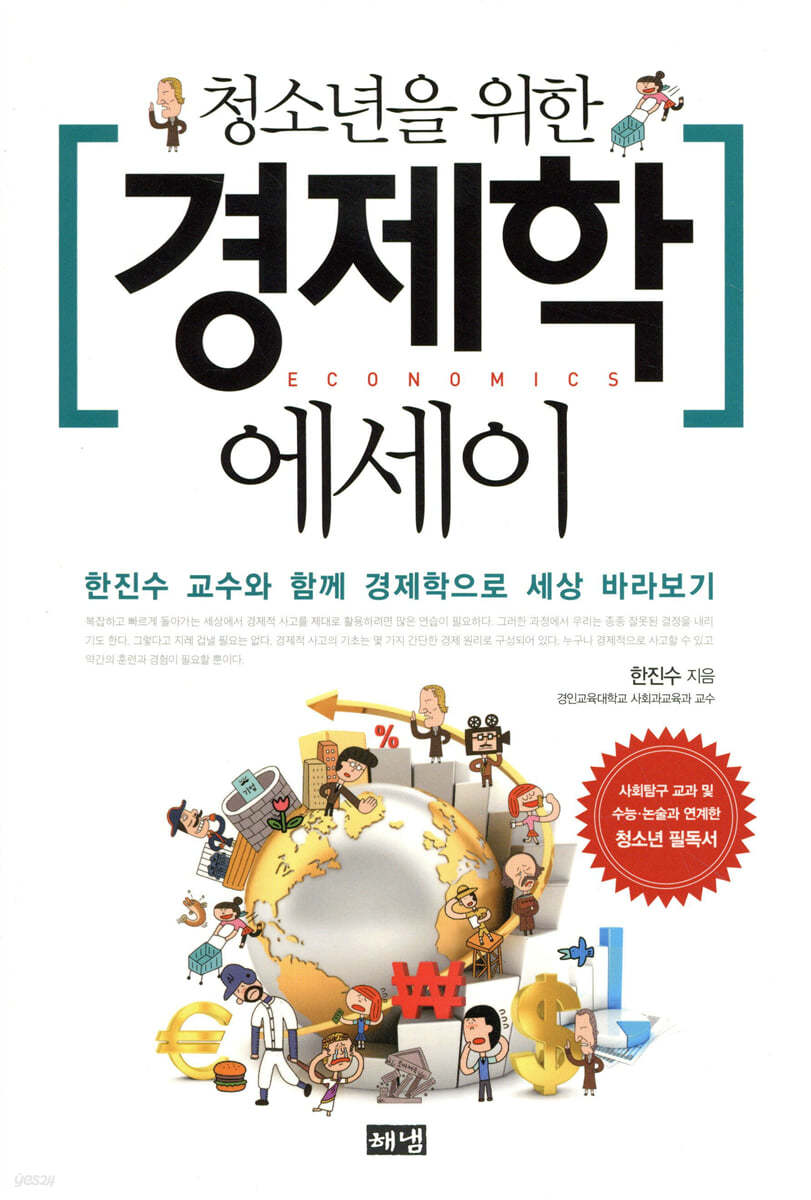
Economics Essays for Teens
 |
Description
Book Introduction
Professor Han Jin-soo, Korea's leading economic education expert
Through economic principles and concepts hidden in everyday life
Raise young people's economic thinking skills and cultivate their perspective on the world!
Warren Buffett, the world's greatest investor, began his economic career at a young age.
At the age of eleven, he had already mastered the principles of market economics and began investing in stocks.
Bill Gates' father, one of the world's richest men and a philanthropist, made efforts to educate his children about finances, including having the young Gates record his purchases in a ledger and engaging in case-based discussions.
Behind these world-class wealthy individuals are sound economic habits and rational thinking acquired through economic education from a young age.
Especially in a world like ours, where financial crises are recurring and growth is prolonged, economic education is an even more important virtue.
Unfortunately, however, although our country's youth are increasingly involved in social participation and economic activities are becoming more active, they do not have many opportunities to learn about 'economics'.
Economic education in schools is rarely provided outside of social studies classes, and instead, economic education programs run by private institutions are proliferating.
At a time when economic education for youth is so desperately needed, Professor Jin-soo Han of Gyeongin National University of Education published “Economics Essays for Youth” as the twelfth book in the “Youth Essay” series, published by Haeneum Publishing as an alternative textbook to foster the creative intelligence and character of youth, to help youth learn economics in a more easy and fun way and internalize its principles.
Through economic principles and concepts hidden in everyday life
Raise young people's economic thinking skills and cultivate their perspective on the world!
Warren Buffett, the world's greatest investor, began his economic career at a young age.
At the age of eleven, he had already mastered the principles of market economics and began investing in stocks.
Bill Gates' father, one of the world's richest men and a philanthropist, made efforts to educate his children about finances, including having the young Gates record his purchases in a ledger and engaging in case-based discussions.
Behind these world-class wealthy individuals are sound economic habits and rational thinking acquired through economic education from a young age.
Especially in a world like ours, where financial crises are recurring and growth is prolonged, economic education is an even more important virtue.
Unfortunately, however, although our country's youth are increasingly involved in social participation and economic activities are becoming more active, they do not have many opportunities to learn about 'economics'.
Economic education in schools is rarely provided outside of social studies classes, and instead, economic education programs run by private institutions are proliferating.
At a time when economic education for youth is so desperately needed, Professor Jin-soo Han of Gyeongin National University of Education published “Economics Essays for Youth” as the twelfth book in the “Youth Essay” series, published by Haeneum Publishing as an alternative textbook to foster the creative intelligence and character of youth, to help youth learn economics in a more easy and fun way and internalize its principles.
- You can preview some of the book's contents.
Preview
index
index
Introduction: Adding 'Economy' to Youth's Thinking
Chapter 1: Let's Dive into the World of Economics
1. Uncover the True Nature of Economics! _Scarcity, Economics
2 How to make rational choices? _Rational choice, economic thinking, opportunity cost
3. Coolly forget about the money you've already spent - sunk costs
4 The economy is a clockwork of rotating gears - the cycle of economic activity, the paradox of thrift, the function of money
5. What's important? Efficiency is important! _Efficiency, production possibilities curve, market economy
6. If I am good, will society be good too? _Consumer surplus, producer surplus
7. Let's get the "percent" wrong on the CSAT. _Percent, Percentage Point
8 Terms to Understand the Economy - Money, Investment, Capital, Scarcity, Freebies, Spending
The Living Economy: Early Savings Are More Important Than Early Education
Chapter 2: A Brief History of Economics
1 Economic thinkers before the birth of economics: Hesiod, Xenophon, Aristotle
2. Blocking imports and increasing exports, Colbert's mercantilism _ Mercantilism, protectionism
3. Adam Smith, the father of economics - The Wealth of Nations, The Invisible Hand, Laissez-faire, Absolute Advantage
4 Malthus vs. Ricardo, the Battle over the Corn Laws _ Comparative Advantage, Corn Laws
5 Marshall, Scientific Analysis of the Economy - The Law of Diminishing Marginal Utility, Neoclassical Economics, Elasticity
6 Keynes's Law, Fiscal Policy, and the Role of Government, Emphasizing the Economic Role of Government
The Living Economy: Private Property as the Driving Force of National Development
Chapter 3: Uncovering Prices: The Core of a Market Economy
1. The power that moves people, incentives, and the cobra effect
2 Why do agricultural product prices fluctuate so much? _Elastic, Inelastic, and the Paradox of a Good Harvest
3. Changes in the status of goods according to supply and income - supply elasticity, income elasticity
4 The Secret of Production Costs That Decrease the More You Make - Fixed Costs, Variable Costs, Economies of Scale, Profit Margin
5. The Economics of Movie Theaters We Didn't Know - Elasticity and Price Discrimination
6 Why are daily reading room fees so expensive? _Demand curve, price discrimination
7 Open Consumers' Wallets - Price Breaking, One-Buy-One, Bundling
The Living Economy: Where Economics and Psychology Meet
Chapter 4: Dissecting the Market Unlocks the Secrets of Economics
1 Too many stores _ monopolies, substitutes, barriers to entry
2 The secret of similar school uniform prices in any store - oligopoly, collusion, product discrimination, price leadership
3 Fierce Competition, How They Survive _ Competition, Monopolistic Competition, Advertising, Brands
4 Economic Principles Explained by Idols: Excess Demand, Black Markets, and Land Rent
5 Singer, Actor _ Risk Diversification, Portfolio, Economies of Scope
6 One plus one equals two _ Synergy effect, catfish effect
The Living Economy: Why Medical School Enrollment Stalls
Chapter 5: Understanding National Economic Issues and Mastering Economics
1 What the government should do in a market economy - public goods, free riders, the tragedy of the commons, externalities
2. The Golden Spoon and the Dirt Spoon _ Polarization, the gap between the rich and the poor, progressive taxation, and the trickle-down effect
3 A World That Recommends Debt - Loans, Debt, Leverage, and National Debt
4 If money fell from the sky - inflation, deflation, aggregate demand, aggregate supply
Operation 5: Reviving the Economy: Monetary Policy, Fiscal Policy, and Quantitative Easing
6. Without my work, there is no tomorrow _ unemployment, job sharing, employment rate
7. Free Trade vs. Protectionism: Which is Better? _Free Trade, Protectionism, FTAs, Infant Industries
The Living Economy: Why We Care About US Interest Rate Hikes
Note
Introduction: Adding 'Economy' to Youth's Thinking
Chapter 1: Let's Dive into the World of Economics
1. Uncover the True Nature of Economics! _Scarcity, Economics
2 How to make rational choices? _Rational choice, economic thinking, opportunity cost
3. Coolly forget about the money you've already spent - sunk costs
4 The economy is a clockwork of rotating gears - the cycle of economic activity, the paradox of thrift, the function of money
5. What's important? Efficiency is important! _Efficiency, production possibilities curve, market economy
6. If I am good, will society be good too? _Consumer surplus, producer surplus
7. Let's get the "percent" wrong on the CSAT. _Percent, Percentage Point
8 Terms to Understand the Economy - Money, Investment, Capital, Scarcity, Freebies, Spending
The Living Economy: Early Savings Are More Important Than Early Education
Chapter 2: A Brief History of Economics
1 Economic thinkers before the birth of economics: Hesiod, Xenophon, Aristotle
2. Blocking imports and increasing exports, Colbert's mercantilism _ Mercantilism, protectionism
3. Adam Smith, the father of economics - The Wealth of Nations, The Invisible Hand, Laissez-faire, Absolute Advantage
4 Malthus vs. Ricardo, the Battle over the Corn Laws _ Comparative Advantage, Corn Laws
5 Marshall, Scientific Analysis of the Economy - The Law of Diminishing Marginal Utility, Neoclassical Economics, Elasticity
6 Keynes's Law, Fiscal Policy, and the Role of Government, Emphasizing the Economic Role of Government
The Living Economy: Private Property as the Driving Force of National Development
Chapter 3: Uncovering Prices: The Core of a Market Economy
1. The power that moves people, incentives, and the cobra effect
2 Why do agricultural product prices fluctuate so much? _Elastic, Inelastic, and the Paradox of a Good Harvest
3. Changes in the status of goods according to supply and income - supply elasticity, income elasticity
4 The Secret of Production Costs That Decrease the More You Make - Fixed Costs, Variable Costs, Economies of Scale, Profit Margin
5. The Economics of Movie Theaters We Didn't Know - Elasticity and Price Discrimination
6 Why are daily reading room fees so expensive? _Demand curve, price discrimination
7 Open Consumers' Wallets - Price Breaking, One-Buy-One, Bundling
The Living Economy: Where Economics and Psychology Meet
Chapter 4: Dissecting the Market Unlocks the Secrets of Economics
1 Too many stores _ monopolies, substitutes, barriers to entry
2 The secret of similar school uniform prices in any store - oligopoly, collusion, product discrimination, price leadership
3 Fierce Competition, How They Survive _ Competition, Monopolistic Competition, Advertising, Brands
4 Economic Principles Explained by Idols: Excess Demand, Black Markets, and Land Rent
5 Singer, Actor _ Risk Diversification, Portfolio, Economies of Scope
6 One plus one equals two _ Synergy effect, catfish effect
The Living Economy: Why Medical School Enrollment Stalls
Chapter 5: Understanding National Economic Issues and Mastering Economics
1 What the government should do in a market economy - public goods, free riders, the tragedy of the commons, externalities
2. The Golden Spoon and the Dirt Spoon _ Polarization, the gap between the rich and the poor, progressive taxation, and the trickle-down effect
3 A World That Recommends Debt - Loans, Debt, Leverage, and National Debt
4 If money fell from the sky - inflation, deflation, aggregate demand, aggregate supply
Operation 5: Reviving the Economy: Monetary Policy, Fiscal Policy, and Quantitative Easing
6. Without my work, there is no tomorrow _ unemployment, job sharing, employment rate
7. Free Trade vs. Protectionism: Which is Better? _Free Trade, Protectionism, FTAs, Infant Industries
The Living Economy: Why We Care About US Interest Rate Hikes
Note
Detailed image

Into the book
“Subjects like Korean, English, and math should be studied regularly.
Studying by cramming right before the test won't improve your score.
So advice like “You should focus on memorizing subjects right before the exam” is a product of economic thinking.
I guarantee that there isn't a single person reading this book who hasn't at least once wondered what to buy with the money they have and what to do with the time they have left.
We all struggle and make choices several times a day.
Therefore, even if you don't have a PhD in economics, everyone in this world can be considered a living economist.
Our lives themselves are an economic phenomenon, and we make economic choices all the time.
What's so important about a PhD? Even without a degree, as long as you can make rational choices, you're more than qualified to be a living economist.
At any point in time when making a decision, the only costs and benefits we need to consider are the 'additional costs to be paid' and the 'additional benefits to be gained' in the future.
Sunk costs are costs that have already been spent in the past and cannot be recovered, so the economic way of thinking is to forget and give up on them, whether they be money, time, or sweat.
Tomorrow the sun will rise again.
We need to shake off the past and consider only what choices are rational for the future.
In novels and dramas, there are often scenes where a character monologues, saying, “I’ve come too far to give up (to turn back).”
It sounds very meaningful and plausible, but in reality it is extremely uneconomical.
Our protagonist, with his economic mindset, would say this:
“We have to stop before we go any further!”
--- "Chapter 1: Let's Depart for the World of Economics"
The Great Depression was a very shocking phenomenon at a time when classical or neoclassical economics were dominant.
Those who were devoted to classical economics believed that long-term mass unemployment or the Great Depression could not occur because the "invisible hand" would work to restore supply and demand to equilibrium.
But the mass unemployment and economic recession unfolding before our eyes was a stark reality.
As it became clear that conventional economics was flawed, people began to need a new economics.
The person who boldly appeared at this time, broke the mold of old thinking, and presented a new economics was Keynes.
He called those who clung to conventional economics fools, saying what good would it do if the economy recovered after everyone died?
--- "Chapter 2: A Brief History of Economics"
There is an important economic principle hidden in the price of popcorn sold at movie theaters.
Compared to the 'medium' character, the 'large' character popcorn is twice as big.
At first, most people hesitate to buy because of the huge size, but when they realize that the price difference is only 500 won, most people order the 'large' size.
And when you leave the movie theater, throw away the uneaten popcorn in the trash.
The marginal additional cost for a movie theater to make a large popcorn is less than 100 won compared to making a medium popcorn.
It only requires a little more corn as an ingredient, and the cost is not that much.
Therefore, even if the price of 'Dae' popcorn is set just 500 won higher, it is not a loss for the movie theater, and the more 'Dae' popcorns are sold, the more profits can be increased.
If you want to entice audiences to buy a lot of 'large' popcorn, the price difference with 'medium' popcorn should not be too large.
So, there is a difference of only 500 won, and many viewers hesitate and fall for the temptation of the word 'big'.
--- "Chapter 3: Uncovering the Core of a Market Economy: Prices"
When an entertainment agency first forms an idol group, it applies the economic principle of comparative advantage.
We thoroughly analyze each member's abilities, determine their areas of comparative advantage, and divide roles so that they can specialize in those areas.
This is because it is judged that the possibility of success is high when a group is formed by appropriately mixing in vocalists, rappers, choreographers, entertainers, and looks.
In the case of EXO, mentioned above, they are evaluated as a team that has perfectly achieved division of labor by part.
Entertainment agencies sometimes employ strategies to increase the number of members to reduce the risk of failure.
This is the same principle that companies diversify their businesses to reduce the risk of investment losses.
Considering that fans have diverse tastes, it's likely that any group with multiple members will have at least one member they like.
The term "monopolistic competitive market" may sound like a contradiction at first glance.
This is because it is a word that combines ‘monopoly’ and ‘competition’, which are diametrically opposed concepts.
However, the reason economists call it 'monopolistic competition' is because although the competition is intense, it contains the characteristics of a monopoly.
In other words, the chicken market has characteristics of both a monopoly and a competitive market.
First of all, our country's chicken market is very competitive.
They try to attract consumers' attention by cooking chicken in various ways.
When a new flavor of chicken is released in one place and becomes popular, other places immediately launch similar flavors to compete.
At the same time, our country's chicken market is 'monopolistic'.
Each chicken company has its own unique cooking method and secret recipe, including seasoning, which makes them slightly different from other companies.
Chicken companies that are confident in their taste and quality have a certain degree of monopoly over the chicken they make, and they also have the market power to set high prices.
--- "Chapter 4: Dissecting the Market Unlocks the Secrets of Economics"
If inflation, where prices continue to rise, places such a heavy burden on the economy, would deflation, where prices continue to fall, help the economy? No.
Just as rising prices distort resource allocation, falling prices also distort resource allocation.
But this time, the direction of the distortion changes.
When deflation occurs, debtors lose and creditors gain.
The problem is that income and assets are concentrated in one direction regardless of one's efforts.
Therefore, deflation is also undesirable.
Deflation might seem like a positive thing because it increases real income, allowing people to buy more goods and services with the same amount of money. However, in reality, deflation is more unwelcome than inflation.
Studying by cramming right before the test won't improve your score.
So advice like “You should focus on memorizing subjects right before the exam” is a product of economic thinking.
I guarantee that there isn't a single person reading this book who hasn't at least once wondered what to buy with the money they have and what to do with the time they have left.
We all struggle and make choices several times a day.
Therefore, even if you don't have a PhD in economics, everyone in this world can be considered a living economist.
Our lives themselves are an economic phenomenon, and we make economic choices all the time.
What's so important about a PhD? Even without a degree, as long as you can make rational choices, you're more than qualified to be a living economist.
At any point in time when making a decision, the only costs and benefits we need to consider are the 'additional costs to be paid' and the 'additional benefits to be gained' in the future.
Sunk costs are costs that have already been spent in the past and cannot be recovered, so the economic way of thinking is to forget and give up on them, whether they be money, time, or sweat.
Tomorrow the sun will rise again.
We need to shake off the past and consider only what choices are rational for the future.
In novels and dramas, there are often scenes where a character monologues, saying, “I’ve come too far to give up (to turn back).”
It sounds very meaningful and plausible, but in reality it is extremely uneconomical.
Our protagonist, with his economic mindset, would say this:
“We have to stop before we go any further!”
--- "Chapter 1: Let's Depart for the World of Economics"
The Great Depression was a very shocking phenomenon at a time when classical or neoclassical economics were dominant.
Those who were devoted to classical economics believed that long-term mass unemployment or the Great Depression could not occur because the "invisible hand" would work to restore supply and demand to equilibrium.
But the mass unemployment and economic recession unfolding before our eyes was a stark reality.
As it became clear that conventional economics was flawed, people began to need a new economics.
The person who boldly appeared at this time, broke the mold of old thinking, and presented a new economics was Keynes.
He called those who clung to conventional economics fools, saying what good would it do if the economy recovered after everyone died?
--- "Chapter 2: A Brief History of Economics"
There is an important economic principle hidden in the price of popcorn sold at movie theaters.
Compared to the 'medium' character, the 'large' character popcorn is twice as big.
At first, most people hesitate to buy because of the huge size, but when they realize that the price difference is only 500 won, most people order the 'large' size.
And when you leave the movie theater, throw away the uneaten popcorn in the trash.
The marginal additional cost for a movie theater to make a large popcorn is less than 100 won compared to making a medium popcorn.
It only requires a little more corn as an ingredient, and the cost is not that much.
Therefore, even if the price of 'Dae' popcorn is set just 500 won higher, it is not a loss for the movie theater, and the more 'Dae' popcorns are sold, the more profits can be increased.
If you want to entice audiences to buy a lot of 'large' popcorn, the price difference with 'medium' popcorn should not be too large.
So, there is a difference of only 500 won, and many viewers hesitate and fall for the temptation of the word 'big'.
--- "Chapter 3: Uncovering the Core of a Market Economy: Prices"
When an entertainment agency first forms an idol group, it applies the economic principle of comparative advantage.
We thoroughly analyze each member's abilities, determine their areas of comparative advantage, and divide roles so that they can specialize in those areas.
This is because it is judged that the possibility of success is high when a group is formed by appropriately mixing in vocalists, rappers, choreographers, entertainers, and looks.
In the case of EXO, mentioned above, they are evaluated as a team that has perfectly achieved division of labor by part.
Entertainment agencies sometimes employ strategies to increase the number of members to reduce the risk of failure.
This is the same principle that companies diversify their businesses to reduce the risk of investment losses.
Considering that fans have diverse tastes, it's likely that any group with multiple members will have at least one member they like.
The term "monopolistic competitive market" may sound like a contradiction at first glance.
This is because it is a word that combines ‘monopoly’ and ‘competition’, which are diametrically opposed concepts.
However, the reason economists call it 'monopolistic competition' is because although the competition is intense, it contains the characteristics of a monopoly.
In other words, the chicken market has characteristics of both a monopoly and a competitive market.
First of all, our country's chicken market is very competitive.
They try to attract consumers' attention by cooking chicken in various ways.
When a new flavor of chicken is released in one place and becomes popular, other places immediately launch similar flavors to compete.
At the same time, our country's chicken market is 'monopolistic'.
Each chicken company has its own unique cooking method and secret recipe, including seasoning, which makes them slightly different from other companies.
Chicken companies that are confident in their taste and quality have a certain degree of monopoly over the chicken they make, and they also have the market power to set high prices.
--- "Chapter 4: Dissecting the Market Unlocks the Secrets of Economics"
If inflation, where prices continue to rise, places such a heavy burden on the economy, would deflation, where prices continue to fall, help the economy? No.
Just as rising prices distort resource allocation, falling prices also distort resource allocation.
But this time, the direction of the distortion changes.
When deflation occurs, debtors lose and creditors gain.
The problem is that income and assets are concentrated in one direction regardless of one's efforts.
Therefore, deflation is also undesirable.
Deflation might seem like a positive thing because it increases real income, allowing people to buy more goods and services with the same amount of money. However, in reality, deflation is more unwelcome than inflation.
--- From the text
Publisher's Review
The author is the president of the Korean Economic Education Association and vice president of the Korean Financial Education Association, and is a leading economic education mentor who is leading the way in revitalizing economic education in Korea.
At first glance, economics is often thought of as a discipline for adults, especially professionals.
However, our lives themselves are an extension of economic phenomena, and young people are always faced with economic choices.
That is why the author says that young people are also like ‘living economists in everyday life.’
The focus was on helping young people naturally acquire economic concepts and principles through economic issues they easily encounter around them.
It consists of a total of five chapters, and in Chapter 1, before entering the world of economics in earnest, we look at what economics is and the concepts and terms mainly used in economics.
In Chapter 2, we looked back at the history of economics and how it has developed, together with major economists.
Chapter 3 delves into the intricacies of 'price,' which can be said to be the core of a market economy, and explains in detail how prices are formed and how the economy circulates.
Chapter 4 covers the 'market', which is the most important factor in understanding the economy.
We focused on the types and functions of markets and the economic principles that operate in markets through examples that can be easily seen around us.
Finally, Chapter 5 examines national economic issues, enabling young people to understand economic trends in our country and the world and gain a broader perspective.
It is full of examples of things that teenagers can experience at home, at school, and in peer groups.
As you delve into a variety of interesting cases that teenagers might be curious about, such as why school uniform prices are similar across all companies, why idol concert tickets are soaring, and why the daily fee for study rooms is so high, along with the author's characteristically sharp and humorous commentary, you will find yourself looking at the world through the eyes of an economist without even realizing it.
Finally, Professor Han Jin-soo advises young people to have an 'economic mindset.'
In a capitalist society, economic thinking is a very important quality for developing a perspective on the world and living one's own life independently.
Young people will be able to learn economic thinking and practice planning their lives in a correct and rational way in the economic realities they will face in the future.
This book will serve as a helpful guide to proper educational methods not only for young people but also for teachers who want to teach students how to view the economy correctly, and for parents who want to accurately inform their children about economic phenomena.
At first glance, economics is often thought of as a discipline for adults, especially professionals.
However, our lives themselves are an extension of economic phenomena, and young people are always faced with economic choices.
That is why the author says that young people are also like ‘living economists in everyday life.’
The focus was on helping young people naturally acquire economic concepts and principles through economic issues they easily encounter around them.
It consists of a total of five chapters, and in Chapter 1, before entering the world of economics in earnest, we look at what economics is and the concepts and terms mainly used in economics.
In Chapter 2, we looked back at the history of economics and how it has developed, together with major economists.
Chapter 3 delves into the intricacies of 'price,' which can be said to be the core of a market economy, and explains in detail how prices are formed and how the economy circulates.
Chapter 4 covers the 'market', which is the most important factor in understanding the economy.
We focused on the types and functions of markets and the economic principles that operate in markets through examples that can be easily seen around us.
Finally, Chapter 5 examines national economic issues, enabling young people to understand economic trends in our country and the world and gain a broader perspective.
It is full of examples of things that teenagers can experience at home, at school, and in peer groups.
As you delve into a variety of interesting cases that teenagers might be curious about, such as why school uniform prices are similar across all companies, why idol concert tickets are soaring, and why the daily fee for study rooms is so high, along with the author's characteristically sharp and humorous commentary, you will find yourself looking at the world through the eyes of an economist without even realizing it.
Finally, Professor Han Jin-soo advises young people to have an 'economic mindset.'
In a capitalist society, economic thinking is a very important quality for developing a perspective on the world and living one's own life independently.
Young people will be able to learn economic thinking and practice planning their lives in a correct and rational way in the economic realities they will face in the future.
This book will serve as a helpful guide to proper educational methods not only for young people but also for teachers who want to teach students how to view the economy correctly, and for parents who want to accurately inform their children about economic phenomena.
GOODS SPECIFICS
- Date of issue: December 5, 2016
- Page count, weight, size: 316 pages | 557g | 153*224*18mm
- ISBN13: 9788965745853
- ISBN10: 8965745853
You may also like
카테고리
korean


korean

![GQ KOREA Mark (Monthly): December [2025]](http://librairie.coreenne.fr/cdn/shop/files/8ef265dbbfbf186523ed75ba7319009d.jpg?v=1765340328&width=3840)


