

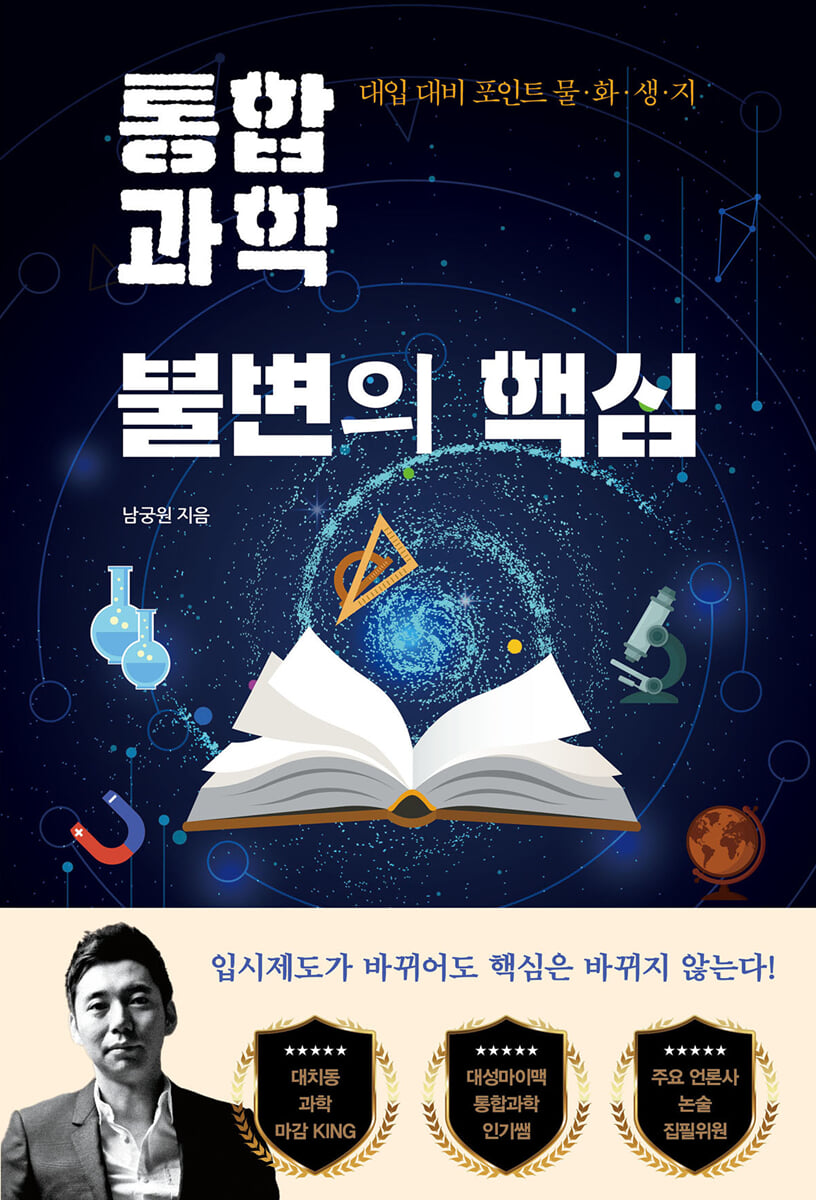
The Unchanging Core of Integrated Science
 |
Description
Book Introduction
A Comprehensive Summary of 20 Years of Core Know-How from a Daechi-dong Science Instructor
College entrance exam preparation points: Physics, Chemistry, Life, and Earth
A book that opens the door to studying science across all disciplines
This is an integrated science textbook for college entrance exam preparation by Namgung Won, a daily science instructor in Daechi-dong and a top lecturer in various science fields.
All the know-how accumulated over 20 years of science lectures is used to explain the curriculum-related content using various examples.
It is structured in the order of concepts to be learned → basic theory → extended cases, so if you understand it step by step, you can enjoy reading integrated science while also enjoying the learning effect.
Starting with the 28th school year entrance exam (currently for high school freshmen) that reflects the 7th revised curriculum, the exam will be held as a single integrated science subject instead of choosing from eight science subjects.
This book covers the entire spectrum of integrated science by combining physics, chemistry, life science, and earth science in accordance with the revised college entrance exam system, allowing young people to learn integrated science more easily and conveniently.
College entrance exam preparation points: Physics, Chemistry, Life, and Earth
A book that opens the door to studying science across all disciplines
This is an integrated science textbook for college entrance exam preparation by Namgung Won, a daily science instructor in Daechi-dong and a top lecturer in various science fields.
All the know-how accumulated over 20 years of science lectures is used to explain the curriculum-related content using various examples.
It is structured in the order of concepts to be learned → basic theory → extended cases, so if you understand it step by step, you can enjoy reading integrated science while also enjoying the learning effect.
Starting with the 28th school year entrance exam (currently for high school freshmen) that reflects the 7th revised curriculum, the exam will be held as a single integrated science subject instead of choosing from eight science subjects.
This book covers the entire spectrum of integrated science by combining physics, chemistry, life science, and earth science in accordance with the revised college entrance exam system, allowing young people to learn integrated science more easily and conveniently.
- You can preview some of the book's contents.
Preview
index
Prologue: Don't Equate Unfamiliarity with Difficulty 4
1.
Physics; If you want to be good at sports, just remember this!
Concept: How can we move faster, farther, and more powerfully?
- Speed and velocity (similar but different concepts, speed and velocity) 17
- Acceleration (rate of change) 22
- Force (Why is the unit of force N) 24
- Momentum (physical quantity indicating the degree of motion) 28
- Impact (physical quantity indicating the degree of impact) 30
- Action and reaction (if there is an action, there must be a reaction) 33
Basics: What needs to be added to make a small impact?
- Momentum and impulse (Momentum and impulse are similar but different cousins) 35
- Impulse and duration of action (two physical effects that occur when the duration of a force is long) 38
- Momentum, impulse, action and reaction (When a truck and a light car collide, why does only the light car suffer the most damage?) 41
Expansion: Sports are more fun when you know physics.
- Home Run King Lee Seung-yeop's Long Hit Secrets 44
Why Baseball Fields Need Safety Fences 47
- Why do snipers use long-barreled guns? 49
- 51 Reasons Why Bungee Jumping Is So Rocky
How does Son Heung-min hit such powerful shots? 53
- 55 Physics Principles Hidden in NBA Logo Shots
Check again! 59
2.
Chemistry; the material world that honestly protects the world
Concept: Let's memorize the periodic table, a synonym for chemistry.
- The composition of atoms and the history of the periodic table (the table is still being filled in) 67
- Periodic table and electron configuration (similar elements are grouped together) 77
- Chemical bonding (instinct toward stabilization) 89
Basics: Atoms meet and pair up.
- Lewis structural formula (solved in 8 Braille characters) 101
- Electron pair repulsion principle (electron pairs determine the shape of a molecule) 106
Expansion: Various substances created by chemical bonds
- Diamond vs. Graphite (same carbon, different composition) 111
- Semiconductor (a collaboration between the properties of electrons and temperature) 116
Graphite vs. Graphene, Carbon Nanotubes, Fullerenes (Various Variations of Carbon) 123
- Characteristics and applications of graphene, carbon nanotubes, and fullerenes (the key is how to connect the top, bottom, left, and right) 128
Check again! 136
3.
Life Sciences; Cells are busy transmitting information.
Concept: Who knew protein was this important!
- Amino acids (basic units of protein composition) 147
- The structure of proteins (twisting and folding to form a necklace) 151
- Function of proteins (source of cells, tissues, and hormones) 156
- Nucleotide (basic unit of nucleic acid) 158
- Structure of DNA and RNA (single-stranded RNA and double-stranded DNA) 161
- Functions of DNA and RNA (DNA stores genetic information, RNA is involved in transmission and protein synthesis) 168
- Genes (DNA that stores genetic information) 171
Fundamentals: Life-Centered Principles
- Transcription and Translation (the process of determining appearance) 176
- Gamow's hypothesis (signaling the start of a codon) 181
- The translation process that creates proteins (moving in step with the genetic code) 184
Expansion: Mutations aren't always bad.
- Genetic abnormalities and genetic diseases (caused by changes in DNA base sequence) 189
- Commonality of genetic code (60% identical between fruit flies and humans) 193
- Mutations favorable to natural selection (sickle cell anemia and natural selection) 197
Check again! 202
4.
Earth Science; We have the Little Prince's glass tube!
Concept: Let's find out how humans can live on Earth.
- Ozone layer (atmosphere that blocks ultraviolet rays) 211
- Solar power (using sunlight, including ultraviolet rays, to generate electricity) 216
- Photosynthesis (the process by which oxygen, the source of ozone, is created) 222
- Bacteria (the first living organisms without a nuclear membrane) 226
- Fossils (evidence of Earth's past) 230
- Geologic era (the standard for dividing the 4.6 billion years of Earth's history) 235
Basics: Auroras created by solar wind
- Layered structure of the atmosphere (atmosphere is clearly divided according to temperature distribution) 240
- How heat is transferred (why do iron ladles have handles) 244
- Changes in the stratified structure of the atmosphere (divided into pre-ozone and post-ozone layers!) 248
Extension: How was the present ozone layer formed?
- Ozone is created by ultraviolet rays (ozone and ultraviolet rays meet and separate repeatedly) 253
Check again! 260
1.
Physics; If you want to be good at sports, just remember this!
Concept: How can we move faster, farther, and more powerfully?
- Speed and velocity (similar but different concepts, speed and velocity) 17
- Acceleration (rate of change) 22
- Force (Why is the unit of force N) 24
- Momentum (physical quantity indicating the degree of motion) 28
- Impact (physical quantity indicating the degree of impact) 30
- Action and reaction (if there is an action, there must be a reaction) 33
Basics: What needs to be added to make a small impact?
- Momentum and impulse (Momentum and impulse are similar but different cousins) 35
- Impulse and duration of action (two physical effects that occur when the duration of a force is long) 38
- Momentum, impulse, action and reaction (When a truck and a light car collide, why does only the light car suffer the most damage?) 41
Expansion: Sports are more fun when you know physics.
- Home Run King Lee Seung-yeop's Long Hit Secrets 44
Why Baseball Fields Need Safety Fences 47
- Why do snipers use long-barreled guns? 49
- 51 Reasons Why Bungee Jumping Is So Rocky
How does Son Heung-min hit such powerful shots? 53
- 55 Physics Principles Hidden in NBA Logo Shots
Check again! 59
2.
Chemistry; the material world that honestly protects the world
Concept: Let's memorize the periodic table, a synonym for chemistry.
- The composition of atoms and the history of the periodic table (the table is still being filled in) 67
- Periodic table and electron configuration (similar elements are grouped together) 77
- Chemical bonding (instinct toward stabilization) 89
Basics: Atoms meet and pair up.
- Lewis structural formula (solved in 8 Braille characters) 101
- Electron pair repulsion principle (electron pairs determine the shape of a molecule) 106
Expansion: Various substances created by chemical bonds
- Diamond vs. Graphite (same carbon, different composition) 111
- Semiconductor (a collaboration between the properties of electrons and temperature) 116
Graphite vs. Graphene, Carbon Nanotubes, Fullerenes (Various Variations of Carbon) 123
- Characteristics and applications of graphene, carbon nanotubes, and fullerenes (the key is how to connect the top, bottom, left, and right) 128
Check again! 136
3.
Life Sciences; Cells are busy transmitting information.
Concept: Who knew protein was this important!
- Amino acids (basic units of protein composition) 147
- The structure of proteins (twisting and folding to form a necklace) 151
- Function of proteins (source of cells, tissues, and hormones) 156
- Nucleotide (basic unit of nucleic acid) 158
- Structure of DNA and RNA (single-stranded RNA and double-stranded DNA) 161
- Functions of DNA and RNA (DNA stores genetic information, RNA is involved in transmission and protein synthesis) 168
- Genes (DNA that stores genetic information) 171
Fundamentals: Life-Centered Principles
- Transcription and Translation (the process of determining appearance) 176
- Gamow's hypothesis (signaling the start of a codon) 181
- The translation process that creates proteins (moving in step with the genetic code) 184
Expansion: Mutations aren't always bad.
- Genetic abnormalities and genetic diseases (caused by changes in DNA base sequence) 189
- Commonality of genetic code (60% identical between fruit flies and humans) 193
- Mutations favorable to natural selection (sickle cell anemia and natural selection) 197
Check again! 202
4.
Earth Science; We have the Little Prince's glass tube!
Concept: Let's find out how humans can live on Earth.
- Ozone layer (atmosphere that blocks ultraviolet rays) 211
- Solar power (using sunlight, including ultraviolet rays, to generate electricity) 216
- Photosynthesis (the process by which oxygen, the source of ozone, is created) 222
- Bacteria (the first living organisms without a nuclear membrane) 226
- Fossils (evidence of Earth's past) 230
- Geologic era (the standard for dividing the 4.6 billion years of Earth's history) 235
Basics: Auroras created by solar wind
- Layered structure of the atmosphere (atmosphere is clearly divided according to temperature distribution) 240
- How heat is transferred (why do iron ladles have handles) 244
- Changes in the stratified structure of the atmosphere (divided into pre-ozone and post-ozone layers!) 248
Extension: How was the present ozone layer formed?
- Ozone is created by ultraviolet rays (ozone and ultraviolet rays meet and separate repeatedly) 253
Check again! 260
Detailed image

Into the book
How should you hit to maximize the effectiveness of a dagger? First, strength is key.
There is a completely different level of difference between an elementary school student hitting a stick and a police officer hitting a stick.
Of course, the strongman Gook Gwan Jang's Takbam will be much more effective.
Second is the time to price the stick.
When hitting an opponent's forehead with your middle finger, if you hit the forehead squarely and your middle finger remains in contact with the forehead for a long time, the duration of the force will be longer.
But if you miss, that time is much shorter.
Do you understand now? Why getting hit by rain doesn't hurt that much.
As in this example, when objects collide, the greater the magnitude of the force acting on the object and the longer the time the force is applied, the greater the effect of the force on the object.
Therefore, the impulse is defined as:
all.
---p.
31, "Physics; If you want to be good at sports, just remember this!"
The most important thing here is the electrons moving in the outermost electron shell.
The 'valence electrons' mentioned above are the electrons that fill the outermost electron shell of an atom, and they directly participate in chemical reactions and therefore determine chemical properties.
When people gather together, if you're standing outside, you're the first to know whether it's raining or windy. It's also easier for someone to talk to you.
Like that, the 'valence electrons' that stand in the outermost electron shell have magnetic properties and meet other electrons to cause chemical reactions.
Therefore, in general, the number of valence electrons and the number of outermost electrons arranged in the outermost electron shell are considered to be the same.
---p.
85, "Chemistry: The Material World That Honestly Protects the World"
Can you see where the two sugars differ? The structures of ribose and deoxyribose are nearly identical.
The only difference is the OH and H attached to carbon 2.
Ribose is written as Ribose in English, and deoxyribose is written as Deoxyribose in English.
Deoxyribose is the prefix Deoxy added to the word Ribose.
Oxy means oxygen, and the prefix De in front of it mainly means 'reverse, negation, separation, or opposite', so we can see that deoxyribose is the result of separating oxygen from ribose.
Even just by interpreting the English words like this, you can immediately see the differences in the structure of this complex party.
---p.
159, from “Life Sciences; Cells Are Working Hard to Transmit Information”
Chemically, ozone is an allotrope of oxygen, consisting of three oxygen atoms bonded together.
Unlike ordinary oxygen, which is made up of two oxygen atoms, it is unstable and decomposes into ordinary oxygen.
Therefore, without oxygen atoms, ozone cannot exist.
When the Earth was first formed, there wasn't much oxygen.
Then, photosynthetic organisms appeared in the primitive ocean, and oxygen was produced through their photosynthesis.
After that, oxygen released into the atmosphere is exposed to ultraviolet rays, creating ozone, and this ozone accumulates in the stratosphere to form the ozone layer.
There is a completely different level of difference between an elementary school student hitting a stick and a police officer hitting a stick.
Of course, the strongman Gook Gwan Jang's Takbam will be much more effective.
Second is the time to price the stick.
When hitting an opponent's forehead with your middle finger, if you hit the forehead squarely and your middle finger remains in contact with the forehead for a long time, the duration of the force will be longer.
But if you miss, that time is much shorter.
Do you understand now? Why getting hit by rain doesn't hurt that much.
As in this example, when objects collide, the greater the magnitude of the force acting on the object and the longer the time the force is applied, the greater the effect of the force on the object.
Therefore, the impulse is defined as:
all.
---p.
31, "Physics; If you want to be good at sports, just remember this!"
The most important thing here is the electrons moving in the outermost electron shell.
The 'valence electrons' mentioned above are the electrons that fill the outermost electron shell of an atom, and they directly participate in chemical reactions and therefore determine chemical properties.
When people gather together, if you're standing outside, you're the first to know whether it's raining or windy. It's also easier for someone to talk to you.
Like that, the 'valence electrons' that stand in the outermost electron shell have magnetic properties and meet other electrons to cause chemical reactions.
Therefore, in general, the number of valence electrons and the number of outermost electrons arranged in the outermost electron shell are considered to be the same.
---p.
85, "Chemistry: The Material World That Honestly Protects the World"
Can you see where the two sugars differ? The structures of ribose and deoxyribose are nearly identical.
The only difference is the OH and H attached to carbon 2.
Ribose is written as Ribose in English, and deoxyribose is written as Deoxyribose in English.
Deoxyribose is the prefix Deoxy added to the word Ribose.
Oxy means oxygen, and the prefix De in front of it mainly means 'reverse, negation, separation, or opposite', so we can see that deoxyribose is the result of separating oxygen from ribose.
Even just by interpreting the English words like this, you can immediately see the differences in the structure of this complex party.
---p.
159, from “Life Sciences; Cells Are Working Hard to Transmit Information”
Chemically, ozone is an allotrope of oxygen, consisting of three oxygen atoms bonded together.
Unlike ordinary oxygen, which is made up of two oxygen atoms, it is unstable and decomposes into ordinary oxygen.
Therefore, without oxygen atoms, ozone cannot exist.
When the Earth was first formed, there wasn't much oxygen.
Then, photosynthetic organisms appeared in the primitive ocean, and oxygen was produced through their photosynthesis.
After that, oxygen released into the atmosphere is exposed to ultraviolet rays, creating ozone, and this ozone accumulates in the stratosphere to form the ozone layer.
---p.
222, from "Earth Science; We Have the Little Prince's Glass Tube!"
222, from "Earth Science; We Have the Little Prince's Glass Tube!"
Publisher's Review
In the changed college entrance exam system, integrated science is equivalent to Korean, English, and math.
Starting with the 28th school year entrance exam (currently for high school freshmen), which reflects the 7th revised curriculum, integrated science will be administered instead of selecting eight science subjects.
In high school, integrated science receives the same class hours as Korean, English, and mathematics.
It has become such an important subject that integrated science is bound to be a variable in the highest grades.
In the college entrance exam, both humanities and science subjects are designated as required subjects, so science has become an unavoidable subject and a key to admissions, whether through regular or special admissions, for both science and humanities students.
The college entrance exam system may change, but the core remains the same.
The new integrated science focuses on cultivating critical thinking and application skills by integrating physics, chemistry, life science, and earth science.
This means that in order to think and apply, you must first have the basic concepts you learned before.
Even if the system changes, the core things that need to be understood do not change.
This book first covers the core concepts to be mastered in the fields of physics, chemistry, biology, and earth science, and then adapts to the new entrance exam style by covering basic theories and extended cases.
Easy and quick understanding with images
Many students find science difficult because it is unfamiliar.
If something is unfamiliar, we tend to assume it is difficult and give up early.
To make studying science fun, you need to be 'immersed' through 'understanding', but that's not easy when studying alone.
The same phenomenon occurs because the lecture is one-way, not two-way.
To help with this, we have included as many images as possible.
It is structured to be easy to understand and immerse yourself in, whether learning the concepts or applying the theory, with various picture explanations included.
20 years of expertise from a top science instructor
The author, who has been giving lectures in Daechi-dong for 20 years and reigns as a top lecturer in Daesung Mymac's integrated science, chemistry, and life science online lectures, has also taught Megastudy's integrated science, chemistry, and life science online lectures and MegaMD's PEET/MD/Dental School transfer general chemistry and organic chemistry online lectures, making him an unrivaled lecturer in science lectures.
We are developing various teaching methods to help students grasp the core, memorize what needs to be memorized, and understand what needs to be understood.
Starting with the 28th school year entrance exam (currently for high school freshmen), which reflects the 7th revised curriculum, integrated science will be administered instead of selecting eight science subjects.
In high school, integrated science receives the same class hours as Korean, English, and mathematics.
It has become such an important subject that integrated science is bound to be a variable in the highest grades.
In the college entrance exam, both humanities and science subjects are designated as required subjects, so science has become an unavoidable subject and a key to admissions, whether through regular or special admissions, for both science and humanities students.
The college entrance exam system may change, but the core remains the same.
The new integrated science focuses on cultivating critical thinking and application skills by integrating physics, chemistry, life science, and earth science.
This means that in order to think and apply, you must first have the basic concepts you learned before.
Even if the system changes, the core things that need to be understood do not change.
This book first covers the core concepts to be mastered in the fields of physics, chemistry, biology, and earth science, and then adapts to the new entrance exam style by covering basic theories and extended cases.
Easy and quick understanding with images
Many students find science difficult because it is unfamiliar.
If something is unfamiliar, we tend to assume it is difficult and give up early.
To make studying science fun, you need to be 'immersed' through 'understanding', but that's not easy when studying alone.
The same phenomenon occurs because the lecture is one-way, not two-way.
To help with this, we have included as many images as possible.
It is structured to be easy to understand and immerse yourself in, whether learning the concepts or applying the theory, with various picture explanations included.
20 years of expertise from a top science instructor
The author, who has been giving lectures in Daechi-dong for 20 years and reigns as a top lecturer in Daesung Mymac's integrated science, chemistry, and life science online lectures, has also taught Megastudy's integrated science, chemistry, and life science online lectures and MegaMD's PEET/MD/Dental School transfer general chemistry and organic chemistry online lectures, making him an unrivaled lecturer in science lectures.
We are developing various teaching methods to help students grasp the core, memorize what needs to be memorized, and understand what needs to be understood.
GOODS SPECIFICS
- Date of issue: July 25, 2025
- Page count, weight, size: 264 pages | 153*225*17mm
- ISBN13: 9791194755548
- ISBN10: 1194755542
You may also like
카테고리
korean


korean

![GQ KOREA Mark (Monthly): December [2025]](http://librairie.coreenne.fr/cdn/shop/files/8ef265dbbfbf186523ed75ba7319009d.jpg?v=1765340328&width=3840)


