

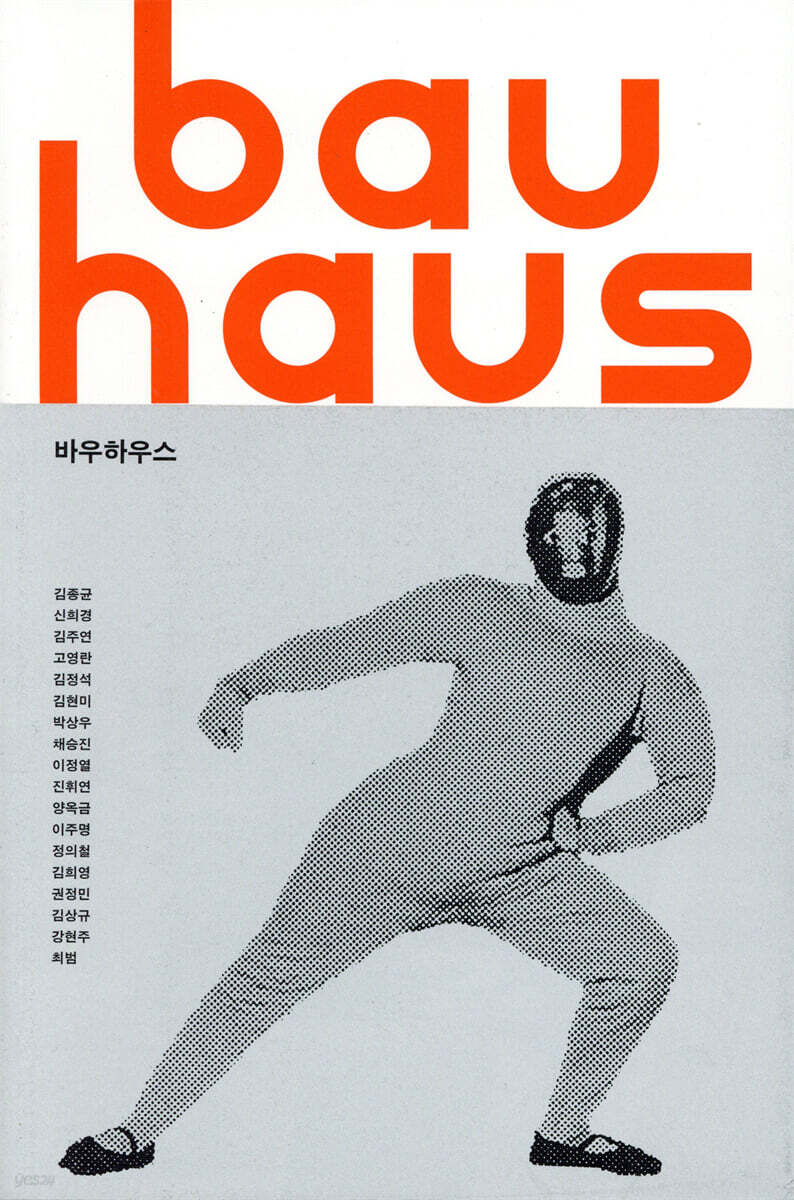
Bauhaus
 |
Description
Book Introduction
Published to commemorate the 100th anniversary of the founding of the Bauhaus!
From the opening of the Bauhaus to its historicization after its closure, we examine the Bauhaus from our own perspective!
“The Bauhaus was not only a comprehensive work of art in itself, but also a workshop that produced many comprehensive works of art.
And these workshops went out into the world.
“It presents various scenarios for reconstructing the world with the spirit of modernism, which is the essence of the Bauhaus building.” - Thorsten Blume / Curator of the Bauhaus Dessau Foundation, Germany
Bauhaus is a giant in art history.
Apple, the American company considered an icon of design innovation, owes its design to the Ulm School of Design, and the ideological foundation of this school is the Bauhaus.
Founded in Weimar, Germany on April 1, 1919, the Bauhaus, with its slogan of "Art and Technology - A New Integration," exerted a diverse influence on various fields within its short history of only 14 years, establishing itself as the prototype of art, architecture, and design, and its formative ideas and methodology became the foundation of modern industrial design.
Design colleges around the world model their curricula on the Bauhaus program from a century ago, the industrial products produced by the Bauhaus have become design classics, and the typography that shaped modern graphic design has become a cornerstone of modern design.
The Bauhaus, which opened 100 years ago, now exists like a legend.
This book is a detailed examination of the Bauhaus, a well-known name but not well-known subject matter, by eighteen authors from the fields of design, architecture, and art.
From the circumstances of the time of the Bauhaus, to the history of the Bauhaus, the main curriculum centered on workshops, and the activities and achievements of the artists who participated as faculty, including the first director Walter Gropius, each section is clearly presented.
Additionally, we can learn about how we accepted the Bauhaus by delving into specific examples of Bauhaus architecture, graphic design, typography, exhibitions and performances, female designers, and crafts, which have not been covered in depth until now.
This book contains relevant materials and illustrations provided by the Bauhaus Dessau Foundation in Germany, and introduces key figures of the Bauhaus separately to help understand the Bauhaus.
These materials also allow us to read the 'expression' of the Bauhaus, which existed for a short time but is now considered a myth.
From the opening of the Bauhaus to its historicization after its closure, we examine the Bauhaus from our own perspective!
“The Bauhaus was not only a comprehensive work of art in itself, but also a workshop that produced many comprehensive works of art.
And these workshops went out into the world.
“It presents various scenarios for reconstructing the world with the spirit of modernism, which is the essence of the Bauhaus building.” - Thorsten Blume / Curator of the Bauhaus Dessau Foundation, Germany
Bauhaus is a giant in art history.
Apple, the American company considered an icon of design innovation, owes its design to the Ulm School of Design, and the ideological foundation of this school is the Bauhaus.
Founded in Weimar, Germany on April 1, 1919, the Bauhaus, with its slogan of "Art and Technology - A New Integration," exerted a diverse influence on various fields within its short history of only 14 years, establishing itself as the prototype of art, architecture, and design, and its formative ideas and methodology became the foundation of modern industrial design.
Design colleges around the world model their curricula on the Bauhaus program from a century ago, the industrial products produced by the Bauhaus have become design classics, and the typography that shaped modern graphic design has become a cornerstone of modern design.
The Bauhaus, which opened 100 years ago, now exists like a legend.
This book is a detailed examination of the Bauhaus, a well-known name but not well-known subject matter, by eighteen authors from the fields of design, architecture, and art.
From the circumstances of the time of the Bauhaus, to the history of the Bauhaus, the main curriculum centered on workshops, and the activities and achievements of the artists who participated as faculty, including the first director Walter Gropius, each section is clearly presented.
Additionally, we can learn about how we accepted the Bauhaus by delving into specific examples of Bauhaus architecture, graphic design, typography, exhibitions and performances, female designers, and crafts, which have not been covered in depth until now.
This book contains relevant materials and illustrations provided by the Bauhaus Dessau Foundation in Germany, and introduces key figures of the Bauhaus separately to help understand the Bauhaus.
These materials also allow us to read the 'expression' of the Bauhaus, which existed for a short time but is now considered a myth.
- You can preview some of the book's contents.
Preview
index
Bauhaus Now and Tomorrow - Thorsten Blume
Introduction - From Rumor to Inquiry - Choi Beom
1. History of the Bauhaus - Kim Jong-gyun
2 The Meaning of Bauhaus Basic Education and Its Significance Today - Shin Hee-kyung
3 Bauhaus Architecture - Kim Joo-yeon
4 The multi-layered nature of Bauhaus discourse: craft, industrial design,
Weaving Workshops and Gender Ideology - Go Young-ran
5 Bauhaus Glass Workshop - Kim Jeong-seok
6 Bauhaus Graphic Design and Typography - Kim Hyun-mi
7 Bauhaus' Media Aesthetics: Focusing on Moholy Energy
- Park Sang-woo
8 Bauhaus and Scientism - Chae Seung-jin and Lee Jeong-yeol
9 Bauhaus Women Designers and Industrialization - Jin Hui-yeon
10 Bauhaus Stage: Experiments or Signs of the Times
Play - Yangokgeum
11 Bauhaus metalwork and Ulm industrial design:
A Journey of Functional Exploration - Lee Ju-myeong
12 Moholy-Nergy's Experiments and Visions, New Bauhaus, Chicago
- Jeong Ui-cheol
13. The Link and Transformation of Bauhaus Education through Josef Albers's Education at Black Mountain College - Kim Hee-young
14 Bauhaus Exhibition: The Museum of Modern Art, New York
Two Different Perspectives on the Bauhaus - Kwon Jeong-min
15 Bauhaus as an Archive: How the Bauhaus
Is it becoming historicized? - Kim Sang-gyu
16 Bauhaus in Korean Universities Through Regularization
Acceptance - Kang Hyun-joo
17 Bauhaus, the birth and meaning of capital letter design - Choi Beom
Key figures of the Bauhaus
References
Introduction - From Rumor to Inquiry - Choi Beom
1. History of the Bauhaus - Kim Jong-gyun
2 The Meaning of Bauhaus Basic Education and Its Significance Today - Shin Hee-kyung
3 Bauhaus Architecture - Kim Joo-yeon
4 The multi-layered nature of Bauhaus discourse: craft, industrial design,
Weaving Workshops and Gender Ideology - Go Young-ran
5 Bauhaus Glass Workshop - Kim Jeong-seok
6 Bauhaus Graphic Design and Typography - Kim Hyun-mi
7 Bauhaus' Media Aesthetics: Focusing on Moholy Energy
- Park Sang-woo
8 Bauhaus and Scientism - Chae Seung-jin and Lee Jeong-yeol
9 Bauhaus Women Designers and Industrialization - Jin Hui-yeon
10 Bauhaus Stage: Experiments or Signs of the Times
Play - Yangokgeum
11 Bauhaus metalwork and Ulm industrial design:
A Journey of Functional Exploration - Lee Ju-myeong
12 Moholy-Nergy's Experiments and Visions, New Bauhaus, Chicago
- Jeong Ui-cheol
13. The Link and Transformation of Bauhaus Education through Josef Albers's Education at Black Mountain College - Kim Hee-young
14 Bauhaus Exhibition: The Museum of Modern Art, New York
Two Different Perspectives on the Bauhaus - Kwon Jeong-min
15 Bauhaus as an Archive: How the Bauhaus
Is it becoming historicized? - Kim Sang-gyu
16 Bauhaus in Korean Universities Through Regularization
Acceptance - Kang Hyun-joo
17 Bauhaus, the birth and meaning of capital letter design - Choi Beom
Key figures of the Bauhaus
References
Detailed image

Into the book
In its 1919 manifesto, the Bauhaus defined itself as a place where "the class distinctions that erect an arrogant barrier between craftsmen and artists" would be overcome.
The goal was to cultivate new and universal designers.
This new designer combines the creativity and aesthetics of an artist with the craftsman's dexterity and focus on production, while maintaining social awareness and responsibility.
The Bauhaus was a place of interdisciplinary reasoning and research with a pedagogical focus on experimental design.
An open mind to new ideas and a contemporary debate about the nature of Gestalt were widespread among apprentices and students.
While studying the necessary practical skills and theories, Bauhaus students learned one more important thing:
The point is that there is no such thing as coincidence in design, and that creating something new requires a thorough analysis of the design problem at hand.
In other words, it is about seeing things as if you are seeing them for the first time and willingly simplifying the design process into basic phenomena and processes.
Page 24, from Thorsten Blume, “Bauhaus Now and Tomorrow”
The Bauhaus holds an important place in the history of art, architecture, and design.
It is not simply a stuffed animal of the past, but has a powerful influence on our daily lives today.
It gave birth to 'functionalist design that integrates art and technology', completed 'internationalist style architecture', and brought about groundbreaking improvements in mass-produced everyday products.
The Bauhaus's design ideas and methodology are the foundation of modern industrial design.
In particular, the formative education of Itten, Albers, and Moholy-Nagy is still passed down as a standard for basic design education even today.
Much of the curriculum at design schools around the world owes a debt to the Bauhaus program of a century ago.
Industrial products produced at the Bauhaus became design classics, and typography and other elements became the basis of modern graphic design.
Page 45, Kim Jong-gyun, “History of Bauhaus”
In 1922, Gropius put forward a new slogan: 'Art and Technology - A New Integration'.
Furthermore, in the summer of 1924, the Bauhaus' production agenda officially stated the basic principles of the Bauhaus and its subsequent policies.
“Humans who engage in creative activities while constantly coming into contact with advancing technologies, new materials, and the discovery of new structures, find their objects in a vivid relationship with tradition, and through this acquire the ability to develop new ideas about practice.
The ability is a firm relationship with a vibrant environment with machines and things to ride on; to shape things according to their own laws without romanticizing them or playing around with them; to limit them to basic shapes and colors that are typical and understandable to everyone; simplicity in diversity; and to use space, materials, time, and money without waste.” Basic education has also changed in this direction.
Page 63, Shin Hee-kyung, “The Meaning of Bauhaus Basic Education and Its Significance Today”
One of the most important Bauhaus achievements was the Dessau school building itself, designed by Gropius.
This teacher's dynamic composition, asymmetrical plan, soft white surfaces, horizontal windows, and flat roof are the characteristics of Bauhaus architecture, which represents the internationalist style of the 1920s.
The Dessau Bauhaus building, with a building space of 2,630 square meters (approximately 800 pyeong), was the realization of Gropius' architectural vision.
It is a space where all areas of life can be brought together under one roof: education, work, housing, entertainment, and exercise.
Pages 86-87, Kim Ju-yeon, “Bauhaus Architecture”
When he founded the Bauhaus, Gropius took a fairly progressive stance for the time, acknowledging that female students were as free as male students.
As if to suggest something self-deprecating, Gropius says, “There is no such thing as a beautiful or strong sex, and there can be no discrimination not only in equality but also in duties.
Don't expect to be treated like a lady.
“When it comes to work, we are all just craftsmen,” she wrote in a note aimed at breaking down gender stereotypes.
However, the ideal of gender equality at the Bauhaus was unfortunately not realized.
This is because the sense of crisis among male masters, who were surprised by the female-dominated phenomenon, brought back the specter of pre-modern patriarchy.
Pages 97-98, Go Young-ran, “The Multilayeredness of Bauhaus Discourse: Craft, Industrial Design, Weaving Workshops, and Gender Ideology”
Bauhaus was a movement that sought to solve the above problems by focusing on the connection between plastic arts and crafts and architecture, and by combining all artistic activities and reintegrating them into components of a new architecture.
The glass workshop, focusing on stained glass, had sufficient rationale and necessity, and was the workshop that best fit the spirit of the Bauhaus.
In order to produce stained glass, it is necessary to acquire skills in glass crafts, painting, and other fields, as well as training in plastic arts. After acquiring these basic skills, the ability to combine handwork and plastic arts in architectural spaces is required.
As glass's role in modern architecture increased over time, stained glass possessed sufficient future-oriented value and potential.
Page 150, Kim Jeong-seok, “Bauhaus Glass Workshop”
Before Moholy-Nagy arrived in 1923, Herbert Bayer was influenced by Itten, Kandinsky, and Klee.
Learning form and color from painters, he struggled between the functional graphic design he had worked in and the free-form painting he created, applying the visual techniques he had learned to each project in a variety of ways without being fixated on any one style.
In addition to the architectural drawing and spatial sense he acquired while working at an architectural firm, his experience with painting and various expressive methods at the Bauhaus enabled him to become an all-round designer who crossed over the realms of planes, space, design, and art after the Bauhaus.
Kim Hyun-mi, “Graphic Design and Typography of the Bauhaus,” pp. 175-176
Through the idea of a total work, Moholy-Nagy attempted to dissolve not only the boundaries between all artistic media, including painting, sculpture, photography, film, installation, and design, but also the boundaries between art and non-art.
He wanted an avant-garde total art that pursued the unity of life and art, which was the goal of avant-garde art at the time, while crossing all media.
Through this, he ultimately aimed to cultivate a utopian human of the future, a 'whole man', a human with highly developed all senses and rich emotions, and at the same time, a human with outstanding intelligence, and thus a human who can adapt well to and lead the complex and multifaceted society to come.
Page 216, Park Sang-woo, “Media Aesthetics of Bauhaus: Focusing on Mohoinergy”
In other words, the work of the logical positivist philosophers, who attempted to derive a universal language from logic and basic perceptual elements, and the work of the Bauhaus artists, who attempted to unify technology and art and construct forms from basic geometric shapes and colors, which are basic perceptual elements, directly influenced each other and formed a close relationship.
At the time, artists and philosophers belonging to the modernist movement were all obsessed with simplicity and functionality.
They also shared the scientific and machine-centric image that had been quite influential in 20th-century Europe and especially the United States, and sought to align their domain with modernist and Fordist modes of production.
Page 257, Chae Seung-jin and Lee Jeong-yeol, “Bauhaus and Scientism”
The work of the Bauhaus women designers should also be highly regarded as the first time since the end of World War I that women collectively achieved innovative and influential achievements in a professional field.
Marianne Brandt, who produced many of the Bauhaus's most representative works in her metal workshop, Alma Siedhoff Buscher, who produced children's wooden furniture and toys in her wood workshop, and several other female designers hold important positions in Bauhaus history.
It is necessary to reexamine the female designers within the Bauhaus by focusing on their major works and subsequent production processes, and to consider the issues of their lives and subsequent evaluation.
Page 276, Jin Hui-yeon, “Bauhaus Women Designers and Industrialization”
The formative and conceptual characteristics of the Bauhaus stage can be seen as having been formed within the historical and artistic currents of the early 20th century theater movement, which composed the stage with a pictorial sensibility close to visual art, and the 'innovation' pursued by the avant-garde art of the time.
It is also not unrelated to the so-called Bauhaus style that appears in other Bauhaus workshops, and is linked to trends such as the architectural composition of stage space based on mathematical calculations and geometric design through the use of color.
In the early Bauhaus of the Weimar period, conflicting tendencies seemed to coexist: irrational and romantic tendencies on the one hand, and technocratic and rationalist tendencies on the other.
However, this gradually transformed into a form of modern performing arts through the Dessau period, combining the two elements of 'technology' and 'abstraction'.
pp. 305-306, Yang Ok-geum, “The Stage of the Bauhaus: Experiments or Plays Containing the Times and Signs”
After World War II ended in 1945, the Ulm School of Design was established in Ulm, southern Germany, in 1953 with the goal of succeeding the Bauhaus.
It was 20 years since the Bauhaus closed in Berlin.
Ulm's first director, Max Bill, studied at the Dessau Bauhaus from 1927 to 1929 under Wassily Kandinsky, Paul Klee, and Oskar Schlemmer.
Although he drew up plans for the new school building in Ulm, he was also a graphic designer and industrial designer. He recognized industrial production as a principle of the times and sought to create products that were both functional and beautiful, in line with economic and technological conditions.
However, his aesthetic concept was unique and powerful, connected to moral and social values, and he firmly believed that life could be morally elevated through the high aesthetic standard of everyday objects.
Pages 346-347, from Lee Ju-myeong, “Metalwork at the Bauhaus and Industrial Design in Ulm: A Journey of Functional Exploration”
The ambitious exhibition of the New Bauhaus in 1937 disappointed many.
(Omitted) The educational program based on the contents of the Dessau Bauhaus did not fit with the atmosphere of American pragmatism and industrial orientation.
The Arts Industry Association saw European-style education as being more artistic than industrial, utopian than realistic, fundamental than functional, and humanistic and socialist than pragmatic.
In this respect, Moholy-Nagy was faced with the significant challenge of how to integrate European concepts of education and cultural practice with American concepts with their industrialist bias.
pp. 370-371, Jeong Ui-cheol, “Moho Energy’s Experiment and Vision, Chicago’s New Bauhaus”
It is noteworthy that the Bauhaus and Black Mountain College (BMC) shared a progressive educational philosophy.
The Bauhaus philosophy corresponds to Dewey's position in its emphasis on individual creativity and creative problem-solving skills.
Moreover, many of the elements that Albers brought over from the Bauhaus, such as the emphasis on practice over theory, learning through practice, the emphasis on study, not art, the rejection of the hierarchy that places pure art above all else, and the recognition of art as an experience rather than a commodity, were well suited to the spirit of the BMC.
Both schools sought to motivate students to think and act for themselves, unlike traditional academic classes that deal with rigid theories.
Kim Hee-young, “Connection and Transformation of Bauhaus Education through Josef Albers’ Education at Black Mountain College,” pp. 391-392
The Bauhaus exhibition, which was harshly criticized by critics over 70 years ago, already presented a new attempt by contemplating the relationship between the audience, the exhibition space, and the exhibition objects.
At the time, Gropius adopted the form of exhibition display that encouraged the audience to participate more actively when viewing the works, and rather than focusing on the information and meaning contained in each work, he made it possible for the exhibition to be experienced as a single, integrated experience with social and political techniques.
His insight is the reason why we should still pay attention to the Bauhaus, which was founded 100 years ago and has a short history of 14 years, and it is the justification for continuing to research the achievements they left behind.
Page 426, Kwon Min-jeong, “Bauhaus Exhibition: Two Different Perspectives on the Bauhaus at the Museum of Modern Art in New York”
The Bauhaus is valuable simply for being an international school and laboratory that creatively unleashed the potential of our time.
And because its influence is so significant, it deserves to be mentioned as the origin of some field.
But to mythologize and highlight it further only serves to prove that the experiment that followed did not have a great impact.
It goes without saying that the Bauhaus cannot be lumped together.
There were many conflicts and many different experiments.
How can an education system that has endured 14 years of hardship remain consistent?
And the myth of the Bauhaus as we know it is supported by what continued after the Bauhaus closed.
Today, it is appropriate to view the Bauhaus as an archive where we can discover and reference the struggles and struggles of contemporary artists.
Page 445, Kim Sang-gyu, “Bauhaus Exhibition as an Archive: How Bauhaus Became Historic”
Jeong Si-hwa's "Art Education of the Bauhaus" published in 1966 was the first work to systematically introduce the Bauhaus to the Korean design world, and it contained critical reflections on the intellectual climate of the Korean design education world at the time, which had a weak theoretical foundation.
(Omitted) One interesting fact is that Jeong Si-hwa and Ahn Sang-soo, who paid attention to Bauhaus in order to improve the quality of design education in Korea, took the lead in launching a school newspaper at their respective alma maters during their college years.
In 1972, Ahn Sang-soo asked Jeong Si-hwa to write a manuscript and published it titled “The Current State and Prospects of Design Education.”
Jeong Si-hwa and Ahn Sang-soo, who had a special interest in design theory, history, and design education during the dawn of modern design education in Korea in the 1960s and 1970s.
It would not have been natural for these two people to turn to Bauhaus to overcome the limitations of Korean design education.
Kang Hyun-joo, “The Acceptance of Bauhaus in Korean Universities through Regularization,” pp. 469-470
Bauhaus entered through the door of craft and came out through the door of design.
During the Bauhaus, craft became design.
As revealed in the manifesto, the Bauhaus in its early days was a craft school full of medieval colors.
This indicates that the Bauhaus was under the direct influence of William Morris.
But the Bauhaus did not stop at the medieval language of William Morris and similar expressionism; it eventually created its own language, its own grammar.
That is ‘design,’ the formative language of the machine age.
As I said before, Bauhaus did not just create one design; it created a universal language of design, the grammar of design itself.
This is what distinguishes the Bauhaus from all other formative practices, both before and after it.
Page 478, Choi Beom, “Bauhaus, the Birth and Meaning of Capital Letter Design”
The goal was to cultivate new and universal designers.
This new designer combines the creativity and aesthetics of an artist with the craftsman's dexterity and focus on production, while maintaining social awareness and responsibility.
The Bauhaus was a place of interdisciplinary reasoning and research with a pedagogical focus on experimental design.
An open mind to new ideas and a contemporary debate about the nature of Gestalt were widespread among apprentices and students.
While studying the necessary practical skills and theories, Bauhaus students learned one more important thing:
The point is that there is no such thing as coincidence in design, and that creating something new requires a thorough analysis of the design problem at hand.
In other words, it is about seeing things as if you are seeing them for the first time and willingly simplifying the design process into basic phenomena and processes.
Page 24, from Thorsten Blume, “Bauhaus Now and Tomorrow”
The Bauhaus holds an important place in the history of art, architecture, and design.
It is not simply a stuffed animal of the past, but has a powerful influence on our daily lives today.
It gave birth to 'functionalist design that integrates art and technology', completed 'internationalist style architecture', and brought about groundbreaking improvements in mass-produced everyday products.
The Bauhaus's design ideas and methodology are the foundation of modern industrial design.
In particular, the formative education of Itten, Albers, and Moholy-Nagy is still passed down as a standard for basic design education even today.
Much of the curriculum at design schools around the world owes a debt to the Bauhaus program of a century ago.
Industrial products produced at the Bauhaus became design classics, and typography and other elements became the basis of modern graphic design.
Page 45, Kim Jong-gyun, “History of Bauhaus”
In 1922, Gropius put forward a new slogan: 'Art and Technology - A New Integration'.
Furthermore, in the summer of 1924, the Bauhaus' production agenda officially stated the basic principles of the Bauhaus and its subsequent policies.
“Humans who engage in creative activities while constantly coming into contact with advancing technologies, new materials, and the discovery of new structures, find their objects in a vivid relationship with tradition, and through this acquire the ability to develop new ideas about practice.
The ability is a firm relationship with a vibrant environment with machines and things to ride on; to shape things according to their own laws without romanticizing them or playing around with them; to limit them to basic shapes and colors that are typical and understandable to everyone; simplicity in diversity; and to use space, materials, time, and money without waste.” Basic education has also changed in this direction.
Page 63, Shin Hee-kyung, “The Meaning of Bauhaus Basic Education and Its Significance Today”
One of the most important Bauhaus achievements was the Dessau school building itself, designed by Gropius.
This teacher's dynamic composition, asymmetrical plan, soft white surfaces, horizontal windows, and flat roof are the characteristics of Bauhaus architecture, which represents the internationalist style of the 1920s.
The Dessau Bauhaus building, with a building space of 2,630 square meters (approximately 800 pyeong), was the realization of Gropius' architectural vision.
It is a space where all areas of life can be brought together under one roof: education, work, housing, entertainment, and exercise.
Pages 86-87, Kim Ju-yeon, “Bauhaus Architecture”
When he founded the Bauhaus, Gropius took a fairly progressive stance for the time, acknowledging that female students were as free as male students.
As if to suggest something self-deprecating, Gropius says, “There is no such thing as a beautiful or strong sex, and there can be no discrimination not only in equality but also in duties.
Don't expect to be treated like a lady.
“When it comes to work, we are all just craftsmen,” she wrote in a note aimed at breaking down gender stereotypes.
However, the ideal of gender equality at the Bauhaus was unfortunately not realized.
This is because the sense of crisis among male masters, who were surprised by the female-dominated phenomenon, brought back the specter of pre-modern patriarchy.
Pages 97-98, Go Young-ran, “The Multilayeredness of Bauhaus Discourse: Craft, Industrial Design, Weaving Workshops, and Gender Ideology”
Bauhaus was a movement that sought to solve the above problems by focusing on the connection between plastic arts and crafts and architecture, and by combining all artistic activities and reintegrating them into components of a new architecture.
The glass workshop, focusing on stained glass, had sufficient rationale and necessity, and was the workshop that best fit the spirit of the Bauhaus.
In order to produce stained glass, it is necessary to acquire skills in glass crafts, painting, and other fields, as well as training in plastic arts. After acquiring these basic skills, the ability to combine handwork and plastic arts in architectural spaces is required.
As glass's role in modern architecture increased over time, stained glass possessed sufficient future-oriented value and potential.
Page 150, Kim Jeong-seok, “Bauhaus Glass Workshop”
Before Moholy-Nagy arrived in 1923, Herbert Bayer was influenced by Itten, Kandinsky, and Klee.
Learning form and color from painters, he struggled between the functional graphic design he had worked in and the free-form painting he created, applying the visual techniques he had learned to each project in a variety of ways without being fixated on any one style.
In addition to the architectural drawing and spatial sense he acquired while working at an architectural firm, his experience with painting and various expressive methods at the Bauhaus enabled him to become an all-round designer who crossed over the realms of planes, space, design, and art after the Bauhaus.
Kim Hyun-mi, “Graphic Design and Typography of the Bauhaus,” pp. 175-176
Through the idea of a total work, Moholy-Nagy attempted to dissolve not only the boundaries between all artistic media, including painting, sculpture, photography, film, installation, and design, but also the boundaries between art and non-art.
He wanted an avant-garde total art that pursued the unity of life and art, which was the goal of avant-garde art at the time, while crossing all media.
Through this, he ultimately aimed to cultivate a utopian human of the future, a 'whole man', a human with highly developed all senses and rich emotions, and at the same time, a human with outstanding intelligence, and thus a human who can adapt well to and lead the complex and multifaceted society to come.
Page 216, Park Sang-woo, “Media Aesthetics of Bauhaus: Focusing on Mohoinergy”
In other words, the work of the logical positivist philosophers, who attempted to derive a universal language from logic and basic perceptual elements, and the work of the Bauhaus artists, who attempted to unify technology and art and construct forms from basic geometric shapes and colors, which are basic perceptual elements, directly influenced each other and formed a close relationship.
At the time, artists and philosophers belonging to the modernist movement were all obsessed with simplicity and functionality.
They also shared the scientific and machine-centric image that had been quite influential in 20th-century Europe and especially the United States, and sought to align their domain with modernist and Fordist modes of production.
Page 257, Chae Seung-jin and Lee Jeong-yeol, “Bauhaus and Scientism”
The work of the Bauhaus women designers should also be highly regarded as the first time since the end of World War I that women collectively achieved innovative and influential achievements in a professional field.
Marianne Brandt, who produced many of the Bauhaus's most representative works in her metal workshop, Alma Siedhoff Buscher, who produced children's wooden furniture and toys in her wood workshop, and several other female designers hold important positions in Bauhaus history.
It is necessary to reexamine the female designers within the Bauhaus by focusing on their major works and subsequent production processes, and to consider the issues of their lives and subsequent evaluation.
Page 276, Jin Hui-yeon, “Bauhaus Women Designers and Industrialization”
The formative and conceptual characteristics of the Bauhaus stage can be seen as having been formed within the historical and artistic currents of the early 20th century theater movement, which composed the stage with a pictorial sensibility close to visual art, and the 'innovation' pursued by the avant-garde art of the time.
It is also not unrelated to the so-called Bauhaus style that appears in other Bauhaus workshops, and is linked to trends such as the architectural composition of stage space based on mathematical calculations and geometric design through the use of color.
In the early Bauhaus of the Weimar period, conflicting tendencies seemed to coexist: irrational and romantic tendencies on the one hand, and technocratic and rationalist tendencies on the other.
However, this gradually transformed into a form of modern performing arts through the Dessau period, combining the two elements of 'technology' and 'abstraction'.
pp. 305-306, Yang Ok-geum, “The Stage of the Bauhaus: Experiments or Plays Containing the Times and Signs”
After World War II ended in 1945, the Ulm School of Design was established in Ulm, southern Germany, in 1953 with the goal of succeeding the Bauhaus.
It was 20 years since the Bauhaus closed in Berlin.
Ulm's first director, Max Bill, studied at the Dessau Bauhaus from 1927 to 1929 under Wassily Kandinsky, Paul Klee, and Oskar Schlemmer.
Although he drew up plans for the new school building in Ulm, he was also a graphic designer and industrial designer. He recognized industrial production as a principle of the times and sought to create products that were both functional and beautiful, in line with economic and technological conditions.
However, his aesthetic concept was unique and powerful, connected to moral and social values, and he firmly believed that life could be morally elevated through the high aesthetic standard of everyday objects.
Pages 346-347, from Lee Ju-myeong, “Metalwork at the Bauhaus and Industrial Design in Ulm: A Journey of Functional Exploration”
The ambitious exhibition of the New Bauhaus in 1937 disappointed many.
(Omitted) The educational program based on the contents of the Dessau Bauhaus did not fit with the atmosphere of American pragmatism and industrial orientation.
The Arts Industry Association saw European-style education as being more artistic than industrial, utopian than realistic, fundamental than functional, and humanistic and socialist than pragmatic.
In this respect, Moholy-Nagy was faced with the significant challenge of how to integrate European concepts of education and cultural practice with American concepts with their industrialist bias.
pp. 370-371, Jeong Ui-cheol, “Moho Energy’s Experiment and Vision, Chicago’s New Bauhaus”
It is noteworthy that the Bauhaus and Black Mountain College (BMC) shared a progressive educational philosophy.
The Bauhaus philosophy corresponds to Dewey's position in its emphasis on individual creativity and creative problem-solving skills.
Moreover, many of the elements that Albers brought over from the Bauhaus, such as the emphasis on practice over theory, learning through practice, the emphasis on study, not art, the rejection of the hierarchy that places pure art above all else, and the recognition of art as an experience rather than a commodity, were well suited to the spirit of the BMC.
Both schools sought to motivate students to think and act for themselves, unlike traditional academic classes that deal with rigid theories.
Kim Hee-young, “Connection and Transformation of Bauhaus Education through Josef Albers’ Education at Black Mountain College,” pp. 391-392
The Bauhaus exhibition, which was harshly criticized by critics over 70 years ago, already presented a new attempt by contemplating the relationship between the audience, the exhibition space, and the exhibition objects.
At the time, Gropius adopted the form of exhibition display that encouraged the audience to participate more actively when viewing the works, and rather than focusing on the information and meaning contained in each work, he made it possible for the exhibition to be experienced as a single, integrated experience with social and political techniques.
His insight is the reason why we should still pay attention to the Bauhaus, which was founded 100 years ago and has a short history of 14 years, and it is the justification for continuing to research the achievements they left behind.
Page 426, Kwon Min-jeong, “Bauhaus Exhibition: Two Different Perspectives on the Bauhaus at the Museum of Modern Art in New York”
The Bauhaus is valuable simply for being an international school and laboratory that creatively unleashed the potential of our time.
And because its influence is so significant, it deserves to be mentioned as the origin of some field.
But to mythologize and highlight it further only serves to prove that the experiment that followed did not have a great impact.
It goes without saying that the Bauhaus cannot be lumped together.
There were many conflicts and many different experiments.
How can an education system that has endured 14 years of hardship remain consistent?
And the myth of the Bauhaus as we know it is supported by what continued after the Bauhaus closed.
Today, it is appropriate to view the Bauhaus as an archive where we can discover and reference the struggles and struggles of contemporary artists.
Page 445, Kim Sang-gyu, “Bauhaus Exhibition as an Archive: How Bauhaus Became Historic”
Jeong Si-hwa's "Art Education of the Bauhaus" published in 1966 was the first work to systematically introduce the Bauhaus to the Korean design world, and it contained critical reflections on the intellectual climate of the Korean design education world at the time, which had a weak theoretical foundation.
(Omitted) One interesting fact is that Jeong Si-hwa and Ahn Sang-soo, who paid attention to Bauhaus in order to improve the quality of design education in Korea, took the lead in launching a school newspaper at their respective alma maters during their college years.
In 1972, Ahn Sang-soo asked Jeong Si-hwa to write a manuscript and published it titled “The Current State and Prospects of Design Education.”
Jeong Si-hwa and Ahn Sang-soo, who had a special interest in design theory, history, and design education during the dawn of modern design education in Korea in the 1960s and 1970s.
It would not have been natural for these two people to turn to Bauhaus to overcome the limitations of Korean design education.
Kang Hyun-joo, “The Acceptance of Bauhaus in Korean Universities through Regularization,” pp. 469-470
Bauhaus entered through the door of craft and came out through the door of design.
During the Bauhaus, craft became design.
As revealed in the manifesto, the Bauhaus in its early days was a craft school full of medieval colors.
This indicates that the Bauhaus was under the direct influence of William Morris.
But the Bauhaus did not stop at the medieval language of William Morris and similar expressionism; it eventually created its own language, its own grammar.
That is ‘design,’ the formative language of the machine age.
As I said before, Bauhaus did not just create one design; it created a universal language of design, the grammar of design itself.
This is what distinguishes the Bauhaus from all other formative practices, both before and after it.
Page 478, Choi Beom, “Bauhaus, the Birth and Meaning of Capital Letter Design”
--- From the text
Publisher's Review
A monumental event in the Korean design world: exploring the Bauhaus.
Design critic Choi Beom, who wrote the preface to this book, describes it as “Korea’s first Bauhaus book” and “a monumental event in the Korean design world.”
For us, Bauhaus was a famous but little-known 'rumor', and this book led us to 'explore' Bauhaus.
He also expressed his hope that “this book will serve as a starting point for thinking about the next 100 years of design while looking back on the 100 years of Bauhaus, and at the same time, as a question about Korean design.”
Until now, most books on Bauhaus were translations and only books written by related researchers were available.
This book was born after about two years of planning and writing.
This is a large-scale project commemorating the 100th anniversary of the founding of the Bauhaus, examining and compiling the results of Bauhaus research conducted in the fields of design, architecture, and art in Korea.
This book studies the Bauhaus from our perspective, critically examining the process of its historicization and mythologization, pointing out not only the meaning of the Bauhaus but also its historical limitations, and analyzing the influence of the Bauhaus on our design.
As Choi Beom pointed out, we need to properly understand Bauhaus from our own perspective in order to understand Korean design.
This is why this book is a monumental 'event' in the Korean design world.
Korea's first Bauhaus anthology, seen from eighteen perspectives.
The book begins with an article titled “Bauhaus Now and Tomorrow” by Thorsten Blume, curator of the Bauhaus Dessau Foundation in Germany.
He evaluated that the Bauhaus was 'a platform and catalyst for the modernist movement' and that the Bauhaus was not only a comprehensive work of art in itself, but also a workshop that produced many comprehensive works of art.
The text unfolds into eighteen chapters.
The first half of this book covers the historical background and curriculum at the time of the founding of the Bauhaus, the history of the Bauhaus from its first director Walter Gropius to its second director Hannes Meyer and its third director Mies van der Rohe, and begins with "The History of the Bauhaus" to help readers understand the Bauhaus. It then analyzes the curriculum and workshop education (architecture, weaving, glass, graphic design and typography, stage, metal, etc.) in detail, and deals with the media aesthetics centered on Moholy Energy, the scientism of the Bauhaus, and the industrialization of female Bauhaus designers.
The latter part covers metalwork and industrial design at the Ulm School of Design after the closure of the Bauhaus, the New Bauhaus founded by Moholy-Nagy in Chicago, the education provided by Josef Albers at Black Mountain College, an introduction and evaluation of the two Bauhaus exhibitions held at the Museum of Modern Art in New York, the Bauhaus as an archive, and finally the influence of the Bauhaus on domestic design.
After the Bauhaus, the process of historicization was illuminated.
The Bauhaus, which opened in Weimar, Germany in April 1919, lasted for a short period of 14 years, including periods in Dessau and Berlin, before being closed in July 1933.
Why has the Bauhaus, a small German school, achieved innovations that shook the foundations of modern design and remained a prototype for over a century? How did the Bauhaus become historicized and mythologized? British art critic Frank Whitford argues that the Bauhaus's reputation actually spread globally after it was forcibly closed by the Nazis and its faculty and students emigrated to various parts of the world.
The activities of Bauhaus graduates that continued into the latter half of the 20th century, such as László Moholy-Nagy's founding of the New Bauhaus in Chicago, Gropius's work at Harvard University, Josef and Anni Albers' establishment at Black Mountain College, and Bauhaus graduate Max Bill's becoming the first president of the Ulm School of Design, are important reasons why the Bauhaus has been historicized and mythologized.
This book describes this process in detail.
Bauhaus, a study of female designers
The Bauhaus often welcomed women who had already received training in art or crafts at other institutions for further training.
At the time, the percentage of women who went on to university was at most around 16%, but in the case of the Bauhaus, the percentage of female students reached 40% during the Weimar period and 26% during the Dessau and Berlin periods.
However, although the Bauhaus' educational program was innovative, it had gender-discriminatory concepts and was not free from male-dominated ideology.
Female designers mainly worked in mural or weaving workshops, and weaving workshops did not issue certificates to female apprentices.
The fact that the Bauhaus art movement failed to overcome these limitations highlights the need for more active research on the many female designers who have been overlooked so far.
Marianne Brandt, who produced many of the Bauhaus's most iconic pieces in her metal workshop, Alma Siedhoff Buscher, who produced children's wooden furniture and toys in her wood workshop, and several other female designers are very important in the history of the Bauhaus.
This book provides a detailed introduction to the major careers and works of female designers, and sheds new light on their lives, achievements, and even their evaluations.
A Pictorial Look at the Bauhaus's "Expressions" and Introduction to Key Figures
When you open the book, the people of Bauhaus are smiling brightly.
They are the ones who breathed and burned with passion at the Bauhaus 100 years ago.
The front of the book contains 16 pages of Bauhaus people, and the back contains 16 pages of various expressions of the Bauhaus building.
The book includes 32 pages of related illustrations.
In the faded old photo, they walk out into the present day, past 100 years, and talk about the Bauhaus.
The photographs and illustrations provided by the Bauhaus Dessau Foundation in Germany to commemorate the publication of this book offer another fun way to read about the Bauhaus.
Additionally, at the end of the book, the lives and achievements of eighteen key figures of the Bauhaus, including Walter Gropius, Johannes Itten, Mies van der Rohe, Josef Albers, Guntha Stölzl, and Marianne Brandt, are summarized.
Design critic Choi Beom, who wrote the preface to this book, describes it as “Korea’s first Bauhaus book” and “a monumental event in the Korean design world.”
For us, Bauhaus was a famous but little-known 'rumor', and this book led us to 'explore' Bauhaus.
He also expressed his hope that “this book will serve as a starting point for thinking about the next 100 years of design while looking back on the 100 years of Bauhaus, and at the same time, as a question about Korean design.”
Until now, most books on Bauhaus were translations and only books written by related researchers were available.
This book was born after about two years of planning and writing.
This is a large-scale project commemorating the 100th anniversary of the founding of the Bauhaus, examining and compiling the results of Bauhaus research conducted in the fields of design, architecture, and art in Korea.
This book studies the Bauhaus from our perspective, critically examining the process of its historicization and mythologization, pointing out not only the meaning of the Bauhaus but also its historical limitations, and analyzing the influence of the Bauhaus on our design.
As Choi Beom pointed out, we need to properly understand Bauhaus from our own perspective in order to understand Korean design.
This is why this book is a monumental 'event' in the Korean design world.
Korea's first Bauhaus anthology, seen from eighteen perspectives.
The book begins with an article titled “Bauhaus Now and Tomorrow” by Thorsten Blume, curator of the Bauhaus Dessau Foundation in Germany.
He evaluated that the Bauhaus was 'a platform and catalyst for the modernist movement' and that the Bauhaus was not only a comprehensive work of art in itself, but also a workshop that produced many comprehensive works of art.
The text unfolds into eighteen chapters.
The first half of this book covers the historical background and curriculum at the time of the founding of the Bauhaus, the history of the Bauhaus from its first director Walter Gropius to its second director Hannes Meyer and its third director Mies van der Rohe, and begins with "The History of the Bauhaus" to help readers understand the Bauhaus. It then analyzes the curriculum and workshop education (architecture, weaving, glass, graphic design and typography, stage, metal, etc.) in detail, and deals with the media aesthetics centered on Moholy Energy, the scientism of the Bauhaus, and the industrialization of female Bauhaus designers.
The latter part covers metalwork and industrial design at the Ulm School of Design after the closure of the Bauhaus, the New Bauhaus founded by Moholy-Nagy in Chicago, the education provided by Josef Albers at Black Mountain College, an introduction and evaluation of the two Bauhaus exhibitions held at the Museum of Modern Art in New York, the Bauhaus as an archive, and finally the influence of the Bauhaus on domestic design.
After the Bauhaus, the process of historicization was illuminated.
The Bauhaus, which opened in Weimar, Germany in April 1919, lasted for a short period of 14 years, including periods in Dessau and Berlin, before being closed in July 1933.
Why has the Bauhaus, a small German school, achieved innovations that shook the foundations of modern design and remained a prototype for over a century? How did the Bauhaus become historicized and mythologized? British art critic Frank Whitford argues that the Bauhaus's reputation actually spread globally after it was forcibly closed by the Nazis and its faculty and students emigrated to various parts of the world.
The activities of Bauhaus graduates that continued into the latter half of the 20th century, such as László Moholy-Nagy's founding of the New Bauhaus in Chicago, Gropius's work at Harvard University, Josef and Anni Albers' establishment at Black Mountain College, and Bauhaus graduate Max Bill's becoming the first president of the Ulm School of Design, are important reasons why the Bauhaus has been historicized and mythologized.
This book describes this process in detail.
Bauhaus, a study of female designers
The Bauhaus often welcomed women who had already received training in art or crafts at other institutions for further training.
At the time, the percentage of women who went on to university was at most around 16%, but in the case of the Bauhaus, the percentage of female students reached 40% during the Weimar period and 26% during the Dessau and Berlin periods.
However, although the Bauhaus' educational program was innovative, it had gender-discriminatory concepts and was not free from male-dominated ideology.
Female designers mainly worked in mural or weaving workshops, and weaving workshops did not issue certificates to female apprentices.
The fact that the Bauhaus art movement failed to overcome these limitations highlights the need for more active research on the many female designers who have been overlooked so far.
Marianne Brandt, who produced many of the Bauhaus's most iconic pieces in her metal workshop, Alma Siedhoff Buscher, who produced children's wooden furniture and toys in her wood workshop, and several other female designers are very important in the history of the Bauhaus.
This book provides a detailed introduction to the major careers and works of female designers, and sheds new light on their lives, achievements, and even their evaluations.
A Pictorial Look at the Bauhaus's "Expressions" and Introduction to Key Figures
When you open the book, the people of Bauhaus are smiling brightly.
They are the ones who breathed and burned with passion at the Bauhaus 100 years ago.
The front of the book contains 16 pages of Bauhaus people, and the back contains 16 pages of various expressions of the Bauhaus building.
The book includes 32 pages of related illustrations.
In the faded old photo, they walk out into the present day, past 100 years, and talk about the Bauhaus.
The photographs and illustrations provided by the Bauhaus Dessau Foundation in Germany to commemorate the publication of this book offer another fun way to read about the Bauhaus.
Additionally, at the end of the book, the lives and achievements of eighteen key figures of the Bauhaus, including Walter Gropius, Johannes Itten, Mies van der Rohe, Josef Albers, Guntha Stölzl, and Marianne Brandt, are summarized.
GOODS SPECIFICS
- Date of issue: April 1, 2019
- Page count, weight, size: 544 pages | 707g | 140*210*35mm
- ISBN13: 9788970599946
- ISBN10: 8970599940
You may also like
카테고리
korean


korean

![GQ KOREA Mark (Monthly): December [2025]](http://librairie.coreenne.fr/cdn/shop/files/8ef265dbbfbf186523ed75ba7319009d.jpg?v=1765340328&width=3840)


