

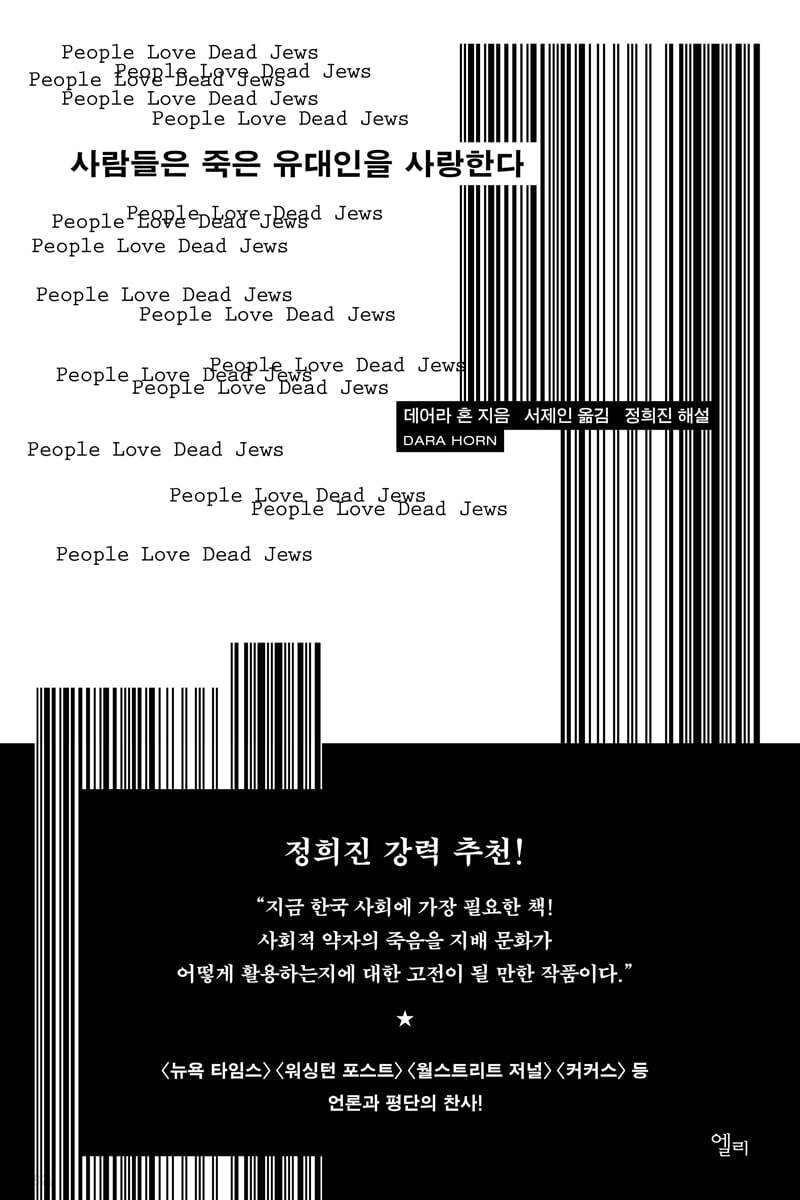
People love dead Jews
 |
Description
Book Introduction
"People Love Dead Jews" is a fascinating and controversial exploration of the world's twisted obsession with consuming dead Jews, a story about Jews we've never known before. It debunks the myth that learning about the Holocaust reduces anti-Semitism, and exposes the ways in which marketing the Holocaust as a "universal" human experience diminishes its horror. It critically presents the real reason why "Anne Frankländer" remains popular worldwide, and offers entirely new perspectives on Harbin, Marc Chagall, and Hannah Arendt. It was selected as a [New York Times] Notable Book, [Publisher's Weekly] Book of the Year, and [Chicago Public Library] Best Book for its poignant questions that shatter old and outdated prejudices, its sharp insights that resist covert and subtle discrimination, and its storytelling that smoothly unfolds comical and tragic material that no one has ever talked about. |
- You can preview some of the book's contents.
Preview
index
From the present where the West Gate ghost is haunted
Chapter 1 Everyone's (Second) Favorite Dead Jew
Chapter 2: The Frozen Jews
Chapter 3: Dead American Jews 1
Chapter 4: The Executed Jews
Chapter 5: Dead Jews in Fiction
Chapter 6: The Legend of the Dead Jews
Chapter 7: Dead American Jews 2
Chapter 8: On Saving People
Chapter 9: Dead Jews in the Desert
Chapter 10: Blockbuster Dead Jews
Chapter 11: The Road to School with Shylock
Chapter 12 Dead American Jews 3 - Turning the Pages
Acknowledgements
Commentary: The Other and the Dead: Radical Questions About Civilization by Jeong Hee-jin
References
Chapter 1 Everyone's (Second) Favorite Dead Jew
Chapter 2: The Frozen Jews
Chapter 3: Dead American Jews 1
Chapter 4: The Executed Jews
Chapter 5: Dead Jews in Fiction
Chapter 6: The Legend of the Dead Jews
Chapter 7: Dead American Jews 2
Chapter 8: On Saving People
Chapter 9: Dead Jews in the Desert
Chapter 10: Blockbuster Dead Jews
Chapter 11: The Road to School with Shylock
Chapter 12 Dead American Jews 3 - Turning the Pages
Acknowledgements
Commentary: The Other and the Dead: Radical Questions About Civilization by Jeong Hee-jin
References
Detailed image

Into the book
The Jews were meant to die for moral and educational purposes.
--- p.15
I had mistakenly assumed that the public's overwhelming interest in the Jewish people's painful past was a show of respect for living Jews.
I was completely wrong.
--- pp.20~21
I struggled to leave everything as autonomous as possible, always trying to tell the story of how and for what the Jews lived rather than how they died.
As I told my roommates in Nashville long ago, I wasn't that dark of a person, neither in my eyes nor in my thoughts.
--- p.22
People love dead Jews.
Living Jews do not love as much.
--- p.27
We can only hope that we have the courage to hear this truth without hiding it, the courage to face the fire and begin again.
--- p.43
What has made the deadly attacks on American Jews in recent years so shocking and disturbing is not just their sheer violence, but also because they contradict the narrative that American Jews have told themselves for generations: that America has never violated anyone's life through anti-Semitism.
We don't just prefer this birth story.
We need it.
Stories are more important than history.
Because stories are devices that create meaning.
--- p.169
I don't know what to tell my children about this tragedy, but I know what to tell you.
The freedoms we cherish are meaningless without our responsibilities to one another.
Without a commitment to engaging in civic dialogue, actively educating the next generation, welcoming strangers, and loving our neighbors.
The beginning of freedom is the beginning of responsibility.
--- p.177
It's easy to forget that some cultures hold different values, that some people see people other than artists and intellectuals as the guardians of civilization, and that most of those actually killed in the Holocaust faithfully believed in one of these alternatives.
--- p.253
Some people of other ethnicities might go to a Holocaust museum, feel sad, and then be proud of themselves for feeling sad.
They will learn something officially important, and discover a sophisticated metaphor for the limitations of Western civilization.
The problem is that for us, the dead Jews are not metaphors, they are real people we don't want our children to become like.
--- p.290
I don't want my children to become metaphors for someone else.
--- p.293
There are several ways to rebuild a broken world, and they all require humility, empathy, and an unwavering recognition that no one is superior to another.
That constant awareness requires practice, vigilance, and an attitude of staying awake on every night of the week.
--- p.15
I had mistakenly assumed that the public's overwhelming interest in the Jewish people's painful past was a show of respect for living Jews.
I was completely wrong.
--- pp.20~21
I struggled to leave everything as autonomous as possible, always trying to tell the story of how and for what the Jews lived rather than how they died.
As I told my roommates in Nashville long ago, I wasn't that dark of a person, neither in my eyes nor in my thoughts.
--- p.22
People love dead Jews.
Living Jews do not love as much.
--- p.27
We can only hope that we have the courage to hear this truth without hiding it, the courage to face the fire and begin again.
--- p.43
What has made the deadly attacks on American Jews in recent years so shocking and disturbing is not just their sheer violence, but also because they contradict the narrative that American Jews have told themselves for generations: that America has never violated anyone's life through anti-Semitism.
We don't just prefer this birth story.
We need it.
Stories are more important than history.
Because stories are devices that create meaning.
--- p.169
I don't know what to tell my children about this tragedy, but I know what to tell you.
The freedoms we cherish are meaningless without our responsibilities to one another.
Without a commitment to engaging in civic dialogue, actively educating the next generation, welcoming strangers, and loving our neighbors.
The beginning of freedom is the beginning of responsibility.
--- p.177
It's easy to forget that some cultures hold different values, that some people see people other than artists and intellectuals as the guardians of civilization, and that most of those actually killed in the Holocaust faithfully believed in one of these alternatives.
--- p.253
Some people of other ethnicities might go to a Holocaust museum, feel sad, and then be proud of themselves for feeling sad.
They will learn something officially important, and discover a sophisticated metaphor for the limitations of Western civilization.
The problem is that for us, the dead Jews are not metaphors, they are real people we don't want our children to become like.
--- p.290
I don't want my children to become metaphors for someone else.
--- p.293
There are several ways to rebuild a broken world, and they all require humility, empathy, and an unwavering recognition that no one is superior to another.
That constant awareness requires practice, vigilance, and an attitude of staying awake on every night of the week.
--- p.345
Publisher's Review
“The book most needed in Korean society right now!
How the dominant culture uses the deaths of the socially vulnerable
“This is a work worthy of becoming a classic.” _Jeong Hee-jin (Visiting Professor, Ewha Womans University, Book Reviewer)
Praise from the New York Times, the Washington Post, Kirkus, and the Wall Street Journal!
Includes commentary by Jeong Hee-jin!
“If you don’t care at all about how people lived,
How those people died
“What’s the use of worrying so much?”
The dead weak are worshipped, consumed and exploited as 'heroes',
It is a wake-up call to those who are indifferent to the suffering of their living neighbors!
The Diary of Anne Frank is a classic and a representative symbol of remembering the victims of the Holocaust.
The Anne Frank House, where the main character Anne lived, is a world-famous tourist attraction with over a million visitors lining up every year to make reservations.
The author recalls a shocking incident that occurred to a young employee working at the museum.
'People Love Dead Jews.' That's the title of this book.
The young employee tried to wear a yarmulke, a small, round, flat hat worn by Jewish men.
The employer encouraged him to wear it unseen under his baseball cap.
The museum is supposed to maintain its 'neutrality', but a living Jew wearing a yarmulke could 'interfere' with the museum's 'independent position'.
After “four months of careful consideration,” the museum finally relented.
The fact that Jews working at the Anne Frank House are urged not to reveal their Jewish identity is a vivid example of the countless prejudices and discrimination that continue to persist around the world.
We honor, preserve, and love the dead Jews while disrespecting the lives of living Jews; we worship, consume, and exploit the weak dead as "heroes," while showing no concern for the suffering of our living neighbors—this is the reality we are turning a blind eye to.
Is Korean society an exception? Could it be that these stories are all connected: the heroic ode to the sexual minority who took their own lives after facing discrimination, the demand for victimhood from victims of sexual violence, and the case of a prostitute who suffered constant cyberbullying while alive and then committed suicide, only to be used as a "victim" in the ideological struggles of the movement?
From 『Anne Frank's Diary』 to 『The Merchant of Venice』,
From the Jewish community in Harbin, China, to the Pittsburgh synagogue massacre.
Raising a sharp question that shatters old and outdated prejudices,
Twelve poignant nonfiction pieces that challenge covert and subtle discrimination.
This book consists of twelve chapters in total.
One axis consists of sharp critical chapters that sound the alarm against the world's prejudice that wants to keep the other called the Jewish people in eternal death and suffering, while the other axis consists of explanatory chapters that enlighten us about things we do not know or do not know correctly about Jews and Jewish culture.
The author, who opens the introduction by saying that he was so angry that he could no longer do it because the press asked him to write stories about "dead Jews" whenever there was a terrorist attack against Jews, says in Chapter 1 that the reason Anne Frank's Diary was so popular around the world was paradoxically because Anne had no future (i.e., she was dead) and the diary did not contain the horrors of the massacre that Anne saw in the concentration camps that would make readers feel guilty, so it could be consumed with peace of mind.
On the other hand, Zalman Gradowski, who wrote the book while imprisoned, like Anne Frank's Diary, and was discovered after her death, and who 'completely' recorded the hellish life in the Auschwitz concentration camp, is an unfamiliar name to us.
His work was neither popular nor well-known.
“In a specially designed crematorium, the hair is the first thing to catch fire, but it takes the longest to burn.
Two small blue flames flicker in each eye socket.
These are two eyes that burn with the brain.
[…] The whole process lasts about twenty minutes.
And one human being, one world, turned to ashes.
[…] It won’t be long before 5,000 people, 5,000 worlds, are consumed by flames.” (p. 42)
Chapter 2 is about a visit to 'Harbin's famous sites with Jewish heritage'. The author was fascinated by the Harbin Ice and Ice Festival and planned a trip there, which led him to visit these sites as well.
In 1896, when the Trans-Siberian Railway was being built in Manchuria, many Russian Jews immigrated to Harbin and laid the foundations of the city. Thirty years later, the Russian Revolution broke out and anti-Semitic Russians moved in, confiscating almost all of their property and killing or expelling these Jews from the country.
Their past, in which they were driven out with nothing after building a city, is unknown to the world, but Harbin is now filled with relics that are nothing more than shells, such as a museum built in a renovated old synagogue filled with confiscated items from exiled Jews and Jewish wax figures.
The story is told in an ironic tone, contrasting the emptiness of these ruins, now part of the capitalist tourism industry, with the Jews who look back on their brief golden age in Harbin as the happiest of times.
Meanwhile, Chapter 4, “The Executed Jews,” Chapter 5, “Dead Jews in Novels,” and Chapter 11, “Commuting with Shylock,” can be said to be chapters that condense the author’s career as a Yiddish/Hebrew literary scholar and novelist.
Chapter 4 follows the life of Benjamin Zuskin, an actor who performed in Yiddish in Soviet Russia, and tells the shocking story of how the Soviet Union initially treated artists like him with respect, then used them to erase the identities of Jewish and other minorities, and then executed them when their purpose had served.
The story of a man who unknowingly participated in the 'cultural genocide' of his own people in a clever way leaves many lingering thoughts about human life and art.
Chapter 5 can be seen as a kind of literary criticism chapter, presenting a surprising perspective that is new to Korean readers.
The author begins with a letter of protest (in response to a protest) from a reader asking him to “write a book that serves humanity, something that will uplift people’s spirits and make them laugh a little more,” and then compares and contrasts the traditions of American/Western/Christian literature with Yiddish/Hebrew literature.
When readers of the former read a story, they automatically expect that 'good characters will be saved, or there will be a moment of epiphany, or a moment of grace given to the characters,' but that is not a rule that applies universally to all literature.
In Yiddish/Hebrew literature, there are many cases where there is no ending at all, rather than a happy ending with a sense of completion. Surprisingly, the author explains this as a religious and intentional device to express the limitations of human beings living in a “broken and unrepairable world.”
Chapter 11, which begins with the author's story of how he played a podcast version of Shakespeare's The Merchant of Venice to his ten-year-old, who was interested in it, but was deeply troubled by the underlying anti-Semitism, seems like an everyday, personal story, but it is also a refreshing, infuriating, and yet refreshing cultural critique, much like the perspectives pointing out the "misogyny implicit in the canons."
The author explains that The Merchant of Venice portrays Shylock, a Jew, as a greedy man who only cares about money, and that there were rumors that were circulating throughout Europe in Shakespeare's time, shortly before he wrote this work, such as the disgusting rumor that Jews committed murder and sold human flesh out of greed for money.
It is highly likely that this work was created in this anti-Semitic atmosphere, but because of the adoration attached to the name of the great writer Shakespeare, the world and himself tried hard not to find out about this fact, and now that they have found out, it is devastating, and it contains concerns about the Jewish generation's children.
Chapter 8 of “On Saving People,” which describes the debt that European culture and art owe to an American “rescuer,” is so interesting that Pulitzer Prize-winning author Tom Rice said, “Chapter 8 alone is worth owning.” It was also published as an e-book and became a bestseller.
This is the bizarre yet fascinating story of the life of Varian Fry, the "good gentile" who helped world-renowned Jewish artists and scholars (Hannah Arendt, Marcel Duchamp, Marc Chagall, Max Ernst, Claude Lévi-Strauss, André Breton) escape to safe countries in Europe during World War II by issuing visas.
Despite his desperate efforts to save Jews, his name is barely known in history, and most of the Jewish artists he rescued not only ignored his requests to continue his rescue work through their works after they were safe, but never even thanked him throughout their lives.
The author analyzes the psychology underlying this peculiar attitude.
It also tells many strange backstories and anecdotes about him, such as how, although it was well-intentioned, Frye was criticized as a vulgar person (by many people, including his own children) for ignoring the rescue requests of other 'ordinary' Jews at the time and only saving 'famous artists', and his choleric temper that seemed to border on anger management issues.
There are also stories about the Hollywood-obsessed "good gentile rescuer narrative" and a slightly different take on Hannah Arendt's "banality of evil."
The author's anger deepens in Chapter 10, "Blockbuster Dead Jews," a critique of the blockbuster exhibition "Auschwitz."
This exhibition was planned by the same company that planned "The Mystery of the Human Body," which was criticized for procuring a large number of human specimens from China.
The author went to this massive exhibition himself and pointed out that all the Jewish items on display were actually the belongings of real people, and argued that the exhibition, which is overly large, detailed, and specific, including gas chambers, torture chambers, and rooms about Nazism, is the exact opposite of the intention that 'after seeing this exhibition, people will oppose anti-Semitism and respect Jews', and that by presenting the Holocaust as so overwhelming, any anti-Semitic hatred and prejudice that falls short of that goal becomes 'nothing', which has the counterproductive effect of making it 'insignificant'.
“Welcoming others isn’t such a crazy thing.”
Ethics in dealing with others
In 2018, a synagogue shooting occurred in Pittsburgh, USA.
At the scene of the massacre where 11 people were killed, the perpetrator shouted, “All Jews must die.”
Six months later, the same thing happened in San Diego.
The Pittsburgh shooting was not an isolated incident, but rather a reminder that America is no exception to the history of Jewish persecution.
Then, in 2019, another shooting occurred in Jersey City against Jewish Americans.
When these anti-Semitic 'hate crimes' occurred, the most common thing the author heard from others was a dull consolation: "I don't know what to say."
The author, who had been asked by the media to speak out when a "hate crime" occurred, realizes that no one has asked him for anything since the third Jewish shooting.
Because when something happens repeatedly, it's no longer 'news'.
“Hating Jews has become normal.”
The author, who insists that Jewish culture “demands lifelong learning and constant questioning” and “demands discomfort,” does not end the book with a plausible solution or conclusion.
It is not concluded with incitement or a code of conduct.
It just poses scary questions for us.
'Why do you only love and mourn the dead Jews?
Why do you see a dead Jew in me, who is alive?
Why don't you welcome your living neighbors?'
“Our world is a broken world.
(…) There are several ways to rebuild a broken world, and they all require humility, empathy, and an unwavering recognition that no one is superior to another.
“That unwavering awareness requires practice, vigilance, and an attitude of staying awake through every night of the night.” (pp. 344, 355)
How the dominant culture uses the deaths of the socially vulnerable
“This is a work worthy of becoming a classic.” _Jeong Hee-jin (Visiting Professor, Ewha Womans University, Book Reviewer)
Praise from the New York Times, the Washington Post, Kirkus, and the Wall Street Journal!
Includes commentary by Jeong Hee-jin!
“If you don’t care at all about how people lived,
How those people died
“What’s the use of worrying so much?”
The dead weak are worshipped, consumed and exploited as 'heroes',
It is a wake-up call to those who are indifferent to the suffering of their living neighbors!
The Diary of Anne Frank is a classic and a representative symbol of remembering the victims of the Holocaust.
The Anne Frank House, where the main character Anne lived, is a world-famous tourist attraction with over a million visitors lining up every year to make reservations.
The author recalls a shocking incident that occurred to a young employee working at the museum.
'People Love Dead Jews.' That's the title of this book.
The young employee tried to wear a yarmulke, a small, round, flat hat worn by Jewish men.
The employer encouraged him to wear it unseen under his baseball cap.
The museum is supposed to maintain its 'neutrality', but a living Jew wearing a yarmulke could 'interfere' with the museum's 'independent position'.
After “four months of careful consideration,” the museum finally relented.
The fact that Jews working at the Anne Frank House are urged not to reveal their Jewish identity is a vivid example of the countless prejudices and discrimination that continue to persist around the world.
We honor, preserve, and love the dead Jews while disrespecting the lives of living Jews; we worship, consume, and exploit the weak dead as "heroes," while showing no concern for the suffering of our living neighbors—this is the reality we are turning a blind eye to.
Is Korean society an exception? Could it be that these stories are all connected: the heroic ode to the sexual minority who took their own lives after facing discrimination, the demand for victimhood from victims of sexual violence, and the case of a prostitute who suffered constant cyberbullying while alive and then committed suicide, only to be used as a "victim" in the ideological struggles of the movement?
From 『Anne Frank's Diary』 to 『The Merchant of Venice』,
From the Jewish community in Harbin, China, to the Pittsburgh synagogue massacre.
Raising a sharp question that shatters old and outdated prejudices,
Twelve poignant nonfiction pieces that challenge covert and subtle discrimination.
This book consists of twelve chapters in total.
One axis consists of sharp critical chapters that sound the alarm against the world's prejudice that wants to keep the other called the Jewish people in eternal death and suffering, while the other axis consists of explanatory chapters that enlighten us about things we do not know or do not know correctly about Jews and Jewish culture.
The author, who opens the introduction by saying that he was so angry that he could no longer do it because the press asked him to write stories about "dead Jews" whenever there was a terrorist attack against Jews, says in Chapter 1 that the reason Anne Frank's Diary was so popular around the world was paradoxically because Anne had no future (i.e., she was dead) and the diary did not contain the horrors of the massacre that Anne saw in the concentration camps that would make readers feel guilty, so it could be consumed with peace of mind.
On the other hand, Zalman Gradowski, who wrote the book while imprisoned, like Anne Frank's Diary, and was discovered after her death, and who 'completely' recorded the hellish life in the Auschwitz concentration camp, is an unfamiliar name to us.
His work was neither popular nor well-known.
“In a specially designed crematorium, the hair is the first thing to catch fire, but it takes the longest to burn.
Two small blue flames flicker in each eye socket.
These are two eyes that burn with the brain.
[…] The whole process lasts about twenty minutes.
And one human being, one world, turned to ashes.
[…] It won’t be long before 5,000 people, 5,000 worlds, are consumed by flames.” (p. 42)
Chapter 2 is about a visit to 'Harbin's famous sites with Jewish heritage'. The author was fascinated by the Harbin Ice and Ice Festival and planned a trip there, which led him to visit these sites as well.
In 1896, when the Trans-Siberian Railway was being built in Manchuria, many Russian Jews immigrated to Harbin and laid the foundations of the city. Thirty years later, the Russian Revolution broke out and anti-Semitic Russians moved in, confiscating almost all of their property and killing or expelling these Jews from the country.
Their past, in which they were driven out with nothing after building a city, is unknown to the world, but Harbin is now filled with relics that are nothing more than shells, such as a museum built in a renovated old synagogue filled with confiscated items from exiled Jews and Jewish wax figures.
The story is told in an ironic tone, contrasting the emptiness of these ruins, now part of the capitalist tourism industry, with the Jews who look back on their brief golden age in Harbin as the happiest of times.
Meanwhile, Chapter 4, “The Executed Jews,” Chapter 5, “Dead Jews in Novels,” and Chapter 11, “Commuting with Shylock,” can be said to be chapters that condense the author’s career as a Yiddish/Hebrew literary scholar and novelist.
Chapter 4 follows the life of Benjamin Zuskin, an actor who performed in Yiddish in Soviet Russia, and tells the shocking story of how the Soviet Union initially treated artists like him with respect, then used them to erase the identities of Jewish and other minorities, and then executed them when their purpose had served.
The story of a man who unknowingly participated in the 'cultural genocide' of his own people in a clever way leaves many lingering thoughts about human life and art.
Chapter 5 can be seen as a kind of literary criticism chapter, presenting a surprising perspective that is new to Korean readers.
The author begins with a letter of protest (in response to a protest) from a reader asking him to “write a book that serves humanity, something that will uplift people’s spirits and make them laugh a little more,” and then compares and contrasts the traditions of American/Western/Christian literature with Yiddish/Hebrew literature.
When readers of the former read a story, they automatically expect that 'good characters will be saved, or there will be a moment of epiphany, or a moment of grace given to the characters,' but that is not a rule that applies universally to all literature.
In Yiddish/Hebrew literature, there are many cases where there is no ending at all, rather than a happy ending with a sense of completion. Surprisingly, the author explains this as a religious and intentional device to express the limitations of human beings living in a “broken and unrepairable world.”
Chapter 11, which begins with the author's story of how he played a podcast version of Shakespeare's The Merchant of Venice to his ten-year-old, who was interested in it, but was deeply troubled by the underlying anti-Semitism, seems like an everyday, personal story, but it is also a refreshing, infuriating, and yet refreshing cultural critique, much like the perspectives pointing out the "misogyny implicit in the canons."
The author explains that The Merchant of Venice portrays Shylock, a Jew, as a greedy man who only cares about money, and that there were rumors that were circulating throughout Europe in Shakespeare's time, shortly before he wrote this work, such as the disgusting rumor that Jews committed murder and sold human flesh out of greed for money.
It is highly likely that this work was created in this anti-Semitic atmosphere, but because of the adoration attached to the name of the great writer Shakespeare, the world and himself tried hard not to find out about this fact, and now that they have found out, it is devastating, and it contains concerns about the Jewish generation's children.
Chapter 8 of “On Saving People,” which describes the debt that European culture and art owe to an American “rescuer,” is so interesting that Pulitzer Prize-winning author Tom Rice said, “Chapter 8 alone is worth owning.” It was also published as an e-book and became a bestseller.
This is the bizarre yet fascinating story of the life of Varian Fry, the "good gentile" who helped world-renowned Jewish artists and scholars (Hannah Arendt, Marcel Duchamp, Marc Chagall, Max Ernst, Claude Lévi-Strauss, André Breton) escape to safe countries in Europe during World War II by issuing visas.
Despite his desperate efforts to save Jews, his name is barely known in history, and most of the Jewish artists he rescued not only ignored his requests to continue his rescue work through their works after they were safe, but never even thanked him throughout their lives.
The author analyzes the psychology underlying this peculiar attitude.
It also tells many strange backstories and anecdotes about him, such as how, although it was well-intentioned, Frye was criticized as a vulgar person (by many people, including his own children) for ignoring the rescue requests of other 'ordinary' Jews at the time and only saving 'famous artists', and his choleric temper that seemed to border on anger management issues.
There are also stories about the Hollywood-obsessed "good gentile rescuer narrative" and a slightly different take on Hannah Arendt's "banality of evil."
The author's anger deepens in Chapter 10, "Blockbuster Dead Jews," a critique of the blockbuster exhibition "Auschwitz."
This exhibition was planned by the same company that planned "The Mystery of the Human Body," which was criticized for procuring a large number of human specimens from China.
The author went to this massive exhibition himself and pointed out that all the Jewish items on display were actually the belongings of real people, and argued that the exhibition, which is overly large, detailed, and specific, including gas chambers, torture chambers, and rooms about Nazism, is the exact opposite of the intention that 'after seeing this exhibition, people will oppose anti-Semitism and respect Jews', and that by presenting the Holocaust as so overwhelming, any anti-Semitic hatred and prejudice that falls short of that goal becomes 'nothing', which has the counterproductive effect of making it 'insignificant'.
“Welcoming others isn’t such a crazy thing.”
Ethics in dealing with others
In 2018, a synagogue shooting occurred in Pittsburgh, USA.
At the scene of the massacre where 11 people were killed, the perpetrator shouted, “All Jews must die.”
Six months later, the same thing happened in San Diego.
The Pittsburgh shooting was not an isolated incident, but rather a reminder that America is no exception to the history of Jewish persecution.
Then, in 2019, another shooting occurred in Jersey City against Jewish Americans.
When these anti-Semitic 'hate crimes' occurred, the most common thing the author heard from others was a dull consolation: "I don't know what to say."
The author, who had been asked by the media to speak out when a "hate crime" occurred, realizes that no one has asked him for anything since the third Jewish shooting.
Because when something happens repeatedly, it's no longer 'news'.
“Hating Jews has become normal.”
The author, who insists that Jewish culture “demands lifelong learning and constant questioning” and “demands discomfort,” does not end the book with a plausible solution or conclusion.
It is not concluded with incitement or a code of conduct.
It just poses scary questions for us.
'Why do you only love and mourn the dead Jews?
Why do you see a dead Jew in me, who is alive?
Why don't you welcome your living neighbors?'
“Our world is a broken world.
(…) There are several ways to rebuild a broken world, and they all require humility, empathy, and an unwavering recognition that no one is superior to another.
“That unwavering awareness requires practice, vigilance, and an attitude of staying awake through every night of the night.” (pp. 344, 355)
GOODS SPECIFICS
- Date of issue: April 12, 2023
- Page count, weight, size: 364 pages | 380g | 140*210*18mm
- ISBN13: 9791191247336
- ISBN10: 1191247333
You may also like
카테고리
korean


korean

![GQ KOREA Mark (Monthly): December [2025]](http://librairie.coreenne.fr/cdn/shop/files/8ef265dbbfbf186523ed75ba7319009d.jpg?v=1765340328&width=3840)


