

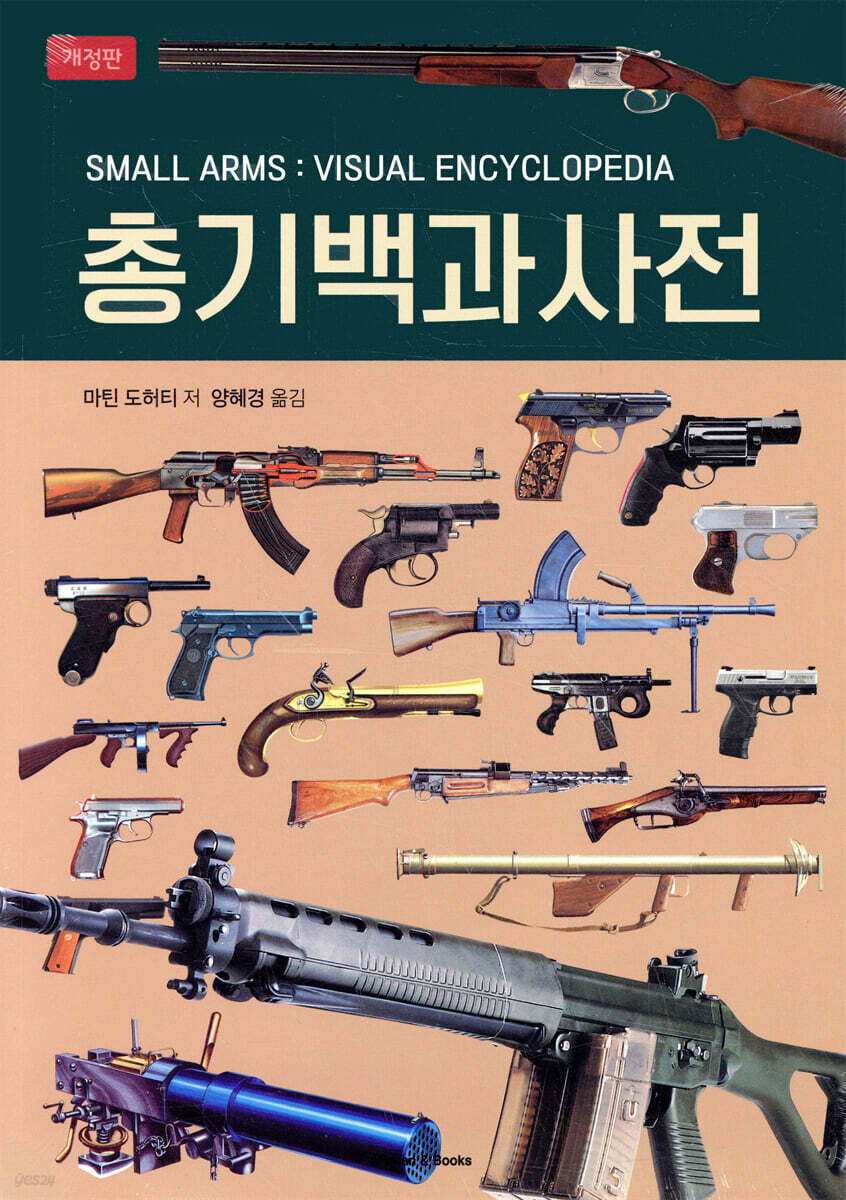
Firearms Encyclopedia
 |
Description
Book Introduction
The revised edition of the gun enthusiast's steady seller, the gun encyclopedia, is finally out!
A book that innovates the design of the firearms encyclopedia and corrects some errors.
From the early matchlock guns to the modern era,
A book containing the genealogy and history of all guns
Detailed analysis of how it works, barrel length, caliber, weight, etc.
The lineage and characteristics of over 800 firearms with color illustrations
From the invention of gunpowder to modern special warfare
Panoramic view of firearm anatomy throughout history
The complete firearms encyclopedia provided by Ember Book, the world's leading military and weapons publisher, has been translated and published.
We introduce firearms that have appeared from the 15th century, when gunpowder weapons were first used, to the present, when advanced automatic weapons are used.
Accordingly, readers can encounter all the guns that have appeared on the stage of history, disappeared at times, or exist to this day: matchlock guns, pistols, rifles, machine guns, submachine guns, heavy machine guns, anti-tank guns, shotguns, shotguns, and special guns.
Each gun is accompanied by a vivid color image, along with detailed financial information, genealogy, and historical background.
It covers not only guns that were popular in their day, such as the Navy Colt, Gatling gun, Carr 98 rifle, Thompson 1928 submachine gun, Uzi, and M110 sniper, but also experimental firearms that were developed and used according to new ideas and needs.
This is a masterpiece by Ember, a world-renowned weapons publisher, and it contains a 448-page guide to the features, structures, specifications, and performance of over 800 types of guns, along with high-quality illustrations.
A detailed glossary of terms is also included, along with a glossary of terms and the original text.
A book that innovates the design of the firearms encyclopedia and corrects some errors.
From the early matchlock guns to the modern era,
A book containing the genealogy and history of all guns
Detailed analysis of how it works, barrel length, caliber, weight, etc.
The lineage and characteristics of over 800 firearms with color illustrations
From the invention of gunpowder to modern special warfare
Panoramic view of firearm anatomy throughout history
The complete firearms encyclopedia provided by Ember Book, the world's leading military and weapons publisher, has been translated and published.
We introduce firearms that have appeared from the 15th century, when gunpowder weapons were first used, to the present, when advanced automatic weapons are used.
Accordingly, readers can encounter all the guns that have appeared on the stage of history, disappeared at times, or exist to this day: matchlock guns, pistols, rifles, machine guns, submachine guns, heavy machine guns, anti-tank guns, shotguns, shotguns, and special guns.
Each gun is accompanied by a vivid color image, along with detailed financial information, genealogy, and historical background.
It covers not only guns that were popular in their day, such as the Navy Colt, Gatling gun, Carr 98 rifle, Thompson 1928 submachine gun, Uzi, and M110 sniper, but also experimental firearms that were developed and used according to new ideas and needs.
This is a masterpiece by Ember, a world-renowned weapons publisher, and it contains a 448-page guide to the features, structures, specifications, and performance of over 800 types of guns, along with high-quality illustrations.
A detailed glossary of terms is also included, along with a glossary of terms and the original text.
index
introduction
Early small arms
The emergence of the repeater
World War I
The period between the two wars
World War II
After World War II
Cold War era
hyundai
sporting guns
Glossary of Terms
Firearms Index
Early small arms
The emergence of the repeater
World War I
The period between the two wars
World War II
After World War II
Cold War era
hyundai
sporting guns
Glossary of Terms
Firearms Index
Into the book
The invention of gunpowder was one of the most profound changes in human history.
Cannons using black powder neutralized fortified castles and transformed the nature of naval warfare.
Lighter weapons, or small arms, brought about a revolution in combat as well as in individual duels.
--- p.6
From the 16th century onwards, small arms rapidly dominated European battlefields, becoming more than just auxiliary weapons for units equipped for close combat, but also the primary military weapon.
However, early small arms were not very reliable, as they took too long to reload.
--- p.9
The matchlock musket remained a standard infantry weapon for decades, with designs competing among several nations.
Muskets had a good hit rate at man-sized targets at ranges of 80-100 meters, but were virtually non-existent at 200 meters.
--- p.20
An intermediate step between hand-fired black powder weapons and integral cartridge small arms was the introduction of the percussion cap, or primer-type ignition device.
The detonator contains a small amount of highly unstable explosive that detonates upon strong impact.
The projectile of a primer-type firearm is the same black powder as before, and when this gunpowder is fed into the barrel, the bullet and charge are placed on top as before.
--- p.26
Being able to load more than one round before reloading is a huge asset, whether in a self-defense duel or on the battlefield.
This is because firing does not always hit the target, and some shots may not cause any damage to the enemy.
The answer to this problem was to develop weapons that carried one or more projectiles ready to fire, which resulted in the popularization of revolver-type firearms.
--- p.30
One of the most famous firearms of all time, the Army Colt Single Action was adopted by the U.S. Army in 1873.
This gun was replaced by a double-action gun in 1892.
The Colt single action for the Army came in three barrels: the 191mm and 140mm were called the 'Gunpiper' (sharpshooter) models, and the 114mm was called the 'Civilian' (civilian).
The nickname "Peacemaker" is believed to be due to the gun's popularity with law enforcement officers.
A variant with an extremely long barrel, known as the 'Bunline Special', also appeared.
--- p.46
World War I marked the arrival of the era of modern small arms.
It was the first large-scale war in which rapid-fire automatic weapons became the mainstay of infantry firepower.
Most infantrymen were armed with bolt-action rifles fed from internal magazines, allowing them to fire quickly and with aim.
During this period, defenders strongly favored tactical balance.
The rifle's firepower was lethal at long range, and the machine gun turned the traditional dense advance into a suicidal march.
--- p.75
One problem faced by the participating nations in World War II was how to provide automatic firing systems for their advance units.
At that time, machine guns were too large to advance across military buffer zones, and it was difficult for the advance units to block enemy counterattacks without machine guns.
The answer to this problem was to provide a lighter automatic support weapon that did not require heavy tripods and water cooling, and could be carried in a convenient magazine or drum.
--- p.114
As John Moses Browning faced death, he devoted himself to one firearm design that would later become one of the most successful of all time.
The new firearm, once production was completed, went on sale under the model name 'Browning Hi-Power'.
It is also called HP-35 and GP-35 (Grande Puissance, French for 'high power').
The term 'High Power' refers not to the special capabilities of the 9mm bullet, but rather to the magazine's impressive 13-round capacity, which was exceptional for its time.
--- p.132
World War II was the first 'modern' war.
Armored vehicles and air power, which had been experimental models in previous wars, have evolved into powerful and far-reaching weapon systems and agile strike forces covering vast areas.
At the same time, the average combat range continued to narrow as close-range urban melee combat became more frequent than ever before.
In these battles, the primary weapons evolved into submachine guns, flamethrowers, and, by the postwar period, assault rifles.
--- p.151
M1 Garand: Although somewhat outdated by modern standards, it was a weapon that brought about a major leap forward in infantry firepower at the time.
The powerful 7.62mm round is fired accurately and rapidly from an 8-round internal magazine and reloads quickly.
The first M1 models had a tendency to jam due to their gas-operated operation.
However, since 1939, reliability has been greatly improved with the introduction of an alternative system that vents gases through a tube under the muzzle.
--- p.162
Between 1960 and 1990, the world was greatly shadowed by the Cold War between the North Atlantic Treaty Organization (NATO) and the Warsaw Pact.
Great powers have always been heavily involved in the procurement of military supplies, providing weapons and military advisers to weaker countries with political stipulations.
Many countries purchased their military equipment from either the West or the Warsaw Pact.
It was rare for a country to have a mixed weapons system from two extreme power groups.
The result is significant polarization regarding weapon types and compatibility.
--- p.241
The AK-47 was modified several times during its first few years of service, and many variant models appeared along with it.
In 1959, the Soviet Army officially adopted a new model, designated AKM (the M stands for 'Modernizirovanniy' or 'Modernized'), which was also heavily modified.
--- p.274
The term 'sporting gun (including shotgun)' can apply to a variety of small arms used for target shooting for recreation, sport, or hunting purposes.
The typical hunter only makes one or two precision shots and doesn't need a large-caliber semi-automatic weapon.
Sporting guns, unlike military weapons, are rarely abused, but are often handled roughly.
It needs to be able to maintain accuracy while on the move or stationary on a slope when hunting, so its sturdiness is very important.
--- p.405
Brno 800 Series: Double-barreled weapons with a smoothbore (shotgun) barrel and a rifled barrel are not as common as real rifles or shotguns, but they are very useful for the rugged hunter who never knows what his next target will be.
Carrying both a loaded rifle and a shotgun effectively at all times provides the hunter with great flexibility.
Cannons using black powder neutralized fortified castles and transformed the nature of naval warfare.
Lighter weapons, or small arms, brought about a revolution in combat as well as in individual duels.
--- p.6
From the 16th century onwards, small arms rapidly dominated European battlefields, becoming more than just auxiliary weapons for units equipped for close combat, but also the primary military weapon.
However, early small arms were not very reliable, as they took too long to reload.
--- p.9
The matchlock musket remained a standard infantry weapon for decades, with designs competing among several nations.
Muskets had a good hit rate at man-sized targets at ranges of 80-100 meters, but were virtually non-existent at 200 meters.
--- p.20
An intermediate step between hand-fired black powder weapons and integral cartridge small arms was the introduction of the percussion cap, or primer-type ignition device.
The detonator contains a small amount of highly unstable explosive that detonates upon strong impact.
The projectile of a primer-type firearm is the same black powder as before, and when this gunpowder is fed into the barrel, the bullet and charge are placed on top as before.
--- p.26
Being able to load more than one round before reloading is a huge asset, whether in a self-defense duel or on the battlefield.
This is because firing does not always hit the target, and some shots may not cause any damage to the enemy.
The answer to this problem was to develop weapons that carried one or more projectiles ready to fire, which resulted in the popularization of revolver-type firearms.
--- p.30
One of the most famous firearms of all time, the Army Colt Single Action was adopted by the U.S. Army in 1873.
This gun was replaced by a double-action gun in 1892.
The Colt single action for the Army came in three barrels: the 191mm and 140mm were called the 'Gunpiper' (sharpshooter) models, and the 114mm was called the 'Civilian' (civilian).
The nickname "Peacemaker" is believed to be due to the gun's popularity with law enforcement officers.
A variant with an extremely long barrel, known as the 'Bunline Special', also appeared.
--- p.46
World War I marked the arrival of the era of modern small arms.
It was the first large-scale war in which rapid-fire automatic weapons became the mainstay of infantry firepower.
Most infantrymen were armed with bolt-action rifles fed from internal magazines, allowing them to fire quickly and with aim.
During this period, defenders strongly favored tactical balance.
The rifle's firepower was lethal at long range, and the machine gun turned the traditional dense advance into a suicidal march.
--- p.75
One problem faced by the participating nations in World War II was how to provide automatic firing systems for their advance units.
At that time, machine guns were too large to advance across military buffer zones, and it was difficult for the advance units to block enemy counterattacks without machine guns.
The answer to this problem was to provide a lighter automatic support weapon that did not require heavy tripods and water cooling, and could be carried in a convenient magazine or drum.
--- p.114
As John Moses Browning faced death, he devoted himself to one firearm design that would later become one of the most successful of all time.
The new firearm, once production was completed, went on sale under the model name 'Browning Hi-Power'.
It is also called HP-35 and GP-35 (Grande Puissance, French for 'high power').
The term 'High Power' refers not to the special capabilities of the 9mm bullet, but rather to the magazine's impressive 13-round capacity, which was exceptional for its time.
--- p.132
World War II was the first 'modern' war.
Armored vehicles and air power, which had been experimental models in previous wars, have evolved into powerful and far-reaching weapon systems and agile strike forces covering vast areas.
At the same time, the average combat range continued to narrow as close-range urban melee combat became more frequent than ever before.
In these battles, the primary weapons evolved into submachine guns, flamethrowers, and, by the postwar period, assault rifles.
--- p.151
M1 Garand: Although somewhat outdated by modern standards, it was a weapon that brought about a major leap forward in infantry firepower at the time.
The powerful 7.62mm round is fired accurately and rapidly from an 8-round internal magazine and reloads quickly.
The first M1 models had a tendency to jam due to their gas-operated operation.
However, since 1939, reliability has been greatly improved with the introduction of an alternative system that vents gases through a tube under the muzzle.
--- p.162
Between 1960 and 1990, the world was greatly shadowed by the Cold War between the North Atlantic Treaty Organization (NATO) and the Warsaw Pact.
Great powers have always been heavily involved in the procurement of military supplies, providing weapons and military advisers to weaker countries with political stipulations.
Many countries purchased their military equipment from either the West or the Warsaw Pact.
It was rare for a country to have a mixed weapons system from two extreme power groups.
The result is significant polarization regarding weapon types and compatibility.
--- p.241
The AK-47 was modified several times during its first few years of service, and many variant models appeared along with it.
In 1959, the Soviet Army officially adopted a new model, designated AKM (the M stands for 'Modernizirovanniy' or 'Modernized'), which was also heavily modified.
--- p.274
The term 'sporting gun (including shotgun)' can apply to a variety of small arms used for target shooting for recreation, sport, or hunting purposes.
The typical hunter only makes one or two precision shots and doesn't need a large-caliber semi-automatic weapon.
Sporting guns, unlike military weapons, are rarely abused, but are often handled roughly.
It needs to be able to maintain accuracy while on the move or stationary on a slope when hunting, so its sturdiness is very important.
--- p.405
Brno 800 Series: Double-barreled weapons with a smoothbore (shotgun) barrel and a rifled barrel are not as common as real rifles or shotguns, but they are very useful for the rugged hunter who never knows what his next target will be.
Carrying both a loaded rifle and a shotgun effectively at all times provides the hunter with great flexibility.
--- p.424
Publisher's Review
From the early matchlock guns to the modern era,
Contains the genealogy and history of all guns in the world!
Detailed analysis of how it works, barrel length, caliber, weight, etc.
The lineage and characteristics of over 800 firearms with color illustrations
The invention of gunpowder was one of the most profound changes in human history.
Cannons using black powder neutralized fortified castles and transformed the nature of naval warfare.
Lighter weapons, or small arms, brought about a revolution in combat as well as in individual duels.
From the 16th century onwards, small arms rapidly dominated European battlefields, becoming more than just auxiliary weapons for units equipped for close combat, but also the primary military weapon.
However, early small arms were not very reliable, as they took too long to reload.
Early repeating pistols were difficult to carry and frequently had problems with malfunctions.
However, despite the disappointing results, the experiments continued despite the sufficiently attractive burst ability.
World War I marked the arrival of the era of modern small arms.
It was the first large-scale war in which rapid-fire automatic weapons became the mainstay of infantry firepower.
Most infantrymen were armed with bolt-action rifles fed from internal magazines, allowing them to fire quickly and with aim.
During this period, defenders strongly favored tactical balance.
The rifle's firepower was lethal at long range, and the machine gun turned the traditional dense advance into a suicidal march.
The ground, heavily riddled with shell holes and barbed wire, slowed the attackers down, allowing the defenders additional time to bring down effective firepower.
During World War I, numerous weapons were tested and weapons technology advanced rapidly.
There was also a revolutionary change in military thinking, and the need for infantry weapons other than rifles arose.
Pistols, shotguns, and submachine guns proved their worth in trench-clearing battles, and advances in these areas were in turn reflected in the civilian and law enforcement markets.
As these events unfolded during periods of great economic and social upheaval, these weapons found their way onto the streets in the hands of gangs, government agents, and revolutionaries.
From the invention of gunpowder to modern special warfare
Panoramic view of firearm anatomy throughout history
World War II was the first 'modern' war.
Armored vehicles and air power, which had been experimental models in previous wars, have evolved into powerful and far-reaching weapon systems and agile strike forces covering vast areas.
At the same time, the average combat range continued to narrow as close-range urban melee combat became more frequent than ever before.
In these battles, the primary weapons evolved into submachine guns, flamethrowers, and, towards the end of the war, assault rifles.
Although assault rifles became widely available only after the war, infantry firepower took another leap forward with the widespread adoption of semi-automatic rifles.
Often firing the same rounds as older bolt-action rifles, soldiers with semi-automatic rifles could reload and fire faster with consistent accuracy.
Even after World War II ended, peace did not come.
Soon after, the participating nations became involved in the Korean War and the Malayan Emergency.
The Chinese Civil War, the wars of independence in Southeast Asia, and the rebellions in Africa that followed placed the major powers in a state of semi-war.
This was also a time when the Cold War began, the NATO-Warsaw Pact alliances were formed, and the possibility that World War II might continue as an East-West conflict in Europe became a reality.
Between 1960 and 1990, the world was greatly shadowed by the Cold War between the North Atlantic Treaty Organization (NATO) and the Warsaw Pact.
Great powers have always been heavily involved in the procurement of military supplies, providing weapons and military advisers to weaker countries with political stipulations.
Many countries purchased their military equipment from the West or the Warsaw Pact.
It was rare for a country to have a mixed weapons system from two extreme power groups.
The result is significant polarization regarding weapon types and compatibility.
There have been several significant advances in weapons technology in recent years, but none of them are particularly notable.
Ergonomics plays a much more important role in design than ever before, with even fairly basic weapons designed for ease of use taking comfort and safety into account.
Modern firearms designers have many niches to consider, and they must either cater to one of them or create a truly exceptional weapon.
As the military environment continues to shift towards smaller and lighter weapons, most combat still takes place at close range.
Contains the genealogy and history of all guns in the world!
Detailed analysis of how it works, barrel length, caliber, weight, etc.
The lineage and characteristics of over 800 firearms with color illustrations
The invention of gunpowder was one of the most profound changes in human history.
Cannons using black powder neutralized fortified castles and transformed the nature of naval warfare.
Lighter weapons, or small arms, brought about a revolution in combat as well as in individual duels.
From the 16th century onwards, small arms rapidly dominated European battlefields, becoming more than just auxiliary weapons for units equipped for close combat, but also the primary military weapon.
However, early small arms were not very reliable, as they took too long to reload.
Early repeating pistols were difficult to carry and frequently had problems with malfunctions.
However, despite the disappointing results, the experiments continued despite the sufficiently attractive burst ability.
World War I marked the arrival of the era of modern small arms.
It was the first large-scale war in which rapid-fire automatic weapons became the mainstay of infantry firepower.
Most infantrymen were armed with bolt-action rifles fed from internal magazines, allowing them to fire quickly and with aim.
During this period, defenders strongly favored tactical balance.
The rifle's firepower was lethal at long range, and the machine gun turned the traditional dense advance into a suicidal march.
The ground, heavily riddled with shell holes and barbed wire, slowed the attackers down, allowing the defenders additional time to bring down effective firepower.
During World War I, numerous weapons were tested and weapons technology advanced rapidly.
There was also a revolutionary change in military thinking, and the need for infantry weapons other than rifles arose.
Pistols, shotguns, and submachine guns proved their worth in trench-clearing battles, and advances in these areas were in turn reflected in the civilian and law enforcement markets.
As these events unfolded during periods of great economic and social upheaval, these weapons found their way onto the streets in the hands of gangs, government agents, and revolutionaries.
From the invention of gunpowder to modern special warfare
Panoramic view of firearm anatomy throughout history
World War II was the first 'modern' war.
Armored vehicles and air power, which had been experimental models in previous wars, have evolved into powerful and far-reaching weapon systems and agile strike forces covering vast areas.
At the same time, the average combat range continued to narrow as close-range urban melee combat became more frequent than ever before.
In these battles, the primary weapons evolved into submachine guns, flamethrowers, and, towards the end of the war, assault rifles.
Although assault rifles became widely available only after the war, infantry firepower took another leap forward with the widespread adoption of semi-automatic rifles.
Often firing the same rounds as older bolt-action rifles, soldiers with semi-automatic rifles could reload and fire faster with consistent accuracy.
Even after World War II ended, peace did not come.
Soon after, the participating nations became involved in the Korean War and the Malayan Emergency.
The Chinese Civil War, the wars of independence in Southeast Asia, and the rebellions in Africa that followed placed the major powers in a state of semi-war.
This was also a time when the Cold War began, the NATO-Warsaw Pact alliances were formed, and the possibility that World War II might continue as an East-West conflict in Europe became a reality.
Between 1960 and 1990, the world was greatly shadowed by the Cold War between the North Atlantic Treaty Organization (NATO) and the Warsaw Pact.
Great powers have always been heavily involved in the procurement of military supplies, providing weapons and military advisers to weaker countries with political stipulations.
Many countries purchased their military equipment from the West or the Warsaw Pact.
It was rare for a country to have a mixed weapons system from two extreme power groups.
The result is significant polarization regarding weapon types and compatibility.
There have been several significant advances in weapons technology in recent years, but none of them are particularly notable.
Ergonomics plays a much more important role in design than ever before, with even fairly basic weapons designed for ease of use taking comfort and safety into account.
Modern firearms designers have many niches to consider, and they must either cater to one of them or create a truly exceptional weapon.
As the military environment continues to shift towards smaller and lighter weapons, most combat still takes place at close range.
GOODS SPECIFICS
- Date of issue: December 1, 2022
- Page count, weight, size: 448 pages | 210*297*30mm
- ISBN13: 9788960787629
- ISBN10: 8960787620
You may also like
카테고리
korean


korean

![GQ KOREA Mark (Monthly): December [2025]](http://librairie.coreenne.fr/cdn/shop/files/8ef265dbbfbf186523ed75ba7319009d.jpg?v=1765340328&width=3840)


