

Design Humanities
 |
Description
Book Introduction
The humanities wind blowing in design
What is the relationship between design and humanities?
What direction will design take in it?
The humanities wind is blowing in the design field as well.
In fact, for a long time in Korea, design was treated as an industry and was limited to the realm of production, focusing only on realizing functionality.
The utilitarian design that became popular in the United States after World War II took root in this country without much modification, prioritizing function over value and meeting the needs and expectations of businesses over the lives of the masses.
Within the shackles of specialization, we were cut off from communication with other fields.
Recently, however, the need for humanities has been emphasized under the leadership of companies.
Unlike in the past, we have reached a point where technology alone can no longer solve the problems facing design, and therefore, a fundamental awakening and innovation are urgently needed.
This is certainly a welcome change.
However, if we look at the underlying principles of this humanities boom, we see that it is no different from the existing approaches that attempted to solve design problems by importing methodologies from business, science, or technology.
The humanities are seen as a kind of tool. However, according to the author, the humanities have already existed within design, not outside of it.
Furthermore, he says that design itself is a lump of humanities.
If so, rather than flipping through humanities books, the key would be to first examine what ‘design’ really is.
To properly understand the relationship between design and the humanities, it is more meaningful to first understand the humanities achievements built within design rather than the humanities theories outside of design.
Therefore, this book examines through abundant examples what design is created through and what constitutes design.
We diagnose several concepts surrounding design, such as technology, commerciality, and artistry (Part 2, 'Things That Make Design'), and examine the elements that make up design, including the form (shape, color) that we see with our eyes and the content contained within it (Part 3, 'Things That Make Up Design').
Following the work of analyzing the inside of the design, we examine the outside of the design.
We explore external factors that influence design and examine examples of how design interacts with the surrounding environment and other fields (Part 4, 'Things that Influence Design').
In other words, by introducing designs that have consistently breathed life into the contemporary socio-cultural context, major values, history, and traditions, we shake up the old perception that regards design as a field isolated from the world.
In addition, we will examine cases in which design has closely interacted with subfields of the humanities, such as philosophy, art, and science (cosmology) (Part 5, 'Design, the Flower of the Humanities').
What is the relationship between design and humanities?
What direction will design take in it?
The humanities wind is blowing in the design field as well.
In fact, for a long time in Korea, design was treated as an industry and was limited to the realm of production, focusing only on realizing functionality.
The utilitarian design that became popular in the United States after World War II took root in this country without much modification, prioritizing function over value and meeting the needs and expectations of businesses over the lives of the masses.
Within the shackles of specialization, we were cut off from communication with other fields.
Recently, however, the need for humanities has been emphasized under the leadership of companies.
Unlike in the past, we have reached a point where technology alone can no longer solve the problems facing design, and therefore, a fundamental awakening and innovation are urgently needed.
This is certainly a welcome change.
However, if we look at the underlying principles of this humanities boom, we see that it is no different from the existing approaches that attempted to solve design problems by importing methodologies from business, science, or technology.
The humanities are seen as a kind of tool. However, according to the author, the humanities have already existed within design, not outside of it.
Furthermore, he says that design itself is a lump of humanities.
If so, rather than flipping through humanities books, the key would be to first examine what ‘design’ really is.
To properly understand the relationship between design and the humanities, it is more meaningful to first understand the humanities achievements built within design rather than the humanities theories outside of design.
Therefore, this book examines through abundant examples what design is created through and what constitutes design.
We diagnose several concepts surrounding design, such as technology, commerciality, and artistry (Part 2, 'Things That Make Design'), and examine the elements that make up design, including the form (shape, color) that we see with our eyes and the content contained within it (Part 3, 'Things That Make Up Design').
Following the work of analyzing the inside of the design, we examine the outside of the design.
We explore external factors that influence design and examine examples of how design interacts with the surrounding environment and other fields (Part 4, 'Things that Influence Design').
In other words, by introducing designs that have consistently breathed life into the contemporary socio-cultural context, major values, history, and traditions, we shake up the old perception that regards design as a field isolated from the world.
In addition, we will examine cases in which design has closely interacted with subfields of the humanities, such as philosophy, art, and science (cosmology) (Part 5, 'Design, the Flower of the Humanities').
- You can preview some of the book's contents.
Preview
index
Part 1.
Design that requires humanities
The humanities wind blowing in design
The era of design competition
Design in Change
_The Camouflage of Functionalism | When We Need to See People, Not Consumers | Communication is Necessary
Signs of change
_Meet the Public | The Card Called Humanities
Design was already a humanities discipline.
Visual Harmony | Expression of Individuality, Ideas | Understanding the World | Soul-stirring Emotions
Part 2.
Things that make design
Technology and design
_When technology seemed paramount | Does cutting-edge technology create design? | The limits of technology | The illusion of technological advancement | Design exists even without technology | Beyond technology
Commerciality and Design
_Is design a product? | Beyond commercialism
Artistry and Design
Art, not emotion | Art is an asset to design.
Part 3.
What makes up a design
In search of good design
Form and content
Form as an external factor
_Shape | Color
Internal elements and their hierarchy
Cultural Anthropological Value | Philosophical Value and Emotion
Part 4.
Things that influence design
World and Design
Design that Shaped the World | Design that Shaped the World | Design that Criticizes Society | Design that Heals Society
History and Design
Designs That Made History | Designs That Made History
Part 5.
Design, the flower of the humanities
Humanities and Design
The humanities are not tools | The humanities are not objects of convergence | The humanities are a system
Art and Design
_Art as Seen by Design | The Flow of Design and Art | Art and Art
Design should be art
Art creates relationships | Art inspires.
Philosophy and Design
Two Aspects | Design Created by Philosophy | Philosophical Design
Space view and design
_The Physical Cosmology and Modern Design | The Emergence of Irregularity | The Emergence of an Organic Cosmology | Now, Back to Nature
Conclusion_ Looking forward to humanistic design
Design that requires humanities
The humanities wind blowing in design
The era of design competition
Design in Change
_The Camouflage of Functionalism | When We Need to See People, Not Consumers | Communication is Necessary
Signs of change
_Meet the Public | The Card Called Humanities
Design was already a humanities discipline.
Visual Harmony | Expression of Individuality, Ideas | Understanding the World | Soul-stirring Emotions
Part 2.
Things that make design
Technology and design
_When technology seemed paramount | Does cutting-edge technology create design? | The limits of technology | The illusion of technological advancement | Design exists even without technology | Beyond technology
Commerciality and Design
_Is design a product? | Beyond commercialism
Artistry and Design
Art, not emotion | Art is an asset to design.
Part 3.
What makes up a design
In search of good design
Form and content
Form as an external factor
_Shape | Color
Internal elements and their hierarchy
Cultural Anthropological Value | Philosophical Value and Emotion
Part 4.
Things that influence design
World and Design
Design that Shaped the World | Design that Shaped the World | Design that Criticizes Society | Design that Heals Society
History and Design
Designs That Made History | Designs That Made History
Part 5.
Design, the flower of the humanities
Humanities and Design
The humanities are not tools | The humanities are not objects of convergence | The humanities are a system
Art and Design
_Art as Seen by Design | The Flow of Design and Art | Art and Art
Design should be art
Art creates relationships | Art inspires.
Philosophy and Design
Two Aspects | Design Created by Philosophy | Philosophical Design
Space view and design
_The Physical Cosmology and Modern Design | The Emergence of Irregularity | The Emergence of an Organic Cosmology | Now, Back to Nature
Conclusion_ Looking forward to humanistic design
Detailed image
Into the book
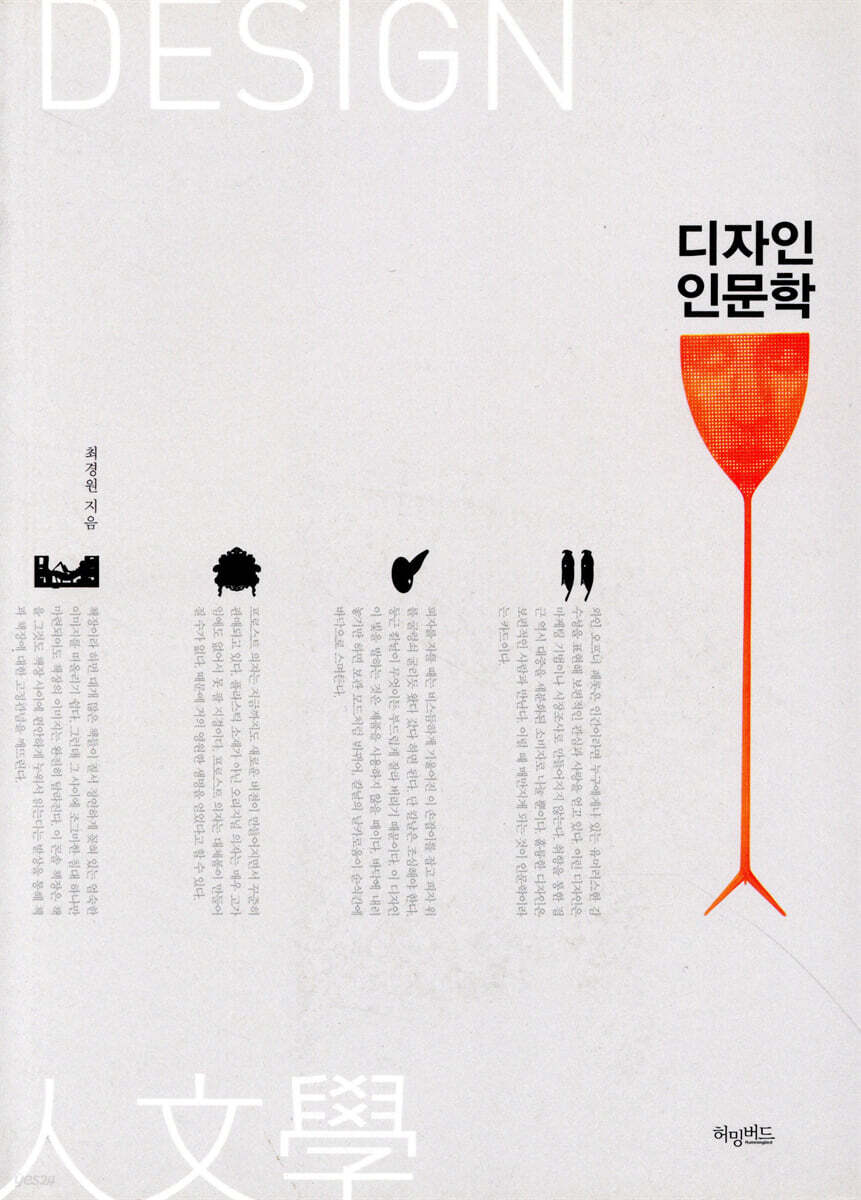
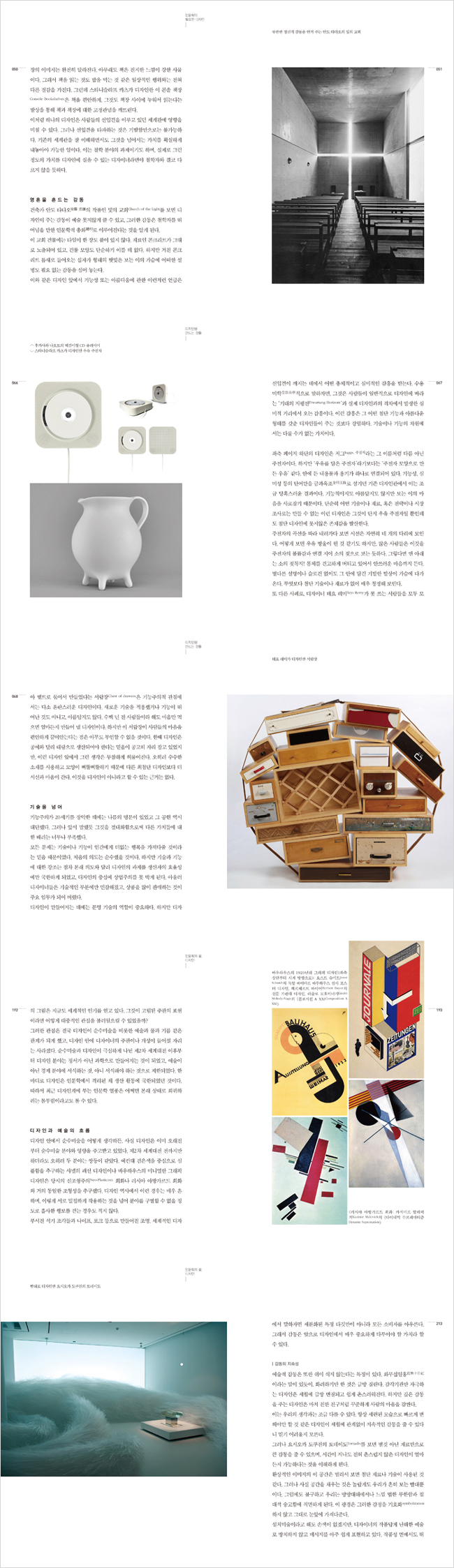
The Parrot wine opener designed by Alessandro Mendini has gained universal attention and love by expressing the humorous sensibility that all humans possess.
These designs are not created through marketing techniques or market research.
Approaching through taste also only divides the public into segmented consumers.
Great design meets universal people.
In other words, in order for a design to reach and captivate many people, it must contain social meaning while relying on human universality.
And in times like these, the card that comes to mind is the ‘humanities’ card.
--- p.33,
However, there are many great designs that do not use special techniques or advanced materials.
Japanese industrial designer Naoto Fukasawa's wall-mounted CD player features no unique form, advanced materials, or cutting-edge technology.
The body is made of plastic, which is used in any electronic product, and it does not have speakers that boast excellent sound quality.
Functionally speaking, the way CDs rotate without a lid seems impractical.
But for people, that's not a problem at all.
First of all, this CD player, which is shaped like a ventilator, brings back memories and shatters preconceived notions about CD players, giving rise to a sense of total aesthetic pleasure.
In terms of reception aesthetics, it is an inspiration that comes from the aesthetic distance that arises from the gap between the 'horizon of expectations (Erwartung Horizont)' that people generally expect from design and the actual design.
This kind of excitement is more powerful than any design with cutting-edge features and beautiful forms.
It is a value that cannot be handled in terms of technology or function.
--- p.65,
From a relationship perspective, a product is not something that is innate.
A commodity is merely a relative state of existence defined only in its relationship with the buying and selling subject.
So to speak, something can only be defined as a commodity when it is within a narrow space where it is traded.
Therefore, Dyson vacuum cleaners exist as a product only until the transaction is concluded in the store.
Moreover, the concept of a product can be said to be one that was created unilaterally from the seller's perspective.
This is because buyers pay money to obtain what they need rather than buying a product.
The buyer's position is very culturally anthropological in this respect.
Moreover, from the moment an object is purchased, it ceases to be a commodity and becomes a cultural and anthropological object that organizes the buyer's life.
In fact, design begins its full-scale activities from this point on.
--- p.77
It's tempting to wonder how unique a small kitchen scale can be, but the products presented by Eva Solo truly demonstrate the power of design to infuse culture into even the narrowest spaces where people live.
It's amazing that a transparent glass cylinder can be used as a scale, but it's also novel that a spring inside it acts as a scale to measure weight.
(syncopation)
With cutting-edge technology and materials, the design could have been made even more functional.
In fact, from a technical standpoint, this scale is running backwards in time.
Because you can't see even the slightest trace of cutting edge in materials like glass or metal springs.
But that doesn't mean it has a retro feel at all.
Rather, it is more innovative than any cutting-edge design.
Perhaps the brilliant interpretation of the act of using scales becomes even more novel when contrasted with the dull materials and techniques.
It would be too much to evaluate this design solely in terms of its dry functionality.
In these days when life is built on digital convenience, this analog method feels very warm.
One scale raises the emotional temperature in the kitchen.
Therefore, it can be said that these designs belong to cultural anthropology, not just a production activity.
--- p.108
The fact that Chanel was able to place 'convenience', 'function', and 'equality' rather than 'class' or 'decoration' at the center of her clothes was not unrelated to the circumstances of the times in which she was active.
In the 1910s, when Chanel began her career, various modern art movements, such as Cubism, Surrealism, and Constructivism, were sprouting.
The first design school, Bauhaus, was founded at this time, and the medium of film emerged, heralding a new era.
A new atmosphere was forming across all sectors of society, and it was moving in the direction of 'functionality' and 'simplicity'.
It was in this very social change that Chanel sketched out the outline of what modern people would wear.
Therefore, it can be said that she did not design fashion, but designed modernity, and the clothes she created were not just clothes, but the essence of 20th-century humanities.
In fact, people sometimes call her 'the spirit of the 20th century'.
--- p.129
Physics, which was based on particle theory until the latter half of the 20th century, was greatly challenged by this perspective based on biology.
Deconstructionism was a transitional cultural phenomenon that emerged during this process of shifting perception.
It wasn't just a matter of destroying the form of the building; the physical and biological worldviews were clashing.
Entering the 21st century, the term 'deconstruction' is no longer mentioned even by those who were called deconstructivist architects.
In addition, the design trend was organized in a direction that pursued organic forms rather than focusing solely on deconstruction.
This means that we have begun to view the universe as a living organism, not a machine.
It is more accurate to view the tendency toward irregular appearances and the frequent appearance of winding or streamlined forms as a phenomenon of the transition of the universe from machines to life, rather than a fleeting fad.
The change in our view of the universe is changing everything about design without us even knowing it.
These designs are not created through marketing techniques or market research.
Approaching through taste also only divides the public into segmented consumers.
Great design meets universal people.
In other words, in order for a design to reach and captivate many people, it must contain social meaning while relying on human universality.
And in times like these, the card that comes to mind is the ‘humanities’ card.
--- p.33,
However, there are many great designs that do not use special techniques or advanced materials.
Japanese industrial designer Naoto Fukasawa's wall-mounted CD player features no unique form, advanced materials, or cutting-edge technology.
The body is made of plastic, which is used in any electronic product, and it does not have speakers that boast excellent sound quality.
Functionally speaking, the way CDs rotate without a lid seems impractical.
But for people, that's not a problem at all.
First of all, this CD player, which is shaped like a ventilator, brings back memories and shatters preconceived notions about CD players, giving rise to a sense of total aesthetic pleasure.
In terms of reception aesthetics, it is an inspiration that comes from the aesthetic distance that arises from the gap between the 'horizon of expectations (Erwartung Horizont)' that people generally expect from design and the actual design.
This kind of excitement is more powerful than any design with cutting-edge features and beautiful forms.
It is a value that cannot be handled in terms of technology or function.
--- p.65,
From a relationship perspective, a product is not something that is innate.
A commodity is merely a relative state of existence defined only in its relationship with the buying and selling subject.
So to speak, something can only be defined as a commodity when it is within a narrow space where it is traded.
Therefore, Dyson vacuum cleaners exist as a product only until the transaction is concluded in the store.
Moreover, the concept of a product can be said to be one that was created unilaterally from the seller's perspective.
This is because buyers pay money to obtain what they need rather than buying a product.
The buyer's position is very culturally anthropological in this respect.
Moreover, from the moment an object is purchased, it ceases to be a commodity and becomes a cultural and anthropological object that organizes the buyer's life.
In fact, design begins its full-scale activities from this point on.
--- p.77
It's tempting to wonder how unique a small kitchen scale can be, but the products presented by Eva Solo truly demonstrate the power of design to infuse culture into even the narrowest spaces where people live.
It's amazing that a transparent glass cylinder can be used as a scale, but it's also novel that a spring inside it acts as a scale to measure weight.
(syncopation)
With cutting-edge technology and materials, the design could have been made even more functional.
In fact, from a technical standpoint, this scale is running backwards in time.
Because you can't see even the slightest trace of cutting edge in materials like glass or metal springs.
But that doesn't mean it has a retro feel at all.
Rather, it is more innovative than any cutting-edge design.
Perhaps the brilliant interpretation of the act of using scales becomes even more novel when contrasted with the dull materials and techniques.
It would be too much to evaluate this design solely in terms of its dry functionality.
In these days when life is built on digital convenience, this analog method feels very warm.
One scale raises the emotional temperature in the kitchen.
Therefore, it can be said that these designs belong to cultural anthropology, not just a production activity.
--- p.108
The fact that Chanel was able to place 'convenience', 'function', and 'equality' rather than 'class' or 'decoration' at the center of her clothes was not unrelated to the circumstances of the times in which she was active.
In the 1910s, when Chanel began her career, various modern art movements, such as Cubism, Surrealism, and Constructivism, were sprouting.
The first design school, Bauhaus, was founded at this time, and the medium of film emerged, heralding a new era.
A new atmosphere was forming across all sectors of society, and it was moving in the direction of 'functionality' and 'simplicity'.
It was in this very social change that Chanel sketched out the outline of what modern people would wear.
Therefore, it can be said that she did not design fashion, but designed modernity, and the clothes she created were not just clothes, but the essence of 20th-century humanities.
In fact, people sometimes call her 'the spirit of the 20th century'.
--- p.129
Physics, which was based on particle theory until the latter half of the 20th century, was greatly challenged by this perspective based on biology.
Deconstructionism was a transitional cultural phenomenon that emerged during this process of shifting perception.
It wasn't just a matter of destroying the form of the building; the physical and biological worldviews were clashing.
Entering the 21st century, the term 'deconstruction' is no longer mentioned even by those who were called deconstructivist architects.
In addition, the design trend was organized in a direction that pursued organic forms rather than focusing solely on deconstruction.
This means that we have begun to view the universe as a living organism, not a machine.
It is more accurate to view the tendency toward irregular appearances and the frequent appearance of winding or streamlined forms as a phenomenon of the transition of the universe from machines to life, rather than a fleeting fad.
The change in our view of the universe is changing everything about design without us even knowing it.
--- p.247
Publisher's Review
The humanities wind blowing in design
What is the relationship between design and humanities?
What direction will design take in it?
The humanities wind is blowing in the design field as well.
In fact, for a long time in Korea, design was treated as an industry and was limited to the realm of production, focusing only on realizing functionality.
The utilitarian design that became popular in the United States after World War II took root in this country without much modification, prioritizing function over value and meeting the needs and expectations of businesses over the lives of the masses.
Within the shackles of specialization, we were cut off from communication with other fields.
Recently, however, the need for humanities has been emphasized under the leadership of companies.
Unlike in the past, we have reached a point where technology alone can no longer solve the problems facing design, and therefore, a fundamental awakening and innovation are urgently needed.
This is certainly a welcome change.
However, if we look at the underlying principles of this humanities boom, we see that it is no different from the existing approaches that attempted to solve design problems by importing methodologies from the fields of business, science, or technology.
It is to regard humanities as a kind of tool.
However, according to the author, the humanities have already existed within design, not outside of it.
Furthermore, he says that design itself is a lump of humanities.
If so, rather than flipping through humanities books, the key would be to first examine what ‘design’ really is.
To properly understand the relationship between design and the humanities, it is more meaningful to first understand the humanities achievements built within design rather than the humanities theories outside of design.
Therefore, this book examines through abundant examples what design is created through and what constitutes design.
We diagnose several concepts surrounding design, such as technology, commerciality, and artistry (Part 2, 'Things That Make Design'), and examine the elements that make up design, including the form (shape, color) that we see with our eyes and the content contained within it (Part 3, 'Things That Make Up Design').
Following the work of analyzing the inside of the design, we examine the outside of the design.
We explore external factors that influence design and examine examples of how design interacts with the surrounding environment and other fields (Part 4, 'Things That Influence Design').
In other words, by introducing designs that have consistently breathed life into the contemporary socio-cultural context, major values, history, and traditions, we shake up the old perception that regards design as a field isolated from the world.
In addition, we will examine cases where design has closely interacted with subfields of the humanities, such as philosophy, art, and science (cosmology) (Part 5, 'Design, the Flower of the Humanities').
The author of "Good Design: The Secret of Things That Look Good," a bestseller in the design field since its publication in 2004, covers a wide range of designs, from those that have made a significant mark on the world of design to the latest design cases that are little known in Korea, sharply criticizing the current state of our design world and calling for change.
Beyond what we see as "good," we talk about what truly "good design" is, what "design" is essentially, and where it should go.
What design needs now is a "humanistic attitude."
A time when humanistic insight and vision are desperately needed.
But why "humanities"? There are several reasons for emphasizing the humanities in design today.
First of all, the power of the public, that is, the people, is highlighted in choosing designs.
It is no longer up to business owners to choose the one they want from among the countless designs that exist in the world.
The public, that is, the 'people' with warm, red blood flowing through their veins.
These are not captured by simple numbers or surveys.
It is impossible to simply define them as 'consumers' and treat them with the logic of business administration or engineering.
Therefore, understanding humanity is more urgent than ever.
More fundamentally, the changing worldview of people is also the background for the design world's call for humanities.
The 21st century is rapidly shifting from the 20th century, which was dominated by a mechanistic view of the universe, to a biological view of the universe.
The design field is no exception, moving beyond the pursuit of functionality and practicality to boldly experiment with organic shapes, irregular structures, and harmony with nature.
It is clear that humanities knowledge will serve as a solid foundation here.
But design doesn't have to look far for the humanities.
According to the author, design is a condensation of all fields of the humanities.
What we come to realize from this book is that design is the "flower of the humanities," a comprehensive expression of the diverse achievements of the humanities, and that it is itself a humanities discipline.
Design was already a humanities discipline.
So what we need in our design now is not the humanities.
It is a ‘humanistic attitude.’
Based on this approach, we anticipate a truly humanistic design that fully communicates with humans.
“Design is influenced by various humanities disciplines, and these humanities are not a parallel combination of various disciplines, but a hierarchical system built from the bottom up.
That is, it is like a tree that forms a continuous system with roots, stems, leaves, and fruits.
Therefore, the humanistic perspective on design must also be structural and comprehensive.
It is desirable to understand the phenomena of design within the framework of the humanities, which extends from cosmology downwards, philosophy upwards, and other fields, to art and design, and only then can meaningful insights be gained.
From that perspective, what design needs now is not so much the humanities as a 'humanistic attitude.'
What matters is not the information.
“It is ‘insight’ and ‘vision.’”
_From the 'Conclusion'
What is the relationship between design and humanities?
What direction will design take in it?
The humanities wind is blowing in the design field as well.
In fact, for a long time in Korea, design was treated as an industry and was limited to the realm of production, focusing only on realizing functionality.
The utilitarian design that became popular in the United States after World War II took root in this country without much modification, prioritizing function over value and meeting the needs and expectations of businesses over the lives of the masses.
Within the shackles of specialization, we were cut off from communication with other fields.
Recently, however, the need for humanities has been emphasized under the leadership of companies.
Unlike in the past, we have reached a point where technology alone can no longer solve the problems facing design, and therefore, a fundamental awakening and innovation are urgently needed.
This is certainly a welcome change.
However, if we look at the underlying principles of this humanities boom, we see that it is no different from the existing approaches that attempted to solve design problems by importing methodologies from the fields of business, science, or technology.
It is to regard humanities as a kind of tool.
However, according to the author, the humanities have already existed within design, not outside of it.
Furthermore, he says that design itself is a lump of humanities.
If so, rather than flipping through humanities books, the key would be to first examine what ‘design’ really is.
To properly understand the relationship between design and the humanities, it is more meaningful to first understand the humanities achievements built within design rather than the humanities theories outside of design.
Therefore, this book examines through abundant examples what design is created through and what constitutes design.
We diagnose several concepts surrounding design, such as technology, commerciality, and artistry (Part 2, 'Things That Make Design'), and examine the elements that make up design, including the form (shape, color) that we see with our eyes and the content contained within it (Part 3, 'Things That Make Up Design').
Following the work of analyzing the inside of the design, we examine the outside of the design.
We explore external factors that influence design and examine examples of how design interacts with the surrounding environment and other fields (Part 4, 'Things That Influence Design').
In other words, by introducing designs that have consistently breathed life into the contemporary socio-cultural context, major values, history, and traditions, we shake up the old perception that regards design as a field isolated from the world.
In addition, we will examine cases where design has closely interacted with subfields of the humanities, such as philosophy, art, and science (cosmology) (Part 5, 'Design, the Flower of the Humanities').
The author of "Good Design: The Secret of Things That Look Good," a bestseller in the design field since its publication in 2004, covers a wide range of designs, from those that have made a significant mark on the world of design to the latest design cases that are little known in Korea, sharply criticizing the current state of our design world and calling for change.
Beyond what we see as "good," we talk about what truly "good design" is, what "design" is essentially, and where it should go.
What design needs now is a "humanistic attitude."
A time when humanistic insight and vision are desperately needed.
But why "humanities"? There are several reasons for emphasizing the humanities in design today.
First of all, the power of the public, that is, the people, is highlighted in choosing designs.
It is no longer up to business owners to choose the one they want from among the countless designs that exist in the world.
The public, that is, the 'people' with warm, red blood flowing through their veins.
These are not captured by simple numbers or surveys.
It is impossible to simply define them as 'consumers' and treat them with the logic of business administration or engineering.
Therefore, understanding humanity is more urgent than ever.
More fundamentally, the changing worldview of people is also the background for the design world's call for humanities.
The 21st century is rapidly shifting from the 20th century, which was dominated by a mechanistic view of the universe, to a biological view of the universe.
The design field is no exception, moving beyond the pursuit of functionality and practicality to boldly experiment with organic shapes, irregular structures, and harmony with nature.
It is clear that humanities knowledge will serve as a solid foundation here.
But design doesn't have to look far for the humanities.
According to the author, design is a condensation of all fields of the humanities.
What we come to realize from this book is that design is the "flower of the humanities," a comprehensive expression of the diverse achievements of the humanities, and that it is itself a humanities discipline.
Design was already a humanities discipline.
So what we need in our design now is not the humanities.
It is a ‘humanistic attitude.’
Based on this approach, we anticipate a truly humanistic design that fully communicates with humans.
“Design is influenced by various humanities disciplines, and these humanities are not a parallel combination of various disciplines, but a hierarchical system built from the bottom up.
That is, it is like a tree that forms a continuous system with roots, stems, leaves, and fruits.
Therefore, the humanistic perspective on design must also be structural and comprehensive.
It is desirable to understand the phenomena of design within the framework of the humanities, which extends from cosmology downwards, philosophy upwards, and other fields, to art and design, and only then can meaningful insights be gained.
From that perspective, what design needs now is not so much the humanities as a 'humanistic attitude.'
What matters is not the information.
“It is ‘insight’ and ‘vision.’”
_From the 'Conclusion'
GOODS SPECIFICS
- Date of publication: November 20, 2014
- Page count, weight, size: 272 pages | 480g | 155*210*20mm
- ISBN13: 9788968330353
- ISBN10: 8968330352
You may also like
카테고리
korean


korean

![GQ KOREA Mark (Monthly): December [2025]](http://librairie.coreenne.fr/cdn/shop/files/8ef265dbbfbf186523ed75ba7319009d.jpg?v=1765340328&width=3840)


