

Encountering a child's heart through picture books
 |
Description
Book Introduction
The story of the picture book class that all-rounder teacher Yura wanted to share with you.
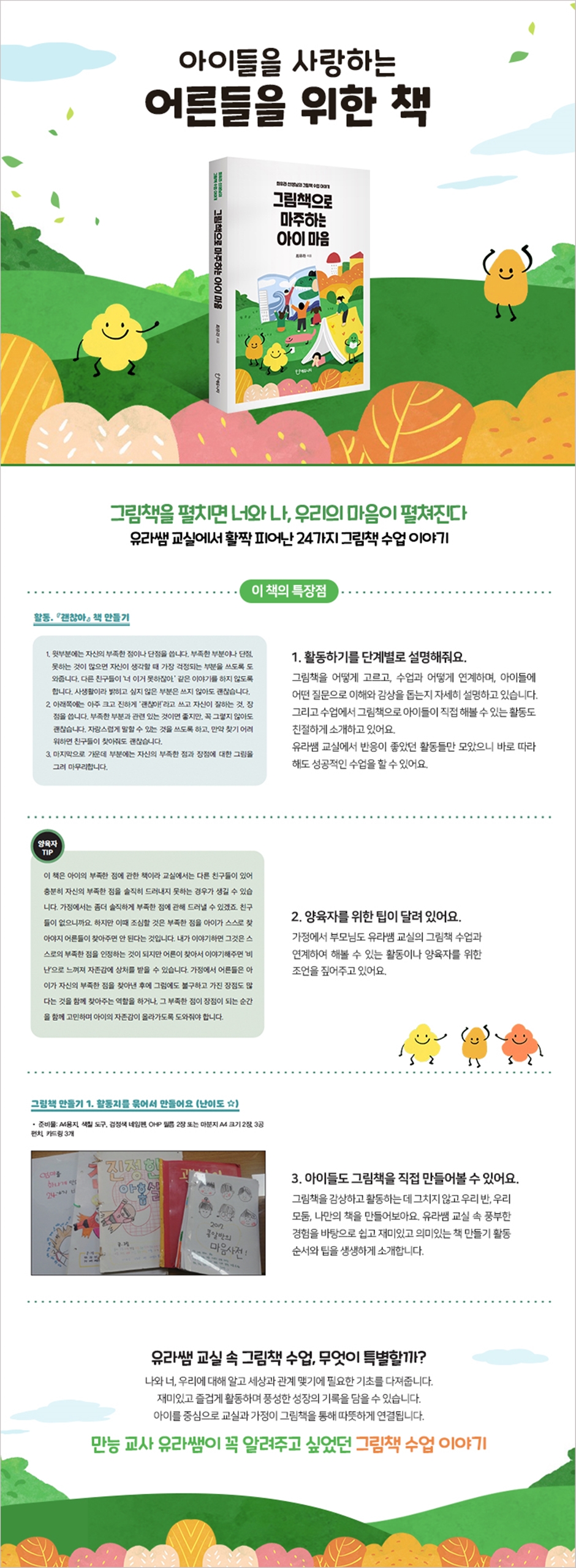
What is the scope of a homeroom teacher's role in an elementary school classroom? From curriculum restructuring and project-based learning to remote learning, classroom management, and integrated education, elementary school homeroom teachers must be truly versatile.
Teacher Choi Yu-ra, who has always been the first to research, implement, and share her experiences in all of these missions, chose 'picture book classes' as the story she most wants to share with adults caring for children.
Rather than setting aside a separate time to read picture books with children, integrated education is naturally achieved by utilizing picture books in various classes, allowing children to explore each other's emotions and communicate through the characters in the stories.
It meticulously captures each step of the process of everyone growing together, looking into each other's eyes, without anyone being left out in the classroom.
What is the scope of a homeroom teacher's role in an elementary school classroom? From curriculum restructuring and project-based learning to remote learning, classroom management, and integrated education, elementary school homeroom teachers must be truly versatile.
Teacher Choi Yu-ra, who has always been the first to research, implement, and share her experiences in all of these missions, chose 'picture book classes' as the story she most wants to share with adults caring for children.
Rather than setting aside a separate time to read picture books with children, integrated education is naturally achieved by utilizing picture books in various classes, allowing children to explore each other's emotions and communicate through the characters in the stories.
It meticulously captures each step of the process of everyone growing together, looking into each other's eyes, without anyone being left out in the classroom.
- You can preview some of the book's contents.
Preview
index
Opening remarks: May we be able to look upon each other's little pots with warmth.
Ⅰ.
Emotions∥Say hello to my heart
Open-Minded Self-Introduction: "No!"
Let's take a look: "Bark, George"
Greetings from the Heart: "A Nine-Year-Old's Dictionary of the Heart"
Everyone Has a Thorn: The Thorn Boy
How to Befriend a Thorn: When Sophie Gets Angry, Really, Really Angry
Ⅱ.
Me, first∥Everyone has five years
Our class' catchphrase: "It's okay."
Opening a Picture Book Cafe: Dog Poop, Short-Eared Rabbit, Chicken Mask, Pink Monster, You're (Not) Small
Everyone's Speed is Different: "The True Seven Years Old"
In fact, everyone is jealous of me: "I'm a Fox, But I'm a Tiger", "Giraffes Are Too Much"
The Happiness of Living Your Own Way: "Super Turtle"
Ⅲ.
Me, the second time∥I face my true self
What Made Me Who I Am: "Blue, Red, and Transparent Me"
Looking at myself quietly: 『Red Wall』
The World vs. Me: Hedgehog X
Ⅳ.
There's nothing more fun than getting to know you
Warm-up.
You're all different: "But did you hear that story?"
Step 1.
How Different You Are: Watching Movies and Picture Books Together
Step 2.
The Secret of Friendship: "Candy"
Step 3.
Don't Do to Others What You Don't Like: 10 Ways to Annoy Your Mom
Practice.
Seeing the World Through Other People's Eyes: The Three Little Pigs and the Wolf's Tale, Red Glasses
V.
Living together in our classroom
What Does Us Mean to Me?: Classroom Picture Book Curation
It's not always about being together: "Tick, tick"
When You Need a Friend: "I Am a Dog"
A warm look: "Burnt Bread"
On Trust: The Fox
Friends I Think of: "To a Friend," "A Gift from Mom"
Appendix: How to Easily Create Picture Books with Children in the Classroom
Ⅰ.
Emotions∥Say hello to my heart
Open-Minded Self-Introduction: "No!"
Let's take a look: "Bark, George"
Greetings from the Heart: "A Nine-Year-Old's Dictionary of the Heart"
Everyone Has a Thorn: The Thorn Boy
How to Befriend a Thorn: When Sophie Gets Angry, Really, Really Angry
Ⅱ.
Me, first∥Everyone has five years
Our class' catchphrase: "It's okay."
Opening a Picture Book Cafe: Dog Poop, Short-Eared Rabbit, Chicken Mask, Pink Monster, You're (Not) Small
Everyone's Speed is Different: "The True Seven Years Old"
In fact, everyone is jealous of me: "I'm a Fox, But I'm a Tiger", "Giraffes Are Too Much"
The Happiness of Living Your Own Way: "Super Turtle"
Ⅲ.
Me, the second time∥I face my true self
What Made Me Who I Am: "Blue, Red, and Transparent Me"
Looking at myself quietly: 『Red Wall』
The World vs. Me: Hedgehog X
Ⅳ.
There's nothing more fun than getting to know you
Warm-up.
You're all different: "But did you hear that story?"
Step 1.
How Different You Are: Watching Movies and Picture Books Together
Step 2.
The Secret of Friendship: "Candy"
Step 3.
Don't Do to Others What You Don't Like: 10 Ways to Annoy Your Mom
Practice.
Seeing the World Through Other People's Eyes: The Three Little Pigs and the Wolf's Tale, Red Glasses
V.
Living together in our classroom
What Does Us Mean to Me?: Classroom Picture Book Curation
It's not always about being together: "Tick, tick"
When You Need a Friend: "I Am a Dog"
A warm look: "Burnt Bread"
On Trust: The Fox
Friends I Think of: "To a Friend," "A Gift from Mom"
Appendix: How to Easily Create Picture Books with Children in the Classroom
Detailed image
Into the book
Children need adults who listen to their stories.
An adult who looks into your stomach, which you don't even know well, helps you take it out and solve it, and reassures you that it's okay.
After I've looked into the inside of my stomach that I didn't even know about, wouldn't I be able to listen to nagging and scolding better?
---From "Things that are invisible but exist"
After taking this class, the classroom changed a lot.
The child in the first picture who cried all the time now has friends who comfort him.
Friends who used to hate me for being like a baby asked me, "Why are you crying?"
The reason you're shedding tears is definitely because it's in your stomach.
A class meeting was held for the second child.
I taught and helped practice how to get angry to a child who didn't know how to get angry.
For a friend who was learning how to be angry, the children often asked the child, "Are you upset?" or "Are you angry?"
I'm still not good at expressing my anger, but I'm learning how to do it little by little.
---From "Everyone has a thorn"
This activity has 'realistic goals'.
Moreover, the meaning of the word 'true' adds weight to the question we ask ourselves.
It helps me think deeply about things that have always been on my mind, things that I really wanted to challenge myself with, even if it was a little difficult, rather than goals that I just set for fun or on a whim.
At the end of deep questioning, we set a goal and complete the activity.
---From "Everyone's speed is different"
Parent Tip: This can also be useful when creating a child growth album at home.
We talk about the experiences of the child growing up while looking at actual photos and videos of the child.
Listen to the story and let the child express himself in his own way.
When making a picture book, it's also a good idea to include actual photos of your child in it.
Then it really becomes 'my book'.
Once the book is finished, have family members read it and write a review.
So that you can know how precious and valuable your child is.
---From "What Made Me Who I Am"
Let's talk about the walls that separate children from each other.
“What is this red wall blocking me?”
Write down what you think the wall is like on each brick of the 'red wall' drawn on the blackboard with a post-it note.
Brick by brick, the walls of the children's hearts are filled.
School, family, friends, studying, indifference, the world, fear… .
The questions don't end here.
"Do I want to overcome that wall? Do I want to tear it down? Do I want to leave it as is? What do I feel like right now?"
---From "I Look Quietly at Myself"
A child raised his hand quietly and asked.
“Teacher, my parrot can’t eat candy, so who will eat that candy?”
“Parrots can’t eat candy.
“If you can’t eat it, there’s nothing I can do, so just tell them and let ○○ eat the candy.” As I absentmindedly answered, a thought crossed my mind.
I looked through the other kids' candy bags, and sure enough, every kid had chosen something they couldn't eat.
that's right.
It was too cruel to give a nine-year-old a piece of candy and ask them to pass it on to someone else.
We constantly research and think about learners and create classes, but unexpected things like this happen.
The next day, we had class again.
This time I gave him three candies.
When I told him to keep two for himself and use one to express his feelings, he finally wrote that he would express his feelings to his family.
---「Step 2.
From "The Beginning of Friendship"
What happened to Doki and Takki happens countless times in our classroom.
From experiences similar to this, like seeing a friend I thought was my best friend playing with another friend, to the experience of being left alone when we took sides, even though it wasn't intentional...
The scene shown in the picture book is 'betrayal of one's best friend', but if you look a little deeper, it could also be a scene expressing loneliness, 'I am alone because I have no friends'.
In such cases, comfort from adults is not of much help.
Because adults have a hard time understanding the scenes in this book as friendships.
For adults, it would be easier to understand it as a long-term relationship between lovers or a married couple.
As we grow up and go our own ways, our friends live their own lives, and a suitable distance develops between the two lives.
Adults who have already experienced this cannot empathize with how frustrated Doki must have been.
'Anyway, as time passes, everything will become distant.
'Life is meant to be lived alone.' This might offer comfort that doesn't sound like comfort.
So, this is an area where children must find a way to comfort and comfort others through picture books.
---From "Building Friendships (1) It's Not About Being Together Unconditionally"
“I think a friend is someone who waits for and shows interest in a slow turtle.”
At that moment, tears welled up in my eyes.
Although it is a story about friendship, I thought that what this child wants from his parents and teachers, who are adults, is for them to wait for him, who is a little slower and quieter, and to pay attention to him and see if he is there or not.
Not feeling frustrated, not forgetting just because the child is quiet, but always being curious about that child's existence and waiting for it.
Thanks to the picture book curation class, the children learned about their friends' hearts, and I also learned about another child's heart.
And from the next year onwards, I started reading with my children.
If you're not sure what story to tell, just ask your children.
I will tell you about the world as much as children do.
---From "Building Friendships (3) Looking at each other warmly"
You can't force something on someone by telling them what they need to learn through experience.
But what if we could help children perceive what they're feeling little by little through their experiences? Wouldn't the relationships they form now and in the future become warmer and stronger? With that in mind, I'm picking up a picture book.
The book we will be reading together is a picture book called “The Fox” by Margaret Wilde.
As you can see from the picture book cover, it doesn't look like a warm and beautiful picture book.
As the title suggests, the cover shows a fox staring ahead with an indecipherable expression, and next to it, a bird is looking at the fox.
“The fox seems to be looking at us.
What does the fox's expression look like? What story do you think it's telling?
"What kind of relationship do you think the bird next to the fox has? What do you think it is just by looking at the cover?"
---From "Building Friendships (4) About Trust"
Even after teaching children about relationships like this, children still experience conflicts with their friends.
Because you can't teach and change children all at once.
But if children can suddenly recall this time when they encounter a situation in their relationships, if they can think that relationships are not something that just happen, but something that must be nurtured, if they can think a little more deeply about the situation they face, and if they can think about it just once within the framework of a relationship rather than speaking and acting as they please, I think that alone will provide an opportunity for their lives to grow a little.
What we learned was about building friendships, but it will also serve as a solid foundation for children to build the many relationships they will encounter in life.
An adult who looks into your stomach, which you don't even know well, helps you take it out and solve it, and reassures you that it's okay.
After I've looked into the inside of my stomach that I didn't even know about, wouldn't I be able to listen to nagging and scolding better?
---From "Things that are invisible but exist"
After taking this class, the classroom changed a lot.
The child in the first picture who cried all the time now has friends who comfort him.
Friends who used to hate me for being like a baby asked me, "Why are you crying?"
The reason you're shedding tears is definitely because it's in your stomach.
A class meeting was held for the second child.
I taught and helped practice how to get angry to a child who didn't know how to get angry.
For a friend who was learning how to be angry, the children often asked the child, "Are you upset?" or "Are you angry?"
I'm still not good at expressing my anger, but I'm learning how to do it little by little.
---From "Everyone has a thorn"
This activity has 'realistic goals'.
Moreover, the meaning of the word 'true' adds weight to the question we ask ourselves.
It helps me think deeply about things that have always been on my mind, things that I really wanted to challenge myself with, even if it was a little difficult, rather than goals that I just set for fun or on a whim.
At the end of deep questioning, we set a goal and complete the activity.
---From "Everyone's speed is different"
Parent Tip: This can also be useful when creating a child growth album at home.
We talk about the experiences of the child growing up while looking at actual photos and videos of the child.
Listen to the story and let the child express himself in his own way.
When making a picture book, it's also a good idea to include actual photos of your child in it.
Then it really becomes 'my book'.
Once the book is finished, have family members read it and write a review.
So that you can know how precious and valuable your child is.
---From "What Made Me Who I Am"
Let's talk about the walls that separate children from each other.
“What is this red wall blocking me?”
Write down what you think the wall is like on each brick of the 'red wall' drawn on the blackboard with a post-it note.
Brick by brick, the walls of the children's hearts are filled.
School, family, friends, studying, indifference, the world, fear… .
The questions don't end here.
"Do I want to overcome that wall? Do I want to tear it down? Do I want to leave it as is? What do I feel like right now?"
---From "I Look Quietly at Myself"
A child raised his hand quietly and asked.
“Teacher, my parrot can’t eat candy, so who will eat that candy?”
“Parrots can’t eat candy.
“If you can’t eat it, there’s nothing I can do, so just tell them and let ○○ eat the candy.” As I absentmindedly answered, a thought crossed my mind.
I looked through the other kids' candy bags, and sure enough, every kid had chosen something they couldn't eat.
that's right.
It was too cruel to give a nine-year-old a piece of candy and ask them to pass it on to someone else.
We constantly research and think about learners and create classes, but unexpected things like this happen.
The next day, we had class again.
This time I gave him three candies.
When I told him to keep two for himself and use one to express his feelings, he finally wrote that he would express his feelings to his family.
---「Step 2.
From "The Beginning of Friendship"
What happened to Doki and Takki happens countless times in our classroom.
From experiences similar to this, like seeing a friend I thought was my best friend playing with another friend, to the experience of being left alone when we took sides, even though it wasn't intentional...
The scene shown in the picture book is 'betrayal of one's best friend', but if you look a little deeper, it could also be a scene expressing loneliness, 'I am alone because I have no friends'.
In such cases, comfort from adults is not of much help.
Because adults have a hard time understanding the scenes in this book as friendships.
For adults, it would be easier to understand it as a long-term relationship between lovers or a married couple.
As we grow up and go our own ways, our friends live their own lives, and a suitable distance develops between the two lives.
Adults who have already experienced this cannot empathize with how frustrated Doki must have been.
'Anyway, as time passes, everything will become distant.
'Life is meant to be lived alone.' This might offer comfort that doesn't sound like comfort.
So, this is an area where children must find a way to comfort and comfort others through picture books.
---From "Building Friendships (1) It's Not About Being Together Unconditionally"
“I think a friend is someone who waits for and shows interest in a slow turtle.”
At that moment, tears welled up in my eyes.
Although it is a story about friendship, I thought that what this child wants from his parents and teachers, who are adults, is for them to wait for him, who is a little slower and quieter, and to pay attention to him and see if he is there or not.
Not feeling frustrated, not forgetting just because the child is quiet, but always being curious about that child's existence and waiting for it.
Thanks to the picture book curation class, the children learned about their friends' hearts, and I also learned about another child's heart.
And from the next year onwards, I started reading with my children.
If you're not sure what story to tell, just ask your children.
I will tell you about the world as much as children do.
---From "Building Friendships (3) Looking at each other warmly"
You can't force something on someone by telling them what they need to learn through experience.
But what if we could help children perceive what they're feeling little by little through their experiences? Wouldn't the relationships they form now and in the future become warmer and stronger? With that in mind, I'm picking up a picture book.
The book we will be reading together is a picture book called “The Fox” by Margaret Wilde.
As you can see from the picture book cover, it doesn't look like a warm and beautiful picture book.
As the title suggests, the cover shows a fox staring ahead with an indecipherable expression, and next to it, a bird is looking at the fox.
“The fox seems to be looking at us.
What does the fox's expression look like? What story do you think it's telling?
"What kind of relationship do you think the bird next to the fox has? What do you think it is just by looking at the cover?"
---From "Building Friendships (4) About Trust"
Even after teaching children about relationships like this, children still experience conflicts with their friends.
Because you can't teach and change children all at once.
But if children can suddenly recall this time when they encounter a situation in their relationships, if they can think that relationships are not something that just happen, but something that must be nurtured, if they can think a little more deeply about the situation they face, and if they can think about it just once within the framework of a relationship rather than speaking and acting as they please, I think that alone will provide an opportunity for their lives to grow a little.
What we learned was about building friendships, but it will also serve as a solid foundation for children to build the many relationships they will encounter in life.
---From "Building Friendships (5) The Friends I Think of"
Publisher's Review
What's so special about Yura's picture book class?
It lays the foundation for understanding ourselves, you, and us, and relating to the world.
There are many different types of children in elementary school classrooms.
Not only do they each have different Korean language comprehension skills, but their family backgrounds and personalities are also different.
There are still children who have not yet adapted to friendships or school life.
The same goes for teachers.
While some teachers are adept at handling their work and guiding children well, others struggle with daily classes and parent consultations.
Above all, the difficulty of 'relationships' makes everything difficult.
Problems arise in all 'between' relationships: relationships with children, relationships with each other, relationships with parents.
Ultimately, these problems arise in the 'mind'.
How can we open our hearts and work together? How can we build a sense of trust that allows us to open our hearts? Teacher Choi Yu-ra says "picture book classes" can be the key to that.
Why do we need picture book classes?
The author says that picture books are materials that anyone can understand.
Anyone can understand it, regardless of literacy level, from children of three or four years old to the elderly.
There is no 'correct answer' to the reader's understanding and appreciation, so there are no restrictions on freely expressing what each person has accepted.
At this time, the teacher's role is to ask appropriate questions so that the students can bring out and express what is in their 'belly'.
The author's questions are well organized with examples in the text.
This is also not the correct answer.
Depending on the situation and context, picture books can be used to pose various questions.
Children express their own feelings and thoughts in response to questions that have no right answer.
This can be used as an opportunity to learn how to express emotions for children who are not familiar with expressing themselves.
And by listening to other children's thoughts, they enrich their own thoughts, gain concrete experiences through activities together, and gain a sense of accomplishment from the results.
How to design and prepare a 40-minute class is well organized in 'Yurasam Tips'.
Guidelines for connected learning at home are provided in 'Parenting Tips', which also includes detailed information on activities and precautions that parents can take in situations other than the classroom.
Picture books, as a medium connecting teachers, children, and parents, are a great help in creating warm and trustworthy connections.
A book for adults who love children
This is truly the golden age of picture books.
As our country's economic power grows, a variety of excellent picture books from around the world are being introduced, and the level of our picture book authors is already world-class.
In the world of picture books, which are made up of various perspectives and expressions, everyone can become the main character and engage in conversation.
The emotions, thoughts, and expressions of children revealed in it are like opening a secret box of a dimension that cannot be reached with the knowledge or experience of adults.
The world of imagination in stories is where we can understand the world of children and where adults can become equal friends with children.
For adults who wish to learn about the world within children's hearts, entering the world of picture books is the most welcome and safest path to reach them without getting lost.
The meticulous records and warm interpretations of Professor Choi Yu-ra, who has walked this path countless times, based on her rich experience, will serve as a valuable guide for adults who are about to embark on this path.
The hilarious mistakes are a bonus.
A lovely book that offers magical moments where even mistakes are reborn as beautiful stories in a classroom with picture books as a bonus.
It lays the foundation for understanding ourselves, you, and us, and relating to the world.
There are many different types of children in elementary school classrooms.
Not only do they each have different Korean language comprehension skills, but their family backgrounds and personalities are also different.
There are still children who have not yet adapted to friendships or school life.
The same goes for teachers.
While some teachers are adept at handling their work and guiding children well, others struggle with daily classes and parent consultations.
Above all, the difficulty of 'relationships' makes everything difficult.
Problems arise in all 'between' relationships: relationships with children, relationships with each other, relationships with parents.
Ultimately, these problems arise in the 'mind'.
How can we open our hearts and work together? How can we build a sense of trust that allows us to open our hearts? Teacher Choi Yu-ra says "picture book classes" can be the key to that.
Why do we need picture book classes?
The author says that picture books are materials that anyone can understand.
Anyone can understand it, regardless of literacy level, from children of three or four years old to the elderly.
There is no 'correct answer' to the reader's understanding and appreciation, so there are no restrictions on freely expressing what each person has accepted.
At this time, the teacher's role is to ask appropriate questions so that the students can bring out and express what is in their 'belly'.
The author's questions are well organized with examples in the text.
This is also not the correct answer.
Depending on the situation and context, picture books can be used to pose various questions.
Children express their own feelings and thoughts in response to questions that have no right answer.
This can be used as an opportunity to learn how to express emotions for children who are not familiar with expressing themselves.
And by listening to other children's thoughts, they enrich their own thoughts, gain concrete experiences through activities together, and gain a sense of accomplishment from the results.
How to design and prepare a 40-minute class is well organized in 'Yurasam Tips'.
Guidelines for connected learning at home are provided in 'Parenting Tips', which also includes detailed information on activities and precautions that parents can take in situations other than the classroom.
Picture books, as a medium connecting teachers, children, and parents, are a great help in creating warm and trustworthy connections.
A book for adults who love children
This is truly the golden age of picture books.
As our country's economic power grows, a variety of excellent picture books from around the world are being introduced, and the level of our picture book authors is already world-class.
In the world of picture books, which are made up of various perspectives and expressions, everyone can become the main character and engage in conversation.
The emotions, thoughts, and expressions of children revealed in it are like opening a secret box of a dimension that cannot be reached with the knowledge or experience of adults.
The world of imagination in stories is where we can understand the world of children and where adults can become equal friends with children.
For adults who wish to learn about the world within children's hearts, entering the world of picture books is the most welcome and safest path to reach them without getting lost.
The meticulous records and warm interpretations of Professor Choi Yu-ra, who has walked this path countless times, based on her rich experience, will serve as a valuable guide for adults who are about to embark on this path.
The hilarious mistakes are a bonus.
A lovely book that offers magical moments where even mistakes are reborn as beautiful stories in a classroom with picture books as a bonus.
GOODS SPECIFICS
- Publication date: November 4, 2022
- Page count, weight, size: 272 pages | 152*225*20mm
- ISBN13: 9791164251315
- ISBN10: 1164251317
You may also like
카테고리
korean


korean

![GQ KOREA Mark (Monthly): December [2025]](http://librairie.coreenne.fr/cdn/shop/files/8ef265dbbfbf186523ed75ba7319009d.jpg?v=1765340328&width=3840)


