

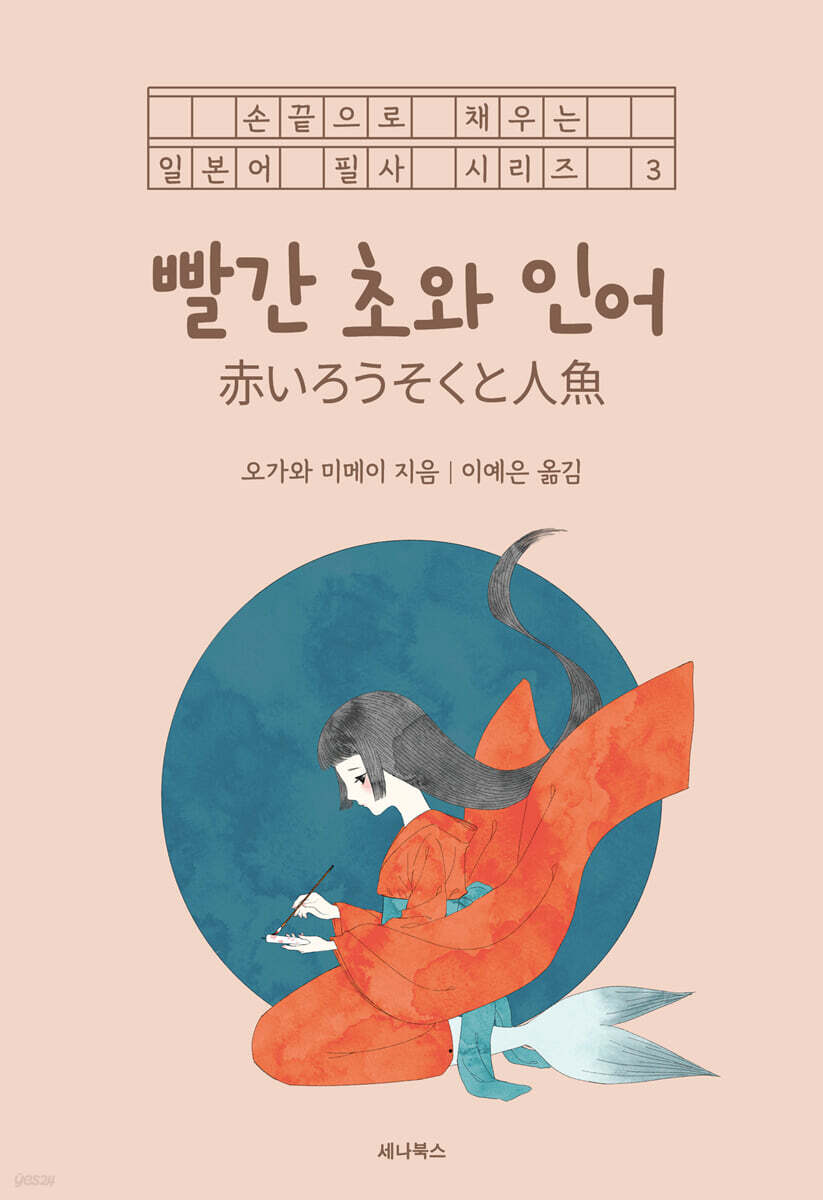
Red candle and mermaid
 |
Description
Book Introduction
Three sad yet beautiful stories from Japan's Andersen Ogawa Mimei.
Study vocabulary, practice transcription, and translate while reading fairy tales filled with unique Japanese sentiment!
Ogawa Mimei's fairy tales, like his pen name, which can be read as "Mimyeong" (未明) in Chinese characters, are imbued with a sadness like the dusky dawn.
It is rare to find a happy ending where the main character lives happily ever after. Rather, there are more heartbreaking endings that leave you feeling empty and lonely after reading.
But there is an undeniable beauty behind it.
Reading his fairy tales, we come to realize that life and happiness are finite, yet precious and lovable.
This book contains three fairy tales by Ogawa Mimei, and includes a space for transcribing the works.
Learning a foreign language is a challenge that opens the door to an exciting world and an adventure to explore a new self.
I hope this book will be a small stepping stone on that mysterious journey.
Study vocabulary, practice transcription, and translate while reading fairy tales filled with unique Japanese sentiment!
Ogawa Mimei's fairy tales, like his pen name, which can be read as "Mimyeong" (未明) in Chinese characters, are imbued with a sadness like the dusky dawn.
It is rare to find a happy ending where the main character lives happily ever after. Rather, there are more heartbreaking endings that leave you feeling empty and lonely after reading.
But there is an undeniable beauty behind it.
Reading his fairy tales, we come to realize that life and happiness are finite, yet precious and lovable.
This book contains three fairy tales by Ogawa Mimei, and includes a space for transcribing the works.
Learning a foreign language is a challenge that opens the door to an exciting world and an adventure to explore a new self.
I hope this book will be a small stepping stone on that mysterious journey.
- You can preview some of the book's contents.
Preview
index
Introduction / 6
How to Use a Notebook Effectively / 10
text
Golden Wheel / 12
The life of a certain ball / 26
Red candle and mermaid / 54
How to Use a Notebook Effectively / 10
text
Golden Wheel / 12
The life of a certain ball / 26
Red candle and mermaid / 54
Detailed image

Into the book
Some sorrows are offset by other sorrows, not by joy.
During a time when I was suddenly immersed in sadness and helplessness, I happened to come across Ogawa Mimei's fairy tales.
Just like his pen name, which can be read as 'Mi-myeong' in Chinese characters, his stories are imbued with a sadness like the dusky dawn.
--- p.6
Looking over, a boy was running down the road, rolling a hoop.
And the hoop glittered gold.
Taro's eyes widened.
Because I have never seen such a beautiful shining hoop before.
--- p.18
'Who on earth could it be?' Daro was extremely puzzled.
He was a boy I had never seen before, but for some reason he felt like my best friend.
--- p.22
Taro dreamed of becoming friends with a boy, receiving a gold hoop from him, and running endlessly down the road together.
--- p.24
One day, the soccer ball, which had been suffering so much from everyone, reached a point where it could hardly bear it.
And I even thought that if I were to suffer like this for days on end, I would rather my skin tear and become useless.
--- p.30
A soccer ball was curled up in the shade of a tree branch, and clouds were looking down from the sky.
Because the cloud took pity on the ball being bullied by the children.
--- p.34
The kids looked really lonely after the soccer ball disappeared from sight.
Even when people gather in the square, they no longer shout and play like they used to.
--- p.40
Gong really missed the times he spent with the kids.
And I couldn't stay still any longer, thinking that I would soon be forgotten by everyone and become an outcast.
--- p.44
Moonlight filtered through the clouds and cast a lonely glow over the waves.
Whichever way you looked, endless, terrifying waves rolled and swelled.
--- p.56
The mermaid was a woman.
And she was carrying a child in her stomach.
We have been living in this desolate blue sea of the north for a long time without any companions.
--- p.60
There was a small village by the sea.
There were several shops in the village, and at the foot of the mountain where the shrine was located, there was a shop selling simple candles.
--- p.64
Grandfather was waiting for Grandmother to return, and when she returned, she was holding a newborn baby.
--- p.70
My daughter was skilled at drawing things like fish, shellfish, and seaweed on white paper with red paint, even though she had never learned it before.
Grandfather was surprised when he saw the picture.
--- p.76
“It’s so wonderful, because it was drawn by a mermaid, not a human,” said the grandfather, as he shared the story with the grandmother.
--- p.78
My daughter, exhausted, would sometimes stick her head out the window on moonlit nights and gaze at the deep blue sea of the far north with tears in her eyes.
--- p.84
'Since ancient times, mermaids have been considered ominous beings.
He said plausibly, 'If you don't get rid of them before it's too late, something bad will definitely happen.'
--- p.86
The daughter sat back down and drew a picture in the grass.
Then, at this moment, there was a commotion outside.
The merchant from the other day finally came to pick up his daughter that night.
--- p.90
When she was unable to draw with the candles she was holding because of the urging, she ended up painting them all red.
The daughter left behind two or three red candles to commemorate her sad memories.
--- p.92
As night broke, a pitch-black, eerie landscape of the distant sea unfolded before us.
The number of ships that were wrecked that night was countless.
--- p.98
Someone once saw a red candle floating on the waves on a dark, starless, rainy night, rising higher and higher, and then moving towards the shrine on the mountain, swaying faintly.
During a time when I was suddenly immersed in sadness and helplessness, I happened to come across Ogawa Mimei's fairy tales.
Just like his pen name, which can be read as 'Mi-myeong' in Chinese characters, his stories are imbued with a sadness like the dusky dawn.
--- p.6
Looking over, a boy was running down the road, rolling a hoop.
And the hoop glittered gold.
Taro's eyes widened.
Because I have never seen such a beautiful shining hoop before.
--- p.18
'Who on earth could it be?' Daro was extremely puzzled.
He was a boy I had never seen before, but for some reason he felt like my best friend.
--- p.22
Taro dreamed of becoming friends with a boy, receiving a gold hoop from him, and running endlessly down the road together.
--- p.24
One day, the soccer ball, which had been suffering so much from everyone, reached a point where it could hardly bear it.
And I even thought that if I were to suffer like this for days on end, I would rather my skin tear and become useless.
--- p.30
A soccer ball was curled up in the shade of a tree branch, and clouds were looking down from the sky.
Because the cloud took pity on the ball being bullied by the children.
--- p.34
The kids looked really lonely after the soccer ball disappeared from sight.
Even when people gather in the square, they no longer shout and play like they used to.
--- p.40
Gong really missed the times he spent with the kids.
And I couldn't stay still any longer, thinking that I would soon be forgotten by everyone and become an outcast.
--- p.44
Moonlight filtered through the clouds and cast a lonely glow over the waves.
Whichever way you looked, endless, terrifying waves rolled and swelled.
--- p.56
The mermaid was a woman.
And she was carrying a child in her stomach.
We have been living in this desolate blue sea of the north for a long time without any companions.
--- p.60
There was a small village by the sea.
There were several shops in the village, and at the foot of the mountain where the shrine was located, there was a shop selling simple candles.
--- p.64
Grandfather was waiting for Grandmother to return, and when she returned, she was holding a newborn baby.
--- p.70
My daughter was skilled at drawing things like fish, shellfish, and seaweed on white paper with red paint, even though she had never learned it before.
Grandfather was surprised when he saw the picture.
--- p.76
“It’s so wonderful, because it was drawn by a mermaid, not a human,” said the grandfather, as he shared the story with the grandmother.
--- p.78
My daughter, exhausted, would sometimes stick her head out the window on moonlit nights and gaze at the deep blue sea of the far north with tears in her eyes.
--- p.84
'Since ancient times, mermaids have been considered ominous beings.
He said plausibly, 'If you don't get rid of them before it's too late, something bad will definitely happen.'
--- p.86
The daughter sat back down and drew a picture in the grass.
Then, at this moment, there was a commotion outside.
The merchant from the other day finally came to pick up his daughter that night.
--- p.90
When she was unable to draw with the candles she was holding because of the urging, she ended up painting them all red.
The daughter left behind two or three red candles to commemorate her sad memories.
--- p.92
As night broke, a pitch-black, eerie landscape of the distant sea unfolded before us.
The number of ships that were wrecked that night was countless.
--- p.98
Someone once saw a red candle floating on the waves on a dark, starless, rainy night, rising higher and higher, and then moving towards the shrine on the mountain, swaying faintly.
--- p.102
Publisher's Review
“It has to be amazing, because it was drawn by a mermaid, not a human!”
“The mermaid left behind two or three red candles to commemorate her sad memories…”
Three sad yet beautiful stories from Japan's Andersen Ogawa Mimei.
Study vocabulary, practice transcription, and translate while reading fairy tales filled with unique Japanese sentiment!
Ogawa Mimei's fairy tales, like his pen name, which can be read as "Mimyeong" (未明) in Chinese characters, are imbued with a sadness like the dusky dawn.
It is rare to find a happy ending where the main character lives happily ever after. Rather, there are more heartbreaking endings that leave you feeling empty and lonely after reading.
But there is an undeniable beauty behind it.
Reading his fairy tales, we come to realize that life and happiness are finite, yet precious and lovable.
This book contains three fairy tales by Ogawa Mimei.
The first story, “The Golden Roller,” tells the story of a boy named Taro, who has been bedridden for a long time due to illness, and a boy of unknown identity who runs vigorously while rolling a roller.
The second story, “The Life of a Ball,” is a unique story that unfolds from the perspective of a soccer ball that has always been tormented by children, drawing readers into the story.
The third story, “The Red Candle and the Mermaid,” begins with a mermaid woman who longs for human life, leaving her child with a human.
The story of a kind and pitiful mermaid girl whose fate is inevitably changed by human love and greed is filled with mystery, sadness, and deep emotion.
When you start learning Japanese as an adult, it's easy to focus on difficult and rigid vocabulary and grammar for purposes such as studying abroad, getting a job, or obtaining a license.
On the other hand, fairy tales written for relatively young readers contain many everyday terms that are so basic that they are easy to miss.
Onomatopoeia and mimetic words often appear, which are difficult to get used to if you did not spend your childhood in Japan.
The way people speak, which changes depending on the relationship between the conversation participants, is also valuable information that can be obtained from fairy tales.
Furthermore, the unique rhythm and repetitive vocabulary and sentence structures of fairy tales are helpful in learning Japanese.
Ogawa Mimei's fairy tales are a great starting point for studying Japanese and reading books in Japanese.
This book provides a space for transcribing Ogawa Mimei's works.
As typing has become more common than handwriting, the number of Japanese people who are not good at writing kanji is increasing.
Even if you have lived in Japan for a long time and have no difficulty speaking or reading, if you do not practice diligently on a daily basis, you will not be able to confidently write a single kanji character on paper other than your name and address.
But can we truly say that we know letters or words that we cannot write with our own hands?
On the other hand, if you consistently practice writing unfamiliar sentences, they will soon become yours.
The sense of learning through the body is much stronger than we think.
By examining the shapes of the letters with your eyes, getting used to the sensation of drawing strokes with your fingertips, and reading them out loud, you will be able to acquire the vocabulary and grammar contained in fairy tales more naturally and deeply.
Learning a foreign language is a challenge that opens the door to an exciting world and an adventure to explore a new self.
I hope this book will be a small stepping stone on that mysterious journey.
“The mermaid left behind two or three red candles to commemorate her sad memories…”
Three sad yet beautiful stories from Japan's Andersen Ogawa Mimei.
Study vocabulary, practice transcription, and translate while reading fairy tales filled with unique Japanese sentiment!
Ogawa Mimei's fairy tales, like his pen name, which can be read as "Mimyeong" (未明) in Chinese characters, are imbued with a sadness like the dusky dawn.
It is rare to find a happy ending where the main character lives happily ever after. Rather, there are more heartbreaking endings that leave you feeling empty and lonely after reading.
But there is an undeniable beauty behind it.
Reading his fairy tales, we come to realize that life and happiness are finite, yet precious and lovable.
This book contains three fairy tales by Ogawa Mimei.
The first story, “The Golden Roller,” tells the story of a boy named Taro, who has been bedridden for a long time due to illness, and a boy of unknown identity who runs vigorously while rolling a roller.
The second story, “The Life of a Ball,” is a unique story that unfolds from the perspective of a soccer ball that has always been tormented by children, drawing readers into the story.
The third story, “The Red Candle and the Mermaid,” begins with a mermaid woman who longs for human life, leaving her child with a human.
The story of a kind and pitiful mermaid girl whose fate is inevitably changed by human love and greed is filled with mystery, sadness, and deep emotion.
When you start learning Japanese as an adult, it's easy to focus on difficult and rigid vocabulary and grammar for purposes such as studying abroad, getting a job, or obtaining a license.
On the other hand, fairy tales written for relatively young readers contain many everyday terms that are so basic that they are easy to miss.
Onomatopoeia and mimetic words often appear, which are difficult to get used to if you did not spend your childhood in Japan.
The way people speak, which changes depending on the relationship between the conversation participants, is also valuable information that can be obtained from fairy tales.
Furthermore, the unique rhythm and repetitive vocabulary and sentence structures of fairy tales are helpful in learning Japanese.
Ogawa Mimei's fairy tales are a great starting point for studying Japanese and reading books in Japanese.
This book provides a space for transcribing Ogawa Mimei's works.
As typing has become more common than handwriting, the number of Japanese people who are not good at writing kanji is increasing.
Even if you have lived in Japan for a long time and have no difficulty speaking or reading, if you do not practice diligently on a daily basis, you will not be able to confidently write a single kanji character on paper other than your name and address.
But can we truly say that we know letters or words that we cannot write with our own hands?
On the other hand, if you consistently practice writing unfamiliar sentences, they will soon become yours.
The sense of learning through the body is much stronger than we think.
By examining the shapes of the letters with your eyes, getting used to the sensation of drawing strokes with your fingertips, and reading them out loud, you will be able to acquire the vocabulary and grammar contained in fairy tales more naturally and deeply.
Learning a foreign language is a challenge that opens the door to an exciting world and an adventure to explore a new self.
I hope this book will be a small stepping stone on that mysterious journey.
GOODS SPECIFICS
- Date of issue: January 23, 2025
- Page count, weight, size: 104 pages | 140*204*20mm
- ISBN13: 9791193614136
- ISBN10: 1193614139
You may also like
카테고리
korean


korean

![GQ KOREA Mark (Monthly): December [2025]](http://librairie.coreenne.fr/cdn/shop/files/8ef265dbbfbf186523ed75ba7319009d.jpg?v=1765340328&width=3840)


