

A story about a classroom powered by money
 |
Description
Book Introduction
Teaching correct economic concepts through classroom currency activities
The story of a classroom run by a 12-year veteran elementary school teacher.
This book is a compilation of the contents of the 'class currency activities' carried out by the elementary school teacher, who was introduced on tvN's [You Quiz on the Block] and is the operator of the YouTube channel [Children Who Pay Taxes] with 20 million cumulative views, in the elementary school classroom, which is called a small society, with children.
Just as most people learn about 'money' by jumping into the real world without any opportunity to practice, and sometimes getting hurt, the author himself was a person who could not properly manage money and did not even know the difference between a deposit and a savings account despite attending school for a total of 16 years - 6 years of elementary school, 3 years of middle school, 3 years of high school, and 4 years of university.
This book is a compilation of various economic and financial education activities that the author carries out with children in the classroom, including the "class currency activity," which he conceived while thinking about how to manage his own unique classroom after becoming an elementary school teacher and trying to teach children about "money," which will have a great impact on their lives in the future, and thus is essential in real life.
The story of a classroom run by a 12-year veteran elementary school teacher.
This book is a compilation of the contents of the 'class currency activities' carried out by the elementary school teacher, who was introduced on tvN's [You Quiz on the Block] and is the operator of the YouTube channel [Children Who Pay Taxes] with 20 million cumulative views, in the elementary school classroom, which is called a small society, with children.
Just as most people learn about 'money' by jumping into the real world without any opportunity to practice, and sometimes getting hurt, the author himself was a person who could not properly manage money and did not even know the difference between a deposit and a savings account despite attending school for a total of 16 years - 6 years of elementary school, 3 years of middle school, 3 years of high school, and 4 years of university.
This book is a compilation of various economic and financial education activities that the author carries out with children in the classroom, including the "class currency activity," which he conceived while thinking about how to manage his own unique classroom after becoming an elementary school teacher and trying to teach children about "money," which will have a great impact on their lives in the future, and thus is essential in real life.
- You can preview some of the book's contents.
Preview
index
prolog
Part 1: Why I Tax Children
1.
Don't be a teacher who is neither here nor there.
I want to be a homeroom teacher again!
I don't want to do it like before!
2.
A first-class economist who doesn't know economics
All I know is saving…
A student who didn't know about time deposits and got a top grade in economics on the college entrance exam
Why don't they teach this in school?
Even elementary school students learn about economics!
Besides studying from textbooks…
3.
Elementary school teachers' working environment and creativity
Elementary teachers have personal offices!
Complacency and Laziness vs. Autonomy and Creativity
4.
Let's teach children about money.
Is it okay to teach children about money?
Will I get full after the first drink?
An unexpected reward awaits you!
This was a fun activity, so try it out!
Classroom Currency Activities: The First Step to Economics
Part 2: Economic Activities in the Classroom
1.
How to Prepare for Economic Education in the Classroom
nation-building
Decide on the name (unit) of the class currency
Determining the form of class currency
Things Teachers Should Keep in Mind Before Conducting Class Currency Activities
Materials that can be used for class currency activities
This is how to secure activity time
2.
Children who have jobs and receive salaries
In return for my investment of labor and time
Creating a job for our class
Jobs essential for classroom currency activities
Occupations that can be utilized for class currency activities
Adjusting the number of occupations
Create your own job
Determine salary by occupation
Qualifications for getting a job
Post a job announcement
Choosing a career
Paying salaries
A job that checks paychecks, a bank teller
Salary Activity Episode
3.
Children who pay taxes
Money forcibly taken from the country
Tax revenue in the classroom
This is how taxes are spent in the classroom!
The job of managing taxes, the Commissioner of the National Tax Service
Tax Activity Episode
4.
Children who manage their credit ratings
Credit Score: The Identity Card of Financial Life
Loans not included in class currency activities
Setting credit ratings in the classroom
Things to Consider in Credit Rating Activities
How to Calculate Your Credit Rating (Statistics Korea)
How to Calculate Your Credit Rating (Credit Rating Committee)
5.
Children who consume
Money is earned to be spent
Small consumption for present satisfaction
A major consumer of future satisfaction
6.
Children who save
Saving alone won't do it, but saving is still necessary!
Purpose of Savings Activities
Difference between deposits and savings
Appropriate savings period
Setting of interest rates
A job that manages savings products, a bank teller
Savings Activity Episode
7.
Children in business
Let's become the boss!
Difference between business income and earned income
Business activities that revitalize small businesses
People who receive a lot of allowance are rich in the classroom too?!
The teacher prepares the items needed for business activities.
A job for our class's business activities, wholesaler
The ABCs of Business
Taxes also levied on business income
Setting the price of goods (price)
Business Activity Episodes
8.
Children who invest
I became a beggar overnight?!
Learning stocks in the classroom
Investment Features
Conditions for numbers that can be used in investment activities
Investing in your teacher's weight
Other figures that can be used
Providing information that can predict changes in investment products
What investment firm employees do
Investment activity episode
9.
Children at a charity auction
Conclusion of the class currency activity
Hold a charity auction
Open bidding, closed bidding, and reverse auction
Conducting an auction for class currency
How to donate class currency
10.
Children working in real estate
The role of classroom space for class currency activities
Analyzing our class's real estate location
Buy the seat you want
Renting a property
Auctioning real estate
Apply for real estate
11.
Children who sign up for insurance
The meaning of insurance
Purpose of insurance activities
Appropriate reaction when receiving insurance money
The difference between insurance premiums and insurance benefits
Insurance that can be used in the classroom
Part 3: Expanding Class Currency Activities
1.
The worldview of class currency activities
Small Society in the Classroom
Expanding the scope of classroom currency activities
2.
Forming our class administration
The executive branch that runs the country according to the law
The dilemma between the class president and vice president
The composition of our class administration
A cabinet meeting to discuss national affairs
What our class administration does
When you want to quit your civil service job
The executive branch that checks the National Assembly
3.
Forming our own National Assembly
The country needs laws!
The legislative branch, the National Assembly, which makes and amends laws
Making our class law
Classrooms operated according to law
Relinquishing teacher authority
We are all members of the National Assembly
Our class's plenary session
Laws created through National Assembly activities
4.
Pay disaster relief funds
Unexpected variables occur
Unemployment rate at 50% from the start?!
The emergence of disaster relief funds
What do I do if there is no tax?
Determining the target and amount of disaster relief funds
5.
The teacher embezzles taxes
I understand why we pay taxes!
Mukbang for children's education
Taxes are weird?!
Kids who are serious about taxes
6.
An immigrant is coming to our class.
What if a transfer student comes?
What transfer students need
Transfer student support policy prepared by public officials
Obtaining National Assembly approval for government-initiated bills
7.
Protect our labor rights
What if you don't get paid properly for the work you do?
A wage arrears situation occurs
No law, no protection
Then let us make a law!
Our class salary law was created that way
8.
Pay royalties
Are you protecting other people's copyrights?
Let's give copyright to children's creations!
Creative works you can find in our class
Copyright royalties serve as a basic income
Class currency activity that serves as material for Part 4 of the lesson
1.
Using class currency during class time
Class currency activities used as lesson materials
Most relevant subject, social studies
Teaching Law Through Classroom Currency Activities
Teaching politics through classroom currency activities
Why there is no court over class currency activities
2.
Using class currency to hold open classes for parents
Travel Product Creation Class
Using class currency in public classes
Prepare travel packages by group
Promote travel products by group
Buy the travel product you like
Share fairly
3.
Using class currency as a good source of writing material
Creating class news and newspapers
Argumentative writing
Epilogue
Part 1: Why I Tax Children
1.
Don't be a teacher who is neither here nor there.
I want to be a homeroom teacher again!
I don't want to do it like before!
2.
A first-class economist who doesn't know economics
All I know is saving…
A student who didn't know about time deposits and got a top grade in economics on the college entrance exam
Why don't they teach this in school?
Even elementary school students learn about economics!
Besides studying from textbooks…
3.
Elementary school teachers' working environment and creativity
Elementary teachers have personal offices!
Complacency and Laziness vs. Autonomy and Creativity
4.
Let's teach children about money.
Is it okay to teach children about money?
Will I get full after the first drink?
An unexpected reward awaits you!
This was a fun activity, so try it out!
Classroom Currency Activities: The First Step to Economics
Part 2: Economic Activities in the Classroom
1.
How to Prepare for Economic Education in the Classroom
nation-building
Decide on the name (unit) of the class currency
Determining the form of class currency
Things Teachers Should Keep in Mind Before Conducting Class Currency Activities
Materials that can be used for class currency activities
This is how to secure activity time
2.
Children who have jobs and receive salaries
In return for my investment of labor and time
Creating a job for our class
Jobs essential for classroom currency activities
Occupations that can be utilized for class currency activities
Adjusting the number of occupations
Create your own job
Determine salary by occupation
Qualifications for getting a job
Post a job announcement
Choosing a career
Paying salaries
A job that checks paychecks, a bank teller
Salary Activity Episode
3.
Children who pay taxes
Money forcibly taken from the country
Tax revenue in the classroom
This is how taxes are spent in the classroom!
The job of managing taxes, the Commissioner of the National Tax Service
Tax Activity Episode
4.
Children who manage their credit ratings
Credit Score: The Identity Card of Financial Life
Loans not included in class currency activities
Setting credit ratings in the classroom
Things to Consider in Credit Rating Activities
How to Calculate Your Credit Rating (Statistics Korea)
How to Calculate Your Credit Rating (Credit Rating Committee)
5.
Children who consume
Money is earned to be spent
Small consumption for present satisfaction
A major consumer of future satisfaction
6.
Children who save
Saving alone won't do it, but saving is still necessary!
Purpose of Savings Activities
Difference between deposits and savings
Appropriate savings period
Setting of interest rates
A job that manages savings products, a bank teller
Savings Activity Episode
7.
Children in business
Let's become the boss!
Difference between business income and earned income
Business activities that revitalize small businesses
People who receive a lot of allowance are rich in the classroom too?!
The teacher prepares the items needed for business activities.
A job for our class's business activities, wholesaler
The ABCs of Business
Taxes also levied on business income
Setting the price of goods (price)
Business Activity Episodes
8.
Children who invest
I became a beggar overnight?!
Learning stocks in the classroom
Investment Features
Conditions for numbers that can be used in investment activities
Investing in your teacher's weight
Other figures that can be used
Providing information that can predict changes in investment products
What investment firm employees do
Investment activity episode
9.
Children at a charity auction
Conclusion of the class currency activity
Hold a charity auction
Open bidding, closed bidding, and reverse auction
Conducting an auction for class currency
How to donate class currency
10.
Children working in real estate
The role of classroom space for class currency activities
Analyzing our class's real estate location
Buy the seat you want
Renting a property
Auctioning real estate
Apply for real estate
11.
Children who sign up for insurance
The meaning of insurance
Purpose of insurance activities
Appropriate reaction when receiving insurance money
The difference between insurance premiums and insurance benefits
Insurance that can be used in the classroom
Part 3: Expanding Class Currency Activities
1.
The worldview of class currency activities
Small Society in the Classroom
Expanding the scope of classroom currency activities
2.
Forming our class administration
The executive branch that runs the country according to the law
The dilemma between the class president and vice president
The composition of our class administration
A cabinet meeting to discuss national affairs
What our class administration does
When you want to quit your civil service job
The executive branch that checks the National Assembly
3.
Forming our own National Assembly
The country needs laws!
The legislative branch, the National Assembly, which makes and amends laws
Making our class law
Classrooms operated according to law
Relinquishing teacher authority
We are all members of the National Assembly
Our class's plenary session
Laws created through National Assembly activities
4.
Pay disaster relief funds
Unexpected variables occur
Unemployment rate at 50% from the start?!
The emergence of disaster relief funds
What do I do if there is no tax?
Determining the target and amount of disaster relief funds
5.
The teacher embezzles taxes
I understand why we pay taxes!
Mukbang for children's education
Taxes are weird?!
Kids who are serious about taxes
6.
An immigrant is coming to our class.
What if a transfer student comes?
What transfer students need
Transfer student support policy prepared by public officials
Obtaining National Assembly approval for government-initiated bills
7.
Protect our labor rights
What if you don't get paid properly for the work you do?
A wage arrears situation occurs
No law, no protection
Then let us make a law!
Our class salary law was created that way
8.
Pay royalties
Are you protecting other people's copyrights?
Let's give copyright to children's creations!
Creative works you can find in our class
Copyright royalties serve as a basic income
Class currency activity that serves as material for Part 4 of the lesson
1.
Using class currency during class time
Class currency activities used as lesson materials
Most relevant subject, social studies
Teaching Law Through Classroom Currency Activities
Teaching politics through classroom currency activities
Why there is no court over class currency activities
2.
Using class currency to hold open classes for parents
Travel Product Creation Class
Using class currency in public classes
Prepare travel packages by group
Promote travel products by group
Buy the travel product you like
Share fairly
3.
Using class currency as a good source of writing material
Creating class news and newspapers
Argumentative writing
Epilogue
Detailed image
Publisher's Review
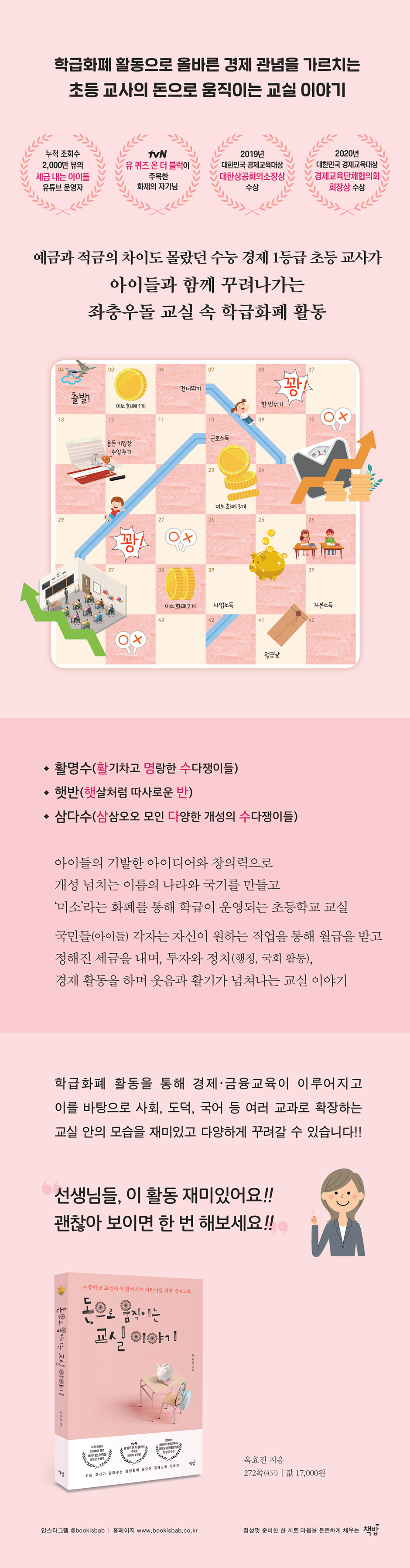
“Teachers~~ This activity is fun!!
If it looks good, give it a try!!”
Hwalmyeongsu (lively and cheerful chatterboxes), Haetban (warm as sunshine), Samdasu (chatty chatterboxes of various personalities gathered in groups of three or five)… .
These names, with their amazing interpretations, are the names of countries created through children's ingenious ideas and creativity.
Children make their own country and flag like this and use the currency called 'smile' to make a living.
Citizens, that is, half of the children, not only work in the jobs they want and receive a salary accordingly, but also pay taxes and continue to engage in investment, politics (administrative and parliamentary activities), and economic activities.
Sometimes, due to changing times, people lose their jobs, create new ones, and create sources of income through various business activities.
These various activities are taking place in one elementary school classroom.
The author, an elementary school teacher for 12 years, conducts economic and financial education in the classroom through class currency activities separate from the curriculum.
The initial concept was economic and financial education through classroom currency, but as it expanded to various subjects and areas such as social studies, ethics, Korean language, politics, copyright, and career education, we were able to discover a small society within the classroom.
This book, "Stories of a Classroom Run by Money," which contains the author's diverse classroom management know-how, explains the background of attempting classroom currency activities, the reason for collecting taxes from children, various economic activities that can be done using class currency in the classroom, activities that can be expanded upon using class currency activities, and class currency activities that serve as teaching materials, as well as various activity methods and directions for classroom management.
The author attempted to provide children with the economic and financial education they need to lead their lives through classroom currency activities. This not only helped children become more familiar with economics and finance, but the biggest benefit was that the classrooms where children and teachers live now offer a lot more enjoyable experiences than before.
You may not need to apply all the activities introduced in this book directly to your classroom.
Depending on the children's level, the school environment, and the teacher's judgment, it would be appropriate to modify and add activities in various ways and design them as activities suitable for each class.
However, wouldn't it be great if teachers and children could create more memories in a fun classroom based on the various activities introduced in this book? That is the hope of the author who wrote this book.
If it looks good, give it a try!!”
Hwalmyeongsu (lively and cheerful chatterboxes), Haetban (warm as sunshine), Samdasu (chatty chatterboxes of various personalities gathered in groups of three or five)… .
These names, with their amazing interpretations, are the names of countries created through children's ingenious ideas and creativity.
Children make their own country and flag like this and use the currency called 'smile' to make a living.
Citizens, that is, half of the children, not only work in the jobs they want and receive a salary accordingly, but also pay taxes and continue to engage in investment, politics (administrative and parliamentary activities), and economic activities.
Sometimes, due to changing times, people lose their jobs, create new ones, and create sources of income through various business activities.
These various activities are taking place in one elementary school classroom.
The author, an elementary school teacher for 12 years, conducts economic and financial education in the classroom through class currency activities separate from the curriculum.
The initial concept was economic and financial education through classroom currency, but as it expanded to various subjects and areas such as social studies, ethics, Korean language, politics, copyright, and career education, we were able to discover a small society within the classroom.
This book, "Stories of a Classroom Run by Money," which contains the author's diverse classroom management know-how, explains the background of attempting classroom currency activities, the reason for collecting taxes from children, various economic activities that can be done using class currency in the classroom, activities that can be expanded upon using class currency activities, and class currency activities that serve as teaching materials, as well as various activity methods and directions for classroom management.
The author attempted to provide children with the economic and financial education they need to lead their lives through classroom currency activities. This not only helped children become more familiar with economics and finance, but the biggest benefit was that the classrooms where children and teachers live now offer a lot more enjoyable experiences than before.
You may not need to apply all the activities introduced in this book directly to your classroom.
Depending on the children's level, the school environment, and the teacher's judgment, it would be appropriate to modify and add activities in various ways and design them as activities suitable for each class.
However, wouldn't it be great if teachers and children could create more memories in a fun classroom based on the various activities introduced in this book? That is the hope of the author who wrote this book.
GOODS SPECIFICS
- Date of issue: January 24, 2022
- Page count, weight, size: 272 pages | 454g | 148*210*17mm
- ISBN13: 9791190641654
- ISBN10: 1190641658
You may also like
카테고리
korean


korean

![GQ KOREA Mark (Monthly): December [2025]](http://librairie.coreenne.fr/cdn/shop/files/8ef265dbbfbf186523ed75ba7319009d.jpg?v=1765340328&width=3840)


