

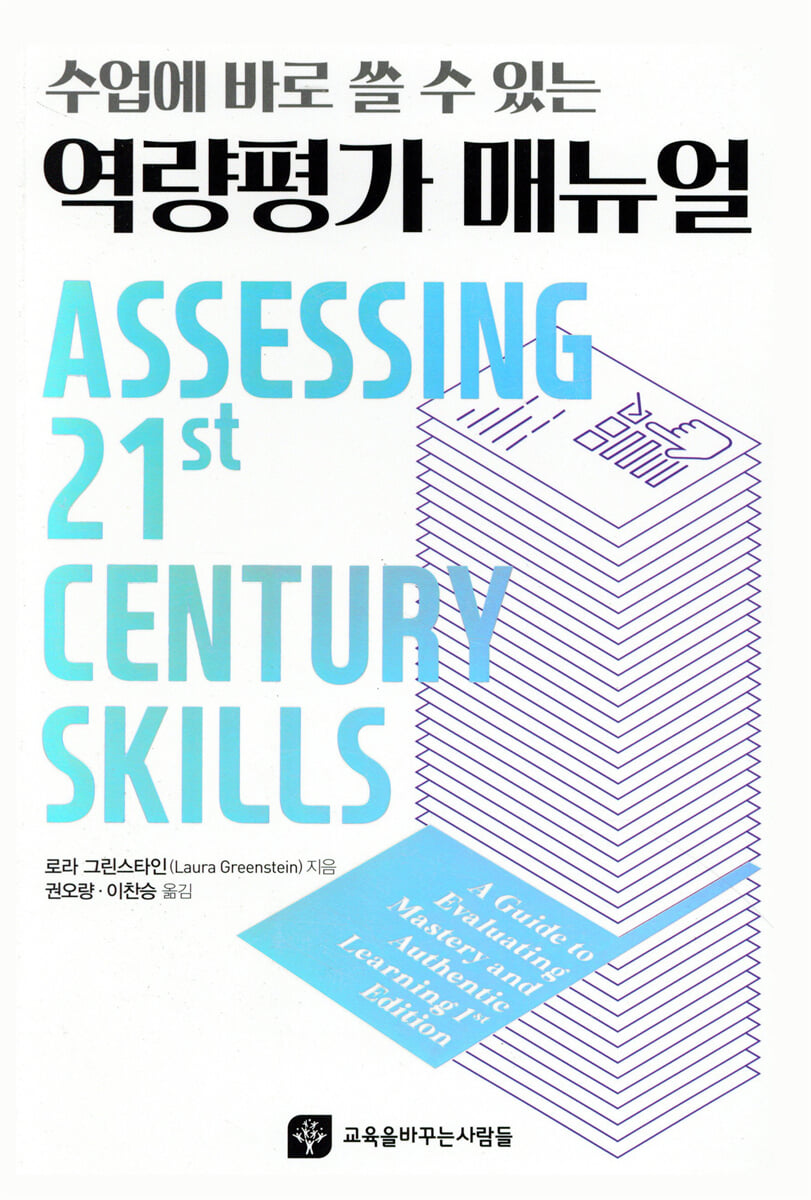
A competency assessment manual that can be used immediately in class
 |
Description
Book Introduction
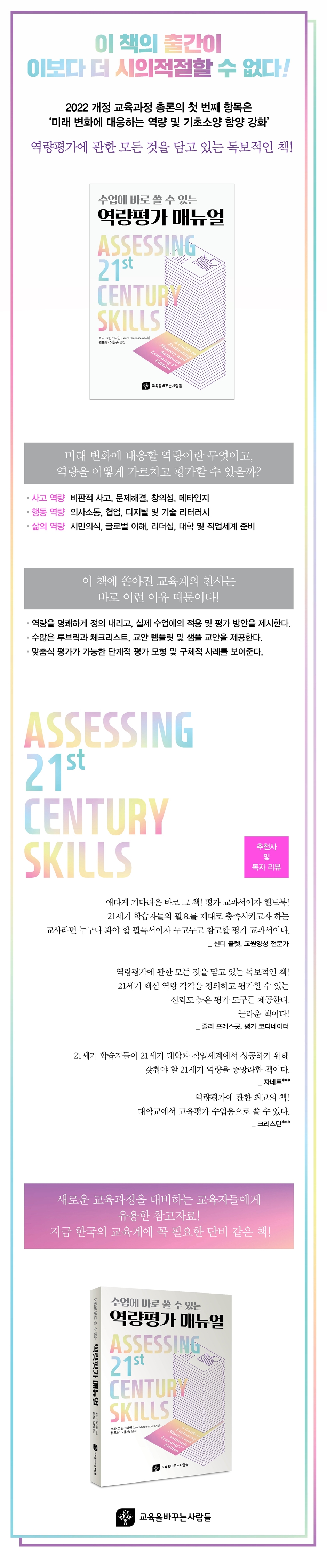
Competency, an important educational goal pursued by the 2022 revised curriculum
How can we teach and assess the capacity to respond to future changes?
“The unparalleled book that covers everything about competency assessment!”
How should we teach and assess so-called 21st-century survival skills—critical thinking, creativity, problem-solving, collaboration, communication, citizenship, leadership, responsibility, digital literacy, and metacognition? What are the essential things students need to know, understand, and be able to do in the world we live in now and in the future, and how can we help them achieve them? This book focuses on these 21st-century learning goals and provides new teaching, learning, and assessment strategies and practical guidelines for fostering the capabilities needed to adapt to future changes.
The author, who has been in the field of education for over 40 years and has focused on assessment and 21st-century competency research, divides competencies into the areas of thinking, behavior, and life, clearly defines the competencies in each area, and suggests methods for applying them to actual classes and for evaluating them.
The book's highlights include rubrics and checklists for grading criteria by competency, lesson plan templates and sample lesson plans, and a step-by-step assessment model that each teacher can use to fit their own classes.
In particular, the author vividly demonstrates how to teach and assess future competencies using learning experiences connected to real life, reflection on learning, and various assessment strategies, which has significant implications for the Korean education sector.
In other words, the first item in the recently announced 2022 revised curriculum outline is "Strengthening the development of capabilities and basic literacy to respond to future changes," which surprisingly overlaps significantly with the content of this book.
A look at the 2022 revised curriculum outline will reveal just how timely this book's publication is for the Korean education community.
The value of this book, which harmoniously combines evidence-based educational theory with classroom practice, is condensed into this one-sentence review.
"A unique book that covers everything about competency assessment!" And as a Korean reader, I'd like to add a few words.
“This book is like a shower of rain that is desperately needed in Korea’s education system today!”
How can we teach and assess the capacity to respond to future changes?
“The unparalleled book that covers everything about competency assessment!”
How should we teach and assess so-called 21st-century survival skills—critical thinking, creativity, problem-solving, collaboration, communication, citizenship, leadership, responsibility, digital literacy, and metacognition? What are the essential things students need to know, understand, and be able to do in the world we live in now and in the future, and how can we help them achieve them? This book focuses on these 21st-century learning goals and provides new teaching, learning, and assessment strategies and practical guidelines for fostering the capabilities needed to adapt to future changes.
The author, who has been in the field of education for over 40 years and has focused on assessment and 21st-century competency research, divides competencies into the areas of thinking, behavior, and life, clearly defines the competencies in each area, and suggests methods for applying them to actual classes and for evaluating them.
The book's highlights include rubrics and checklists for grading criteria by competency, lesson plan templates and sample lesson plans, and a step-by-step assessment model that each teacher can use to fit their own classes.
In particular, the author vividly demonstrates how to teach and assess future competencies using learning experiences connected to real life, reflection on learning, and various assessment strategies, which has significant implications for the Korean education sector.
In other words, the first item in the recently announced 2022 revised curriculum outline is "Strengthening the development of capabilities and basic literacy to respond to future changes," which surprisingly overlaps significantly with the content of this book.
A look at the 2022 revised curriculum outline will reveal just how timely this book's publication is for the Korean education community.
The value of this book, which harmoniously combines evidence-based educational theory with classroom practice, is condensed into this one-sentence review.
"A unique book that covers everything about competency assessment!" And as a Korean reader, I'd like to add a few words.
“This book is like a shower of rain that is desperately needed in Korea’s education system today!”
- You can preview some of the book's contents.
Preview
index
Introduction 6
Chapter 1 Introduction 19
Posture 21 for the 21st Century
Foundations of 21st Century Learning Research 29
A fundamental shift in evaluation 46
Achievement Standards and Skills 48
Chapter 2: Comprehensive 21st Century Skills 55
Accident skill 60
Action Skill 64
Life Skills 69
Conclusion and Paradigm 73
Chapter 3: Fundamental Principles of 21st Century Assessment 77
Valuable Change 79
Basic Principles of Good Evaluation 81
Starting from the final result 84
21st Century Common Core Achievement Standards 86
Fundamental Principles of 21st Century Assessment 89
Integration of Evaluation Strategies 93
Challenges of 21st Century Assessment 96
Chapter 4: 21st Century Assessment Strategies 99
Assessing Skills and Knowledge on a Continuum 102
Authentic Learning and Alternative Assessment 103
21st Century Assessment Strategies 107
Three Aspects of 21st Century Assessment 119
Chapter 5: Assessing Thinking Skills 121
Critical Thinking 122
Problem Solving 133
Creativity 140
Metacognition 158
Final Considerations 170
Chapter 6: Behavioral Skills Assessment 173
Communication 174
Collaboration 193
Digital Literacy 207
Visual Literacy 223
Technology Literacy 229
Final Considerations 244
Chapter 7: Life Skills Assessment 247
Civic and Civic Awareness Skills 249
Global Understanding 256
Leadership and Responsibility 268
Skills for College, Career, and the Workplace 275
Final Considerations 285
Chapter 8 Multipurpose Assessment 287
Project Lesson 288
Portfolio 305
Chapter 9: Transitioning to 21st-Century Assessment 321
Run 322
Leadership 324
Policy 325
Change focus 330
Letting Go of the Old and Starting anew 334
Appendix 339
Appendix A: 21st Century Rubric 340
Appendix B: 21st Century Lesson Plan 365
Appendix C: Questions and Answers 371
Reference 384
Search 394
Chapter 1 Introduction 19
Posture 21 for the 21st Century
Foundations of 21st Century Learning Research 29
A fundamental shift in evaluation 46
Achievement Standards and Skills 48
Chapter 2: Comprehensive 21st Century Skills 55
Accident skill 60
Action Skill 64
Life Skills 69
Conclusion and Paradigm 73
Chapter 3: Fundamental Principles of 21st Century Assessment 77
Valuable Change 79
Basic Principles of Good Evaluation 81
Starting from the final result 84
21st Century Common Core Achievement Standards 86
Fundamental Principles of 21st Century Assessment 89
Integration of Evaluation Strategies 93
Challenges of 21st Century Assessment 96
Chapter 4: 21st Century Assessment Strategies 99
Assessing Skills and Knowledge on a Continuum 102
Authentic Learning and Alternative Assessment 103
21st Century Assessment Strategies 107
Three Aspects of 21st Century Assessment 119
Chapter 5: Assessing Thinking Skills 121
Critical Thinking 122
Problem Solving 133
Creativity 140
Metacognition 158
Final Considerations 170
Chapter 6: Behavioral Skills Assessment 173
Communication 174
Collaboration 193
Digital Literacy 207
Visual Literacy 223
Technology Literacy 229
Final Considerations 244
Chapter 7: Life Skills Assessment 247
Civic and Civic Awareness Skills 249
Global Understanding 256
Leadership and Responsibility 268
Skills for College, Career, and the Workplace 275
Final Considerations 285
Chapter 8 Multipurpose Assessment 287
Project Lesson 288
Portfolio 305
Chapter 9: Transitioning to 21st-Century Assessment 321
Run 322
Leadership 324
Policy 325
Change focus 330
Letting Go of the Old and Starting anew 334
Appendix 339
Appendix A: 21st Century Rubric 340
Appendix B: 21st Century Lesson Plan 365
Appendix C: Questions and Answers 371
Reference 384
Search 394
Detailed image
Into the book
As the times are complex, there are many issues in the current education world that present sharp conflicts of opinion.
While some argue that school education should focus entirely on literacy and numeracy, others argue that it should focus on preparing students for college and the world of work.
It's impossible to prepare for college and the world of work without a solid foundation of core skills and knowledge.
And that foundation must include 21st-century skills: critical thinking, successful action, and the ability to apply these appropriately in a global society.
For today's students who must compete in a rapidly changing world, schools must provide real-world connections through relevant and challenging assignments.
---From the "Preface"
‘Core knowledge’ and ‘21st century skills’ are not mutually exclusive.
21st century skills complement, not replace, content knowledge.
Meaningful content, combined with quality teaching and valid assessment, becomes the starting point for expanding learning opportunities.
Integrating 21st-century skills across all areas of the curriculum is a key challenge for education today, and this requires assessments that are relevant to real-world learning.
---From the "Preface"
Experts in the field argue that changes are needed in the content and methods of education.
We need to teach complex thinking, not just content knowledge, and we need to change the method of knowledge transfer to one where students build knowledge through their participation.
There must also be a change in evaluation.
We need to shift from relying on traditional multiple-choice and completion-based tests to placing greater emphasis on alternative assessments of authentic learning (actual learning that addresses real-life problems).
To do so, we need to move away from large-scale assessments that involve annual nationwide literacy and numeracy tests and focus on multi-disciplinary, regional assessment models that assess higher-order thinking, creativity, collaboration, digital skills, and global understanding.
---From the "Preface"
“What do students need to know, understand, and do to succeed in the world of today and tomorrow?” The answer to this question will guide our path.
It focuses on 21st century learning goals.
---From the "Preface"
In this book, you will find assessment strategies and practical guidelines for the 21st-century classroom.
Expanding basic content knowledge into a 21st-century knowledge and skills model is crucial, and current trends such as globalization, technological advancements, and changing workplace requirements further support this need.
To effectively respond to this environment, we need to ask ourselves the following questions:
"Are students able to question and critically evaluate the information provided? Can they collaborate to solve problems? How do they act when faced with new challenges? Can they understand and synthesize multiple perspectives?"
---From the "Preface"
The skills needed for the 21st century must build on the core literacy and numeracy skills that all students must master.
Measuring knowledge of fragmented vocabulary or individual facts has its limitations.
Students need to think critically and creatively to become productive, responsible citizens and leaders. While these skills have historically been measured in numbers, proper assessments should now provide guidance on how to improve.
There are many difficult tasks ahead of us.
For example, this involves developing a new curriculum, establishing new achievement standards, developing learning strategies to achieve those standards, and developing assessment tools to measure these skills while meeting ideal levels of validity, reliability, and fairness.
---From "Chapter 1 Introduction"
Research on effective teaching strategies has common elements: a feasible curriculum, effective teaching methods, clear goals, differentiated instruction, and a connection to the subject matter.
Education policy should support these best practices.
If we leverage this empirical data and implement research-based practices, the nature of assessment in schools will change completely.
Teachers and students will be able to measure competencies in multiple ways, and the balanced use of formative, summative, and alternative assessments will become more common.
Exams administered over a significant period of time will demonstrate students' readiness and proficiency for the next level.
Test scores will no longer be used simply once a year to compare students with other students, but will serve a purpose of demonstrating students' growth.
As students fully understand and master the material, they will be able to think and perform at higher levels, while those who need additional assistance will continue to learn to build on the foundation.
That is, the focus will be on student growth.
---From "Chapter 1 Introduction"
Today's students have access to endless information with just a few clicks.
Now, we need to shift from a curriculum that focuses on mastering factual knowledge to one that focuses on understanding and applying knowledge.
These changes in teaching and learning ultimately lead to changes in assessment.
---From "Chapter 2: Summary of 21st Century Skills"
The outdated assessment methods we've used for so long can't effectively measure students' analytical, synthetic, and creative abilities, whether they're administered at the class level or on a larger scale.
Traditional multiple-choice test questions typically assess lower-level cognitive abilities such as memory and recall.
Although assessments such as inquiry, inquiry, and position-supporting engage higher-order cognitive skills, assessments that require students to investigate, decide, generate, and invent are rare.
While we don't need to stop assessing content knowledge, we need to move toward assessing more complex skills, such as organization, collaboration, and creativity.
---From “Chapter 3: Basic Principles of 21st Century Evaluation”
Alternative assessment encompasses all aspects of teaching and learning.
In general, the literature on this topic deals with alternative learning strategies and does not address strategies for evaluating their outcomes.
The idea behind alternative or authentic assessment is that students demonstrate the knowledge and skills they have acquired by performing real-world tasks.
It is worth discussing how assessment came to be seen as something completely separate from the skills it targets and from actual teaching and learning.
---From "Chapter 4: 21st Century Evaluation Strategies"
The book consistently emphasized the need for coordination and balance between traditional and 21st-century educational goals.
Schools must ensure a balance between the rigorous teaching of content knowledge and its appropriate application.
This does not mean that we are demanding a complete change in direction in evaluation.
The key is to incorporate critical thinking skills into real-world assessments, from individual class-level assessments to international assessments.
Students must be prepared to survive in a global world and workplace.
While domestic tests have traditionally measured content knowledge, international assessments such as the Program for International Student Assessment (PISA) assess the ability to think critically, analyze information, and apply it to real-life situations.
---From "Chapter 5 Thinking Skills Evaluation"
As national-level online responsive assessments like these develop, there is a need for teachers to use technology in their classrooms to assess.
This requires substantial professional development and strong technical support for teachers.
As a result, students will be more engaged in class, more self-directed, and make more autonomous decisions about their learning.
---From "Chapter 6 Behavioral Skill Evaluation"
Preparing for college and the world of work begins with developing the critical thinking skills covered in Chapter 5 of this book.
A student with essential cognitive skills is one who has reached a high level in Bloom's Taxonomy of Learning Objectives, is able to solve problems, use creativity, and understand the principles of thinking and learning.
The activities in Chapter 6—communication, collaboration, and technical expertise—are competencies that employers value in the workplace.
Chapter 7 explores the competencies necessary for navigating the world: civic, international, and personal responsibility, as well as leadership skills, which are increasingly important in today's global economy.
---From "Chapter 7: Life Skills Assessment"
The overwhelming majority of teachers and parents agreed that college and career preparation should be a priority in education.
While literacy and numeracy are certainly key to this preparation, critical thinking skills are also highly valued.
Few mentioned soft skills like emotional intelligence and intrinsic motivation, yet these skills have proven to be essential for a successful life.
---From "Chapter 7: Life Skills Assessment"
The tangible outcomes of meaningful and valuable learning are often measured in the classroom through alternative assessment strategies.
These outcomes are rarely objectively evaluated against explicit criteria.
The guidelines in this chapter introduce key elements of projects and portfolios, provide examples, and outline detailed strategies for conducting 21st-century assessments.
---From "Chapter 8 Multipurpose Evaluation"
School leaders must have a vision.
It must be a vision that goes beyond simply improving schools, but fundamentally transforms them.
Students aren't the only ones who need 21st-century skills and knowledge.
Educational leaders must also be collaborative, leverage technology, effectively solve problems, distribute leadership and roles, and maintain a global perspective.
Developing a curriculum that is both rich in content and focused on 21st-century skills can be a challenging task.
Creating a teaching schedule that provides sufficient time for knowledge acquisition and applied learning requires flexibility and creativity.
While some argue that school education should focus entirely on literacy and numeracy, others argue that it should focus on preparing students for college and the world of work.
It's impossible to prepare for college and the world of work without a solid foundation of core skills and knowledge.
And that foundation must include 21st-century skills: critical thinking, successful action, and the ability to apply these appropriately in a global society.
For today's students who must compete in a rapidly changing world, schools must provide real-world connections through relevant and challenging assignments.
---From the "Preface"
‘Core knowledge’ and ‘21st century skills’ are not mutually exclusive.
21st century skills complement, not replace, content knowledge.
Meaningful content, combined with quality teaching and valid assessment, becomes the starting point for expanding learning opportunities.
Integrating 21st-century skills across all areas of the curriculum is a key challenge for education today, and this requires assessments that are relevant to real-world learning.
---From the "Preface"
Experts in the field argue that changes are needed in the content and methods of education.
We need to teach complex thinking, not just content knowledge, and we need to change the method of knowledge transfer to one where students build knowledge through their participation.
There must also be a change in evaluation.
We need to shift from relying on traditional multiple-choice and completion-based tests to placing greater emphasis on alternative assessments of authentic learning (actual learning that addresses real-life problems).
To do so, we need to move away from large-scale assessments that involve annual nationwide literacy and numeracy tests and focus on multi-disciplinary, regional assessment models that assess higher-order thinking, creativity, collaboration, digital skills, and global understanding.
---From the "Preface"
“What do students need to know, understand, and do to succeed in the world of today and tomorrow?” The answer to this question will guide our path.
It focuses on 21st century learning goals.
---From the "Preface"
In this book, you will find assessment strategies and practical guidelines for the 21st-century classroom.
Expanding basic content knowledge into a 21st-century knowledge and skills model is crucial, and current trends such as globalization, technological advancements, and changing workplace requirements further support this need.
To effectively respond to this environment, we need to ask ourselves the following questions:
"Are students able to question and critically evaluate the information provided? Can they collaborate to solve problems? How do they act when faced with new challenges? Can they understand and synthesize multiple perspectives?"
---From the "Preface"
The skills needed for the 21st century must build on the core literacy and numeracy skills that all students must master.
Measuring knowledge of fragmented vocabulary or individual facts has its limitations.
Students need to think critically and creatively to become productive, responsible citizens and leaders. While these skills have historically been measured in numbers, proper assessments should now provide guidance on how to improve.
There are many difficult tasks ahead of us.
For example, this involves developing a new curriculum, establishing new achievement standards, developing learning strategies to achieve those standards, and developing assessment tools to measure these skills while meeting ideal levels of validity, reliability, and fairness.
---From "Chapter 1 Introduction"
Research on effective teaching strategies has common elements: a feasible curriculum, effective teaching methods, clear goals, differentiated instruction, and a connection to the subject matter.
Education policy should support these best practices.
If we leverage this empirical data and implement research-based practices, the nature of assessment in schools will change completely.
Teachers and students will be able to measure competencies in multiple ways, and the balanced use of formative, summative, and alternative assessments will become more common.
Exams administered over a significant period of time will demonstrate students' readiness and proficiency for the next level.
Test scores will no longer be used simply once a year to compare students with other students, but will serve a purpose of demonstrating students' growth.
As students fully understand and master the material, they will be able to think and perform at higher levels, while those who need additional assistance will continue to learn to build on the foundation.
That is, the focus will be on student growth.
---From "Chapter 1 Introduction"
Today's students have access to endless information with just a few clicks.
Now, we need to shift from a curriculum that focuses on mastering factual knowledge to one that focuses on understanding and applying knowledge.
These changes in teaching and learning ultimately lead to changes in assessment.
---From "Chapter 2: Summary of 21st Century Skills"
The outdated assessment methods we've used for so long can't effectively measure students' analytical, synthetic, and creative abilities, whether they're administered at the class level or on a larger scale.
Traditional multiple-choice test questions typically assess lower-level cognitive abilities such as memory and recall.
Although assessments such as inquiry, inquiry, and position-supporting engage higher-order cognitive skills, assessments that require students to investigate, decide, generate, and invent are rare.
While we don't need to stop assessing content knowledge, we need to move toward assessing more complex skills, such as organization, collaboration, and creativity.
---From “Chapter 3: Basic Principles of 21st Century Evaluation”
Alternative assessment encompasses all aspects of teaching and learning.
In general, the literature on this topic deals with alternative learning strategies and does not address strategies for evaluating their outcomes.
The idea behind alternative or authentic assessment is that students demonstrate the knowledge and skills they have acquired by performing real-world tasks.
It is worth discussing how assessment came to be seen as something completely separate from the skills it targets and from actual teaching and learning.
---From "Chapter 4: 21st Century Evaluation Strategies"
The book consistently emphasized the need for coordination and balance between traditional and 21st-century educational goals.
Schools must ensure a balance between the rigorous teaching of content knowledge and its appropriate application.
This does not mean that we are demanding a complete change in direction in evaluation.
The key is to incorporate critical thinking skills into real-world assessments, from individual class-level assessments to international assessments.
Students must be prepared to survive in a global world and workplace.
While domestic tests have traditionally measured content knowledge, international assessments such as the Program for International Student Assessment (PISA) assess the ability to think critically, analyze information, and apply it to real-life situations.
---From "Chapter 5 Thinking Skills Evaluation"
As national-level online responsive assessments like these develop, there is a need for teachers to use technology in their classrooms to assess.
This requires substantial professional development and strong technical support for teachers.
As a result, students will be more engaged in class, more self-directed, and make more autonomous decisions about their learning.
---From "Chapter 6 Behavioral Skill Evaluation"
Preparing for college and the world of work begins with developing the critical thinking skills covered in Chapter 5 of this book.
A student with essential cognitive skills is one who has reached a high level in Bloom's Taxonomy of Learning Objectives, is able to solve problems, use creativity, and understand the principles of thinking and learning.
The activities in Chapter 6—communication, collaboration, and technical expertise—are competencies that employers value in the workplace.
Chapter 7 explores the competencies necessary for navigating the world: civic, international, and personal responsibility, as well as leadership skills, which are increasingly important in today's global economy.
---From "Chapter 7: Life Skills Assessment"
The overwhelming majority of teachers and parents agreed that college and career preparation should be a priority in education.
While literacy and numeracy are certainly key to this preparation, critical thinking skills are also highly valued.
Few mentioned soft skills like emotional intelligence and intrinsic motivation, yet these skills have proven to be essential for a successful life.
---From "Chapter 7: Life Skills Assessment"
The tangible outcomes of meaningful and valuable learning are often measured in the classroom through alternative assessment strategies.
These outcomes are rarely objectively evaluated against explicit criteria.
The guidelines in this chapter introduce key elements of projects and portfolios, provide examples, and outline detailed strategies for conducting 21st-century assessments.
---From "Chapter 8 Multipurpose Evaluation"
School leaders must have a vision.
It must be a vision that goes beyond simply improving schools, but fundamentally transforms them.
Students aren't the only ones who need 21st-century skills and knowledge.
Educational leaders must also be collaborative, leverage technology, effectively solve problems, distribute leadership and roles, and maintain a global perspective.
Developing a curriculum that is both rich in content and focused on 21st-century skills can be a challenging task.
Creating a teaching schedule that provides sufficient time for knowledge acquisition and applied learning requires flexibility and creativity.
---From "Chapter 9: Transition to 21st Century Evaluation"
Publisher's Review
Key points of the '2022 Revised Curriculum' announced!
Competency is one of the important educational goals of the new curriculum!
On November 24th, the "2022 Revised Curriculum Overview and Key Points" was announced.
The first item in the general principles of the '2022 Revised Curriculum', which advocates 'A Better Future, Education for All', is 'Strengthening the Cultivation of Capabilities and Basic Literacy to Respond to Future Changes' (Press Release, "Announcement of Key Points of the '2022 Revised Curriculum' General Principles", November 24, 2021).
The new curriculum clearly states that it will reform the current education system to cultivate learners' fundamental knowledge and capabilities to actively respond to changes in future society, thereby enabling them to grow into "inclusive and creative, proactive individuals."
In other words, to develop a curriculum capable of fostering the capabilities demanded by future society, we will emphasize in-depth learning and inquiry skills linked to life, and strengthen digital literacy, ecological transition education, and democratic citizenship education.
In particular, the direction of the revision is clearly stated to be developing a competency-building curriculum centered on 'deep learning, connection and integration between subjects, learning connected to life, and reflection on the learning process.'
Another notable item is the improvement of teaching, learning, and evaluation to foster future capabilities such as creativity and critical thinking.
Cultivating the competencies required by 21st-century society is undoubtedly one of the key educational goals of the 2022 Revised Curriculum.
How can we teach and assess the capacity to respond to future changes?
The publication of this book could not be more timely!
Surprisingly, a significant portion of the content of this book, "A Competency Assessment Manual for Immediate Use in Class," overlaps with the "Announcement of Key Points of the '2022 Revised Curriculum' General Theory."
The United States' Common Core State Standards (CCSS) have long clearly defined the competencies students need to succeed in future colleges and workplaces.
For example, these are the so-called 21st century core competencies, future survival skills, such as creativity, critical thinking, problem-solving skills, digital capabilities, collaboration, leadership, communication, civic awareness, and metacognition.
The question is how to teach these competencies and how to assess their mastery.
This book started from such a problem awareness.
Having worked in education for over 40 years, with diverse experiences as a teacher, school leader, professor, and educational consultant, the author has concluded that "evaluation must drive all aspects of education." This book is the result of his dedicated research into assessment and 21st-century competencies.
The author vividly demonstrates, based on credible research and evidence, how to teach and assess core competencies to address the uncertainties of the future.
In particular, the author's insight that solid and deep content knowledge is the foundation and basis for developing competencies rather than viewing competency and knowledge as opposing entities is remarkable.
This has significant implications for the Korean education community, which misunderstood competency-based education as a replacement for knowledge-based education during the 2015 revised curriculum.
A careful examination of the 2022 Revised Curriculum Overview will reveal just how timely this book is for the Korean educational community.
The one-of-a-kind book that covers everything about competency assessment!
A book like a shower of rain that is desperately needed in Korea's education system right now!
The amazing thing about this book doesn't stop there.
"What exactly is competence?" While competency has been repeatedly emphasized in educational settings both domestically and internationally, its true nature and definition have remained unclear. The author clearly organizes and defines it.
It also vividly demonstrates, with concrete examples, how competencies can be taught and assessed, and how learning and mastery can be assessed in a way that is relevant to real-life situations.
Competency-based education, which fosters the core competencies necessary for successful living in the 21st century, has taken the education world by storm both domestically and internationally. However, its specific form remains unclear and educators on the front lines are confused about how to implement it in their classrooms. The author serves as a beacon of guidance for educators.
When you see the contents of this book, such as clear definitions of each core competency to cope with an uncertain future, ways to apply it to actual classes, numerous specific and detailed rubrics and checklists, step-by-step models and lesson plan templates to help each class develop assessments that are suitable for their own classes, and completed lesson plan samples, you will nod in agreement as to why the publication of this book has been so eagerly anticipated in the American educational community and why it is praised as containing everything about 21st century competency assessment.
And it is expected that the praise and contributions received from the American educational community will be replicated in the Korean educational community as well.
From the introduction to the appendix, this book is packed with practical ideas and useful information on competency assessment, with no detail overlooked! The book's value is encapsulated in this one-word review from a reader.
"A unique book that covers everything about competency assessment!" And as a Korean reader, I'd like to add this.
“This book is like a shower of rain that is desperately needed in Korea’s education system today!”
Competency is one of the important educational goals of the new curriculum!
On November 24th, the "2022 Revised Curriculum Overview and Key Points" was announced.
The first item in the general principles of the '2022 Revised Curriculum', which advocates 'A Better Future, Education for All', is 'Strengthening the Cultivation of Capabilities and Basic Literacy to Respond to Future Changes' (Press Release, "Announcement of Key Points of the '2022 Revised Curriculum' General Principles", November 24, 2021).
The new curriculum clearly states that it will reform the current education system to cultivate learners' fundamental knowledge and capabilities to actively respond to changes in future society, thereby enabling them to grow into "inclusive and creative, proactive individuals."
In other words, to develop a curriculum capable of fostering the capabilities demanded by future society, we will emphasize in-depth learning and inquiry skills linked to life, and strengthen digital literacy, ecological transition education, and democratic citizenship education.
In particular, the direction of the revision is clearly stated to be developing a competency-building curriculum centered on 'deep learning, connection and integration between subjects, learning connected to life, and reflection on the learning process.'
Another notable item is the improvement of teaching, learning, and evaluation to foster future capabilities such as creativity and critical thinking.
Cultivating the competencies required by 21st-century society is undoubtedly one of the key educational goals of the 2022 Revised Curriculum.
How can we teach and assess the capacity to respond to future changes?
The publication of this book could not be more timely!
Surprisingly, a significant portion of the content of this book, "A Competency Assessment Manual for Immediate Use in Class," overlaps with the "Announcement of Key Points of the '2022 Revised Curriculum' General Theory."
The United States' Common Core State Standards (CCSS) have long clearly defined the competencies students need to succeed in future colleges and workplaces.
For example, these are the so-called 21st century core competencies, future survival skills, such as creativity, critical thinking, problem-solving skills, digital capabilities, collaboration, leadership, communication, civic awareness, and metacognition.
The question is how to teach these competencies and how to assess their mastery.
This book started from such a problem awareness.
Having worked in education for over 40 years, with diverse experiences as a teacher, school leader, professor, and educational consultant, the author has concluded that "evaluation must drive all aspects of education." This book is the result of his dedicated research into assessment and 21st-century competencies.
The author vividly demonstrates, based on credible research and evidence, how to teach and assess core competencies to address the uncertainties of the future.
In particular, the author's insight that solid and deep content knowledge is the foundation and basis for developing competencies rather than viewing competency and knowledge as opposing entities is remarkable.
This has significant implications for the Korean education community, which misunderstood competency-based education as a replacement for knowledge-based education during the 2015 revised curriculum.
A careful examination of the 2022 Revised Curriculum Overview will reveal just how timely this book is for the Korean educational community.
The one-of-a-kind book that covers everything about competency assessment!
A book like a shower of rain that is desperately needed in Korea's education system right now!
The amazing thing about this book doesn't stop there.
"What exactly is competence?" While competency has been repeatedly emphasized in educational settings both domestically and internationally, its true nature and definition have remained unclear. The author clearly organizes and defines it.
It also vividly demonstrates, with concrete examples, how competencies can be taught and assessed, and how learning and mastery can be assessed in a way that is relevant to real-life situations.
Competency-based education, which fosters the core competencies necessary for successful living in the 21st century, has taken the education world by storm both domestically and internationally. However, its specific form remains unclear and educators on the front lines are confused about how to implement it in their classrooms. The author serves as a beacon of guidance for educators.
When you see the contents of this book, such as clear definitions of each core competency to cope with an uncertain future, ways to apply it to actual classes, numerous specific and detailed rubrics and checklists, step-by-step models and lesson plan templates to help each class develop assessments that are suitable for their own classes, and completed lesson plan samples, you will nod in agreement as to why the publication of this book has been so eagerly anticipated in the American educational community and why it is praised as containing everything about 21st century competency assessment.
And it is expected that the praise and contributions received from the American educational community will be replicated in the Korean educational community as well.
From the introduction to the appendix, this book is packed with practical ideas and useful information on competency assessment, with no detail overlooked! The book's value is encapsulated in this one-word review from a reader.
"A unique book that covers everything about competency assessment!" And as a Korean reader, I'd like to add this.
“This book is like a shower of rain that is desperately needed in Korea’s education system today!”
GOODS SPECIFICS
- Publication date: December 6, 2021
- Page count, weight, size: 400 pages | 152*225*30mm
- ISBN13: 9788997724130
- ISBN10: 8997724134
You may also like
카테고리
korean


korean

![GQ KOREA Mark (Monthly): December [2025]](http://librairie.coreenne.fr/cdn/shop/files/8ef265dbbfbf186523ed75ba7319009d.jpg?v=1765340328&width=3840)


