

World's Best Travelogue: Yeolha Diary Award
 |
Description
Book Introduction
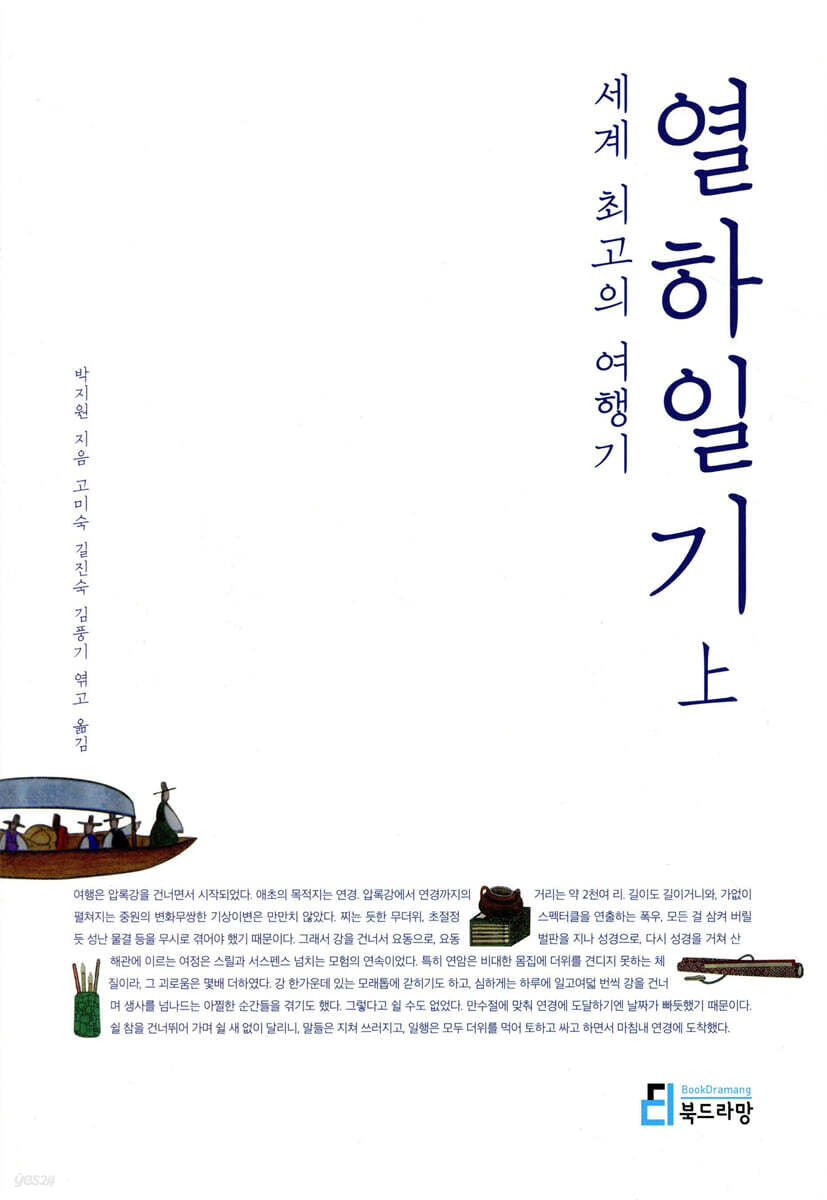
This is a revised edition of 『The World's Greatest Travelogue, Yeolha Diary』, a translation and compilation of Yeonam Park Ji-won's 『Yeolha Diary』, to make it more accessible to young people.
From the 『Jehol Diary』, the entire journey on the road, recorded by date, from the "Do-gang-rok" that begins with crossing the Yalu River to the "Hwan-yeon-do-jung-rok" that contains the journey back from Jehol to Yanjing (Beijing), was transferred and included. In addition, stories exchanged with Chinese scholars, records of Yeon-am's thoughts while observing Chinese civilization, and strange stories heard outside the Great Wall were edited and included in conjunction with the related journey.
In addition, he added abundant illustrations and explanations to make it easier to understand the customs that Yeonam saw and heard, and the idioms he quoted.
This book is for those who want to approach the most unique and vivid travelogue in Korean history, and even in the world, 『Yeolha Diary』.
From the 『Jehol Diary』, the entire journey on the road, recorded by date, from the "Do-gang-rok" that begins with crossing the Yalu River to the "Hwan-yeon-do-jung-rok" that contains the journey back from Jehol to Yanjing (Beijing), was transferred and included. In addition, stories exchanged with Chinese scholars, records of Yeon-am's thoughts while observing Chinese civilization, and strange stories heard outside the Great Wall were edited and included in conjunction with the related journey.
In addition, he added abundant illustrations and explanations to make it easier to understand the customs that Yeonam saw and heard, and the idioms he quoted.
This book is for those who want to approach the most unique and vivid travelogue in Korean history, and even in the world, 『Yeolha Diary』.
- You can preview some of the book's contents.
Preview
index
(Upper) volume
Preface to the Revised Edition
Composition of the gambling group
『Yeolha Diary』 Journey Map
Yeonam Park Ji-won's Pharmacopoeia
Dogangnok
Dogangnok Seo │ June 24 │ June 25 │ June 26 │ June 27 │ June 28 │ June 29 │ July 1 │ July 2 │ July 3 │ July 4 │ July 5 │ July 6 │ July 7 │ July 8 │ July 9 │ Climbing the old castle of Liaodong (Gyudonggi) │ White pagodas of Liaodong (Liaodong Hundred Pagodas) │ Sketch of the scenery of Guandi Temple (Guandi Temple) │ Story of Guangwoo Temple (Guangwoosagi)
Bible Magazine
July 10 │ July 11 │ Friends met at Yeokjae (Sokjae Pildam) │ A beautiful meeting at Gasanru (Sangru Pildam) │ July 12 │ July 13 │ July 14 │ Temples of the Bible (Bible Garamgi) │ Mountains and rivers of Liaodong (Sancheon Giryak)
Ilshin Essay
Essays of the New Life │ July 15 │ July 16 │ July 17 │ July 18 │ July 19 │ July 20 │ July 21 │ July 22 │ July 23 │ Maeng Gangnyeo who became a stone statue (Gangnyeo Myogi) │ Climbing up and down a pole is like holding an official position (Jangdaegi) │ Climbing up to the Shanhaiguan Pass and thinking about the history of the past and present (Shanhaiguan Gi)
Preface to the Revised Edition
Composition of the gambling group
『Yeolha Diary』 Journey Map
Yeonam Park Ji-won's Pharmacopoeia
Dogangnok
Dogangnok Seo │ June 24 │ June 25 │ June 26 │ June 27 │ June 28 │ June 29 │ July 1 │ July 2 │ July 3 │ July 4 │ July 5 │ July 6 │ July 7 │ July 8 │ July 9 │ Climbing the old castle of Liaodong (Gyudonggi) │ White pagodas of Liaodong (Liaodong Hundred Pagodas) │ Sketch of the scenery of Guandi Temple (Guandi Temple) │ Story of Guangwoo Temple (Guangwoosagi)
Bible Magazine
July 10 │ July 11 │ Friends met at Yeokjae (Sokjae Pildam) │ A beautiful meeting at Gasanru (Sangru Pildam) │ July 12 │ July 13 │ July 14 │ Temples of the Bible (Bible Garamgi) │ Mountains and rivers of Liaodong (Sancheon Giryak)
Ilshin Essay
Essays of the New Life │ July 15 │ July 16 │ July 17 │ July 18 │ July 19 │ July 20 │ July 21 │ July 22 │ July 23 │ Maeng Gangnyeo who became a stone statue (Gangnyeo Myogi) │ Climbing up and down a pole is like holding an official position (Jangdaegi) │ Climbing up to the Shanhaiguan Pass and thinking about the history of the past and present (Shanhaiguan Gi)
Into the book
“If I had to choose just one text from the 500 years of the Joseon Dynasty, I would definitely choose 『Yeolha Diary』.
If I had to choose only one travelogue from all the past and present, I would also choose 『Yeolha Diary』.
『Yeolha Diary』 is not a typical travelogue that lists exotic sights and bizarre experiences.
It is a process of passionate 'connection' with heterogeneous objects, a site of 'excavation' where 'words and things' that had been silent come alive, and a place of 'creation' where unexpected discourses overflow.
For that reason, through 『Yeolha Diary』, we encounter a very unfamiliar and new travel arrangement.”
“For Yeonam, life and travel were not separate.
He was a 'nomad' who thought on the road and set out on the road while thinking.
A nomad, a being who cheerfully navigates between disparate elements, always creating unexpected and creative lines! "Yeolha Diary" is this nomad's delightful nomadic journal.
“That is why 『Yeolha Diary』 is not confined to the 18th century, but offers a dazzling vision of life and the universe to ‘us, now.’”
---From the Translator's Note
There is no point in discussing learning with those who rely only on their mouths and ears.
Isn't learning something that you can never achieve even if you put your whole life's effort into it?
When people say, “A sage climbed Mount Tai and looked down, and the world seemed small,” they will say yes, even if they don’t think so in their hearts.
However, if you say, “Buddha saw the ten directions of the world,” they will reject it as absurd, and if you say, “A Westerner sailed around the world in a large ship,” they will get angry and say it is nonsense.
Then, with whom can I discuss this grand spectacle between heaven and earth? Ah, Confucius summarized 240 years of history in the Spring and Autumn Annals, but the military and diplomatic events that occurred during those 240 years were nothing more than fleeting events, like the blooming of flowers and the falling of leaves.
As I was recording the things that passed by on a running horse, this thought suddenly occurred to me.
The time between taking a bite of food is only a short moment, like blinking an eye and taking a breath.
In the blink of an eye and the breath of an eye, it has already become a small old time, a small today.
In that case, one past or today could also be said to be a time between a big blink of an eye and a big breath.
How can one not feel sad when one is greedy and seeks to make a name for oneself and achieve great things in this fleeting world?
---From "Ilshin Essay"
I went two more miles and crossed the river on horseback.
The river isn't that wide, but the current is much stronger than where we crossed yesterday.
He sat huddled on the saddle, his knees bent and his feet together.
Changdae hugs the horse's head tightly, and Jangbok supports my buttocks with all his might.
They depend on each other's lives and pray for a brief moment of safety.
Even the sound of a horse's croaking sounds mournful, like a sigh of 'Oh-ho'.
As the horse reaches the middle of the river, its body suddenly leans to the left.
Usually, when a horse's belly is submerged in water, its four hooves lift themselves up, so the horse lies down and crosses.
Before I knew it, my body tilted to the right and I almost fell into the water.
In front of me, the tail of a horse is floating and scattered on the water.
In a hurry, I grabbed it, steadyed myself, and barely managed to avoid falling.
Phew~ I never thought I could be this agile.
The spear was in danger of being kicked by the horse's leg, but the horse suddenly raised its head and straightened its body.
The water was shallow enough that my feet could touch the ground.
---From "Dogangnok"
The sound of a river changes completely depending on how you listen to it.
My house is deep in the mountains.
There is a large stream in front of the gate, and every time there is a heavy rain in the summer, the water rises suddenly and there is always a tremendous noise like the sound of carts, cavalry, cannons and drums, which eventually becomes a great disaster to the ears.
I once closed the door and lay down quietly, listening to these sounds and comparing them.
It is because I listened with a pure heart that the deep pine forest sounds like the sound of a flute. It is because I listened with an angry heart that the mountains crack and the hills crumble. It is because I listened with an arrogant heart that it sounds like a flock of frogs croaking in competition.
It sounds like ten thousand axes making alternate sounds because I listened with an angry heart. It sounds like thunder and thunder claps because I listened with a startled heart. It sounds like tea water bubbling because I listened with an excited heart. It sounds like the geomungo is ringing with a feather tune because I listened with a sad heart. It sounds like the wind is howling against a window covered with Korean paper because I listened with a suspicious heart.
All of this is not being heard with the right mind, but rather with the ears, with the sounds that have already been created in one's heart.
---From "Crossing the River Nine Times in One Night"
The old sages were very careful when giving and receiving things.
If it wasn't right, I wouldn't give even a single piece of trash to anyone, and if it wasn't right, I wouldn't receive even a single piece of trash from anyone.
After all, a rag is such a small and insignificant thing in the world that it is not even considered as one of the many things, and the exchange of a single rag is not even a topic of discussion.
So, I couldn't help but feel that the adult's words about being careful even with trivial things like rags were taking integrity too far.
But after experiencing the Omija incident today, I finally realized that the saint's words about the rags were not an exaggeration.
Ah, how could an adult deceive me?
A few omija seeds are really worthless things, like rags, but that foolish monk is using that as an excuse to be so rude to me.
Since he did something, it can be said that it was an act that went against common sense.
But because of this, a fight broke out and it escalated into a fistfight, and when they finally started fighting, they couldn't contain their anger and ended up fighting each other for their lives.
In this situation, even if it's just a few five-flavor berries, the disaster will be as big as a mountain, so I know that I can never underestimate something small or insignificant.
If I had to choose only one travelogue from all the past and present, I would also choose 『Yeolha Diary』.
『Yeolha Diary』 is not a typical travelogue that lists exotic sights and bizarre experiences.
It is a process of passionate 'connection' with heterogeneous objects, a site of 'excavation' where 'words and things' that had been silent come alive, and a place of 'creation' where unexpected discourses overflow.
For that reason, through 『Yeolha Diary』, we encounter a very unfamiliar and new travel arrangement.”
“For Yeonam, life and travel were not separate.
He was a 'nomad' who thought on the road and set out on the road while thinking.
A nomad, a being who cheerfully navigates between disparate elements, always creating unexpected and creative lines! "Yeolha Diary" is this nomad's delightful nomadic journal.
“That is why 『Yeolha Diary』 is not confined to the 18th century, but offers a dazzling vision of life and the universe to ‘us, now.’”
---From the Translator's Note
There is no point in discussing learning with those who rely only on their mouths and ears.
Isn't learning something that you can never achieve even if you put your whole life's effort into it?
When people say, “A sage climbed Mount Tai and looked down, and the world seemed small,” they will say yes, even if they don’t think so in their hearts.
However, if you say, “Buddha saw the ten directions of the world,” they will reject it as absurd, and if you say, “A Westerner sailed around the world in a large ship,” they will get angry and say it is nonsense.
Then, with whom can I discuss this grand spectacle between heaven and earth? Ah, Confucius summarized 240 years of history in the Spring and Autumn Annals, but the military and diplomatic events that occurred during those 240 years were nothing more than fleeting events, like the blooming of flowers and the falling of leaves.
As I was recording the things that passed by on a running horse, this thought suddenly occurred to me.
The time between taking a bite of food is only a short moment, like blinking an eye and taking a breath.
In the blink of an eye and the breath of an eye, it has already become a small old time, a small today.
In that case, one past or today could also be said to be a time between a big blink of an eye and a big breath.
How can one not feel sad when one is greedy and seeks to make a name for oneself and achieve great things in this fleeting world?
---From "Ilshin Essay"
I went two more miles and crossed the river on horseback.
The river isn't that wide, but the current is much stronger than where we crossed yesterday.
He sat huddled on the saddle, his knees bent and his feet together.
Changdae hugs the horse's head tightly, and Jangbok supports my buttocks with all his might.
They depend on each other's lives and pray for a brief moment of safety.
Even the sound of a horse's croaking sounds mournful, like a sigh of 'Oh-ho'.
As the horse reaches the middle of the river, its body suddenly leans to the left.
Usually, when a horse's belly is submerged in water, its four hooves lift themselves up, so the horse lies down and crosses.
Before I knew it, my body tilted to the right and I almost fell into the water.
In front of me, the tail of a horse is floating and scattered on the water.
In a hurry, I grabbed it, steadyed myself, and barely managed to avoid falling.
Phew~ I never thought I could be this agile.
The spear was in danger of being kicked by the horse's leg, but the horse suddenly raised its head and straightened its body.
The water was shallow enough that my feet could touch the ground.
---From "Dogangnok"
The sound of a river changes completely depending on how you listen to it.
My house is deep in the mountains.
There is a large stream in front of the gate, and every time there is a heavy rain in the summer, the water rises suddenly and there is always a tremendous noise like the sound of carts, cavalry, cannons and drums, which eventually becomes a great disaster to the ears.
I once closed the door and lay down quietly, listening to these sounds and comparing them.
It is because I listened with a pure heart that the deep pine forest sounds like the sound of a flute. It is because I listened with an angry heart that the mountains crack and the hills crumble. It is because I listened with an arrogant heart that it sounds like a flock of frogs croaking in competition.
It sounds like ten thousand axes making alternate sounds because I listened with an angry heart. It sounds like thunder and thunder claps because I listened with a startled heart. It sounds like tea water bubbling because I listened with an excited heart. It sounds like the geomungo is ringing with a feather tune because I listened with a sad heart. It sounds like the wind is howling against a window covered with Korean paper because I listened with a suspicious heart.
All of this is not being heard with the right mind, but rather with the ears, with the sounds that have already been created in one's heart.
---From "Crossing the River Nine Times in One Night"
The old sages were very careful when giving and receiving things.
If it wasn't right, I wouldn't give even a single piece of trash to anyone, and if it wasn't right, I wouldn't receive even a single piece of trash from anyone.
After all, a rag is such a small and insignificant thing in the world that it is not even considered as one of the many things, and the exchange of a single rag is not even a topic of discussion.
So, I couldn't help but feel that the adult's words about being careful even with trivial things like rags were taking integrity too far.
But after experiencing the Omija incident today, I finally realized that the saint's words about the rags were not an exaggeration.
Ah, how could an adult deceive me?
A few omija seeds are really worthless things, like rags, but that foolish monk is using that as an excuse to be so rude to me.
Since he did something, it can be said that it was an act that went against common sense.
But because of this, a fight broke out and it escalated into a fistfight, and when they finally started fighting, they couldn't contain their anger and ended up fighting each other for their lives.
In this situation, even if it's just a few five-flavor berries, the disaster will be as big as a mountain, so I know that I can never underestimate something small or insignificant.
---From "Hwanyeondojungnok"
GOODS SPECIFICS
- Date of issue: September 30, 2013
- Page count, weight, size: 312 pages | 610g | 160*230*30mm
- ISBN13: 9788997969265
- ISBN10: 8997969269
You may also like
카테고리
korean


korean

![GQ KOREA Mark (Monthly): December [2025]](http://librairie.coreenne.fr/cdn/shop/files/8ef265dbbfbf186523ed75ba7319009d.jpg?v=1765340328&width=3840)


